Category Archives: The ladies who say ooooh

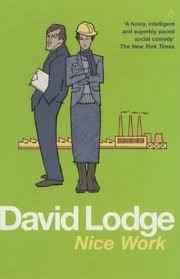
‘Nice Work’ by David Lodge

lodge

1988, 277 p.

I often find that my response to a book is largely influenced by the book that I read immediately before.  For example, I found myself quite unable to pick up another fiction book for some time after reading War and Peace, and sometimes I want to get my teeth into something really meaty after reading some self-indulgent fluff.  In this case, I came to David Lodge’s Nice Work as a face-to-face bookgroup read after just finishing the challenging (on all levels) A Girl is a Half-Formed Thing.  I must confess that much of the joy in reading this book was Lodge’s masterful, urbane and instantly comprehensible prose.  In comparison with the book that I read immediately preceding it, this one just flew off the page.

David Lodge, as a former Professor of English Literature at the University of Birmingham, is well placed to turn his wry, satirical eye to red-brick university life in his ‘Campus Trilogy’ comprising Changing Places: A Tale of Two Campuses (1975), Small World: An Academic Romance (1984), and this book  Nice Work (1988).  In this book, flame-haired feminist academic Robyn Penrose, trying hard to get a tenured position at the University of Rummidge (a thinly disguised Birmingham), agrees to be involved in a job-shadowing scheme as part of improving links between the university and the workplace.  She is allocated to Vic Wilcox, the manager of an engineering firm. I think that you can guess what happens….

And it does, and to a certain extent there’s a reassuring predictability about the plot. What I really enjoyed about this book, though, is Lodge’s satirical but penetrating analysis of his characters.  He’s not kind about either of them, but he does not lack affection for them either.  Robyn is immured in the postmodernist sludge served up by Derrida and Kristeva that makes me shrivel up inside, while Vic Wilcox is one of those buttoned-up, slightly pathetic middle-aged men who might be driving his small company car next to you at the traffic lights at 8.00 a.m.

Not content with mere waspishness, Lodge has literary fun in the book as well. The epigraphs that separate the multiple parts of this book are sprinkled with quotes from 19th English novels, most particularly Elizabeth Gaskell’s North and South, and there’s quite a bit of North and South in this book as well.  It’s enjoyable without knowing any of this, but for those in on the joke, it adds another layer as well.


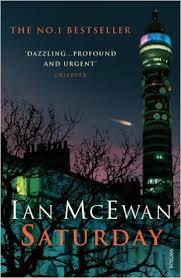
‘Saturday’ by Ian McEwan

Mcewan_saturday

2005, 308 p.

This is a re-read for my bookgroup, but I read it in 2007 and quite frankly could not really remember much about the book. What I did remember, however – and what strikes me anew on re-reading it- is how well it captures the post-9/11 anxiety about international news, and the interior conversations we tend to have about our own personal security in the face of international insecurity.

In the opening pages, successful neurosugeon Henry Perowne wakes early on Saturday 15 February 2003 to see a plane engulfed in flames streaking across the London skyline. Surely this news will saturate the media and yet, as he goes about his affairs on a normal Saturday – playing squash with a friend; buying fish for a family dinner that night- what he expected to be another 9/11 dwindles into insignificance as news. Securely ensconced in his upper-middle class, educated existence, he is thrust into a different form of terrorism when and where he least expects it.

The book has parallels with Virginia Woolf’s Mrs Dalloway, or James Joyce’s Ulysses. All three books are contained within a 24 hour period, describing the interior thoughts that bubble underneath an ordinary day.

Saturday is written in the present tense, which is a tense that I generally dislike because it makes me feel unsettled and anxious.  But in this case, that is exactly the feeling that McEwan wants to convey, and it works well.  Master writer that he is, he handles shifts in time well. Much of the book is steeped in banality, but as a reader you are fearful, expecting disaster with the turn of each page.

It is this fear of imminent disaster, both personally and globally, that captures living in a internet-connected, news-saturated post 9/11 world. I identify with this. Part of my awakened interest in world events has been driven in equal part by a desire to understand but also a fear that momentous. terrifying, world-changing things are happening right now somewhere in the world, and that I don’t yet know it.  Henry Perowne feels it too:

 He takes a step towards the CD player, then changes his mind for he’s feeling the pull, like gravity of the approaching TV news.  It’s a condition of the times, this compulsion to hear how it stands with the world, and be joined to the generality, to a community of anxiety.  The habit’s grown stronger these past two years; a different scale of news value has been set by monstrous and spectacular scenes.  The possibility of their recurrence is one thread that binds the day…  Everyone fears it, but there’s also a darker longing in the collective mind, a sickening for self-punishment and a blasphemous curiosity… Bigger, grosser, next time. Please don’t let it happen. But let me see it all the same, as it’s happening and from every angle, and let me be among the first to know. (p 176)

I share his response:

It’s an illusion, to believe himself active in the story. Does he think he’s contributing something, watching news programmes, or lying on his back on the sofa on Sunday afternoons, reading more opinion columns of ungrounded certainties, more long articles about what really lies behind this or that development, or about what is most surely going to happen next, predictions forgotten as soon as they are read, well before events disprove them?…His nerves, like tautened strings, vibrate obediently with each news ‘release’. He’s lost the habits of scepticism, he’s becoming dim with contradictory opinion, he isn’t thinking clearly, and just as bad he senses he isn’t thinking independently. (p.180)

I very much like Ian McEwan as a writer and this book is no exception. It’s a pleasure to read such smooth, masterful prose.

My rating: 9/10

Source: CAE bookgroup.


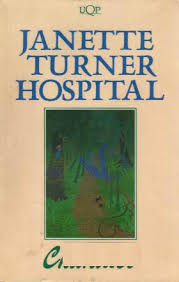
‘Charades’ by Janette Turner Hospital

charades

1988,  345 p

I hadn’t heard of this book at all, although I’ve read several of Janette Turner Hospital’s books previously (see here and here for reviews).  It was written in 1988 which is, after all, quite some time ago, and was included in the New York Times Book Review‘s fifty most notable novels of 1988. It was long-listed for the Booker Prize, and shortlisted for the Miles Franklin, the Banjo and the Adelaide Festival National Fiction Awards.

Stripped back to its bare bones, it’s the story of a rather lecherous Canadian university lecturer in physics, Koenig, who embarks on a relationship with a young student who, between bouts of frantic and sweaty lovemaking, regales him with stories of her search for her father and her unconventional mother.  The stories distract Koenig from his own woes about his wife’s breakdown, the end of his marriage and his son’s conversion to the Moonies.

That’s the simple version.  It’s also a riff on Scheharazade, story-telling and truth.  It’s all a bit contrived: we have the rather twee twist on ‘Charade’ as the young student’s name.  Add to this some rather laboured complications of physics and the uncertainty principle. Hence we have Bea, her mother, or ‘B’ (as in the B-narrative) and Kay, her ‘aunt’ (as in K, the symbol for constant value in physics), Nicholas Truman (true-man) and the mysterious Verity.

It’s not an easy book, and I very nearly abandoned it after Part I. But just at that point, either it improved or I succumbed to it, and I’m glad that I did. As a reader, you have to tolerate leaps between the frame story and flashbacks, and to have one story immediately contradicted by an alternate story.  At this point, you just have to hold on and trust Turner Hospital that she’s going to hold it all together- and she does, largely.

I could have done without all the physics, which nearly tipped me over the edge.  There are elements of this book that she repeats in later work (looking for lost parents; mobility and dislocation; the Queensland setting; bohemianism etc) and I think that she has become more refined and controlled in her writing over the decades.  But the book is worth persevering with, and is a satisfying read as you reach the end.  The word ‘virtuoso’ is often used to describe her work and it’s apposite: she flies high and takes risks.  It’s exhilarating, but not comfortable.

Posted to the Australian Women Writers challenge site as surely my final contribution for the year!

aww-badge-2015-200x300

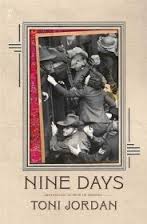
‘Nine Days’ by Toni Jordan

ninedays

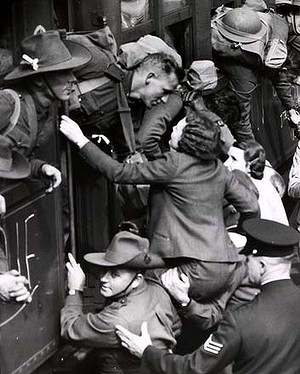
Often front covers of books use stock images, but the photograph on the cover of Toni Jordan’s Nine Days is integral to the story.  It shows a young woman being hoisted onto the shoulders of soldiers and well-wishers who are gathered around a troop train.

ninedays2

The photograph was the impetus for Jordan to write this book, and its significance becomes clear by the end of the story.  However, the book is about much more than this photograph.

The Westaway family live in Rowena Street Richmond during the late 1930s. Connie is the eldest, Kip and Francis are 15-year-old twins. Their father has died, money is tight but Jean Westaway, their mother, prides herself that the family has improved itself by living ‘up the hill’, away from the slums .  Nearby lives Jack, recently returned from the country, who has returned to live with his parents whose house adjoins their business overlooking the Westaway’s backyard. It is 1939 and men are enlisting- Jack among them- and it’s no real surprise that in Toni Jordan’s hands, the photograph on the cover is of Jack and Connie’s farewell.

Although this is the central motif, the narrative and chronology of the book skips back and forth. There are nine first-person narrators, all connected to the Westaway family, but separated by time, generation and social class.  Jordan makes you work hard as a reader. Each chapter has the narrator’s name, but no information about date or location, and you need to make the connections yourself.  Too complex? I don’t think so. Even though I almost resented being shunted from one narrator to the next and being dragged back and forth through the decades, each chapter did its work in bringing the plot forward.

In her acknowledgments Jordan thanks historians Janet McCalman from Struggletown and Kate Darian Smith for On the Homefront. Jordan, as a fiction-writer, makes just the sort of use of secondary historical sources that a historian would want.  She doesn’t ‘Trove-ize’ Richmond by slathering on detail, but she gives it a lived-in feel,  because her research has attuned her to the broad sweep of a community and sensitized her to the meaning of place and not just its appearance.   By presenting narratives across multiple decades, she traces the gentrification of both real-estate and aspiration.

This book is a departure from Jordan’s  earlier work, Addition and The Fall Girl, both of which are light, humourous reads.  Even though Nine Days is a sad book which moved me to tears, there are flashes of humour here too.  Overall, it’s a much more complex book than her earlier work.  You have to work harder as a reader, and Jordan has worked harder as a writer too, to good effect.

aww-badge-2015-200x300 Posted to the Australian Women Writers Challenge 2015.

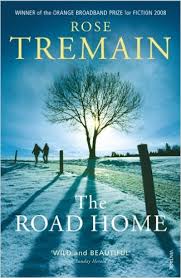
‘The Way Home’ by Rose Tremain

roadhome

2007, 384 P.

It took me some time to realize the cleverness of the title of this book, which seems far more a journey away from home, rather than towards it.  Lev is an unemployed lumberworker and what we’d call today an  ‘economic migrant’ from an unnamed Eastern European country who travels to England from his economically-hollowed out town to make enough money to carve out a better life for his family back home.  He is not, as he emphasizes, “illegal” under the then-current Worker Registration Scheme that made it possible for workers from the central Europeans and Baltic A8 states  to work in the UK, but he quickly moves towards that eddy of marginal casualized workers that underpin the hospitality and agricultural sectors of the UK economy.

Lev is a widower, with a young daughter after his wife Maria died with cancer a few years earlier.  The daughter has been left behind with her grandmother. On the bus that bears him across Europe towards England he is fortunate to be seated beside Lydia, a teacher with similar dreams of economic advancement, whose English is much better than his. As Lev moves through a succession of poorly paid jobs, Lydia finds a job as a translator to a world famous musician and shifts into a different social and cultural milieu.  But she continues to come to Lev’s assistance, even though he does not, in truth, treat her well.

His other piece of good fortune was to find lodgings with Christy, an Irishman reeling from the breakdown of his marriage and the loss of his daughter.  Lev sleeps in a bunk in the daughter’s bedroom, surrounded by the pink plastic detritus of children’s toys.  He and Christy drink too much, but they are good for each other.

Lev is a complex character.  In many ways, he is a good man, but he is also proud, jealous and inclined to violence.  He is also hard-working and quick, and when he gains a job as a dishwasher at the upmarket restaurant G K Ashe, he uses the opportunity to watch and learn.  He becomes involved with Sophie, one of the other cooks, but when their relationship becomes too messy, it is Lev who is sacked.  Sophie, like Lydia, is drawn into the celebrity culture of London when she becomes involves with the pretentious artist Howie Preece, but Lev continues to visit the aged care house where Sophie volunteered even after she had flitted into a new life.  He works hard and gradually an idea coalesces for a new life back home, with his friend Rudi, his mother and daughter.  It is at this point that I realized that this exile was all part of the way home- hence the title.

This book was my choice for my face-to-face bookgroup, chosen largely because I’ve enjoyed Rose Tremain’s work before and because I was aware that it had been awarded the Orange Prize in 2008.  Such responsibility! (no-one likes to hear the words “Who chose this book?”)  I feared that “the ladies” might think it too slow moving and at times I wondered where the book was going.  I must confess to fearing with each page that something tragic or dreadful was about to happen, but instead Lev’s progress was slow and prosaic.  But, along with my bookgroup ladies, I found the ending far more emotionally satisfying than I thought it would.

I’ve read critiques of the book where reviewers criticize the lack of specificity of Lev’s origins (thereby suggesting that all Eastern European countries were the same), or the political neatness of sending Lev ‘back home’ .  Neither of these things bothered me. I remember being disturbed by the open prejudice voiced against Eastern European migrants in England when I visited in 2007 – precisely the time that this book was published-  and the images we now see of young African economic migrants waiting at the Calais tunnel are challenging.  I found that Tremain’s book put a human back into the images and stereotypes.  She held back in the right places: there was no fairytale ending, but not did the whole thing descend into squalor or outright degradation.

And yes, the bookgroup ladies enjoyed it too.

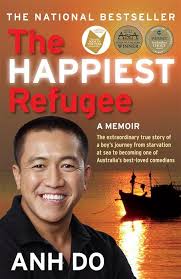
‘The Happiest Refugee’ by Ahn Do

ahndo

2010, 240 p.

This was a bookgroup selection, which I would never have chosen for myself.  Comedians’ autobiographies are not a must-read for me: I’ve read Judith Lucy and um…… surely Clive James is more than a comedian?  So let’s just say that I’m drawing from a very small puddle of familiarity with the genre.

Ahn Do is a young Australian comedian of Vietnamese heritage. I must confess that while I know who he is, I can’t remember actually seeing him perform, as he tends to work on commercial channels and aimed at a younger demographic than I.

The book reads like a series of stand-up routines, with very few of them extending beyond two pages (and sometimes much shorter) often with a rather inflated hook sentence to draw you in, and a soft punchline at the end.   I must say that it’s not a structure that particularly satisfied me because it left you skating across the topic without tunnelling very deep. The book was organized chronologically as Ahn Do told his story of travelling to Australia from Vietnam as a ‘boat-person’, his family’s striving for financial security, the break-up of his parents’ marriage, the progress of his own career and marriage, and his reconciliation with his estranged father.

The story was far better than the telling of it. At a time when our government has twisted the language to conflate ‘asylum’ and ‘illegal’, it was instructive to read of the fear and precariousness of their trip by sea to Australia, and their deep gratitude to the then-government for offering a new life to the family. In many ways the family acted in the ways that most evoke fear and disdain for the Australian population- the extended family living in crowded conditions in a factory, the domestic sweating of female family members, the buying up of property- but all these activities made complete sense within the cultural world-view and history of this Vietnamese family.

What shines through is Ahn Do’s love for his family, and his gratitude for his mother in particular who worked so hard when the family broke up.

There’s so much we don’t know when we sit in the back seat of a taxi, wary perhaps of the driver; when we scowl at large family groups at auctions ‘taking over’ the suburb; or when we see veiled mothers and children at shopping centres. I, at least, feel shy about asking and yet there is probably so much that I could learn, and this book is such an experience.

That said though, Ahn Do should probably stick to stand-up comedy.

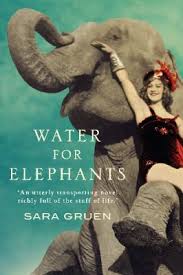
‘Water for Elephants’ by Sara Gruen

gruen

2007, 350 p.

To run off with the circus is a common escapist trope, and this book too is sheer escapism. Jacob Jankowski is a veterinary science student at Harvard University in the 1930s.  His world falls apart with the death of his parents in an accident and  what had appeared to him to be financial security  unravels quickly in the wake of their deaths. Stunned by the rapid change in his life he suffers, in effect, a nervous breakdown during his exams, walks out and- yep, joins the circus.

The circus is a little self-contained world with its own castes and hierarchies. It is owned by Uncle Al, a ruthless, avaricious entrepreneur who cannabilizes other circuses that fall on hard times during the Depression, picking the best of their artists and animals to join to his circus.  One of the animals is Rosie, an apparently intransigent elephant and she, like the other animals in the circus, comes under his care.  The equestrian director, August, is cruel to both the animals and to his wife Marlena but, as with many cruel people, can be charming and obsequious as well.  And, as you might expect, Jacob and Marlena fall in love.

The story has two alternating narrative threads.  Ninety-three year old Jacob is now a widower in a nursing home, frustrated by the infantalizing and brusque treatment he is receiving.  He’s a difficult but alert  [im]patient and Gruen has written this part well.  Sometimes when there’s a double narrative like this, I find myself inwardly groaning when it switches to the thread I’m less keen on, but this didn’t happen in this book.  The circus section is obviously well-researched (and only occasionally a little too obviously well-researched) both in terms of the times and circus lore.  Our edition was liberally sprinkled with archive photos which can be seen here.

There’s also a YouTube video advertising another book that has interesting images too.

https://youtu.be/3SsSrf-jTJI

Water for Elephants is a light read; it was on the best-seller list for ages; it was turned into a film starring Robert Pattinson and Reese Witherspoon,  and I gather from all the plot summaries online, must be set on school reading lists.  The goodies are good; the baddies are bad and the ending is nicely tied up.

My rating: 8/10 for a very light read

Sourced from : CAE Book Group for the Book Group Ladies a.k.a. ‘The Ladies Who Say Oooh’

‘Spies’ by Michael Frayn

Spies_Frayn

2002, 213 p.

For Proust it was a madeleine.  For the narrator of Spies it was the cloying, heady smell of a flower in a suburban garden, and it took him back to a wartime summer, a hideout in the garden hedge, secrets, fantasies and ambivalent shame.

Stephen Wheatley was small and unpopular, with ears that stuck out. His friend Keith was unpopular too, but he lived in a big house, his toys were kept in pristine condition in their boxes, and the afternoon teas dispensed  by Keith’s mother were Blytonesque, even if she did so without ever quite acknowledging Stephen’s presence.  Stephen was drawn along in Keith’s wake and when Keith announced that his mother was a German spy, well, then- yes, perhaps she was.  After all, there was her diary with the odd crosses once a month in keeping with the phases of the moon (for night-time spying duties, of course), and she seemed to spend a lot of time going into the village posting letters (to the German authorities, of course) or pretending to shop for her sister who lived down the street.  So the boys  snooped in her writing desk and followed her, and found more than they had bargained for.

This is a beautifully told story.  It has that wistful, golden glow of L.P. Hartley’s The Go-Between or Ian McEwan’s Atonement, and as in those books, the narrator in Spies also sees too much and yet doesn’t know what s/he is looking at.

Frayn’s control of the story is masterful, especially in the switch between present tense and reminiscence, which can be clunky in less sure hands. This was the second time that I had read the book, but I think even the first time I quickly cottoned on to Stephen’s misconstructions – just as Frayn, I think, intended his readers to do.   The story is told with humour and humility, and the adult Stephen is affectionately kind to his younger self and withholds judgment from him.  Little details fit together so cleverly- the play on ‘privet’ for example- and the last chapter colours in much of what had only been sketchy or incomplete previously.

I really liked this book, just as much on the second reading as on the first. You’re in the hands of a master writer, and you know it.

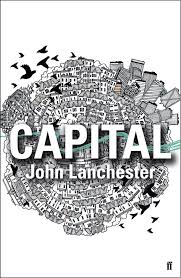
‘Capital’ by John Lanchester

lanchester

528 p. 2012

How can a writer fill over 500 pages largely about ordinary lives where nothing much happens and yet leave you wanting more? This was my selection for bookgroup but I must confess that I didn’t realize that it was quite so long. Oh dear, I thought, the ladies will be very cross with me, but it didn’t take long for me  to not even care.

The book is set over a roughly a one-year period, starting in December 2007, just as the Global Financial Crisis is starting to bite.  It focusses on Pepys Road in South London, a street where prices have boomed. Some families have lived there for decades, almost oblivious to the goldmine that they’re sitting on, while others are on their upward professional trajectory, only too aware of their burgeoning wealth. They are a diverse group: a widowed elderly woman, a Pakistani family who own the small grocery shop, an African footballer who has a contract with an English football team, a wealthy money trader and his wife, and an Eastern European housepainter.  Then there are other people who are tied to these householders: a nanny, a grandson, a daughter, an aggrieved personal assistant and a Zimbabwean refugee working as a parking inspector.

What is common to the residents of Pepys Road is that they have all received in their letter box a postcard that shows a photograph of their front door and the enigmatic message ‘We Want What You Have’.  The postcards keep coming, with photographs of their houses from varying sightlines and at different times.

The book follows the little dramas of the inhabitants of Pepys Road in short chapters of just a couple of pages each.  I felt, in a way, like the unnamed postcard-sender, looking in at the window of one house for just a few minutes before moving onto the next.  It was a wonderful way to approach such a lengthy, sprawling book.  The characters were so well defined, so quickly,  that I only once or twice had to flick back to see who they were again.  I found myself sitting down on the edge of the bed to read just one or two chapters for a couple of minutes, then coming back half an hour later to read another few.  I was genuinely sorry that the book ended.  I didn’t even particularly care who was sending the postcards, although the book does use the solving of that little mystery as a way of bringing the narrative to a close.

And the bookgroup ladies?  Not a single grizzle about the length, and they enjoyed it too.

My rating: 9/10

Read because: my own selection for CAE bookgroup

‘Instructions for a Heatwave’ by Maggie O’Farrell

o'farrell

2013, 338 p

On a hot July morning in 1976, recently retired  Robert Riordan gets up from the breakfast table and announces that he’ll pop out to get the newspaper. He doesn’t come back.

His wife of 40 years, Gretta waits a little while, then calls her children. Two of them, anyway: school teacher Michael whose wife is growing away from him as she becomes increasingly engrossed in her Open University course, and Monica whose relationship with her stepdaughters is strained and leaching into her second marriage with an older man.  Gretta can’t call her youngest daughter, Aoife in New York, because she doesn’t know her number.  Aoife, who has struggled with dyslexia all her life, has a job as a personal assistant to a photographer she admires, and is just embarking on a new relationship. She had fled to New York after a falling out with her sister and had cut off all contact. But once the word is out, all three children come home to help find their father, trailing their disappointments, anxieties, tensions and resentments behind them.

The action stretches over four days, but a very long four days in narrative terms because so much of the story is being told in flashback- not a technique that I’m particularly fond of.  The focus shifts from one family member to another, with the exception of the absent Robert, who is just as ‘missing’ in the book as he is in the plot.

The book is set against the 1976 heatwave that roasted London with sixteen consecutive days over 30 degrees.  English houses are not built for heat, and water restrictions were imposed.  (There’s some good photos here). I must admit that as a reader more accustomed to antipodean heat waves, it didn’t quite capture heat as we know it here . We were being told about the heat, but as a reader, I didn’t feel it.  What I did feel was the oppression of family arguments and pain, and the burden of secrets.

I read this for bookgroup and it was a good bookgroup choice.  It always sounds a bit patronizing saying that, but it was the sort of book that nudged you into making judgments and taking sides.  It was certainly easy to read and my interest in the characters ensured that I didn’t particularly care one way or the other about what happened to Robert, and whether he did get that newspaper after all. The book’s not really about him at all, or the heat, for that matter.  It’s about families and secrets, and choices and their consequences.

My rating: 7.5

Read because: CAE bookgroup