Category Archives: Port Phillip history

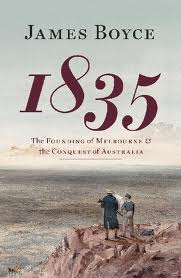
‘1835’ by James Boyce

James Boyce, 1835: The Founding of Melbourne and the Conquest of Australia, Black Inc, Melbourne, 2011.  212 p & notes

At last! I thought when I finally got my hands on this book.  In fact, three ‘at lasts!’  I’m almost sure (nothing is really sure these middle-aged days!) that I read about this book at the beginning of 2010 when publishers were spruiking the books that were about to appear during the year.  I waited throughout 2010 but no sign of it.  And now- here it is.  And ‘at last!’ I thought because in the closing chapters of excellent previous book, Van Diemen’s Land, James Boyce clearly signalled that, just like Tasmanian settlers themselves, his own  thoughts about Van Diemen’s Land crossed the strait as well.  And ‘at last!’ again  I thought because in reading about the early history of the Port Phillip District – for example in A.G.L. Shaw’s A History of the Port Phillip District – you find yourself wondering if Port Phillip will ever get itself off the ground.  Navigators just kept sailing past it, missing the bay completely; Collins picked up sticks and decamped for Hobart after a short time, and the aborted and rather half-hearted  attempts to establish a settlement on Westernport Bay sputtered away fitfully.  Like a car with a flat battery, the Port Phillip settlement just didn’t seem to be able to turn over and take off for decades.

Boyce describes the arrival of squatters coming across from Launceston in 1835 as “a brazen act” that “would shape the history of Australia as much as would the arrival of the First Fleet in 1788” (p xi). It’s a big claim:

…the policy turmoil which followed the establishment of a squatters’ camp in 1835 had an significance far beyond the baptism of a great city.  In this place, at this time, ‘Australia’ was born. (p. xiii)

As might be expected from the title, Boyce starts his book in the year 1835, which he approaches from a range of perspectives: by locating us in the deep time of the Yarra River, and then  amongst the smaller black/white encounters along Bass Strait in the decades prior to 1835 through the unregulated and largely undocumented whaling, sealing and wattle-bark industries.  After this largely geographical perspective he then moves on to explore the political mindset of the three groups of players during 1835: – the financiers, pastoralists and adventurers in nearby Van Diemen’s Land who formed themselves into the Port Phillip Association ; the governors in Sydney under official British instructions to limit settlement to the area adjacent to Sydney ; and the Colonial Office and lobbyists representing opposing evangelical and pastoral interests in London.

It’s important to remember that there was no inevitability about the Port Phillip district being considered as part of New South Wales.  In terms of distance, it was far closer to Van Diemen’s Land than it was to Sydney- it still surprises me when driving down near Lakes Entrance that you’re just as likely to find local Tasmanian stations as Victorian ones on the car radio.  Governor Arthur, whom Boyce suggests was influential in the whole Port Phillip Association endeavour, certainly was in no hurry to let Sydney know what was going on across the strait.

Indeed, as Boyce suggests,  this policy double-speak pervaded the whole endeavour.  Batman’s so-called ‘treaty’, was as Bain Attwood also suggests in his recent book Possession, a legal fiction, but Boyce claims that it was not meaningless, either to the Port Phillip Association, or to the Kulin leaders who putatively ‘signed’ it. Adopting the slow-motion, close reading that Inga Clendinnen used to such good effect in Dancing with Strangers,  Boyce traces the pedigree of the treaty in colonial thinking generally and in the actions of both black and white protagonists in that first year.  There was an intricate dance of go-slow and evasion between all the political actors involved, in Port Phillip, Hobart, Sydney and London, that exploited all the silences and ambiguities of correspondence at a distance.   Had the Colonial Office, or its representatives in Sydney really wanted to suppress the Port Phillip settlement in line with the espoused policy of closer settlement,  they could have used policy to do so. It could have punished squatters for illegal possession by banning them from future land purchases; it could have with-held convict labour from them and it could have equipped Aboriginal Protectors with the authority to award or strip leases depending on the treatment of the Aboriginal tribes already there.  There was, he claims, a choice involved, and the governments here in NSW and the British Govt through the Colonial Office,  chose to do none of these things.

Boyce takes up a second theme that he foreshadowed in his chapter in Van Diemen’s Land entitled ‘Victoria’s Van Diemonian Foundation’.   There was, he claims, a deliberate policy both in the Colonial Office and in Sydney to dilute the influence of the small, bush-savvy Tasmanian ex-convicts who flooded across the strait as shepherds and labourers.  By blaming ex-convict shepherds  as the main threat to Aboriginal tribes, Sydney and the Colonial Office and the behind-the-scene evangelists, championed the more ‘respectable’ large, NSW-based pastoralists as the means of civilizing and incorporating Aboriginal people into the settlement endeavour.  The pastoralists, already a powerful lobby group, were only too pleased to reap the benefits of this portrayal.    Boyce’s argument is not couched in the Marxist terms and language of Martin Sullivan’s earlier Men and Women of Port Phillip, but there is a strong class dynamic at play nonetheless.  In this regard, Boyce’s argument needs to spill out of the 1835 chronological straitjacket he has confined himself within.  For example, although Boyce does not mention it, in succeeding years the decision to hold the first land auctions in Sydney rather than in Melbourne itself played to the interests of Sydney pastoralists and speculators, and the early constitutional arrangements for elections to the Legislative Assembly favoured Sydney-based candidates for Port Phillip seats.  This process of expunging the VDL-based nature of Port Phillip society was set in play in 1835 and intensified in the years following.  But because his book focuses on the first year of settlement in Melbourne,  his account gives more prominence to VDL than the longer-term perspective suggests.

Boyce closes his book by asserting that the land rush and dispossession that so quickly followed the settlement of Port Phillip was not inevitable, even though it was portrayed that way by Governors and the Colonial Office at the time and is still portrayed that waytoday.  His final chapter engages in an exploration of ‘what-if’.  I’m always wary of ‘what-if’ (even though I enjoy it!)- I see it as a guilty pleasure but ultimately a sterile pursuit because the reality is that it didn’t happen.

I’m likewise  a bit uncomfortable about his closing observations that extend his observations about government decision-making, or the lack thereof, during the settlement of Port Phillip  into a discussion of climate change policy today.  His argument has been strong and  persuasive throughout the rest of the book but I don’t know if it can stretch this far into the realm of present-day politics.  Although ‘doing nothing’ or failure to act (are they the same thing?) might be the end result, I’m not sure that it always springs from the same impetus. It might be a deliberate delaying tactic; it may be quite self-conscious; it may be because some actions are literally unthinkable and certainly unvoiceable because other imperatives are more important, or it may reflect a failure of imagination.  I’m not convinced that failure to act on climate change and failure to act to suppress illegal possession are the same thing.  It’s a debate worth having, I suppose, and perhaps that was his purpose in introducing the question at all.

This book is well-written, clear, engaging and forceful in its claims and well worth reading.   As a Melburnian, it nudges you into a different place to look at your city’s history, and that’s a bracing and exciting thing to do.
Bishopscourt

It was Melbourne Open House on Sunday, and on such a magnificent winter day, I just had to call into one of the locations while I was in the area.  We had come across Toronto’s Open House while we were there, and London’s too for that matter, but I think that Open House days are meant for the residents of a city rather than visitors.  Some of the sites are open year round so there was no great appeal there (unless you went to parts of the building not normally accessible), but I was more drawn to places that are not normally open to the public.  I was walking past Bishopscourt and had always been intrigued by it- so Bishopscourt it was!

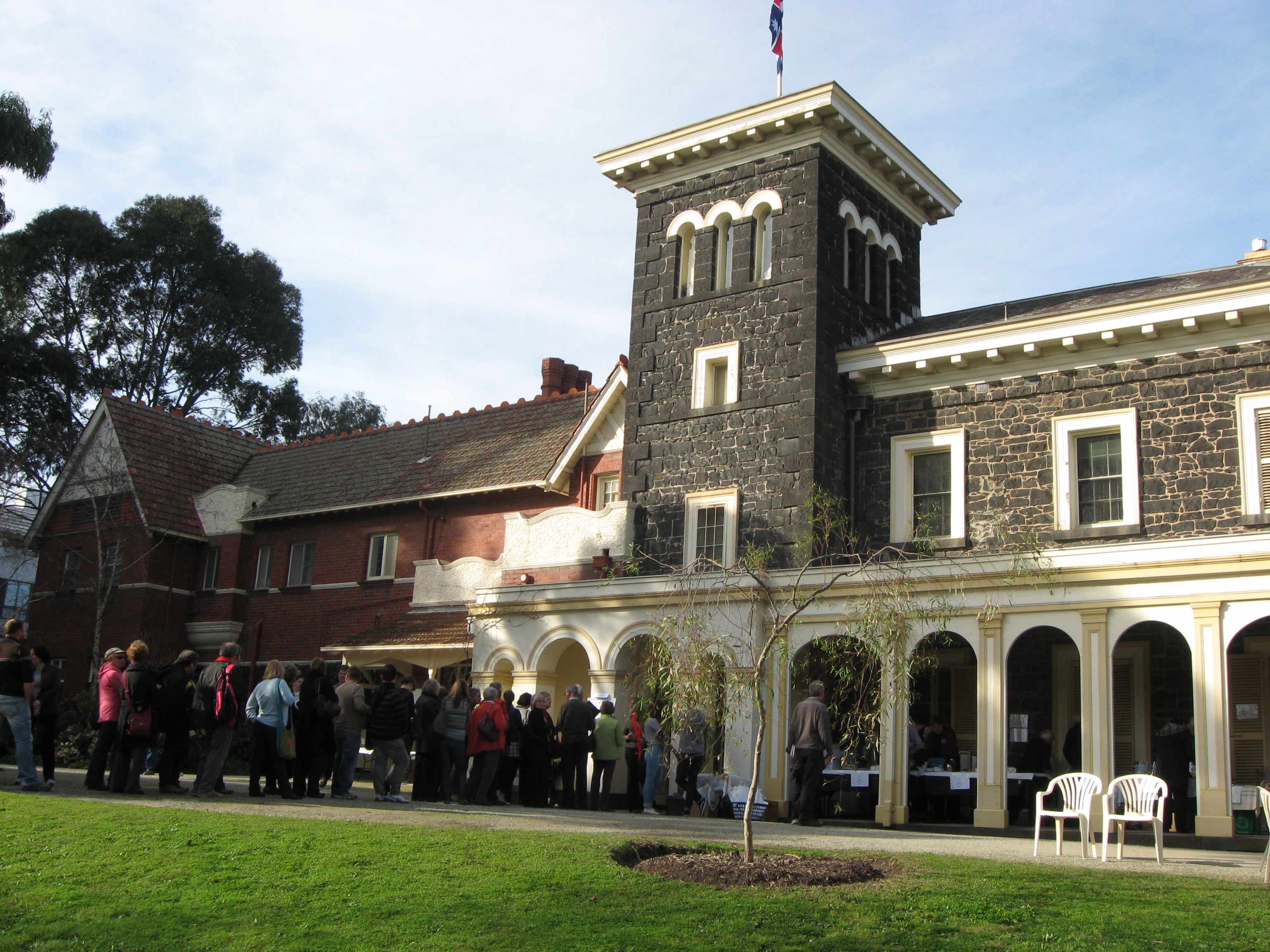
Bishopscourt is located in Clarendon Street, opposite the Fitzroy Gardens.  It has been the family home of the Anglican Bishop and later Archbishop of Melbourne since it was built in 1853.

If it looks a bit of a hodge-podge, that’s because it is.  The first Bishop of Melbourne, Bishop Perry, selected the location so that he could walk into Melbourne itself, while being close to the site that was originally considered for the Cathedral between Hotham and George Streets in East Melbourne .  It was later decided to construct the Cathedral in its present location on the corner of Swanston and Flinders Streets. Construction of  Bishopscourt began in 1851 but because of the shortage of building labourers in these goldrush years, the house was not completed until 1853.  Sixty years later it was decided that a grander house was required. One of the bluestone wings was demolished in 1903 and replaced with the rather discordant red-brick wing, resulting in its rather schizophrenic  appearance.

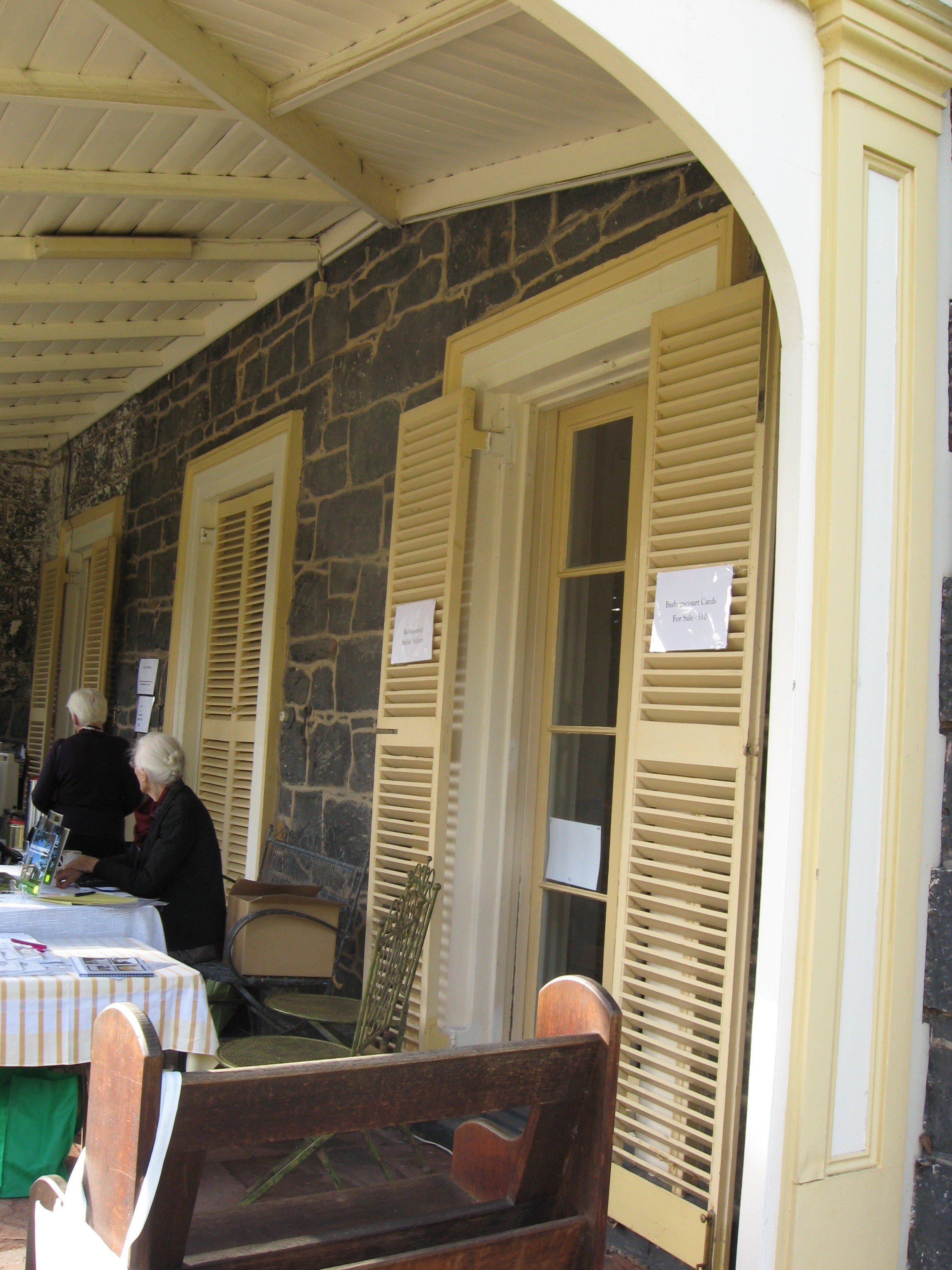
Although constructed in wealthier gold-rush days,  the design of the bluestone section evokes an earlier, more Georgian influence with its French windows and shutters, wide doors and simple architecture.

The bluestone is rather roughly laid on the front and side of the house, and it has been suggested that perhaps it was intended that the facade be stuccoed at a later time.  The new red-brick section included a large dining room and a private chapel which was a warm, intimate space that might hold perhaps twenty people.  I wish they had let us take photographs, because the chapel was very special place, with many of the furnishings and decorations donated by previous occupants.

The chapel from the outside

Tours ran approximately every half hour and you were ushered from one room to another, where someone who had previously lived at Bishopscourt spoke about their memories of the room as part of their family home.  The Archbishop of Melbourne was there in the drawing room, decked out in his purpleness, and the daughters and daughter-in-law of the former Archbishop Frank Woods spoke in the morning room, dining room and chapel.  Unfortunately we were restricted to the ground floor- I was intrigued by the staircase which was carved with silhouettes of bishops’ mitres- but I suppose that some privacy was in order as the house continues to be used as a family home: the only pre-gold rush estate still to be used for its original purpose.

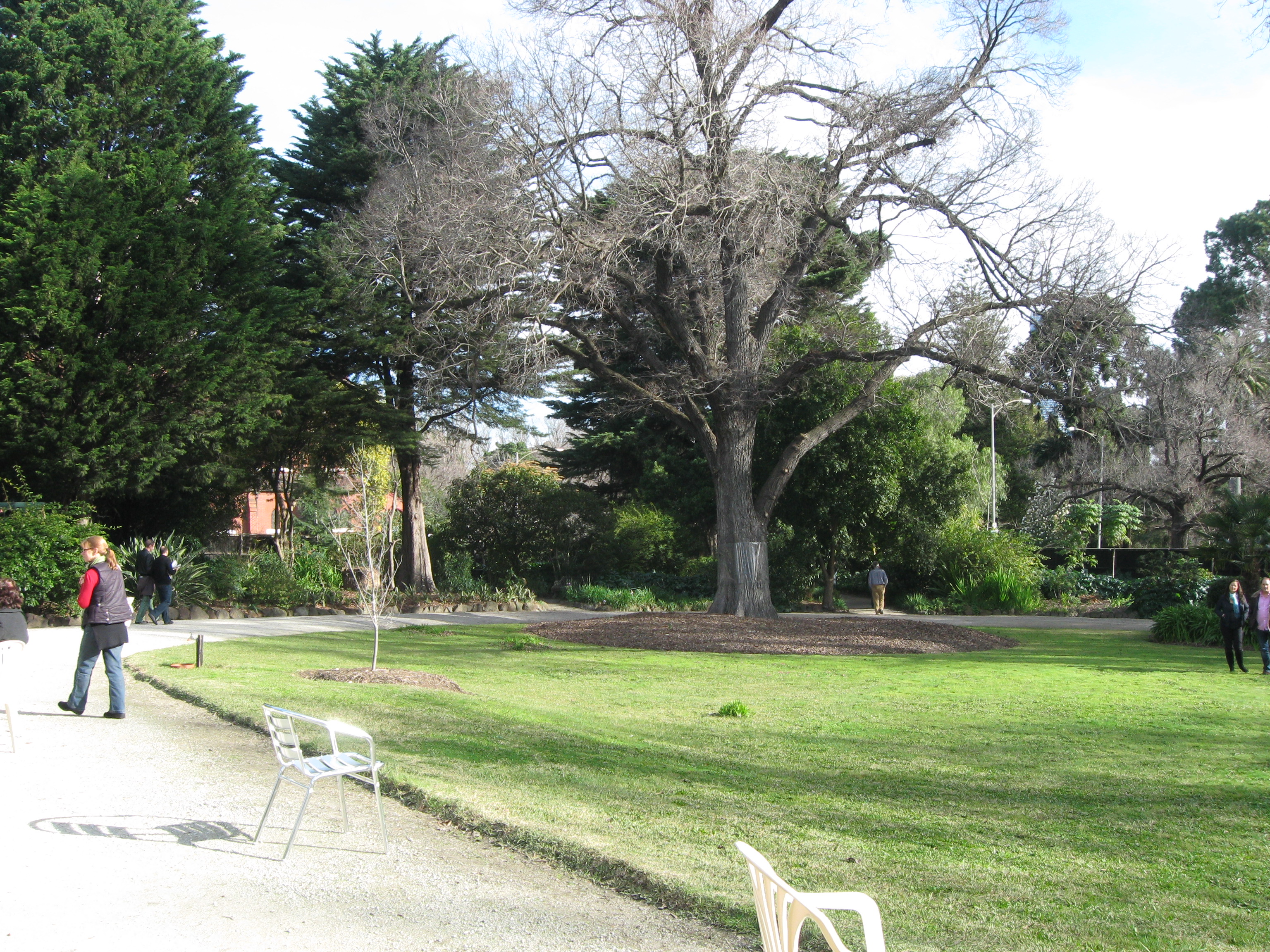
The gardens have been rescued from disrepair by a dedicated band of volunteers and they were in beautiful condition.

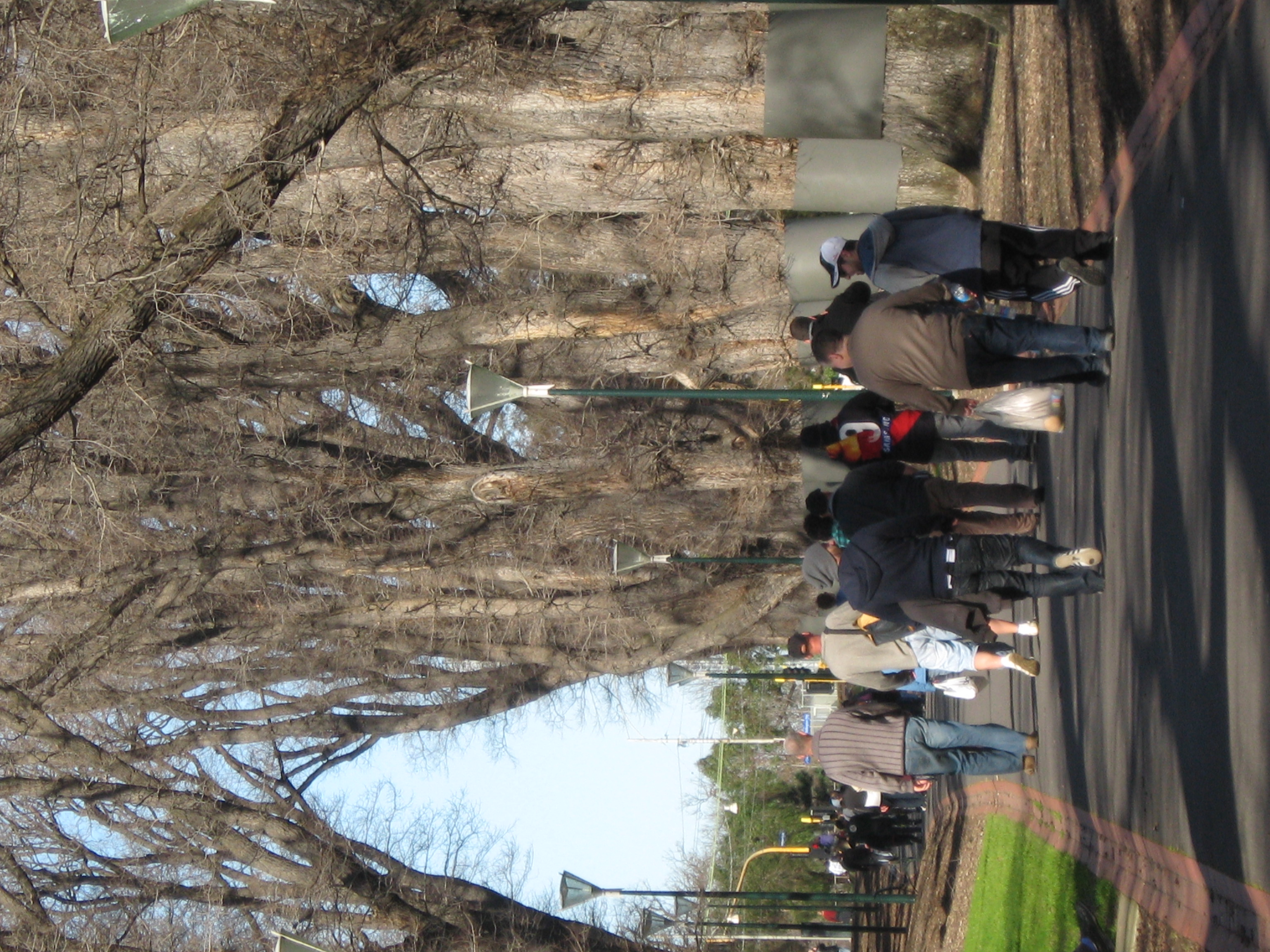
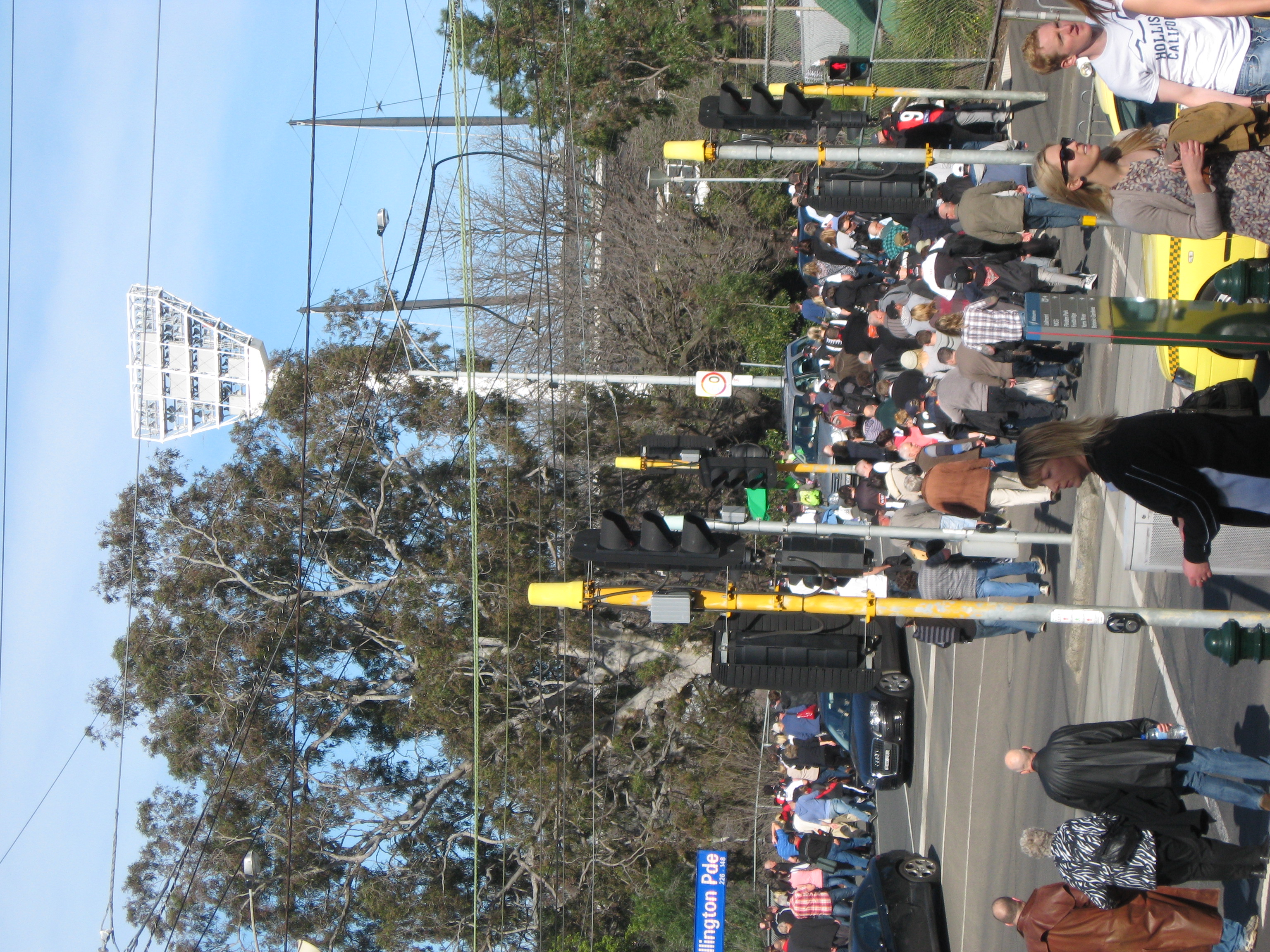
As I left, there was a religious pilgrimage of a different type through the Fitzroy Gardens as the crowds headed towards the MCG for the Collingwood/Essendon match.

The processional to the 'G

Ah- the footy and the MCG on a sunny winter afternoon- hot pies (unfortunately), seagulls, the Footy Record and Jolimont railway station. Who could want for more?

By the way, I wasn’t the only one checking out Melbourne Open House.  Andrew at High Riser had a very busy day and more success photographing than I did.

Age in the colonies

Just tootling around the ‘net, as one does, I found a review of a book that sounds fascinating- Aging by the Book: The Emergence of Mid-Life in Victorian Britain by Kay Heath.  The review is  well worth reading, and you’ll find it at the Rorotoko site.

2009, 262 p.

Here’s the blurb for the book from the publisher’s website, which also includes a download of the first chapter:

Aging by the Book offers an innovative look at the ways in which middle age, which for centuries had been considered the prime of life, was transformed during the Victorian era into a period of decline. Single women were nearing middle age at thirty, and mothers in their forties were expected to become sexless; meanwhile, fortyish men anguished over whether their “time for love had gone by.” Looking at well-known novels of the period, as well as advertisements, cartoons, and medical and advice manuals, Kay Heath uncovers how this ideology of decline permeated a changing culture. Aging by the Book unmasks and confronts midlife anxiety by examining its origins, demonstrating that our current negative attitude toward midlife springs from Victorian roots, and arguing that only when we understand the culturally constructed nature of age can we expose its ubiquitous and stealthy influence.

One of the things that struck me when looking at Port Phillip was how young people were.  At one level, this seems reasonable: the trip from the United Kingdom (which is where many immigrants came from) was formidable, although some older people did broach it.   Sydney and Van Diemen’s land, as the older settlements,  had seen the elapse of generations by the time of Port Phillip’s establishment in the 1830s, and many of these second and third generation settlers crossed the strait or came down from Sydney to a ‘new’ settlement that did not have  tainted connotations and which offered a new frontier and opportunities.

In Port Phillip itself, people commented about the youth of the population at the time.  E. M. Curr wrote:

Perhaps the first thing one noticed was the almost total absence of women from the streets, as well as the paucity of old men.  In those days anyone over thirty was spoken of as old So-and-so ( E. M. Curr, Recollections of Squatting in Victoria)

The figures (flawed as they may be) of the 1841 Census for the Port Phillip District bear him out:

AGE MALE FEMALE
Under 2 305 340
2 and under 7 479 425
7 and under 14 395 395
14 and under 21 561 384
21 and under 45 6045 1824
45 and under 60 442 86
Over 60 47 6

Source:  HCCDA Historical Census and Colonial Data Archive

There’s that huge imbalance of men between the ages of 21-45, many of whom arrived by themselves or with their brothers and they so quickly take their place in Port Phillip society.  Redmond Barry was 26 when he arrived; the newspaper editor George Arden was about 21 when he confronted Judge Willis.  Peter Snodgrass, another young man about town who also fell under Willis’ notice was 24.

Paul de Serville in his book Port Phillip Gentlemen  likens polite society prior to the 1842 depression to

…an unreformed public school before the tone had been elevated by a middle-class Arnold.  Visitors and new arrivals were at once struck by the youth of the colonists (p.37)

I haven’t, as yet, noticed the same phenomenon in Upper Canada where, so far at least, it seems that there is more emphasis on family migration.  Something to bear in mind perhaps.

Opening of the Supreme Court in Melbourne 12 April

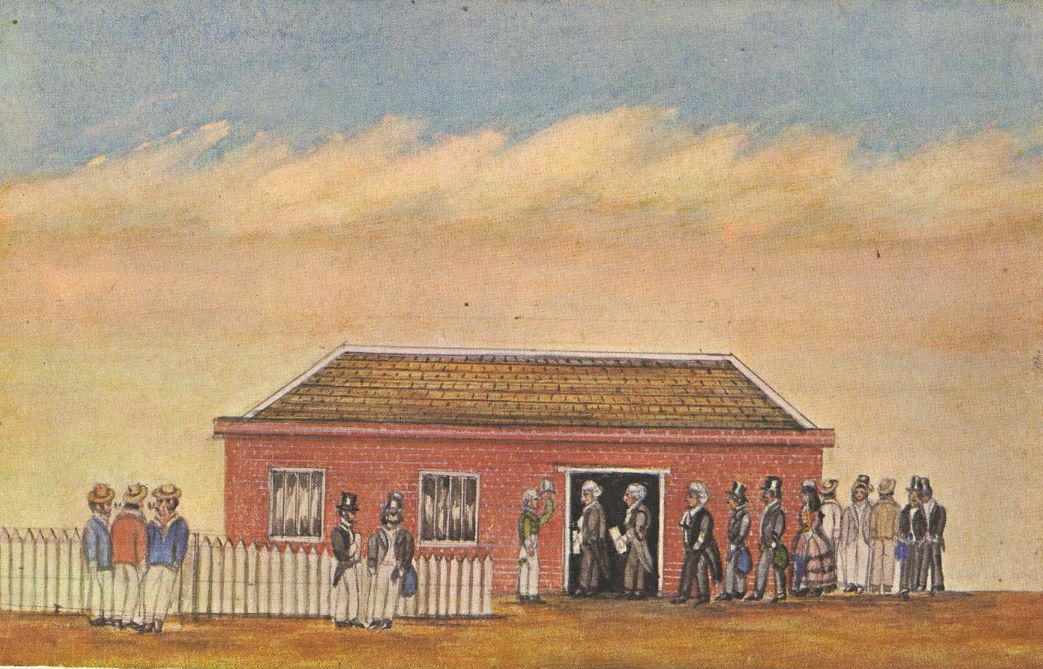
I see that the The Honorable Marilyn Warren AC, Chief Justice of Victoria  is to speak at the RHSV on the 28th April about the opening of the Supreme Court in Melbourne 170 years ago this month.  Look at the header on this blog- this is Liardet’s rendering of the occasion, many years later.  Here’s the uncropped picture:

By all accounts, the first Supreme Court occupied a rather unprepossessing temporary building that was blazing hot in summer and cold in winter.  Here’s what Garryowen (Edmund Finn) had to say about it:

At the south-west corner of King and Bourke Streets there was, in early days, erected a plain-looking, store-like, brick-walled, shingle-covered building, and therein the small business of the Crown Lands Department (controlled by Commissioners) was disposed of.  The entrance at one end faced Bourke Street, and nothing could be less pretentious, less comfortable, or uglier.  In the beginning of 1841, when it was known that a branch of the Supreme Court was to be established in the district, the ruling powers were at their wits’ end as to how, and where, an apartment could be procured for the temporary accommodation of the Resident Judge and his judicial following.  After a good deal of casting about, it was finally resolved to convert this place into a legal “make-shift” and the Crown Lands Commissioners, with their troopers and bailiffs, were hurried off to a wattle-and-daub shed, a rearward appurtenance of the Superintendent’s establishment on Batman’s Hill.  So the barn underwent a partial process of fitting up; and the single-roomed cottage referred to in a previous chapter as a Clerk of Works’ Office behind, was transformed into “Chambers”.  p. 179 This “rookery” then became the Supreme Court, and here it was that the willful and wayward Judge Willis “ruled the roost”. (p. 179)

It certainly had none of the grandeur and visual power of the later, purpose-designed courthouse erected where the Old City Court building now stands in Russell Street.  Instead, it was rather gently derided by the Port Phillip inhabitants:

THE COURT HOUSE:- Some steps should be taken to render this place tenantable.  In winter, parties compelled to attend undergo the operation of freezing, which is materially aided by the chilling draught of air which circulates freely in the building, obtaining ingress and egress through the roof, windows and door.  In the summer, the N.W. Sirocco will scorch the auditory, while the gentlemen of the press will require neither pounce (1) nor blotting paper to absorb the moisture of their hieroglyphics.  Lath and plaster might go a great way to remove this cause of complaint; while the expense would be trifling, the convenience would be great, and prevent many of “the ills which flesh is heir to”. During the present cold weather a machine has been erected on the platform of the Bench, out of sight, bearing a strong resemblance to the tin establishment of an itinerant vendor of roasted potatoes; but whatever heat emanates therefrom must be appropriated to the peculiar cherishment of His Honor’s legs- “Reform it altogether.” Port Phillip Herald, 22 June 1841

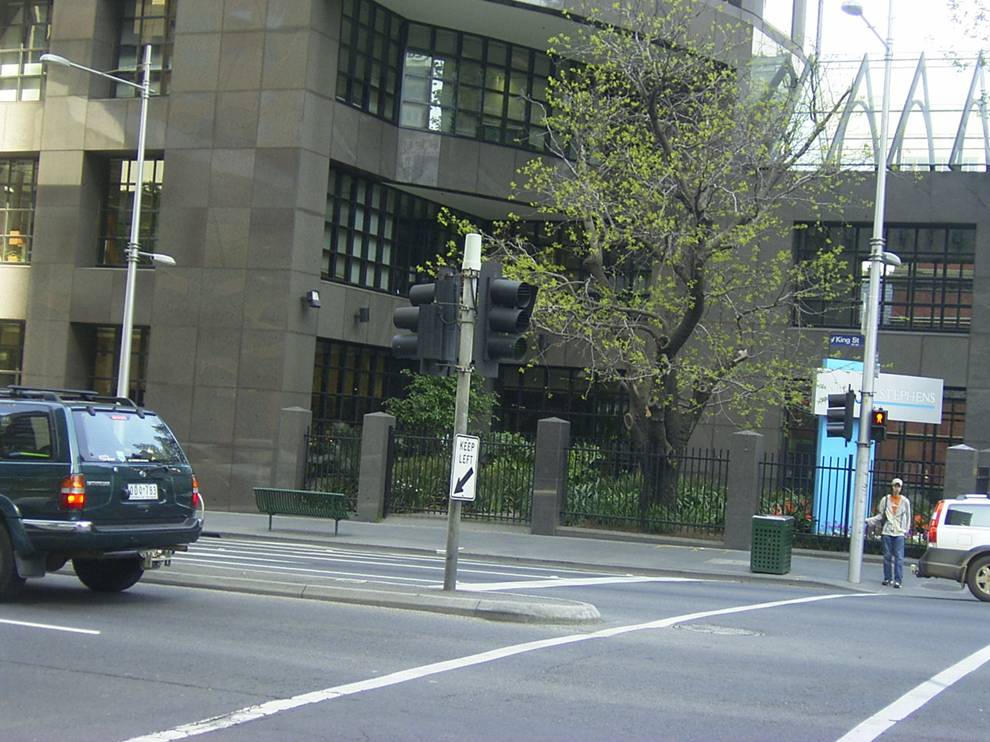
You’re hard pressed to find any hint of that first, small Supreme Court building now.

South -west corner King and Bourke Streets, Melbourne, site of the first Supreme Court

Here’s the Port Phillip Gazette report of the occasion of the opening of the court:

SUPREME COURT-

The first sitting of this tribunal took place   at the temporary Court House in King street on Monday the 12th instant. As might have been expected on such a momentous occasion, there was a large attendance of the inhabitants drawn together by the importance and the novelty of the scene. After the reading of the Act for the   prevention of ” vice and immorality” the proclamation of the authority of the Court, and the commission of His Honor Judge Willis, and  after he had submitted to the ceremony of  being sworn in, in a full and clear voice the learned judge delivered himself of the following   opening address, which for the legal acumen displayed in its production, and the good feeling manifested in its tone and delivery cannot be too highly spoken of.-

And then he launched into his opening address which you can read through Trove (Sydney Herald, 26th April 1841). Knowing as we do that Judge Willis was to dismissed just over two years later on pretty much the grounds he identifies here,  the speech is steeped in irony for us as readers.  No doubt people at the time heard it differently.

All very stirring, uplifting stuff.  But even at this earliest stage of Willis’ time in Melbourne, the Port Phillip Herald raised a sceptical eyebrow and reserved its judgment about the speeches  for the time being:

The Port Phillip Bar.- Upon the induction of the bar on Monday last, the supply of wig and gown was most promising-white neck- cloths were at a premium-and there was that cheerful diversity of nose and whisker surrounding the table, for which the English bar is so eminently celebrated. Touching the Demosthenian or Ciceronian orations delivered on the   occasion, we say nothing, but pause until time shall have mellowed down those fiery exhibitions usually accompanying maiden efforts.

Notes:

[1] Pounce, apparently, was a powder used to prevent ink from spreading and blot up excess ink.

‘The hated Protector’ by Lindsey Arkley

2000, 469 p. & notes

Lindsey Arkley The hated Protector: The story of Charles Wightman Sievwright Protector of Aborigines 1839-42. Mentone Vic, Orbit Press, 2000.

Charles Sievwright is an ‘interesting’ man from 170 years distance, and was certainly controversial and combative at the time.  This biography of Sievwright examines his time in the Port Phillip District as Assistant Protector for Aborigines in the western district of Victoria between 1839-1842.  Lindsey Arkley, the author, also wrote Sievwright’s entry in the Australian Dictionary of Biography.

The Aboriginal Protectorates were an experimental measure, urged on the Colonial Office  in London by the evangelical pressure groups concerned about the treatment of indigenous subjects throughout the empire.   They were established as a secular adjunct to the church missionary system and comprised a Chief Protector and several Assistant Protectors. They were given the remit to firstly, protect indigenous people from settler cruelty and secondly, assist the church-based missionaries in converting Aborigines from a wandering and barbaric state into sedentary,  ‘civilized’ Christians.   The inland areas of the  Port Phillip District had only been recently exposed to widespread settler incursion, and it was rather optimistically hoped in London that this could herald a new and better approach.  It was an experiment imposed on Governor Gipps in Sydney and his local superintendent in Melbourne, Charles LaTrobe, and in the absence of any clear vision of how it would work in practice, George Augustus Robinson was appointed Chief Protector on the basis of his work in Van Diemen’s Land.  Unlike the other Assistant Protectors who were school teachers, Charles Sievwright had a military background and used his admittedly rather impressive patronage ties to get the position after some rather dubious gambling problems back in Europe.

It was a position fraught with tension, ambiguities and contradictions, even without the added complication of the deeply flawed individuals who were chosen to fill the roles.  Chief Protector Robinson was variously jealous, ambitious, inefficient, blustering, out of his depth and conflicted, and the Assistant Protectors soon began fighting both with Robinson and among themselves over lack of supplies, perceived lack of support, ambiguous instructions and – importantly for Sievwright- rumours of sexual impropriety.   In Sievwright’s Port Phillip career, and in his subsequent dismissal, these rumours of sexual misconduct including domestic violence, attempted seduction of other Protectors’ wives and most damaging of all, incest with his own daughter bubbled underneath all his interactions with his superiors, other bureaucrats, and the white settlers who resented his presence in prime grazing territory.

This is a very long biography at over 400 pages dealing mainly with three years of Sievwright’s career in Port Phillip, although the ‘before’ and ‘after’ are dealt with in the opening and closing chapters.  Arkley has drawn heavily on official correspondence, particularly the letters written to, from and by La Trobe and the local bureaucracy and the resultant reports between and by Gipps and the Colonial Office.    This is territory that I have been likewise wading through with my own research, and seeing how Arkley has dealt with it has made me more reflective about its value and limitations as a genre and source.  He has published much of this information in a much more accessible form than the originals, and been punctilious in his footnoting, but there is so much of it and often over so little.   This is something that I have likewise struggled with, in both a narrative and methodological sense.   Arkley reproduces the texts and has placed  the ‘controversy of the moment’ (and there were many!) within its context, but much of this is ‘he said/he said’ reportage.

Arkley started each chapter- and there are (too) many at 35 of them- with a few brief, interest-arousing observations but these are fairly general, often rejoicing in coincidence and juxtaposition and not always particularly relevant to the chapter.   In Arkley’s telling there are clearcut baddies- “Flogger” Fyans, Robinson, and the duplicitous La Trobe and Gipps- and one senses that Arkley’s purpose is largely to rescue Sievwright’s reputation from their clutches.

But in doing so, there is no scholarly discussion of the protectorate system and its ambiguities and no exploration of the meaning of the sexual scandal and its relationship with the other grounds given for Sievwright’s dismissal.  Perhaps this was not Arkley’s intention: I see in the blurbs that the book was embraced by local historians and Arkley himself works as a journalist.  Other historians have picked up on Arkley’s work- in particular Alan Lester and Fay Dussart in their article “Masculinity, ‘race’ and families in the colonies: protecting Aborigines in the early 19th century” [1] who thank him directly in their Acknowledgments.  I’m sure that Kirsten McKenzie [2] would do much with  Arkley’s work on Sievwright as well.

Is it valid to critique a book for what it doesn’t do, and perhaps even had no intention of ever doing? I’m not sure.  After all,  we stand on the shoulders of other researchers, and there is certainly value in Arkley’s collection and reproduction of much of the archival material on Sievwright.  His footnoting is excellent, and I’ve been able to find many of the sources he cites.  But at times I found myself wary of his clear attempt to promote and rehabilitate Sievwright’s reputation, and found myself having to read against Arkley’s text for much of the time and wanting to prod him a bit further.  Sometimes a bit of ambiguity and scepticism is not a bad thing.

Notes:

[1] Alan Lester and Fay Dussart ‘Masculinity, ‘race’ and families in the colonies:  protecting Aborigines in the early 19th century’ Gender Place and Culture, vol 16, no 1, 2009 pp.  65-76

[2] Kirsten McKenzie Scandal in the Colonies: Sydney and Cape Town 1820-1850 Carlton Victoria, Melbourne University Press, 2004

Also:

Ian D. Clark The Hated Protector: The Story of Charles Wightman Sievwright Protector of Aborigines 1839-42 [Book Review]  Aboriginal History, Vol. 24, 2000: 305-313.

‘High Tea’ at Bundoora Homestead Art Centre

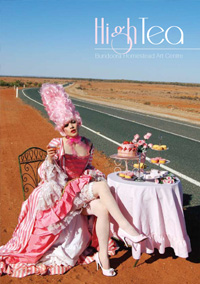
‘High Tea’, Bundoora Homestead Art Centre 3 December 2010- 6th February 2011

What a hoot! We went today to see “High Tea” before it closes on 6th February at the Bundoora Homestead Art Centre.  The publicity on the web page describes the exhibition thusly:

A social ritual, the ceremony of high tea is comprised of a series of gestures governing things such as; the way tea should be stirred, the direction of a teapot spout, and the proper way to eat a scone!

High Tea explores the social, political and cultural role of high tea in contemporary culture. What has compelled and sustained this seemingly rigid practice throughout the centuries, how has it evolved and developed as a tradition that is still cherished today?

The artists present unique interpretations of this practice through various mediums and methods – glass, paper, textiles and smell! Each installation sets out to provide a contemporary appreciation of high tea.

We weren’t really quite sure what the exhibition would be, but we saw that there would be a dance installation at 1.00 pm and unsure of even what that was, we tottered along. It took a little while to realize that the performance (is that the right thing to call it?) was actually underway as we wandered around the space, partaking as the sign suggested of a scone, jam and cream in return for a gold coin donation, and then wondering if perhaps we’d misread the sign and were EATING the exhibition! How embarrassment that would be! There’s buttons to press, peepholes to squint through, a wall of cupcake papers that seemed to take on a beauty of their own and an installation of recorded admonitions (“say thank you”) that made you squirm with the memories of being squashed between grown-ups and being on your best behaviour.

Across in the main gallery itself are several displays- photographs, knitted cakes,  doodled doileys and paper cakes.  My favourite exhibit was a room redolent of the smells of high tea- one long sniff of different smells that you might encounter at a high tea in 1910 compared with its counterpart in 2010.  I’m a very smell-y person (as in ‘highly olefactorily attuned’ if there’s any such expression) with smell an integral part of how I experience the world and deeply embedded in my memories.  Smell is always part of how I perceive any work of art – the smell of the paint, the cleaning products used in the gallery, the still air-  and I absolutely relished having it consciously prodded and teased in this exhibit.

Have you heard of the Bundoora Homestead Art Centre? It’s a beautiful Queen Anne-style homestead in Bundoora which at the time was prime horse-racing stud territory.  Suburbia has crept up around it, but it would have once commanded a wonderful position- you can see the city,  the Dandenongs and the Macedon Ranges from the nearby Mt Cooper lookout.  Its most famous equine resident was Wallace, the offspring of the  legendary 1890 Melbourne Cup winner, Carbine.  In his three year old season in 1895 Wallace himself won the Caulfield Guineas, the Derby, was beaten in the Melbourne Cup but on the following Saturday dead-heated to win the C. B. Fisher Plate.  He won the 1896 Sydney Cup,  but illness forced him to retire.  He then stood at stud for 22 years (!!), siring progeny that competed in 949 races, winning nearly a quarter of a million dollars in prize money.  For those with a paranormal bent, there’s a story that on a dark night the sound of hooves can be heard around Wallace’s grave in the adjacent Bundoora Park.

It’s a beautiful house- glorious stained glass and a spectacular staircase with pyrographic panels.  It was used as a convalescence farm after World War I, later renamed the Mental Repatriation Hospital, then the Bundoora Repatriation Hospital.

But wait, there’s more! Those of you who have followed this blog  will know that one of my little interests is to find six degrees of separation between Judge Willis (the REAL Resident Judge of Port Phillip) and – well, anything you might like to name.  This one is easy- the original owner of Bundoora Park was John Matthew Vincent Smith, the only son of John Matthew Smith.  And who was he, you ask?  John Matthew Smith arrived in Port Phillip in 1839 and took up employment as a law clerk with Horatio Nelson Carrington.  There was certainly no love lost between Willis and Carrington, who was one of the ‘Twelve Apostles’ financial ring,  and Willis’ disdain extended to John Matthew Smith as well, whom Willis described as

too insignificant for an attachment; his law is as absurd and insignificant as himself.  (Finn ‘Garryowen’ p 69)

So, if the “High Tea” exhibition  or Bundoora Homestead itself, Wallace’s grave and even if the ghost horse don’t tempt you to venture out to Bundoora, the sure knowledge that you’re only two degrees of separation from John Walpole Willis will surely do the trick.

169th Anniversary

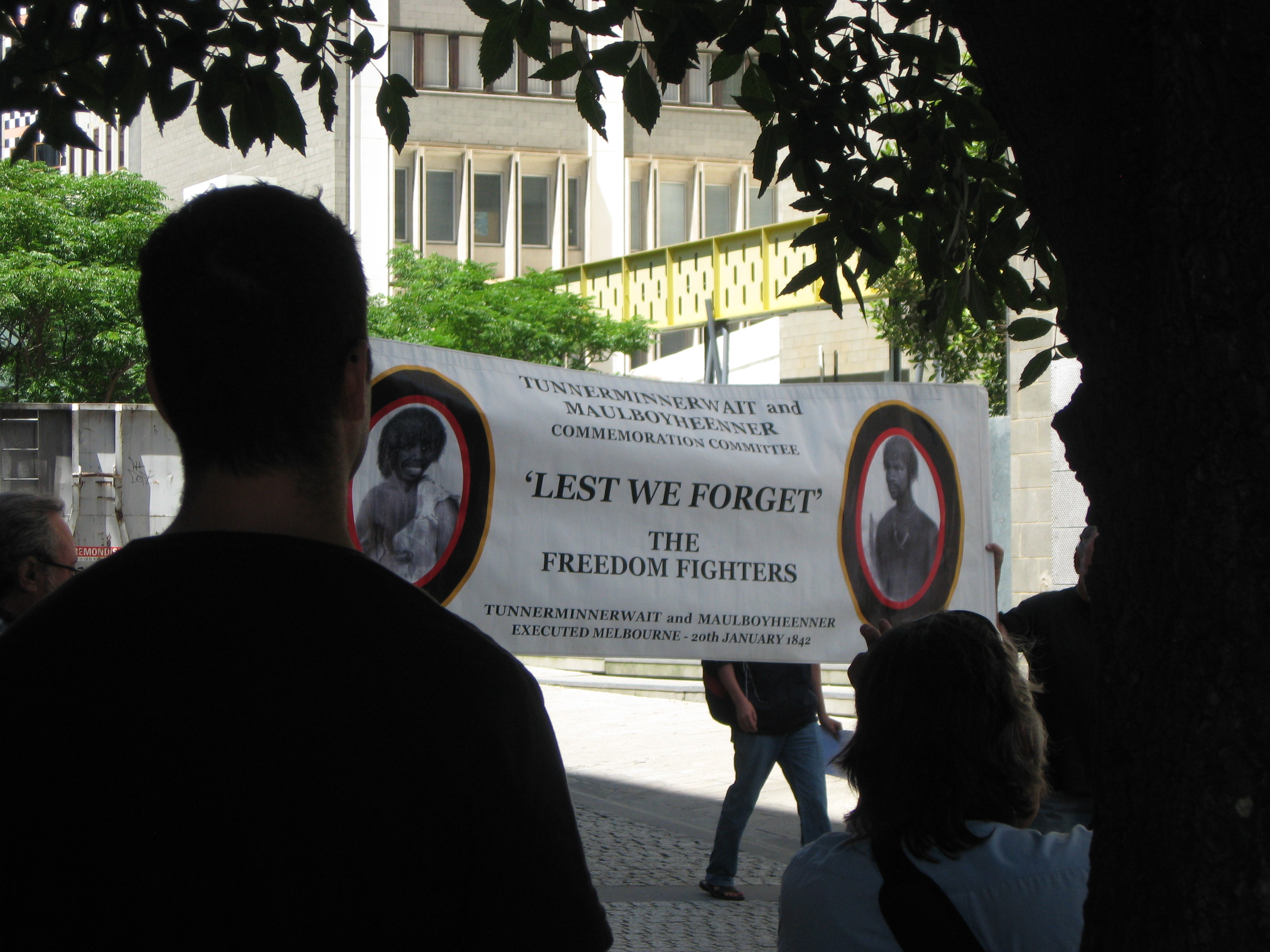
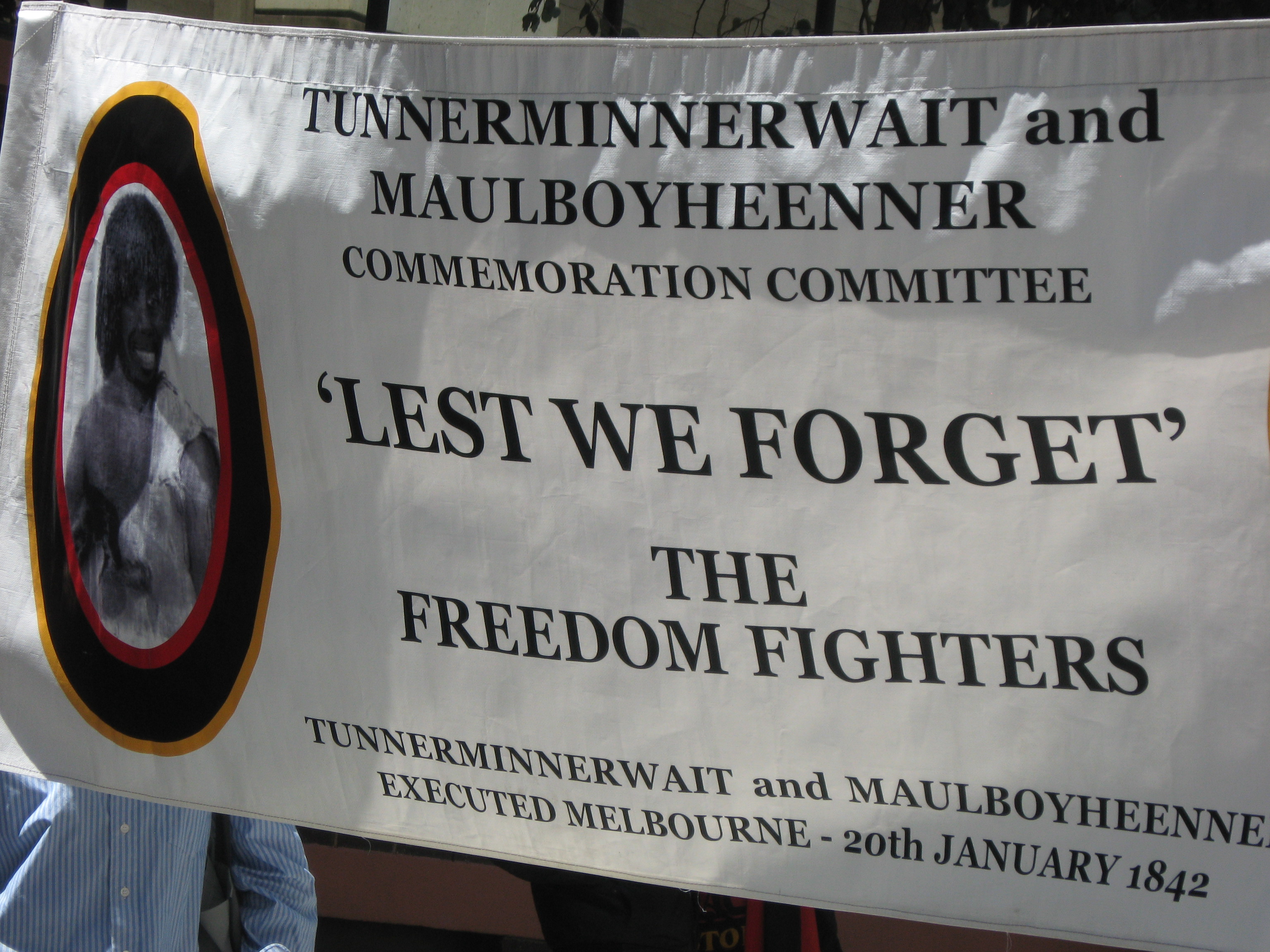
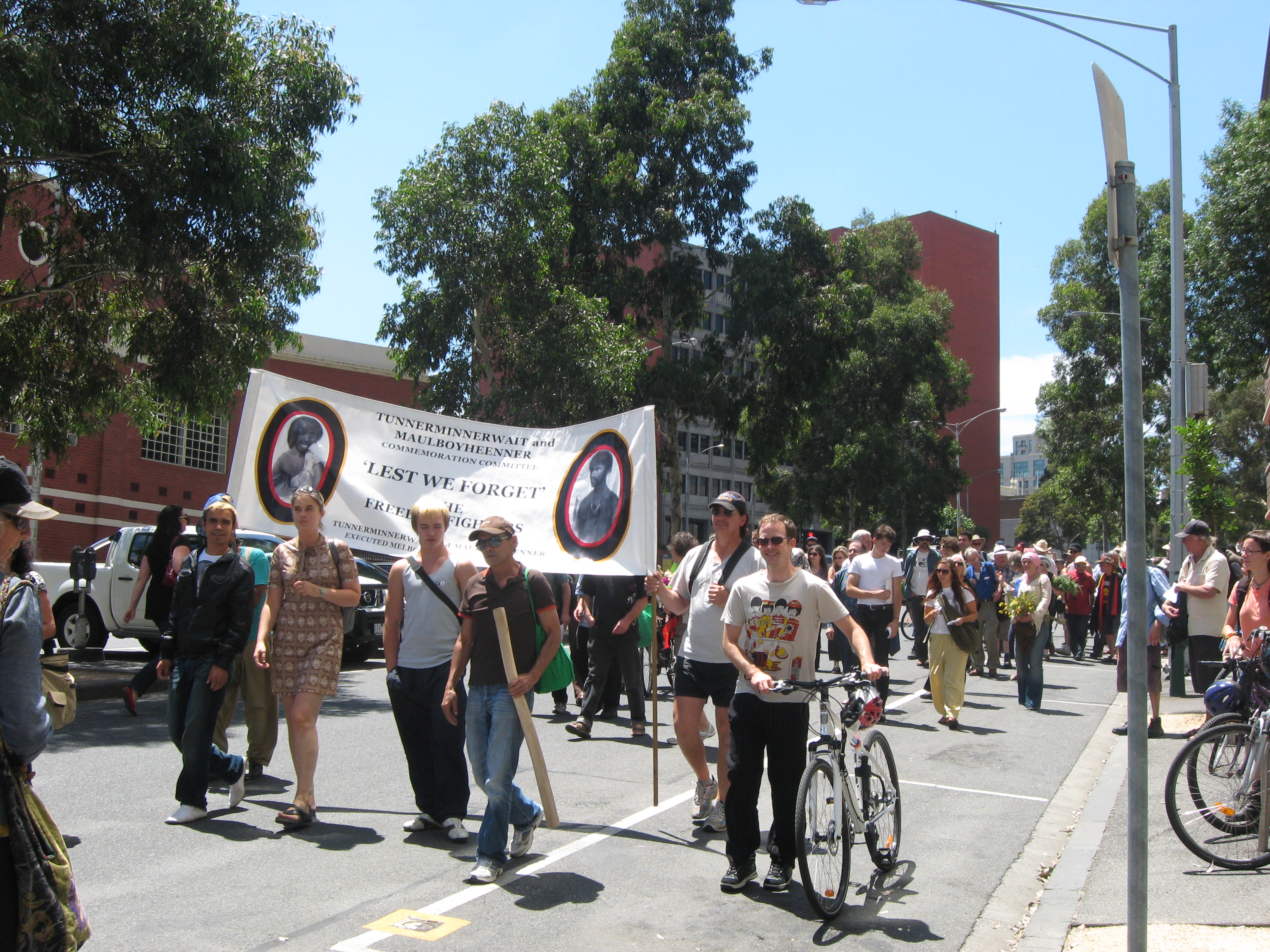
If you go into Melbourne on Thursday 20th January at 12.00  and head up to the corner of Bowen and Franklin Streets, you’ll see the 169th anniversary of the hanging of Tunnerminnerwait and Maulboyheener.  These commemorations have been conducted for several years now- in fact, the Lord Mayor Robert Doyle spoke at the 2009 commemoration.

I’ve heard it said that once a blog starts to cannibalise itself, then the end is nigh- I hope this is not the case.  But just this once I’ll refer you back to an earlier post that I wrote on this anniversary two years ago and a post on images of Tunnerminnerwait in  the Robert Dowling exhibition at the Geelong Gallery and later National Gallery of Australia last year.

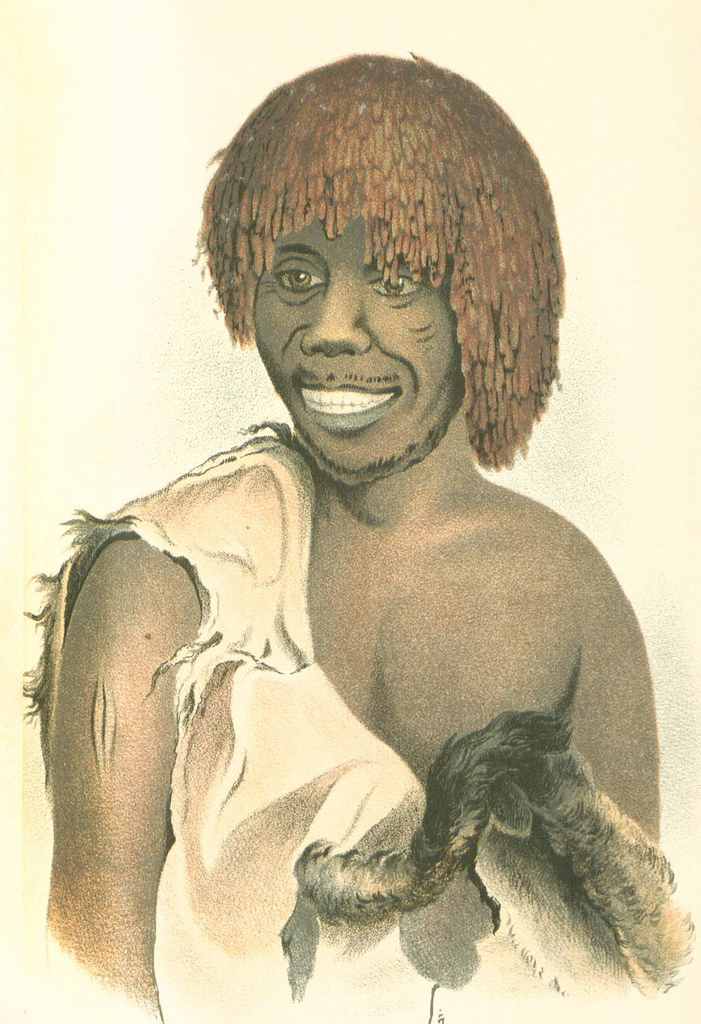
The smile in this image – so unusual amongst depictions of Aboriginal people at the time- is explored by Leonie Stevens in her article ‘The Phenomenal Coolness of Tunnerminnerwait’ published in the Victorian Historical Journal, Vol 81, Number 1, June 2010.  If you belong to a library that has access to Informit, then it’s well worth following up.

Abstract: There have been numerous historical constructions of Tunnerminnerwait, alias Cape Grim Jack, who was publicly executed along with his friend, Maulboyheener in Melbourne in January 1842.  This paper revisits the documentary record and historicizing of the two young Tasmanians, and asks, were they victims of colonial indifference, freedom fighters, or simply wild Tasmanians enacting the final stages of the Black Wars?

The commemorations on 20th January that have been held over several years now certainly claims them as freedom fighters, but I’m not particularly comfortable with that characterization.  I concur with Stevens that they were defiant, independent actors, and her article highlights the difficulty in ascribing any one motive to their actions when dealing with  such a partial and complex historical record.  For me the connotation of politicized, communal action denoted by 20th century term ‘freedom fighter’ does not ring true for a small group of Aboriginal people cast adrift from their country and tribal structure and utter strangers to the land they found themselves in.

I’m puzzled, too, by the recommendation to mercy by the jury: a recommendation that  that was not supported by Judge Willis and disregarded by the colonial authorities.  The Van Diemens Land Blacks encapsulated the two huge and very sharp anxieties of the frontier- blacks AND bushrangers rolled into one- yet there was obviously some disquiet about the death penalty among the jurors at least.  Nonetheless,   large crowds witnessed the execution outside the jail but here too, we can only guess at what motivated them to come out in such numbers:   curiosity? sense of occasion? 19th century popular culture? crowd behaviour?-  close to the spot where the commemoration on 20th January will take place.

Postscript:

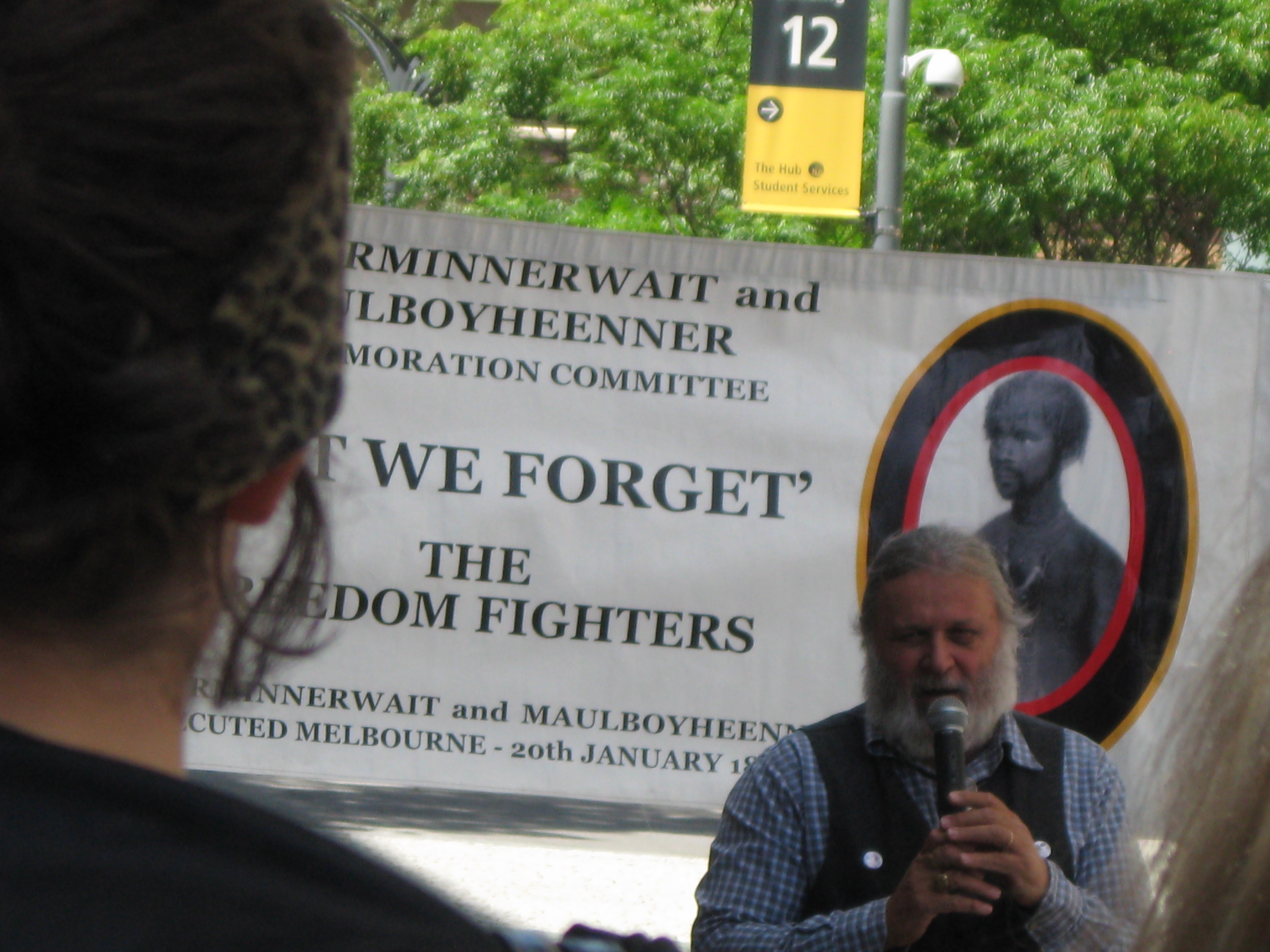
And here it was:

Corner Bowen and Franklin Streets, Melbourne

What's a demo without good old Joe Toscano?

Up Franklin Street on the way to the Vic Market

‘Good Men and True: The Aboriginal Police of the Port Phillip District 1837-1853’ by Marie Hansen Fels

1988, 227 p. plus appendices and notes

In her book, Marie Fels warns of a number of ethnocentric blindnesses and misconceptions, and I’m afraid that I’m guilty of at least three of them.  The first, she says, is to simply not see the presence of the Native Police and I’m certainly guilty of this.  I’ve been aware of them in my reading on Port Phillip, but hadn’t particularly considered what they might be doing there.  Then I noted that Jan Critchett attributed the turning point in aboriginal/settler “collisions” to their skill in pursuit and this notion fed, I suppose into my second misconception- that the Port Phillip Native Police Corps, like the Queensland Native Police Corps which was later modelled on it, was responsible for atrocities against aboriginal people.  And this, in turn, reflects my third ethnocentricity: the assumption that the act of joining the Native Police Corps was a form of treachery, undertaken only by marginal men who would be ostracized by their tribesmen because of their involvement .

Instead, Fels argues, the men who joined the Native Police Corps were leaders of clans or their heirs.  They willingly joined with Europeans in policing work: policing in its pre-Peelite manifestation as ‘keeping the peace’ rather than ‘upholding the law’, and certainly more than just tracking.

Joining the Native Police Corps is best seen as a strategy in the direction of sharing power and authority in the Port Phillip District, in the changed environment of the powerful and permanent European presence.  Besides the material things that police could see they would get, an opportunity was put before them of becoming men of standing within their transformed world.  They took it, and furthermore, they used it.  They bent it back, exploiting their acquired prestige and influence to operate within traditional group politics, to such effect that while the Corps was in existence, these men were the powerbrokers… Being a native policeman was a state of dual consciousness and divided loyalty; it appears not to have been a matter of rejecting Aboriginality, but rather of learning to live in two different worlds (p. 87)

The men of the Native Police Corps were proud of their uniforms and they kept them in immaculate condition; they craved guns but rarely used them “on the side”;  they were able to read the nuances in status between white settlers, and they operated in a number of roles including escorting,  taking messages, guarding, search and rescue and a highly visible ceremonial role within white society.

Although men of  the Warwoorong and Bunerong tribes (her spelling) from around Melbourne initially formed the heart of the unit, they were not just 20 troopers drawn solely from those tribes, as it has been described in the past.  Instead she has identified over 140 individuals drawn from various tribes across Victoria- even, though to a lesser extent, from the Gippsland tribes who were the traditional enemies of the Warwoorong/Bunerong federation.  One of her appendices gives the biographical details of five such men, and she refers to the full 114 page version of the appendix that she attached to her thesis,  available at the University of Melbourne, which covers the other men.

Good men and true?  Dana, their commandant certainly thought so, and was staunch in his defence of his men.  For there were, and are, rumours that the Native Police Corps itself was involved in the slaughter of aboriginal people- indeed the Native Police themselves bragged of it.  Here Fels, likewise, springs to their defence, drawing on statistics about ammunition and weaponry to undercut the claims of multiple shootings; querying the motives of men who made the reports to La Trobe,  issuing cautions about the reliability of any Aboriginal evidence, and challenging the ready acceptance of Aboriginal reports of ‘many’ being killed.  While this may be true, it is an argument that must be balm to Windschuttle et. al who query the statistics over white atrocities as well.  Is there an ethical responsibility in using a line of argument that could be picked up and used to make a contrary, and possibly abhorrent point?  Or is there an intellectual responsibility NOT to resile from an argument out of fear that this might occur?   The line between challenging misconceptions and inaccuracies on the one hand, and defensiveness on the other  is a narrow one, and at times I felt that she over-reached a little.  But even she admitted her uneasiness about reports of the Native Police Corps in Gippsland, the territory of their enemies far from the reach of authority, and her credibility was strengthened by her caution here.

Top of the list of her acknowledgments is Greg Dening, and the book is dedicated to him.  I can see his influence here, in the way that she walks around an episode, reading against the record, stepping away and  reminding us:

Always the first question to be asked when examining the action of the Corps is ‘What was the nature of the traditional relationship?’ (p. 157)

I feel that the typesetting of her book did her a disservice, though.  The book is a densely woven argument and more white space would have given her reader a little more oxygen.  At times she launched into examination of an episode without warning and I’d screech to a halt wondering “Hold on- do I know about this? Has she talked about this earlier?” only to read on for a couple of paragraphs to realize that I’d been dropped into an episode for some close-up scrutiny.

In her introduction she stakes her claim:

Part of the task of the historian is to recognize that the issues which kindle interest and shape enquiry do emerge from the cultural present, but the written end-product succeeds or fails according to how well the historian has understood and explained the past on its own terms. (p. 5)

This book challenges our conceptions of the role of the Native Police Corps and its meaning for its participants and those who encountered it at the time.  I’ll leave the last word with her in her own closing paragraph, because it’s a strong argument:

To recognize that they were the victims of the European takeover of their land is one thing; to write a history of the origins and growth of the contemporary sense of oppression is another; but to impose the attitudes of the present on the evidence of the past is ahistorical, producing the effect of leaving out of our histories the evidence of creative and adaptive Aboriginal strategies such as this one- becoming a native policeman. (p. 227)

Bringing ’em in

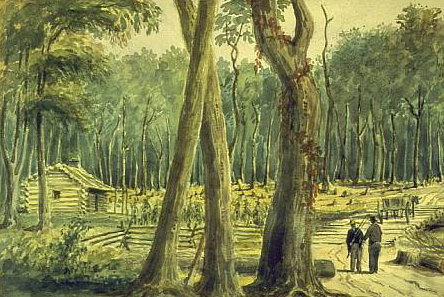
Pioneer homestead, Chatham Upper Canada 1828. P.J. Bainbrigge

Those of you following my academic progress (such as it is) will know that I’ve been turning my attention to Upper Canada, where Judge Willis presided on the Kings Bench in 1827-28.  It’s with an element of trepidation that I post anything about Upper Canada here at all on a blog ostensibly oriented towards Port Phillip in Australia, aware as I am of my lack of knowledge in the field.  Be that as it may, I find myself reading through bi-focal glasses now: alert to resonances in one colony that I’ve detected in the other, and conscious of parallel movements across the empire.

I’ve just finished reading an article by J.K. Johnson called ‘Land Policy and the Upper Canadian Elite Reconsidered: The Canadian Emigration Association, 1840-1841’ in an edited collection of essays in honour of the Canadian historian J. M.S. Careless. [Surely an unfortunate surname for any historian.  Careless himself reassured students in his survey of Canadian history course that they should not be concerned at having a lecturer called Careless, for a former head of the Department had been a Professor Wrong. (p. 21)]

Although this article falls beyond my 1827/8 pre-Rebellion interest in Upper Canada, I was drawn to read it because I was conscious of the emigration schemes operating within Port Phillip during the 1840s and was interested to compare them.  The ultimately-unsuccessful  Canadian Emigration Society was established in 1840 with a 2-pronged approach.  Prominent landowners in Britain (and particularly Scottish landlords)  would be encouraged to promote and support emigration to Upper Canada while, at the other end,  Upper Canadian landholders would offer free grants of 50 acres to incoming settlers.   There was a general feeling in Upper Canada that immigration per se was good for the colony, and the steep drop in incoming migrants after the 1837 Rebellion was viewed with alarm.  But, just as importantly, a number of well-connected Upper Canadians had amassed large landholdings as a speculative venture and their own land would increase in value if settlers could be attracted to the area.

There was a strong emphasis on land clearing.  I’m also reading Susanna Moodie’s Roughing it in the Bush, and I’m very much aware of the presence of the forest- it seems almost disloyal as an Australian to refer to it as ‘bush’.  The imperative to clear land was built into the Canadian Emigration Association Scheme:

“To such emigrants with families as shall come out under the auspices or with the special recommendation of the societies at home, it is proposed to give fifty acres each, upon condition of actual settlement and clearing a space of ten acres of the front of their locations, erecting a dwelling house etc for themselves, and clearing one-half of that portion of road lying in front of the lot of which their grant forms a part.  The use and possession of this land will be secured to them immediately, and after three years’ actual residence, and the performance of the conditions above specified, a deed in fee simple, without charge, will be given to them”

In an article in Historical Essays on Upper Canada: New Perspectives called ‘Forest into Farmland: Upper Canadian Clearing Rates 1822-1839′ Peter A. Russell notes that the rate of clearing forest was seen as a crucial index of a man’s  economic success and social advancement.  He noted that at first settlers needed to clear to provide immediate shelter for themselves and their families, while often working for wages on a more advanced settler’s tract. After a couple of years, the land had to be cleared again because of secondary regrowth.   Darrell A. Norris’ chapter in the same volume ‘Migration, Pioneer Settlement and the Life Course: The First Families of an Ontario Township’ noted that often families lived temporarily in more settled towns before shifting to the bush once they had sufficient working-age children to make a go of it.

I find myself comparing this with Port Phillip emigration at much the same time. There were bounty migrant schemes, but the emphasis there was on attracting labourers, both agricultural and industrial, and domestic servants.  There was a general reluctance for newcomers to shift into the country where there was much more of an emphasis on pastoral activity than farming, and it was mainly ex-convicts and single men who took on the role of sheep-hand, for which labour was most scarce.

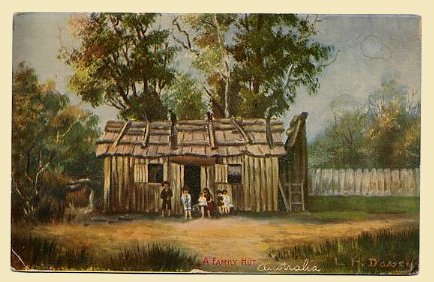
Postcard Family Hut Australia (1909)

Certainly ‘improvements’ were expected of selectors under the 1869 Selection Act- a house, boundary fences, clearing and cultivating at least 32 acres. (Some interesting, later images here)   Of course, the type of land dictated the emphasis given to clearing. Sparsely timbered plains posed no problem, but especially in Gippsland, the bush took on a daunting scale more similar to that in Canada.  But once it had been ring-barked and burnt,  the battle seemed won.  As one Gippsland selector W. M. Elliot, rejoiced at the end of his life

not a vestige remains of the vast forest that once so stubbornly resisted our labours.  Hill and vale covered in verdure as far as the eye can see! (cited in Dingle p. 67)

In the end, the Canadian Emigration Association was eclipsed by other developments.  The main proponent, Dr Thomas Rolph, became attracted by other (likewise unsuccessful) large-scale land development schemes whereby huge tracts of land would be purchased in England and sold to settlers, and by the early 1840s emigration had picked up of its own accord.  In Port Phillip, the bounty scheme almost bankrupted the government in a time of depression and by the early 1850s the gold rush made such schemes redundant.

References:

J. K. Johnson ‘Land Policy and the Upper Canadian Elite Reconsidered: The Canadian Emigration Association, 1840-1841’ in David Keane & Colin Read (eds) Old Ontario: Essays in Honour of J. M. S. Careless, Toronto and Oxford, Dundurn Press, 1990.  pp. 217-233

Peter A. Russell ‘Forest into Farmland: Upper Canadian Clearing Rates 1822-1839’ in (Ed.) J. K. Johnson and Bruce G. Wilson Historical Essays on Upper Canada: New Perspectives I ,Ottawa Canada, Carleton University Press, 1989. pp.131-149

Darrell A. Norris ‘Migration, Pioneer Settlement and the Life Course: The First Families of an Ontario Township.’ (Ed.) J. K. Johnson and Bruce G. Wilson Historical Essays on Upper Canada: New Perspectives I ,Ottawa Canada, Carleton University Press, 1989. Pp. 175-201

Tony Dingle Settling, NSW Australia, Fairfax Syme and Weldon, 1984

Melbourne Day? 30 August

Poor Melbourne.  She’s been thrashing about for years, looking for a day to celebrate herself.  At the moment the good burghers of the town have settled on Melbourne Day on 30 August, the day that the landing party of the Enterprize went onshore.  The cynics amongst us might see the nomination of 30 August as another step in the Batman/Fawkner controversy over the founding of Melbourne that I’ve alluded to previously here and here.   And just look at all the things you can do today on the Melbourne Day website

Being a daughter of the land of the long weekend, a day’s not worth celebrating unless it’s a day off, and I can’t see that happening in a hurry.

But this yearning for a Big Day is not just a rush of blood to the collective heads of the City of Melbourne Public Relations Committee. Tom Griffiths in Hunters and Collectors goes through some of the other attempts to have a Melbourne Big Day- attempts that were as unsuccessful as I strongly suspect Melbourne Day will be.

There was, of course, Foundation Day or ANA day on 26th January but -damn it- school holidays were longer then and the little tackers were still on holiday. Besides, it’s always been a bit Sydney-centric, and there’s the problem of all those convicts…

Separation Day on 1 July, to celebrate the separation of Victoria from New South Wales in 1851 was Victoria’s first day of commemoration, but it faded away quickly.  It was inaugurated only a couple of days before the discovery of gold.  With the influx of newcomers with the gold rush, it meant little and soon fizzled out.   The recent ringbarking of the Separation Tree in the Botanic Gardens provoked regret but not outrage, and I suspect that Separation’s not about to capture the public imagination anymore.

In 1911 the Victorian  Education Department declared 19th April to be “Discovery Day” because on that day Lieutenant Hicks sighted Victoria from Cook’s Endeavour (and sailed right on past….).  But then Anzac Day was inconsiderate enough to happen on 25 April so that was the end of a perfectly good date because the children and their teachers had quite enough to do with Simpson and Last Posts etc.

What about November 19 then?  It became “Pioneers Day” to commemorate the day that Edward Henty landed at Portland and became, so it was said, Victoria’s first permanent settler, complete with ploughs and sheep.  I don’t know when this day fell off the calendar.

We tend to have days for good causes, but particularly around the turn of the twentieth century,  “nature” days were all the go.  There was Arbor Day, (picked up from the United States) now known as National Tree Day, and held at different times around Australia.  I remember this one- being given a little tree in a tube to plant in the rock-hard, clayey school garden.  I also remember planting trees down by the Yarra River- the plantations are still there- but I’m not sure if that was for Arbor Day or not.  It may have just been a tree-planting scheme.

Then there was Bird Day, which was first held in Victoria in 1909 by the Gould League.  It was their centenary in 2009-  look here at their gallery of memorabilia.  I was a proud member of the Gould League with their tasteful little badge (I wonder if I still have it somewhere?); I loved the smell of their glossy magazines, and I had their sketch book with the magpie on the front. I entered a picture of an ibis (execrable creatures) for one of their competitions.   To be honest, there’s a twitcher in me that threatens to escape sometimes.

Wattle Day? 1st September apparently. It’s their centenary this year. They’ve got some fun suggestions for celebrating it.  Or not.  I remember someone bringing wattle to my fourth grade teacher -do children still take flowers to class? I suspect not.  Poor old Mrs Kenny was allergic to it, and was away from school for a fortnight.   Would bursting into “bwah-ha-ha” lower the tone of my blog?

Why not? I’m feeling so festive on our putative 175th Anniversary… Happy Melbourne Day to you too.