Category Archives: Nineteenth Century British History

‘Incest and influence: the private life of bourgeois England’ by Adam Kuper

2009,  256 p. & notes

This book is nowhere near as kinky or Marxist as the title suggests.  Neither of the two forms of ‘incest’ described (cousin marriage and in-law marriage) are viewed that way today, and the ‘bourgeoisie’ is defined not so much in economic terms but as a network  of influence.  So if you’re going by the title, you may be led astray.

Cousin marriage, according to the Attorney-General’s web is not illegal in Australia (although it is in some states in the US), and there is no prohibition on in-law marriage with a dead partner’s sibling.  Yet both these relationships have been controversial in the past, with a mismatch between legal regulation, practice and literary depiction.   Cousin marriage, for example, occurs repeatedly in Victorian novels but its legal status was uncertain for many years, and the first chapter of the book explores the literary depiction of cousin marriage in some detail.   In-law marriage was even more legally contested, with even the Bible providing contradictory examples.  There were many examples of in-law marriage in the Old Testament, and Deuteronomy 25:5-6 made it the duty of a younger brother to “raise up seed” with the widow of an older brother, at least in certain circumstances.  An alternative theological stance, however, was that in the act of a man and wife becoming ‘one flesh’, one’s in-laws therefore became blood relatives.  This was the argument that Henry VIII used in seeking to annul his marriage to Katherine of Aragon, but then several marriages later had to wriggle in the opposite direction in order to marry Katherine Howard who was Anne Boleyn’s cousin (and hence under the ‘one flesh’ scenario, also his cousin).  While the technicalities were of crucial importance to the king and hence the succession, it was of less importance to the population at large.  In fact, it suited everybody’s purposes to have the law about in-law marriage  left rather ambiguous until Lord Lyndhurst ushered through an act of Parliament that made in-law marriages  illegal after August 31, 1835.  The deadline was crucial.  Lord Lyndhurst was acting to assist the seventh Duke of Bedford who had married his dead wife’s half-sister.  The inheritance of the son born from this second marriage could be challenged, and hence the cut-off date to ensure that it did not apply to him.  The law lasted for 60 years until it was repealed, largely because the colonies allowed this form of marriage.  Many people were caught up in the legislation, and it made illegal a form of marriage that had arisen quite naturally in many situations.  It was common for a sister to take over the care of her motherless nieces and nephews after a death in childbirth, and such a marriage could be seen as an act of fidelity on the part of both the husband and the sister.

Kuper then goes on to examine three different constellations of  marriage among three prominent circles of influence:  the Wedgewood/Darwin Lunar Men group, the Clapham Sect of Wilberforces, Thorntons, Stephens etc who were influential in the abolition of slavery, and finally the Bloomsbury circle.  This last group jarred a little because, not only was it set chronologically and hence historically in a different era, but also because bonking each other did not carry these same weight of marrying each other in order to cement family interests.  The book here relied on a fair bit of prior knowledge, and the genealogical details became rather tedious- almost as eye-glazing as the ‘begats’ in the first books of the Bible.

Darwin is a crucial figure in this study because, not only was his family thoroughly enmeshed in the tangled web of cousin and in-law marriage, but his own theory of sexual selection and inherited characteristics led to a re-evaluation of the dangers of cousin marriage, although members of the wider Darwin family took opposing views on the dangers of first-cousin marriages. The book closes with a fast-forward description of legislative and demographic changes over the course of the nineteenth and early twentieth centuries.  It points out during the 1920s the eugenics movement condemned cousin marriage and these scientific concerns passed into the general culture, leading to a decline in cousin-marriage numbers in both middle and upper class families.  However, even more influential may have been changes in business legislation which made limited liability a useful option for medium-sized firms who no longer had to keep marriage (and hence the money) ‘in the family’ in order to protect their assets. The imbalance of the sexes after WWI also affected cousin marriage, and the reduced size of families meant that there were fewer marriagable cousins to choose from anyway.

It does come as a bit of a jolt in the final demographic chapter, then,  to realize that the proportion of cousin marriages that he has been describing was always very small to begin with.  The figure of around 8-12% for bourgeois families is used early in the book, but then modified downwards to between 3-5 and 4.5 among the aristocracy and upper middle class half-way through.  It seems to have remained steady at between 4-5% throughout the nineteenth century and no percentage figures are given for the 20th century so it is hard to compare.  It would seem, then, that the convoluted marriage patterns that he describes in the three family constellations were rather more exceptional than he suggests, and that a more important question might be why nineteenth-century novels emphasized cousin and in-law marriage so much as a plot device when the statistical reality was so different.

Sourced from: Queensland University of Technology

Read because: I saw it at the new Readers Feast bookshop in the city, and thought it looked interesting.
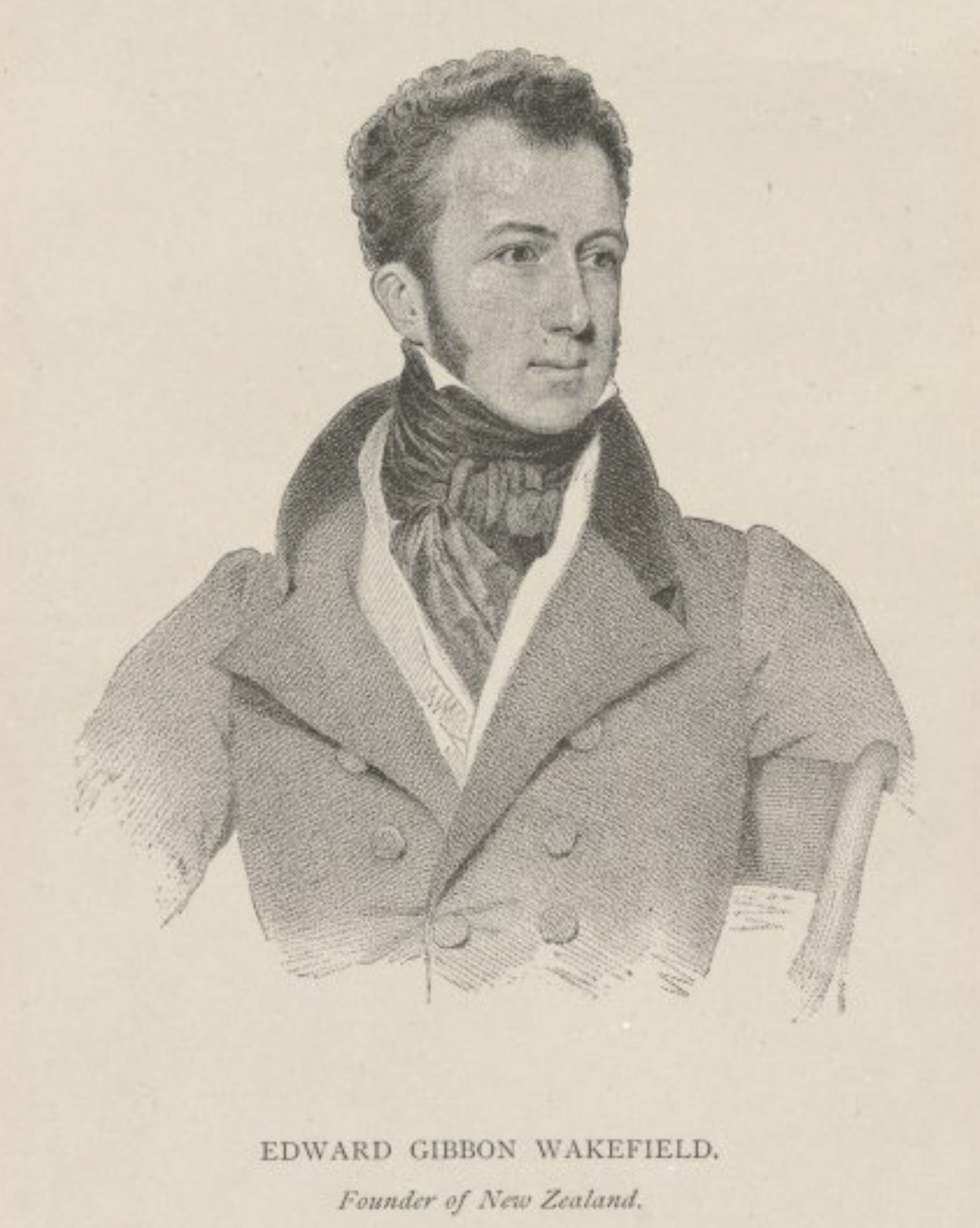
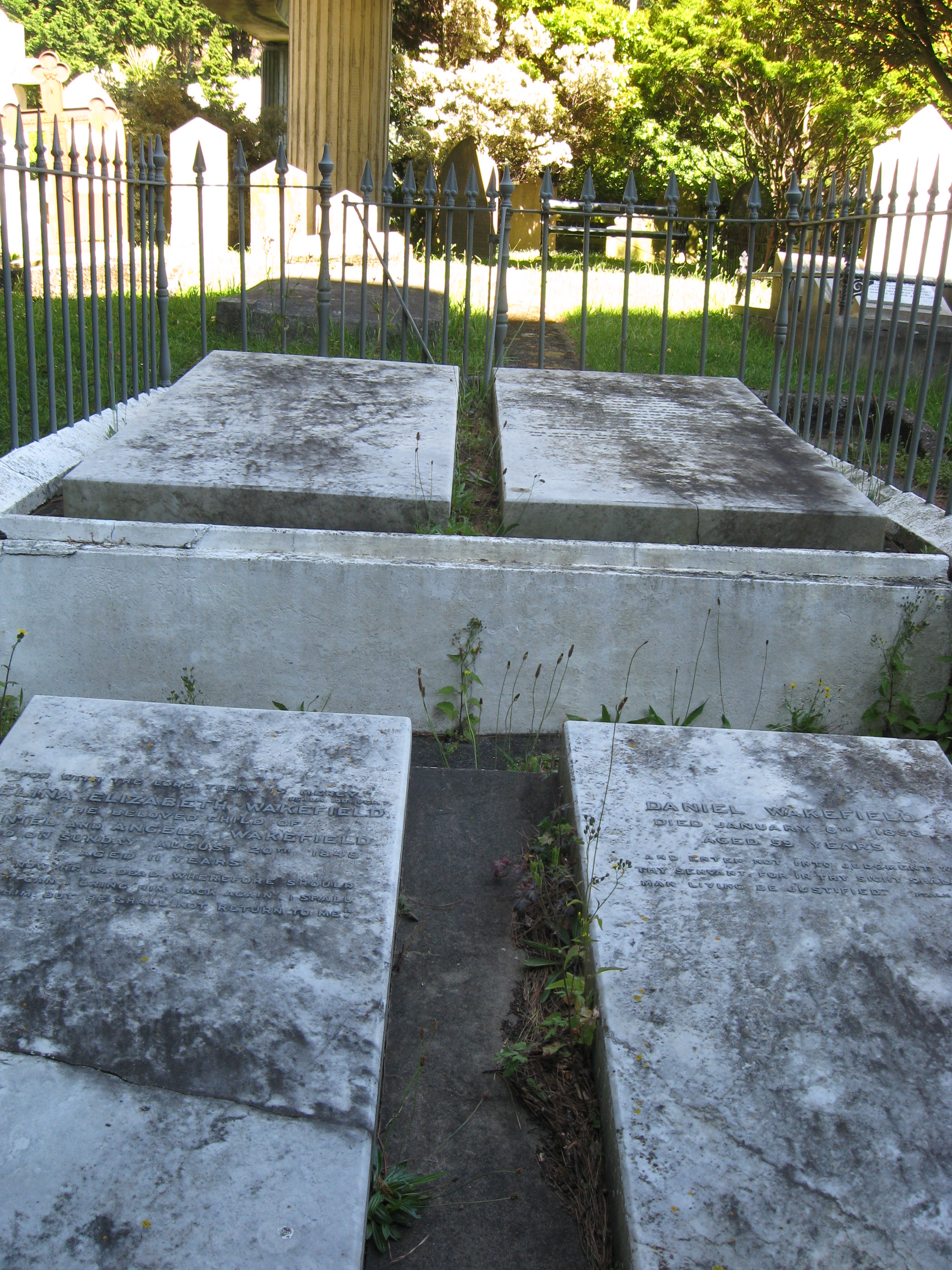
Edward Gibbon Wakefield and all the other Wakefields.

One of the joys of research- and yes, it IS still a joy- is that sometimes you are led into a direction that you didn’t anticipate.  I’m not talking about the siren-songs of distraction that keep your head turning from side to side, but a genuine surprise that makes you stop to re-evaluate what you’ve already found from a different perspective. The other day  I was speaking with a friend who is a librarian, who enjoys the act of finding and building order into material, and he said that he could not tolerate the anxiety that the next resource he turned over might upend the whole thing. I don’t see it that way (yet?): I am still open to surprise and fluidity.

As a result, regular readers might have detected that I am wandering recently into the swamps of colonial constitutional history- not a destination I would have expected or relished-  and it is here that I have stopped for a little while with Edward Gibbon Wakefield (EGW from hereon) with two books that I’ve just read.

Edward Gibbon Wakefield (to the extent that he is known at all)  is most often associated in Australia for his connection with the settlement of  South Australia in 1836 under his theory of ‘systematic colonization’.  Put very briefly, this involved encouraging immigration to the colonies across all strata of British society, but ensuring that labourers remain available as a mobile labour force by selling land at a “sufficient price” that too high for them to purchase until they had been in the colony for a number of years. I was aware that there were Wakefieldian settlements in New Zealand, in Christchurch in particular, and so I was rather bemused by all the Wakefieldian graves in Wellington.

Wakefield family graves, Bolton St cemetery Wellington

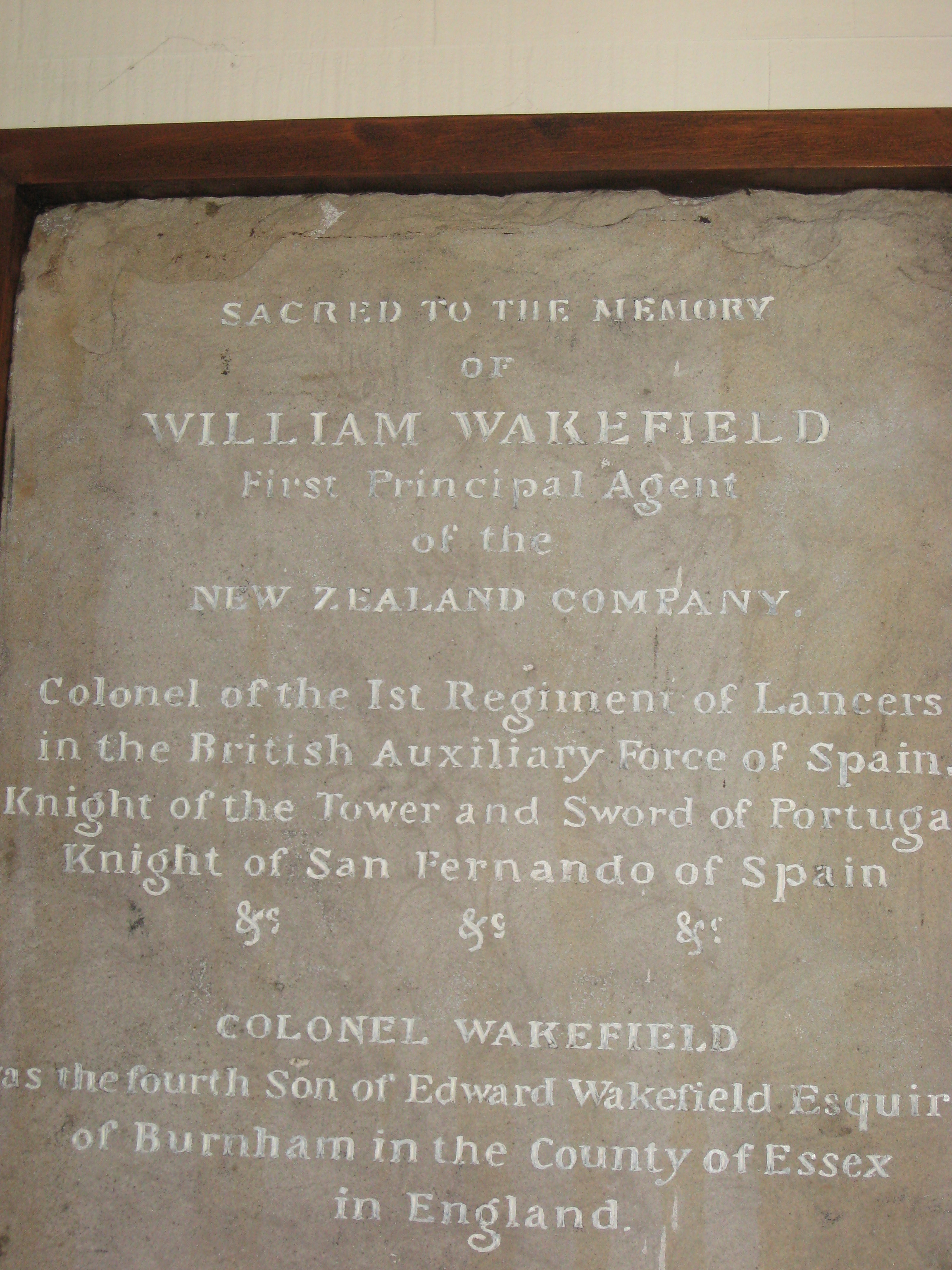
Memorial plaque to Col. William Wakefield, Bolton St cemetery.

The works that I have read on New Zealand, namely Paul Moon’s Hobson  and Peter Adams’ Fatal Necessity portray the Wakefieldians as insistent self-interested lobbyists, who needed to be watched carefully. I was also aware that Wakefield had been imprisoned for kidnapping an heiress- indeed, it was during this period of incarceration that he wrote his Letter from Sydney (penned from his cell in Newgate!) which spelled out his systematic colonization theories.

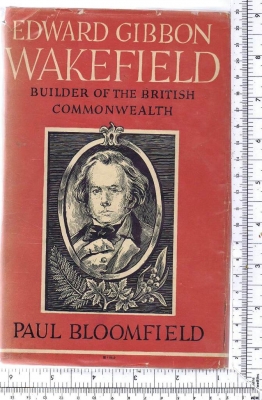
Paul Bloomfield: Edward Gibbon Wakefield: Builder of the British Commonwealth, London, Longmans, 1961, 378 p.

The first of the two books I have read recently is Paul Bloomfield’s Edward Gibbon Wakefield: Builder of the British Commonwealth. This book, written in 1961, has been described in a paper by Ged Martin as “the high-water mark of uncritical admiration of Wakefield and his work ” as the title might suggest. He starts his book with the abduction, told in racy and engaging prose- and why not, because it’s a good story.  It was, however, an episode that cruelled Wakefield’s career from that point on, as the scandal attached to it ensured that he could never put his name to any official policy that drew on his principles, and  he had to content himself with background lobbying and influence instead.  There are relatively few footnotes, although there is a bibliography and useful index, and there are frequent references to novels and literary characters, as if Wakefield himself sprang from fictional origins.  This is something that I find myself having to resist in my own work.  The 19th century novel is so pervasive and its representation in film and television provides such a ready visual backdrop that it’s easy to switch to a fictional shorthand.  As such, Bloomfield depicts the abduction as a youthful aberration that denied Wakefield the acclaim he deserved.  The emphasis is mainly on Wakefield’s lobbying in England amongst Parliamentarians, although it does follow him to Canada and New Zealand as well.

He made an interesting observation (especially in light of my recent posting and resultant comments about Christmas with the cousins)

One day someone will publish a study of the difference made in English sentiment by the change from a fifteen million population composed of large families to a fifty million population in which most parents have no more than two children.  We have only to look into the lives of the prolific Quaker cousinhoods, including the Wakefields, to see what an advantage their special community-sense was to them, what a source of strength it was to them to live in a clime of mutual aid. (p. 205)

The second book that I’ve read recently on Wakefield does just this.

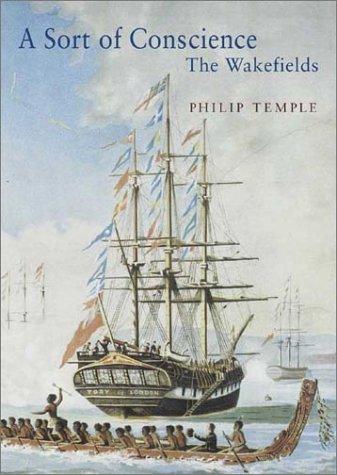
Philip Temple, A Sort of Conscience: The Wakefields, Auckland, Auckland University Press, 2002 (paperback edition 2003), 541 p.

A Sort of Conscience is more nuanced than the Bloomfield account, and it spreads its analysis further into the Wakefield family as a whole- the brothers and sisters, nieces and nephews, many (but not all) of whom ended up embroiled in one way or another with Wakefieldian enterprises.  Although fundamentally positive towards Wakefield, Temple acknowledges the flaws of personality amongst many of the Wakefield siblings and while not dismissing the abduction completely, argues that even more disquiet amongst influential people was prompted by  Wakefield’s involvement in a dubious legal case about his first wife’s lucrative will, some ten years prior to the abduction escapade.  Like Bloomfield, Temple shows that Wakefield was forced to operate in the background when his policies were implemented, but this seems fortuitous as he was overbearing, interfering and careless of details.

Temple draws heavily on family correspondence, which seems to be voluminous, especially once the family spread across the globe.  Many of the letters were addressed to Edward Gibbon Wakefield’s sister, Catherine, who married a minister and stayed behind in England- in fact, Temple quips at one stage that his book could easily have been called “Dear Catherine”.   You can detect in the family a bifurcation between the family members who moved from the Quaker to Evangelical affiliations, and those who became caught up in the entrepreneurialism and politicking of EGW as he sought to have his theory of systematic colonization embedded into colonial policy.  However, you’d have to say that the politicking won out, as more and more siblings and nephews travelled overseas to New Zealand in particular, where Wakefieldianism was implemented in its purest form.  EGW himself ended his days there, although in Wellington rather than Christchurch (the settlement which most closely approximated his theory. )

Wakefieldianism is often presented as a monolithic and inflexible policy, although frustratingly vague in important details like the price that should be charged for land to make sure that settlers remained labourers for a few years instead of moving straight on to being self-employed farmers.  I was interested, then, to see that Wakefield himself was more pragmatic and open to change than I expected once he actually moved to the colonies settled under variations of his theories.

This book is, like Bloomfield’s, ultimately sympathetic to Wakefield, although with more serious qualifications, as the ambivalence of the title suggests.  By following him more closely to the colonies, and by broadening the scope to the Wakefield family as a whole,  Temple captures well its mobility and the emotional tenor of lobbying and patronage in early 19th Britain and its colonies.  The book has been very well received, winning the Ernest Scott Prize in 2003, the Ian Wards prize for historical writing, and the Biography category of the 2003 Montana New Zealand Book Awards.

‘James Stephen and the British Colonial System 1813-1847’ by Paul Knaplund

If ‘Yes Minister’ were true (and who’s to say it isn’t?) ‘The Policies of Rt. Honorable James Hacker MP’ might more correctly be described as ‘The Policies of Sir Humphrey Applebee’.  Likewise, when considering the colonial policies of Peel and Russell, as I did recently,there is a Sir Humphrey-like character at work there too: Sir James Stephen, the Permanent Undersecretary of State for War and the Colonies.  He acted as Permanent Undersecretary between 1836 and 1847, but his involvement with the Colonial Office extended from 1813 when he commenced work as legal counsel there.  As a result, he served under, by my reckoning, thirteen different Secretaries of State, several of whom had multiple rides on the ministerial merry-go-round.

The Stephen family is a prominent English family, many of whom worked as colonial judges and legal officers, and hence moved in the same orbit as Judge Willis.  Another branch of the family extended into ‘arts and letters’ through Sir Leslie Stephen (of the Dictionary of National Biography fame) and his daughter Virginia Woolf.  The family ethos was strongly Evangelical, with links to the Clapham Sect and the anti-slavery movement.

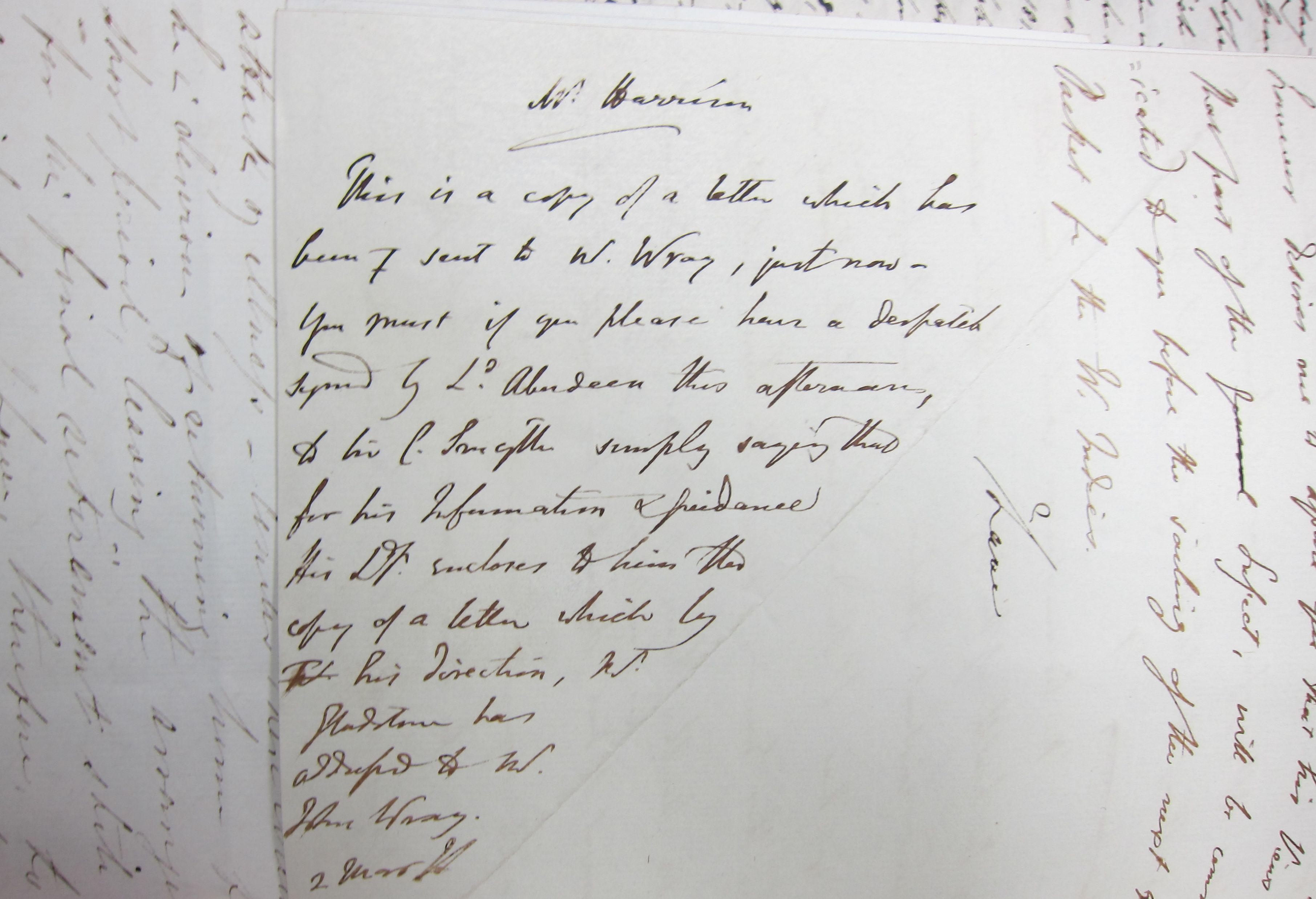
When you’re looking at the Colonial Office records, there are little glimpses of Sir James Stephen in many places.  As part of his drive to introduce more efficiency into the Colonial Office, he introduced a stamp system by which a document would move up and down the bureaucratic ladder, from civil servant to civil servant, up to the Secretary of State and back down again, with each initialling and dating in the designated spot on the document as it made its progress through the Colonial Office.

Where it was felt that a comment should be made, the edge of the document was turned over to make a dog-ear, and the civil servant or politician would make an annotation written at right angles to the rest of the document,  asking a question, or making a comment to the next person up the chain.  If the issue raised was a curly one, it might bounce back and forth between two civil servants with comment and counter-comment until it moved further up or down the bureaucratic ladder.

On occasions, James Stephen would write a longer memorandum that would be attached to the document in question.  In the archives today, these memoranda stay with the original correspondence, each carefully hived off into the files for the each specific colony.   This colony-specific focus tends to obscure the fact that, in any given week, the Colonial Office was dealing with the small dramas and mind-numbing minutiae of British colonies across the globe.  Yet there were commonalities among the types of issues that crossed the CO desks, and the response to them was underpinned by a broader, consistent theory of empire, largely embodied in Sir James Stephen’s bureaucratic contribution.

This book takes as a whole James Stephen’s attitudes and advice on colonial policy across the portfolio and over the thirty-odd years that he was at the Colonial Office.  There is, of course, contradiction and change in his opinions as the empire itself changed: I’m sure that Stephen would have agreed with the aphorism attributed to John Maynard Keynes (“When the facts change, I change my mind. What do you do, sir?”). Nonetheless, there are  bedrock beliefs in James Stephen’s annotations and memoranda that Knaplund draws out in this book.

One of these was his suspicion of colonial adventurers on the lookout for quick profits.  In particular, he was wary of the Wakefieldians who returned his distrust with the sobriquets ‘Mr Mother Country’ and ‘Mr Over Secretary Stephen’ and very public ridicule.  He was insistent on safeguarding humanitarian principles in relation to slavery, transportation and prison policy, and indigenous policy.  He was particularly distrustful of the West Indian plantation owners and their influence on the local legislature and judicial system.

His mode of operation was to always support the governor on the ground in the colony rather than laying down prescriptive policy from the Colonial Office.  As long as no-one other than the colonists were being hurt by what he perceived as bad policy, he was happy to let it stand.  The colonists themselves would realize their own error, he reasoned, and the Colonial Office would be in greater odour for intervening rather than letting the colonies reap what they sowed legislatively.

He was also supportive of self-government, probably moreso than his political masters.  He viewed self-government as an inevitable developmental process, arguing that the colonial children would soon grow into adolescence and demand a more adult relationship with the mother country.

He was, apparently, a painfully shy man, describing himself as “virtually without skin” and rather ascetic by nature, eschewing cigars after having just one and enjoying it too much.  He was a prodigiously hard worker and the breadth of his knowledge of events and personalities across the empire is mightily impressive.  He was in many ways the corporate memory of the Colonial Office, even though the Secretaries of State that he served under sometimes disregarded or over-ruled his advice.  Nonetheless, his is another voice in the chorus of Colonial Office policy, and one that cannot be overlooked.

‘British Colonial Policy in the Age of Peel and Russell’ by W.P. Morrell

First edition 1930; reprinted 1966, 554 p.

When you change the government, you change the country” Paul Keating once said.  You mightn’t detect it from the title, but this book is not only about colonial policy but also about the ramifications of a change of government on an issue of such importance to 19th British politics and imperial identity.

You’ve got to hand it to the historians of the 1930s when they chose their titles- there’s no tricksy double-barrelled postmodern titles with colons and parentheses here.  What you’re promised is what you get- British colonial policy under the conservative Prime Minister Sir Robert Peel (1841-1846) , and then under the Whig Prime Minister Lord John Russell (1846-1852).  There is some slight blurring of the lines though because the cabinet responsibility for the colonies rested with the Secretary of State for War and the Colonies, rather than the Prime Minister .  Although the Secretary of State  position was a bit of a revolving door during the 1830s with Secretaries coming and going in quick succession,it was more stable under the Peel and Russell administrations.  Lord Stanley acted as Secretary of State for nearly all of Peel’s time as Prime Minister, and Earl Grey was Russell’s Secretary of State for nearly the whole Russell government as well.  So the title could just as easily have been ‘British Colonial Policy in the Age of Stanley and Grey’, although of course the Prime Ministers held the ultimate authority.  Then of course, there was the Under-Secretary of State in the Colonial Office, Sir James Stephen, the civil servant who worked behind the scenes during both administrations.  Perhaps the title could expand to encompass Peel, Russell, Stanley, Grey and Stephen- but try fitting that onto the spine of the book!

Morrell identifies two main lobby groups who also exerted pressure on colonial policy. The humanitarians are well known because of  their influence on indigenous policy, and their anti-slavery and later anti-transportation activities. But the second lobby group, the Wakefieldians or the ‘Colonial Reformers’,  is less visible, and probably less appealing to 21st century activists.  Their systematic colonization cause is tied up with land policy, immigration and labour supply, and their intermixing of commercial and altruistic motivations is problematic for us today.  Their figurehead, Edward Gibbon Wakefield, was controversial and enigmatic then and now.  He had particular influence over a string of British politicians, including Earl Grey, Goderich, Molesworth, Gladstone and Lord Stanley, and because of their positions at the heart of the colonial debate in both conservative and Whig governments, his ideas were promulgated throughout the empire and especially in South Australia and New Zealand.

Structurally, the book is divided into two parts: Peel and Russell.  Within each part  there are chapters  devoted to a single colony- New Zealand, Australia, North America, South Africa, the Sugar Colonies, interspersed with more general chapters dealing with economic policy and transportation. Reflecting the author’s admiration for Earl Grey, the book closes with one chapter on his relationship with the Colonial Reformers and another on Grey’s place in imperial history.

Both Peel’s and Russell’s  administrations were united by a bipartisan acceptance of free trade economic policy, and this thread runs throughout the book.  It was a striking feature of the Peel administration, and it continued during Russell’s time as well.  So was Paul Keating right about a change of government changing the country? Yes, in that Peel’s administration strongly resisted self-government for the colonies and generally took the side of the plantation owners in the sugar colonies, and the Loyalists in Upper Canada.  Russell’s administration, on the other hand, was receptive to Wakefieldian ideas and amenable to discussions of representative and then responsible government,  even though Wakefield and the Colonial Reformers later turned against Earl Grey who had been their great hope as a fellow Colonial Reformer.  The analysis of colonial policy under the two administrations is a nuanced one that recognizes continuity but also detects difference, even if it is a matter of degree rather than stark contrast.

William Parker Morrell was a New Zealand historian, and he died in 1986. I sometimes wish that it was possible to take a book written many decades earlier- (and remember that this book was written in the 1930s) – and using the same structure and question, revisit it again in the light of more recent scholarship and interests.  Not rewrite the original, mind you, but just to look again from a different perspective, to see what has changed and what parts have taken on even more significance.

‘The Last Journey of William Huskisson’ by Simon Garfield

2002, 229 p

(3.5/5)

My real work has taken me away from the Resident Judge of Port Phillip, John Walpole Willis, to the Puisne Judge of the Kings Bench of Upper Canada, the same John Walpole Willis.  So here I am, wading through the Colonial Office correspondence from Upper Canada that looks and sounds so similar to the Colonial Office correspondence from New South Wales.  Because it’s dated some fifteen years earlier, it is addressed to Secretary of State for War and the Colonies Huskisson instead of Secretary of State for War and the Colonies Russell, then Secretary of  State for War and the Colonies Stanley.  Huskisson, Huskisson- where do I know that name? Corn Laws? And then I remembered this book, written by Simon Garfield, that lies directly in my eyeline in the bookshelf beside the television in Mr Judge’s loungeroom. William Huskisson, as well as being  the Secretary of State for War and the Colonies, was also the first victim of a railway accident in 1830.

From the title and the preface, you know that this is not going to end well:

There were a great many witnesses to the terrible accident which befell William Huskisson, but none could agree precisely what occurred.  Some said his left leg fell on the track in one way, some quite another, and some said it was his thigh.  A few observed a ‘fiery fountain’ of blook, but others saw only a trickle.  Some claimed there was shrieking, but the rest believed he was rendered mute by the shock. Yet there was one thing on which everyone agreed. They all said that the accident was the worst thing they had ever seen, and the one thing they would never forget.

The following pages recount how a day of triumph became a day of despair at the turn of a wheel.

This is only a short book, and Garfield certainly takes his time getting the accident that we all know is going to occur- 140 pages no less. On the way, he takes us on quite a journey into British parliamentary politics, the economics of railways compared with canal transport, the rivalry between competing inventors and the  entrepreneurial drive of railway promoters.  Not that it’s a boring trip- in fact, it is quite fascinating- but it does take rather a long time to get there.

The book is generously illustrated with black and white photographs and images, and it has a lively conversational tone.  The irony that this popular, if somewhat politically clumsy politician should be run over by the first train running on the railway that he had done so much to champion,  is rich and runs throughout the narrative.  Garfield has captured well the energy of industrializing Britain, the edginess of pre-Reform Bill politics and the bustling self-importance of Victorian Man.  It’s an interesting, easy ride.

‘The Gentleman’s Daughter’ by Amanda Vickery

1998, 436 p.

Don’t let the demure cover deceive you: this is a rather pugnacious book that rattles the commonly-received image of female domesticity during the 18th and 19th centuries.  Amanda Vickery points out in her introduction that historians of epoch after epoch have  adopted the argument that women’s lives became increasingly marginalized and  constricted to the private sphere during the particular period that they have studied. Surely, she suggests, they can’t all be right.  Instead of identifying a particular time when women’s experience changed, she emphasizes the continuity of women’s lives across the eighteenth and nineteenth centuries.

Her research is grounded in local elites, in particular that of Lancashire.  In an exhaustive study, she examined all the letters and diaries of privileged women from the early 18th to early 19th centuries the Lancashire Record Office, irrespective of how that wealth was accrued.   By casting her net wide like this, she eschews the view of the gentry, the professions and the upper trades as distinct strata of the social hierarchy.  Instead, she sees them as part of a “woven fabric” or an “intricate cobweb” of social structure and social relations that extended both horizontally and vertically.   This local examination is then compared with London because there were so many links between Lancashire and the metropole.  One of her main information sources is Elizabeth Shackleton, whose detailed diaries for the years 1773 and 1780 are mined for a database of all social interactions in that year.

Again, though, I find myself wishing as a reader, that the introductions to her main informants were not so rushed.  One of the things that I admire so much about Inga Clendinnen’s Dancing With Strangers is that she slows down to properly introduce her sources as discrete, rounded characters.  Vickery does introduce several women in her early chapters whom we will meet again and again, and who represented a period of over 100 years but I don’t think that I realized while reading it the importance of the wide time-span that her informants operated within.  She is arguing for the continuity of women’s experiences across a wide expanse of time, resisting the urge to identify any one period of dramatic change.  This is an important argument, but  I didn’t pick up sufficiently in her opening introductions to her main informants.

From these sources, she draws out a number of themes that exercised the letter-writers and diarists of her study rather than the interests of twentieth-century historians : gentility, love and duty, fortitude and resignation, prudent economy, elegance, civility and propriety.   These abstractions were played out in the lived experience of women’s lives through courtship, marriage, childbearing, housekeeping, material culture and sociability as described by real people in their diaries and letters to each other.

My own work is based on the colonial experience, and I found myself thinking of colonial letters and diaries where these same interests were aired, but in a different setting, far from the density and bustle of English life.  For example, Vickery writes of the importance of promenades and walks as a site of leisure for the female world, and I found myself thinking of The Block in Melbourne- a smaller walk perhaps, but one which fulfilled the same function.  She describes the way that roles and responsibilities were often mutually agreed, and sometimes bitterly contested,  by a man and his wife, and I think of the journals of early settlers in Upper Canada and Port Phillip.  She describes the way that genteel families were linked to the world through a multiplicity of ways and I think of the smaller, but equally dense connections between Port Phillip elites and those in Upper Canada.  At the end of the book she points out that the sociability of  any individual woman’s life shifted according to her progress through the life span- as young girl on the marriage market, mother of young children, then later chaperone of her own daughters.  “Women’s lives” are not a static condition- they respond to biology and societal expectations alike.

Why a pugnacious book? It might not seem so from my description, but she shapes up to and wrestles with the biggies of domestic historiography and sociology-  Phillipe Aries,  Lawrence Stone, Davidoff and Hall, Veblen, Habermas.   It is not particularly necessary to be familiar with these scholars and their arguments- I’m not- but perhaps the academic jousting might be a more enjoyable spectator sport if you are.  For myself, I was content with the fine detail of the lives she describes so sensitively, on their own terms and using their own concepts, and I found it a useful lens through which to view the experience of the colonial women I am encountering.

‘Englishness Identified: Manners and Character 1650-1850’ by Paul Langford

2000,  320p & notes

It seems that much ink has been spilled in Australia trying to define Australianness, and I had always assumed that this was a form of nationalistic adolescence that we would eventually outgrow.  Just as it’s hard to imagine your own parents as teenagers, it hadn’t occurred to me that the Mother Country herself might have undergone the same soul-searching.  But clearly the debate over Britishness and Englishness is a lively one. I’m aware of, but to my embarrassment have not read Linda Colley’s Britons, even though it sits on the shelf waiting to be read. However this book distances itself from the endeavour of explaining the distinction between Britishness and Englishness, and does not enter into the debate over the process by which the two concepts were developed.  Instead, Langford looks at “the things identified rather than the process of identification” (p. 2)  In particular he focuses on manners and character.

Langford argues that until about 1650, the English were viewed as Europe’s mavericks- capable occasionally of spasmodic splendour, but also prone to bouts of violence, turbulence and instability.  If pressed to nominate the point at which there was acceptance of the possibility of English pre-eminence, it probably came somewhere around the 1760s.   From the eighteenth-century on, there was increasing interest in England and its people from Continental travellers and an period of outright Anglo-mania, particularly on the part of the French, between the 1730s and 1780.  Langford draws on the travel writings of these visitors as his primary sources, much of which was written with the droll superciliousness not unknown to travel documentaries today.

He has divided his book into six main chapters: Energy, Candour, Decency, Taciturnity, Reserve and Eccentricity and these in turn are divided into subsections likewise headed by nouns- barbarity, domesticity, clubbability etc.  At times the distinctions are not clear-cut.  For example, the coverage of Liberty  under “Eccentricity” is not intuitive;  or the inclusion of Conversation, Oratory and Clubbability under “Taciturnity” undercuts the chapter heading somewhat. But as he says, “feelings are hard to distinguish from thoughts” (p.251), and hard to distinguish from actions as well.  They’re slippery things, feelings, and don’t always fit neatly under a heading.

The chapter structure of the book reflects the emphasis on affective concepts, as suggested by the title.  There is an underlying chronological thread to the argument as well, though, and it is not served well by the overarching structure.  He argues, as did Marjorie Morgan, that the Evangelicalism of the late 18th century gave rise to new ideals of behaviour, and he begins his two-century examination of the change in Englishness from the middle of the 17th century.  He notes that there is an evolution over time, but he does not give the chronological factor much prominence.  This a-chronological (if there is any such word) approach is underscored by the formatting of his  footnoting, where a primary source is dated on its first appearance, but not in subsequent citations.  Because there is no bibliography, it is nigh on impossible to locate a reference amongst his detailed footnotes to ascertain whether it is an observation made in the late seventeenth or mid-nineteenth century.  The footnoting format could well have been imposed by the publishers- although it would be a pity to learn that a University publisher was stepping back from academic conventions in this way- but it does not serve the book well.

Although not engaging at a theoretical level with the Britishness/Englishness identity debate, the foreign travellers that Langford cites can clearly differentiate between the English, Scots, Irish and Welsh in their observations.  Because he is drawing on such a large dragnet of observations, there are often inconsistencies between them, especially when closely related traits are discussed in separate sections of the book.  However this did not detract from his argument: instead it served to underline that character is just as much in the eye of the beholder as in the image that the subject wants to project, and just how complex, baffling and nuanced a ‘national character’ can be once you try to move beyond the stereotype.

‘Manners, Morals and Class in England, 1774-1858’ by Marjorie Morgan

1994,  148p.  & notes.

This is not a book about events or facts, but instead it is about ideals.  Ideals, suggests the author, reveal as much or more about a society as reality does. The ideals she is exploring are those found in three different genres of improving literature published from the late eighteenth century to the mid nineteenth century.

The first genre is the courtesy book, a literary type written primarily by and for men.  Courtesy books often took the form of an informal, practical guide written by an older man, based on his personal experience, for a younger man.  Some focussed on the arts of worldly success, others on civility and deportment, but underlying them all was the assumption that manners and morals were inseparable and indistinguishable.

The second genre is the conduct book, which became more popular under the influence of Evangelicalism in the mid-late 18th century.  The underlying principle was that religion- not fashion, or custom, nor taste- was the basis of both manners and morals.  The writers were middle class and many addressed female audiences.

Finally there were etiquette books, which emerged in the 1830s, even though etiquette itself had been around for much longer than that.  They did not so much create behavioural rules in the 1830s, as codify those that had been in existence for the previous 50 years. They were practical digests of rules and information to avoid vulgar behaviour, and unlike the Conduct Books, they were largely indifferent to one’s internal nature and character, moral paradigms or the spiritual domain.  Instead, the focus was on outward visible indicators and display.

She suggests that the etiquette book arose during the 1830s as  the upwardly mobile middle class became wealthier and the boundaries were blurred with the aristocracy.  However, she is at pains to point out that both the middle class and the aristocracy, in and among themselves, expressed conflicting values.  The middle class may have been industrial, but it also embraced an antithetical ethic that denigrated competition; the aristocracy combined elements of disinterestedness with aggressive competition.  Depending on the values under discussion, relations between the middle class and aristocracy could conflict with, or accommodate each other.

She has examined a huge range of texts across these three genres- her bibliography for these primary sources stretches to eight pages.   The whole enterprise of proscription and prescription of morals and manners was steeped in paradox.  The standards for fashionable behaviour were spelled out to facilitate social advancement, but at the same time, they kept changing so as to keep people out.   The evangelical moralists exhorted people of sound moral character to appear as they really were, but at the same time they were to avoid offending others and be reserved and modest and above all, sincere- even if they weren’t really.

However, she noted a change in the early 1840s, when etiquette books began to incorporate elements, albeit superficially at first, of principles of morality and ethics while continuing their emphasis on manners and decorum.  This trend manifested itself in the rise of professionalism whereby aristocratic and middle-class ideals were merged into legally sanctioned professional behavioural codes and credentials, firmly ground in etiquette and ethics, in a range of fields- the church, law, medicine, government and armed services.  It was an accommodation on the part of both the aristocracy and the middle class and both groups felt that they could embrace professional goals without feeling they had compromised their values.

Written in 1994, this book travels in the wake of Davidoff and Hall’s Family Fortunes which was first published in 1987.  Its argument is largely consistent with Davidoff and Hall, but it delves into the realm of ideals and expectations, rather than actual lives that figure so strongly in Davidoff and Hall’s book.  The earlier book took the middle class, and particularly women, as its focus, but Morgan’s book looks at the accommodation between both the aristocracy and the middle class, both in expectation of behaviour in the home and in the professions more widely.

This book interested me in relation to Judge Willis because I am examining his career from the 1820s to 1840s- precisely the time that these changes were occurring.   Our perception of  the early Victorian sensibility tends to be swamped by the depictions of behaviour and expectations so vividly drawn by the mid-Victorian novelists- our Dickens and Trollopes.  The settler colonial condition, both in Upper Canada and New South Wales, added more tension to already brittle upward mobility.   The Port Phillip newspapers carried in their columns the reports of fashions and observations about behaviour taken from metropolitan newspapers, and although these new societies brought together strangers into new constellations, you have the sense that, among those who aspired to colonial gentry at least, everyone was watching everyone else very closely.  There was a mental template for how one ought to behave, and this book provides one way of investigating this ideal- no matter how imperfectly it was met.

‘Aspects of Aristocracy’ by David Cannadine

1994, 245p

This book is a series of essays that Cannadine wrote during the process of writing his Decline and Fall of the British Aristocracy.  Having not read that book, I can only assume that the essays reflect aspects of the larger work, but in themselves they are self-contained and immensely readable.

Cannadine argues that, despite the assertion by the aristocracy itself of its unchanging nature and antiquity, the aristocracy was in fact transformed in the late eighteenth century. Because of a largely unexplained demographic crisis among English noble families at that time, estates were integrated and consolidated into supra-national empires, spanning England, Wales, Ireland and Scotland, thus leading to a new apex of super-rich grandees.  These were supplemented by self-made merchants, nabobs and industrialists who bought their way in, then established themselves as bona-fide landlords.  Public servants, too, fitted themselves out with the accoutrements of landed aristocracy.  That bible of gentility, Burkes Peerage, published in 1826  documented this new/old phenomenon, a hold that they maintained by making, in reality, very few concessions.

He picks up on the debate between David Spring and F.M.L. Thompson over aristocratic indebtedness, and especially the received Spring-ian view that the Regency families were spendthrifts, while their mid-Victorian sons moved towards sobriety and solvency in the mid 1800s. Cannadine finds that debt seemed to be an ongoing reality, though its arena changed- e.g. development of money markets with local attorneys and solicitors, banks, insurance companies etc.  There was borrowing to maintain and enhance family prestige e.g. to provide settlements for members of the family, to build houses and buy land, but there was also borrowing for profit e.g. improvement of land and investment in non-agricultural enterprises- especially coal mining and transport.  He concludes, therefore, that the distinction between early and mid-Victorian debt was overdrawn, and that if there is a pivotal period, rather than the 1840s  it is 1870-1880 when declining rentals and agricultural prices led to greater indebtedness.  When death duties were introduced in 1894, they were 10% of the property assessed higher than 1 million pounds- ruinous if a property was heavily encumbered.

Cannadine points out that

while biographers are conscious of the things that make their subjects unique, historians are more concerned with seeing individuals in the context of their times and class (p.3)

The rest of the book deals with different dynastic and individual portraits that illustrate his central thesis.  Lord Curzon is depicted as a “ceremonial impressario” whose stage-craft embodied and shaped the image and consciousness of empire. Winston Churchill he sees as inherently unrespectable in both his relatives and choice of friends: he was politically suspect and unpredictable, and essentially paternalistic and anti-democratic.  The Cozens-Hardy family of Norfolk exemplify the ‘new’ upper class, spreading across trade, the law, local paternalist government and local/antiquarian history.  Nicholson/Sackville-West are addressed less as sexual and literary oddities than as exemplars of the snobbish, anachronistic, sheltered and nostalgic twentieth-century upper class.

To prove, eventually, that he has a political purpose, Cannadine closes with a condemnation of country-house worship that embalms what their owners themselves were happy to demolish, and transforms country houses into shrines to private galleries, a risible moral superiority and an unconscionable claim on public money.

Enough of snobbery and nostalgia.  Good riddance to ignorant and sentimental deference. It is time we got beyond the country house (p.245)

That’s telling ’em.

‘Their Noble Lordships’ by Simon Winchester

1981, 305 p.

I am of an age and political bent that makes me fairly dismissive of aristocracy and I bridle at deference demanded on the basis of birth or wealth alone.  On the other hand, I must admit a sneaking fascination, tinged with horrified incredulity, at lifestyles and attitudes that seem so foreign to me and yet part of the cultural baggage that comes from growing up in a Commonwealth country.  Since I have started my thesis, I have often been frustrated by the impermanence of the titles by which a person was known:  Viscounts turn into Earls, not just Viscount Bill to Earl Bill but Viscount Bill to Earl Ben.  Meanwhile family names (surnames to the rest of us) coexist with titles, so that one person can move through an array of names and titles within one lifetime. Conversely one title can, within a few decades, be held by several people.

This is one of Simon Winchester’s early works, published in 1981 but actually written in 1976 when he was still a journalist and travel writer.  The hiatus between manuscript and publication is interesting: the book was held up because of threats of legal action against the author by some of the peers he interviewed.   It finally emerged, it would seem, with the legal assistance of the “redoubtable scholar of Scots peerage lore”, the splendidly named Sir Iain Moncrieffe of that Ilk (yes, that’s his whole name), whom Winchester thanks in his preface.  He also thanks Hugh Mongomery-Massingberd of Burke’s Peerage as well, but he did not return the favour.  In a review of the revised and finally released book  in the Times, 28 Jan 1982, Mongomery-Massingberd responded to Winchester, “a drippingly wet liberal” by writing:

Apart from the cuts imposed by the lawyers, one wonders how much real revision has been undertaken by the author; the book is frequently out of date.  The learned Sir Iain Moncreiffe of that Ilk has clearly had a hand in the overhaul; many of the pithy footnotes can be confidently attributed to this colourful scholar…To be fair to Mr Winchester this second attempt is an improvement on his first- as far as I can recall the “suppressed” version contained about one mistake a page, this time the average is nearer one to every two-and-a-half pages.  As he has regaled us with so many meaningless statistics I offer these by way of exchange: from a total of some 259 pages of actual text (as opposed to absurd maps, corny or pointless epigraphs etc) I counted very nearly 100 errors ranging from really whopping howlers to mere misspellings of names. This is surely unacceptable for any book with even half a claim to be taken seriously.

While I certainly didn’t take the umbrage that Hugh Mongomery-Massingberd (where DID that ‘t’ in Montgomery go?), I do agree with the dated feel to the book, but probably not for the same reasons.  I raised an eyebrow at the designation of the Labour party as the “Socialist Party” complete with capital S.    What about Thatcher? What about Lady Di? I asked.  But, on closer investigation, I have become muddled over dates and chronology.  He does mention Prime Minister Margaret Thatcher, but she had not, when he wrote the book, yet created the last three hereditary peers (Viscount Whitelaw (Wille Whitelaw) created in 1990, Viscount Tonypandy (Thomas- a Labour Party politician)created  in 1983 and the Earl of Stockton(Harold Macmillan)  in 1984).  Lady Diana Spencer, whose royal descent brought the peerage into full view only became engaged and married to Prince Charles in 1981.  So it was not so much that Winchester’s work was dated, as that these events had not yet occurred.

Winchester goes through the five ranks of the peerage, from highest to lowest.  For this, I am grateful.  I have now devised my own mnemonic, using the names of my children, to keep them straight in my own mind: Dean and Martine Eat Victoria Bitter.  (Duke, Marquis, Earl, Viscount Baron).  Yes, I know that it doesn’t make sense.  Yes, I know I could have them “enjoying” Victoria Bitter, or eating “Vita Brits”.  I like it the way it is:  it works for me, and that’s all that matters.

Dukes are the highest, and at the time of writing this book there were only twenty-five surviving, not including the three Dukes of the Blood Royal or the Duke of Edinburgh.  Fewer than 500 men have been Dukes in the last six and a half centuries they have existed.  They are called “Your Grace”, not “My Lord”, and the monarch calls them “Our right trusty and right entirely beloved cousin”.

Then come the Marquesses, which has always struck me as a rather effeminate name.  Its origin is the Latin marchio, referring to the Continental counts who guarded the “marches”, the borders with neighbouring countries.  Apparently it’s not a particularly well-received honour, and often the Earls who follow them in precedence are wealthier. There were thirty-seven when the book was written, with the last created in 1936.  Many Viceroys of India were awarded the honour.

The Earls are the backbone of the British peerage system, with Lord Lucan one of the more notorious twentieth century ones.  At the time of writing there were 173 non-Irish Earls and Countesses dotted around the country. They are often of Old English or Scots county stock, distinguished heroes, or ex-Prime Ministers.

They are followed by the Viscounts- 110 of them in 1981.  They are a recently revived rank, with more than a hundred created in the twentieth century.  Here there can be detected the rewards for mercantilism, with the captains of industry often being awarded the title.  Few are landowners to any great degree,  but they do not lack money.

The Barons are the broad base of the pyramid, with 438 men and women in 1981.  Hereditary barons are no longer created : since 1958 with the Life Peerages Act, they are now life peers.   The bulk of the baronage is of twentieth-century origin, with many war heroes being awarded the honour after WWII, and industrial figures, civil servants, judges, politicians, scientists, writers and artists being recognized  with the title.

The Irish Peers,  left out in the cold, are awarded their own chapter.

The book has a chatty, journalistic tone as the author travels around the countryside, conducting interviews with various worthies.  There are direct quotes, and quite a bit of paraphrasing but it is reported without much rigour in a strictly historical sense.  There is a reading list, organized alphabetically by title (rather than author), and although David Cannadine is quoted as the one academic text, the title of his work is not included in the reference list.  Each chapter begins with a map, showing the distribution of the title under discussion, but I found my lack of knowledge of British geography rather limiting here- a label or two wouldn’t have gone astray.

Near the end of the book he tries, without success, to establish the land holdings of the nobility. Interestingly enough, it was a very difficult endeavour with few firm official figures available- intentionally so.  It is obviously a question that powerful people did not want answered, at least in the 1980s.  His conclusion?

On Spaceship Earth, ennoblement by reason of fortuitous birth has no place: the British nobility, decent a body of men and women as well they may be, have outlived their usefulness, and must go quietly, out by the back door. (p. 305)

And it seems, by the House of Lords Act of 1999, that certainly things have changed since the book was written, and no doubt will change even further.

This book is not academic and seems to have sunk without a trace- Simon Winchester’s own webpage certainly underplays it.  I think that perhaps it was a book of its time, written largely for a home audience, and surpassed by his later work.