Category Archives: Life in Melbourne

The Threepenny Opera

As the final instalment in my art-and-crime festival, we went to see Victorian Opera’s  The Threepenny Opera at the Malthouse last night.   What a sordid week!  I’ve read a crime novel, seen a crime movie and then last night a crime play.  Now I turn my mind to gardening instead.

We decided to go see this production of the Threepenny Opera as soon as we heard about it: fantastic cast- Paul Capsis (who played Jenny), Eddie Perfect, Judi Connelli, Casey Bennetto.  The sets were inventive, singing very strong and, much to the chagrin of the people walking behind us back to our car, it had been updated and rather subverted by pantomime at the end- all thoroughly in keeping, I’d say.

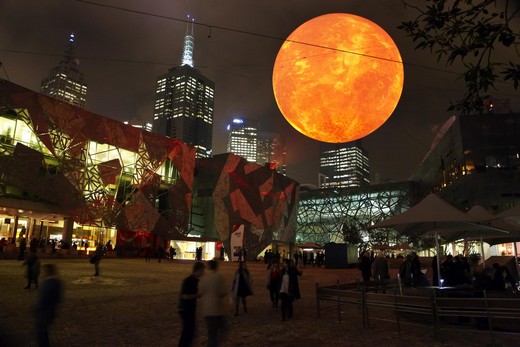
On the way back to the northern ‘burbs we stopped off at Fed Square to see the light installation they have there until the beginning of June.  Beautiful

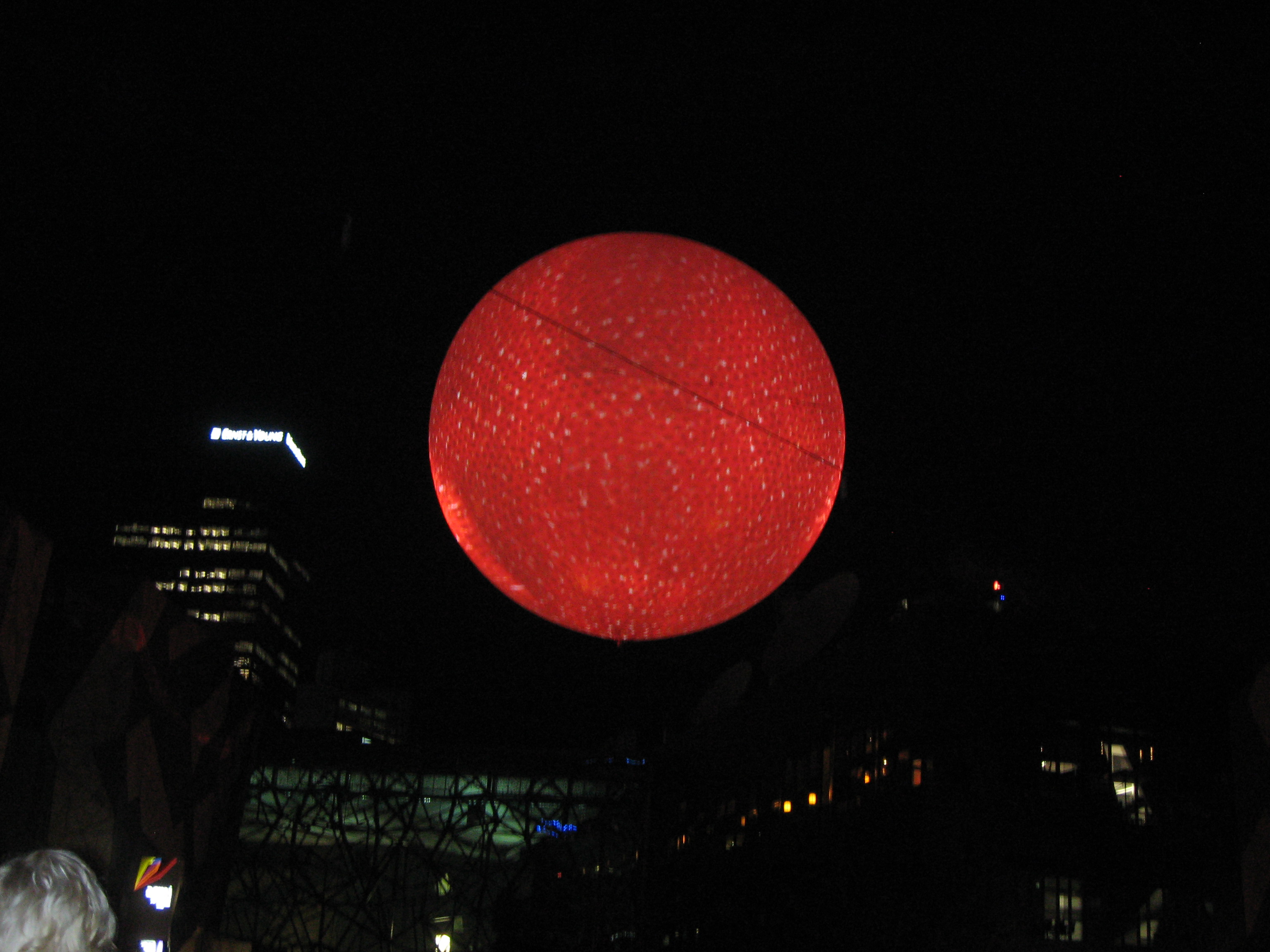
It’s called Solar Equation.  It’s a huge illuminated disk that hangs over Federation Square with swirls and eruptions of what looks like magma. Apparently the animation of solar flares, turbulence and sunspots is generated mathematically and projected onto the disk from below.  Mr Judge hoisted himself up to peer over the black box to which it had been tethered: it would not have been seemly (nor indeed possible) for the Resident Judge to have done the same.

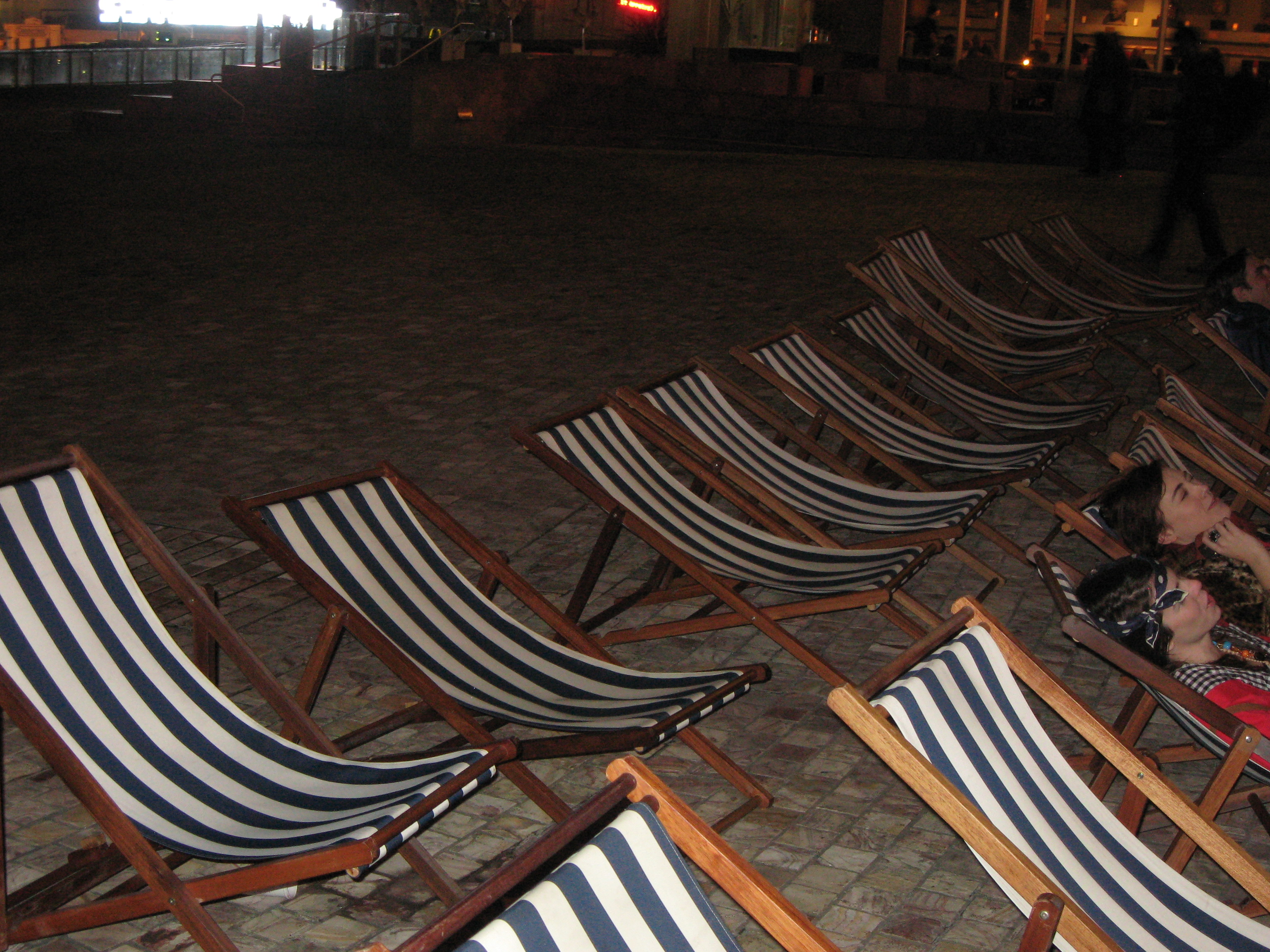
There are deck chairs arranged on the concourse so that you can lie back and watch it.  All rather St-Tropez for a chilly Tuesday night in June.  As you can see, there weren’t too many takers.

Apparently you can change the patterns with your i-phone but as I don’t have one, it’s not really an option.  I don’t understand any of it- the sun or the moon for that matter or telephones really- but it was thing of beauty on a cold winter night.

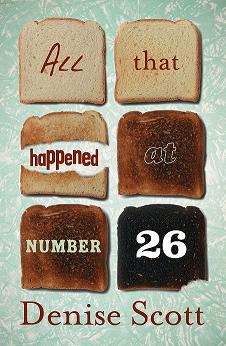
‘All that happened at Number 26’ by Denise Scott

2008, 257 p.

So what does one turn to after finishing reading Hilary Mantel’s stunning Wolf Hall? Why, an autobiography written by someone who feels like a very funny friend, that’s what.  And neither book suffered by the juxtaposition.

Denise Scott is one of the two comedians that I love seeing on Spicks and Specks on a Wednesday night, and if Hamish Blake is on as well then even better!

Denise Scott is my age and she lives a couple of suburbs away.  My stepchildren were involved in some of the episodes of the book, and reading the book is like reading my own life through the eyes of someone much funnier than I am.  I laughed out loud often in this book, much to the disgruntlement of Mr Judge trying to sleep on the other side of the bed.

Nothing really happens in the book- it’s more a series of anecdotes and yarns about family life, marriage, motherhood and daughterhood.  Family is at the heart of this book, but there’s barbs too:  the marriage falls apart at one stage; her mother suffers from Alzheimers; her closest friend Lynda Gibson dies.   She obviously enjoys having young children around her but feels that she is being left behind in her career.  Money was really tight at one stage and you feel a rush of gratitude to whoever it was who left an envelope with $500.00 to tide them over.  She embarks on her comedy career, nauseous with anxiety, but withdraws from the overseas trip that her  fellow-comedians undertake when their act is successful because she doesn’t want to leave her children.

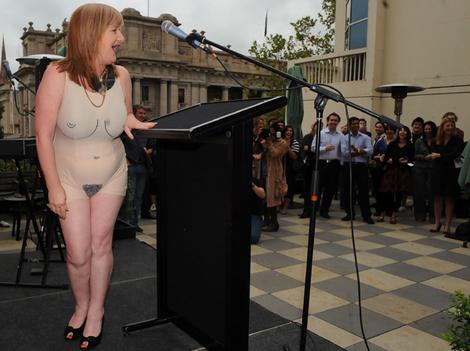
She fears that now that her children have grown up that she has lost her well of family anecdotes, but I don’t think she need worry.  She has that wonderful ability of sniffing out the ridiculous in life and she makes me feel good about being a 50plus year old woman living in Melbourne. And hey, anyone who’s game to appear in public like this will always have a place in my heart!

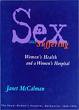
‘Sex and Suffering’ by Janet McCalman

mccalman

1998, 368p

I’d already worked out what I was going to say in reviewing this book.

I am not keen on institutional histories.  I dislike their celebratory nature and the way that their authors obviously feel compelled to doff their hats and gush over the institutional big-wigs and stalwarts.  You can often sense the shadowy presence of the steering committee in the back-ground and that a publicist and risk-management expert are hovering in the wings.

However, I was drawn to read this history of the Royal Women’s Hospital after hearing a Radio National Hindsight program on it, available for download hereJanet McCalman, from the University of Melbourne ( I see that she, at least still works there, given the University’s decimation of its Arts faculty) wrote Struggletown: Public and Private Life in Richmond 1900-1965 – a history of the working-class suburb of Richmond,  and Journeyings: The Biography of a Middle Class Generation 1920-1990, which followed the No 69 tram through the middle-class suburbs of Melbourne.  She’s obviously drawn to writing larger social histories by focussing her lens on a small patch of inquiry.

And so Sex and Suffering: Women’s Health and a Women’s Hospital carries on an approach that she obviously feels comfortable with.  As the title might suggest, this is not just a history of an institution: instead it deals with sex and the experience of being woman, health and institutions.

The experience of childbirth is intimately woven into the hidden parts of private lives and soon overlaid by the other experiences and achievements of a growing person.   It is common to us all, and for a short period of time is overwhelming in its effect on the mother at her exposed, most basic core and on the people closest to her.   So it was fascinating to consider the act childbirth- that most intimate and personal of events- as part of a social phenomenon that can be handled at the structural level in so many ways.

The book itself follows a chronological approach, with seven sections covering roughly 20-30 year periods.  The emphasis varies in the sections, from the clinical (particularly in the sections discussing sepsis and antisepsis) to the social and structural (where the judgments of upper-middleclass doctors and the Board of Management were trained onto the predomiantly working-class and migrant clientele).   Throughout most of the book, she draws on the case notes of individual women- helpfully supplemented with a glossary of medical terms in the margin- to make real her discussion of anaesthesia and surgery and its effect on horrendous labour situations, the horror of clostridium welchii which could kill a woman in hours, and the changes in attitudes towards labouring women and their partners.  Ye Gods- some women had enormous babies- particularly in the post-Gold Rush period when women who had suffered malformations of the pelvis through malnutrition themselves as children, especially in Ireland,  gave birth to large babies when their own diets had become carbohydrate-heavy in a new country.  There’s something stark in reading the case notes reproduced at the end of the book that chart the death over a number of days of a woman, knowing that there are mothers and fathers, husbands and other children who have been left bereft.

I know that when I was in labour with my children, I was very conscious that I was part of a chain of labouring women in my family and thought -even then!- about how absolutely dreadful it would be to die in childbirth. Hormonally, physically and from an evolutionary sense, every sinew of your being is focussed on giving birth to that child then and there, even if it is your twelfth or illegitimate.  I felt as if I was surrounded by generations of women who had given birth before, and that I was stripped down to my essential female-ness.  In reading this book I was made conscious of the effects of bad births- those fistulas you now only know of in Third World countries,  the lifelong invalidism that followed some births, and the amount of pain that lingered on year after year.  It made the knowledge of my maternal grandmother’s seven births and several miscarriages, and my paternal grandfather’s first wife’s death in childbirth, more meaningful.

There are wonderful photographs and diagrams in this book.  The photographs of Melbourne in the early chapters from both the La Trobe Picture collection and the Royal Women’s Hospital Archives are clear and showed perspectives of my city that I hadn’t seen before.  The internal photographs of the hospital, again from the hospital archives,  while deliberately posed, speak volumes about hospital discipline and nurses’ roles.

A second thread that runs through the book is a commentary on class and gender in Melbourne. The more feminist, women-centred  Queen Victoria hospital stands as a counter-point to the more traditional, male-dominated Royal Women’s Hospital, and the class perspectives of the charity-oriented upper-middle class female board members run through the attitudes towards sexually-transmitted disease, abortion and adoption that the hospital had to deal with.

Well, this is what I was going to say until I got to the last part of the book.  The last section, unfortunately, descended into that boosterism and oily fulsomeness of the standard institutional history.  Probably for privacy reasons, the case histories dropped out of the narrative.  Although they were replaced by oral history reminiscenes of experiences in the Women’s, they lacked the immediacy and contingency of those earlier case notes.   Judgments about individuals who are alive and likely to read this book need to be tempered, and as a still-operating (though re-located) hospital , there is the equivalent, I guess, of the doctor’s  “do no harm” in writing about the institutional culture.  The management-speak of the final pages reflects the funding and political milieu in which institutions now exist, but I also suspect that it has been carefully vetted by the current hospital administration as well.

So, if you read this book- and I exhort you so to do- you might want to stop after Section VI in 1970.  To that point, it’s fascinating.

Port Phillip Newspapers

This morning’s Age newspaper brought with it a supplement sponsored by Melbourne University called “Voice”.  I’m usually rather sniffy about this supplement, which feels like a long advertisement for the Melbourne Model, but I must admit that I do take a peek at it nonetheless. Interestingly enough, pages 3, 5 and 7 identify the supplement as an ‘Advertising Feature’, but this is not apparent on the first page.   This particular edition is all rather reflexive: a supplement of the newspaper devoted in this edition to predictions about the death of the newspaper;  a supplement called “Voice” that is print-based; mirrors upon mirrors upon mirrors.

I was interested by an article ‘NEWspaper Business Model’ by Joshua Gans , Professor of Management (Information Economics) at Melbourne Business School.  In an article reflecting on the business imperatives that militate against the ‘old’ newspaper business model, he notes  the inflexibility of publishing deadlines for the conventional newspaper, and the effect of loss of timeliness in an immediate, socially-connected online environment.  He makes the comment:

The conventional view about the news is that it is ‘information’ or ‘content’.  People value knowing what is going on.  But this fails to recognise that as content, the news is fairly inconsequential…Put simply, for the vast majority of news, the value comes from being able to talk about and share it (“did you hear about?”) rather than add to your pool of knowledge per se.  And this is precisely why the loss of timeliness is so critical.

Thinking about the Port Phillip newspapers, I think that this has always been the case.  Melbourne’s first newspaper, John Fawkner’s  Melbourne Advertiser was hand-written and largely filled with shipping news, cut-and-paste from Sydney papers and advertising for local businesses – especially Fawkner’s own!  (click here for images and transcripts of the first editions).  However, much as Gans suggests here, the importance of the paper lay not in the content, but the fact that people talked about it, and Fawkner initially planned to give the paper away for free. But never one to let a business opportunity pass him by, he began including the paper in the cost of a counter meal at his pub.

By the time that Judge Willis arrived in Port Phillip, there were three regular newspapers, each published twice a week: the Port Phillip Gazette, edited by the very young George Arden (in fact, it never fails to strike me how much Port Phillip was a young-man’s sort of place); the Port Phillip Herald, edited by George Cavenagh; and the later incarnation of the Melbourne Advertiser, John Fawkner’s Port Phillip Patriot.  Newspaper editors were prominent in civic affairs and they had a vested business interest in stimulating passions over local politics and events.   Their newspapers reflected the political stance and interests of their editors, and in Judge Willis’ case, the editors and their relationship with the Judge often was the news.   Each newspaper appeared on a different day, giving six-day-a-week coverage, but without directly competing with each other by appearing simultaneously.  On momentous occasions- for example, Governor Gipps’ visit, the newspapers co-operated to publish a common supplement.  Not that all was sweetness and light by any means: many column inches were devoted to slanging off at each other’s accuracy, print quality and personal qualities of their respective editors.  Underneath all this largely confected piss-and-vinegar was a fundamental political split between Arden and Cavenagh on the one hand, and Fawkner on the other.  The controversy over Judge Willis fed directly into and reflected this political factional split.

The nature of timeliness- as commented on in the Gans article-  is instructive here.  The newspapers themselves seem to have a very limited time-scape at the local level, possibly because there was a three day gap between editions of any one paper.  Events were generally advertised only about a week in advance, and reports of events after the fact tended to only look back a couple of days.   For example, meetings were advertised that would occur that day, or in the next couple of days; and court reports might extend backwards perhaps four or five days but not much further than that.

Juxtaposed against the limited time-frame of local events is the long gaps between intelligence received from other colonies and especially from overseas.  The newspapers often listed the dates of the most recent newspapers received as ships docked, and all three newspapers would comb through for news articles that would then be presented as if they had just occurred, although of course, they were some four or five months outdated.  But for the people of Port Phillip, they were literally ‘news’ as no-one else had any more recent intelligence, and very much the stuff of “Did you hear about?” conversations.

The National Library of Australia has a fantastic site for colonial newspapers, although the early newspapers of Port Phillip do not yet appear (nor do there seem to be any plans for them to do so in the next 3 years) , with only the Argus from 1846 represented- too late for Judge Willis.  However, just as the Port Phillip papers cut and pasted extracts from the newspapers of other colonies,  the action was reciprocated and extracts from the Port Phillip Gazette, Herald and Patriot often appear in other newspapers, albeit some weeks after the original publication.

If you look at other newspapers published at the time (e.g. Hobart’s Courier, Town Gazette; the Maitland Mercury; the Perth Gazette and the Sydney Gazette), you’ll notice a similarity between them in layout and structure.  For the Port Phillip Herald which, until recently was available at Paper of Record but has since been swallowed up without trace by the Google juggernaut,  it might be interesting to do a content analysis on a few 1840s editions.

Tuesday 13 July 1841 (168 years ago today)

Page 1

Page 1 consists entirely of advertisements.  The only illustration is a picture of a ship which occurs against a number of the shipping advertisements- a stock icon that is identical in each case.  There are eight advertisements for ships soon to depart (1 for London; 2 for Hobart, 1 for Port Albert (Gippsland) and Launceston; 1 for Launceston direct; 1 for Adelaide, 1 for Port Nicholson New Zealand, and one to ship goods up from Hobsons Bay).  Six advertisements refer to goods recently landed and 1 refers to a tobacco shipment.   There are 9 real estate advertisements, 1 for a demountable house and 2 for tents.   There are 13 advertisements for stock (cattle, sheep and pigs); 3 for seed crops; and 2 for horse sales.  There is an advertisement for the sale of  a carriage ; a printing press (the Herald’s very own!), surgical instruments, a piano and a billiard table.   There are retail advertisements for 2 butchers, 1 chemist, 3 grocery warehouses, 1 coachbuilder, 1 hairdresser, 2 cloth warehouses, and 1 saddler.  Four hotels advertise their services; there are 2 advertisements for accountant/attorneys and 1 for an agent.  Two banks and one insurance agency advertise; and there are three advertisements for ladies’ seminaries (but not boys’ schools). There is one advertisement for the upcoming races, and one for a subscription concert, complete with a list of the men who have already purchased their tickets.

Page 2

Page 2 and 3 generally constitute the local news- the “Did you hear about?” component of the paper.  The top of the first column is always dedicated to Shipping Intelligence, with a list of the ships due to arrive and depart.  This is followed by Commercial Intelligence, which brings market news from Hobart, the Cape of Good Hope (extracted from the South African Advertiser of May 5), and Melbourne auction sales of merchandise, property sales and sheep prices.  Then appears a Calendar, showing the moon’s age, sunrise and sunset and tide times for high water in Hobson’s Bay- reminding us of the importance of night in a colony with only very rudimentary street lighting outside public house and otherwise reliant on moonlight.  Further on this page there is a call for lamps to be hung near the ditches that run beside the main intersections.

The dates of the most recent newspapers received are then listed, and this emphasizes the variation of currency of overseas intelligence:  England 10 March; China 23 March; America 17 February; Sydney 26 June; Van Diemen’s Land 1st July; South Australia 9 June.

Then follows a bit of inter-newspaper squabbling over circulation figures- a newspaper habit that seems to persist until today with the Age and Herald Sun always BOTH managing to draw comfort from recent circulation figures in 2009.  There is another dig at the Patriot’s inaccuracy further in on this page, in relation to the War with China.

The Editorial for this issue has two topics: first, a call for Gipps to consider the figures in the Abstract of Colonial Revenue which demonstrate the wealth being siphoned off  from Port Phillip, without any reciprocal expenditure; and the need to fix the prices charged by Carters.

The Domestic Intelligence section lists the auctions scheduled for today, tomorrow and Thursday.  There is a long report of the Coal Company meeting with the resolutions listed.  There is a call for more punts,  government-funded hospital conveyance, and a complaint about rubbish and effluvia in the streets, and the failure of the church doors to properly close out the sound of the street outside.  Mr Gautrot’s benefit concert (advertised on p. 1) is publicized, and there is a cautionary tale about the drunkenness of an old army pensioner who ended up falling into the Salt Water Creek.   There is a humourous and  evocative word-picture of a steamer departing from Queen’s Wharf, and a commentary on under-age children giving the oath in the courts.   The Commissioner of Crown Lands now has a drop-box for documents,  and St John is mentioned as a candidate for the Police Magistrate position.  There is also a vacancy for Chief Constable, as well as a criticism of the behaviour of other police constables. A bag of ginger that must have dropped from a dray now rests at the police office.  The pastoral and farming nature of the colony is emphasized by an article encouraging people to feed maize to their horses, the danger of infected scabby sheep, and the habit of hiding stolen cattle in the bush then claiming the reward for their return.  There are street dangers from runaway horses, four cases of burglary, a murder on the Sydney Road, a drowning on the Goulburn River, and the death by burning of a man so intoxicated that he fell into the fire.  The construction of the new jail is progressing well; a Sabbath Observance petition is in circulation; there is talk of the purchase of a second steamer for Hobson’s Bay; there is a creditors meeting for Langhorne Brothers and fall-out from the windup of the Pastoral Society.  The military escort accompanying La Trobe and Lonsdale back from church is berated for smoking cigars in public.

Page 3

The court and police reports are often found on p.2 or 3.  This issue has notice of the upcoming criminal hearings on 15th, two reports of the coroner’s inquests (both deaths caused by excessive drinking), and a daily report of Police Intelligence.  The Police Intelligence column, which often culminates in a hearing before the magistrates or with the perpetrators cooling their heels in the lockup is written in a jovial, Pickwick Papers-esque style.  The Original Correspondence consists of two letters to the editors: one from “A Settler on the Plenty” complaining about the erection of fences across what had until recently been public thoroughfares, and a letter from “Justicia” arguing that there are no avenues for appeal against the findings of the Court of Quarter Sessions.  There is one personal classified, advising of a marriage.  The paid advertisements then continue from Page 1, with 2 shipping advertisements, five positions vacant and six positions wanted advertisement, 10 real estate to let advertisement, 3 lists of stock available in trading houses, 13 auction notices for property, stock and china sales.   The Sabbath Day Observance petition is printed, along with arrangements for signing it, and there are other small notices e.g. tenders to build the Roman Catholic Church, stolen horses; notices from the Navigation Company and the Port Phillip Bank etc.

Page 4

The top left hand column of the Port Phillip Herald is usually reserved for poetry- in this case “Oh! I remember well”- author unknown.  Then follows extracts from other newspapers: in this case, from Van Diemens Land (which includes some news from Madras); Sydney extracts, and about 3 columns of English Extracts.   For the predominantly British settlers in Port Phillip, no doubt the English Extracts held strong “Did you hear that..?” appeal.   So what sort of information was extracted?  There’s a long report of the English and Turks fighting the Bedouins in Gaza; information about settling the Danish claims; fires in Bermondsey, a robbery in Liverpool, a duel in Regents Park, the defalcation of one of the Dublin Board of Aldermen, a horse accident involving the Hon. Mr Dundas the M.P. for York, George Stephenson the engineer’s purchase of coal mines and the presentation of plate to Rev T. Dale, late Professor of English Literature and Modern History at Kings College London.

A half-column of Miscellaneous Extracts includes a piece from the United Service Gazette about Commodore Napier;  and a list of moral virtues drawn up by Dr Franklin for the regulation of his life- temperance, silence, order, resolution, frugality, industry, sincerity, justice, moderation, cleanliness, tranquility and humility.

Then follows more paid advertising- 13 ‘to let’ advertisements, two board and lodging advertisements, a string of lost, found or strayed advertisements for stock (offering up to 20 pounds reward for a bullock) with one advertisement for the return of George Williams who had engaged as a servant but absconded (offering only 2 pounds reward).   Four creditors meetings; one legal notice, two change of trading address, 1 dissolution of partnership.  The final column is always devoted to Wholesale Prices Current for imported and local produce, then subscriber and advertiser information and the name of the editor and printer.

So two years later, did the papers look the same?  By this time, Port Phillip had been gripped by economic crises, and the Legislative Council elections and Town Council elections had been held.  Judge Willis had just returned to England, so that particular controversy should be in abeyance.  I actually started looking at March 1843 to avoid these events, but found myself wondering if seasonal events were influencing the content so have settled for a similar date, two years on.

Friday 14th July 1843

p. 1

Only one ship, bound for Sydney.  A large advertisement for the Australian Colonial and General Life Assurance Company, and small advertisements for a butcher, umbrella seller, wine and spirits.  The silk dyer and scourer has reduced his prices because of the depression; a registry office for servants has opened, and there is one position wanted advertisement.  Two houses to let, one house for sale, one farm.  One ladies seminary.  There’s quite a bit of official Government advertising- a long column authorized by Gipps proclaiming the boundaries of the Port Phillip district, deeds of (land?) grants arranged alphabetically, depasturing licences.  There’s a list of eight men who had absconded from the government stockade, along with descriptions (Thomas Taylor, age 30; native place Liverpool;  trade or calling, sailor;  when tried April 1836; sentence, life; ship, John;  year of arrival 1837;  height 5 feet 6 inches; complexion, ruddy; hair, brown; eyes, grey.  Marks, woman and flag anchor,  F. O. seven stars on right arm, and weeping willow on left arm).  Actually- they’re all quite short- the tallest is five feet 10 inches; the shortest 5 ft 3.  There’s official notification of the opening of the post office at Port Fairy.  There’s a column of stock impounded at the South Yarra Pound.  The Wholesale Price Current list has moved onto the front page in this issue.

p. 2

The shipping news remains at the top left column of Page 2.    There is an advertisement for a special opening of the theatre for a performance of ‘Frederick the Great’ , followed by singing and dancing, and the favourite melodrama ‘The Bandit Merchant or the Dumb Girl of Genoa’.

The editorial greets the arrival of Judge Willis’ replacement Justice Jeffcott.  From Sydney comes the results of the Legislative Council elections.  Four and a half columns follow with details of the Town Council proceedings from Tuesday.

The Domestic Intelligence column includes information about the anti-Willis petition (which the Herald championed); the thwarted escape of two convicts en route to Sydney; notice of scabby sheep; criticism of the Town Clerk for accompanying Judge Willis to the boat for his return home; a sentence of flogging for theft.

p. 3

As with the 1841 paper, the third page maintained its focus on court and police matters.  Of course,  the Supreme Court was in abeyance because of Judge Willis’ amoval, and half of the first column reports on the address to Judge Willis by some of his supporters.   There is then a long report about a summons issued at the Police Office over Capt S. J. Browne (the father of the writer Rolf Boldrewood) and his attempt to take property back to England on the same ship that Judge Willis was to sail on.  There is a short report on the Court of Petty Sessions,  and notice of the next sitting of the Court of Requests.  Police reports include arrests for prostitution, insolence and neglect of duty by the assistant executioner at the jail, and forgery.  A Fred Ebsworth of Pitt Street  writes to the editor in the Original Correspondence column regarding the boiling down of sheep (a process that stopped the free-fall in sheep prices in the province).   A Government proclamation issued under the auspices of Governor Gipps  marks the August meeting of the Legislative Council in Sydney.

Paid advertising follows- 2 ‘to let’ advertisements, one farming allotment sale, an offer of indenture of two respectable young men as druggists.  There are auction sales for building materials, carpet, clothing, tea, ironmongery, coffee and clothes, and four stock sales.  There is a long list of the library books being auctioned by a gentleman about to leave the province- on the Glenbervie with Judge Willis perhaps?  Willis himself- although there’s a large number of theological works in the collection.  Current events include meetings of the Port Phillip Bank and shareholders meeting for the Port Phillip Steam Navigation Company, notification of the cancellation of a lecture at the Mechanics Institute and the second anniversary of the opening of the Wesleyan Chapel.  It is striking and telling that there are four insolvents’ sales- something not seen as prominently in 1841.

p. 4

Two rather paradoxical themes take up the final page of the paper.  One is the aerial ship, and a long extract from the Sydney Morning Herald of June 28th praises the technological change experienced so far- railways, gas lighting- and heralds developments in aerial navigation, with an aerial carriage raised and driven by a 14 horsepower steam engine.  Other extracts from the Sydney Morning Herald include a list of new insolvents, and a report of the 28th Regiment in India.

The aerial ship is taken up in the English Extracts.  The carriage is to be constructed of thin copper sheaths, with a boiler and two high pressure engines, and wings.  A similar report is taken from the Calcutta Englishman.

Rather more prosaically, there is a continuation from Chambers Information for the People No 79 titled ‘Sheep: Choice of Breeds’ that takes up nearly three columns and is to be continued.  The identifying information at the bottom of the paper lists the printer and publisher of the Port Phillip Herald as Charles Fyshe.

So, where am I going with this? I don’t know!  The local papers provide probably a higher proportion of international news than our newspapers today would, and much of this content is conversation-provoking gossip from home, or technology-based ‘next new thing’ ideas.  There’s not a large ‘What’s On’ emphasis, especially in 1843.  By 1843 there is much more emphasis on formal political structures like the Town Council and Legislative Council in Sydney.  The small business ethos of traders and entrepreneurs seems to have dropped away by 1843, and the shadow of insolvency falls over the paper.

But in terms of “Did you hear about…?” the Port Phillip papers operate just as well as papers today do.  A winning formula, you might say.

Where’s that wrecking ball?

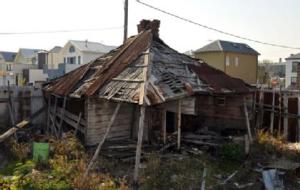
n_williamstown-420x0

I see that the good people of Williamstown are concerned about the possible demolition of what they suspect might be Melbourne’s oldest house.  Judging by the McMansions in the background, it no doubt occupies valuable space.   The evidence for the 1842 date seems to be rather sketchy though- land could change hands several times in the efferversence of the early 1840s without an actual dwelling being built.  A search on the Heritage Victoria database records that Pope, who purchased it from James Cain in 1842, was a property-owner and eligible to vote in 1843.  However, many men had several parcels of property, and he could have qualified otherwise through other holdings.  The database gives an approximate date of 1855, presumably because the type of construction was common around 1850.  The 1856 rate book records it as a four room timber building.

Attached though I am to old things, I don’t know if I’d die in the ditch for it.  It needs so much work as to constitute an absolute re-build.   Its value as a curiosity, or as a reminder of times past could just as easily be achieved by shifting it to a park somewhere.

One building that I would have stormed the barricades for, though, was Redmond Barry’s house at 494 Bourke Street that was demolished in 1924.  (It must be a sign of age that I think of it as “only in 1924″ when it’s actually ninety years ago).   It was situated between Queen and Elizabeth Streets, on the north side of Bourke Street- then numbered as  97 Bourke Street West.  The five roomed, low-slung brick cottage with an old mulberry tree in the remnant of a garden would have stood as a reminder that there were people living in that section of  Bourke Street, at that time close to the hub of town,  as distinct from shopping or working in it.  There’s so much else in Melbourne that commemorates him as literally larger-than-life, and this brings the man back to a human scale.

You can see a painting of the house made in 1915, and a photograph of the house just prior to demolition.

But this building is long gone of course, so perhaps I should gird my loins to defend the Northcote Bowl.  Ugly, yes.  At one time ubiquitous, yes.  And, while not the first or only, it’s one of the last left standing in suburban Melbourne, yes.  There’s a sentimental glow about something from a hundred years ago, but it’s just as important- and more difficult- to fight for something forty years old that now violates every concept of good taste without yet attaining the gravitas of being ‘historical’.

northcotebowl21

References:

Robyn Annear  A City Lost & Found: Whelan the Wrecker’s Melbourne

Update to the Williamstown house:

The Sunday Age of 30 August 2009 reported that the land will be auctioned on Sept 19 2009 and it is expected to bring about $1 million dollars and be developed as a townhouse project.  Heritage Victoria recently authorized the dismantling of the house.

“The dismantling will be recorded and it will form part of an archival record which will be lodged with the State Library, the National Trust and the Williamstown Historical Society” Heritage Victoria acting executive director Jim Gard’ner said.

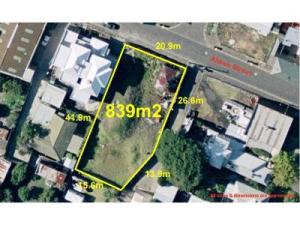
williamstownmap

The permit be directed that the parts of the house be “stored” at the owner’s discretion.   Apparently all fabric and any significant archaelogical items are to be removed and catalogued.

I think they could do better than this.  Somehow the documentation of the dismantling seems a rather inadequate response, and “at the owner’s discretion” is so wide that you could drive a truck through it.

The Elizabeth Street Creek

Melbourne has experienced two earthquakes in recent weeks.  They tell us that it’s due to geological activity around Korumburra, but don’t believe a word of it.  It’s not an earthquake: instead, it’s the sound of the Port Phillip fathers turning in their graves as they hear of a proposal to return Elizabeth Street in Melbourne to a creek bed.

The Age on Saturday invited a number of Melbourne worthies to respond to the question “What would you do for this city if you could?” releasing them from those pesky considerations of economic and political constraints.  Gilbert Rochecouste, described as a “planning mastermind” (who has escaped my radar completely, but apparently he’s the man who led the rejuvenation of Melbourne’s laneways), suggested opening up the concrete on Elizabeth Street and letting Williams Creek underneath flow free.

Actually, I hadn’t heard it referred to as “Williams Creek” before, but William Westgarth’s recollections confirm that it was previously known by this name.  The people of early Melbourne had other names for it too- “a jungly chasm” is particularly evocative.   The corner of Collins and Elizabeth Street seems to have been particularly treacherous.  Thomas Strode the newspaperman recalled in 1868

At almost every hour of the day may be viewed the interesting spectacle of drays being bogged in the muddy depths of Collins-street…We remember on [one] occasion a dray of bullocks were so hopelessly imbedded in a hole in Elizabeth-street, that the animals were allowed to stifle in the mud, and its being nobody’s duty to remove the nuisance, their remains with that of the dray, lie buried in that extemporary graveyard to the present day.  (cited in Annear p. 41)

Perhaps the reclamation of “Williams Creek” may uncover them!  It was obviously a pretty boggy area. Apart from Williams Creek, two other tributaries  ran  into Yarra.  “River Townend” which ran from the corner of Collins and Elizabeth Streets  was named after Michael Townend, the ‘fat, comfortable-looking grocer’ on the south-west corner. “River Enscoe” ran from the north-west corner of William and Flinders street, and was named for the merchant John Enscoe who very nearly drowned in it.

Each winter “Lake Cashmore” would form on the doorstep of Michael Cashmore the draper who owned the shop on the northeast “Block” corner of Collins and Elizabeth Streets, described by Garryowen as “a large pool of stagnant water, not sufficiently deep to drown a man, but quite sufficient to half do it. ” (Garryowen p. 457)

During downpours of rain,  litter from the surrounding streets would pour into Elizabeth Street gully:

Pieces of timber, wisps of straw, waste paper, and corks, as they are borne past and beyond carpenter’s shops, stable yards, printing offices, or hotels, sufficiently indicate the character of the neighbourhoods from which they have been carried; corks come down into the main stream from every side.  From all the ‘rights-of-way’ they pour in crowds.  They rush out of the lower slums of Little Bourke Street, and from both ends of every street in the town, until they collect in a dense mass in the wide space between Collins Street and Flinders Lane, where they form a closely-packed army of bobbing bedouins… (cited Brown-May, p. 75)

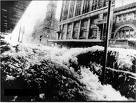
Somehow the ‘bobbing bedouins’  of wine and champagne corks is a quainter image than a congealed mass of Big Mac wrappers.  Melburnians of a certain age will remember when Elizabeth Street flooded in 1972:  looking back, it seems remarkable that no-one drowned given the number of basement shops and subways there.

elizabethflood

When the ravine was in full flood during the early years, the only safe place to cross it was at Lonsdale Street.  In 1880s Elizabeth Street became one of the first stormwater drains, carrying water from Carlton down to the river.   In the Stork Hotel at the top of Elizabeth Street (much loved for the late Dennis Prior’s dramatizations of the Greek myths), there used to be a series of photographs on the wall showing the raising of Elizabeth Street so that what had previously been the street-level bar became the basement.

All that engineering; all that technology!  What would the city fathers say?

Well, actually, one of them thought of it first. William Westgarth in his Personal Recollections of Early Melbourne wrote in 1888:

Melbourne missed a great chance in filling up with a street this troublesome, and as a street, unhealthy hollow… A reservation of the natural grass and gum-trees between Queen and Swanston street would have redeemed Melbourne up to the first rank of urban scenic effect and the riotous Williams might, with entire usefulness, have subsided into a succession of ornamental lakes and fish ponds.

Maybe all this earthquake activity is not the city fathers turning in their graves; perhaps it’s old Willie Westgarth slapping his knees and roaring with laughter that it has taken us 121 years to embrace his vision.

References:

Robyn Annear, Bearbrass: Imagining Early Melbourne, 1995

Andew Brown-May Melbourne Street Life 1998

Garryowen Chronicles of Early Melbourne

Kirsten Otto Yarra: A Diverting History of Melbourne’s Murky River,  2005

William Westgarth Personal Recollections of Early Melbourne (e-text)

Before the storm

Like millions of other Victorians, today I received a text message from the police.  It read:

Extreme weather in Vic expected Mon night & Tues.  High wind & fire risk.  Listen to  Local ABC Radio for emergency updates. Do not reply to this msg. End.

It is a very still evening, just as it was before the Saturday of the bushfires a few weeks ago. It’s hard to believe that the wind is going to spring up at about midnight tonight, and blow all day tomorrow until it changes direction at about 5.00 p.m.  There are large bushfires still burning from three weeks ago which, although contained, could well jump containment lines and take off again- to say nothing of any new fires that might spring up.  I think of my parklands, the plantings along our watercourses and rivers – we are all so very, very dry.

A friend of mine at choir tonight lives in Hurstbridge, surrounded by bush, with only one road in and out.  “Keep safe” we say as she leaves, knowing that she could be plunged into a nightmare tomorrow- or maybe not.  Leave early; activate your bushfire plans we are warned; prepare for gale force winds we are advised.

We are uneasy.

You know it’s dry when…

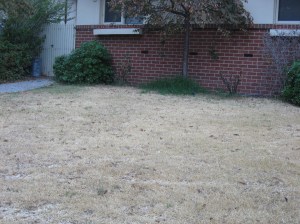
This is not actually a complaint.  There has been so much loss and sadness with the bushfires, and so much hardship with the drought that south-eastern Australia has suffered over the past decade, that it would be churlish to complain about lack of water in the suburbs.  This is more to document how everyday life has changed in Melbourne,  where the rainfall total for February has been 3.0 mm against against an average of 47.6 mm, with our overall rainfall for 2009 a mere 3.9 mm.

So, you know it’s dry when…

march2009-011

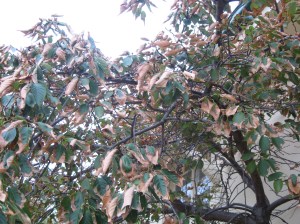
Your agapanthus-es (agapanthi?) look sick

march2009-020

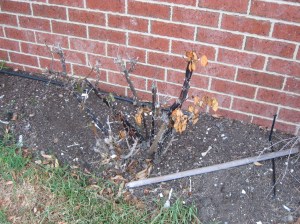
Your rose-bush is deadybones…

march2009-012

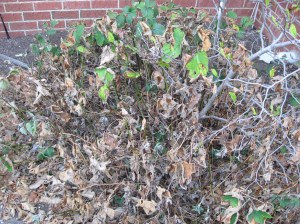
and your Japanese windflowers look decidedly worse for wear.

march2009-015

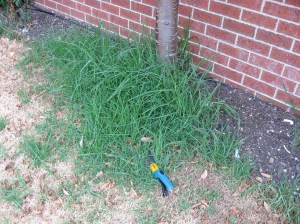
Instead of getting the lawnmower out, you cut the only bit of green grass with grass shears. The only reason this has grown is because it is under the weeping cherry…

march2009-021

which has been burnt by the hot weather and is lovingly watered by…

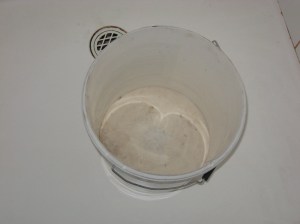
march2009-022

the water collected in a bucket in the shower, while waiting for the hot water to come through. You will note the careful arrangement of this photograph in a vain attempt to avoid revealing the shower scurf on the tiles, lest you think my housekeeping is slovenly.

march2009-016

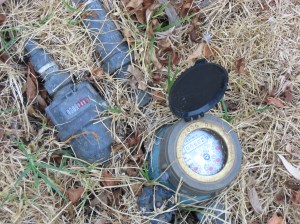
Reading the water meter on a Sunday morning has become a bit of a ritual…

march2009-023

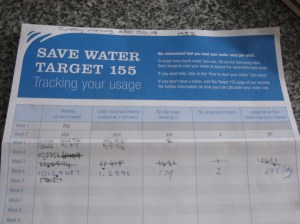
and the tension builds as the intricate computations show whether we have met the target of 155 litres per person per day.  We have!! with some to spare!!  Only 89 litres per day this week! Welcome home, daughter: your presence (and water entitlement)  makes my water consumption look respectable.

But is any of this water-dripping conservation really doing anything?  In a year or two will the government be happy for me to splosh around with their public/private desalination plant water to my heart’s content, with great expenditure of electricity, and my bank balance’s chagrin?

march2009-018

I have become truly pathetic, peeping through the blinds and skulking in what’s left of the shrubbery to catch and chastise the postman for running over my “lawn” with his motorbike, leaving trackmarks through the “grass”.

This is what I have come to.

The Wildlife of Macleod

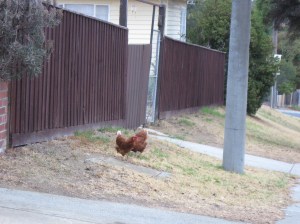
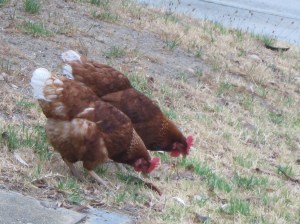
Seen, pecking their way from garden to garden along the street.

march2009-007

march2009-008

Go for it, girls!

Victorian bushfires memorial service

I decided that I would go to the bushfires memorial service this morning.  I knew that it was being televised, but I didn’t want to sit alone in my lounge room watching it.  I’m not really sure what I wanted it to be, and hence my ambivalence about it, I suppose.   I didn’t want it to be about what it could do for me,  but I did want to mark my respect and acknowledge the loss, and I wanted to do it with other people.

fed_square3_gallery__600x4001

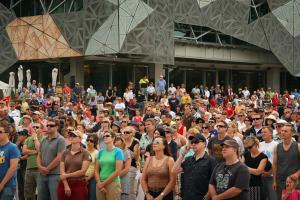
The sound of St Paul’s Cathedral bells marked the start of the service, and I was surprised that there were not more bells- a sign, perhaps, of the gradual disappearance of city churches in the central business district.  The crowd was smaller than I anticipated, although it built as the service went on.  It was a sombre gathering: certainly no-one sang the national anthem.

The service opened with the didgeridoo- a haunting, ethereal, intensely Australian  sound, and Auntie Joy Wandin’s welcome to country which, actually, I thought was most heartfelt address given.   There was a succession of politicians and church leaders shown on the large screen- “Our Quentin” who is surely as regal as Her Maj, the Governor, the Prime Minister, Premier, Opposition leaders etc.   Most of them spoke- even though words are inadequate and superfluous- and I was surprised by the little ripples of applause that started, at least at Fed Square, for Princess Anne.  As the service went on, people were more likely to applaud the speaker- I’m not sure if the later speakers were any more eloquent or insightful than the earlier ones or whether it was just that people felt less inhibited about clapping as time went on.

At times the choice of music seemed somewhat oblique- Leonard Cohen’s “Halleluia” with its inappropriate lyrics which are obscure at the best of times, and a rapturously delivered “Reach out and touch somebody” by Michael Paynter (who I’d never heard of but evoked shades of Hillsong evangelical church)  once we’d moved onto the feel-good part of the ceremony.

And, though I hate to admit it, it was Kevin Rudd’s speech that had me shifting most uncomfortably. He admitted that the human qualities shown through the fires were universal , but then proceeded to wrap them up in the Aussie-values rhetoric that could just as easily come from John Howard at his most hubristic.   Ironically, Bruce Woodley’s “I am, you are, we are Australian” was less overtly nationalistic, with two specially penned verses that felt like a gift to the country at a time when something more had to be added to our view of ourselves.

I felt as if I was been ‘evented’ at this service-  start with some sombre reflection, then a dash of nationalism, then some upbeat, feel-good stuff to send us on our way tapping our feet.  There was remarkably little emphasis on the people who had died- I envisaged, with some trepedation, an acknowledgement of individuals who had died, similar perhaps to the tolling of the bell for each person who died in the Twin Towers.  Perhaps it’s because they don’t know the final toll yet; perhaps even an acknowledgement that the bushfires may be with us tomorrow, or Friday when the hot winds come again. Or perhaps that would be just too painful for now.

It’s interesting to note that people from the bushfire regions spurned the buses laid on to bring them en masse to the city for the memorial. They turned instead to their own community, and watched it from their showgrounds and footy grounds.  Perhaps they were not ready to be turned into an event, either.

The image that stays with me from these fires is one that they used, ironically enough, to advertise the televising of this memorial service on Channel 2: a thick, evil green, glowing ball of smoke and ash, rolling along a road towards you- a sight truly from hell.   Surely anyone who looked at that and survived, would be changed forever.

For me, the most affecting part of the service was seeing photographs of what we have lost- little Marysville nestling in amongst the red and gold of autumn leaves; the tall, straight trees of the Black Spur wreathed in mist, that dry, dense bush around Kinglake.  I think that to stand in the bush again, and to smell it and listen to its shifting stillness, and to remember those two hundred people who also loved it and died in it, will be my best memorial.