Category Archives: Life in Melbourne

Earthquakes in Melbourne

The big news here in Melbourne is that last night we experienced an earthquake measuring 5.3 in magnitude, the largest in 100 years.

The Port Phillip Herald of 11 June 1841 reported an earthquake too:

On Sunday last, during the hours of divine service, a rumbling noise was heard in the earth, supposed to be the forerunner of an earthquake.  In the church it was distinctly heard, and the congregation alarmed; also in several parts of the town, giving rise to various speculations upon the subject.

And well might they speculate. Seismology as a discipline was at a rudimentary stage, with the development of monitoring equipment still some decades in the future. The good people of Port Phillip in 1841, who had only been settling in substantial  numbers since 1835, were not to know whether this new frontier was earthquake-prone or not. On the other hand, perhaps it was just a rattling good sermon…

A rainy day at the NGV

It’s cold and wet, in the way that winter days used to be.  Three years ago, in the midst of drought, I was wondering if I’d ever see one of these wet days from my childhood again- the ones where you wake up to the sound of rain that just goes on and on.  But here a rainy day is back, although I note from the weather segment that once again this rain is courtesy of low pressure troughs moving down from the north, quite unlike the across-the-Nullabor weather patterns that I’ve been used to all my life.

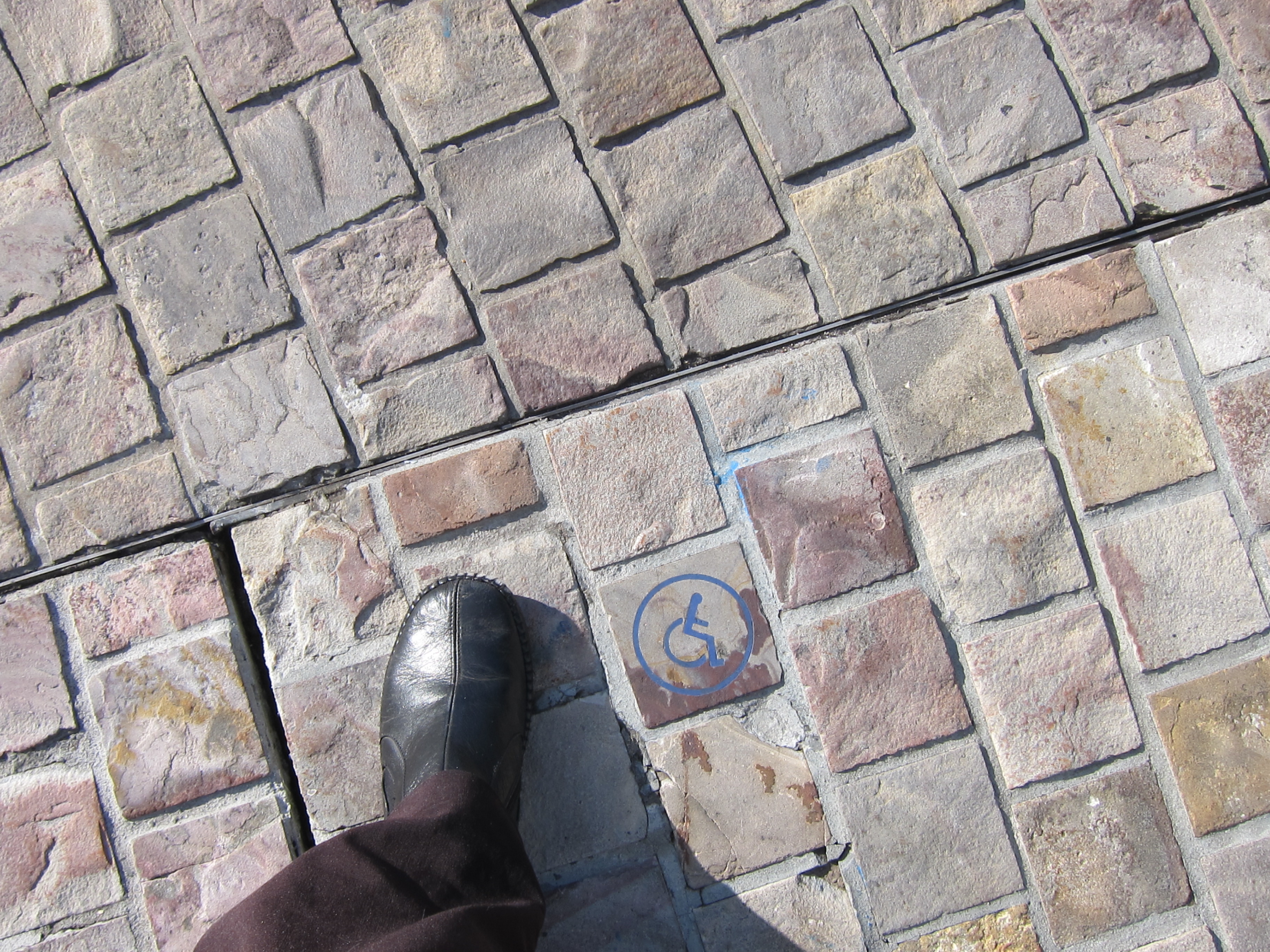
Weather notwithstanding, off we toddled to the National Gallery of Victoria to take advantage of the members’ free entry today to the Fred Williams exhibition. I really don’t know why I keep going back to the Fed Square gallery (other than being forced to if I want to see particular exhibitions) because it always enrages me.  My chagrin starts with the cobbled, windswept forecourt. It is bleak in winter and baking in summer, uneven, and slopes upwards onto an artificially created hill that ensures that the whole Federation Square complex completely blocks any sight of the river.  It amuses me that the so-called ‘accessibility’ markers that denote a slightly smoother path  are themselves virtually indistinguishable from the rest of the cobblestones.

Then, how to get into the damned gallery?  You’ve got to hand it to the NGV- in both the Fed Square and the International Galleries, the doors are squirrelled away out of sight- I mean, you wouldn’t want anyone to come IN would you?

Having solved the mystery of getting in to the gallery, and having passed the highly prominent and clearly-sign posted shop (the only thing, along with the ticket box, that is clearly signposted in the whole building)  your next task is to work out how to get upstairs, as the exhibition you want is most certainly upstairs.  Ah- there’s the escalator- a little single-file, one-way escalator tucked away in a corner.  You want to go down again? I’m yet to find the down-escalator, but I have found the wooden staircase that has the steps sawn off at an angle like spiral steps, but in a squared, boxlike structure.  Or there’s another staircase that just goes on and on and on upwards- oddly I’ve never found how to get down again.  Isn’t there some regulation about landings in staircases??

Exhibition seen, now for coffee! There’s the cafe with a narrow window that looks out onto the river- well, it would if it weren’t covered with artistically hung black mesh.  What goes in, must come out-so where ARE the toilets? Ah, there’s a subtle little sign over in the corner, virtually indistinguishable.  The door opens into a stygian darkness, which lifts slightly over the cubicles, but barely enough to detect the flush buttons that are mere engravings on the stainless steel walls.  The whole place is so damned impractical and must break every possible regulation in terms of accessibility and safety.  I have no idea how they could evacuate the building in an emergency. It’s architectural pretension run amok.

Am I in a bad mood today? Perhaps I am.  Let’s just say that I’m glad I had free entry to the Fred Williams exhibition.  I’m with Robert Nelson on this one- his review Dogged dabs of a blobby dazzler pretty much sums it up for me.

Fortunately my rainy day at the NGV was saved by “Intimate Landscapes”, the Fred Kruger exhibition of photographs– no, not the Nightmare on Elm Street Freddy Krueger, but instead the German photographer who worked in Victoria between 1860s-80s.  He was a travelling commercial photographer who was contracted, among other things, to photograph the Aboriginal people living at Coranderrk mission, near Healesville for the Aborigines Protection Board.  His photographs, intended to highlight the industry of the inhabitants, and the success of the mission, are freighted with all the “dying race” and “clean and useful” philosophies of the time.  He also took photographs of bridges, reservoirs, and rivers, often with small human figures alongside.  In a feat of organisation, he took a large group shot of literally hundreds of school children outside Flinders Primary School in 1880- you can see it here.   There are street shots of Queenscliff, Geelong and Ballarat as well. Fascinating, and well worth the cobblestones and steps, clammy umbrellas and wet socks.

A pleasant Sunday drive to….The Portable Iron Houses

Do people do Sunday drives anymore? We did- across the Yarra and down to South Melbourne to look at the Portable Iron Houses in Coventry Street South Melbourne.

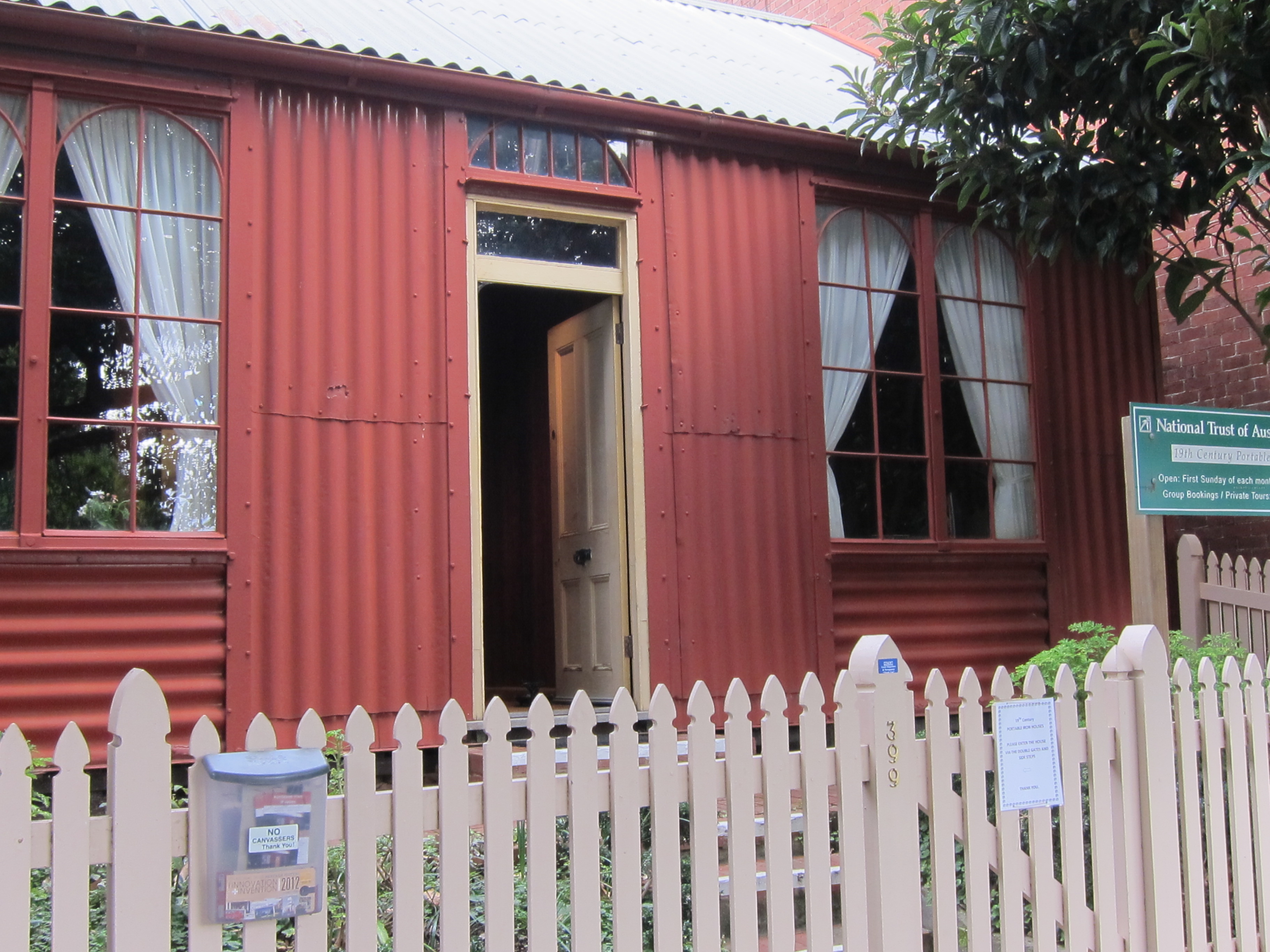
Patterson House, Coventry St South Melbourne

There are three galvanized iron houses on the South Melbourne site.  The one facing Coventry Street, shown above, is still in its original position where, in 1855 it was one of nearly one hundred portable buildings in the vicinity that included cottages, two-storey houses, shops, stores and a coach house.  It was valued at 60 pounds when it was erected in 1853/4.   Portable iron houses were packed in wooden cases (which could be used to line the internal walls) and easily transported by ship or cart.  They were quickly erected and could be unbolted and dismantled to be taken elsewhere for re-erection as a practical and enterprising solution to the dire housing shortage in gold-rush Melbourne.  The house above contained four rooms on the ground floor, with two attic bedrooms that are reached by a precipitous stairway.  I found it hard to envisage negotiating these stairs- barely more than a ladder really- with a babe in arms.  The temperature of the attic rooms in summer must have been fearsome too.

The second house on the side, Bellhouse House, was originally built at 42 Moor Street Fitzroy.

Bellhouse House, South Melbourne

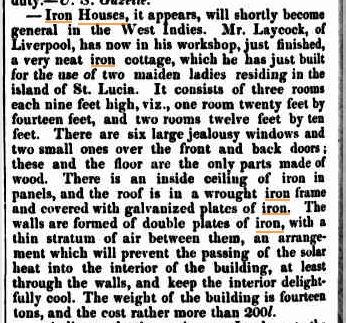
It is believed to be the only remaining example of the work of Edward T Bellhouse of Manchester England.  In 1851 he displayed his portable houses at the Great Exhibition, where they exemplified the practical use of new technology, especially for an imperial context.  There had been iron houses available previously- say for example, this house designed for St Lucia in the West Indies, but the cost and the weight were prohibitive

The Courier (Tasmania) May 8, 1845

(by the way, it should be ‘jalousie’ window, which apparently is just a louvre window).

There had been timber pre-fabricated houses as well (La Trobe’s cottage is a good example) but with these iron houses we are talking mass-produced, cheap, urban housing that could be manufactured in Britain and shipped to colonies throughout the world.  The iron on the Bellhouse House runs horizontally, and it would have originally contained three rooms.  I must admit that I found it rather charmless.

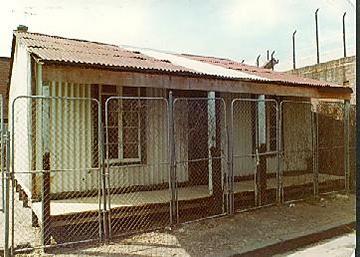
The house that I was most intrigued by was Abercrombie House, which faces Patterson Place at the back, where there were originally fourteen houses of a smaller size erected by the entrepreneur who erected the Coventry Street House.

Abercrombie House, Patterson Place South Melbourne

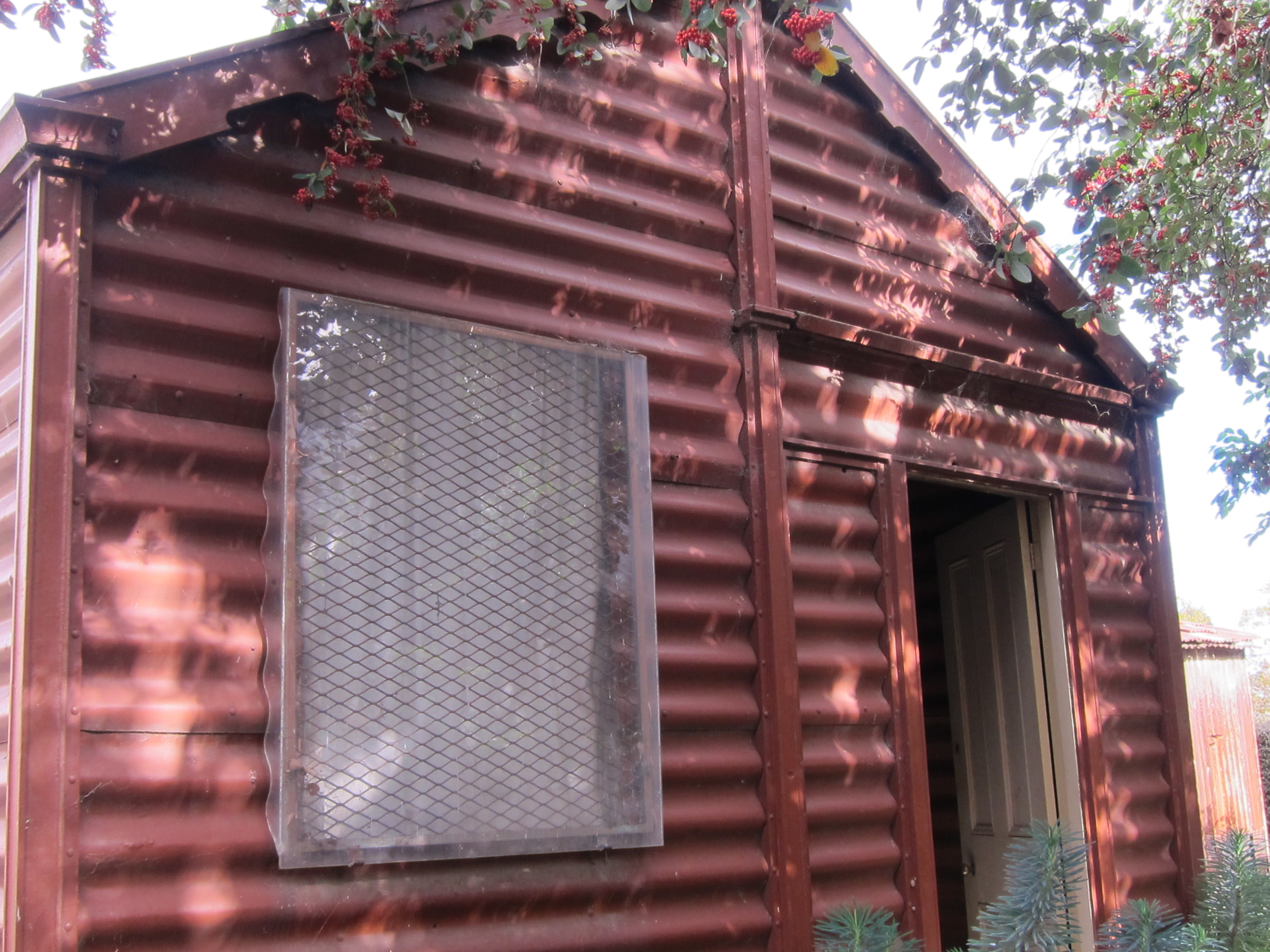
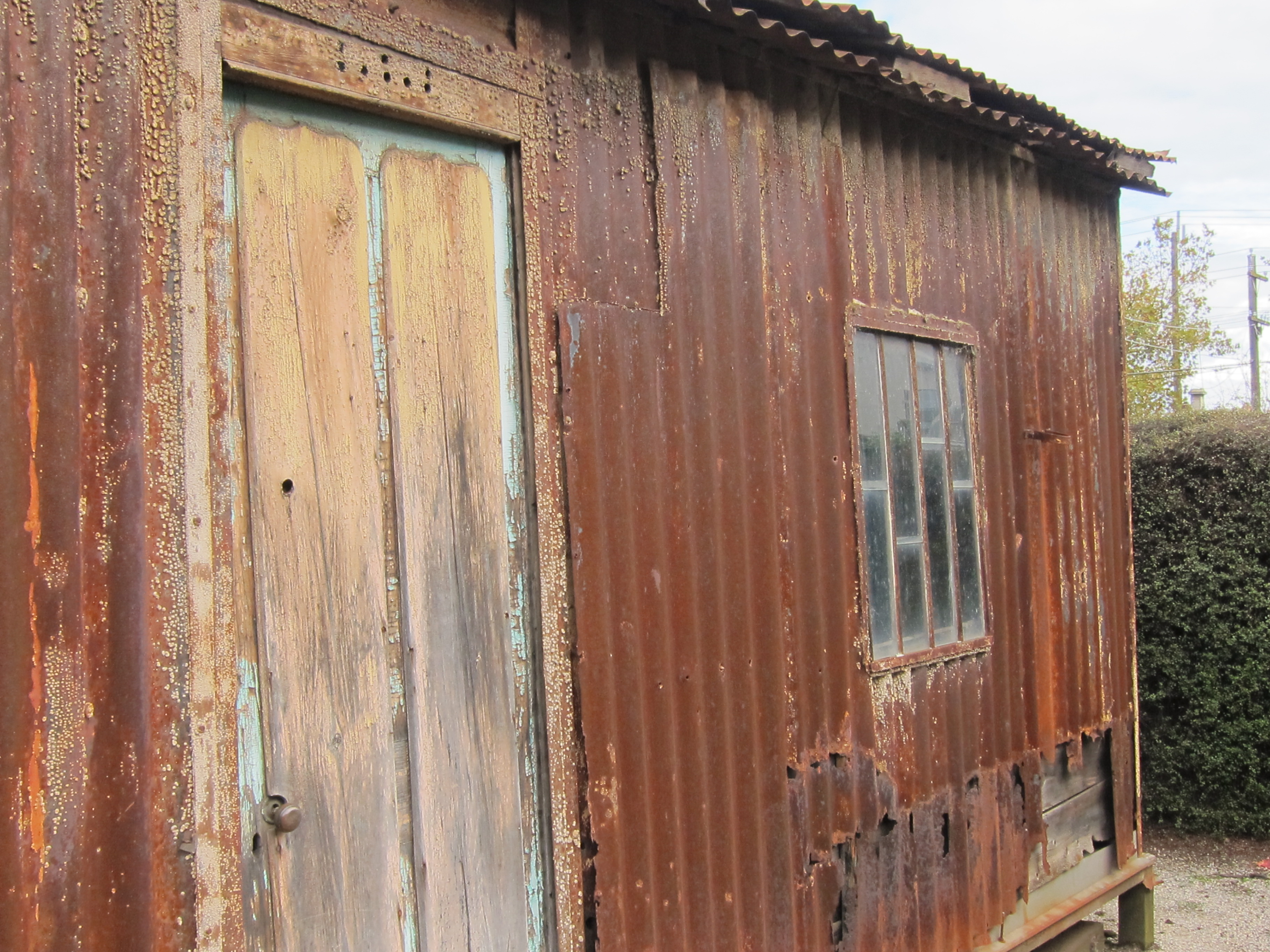
This particular house was moved from its original location at 59 Arden Street, North Melboune in about 1980.  You can see a picture of the house still in North Melbourne here  and it being shifted by semi-trailer after being cut in half here. They must have had their hearts in their mouths while they were moving it, because it is certainly in a very precarious condition.  It was last occupied in 1976, and standing there looking at the single light bulging hessian-covered ceiling and the layers of wall paper, it’s hard to credit that such primitive living conditions still existed in the middle of Melbourne forty-odd years ago.  But conversely, on a wet and cold winter’s day, it’s also important to recognize what a vast improvement this house would have been on the canvas tents that were the alternative.

Abercrombie House from Patterson Place

The Portable Iron Houses are presented by the National Trust, and they are open on the first Sunday of the month 1-4 p.m.

The pipes, the pipes are calling

One of the joys of living in Macleod is the sound of bagpipes that drifts up the hill on Thursday evenings as the local bagpipe band has its weekly practice.  Up past Ferguson St, Strathallan Rd, Erskine Rd, Argyle St, Munro St it comes, borne on a hot summer breeze or cutting through the cold air on a still, brittle, frosty night.

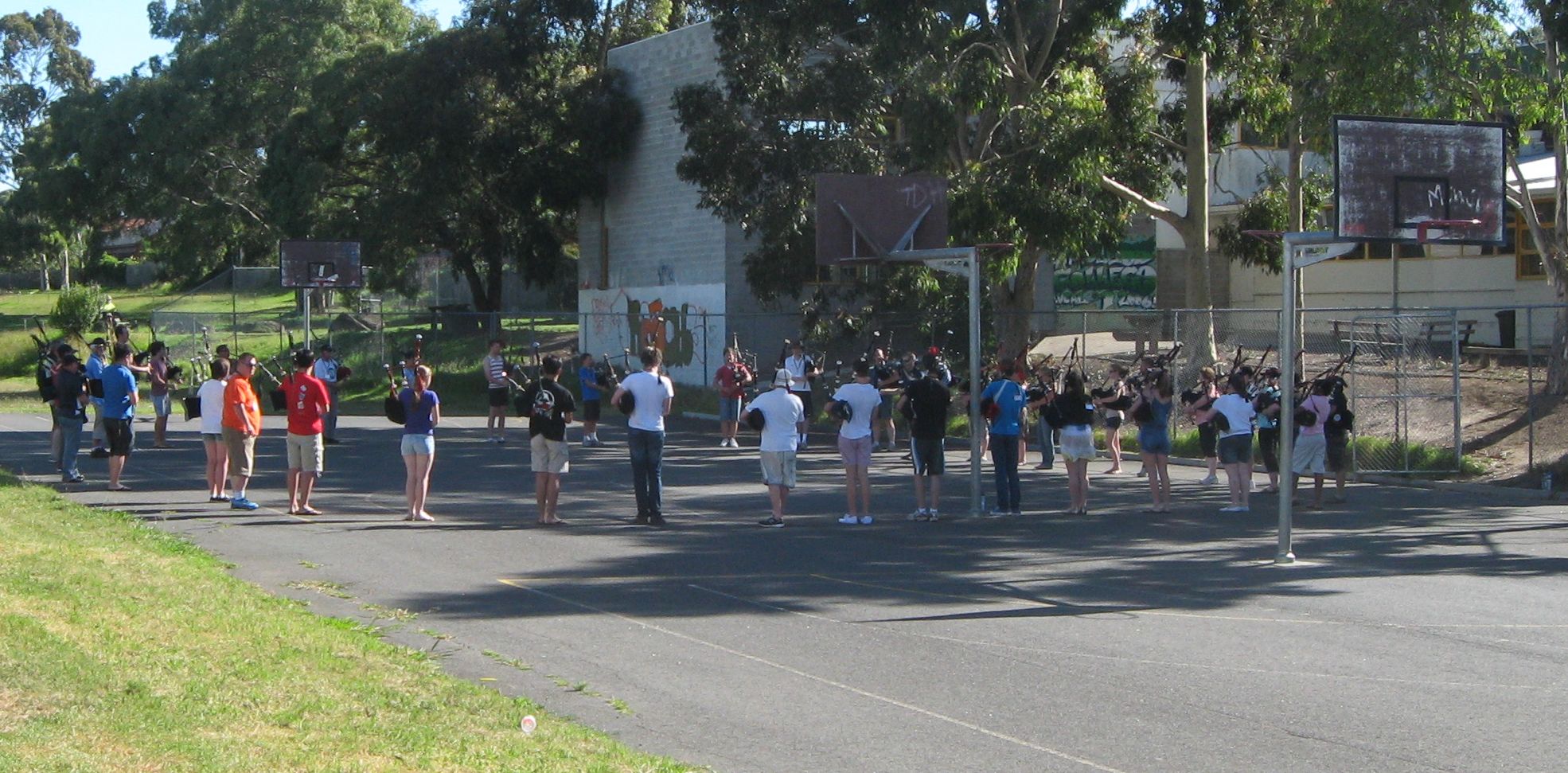
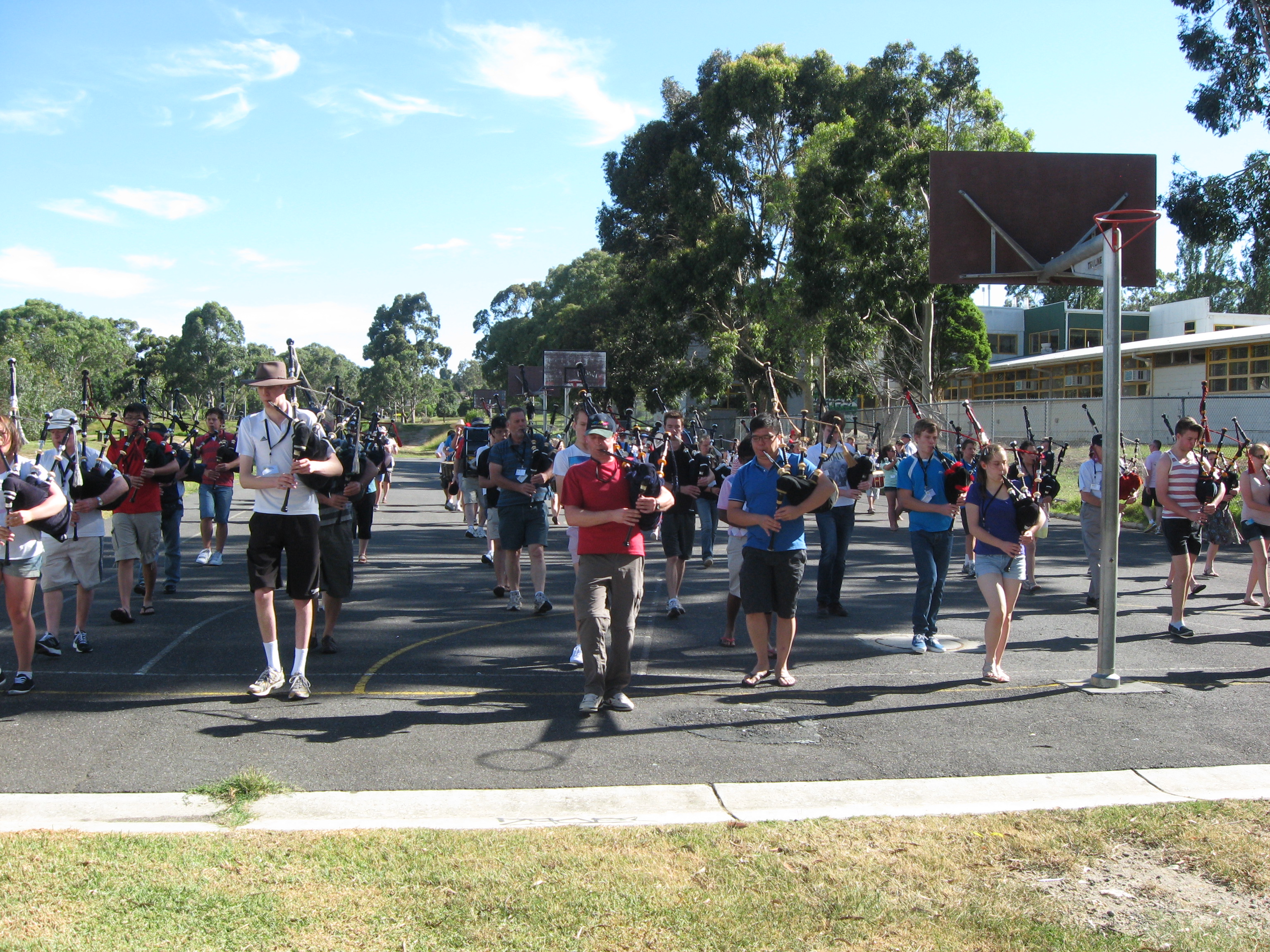
But what was that rattle of the drums this morning?- and the pipes- lots of them! There they were on the basketball court at the local high school at 9.30 on a hot Tuesday morning

I’m not quite sure what it was: it may have been a camp for a band perhaps because people were wearing nametags on lanyards around their necks.

It was really encouraging to see such a wide range of musicians: young, old, male, female, Asian, Indian.  Somehow I think there will still be Scots Pipe Bands in fifty years time.  A thoroughly good thing too.

Frocking up for the theatre

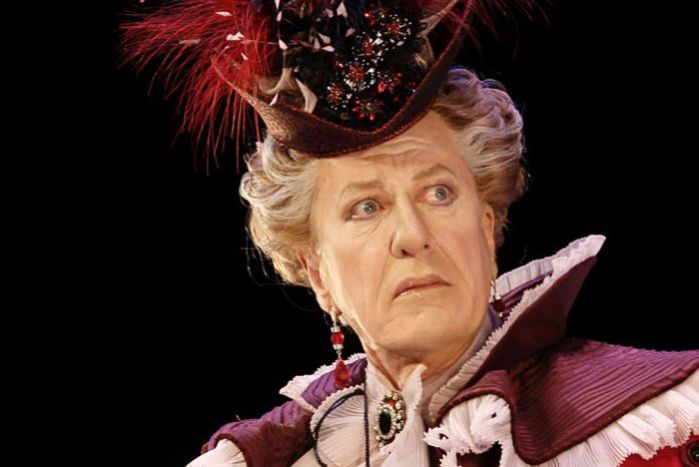
For a little treat the other night (well…a rather expensive treat actually) it was off to see the MTC production of The Importance of Being Earnest.  To get ourselves in the mood we watched Wilde starring Stephen Fry the night before, and sitting in the Sumner Theatre on Tuesday night, I was very much aware that we were laughing away at the same lines, probably delivered in much the same way to the audience at its opening night on St Valentine’s Day 1895.  It was a very traditional performance- no postmodern trickery or contemporary insertions here- and I felt rather overawed to be three rows away from one of the world’s greatest actors, Geoffrey Rush, right here in our shared home town.

What a striking, imperious and handsome Lady Bracknell he makes! (even though I don’t particularly think of Geoffrey Rush as handsome.)  He clearly relished rolling around in  the language, and being so close, we could see every raised eyebrow and every moue.  The rest of the cast was very good too, although if I had to name any criticism it would be at the slightly over-rehearsed delivery of Algernon’s lines. I recall Fry’s character in Wilde issuing the injunction that the lines should be delivered as sparkling, off-the-cuff repartee, rather than something that had been memorized and enunciated, and I think that the same observation could be made here too.

Two odd things about our night at the theatre though.  One was the sight of a very pushy woman, approaching everybody in the front row, asking them if instead of enduring their front row seat, they would be willing to swap with her seat at the back (“See, where the man is waving?”). When someone asked her if there was a particular reason, she said that she liked to be able to see their faces close up- well, don’t we all?  What amazed me was that someone actually did swap with her.

The second odd thing was an email we received a couple of days prior to the performance.  We have just endured a couple of hot days, and the email cautioned that the stage was heavily airconditioned for the comfort of the actors on stage in heavy costumes, and that as we were sitting in the front rows, we might want to bring a jacket or shawl.  It was good advice- it did get chilly after a while.

Patrons might have appreciated advice about their big night out at at Melbourne’s first theatre during the 1840s too.  The Pavilion, later renamed the Theatre Royal, was located on the east side of Bourke Street, between Elizabeth and Collins Street.  Garryowen describes it as:

one of the queerest fabrics imaginable.  Whenever the wind was high it would rock like an old collier at sea, and it was difficult  to account for it not heeling over in a gale.  The public entrance from Bourke Street was up half-a-dozen creaking steps; and the further ascent to the “dress circle” and a circular row of small pens known as upper boxes or gallery, was by a ladder-like staircase of a very unstable description. Internally it was lighted by tin sconces, nailed at intervals to the boarding filled with guttering candles, flickering with a dim and sickly glare. A swing lamp and wax tapers were afterwards substituted, and the immunity of the place from fire is a marvel.  It was never thoroughly water-proof, and, after it was opened for public purposes, in wet weather the audience would be treated to a shower bath. Umbrellas were not then the common personal accompaniment they are now in Melbourne, but such playgoers as could sport a convenience of the kind took it to the theatre, where it was often found to be as necessary within as without. The expanded gingham would of course, very seriously incommode the comfort and view of the adjacent sittings, but that was a consideration so trifling as to be scarcely thought about.  (Garryowen ‘Chronicles of Early Melbourne’ p. 452)

I know that we often complain about people with their mobile phones in the theatre, but there are worse things:

… the Pavilion would at times be turned into a smoking saloon, and even when some of the more mannerly persons in the pit would take off their hats and place them on the floor, the bell-topper, cabbage-tree, or pull-over, whichever it was, would be utilized as a spittoon for shots expectorated with sure aim from the dress circle.  If any of the unhatted individuals happened to present a bald pate, the spot was regarded as a justifiable target for hitting at short range, and terrible would be the indignation with which an unoffending spectator, somewhat sparse in hair, would find himself patted on the bald crown-piece with something analogous to a molluscous substance “shelled” at him from one of the side boxes.  In hot weather or cold the moist application was an unpleasant sensation, and naturally resented. The person so “potted” would pull out his handkerchief, wipe his head, jump up, and “rush the batter” whence he would be probably repelled with a black eye or enlarged nose. (Garryowen, p. 456)

So, are we ready and all frocked up for our night at the theatre? Let’s see …  umbrella, hat, handkerchief….I’ll settle for the shawl or jacket thank you.

At the NGV: ‘The Mad Square: Modernity in German Art 1910-1937’

Some months ago we went to the NGV to see the Vienna Art and Design exhibition.  As you walked around that exhibition, which took a largely chronological approach, the 20th century works in the final rooms became increasingly fractured, subversive and unsettling, and the political chill of the approaching Nazism was almost palpable.

However, entering this current exhibition, part of the Art Gallery of NSW’s travelling exhibition program,  what had seemed to be subversive in the Vienna exhibition now appeared defiant and brave.  As a child, one of my favourite stories was The Snow Queen by Hans Christian Anderson, where a shard from an evil, broken mirror enters the eye and makes everything appear ugly.  Shards have warped the vision of the world here- a perverted, edgy, dissonant world- but it’s also a world clearly responding to the ugliness outside of  war, defeat, inflation, radicalism and increasing totalitarianism.

The shadows of World War I are long, and they manifest themselves through confronting depictions of maimed soldiers, pushed to the margins of society.  Were disfigured soldiers found in English art of the same period?- I’m not aware that they were.  I’m sure that the wounded were just as present but their meaning was different for the side that ‘won’ the war.

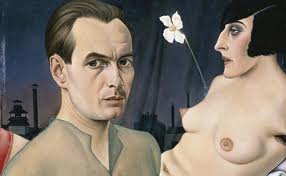
There is also the underlying menace of sexual violence, exemplified by Davringhausen’s painting of Der Lustmorder (The Sex Murderer) where a sickly, boyish prostitute lies on a bed oblivious to the murderer lying underneath (see here)  and there are film clips of abducted women in The Cabinet of Dr Caligari, and debased women in Metropolis.  This is an ugly world.

The last room of the exhibition has archival footage showing Hitler’s Degenerate Art exhibition, where works such as these were collected and shown, captioned with ridicule, before being destroyed or sold off onto the international market.  One of the final paintings in the exhibition is The Mad Square, from which the exhibition takes its name, by Felix Nussbaum, depicting artists protesting against their exclusion from the Prussian Academy of Arts, their artworks tucked under their arms.  It is sobering to remember that Nussbaum and his entire family perished in the concentration camps.

This is an unsettling exhibition.  After a while, the blockbuster exhibitions tend to merge into a bit of an blur  (did we see that at The Impressionists? or Vienna? or Dutch Masters?) but I think that this exhibition stands alone. Well worth seeing.

There’s an excellent companion website here at the Art Gallery of NSW.

An Australian Christmas c.1963

Christmas seemed so much more fun when you were a kid.  Will our children and grandchildren look back at their Christmases with such fondness? I hope so.

My Mum was the youngest of seven and no doubt as the spoilt youngest child, managed to avoid doing Christmas dinner until I was about thirteen years old. Until then, every Christmas was the same with lunch and dinner over at Auntie Flo’s and it is these Christmases that I think back on.

Father Christmas would come as he could always be relied to do, leaving presents in a pillow case at the end of the bed. He was an orderly Santa- along with larger presents there would always be a rectangular box of assorted lollies that included Fruit Pastilles (both multicoloured and blackberry), a Choo-Choo bar and a Kit Kat.  There would be a glass jar jar of puce-coloured candied peanuts: the jar itself bore a very strong resemblance to a  jar that might once have held Vegemite or Kraft Creamed Cheese spread, and I’m almost sure that it did.  Among other presents, there was always a book for me, sourced from a large box of remaindered children’s books that my parents bought at auction somewhere.  As a result, the book itself was pretty hit-or-miss, although one year it was Charles Lambs’ Tales from Shakespeare , another year a collection of Greek myths.   One particularly memorable year there was a wooden paddle-board that obviously didn’t fit in the pillow case which was maneuvered into my room by Santa with much un-Santa-like giggling and muffled laughter.  On another earlier Christmas, Santa brought my doll Debbie in a pink dress in a proper doll box.  There was always, always an orange at the bottom of the pillow case.

Then over to my Auntie Flo and Uncle Ted’s for Christmas lunch. They lived in Waiora Rd Heidelberg Heights in a house with huge gardens, overlooking the Yarra Valley right across to the Dandenongs.  I always loved going there. Although I was a little scared of my uncle’s very dry sense of humour and bristling moustache, I loved my Auntie Flo, my favourite aunt and my godmother.   Girl cousins were fairly rare in my family- four girls to eleven boys.  Auntie Flo didn’t have a daughter, and I always felt very special with her. My cousins Wayne and Paul held all of the attraction of older male cousins: they were handsome, funny and big and very affectionate to their little girl cousin.   The Christmas I can remember most clearly was a very hot day, so the canvas awnings were all pulled down, bathing the inside of the house in a green, almost underwater light.  The house  smelt of Christmas pudding that would have been bubbling away for hours: I now make the pudding for my own family to the same recipe, amused every year at how much alcohol is in this pudding that was eagerly eaten by a family of teetotallers (3 tablespoons of spirits; 200 ml beer).  After lunch, more presents- always something special from Auntie Flo, and once even a doll’s house WITH STEPS made by my cousin Wayne in woodwork, all decked out in curtain and carpet scraps from their own decorating and my initials JL in gold paint over the front door.
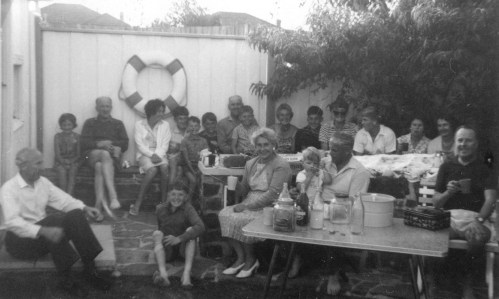
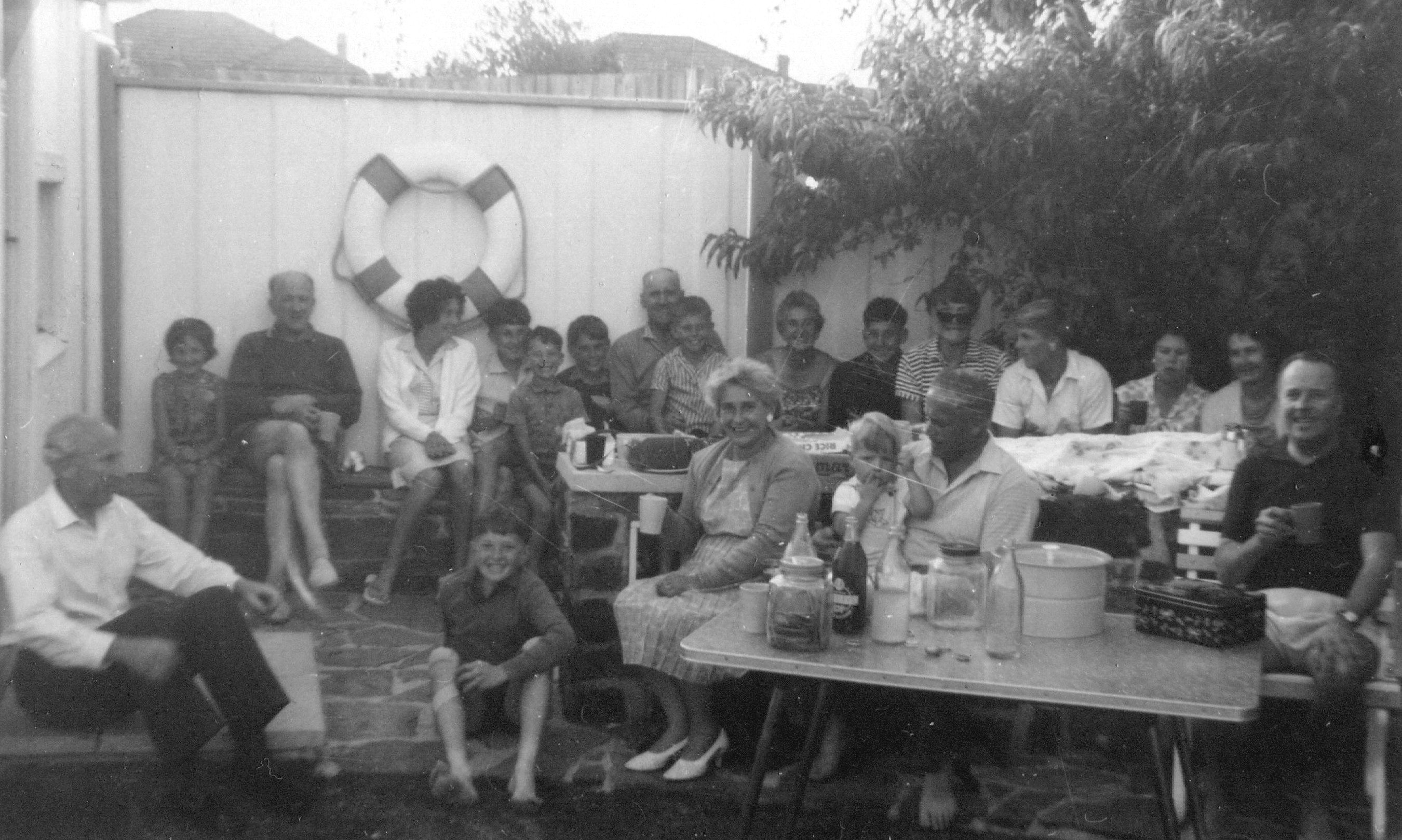
I'm sitting on the extreme left hand side at the back. My brother Colin is sitting 5 from the left with Auntie Flo in the middle, 9 from the left. I THINK that Cousin Paul is wearing sunglasses 11 along, with his brother Cousin Wayne turning towards him. Mum is seond from the right hand side. Uncle Ted is sitting on the ground at front left, and my brother Rohan is sitting on Dad's lap front centre.

After lunch, the other cousins would come over- all older than us- and loud and funny and boisterous.  Auntie Flo and Uncle Ted had a fully tiled inground pool, which was rare in those days, complete with a changing room up the back, and footbaths set into the concrete to wash the grass from your feet before going in.  Once the obligatory and scrupulously kept hour for our “dinner to go down” elapsed (does anyone do that these days?), it was into the pool. They had inner tube tyre rings in the pool, and there would be a rough game of pool basketball, races up and down the pool and  pool-wrestling perched on top of my cousins’ shoulders.  Once our fingers were corrugated and our lips blue with the cold from being in for so long, we’d play shuttlecock on another terrace of the lawn, with the shadows from the trees lengthening around us.

Yet more food- cold meat brought by my butcher Uncle from Geelong (and maybe the butcher uncle from Reservoir?), salads, my mum’s famous pavlova and my Auntie Flo’s shortbread.  I once announced that I prefered Auntie Flo’s shortbread to my mother’s: I was not popular.  Another family of cousins had joined us by this stage, and then there would be the third round of presents, although often smaller ones by this stage.

By now, there would be much rubbing of little eyes and we’d head off home. We travelled out of our way to see the Boulevard lights in East Ivanhoe- strings of multicoloured globe lights and decorated gardens.  There would be one or two illuminated houses, then a few more, then the main display, concentrated in the middle of this long, curving street.  Crowds would cluster around these main houses, and the traffic would slow to a crawl.  Little did I realize that some 15  years later I would marry the little boy who then lived in the house on the bend with the most spectacular lights, and that 20 years later the week-long display of “the lights” would be an integral part of my own children’s Christmas.

But gradually the gaps between the displays would get wider and wider, until there would be just one or two outlying houses and the car would finally reach Burke Rd.  It was then- and only then- that I would know that Christmas was over for that year.

Happy Christmas.

The great Great Melbourne Telescope

When I hear the term ‘GMT’, I automatically think of Greenwich Mean Time.  Those of an astronomical bent, apparently, think of the Giant Magellan Telescope, four times more powerful than existing telescopes, and scheduled for completion in 2018.   But there’s another GMT too- The Great Melbourne Telescope, which I heard about at a lecture at La Trobe last week given by Richard Gillespie, the author of a recently-released book of the same title.  And a great little story it is too.

John Herschel, the son of the inventor William Herschel, first turned the telescope to the southern skies at the Cape of Good Hope in 1834-8, and in 1849 the British Association for the Advancement of Science called for a large reflecting telescope to be erected in the southern hemisphere.  Four years later they teamed with the Royal Society to create the Southern Telescope Committee to assess designs and seek funding.   The Cape of Good Hope, Sydney and Tasmania were considered as possible sites, but thanks to effective lobbying by William Parkinson Wilson of the University of Melbourne and support from the Victorian Government flush with post-Gold Rush wealth, the telescope was placed in Melbourne.  It was not the largest telescope in the world- that honour went to Lord Rosse’s ‘Leviathan of Parsontown’ in Ireland until 1917 but it was the second largest telescope at the time, and more importantly it was the largest steerable equatorial telescope, scanning not just up and down but across the skies as well.

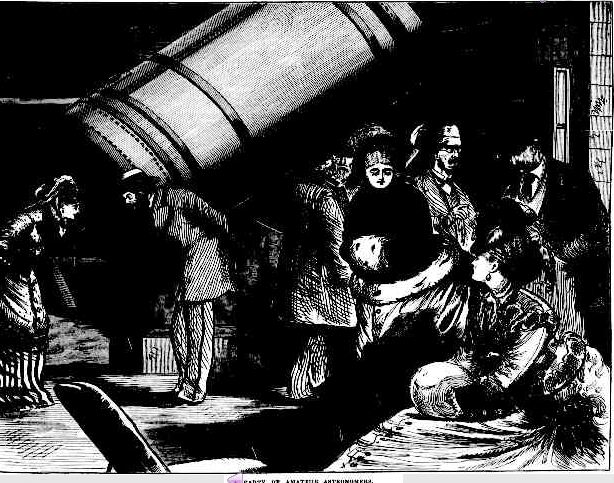
It was the pride of Melbourne- and why shouldn’t it be.  The Irish-built telescope opened in a purpose built house in the grounds adjacent to the Botanic Gardens in June 1869. Its close proximity to Government House meant that the governor and visiting dignitaries and their ladies could pop in for a squizz (literally).  A brilliant image of the moon captured by the camera attached to the telescope in the 1870s was distributed to schools, libraries and Mechanics’ Institutes  throughout Victoria.  The “Great Melbourne” referred not only to the telescope, but to the self-image of Melbourne itself at the time as a centre of learning and civilization in an international context.

But technology and invention does not stand still, and other telescopes were devised with superior design and capacities surpassed the GMT.  Its lens became tarnished and by the 1940s the telescope was dismantled and moved to Mt Stromlo Observatory where it formed the skeleton of a new improved telescope, overlaid with new technology and materials.  This updating was an ongoing process and more than half of the original telescope was harvested in 1984 by Museum Victoria as a historical artefact.  The GMT was barely recognizable, visually at least, as the technology that had evoked such pride seventy years earlier.

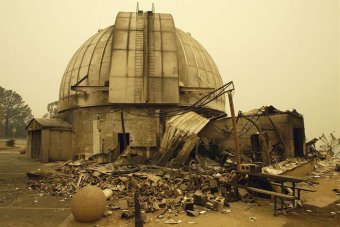
In 2003 the Mt Stromlo Observatory was destroyed by fire, including the cannabalized remnants of the GMT. But,- and here there’s a flush of parochial pride- the fire stripped away all the plastic and modern metal, leaving the original cast iron skeleton of the telescope. Alongside the parts that had been harvested earlier, 90% of the original telescope still exists in one form or another.

The original telescope house still exists on the grounds of the former Observatory side, now part of  the Botanic Gardens.  There are plans to restore the house and the telescope and make it available again to the public which involves a balancing act between restoration and the re-creation of a :century telescope.  They won’t, for example, be using a speculum lens again that caused so much grief and expense in the original telescope.  They’re trying to raise a million dollars- which seems chicken-feed in these corporation days- hence the publication of this book (which I assume will be available at Museum Victoria even though it doesn’t seem to be in the bookshop yet).

‘The River’ at Bundoora Homestead

A wet, humid day and nothing to do on a Saturday afternoon so up we went to Bundoora Homestead to see their current exhibition ‘The River’. I’ve written about Bundoora Homestead previously.  It’s a beautiful Federation-era house, well worth seeing in its own right.

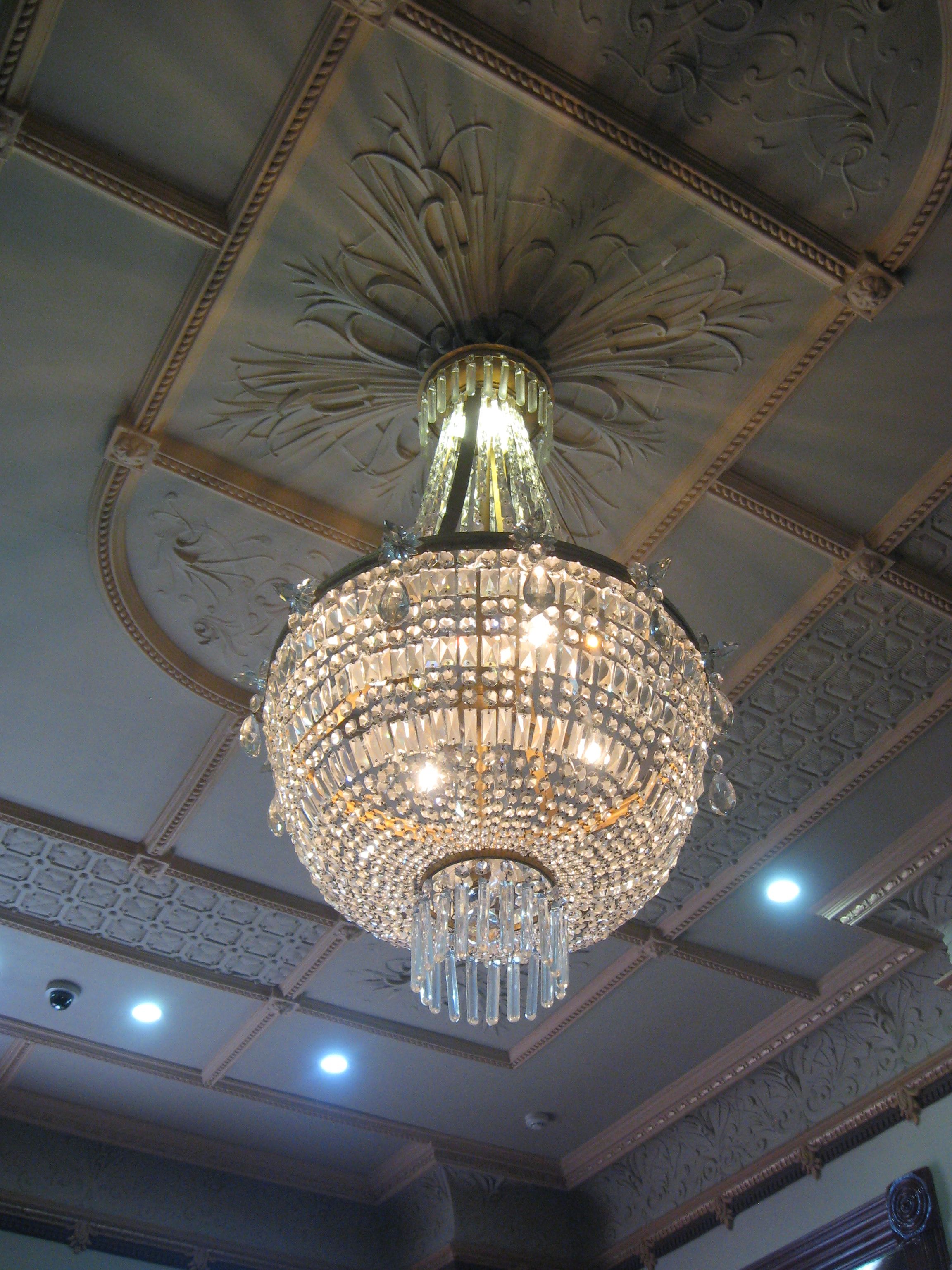
Chandelier in dining room, Bundoora Homestead

Another homestead that was once a gallery, Banyule Homestead, is very much in my thoughts at the moment.  More than ever I realize that if you value a gallery or a library or a museum,  then you need to visit it- you need to walk right through that door and go in.  In the case of Bundoora Homestead, it’s free and it literally costs you nothing: the gain is all yours.

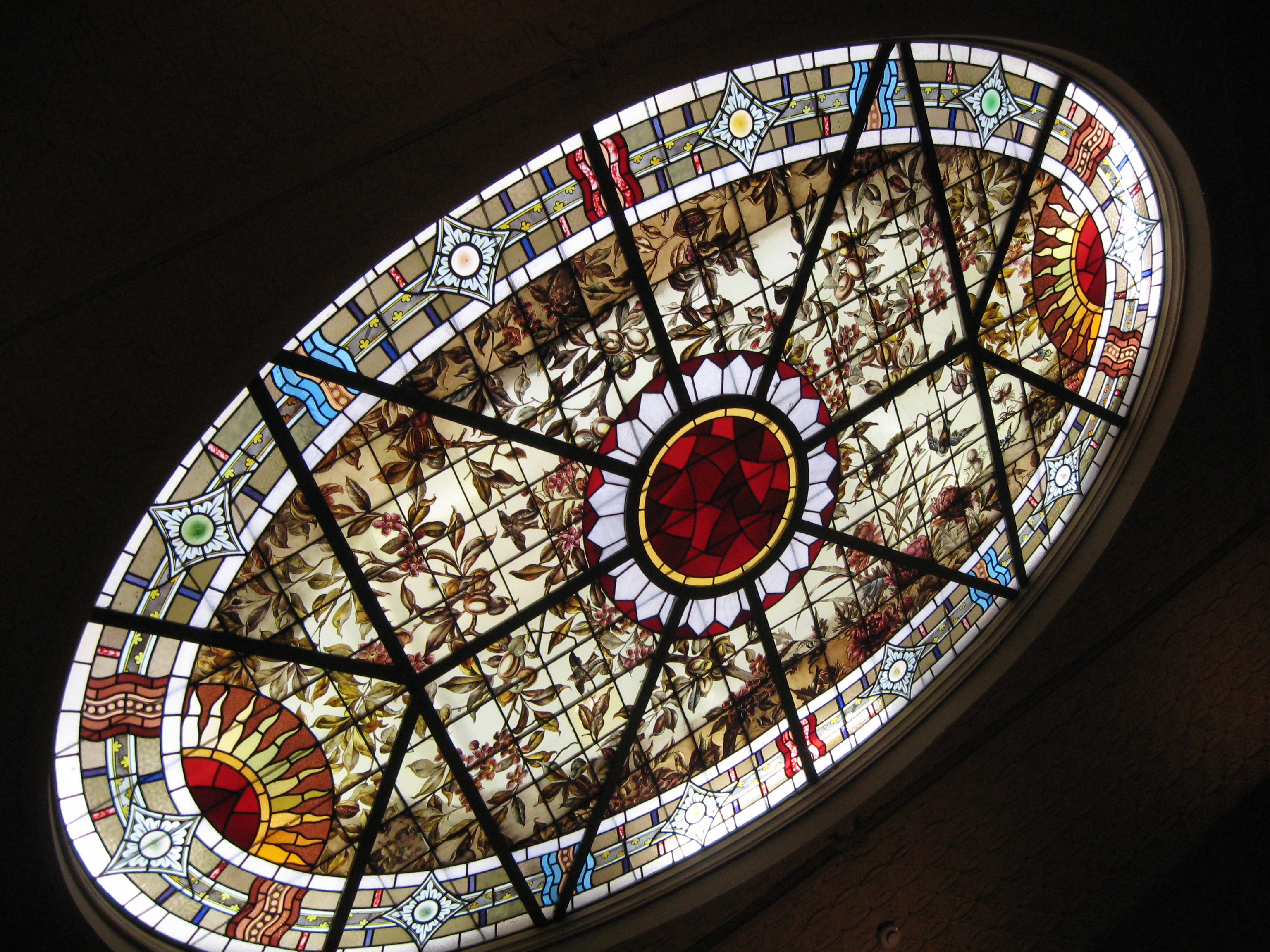
Stained glass skylight, Bundoora Homestead

The current exhibition is called ‘The River’ and it centres on Melbourne rivers (well, creeks) the Merri  and the Darebin Creeks. In recent years of drought these creeks have dwindled to small puddles connected by a fitful ribbon of water.   One of the joys of the recent rains this year has been to look down from a train into the city, as you cross over the creek, and to see the water gushing and tumbling along waterways that had seemed so dismal just a few years ago.

The exhibition contains well-known works, most particularly Burtt’s depiction of the purported signing of the Batman treaty and several Heidelberg school paintings of river scenes around Melbourne, as well as 19th century photographs and engravings.  These are juxtaposed against more recent works on the Merri and Darebin Creeks, including reflections on the ‘treaty’ painting and more surreal and threatening depictions of these urban places.  There will be a lecture panel this coming Thursday 24th November at 2.00 discussing Burtt’s painting.

This is a terrific exhibition. I’ve seen reproductions of the Batman painting before, but not the original, and I was delighted to see Sarah Susannah Bunbury’s painting of her house on the Darebin Creek in 1841.  I liked the sense of fun in many of the modern depictions, and it was lovely to see it in a beautiful suburban gallery, close by to the two rivers featured in the exhibition itself.


Surprising things: a costume museum

Should someone suggest to you a visit to a private costume museum out at Bulleen,  then just say yes.

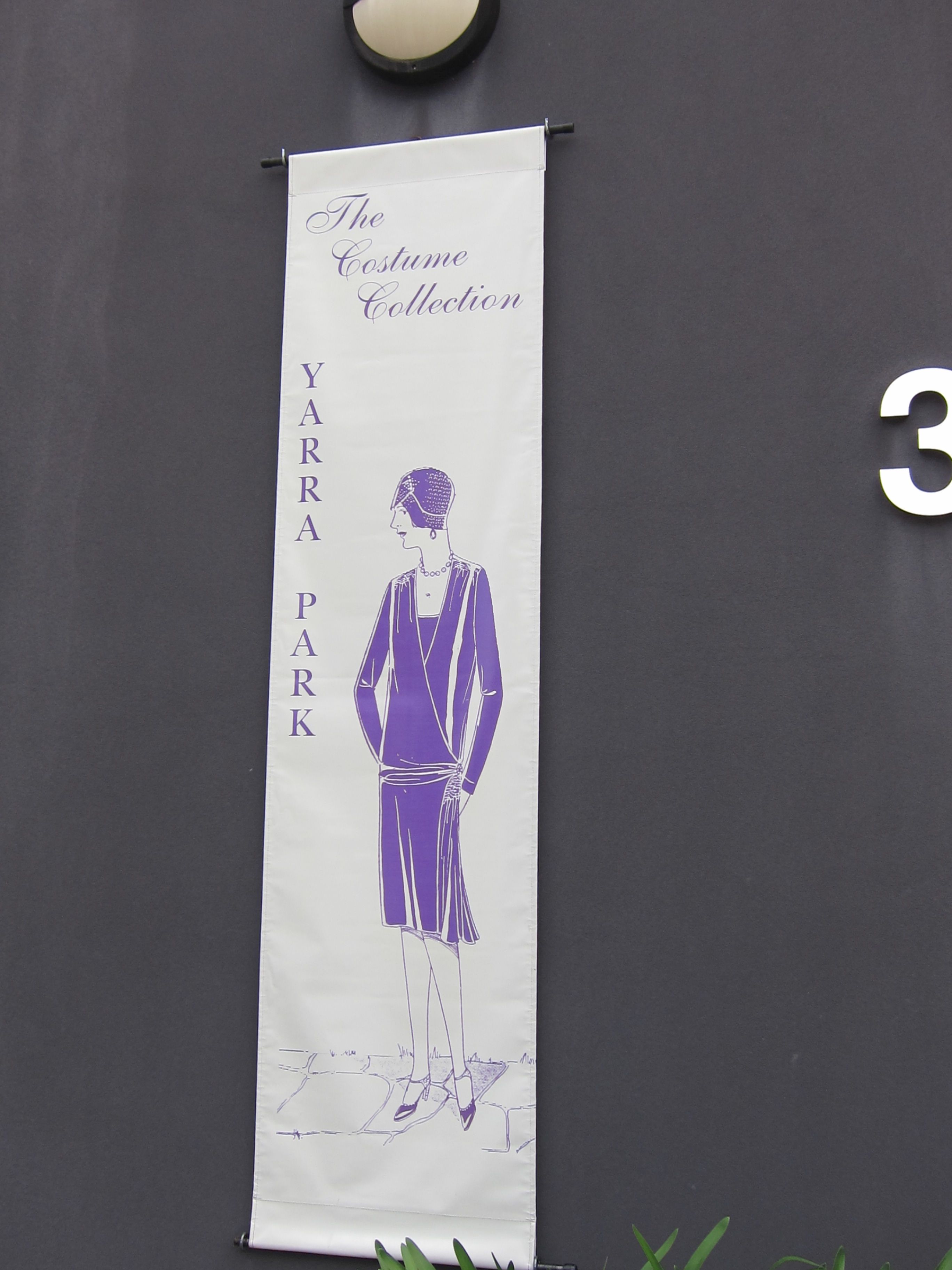
They’ll mean The Costume Collection, Yarra Park in Greenaway Street Bulleen.  You’ll drive down Greenaway Street (named for an early farmer in the district), past the factories and chain wire fences and you’ll think “This couldn’t possibly be right”.  But it is.

The owner and curator, Loel Thomson, describes her museum as “a hobby that grew”- hence the rather unconventional setting in a factory in a small industrial pocket beside the Yarra River.  The factory, however, provided many of the things her costume museum needed- space, few windows and an airconditioned and filtered atmosphere.  She has more than 10,000 items in her collection, though only a fraction of them are on display at any one time, and the display changes regularly.

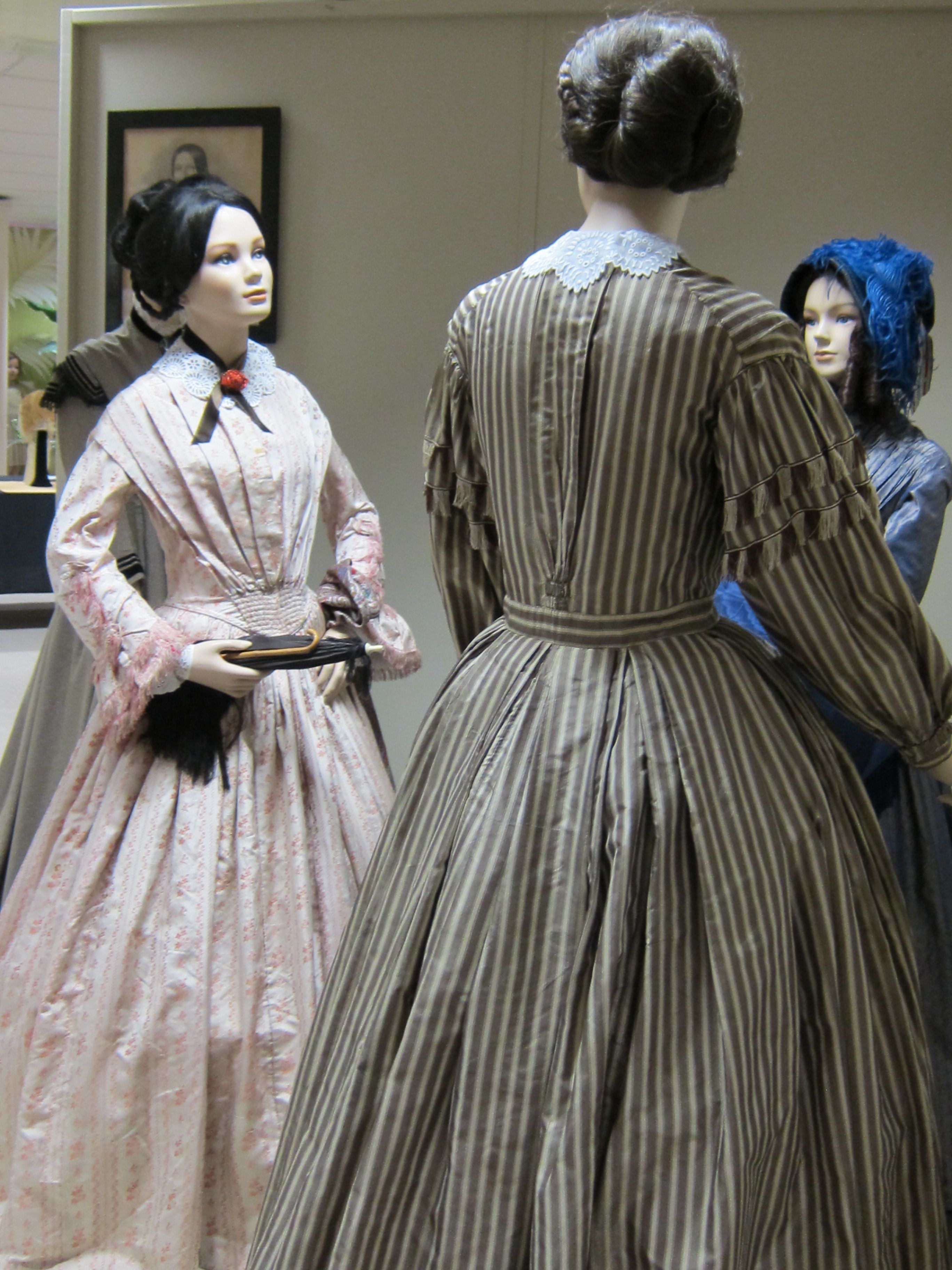
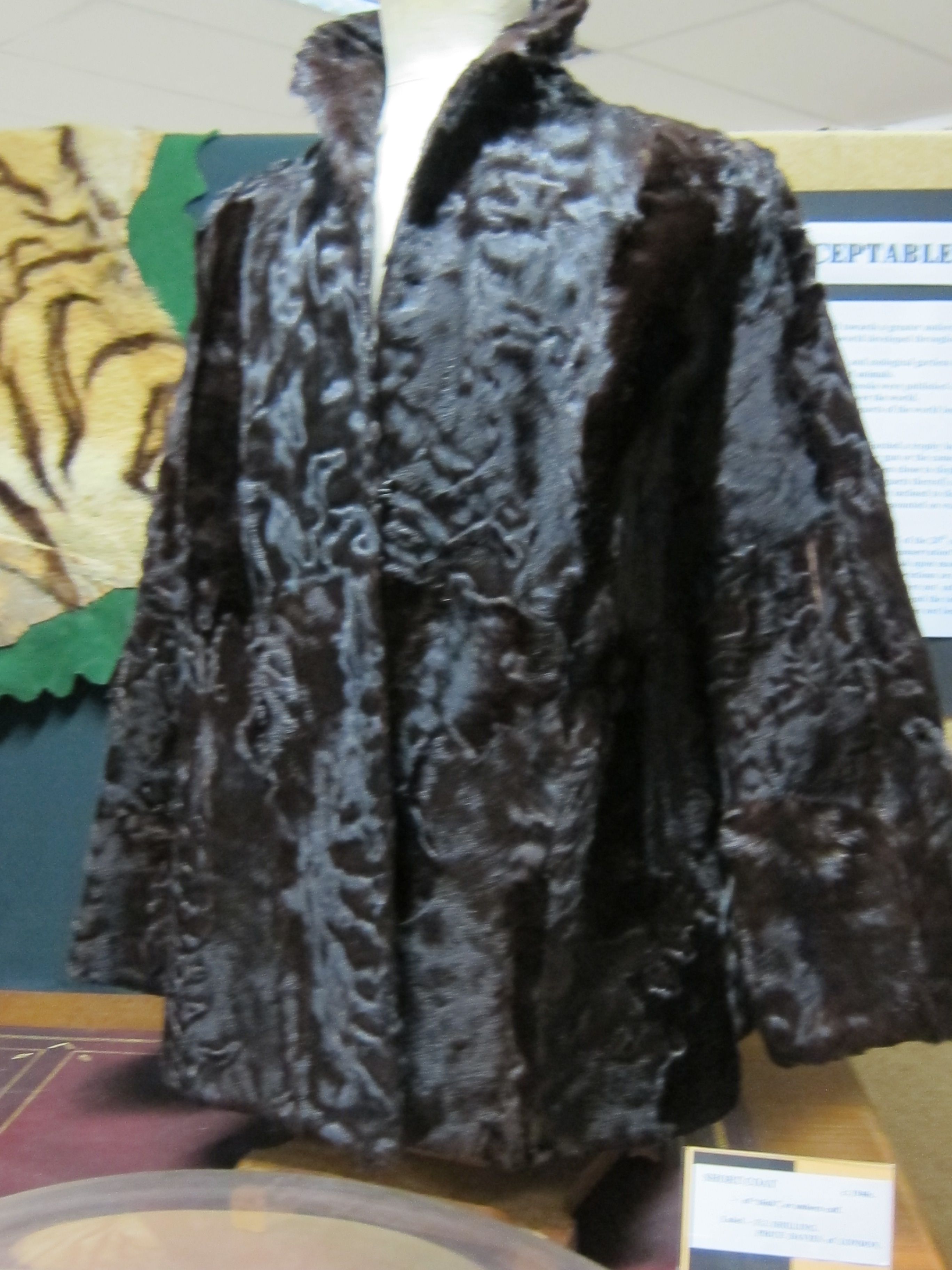
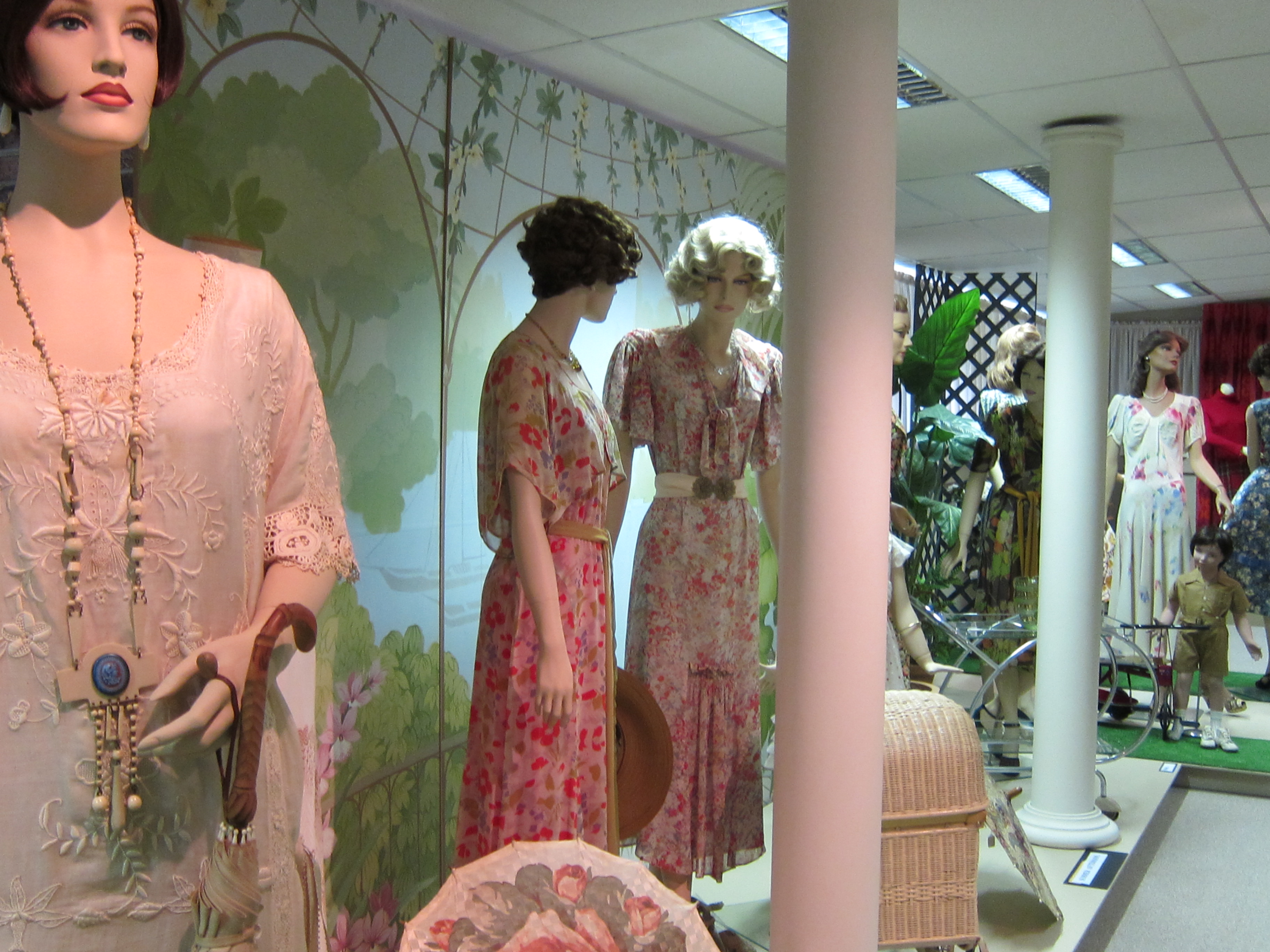
I loved the way the costumes were displayed.  Mostly you could walk around them to see them from all sides, and for those that were less accessible she had wardrobes and furniture of the period arranged so that mirrors reflected the costume from the side or rear.  There was a strong chronological aspect to the display, and it included children’s and men’s clothes as well.   A fascinating section featured ‘things we wouldn’t wear today’ showing furs and jewellery made from animal parts. There was  this ‘slink’ jacket-

that looked like fur jackets that I remember women wearing.  It’s only when you read the sign that you realize that ‘slink’ means ‘unborn calf’.  What travesties euphemisms cover!

Her aim in creating the museum is to collect everyday clothes that people wore.  Obviously the clothes were treasured enough for them to be preserved by family, or put away ‘for good’.  Many of them are purchased, commercially-produced items (she shows the labels) and although there are some formal wear costumes, most of them are day clothes.  She has a large library of magazines, pictures and books in order to research her displays, and in many cases she has been able to match private photographs of people wearing similar clothes,  or magazine advertisements,  to the costumes on show.

The museum is open only by appointment, so you’ll need to ring Loel Thomson herself on  9852 1794 and if there’s only a few of you she may be able to join you up with a larger group.  There’s a small entry charge by donation, which goes to charity.  It’s worth every cent and more.

There’s more photos from her collection here in a blog from February 2010- they are all beautiful too, and most of them were new to me so the display obviously changes quite substantially from time to time.  So- if you’re offered an opportunity to see it, or if you’d like to organize a trip for a group yourself- do!