
In a laneway near the Queen Vic market yesterday….


In a laneway near the Queen Vic market yesterday….
Posted in Life in Melbourne
A year ago I wrote about the sad demise of my pergola on the back deck, brought down (literally) by a rampant wisteria. I grieved its loss. It was a verdant, shady space and it seemed stark and uninviting once the pergola and greenery were removed.

The original wisteria in all its glory

Oh dear. All fall down
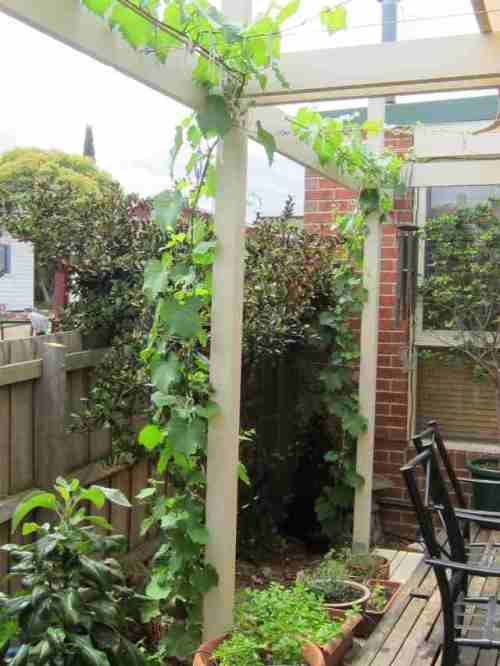
But time heals all things, even pergolas, and Mr Judge has built a pergola that will outlast me. It will outlast the house. It may well outlast the apocalypse. It has a small shade sail that will have to suffice until the greenery re-establishes itself.

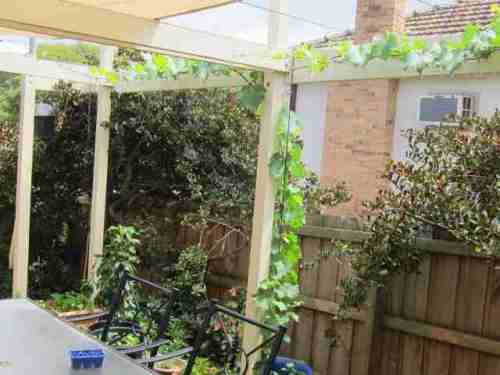
Having learnt at first hand the ferocity of a feral wisteria, we opted for an ornamental grape instead. Hopefully it will turn a rich shade of red during autumn. Its growth has been phenomenal. We only planted it in October and it has grown about 3 cm a day and is still growing. We’re now starting to train it along the wires.

Posted in Life in Melbourne, Macleod
I bet that Victoria’s premier, Daniel Andrews, was watching the weather forecasts rather anxiously this week. After all, I don’t think that the weather gods favour the Labor Party. I only need think back to the election day in 2010 that brought the Liberal Party’s Ted Baillieu into power. The rain absolutely bucketed down, breaking the long drought that had dessicated the nation for about fifteen years, and gifting to the Liberal Party an endless source of much glee about the desalination plant that the Labor government had urgently commissioned. (Mind you, I am positive that there will be summers ahead when we all say “Thank God for the desalination plant”)
But the weather gods were kinder on this inaugural Grand Final Public Holiday. Had it rained, or been one of the bitterly cold days that spring can buffet us with, it might have been an absolute flop. Certainly the employer groups were grumbling about it and Prime Minister Mal was gloating about the lack of crowds early in the morning. But instead, the skies were blue, the sun shone, the crowds came out after a sleep-in and a new tradition has started, I suspect. It was lovely to see so many Dads with their kids on this day, whether they went to the parade or not.
As for us, we caught the train to the ‘other side’ to Williamstown. I felt like quite the tourist, noticing the benighted Melbourne Star ferris wheel (was it working or not?) which can’t be seen from the northern suburbs; marvelling at the size of the cranes on the docks, and wondering which old factories or stockyards had been levelled to yield all this new housing.
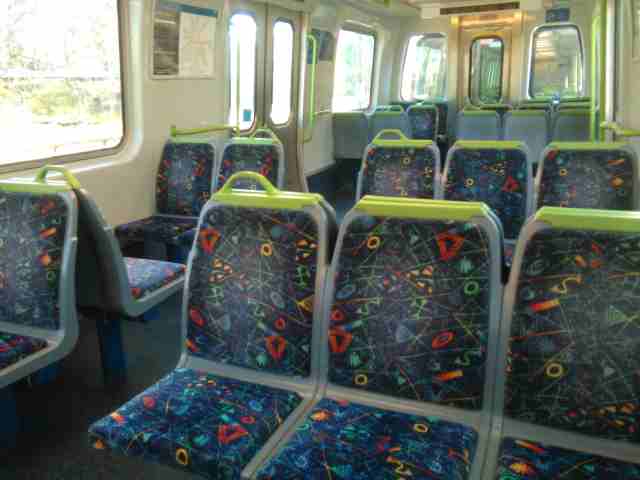
I was surprised that the train carriage still had the configuration of 3-across seats. On the Hurstbridge line (my line) they have removed the third seat so that more people can stand.
Williamstown is only 8km from the centre of Melbourne but somehow it feels like a completely different place, with Melbourne visible across the water.
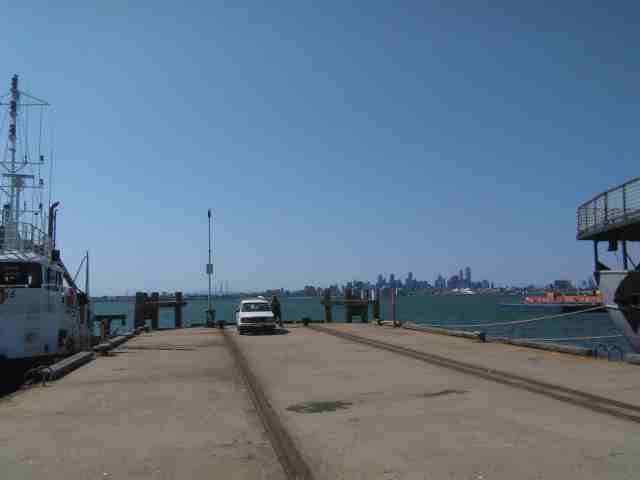
When Governor Bourke came down to the embryonic Melbourne village in 1837, he ordered surveyors to lay out two towns: Melbourne after the British Prime Minister and Williamstown (or Williams Town) after King William IV. With its deep harbour, it became the centre of maritime activity. The Alfred Graving Dock and State shipbuilding yard was completed there in 1874, one of the most expensive infrastructure projects undertaken by the Victorian colonial government. Prison hulks were stationed at Williamstown and this was the site of the murder of the infamous John Price, Inspector General of Penal Establishments.
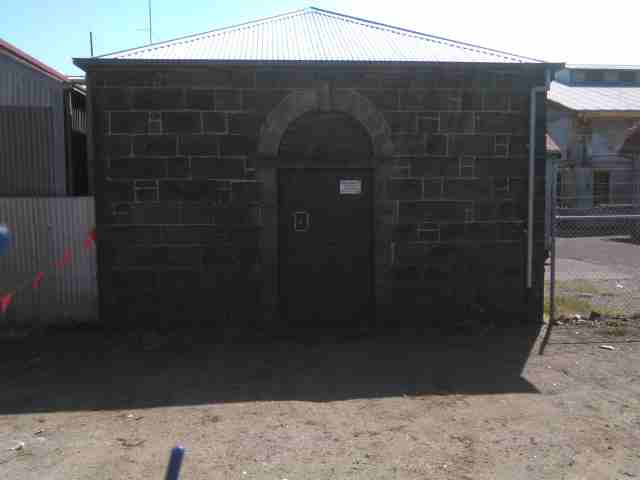
This is the bluestone morgue, now in Ann Street, moved from its original position on Gem Wharf. It was constructed in 1859, only a short time after the first morgue was fully completed in Melbourne, possibly at the Western end of Flinders Street (an earlier morgue started near Princes Bridge in Melbourne in 1853-4 was never completed). The Williamstown morgue was built using convict labour from the hulks and it was sited on the wharf where the tidal waters could wash away the…um…waste.
Many hotels (many now disused) catered for the port labourers. However, it was notable as we walked around, reading the plaques attached by the Williamstown Historical Society and the Hobsons Bay Council, that many of these pubs were built from the 1860s onwards, replacing earlier buildings. There’s a lot of new development happening down there again, and I posted earlier about an old house that didn’t survive.
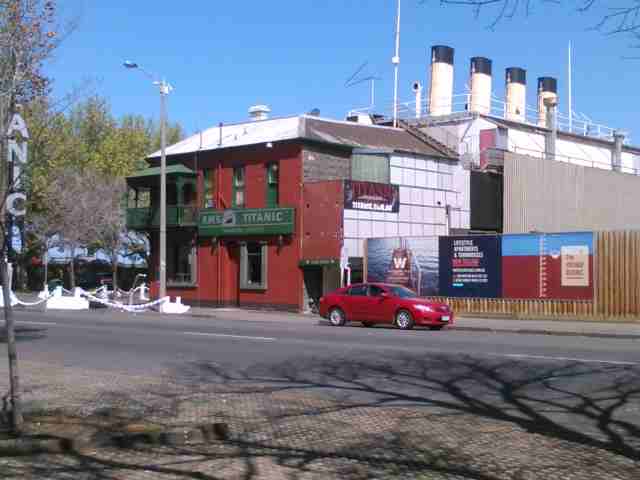
Hotel tricked up to reference the Titanic. I guess someone thought it was a good idea at the time.
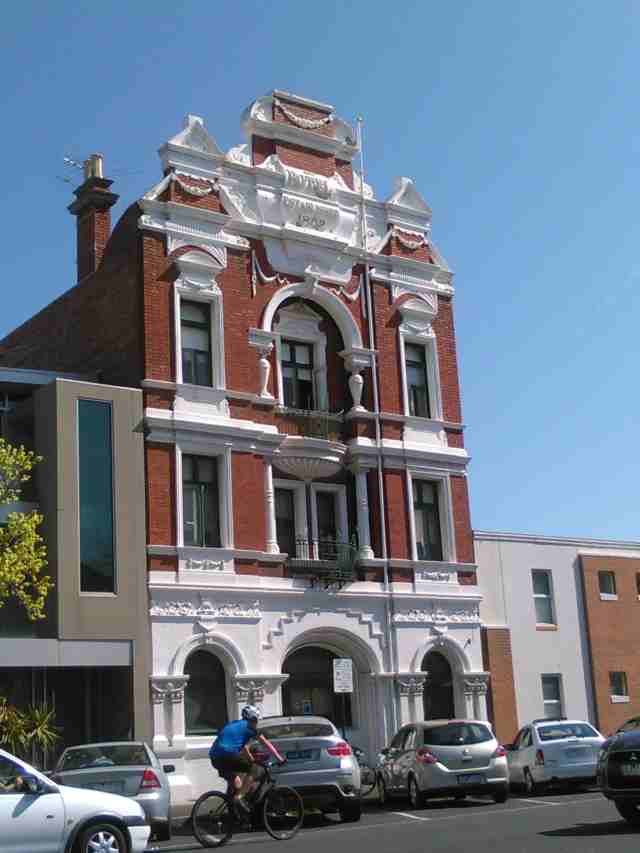
The first hotel on this site was the Royal Oak, built in 1852 but it was replaced in 1893 with this rather grand edifice. It has been used as a boarding house for many years.
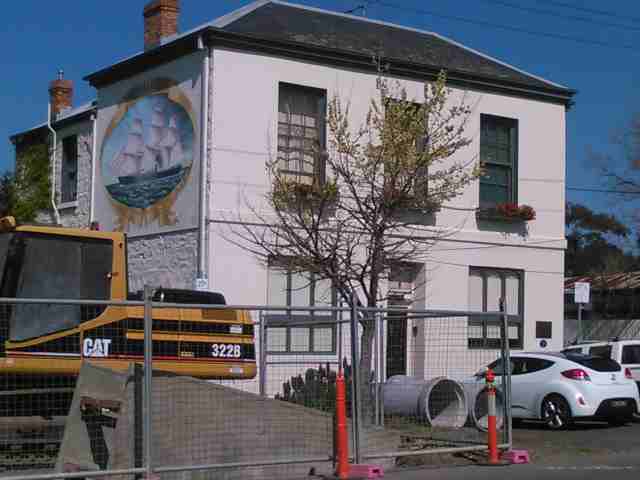
This hotel had a picture of the Shenandoah, a Confederate ship which arrived at Williamstown in January 1865 for repairs after damage received while chasing Union whaling ships. The Confederate sailors were feted by the citizens of Melbourne, and protected from arrest by Governor Darling. There’s been quite a bit of interest in the ship for the 150th anniversary of its arrival
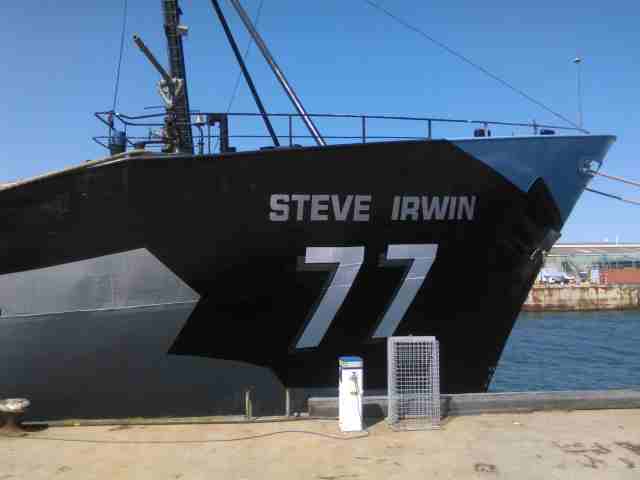
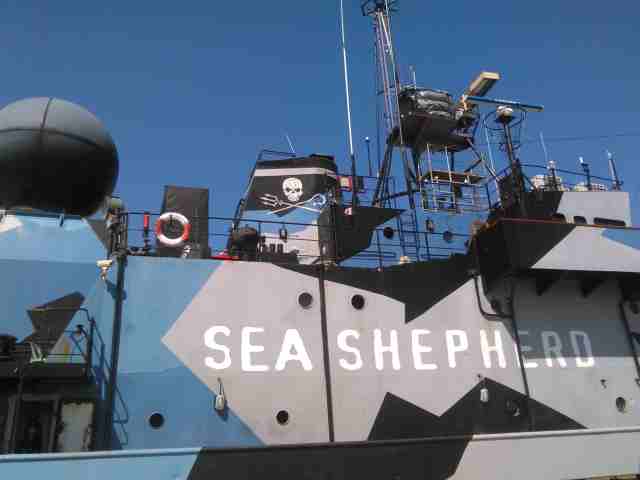
No sign of the Shenandoah, but there was another controversial ship- the Steve Irwin, part of the Sea Shepherd fleet.
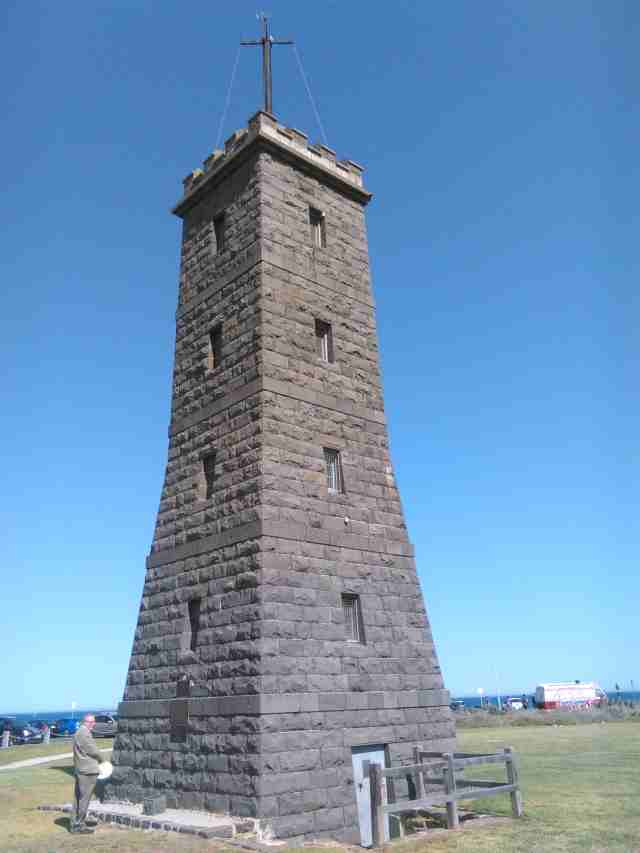
The Williamstown Tower was built in 1849, originally as a lighthouse, then after it was taken over by the Williamstown Observatory, a timeball was fitted and it served as a timeball tower between 1861-1926. At precisely 1.00 p.m. each day the timeball would descend, marking the time exactly for ships anchored out in the bay so that they could adjust their chronometers. Wikipedia tells me that it’s the second oldest lighthouse in Victoria.
We had a very good lunch at Tick Tock Cafe, followed by an ice-cream sitting in the park, then headed for home. The train was filled with people who’d been in at the Grand Final parade and good feeling abounded. The first Grand Final Public Holiday has been a resounding success, I should imagine.
And Hawthorn won.

The Royal Historical Society of Victoria have a fantastic exhibition at the moment that draws on their collection of material about Macpherson Robertson – the source (bless him) of Australia’s oldest, and my very favourite chocolate bar: The Cherry Ripe (now produced by Cadbury)
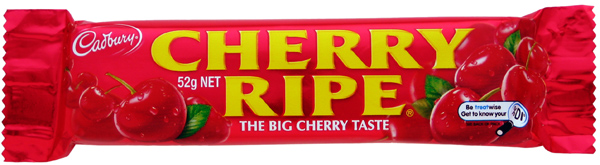
Titled “Nail Can to Knighthood”, this exhibition covers the life of Sir Macpherson Robertson and the significance of his factories in Fitzroy, Melbourne. Australians, it seems, are always being berated for their lack of philanthropy, especially in comparison with the American tradition, but Macpherson Robinson was a Philanthropist with a capital P, and several Melbourne landmarks associated with the centenary of Victoria in 1934 bear his name to this day.
A child of the goldfields, Macpherson Robertson was born in Ballarat in 1859 to a Scottish father and Irish mother. The family returned to Leith, Scotland when his father moved to Fiji in search of work and as a photograph in the exhibition shows, this was not a wealthy family at all. To help the family finances, Macpherson took odd jobs, including working in two confectionery factories. When the family returned to Melbourne in 1874, he started an apprenticeship at the Victoria Confectionery Company. At the age of 21 he started his own business in the family home in Argyle Street Fitzroy, using a nail can and tin pannikin to boil up the syrup that he poured into moulds and rolled in sugar that his mother wrapped in paper cones. Macpherson went on foot to distribute his lollies for sale. From these humble beginnings (and the original nail can and pannikin are on show), he built up a huge enterprise that dominated the suburb of Fitzroy and made him enormously wealthy.
He certainly had entrepreneurial flair and knew the benefits of good advertising. He realized that the name ‘Macpherson Robertson’ was too long to fit onto a lolly wrapper, and so he shortened it to ‘MacRobertsons’. Often his advertising and personal interests converged. When promoting chewing gum (which he brought to Australia after living in America for several years) he spruiked it as being of particular benefit to cyclists. He established a Cycling School, presided over by “Professor Eckenstein” who had taught no lesser luminaries than the Prince of Wales, the Duke and Duchess of Connaught and Lord Lennox! He was fond of cars and sponsored the Round Australia Competition in 1928, and established MacRobertson- Miller Airlines. A croquet aficionado himself, he contributed the land from his own estate in Station Street Fairfield to establish the Fairfield Bowling and Croquet Club, and the MacRobertson Shield is still the most prestigious tournament on the International Croquet scene. He knew how to market his own story as well, with several publications issued during his lifetime that drew on the legend of the nail can.
His philanthropy really hit its straps during 1934, the Centenary of Victoria. He sponsored the London to Melbourne International Air Race in 1934, Mac.Robertson Girls’ High School, MacRobertson fountain near the Shrine and MacRobertson Bridge. As you can see, he was not shy in having his name attached to his gifts, and Sir Douglas Mawson likewise thanked him for his sponsorship of the Antarctic Exhibitions of 1929 and 1930 by naming MacRobertsonLand in Antarctica after him.
The RHSV has a wonderful collection of material, supplemented by material on loan from a variety of sources. As well as the original tin can, there’s a cabinet of lolly samples which are displayed one drawer at a time for conservation reasons, showing the different sorts of lollies produced by MacRobertsons in test-tubes. There’s some fascinating video footage, complete with sound, and I was interested that, considering he left school at such a young age, he had acquired over his lifetime an upper class, albeit completely Australian, accent. Most intruiging of all was a bust of Macpherson Robertson that turned out not to be as it seemed.
The exhibition will be open until Friday 18th December, Mon-Thurs 10.00-4.00 and Friday 10.00-3.00. Gold coin donation entry
If you can’t make it, there’s an excellent site (so excellent, in fact that I wonder if it doesn’t pre-empt the exhibition?) at http://www.culturevictoria.com/stories/built-environment/macrobertsons-confectionery-factory/
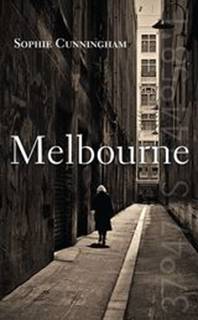
2011, 272 p.
This book is one of a series published by New South where an established author is given an open brief to write a ‘travel book where no-one leaves home’ of about 50,000 – 60,000 words about their own town. There are nine in the series: Peter Timms (Hobart); Matthew Condon (Brisbane); Delia Falconer (Sydney), David Whish-Wilson (Perth); Kerryn Goldsworthy (Adelaide); Paul Daley (Canberra), Eleanor Hogan (Alice Springs);Tess Lea (Darwin) – and this one, Sophie Cunningham’s ‘Melbourne’.
As the commissioning editor Phillipa McGuiness said:
the inspiration for this series was literary, not some pointy-headed urge to make a grand statement about Australia’s cities….While people may read local histories, or dispassionate general histories about where they live, we rarely get the chance to read about our own cities in a way that resonates with our own experience and resurrects memories….So I wanted to ask some of our best novelists and writers to write non-fiction about the cities they lived in – or have adopted – in a way that would evoke intense sense memories for people who are familiar with them and give those who aren’t a sense of what it’s like to live in Brisbane or Adelaide or wherever.
In this book, Sophie Cunningham uses the seasonal year as her organizing structure, starting off with summer and moving through the seasons until finishing up with summer again. Of course- in a city that is obsessed with weather- too hot, too cold, too dry, too wet- and famously has “four seasons in one day”, what other device could you use? In particular, she uses the year 2009-2010, reflecting no doubt the date of commission, but that year was also a particularly memorable one for weather. The summer of 2009 saw three days of excruciating heat (I wrote about it at the time, here) that culminated in the Black Saturday bushfires (that I also wrote about here) that razed Marysville and Kinglake. I think that the fact that I can so easily link to four posts in this blog (and there are more than I could have linked) demonstrates how deeply these events are gouged into the consciousness of a Melburnian.
Cunningham’s book is consciously literary. Not only is she a writer and likely to bring a writer’s consciousness to the task, but the book was written in the wake of her resignation from Meanjin, a literary journal deeply embedded in Melbourne’s cultural identity. She may have left Meanjin under contested circumstances, but her frequent citations of articles from Meanjin commissioned and published under her editorship suggest a continued identification with – and even a lingering sense of grief over- Meanjin.
For readers who are familiar with the city being discussed, there’s an internal comparison at work – “Would I have written the book this way??” Cunningham’s take is very much based on the inner suburbs of Melbourne, and a much younger perspective than I could bring. She is gay, without children, and part of a literary milieu that as a mere reader, I can only observe from outside the window. I think that if I were writing it, I’d be harking back to an older liberalism (all those Victorian worthies who in their way were quite radical), more architecture and possibly more politics. I think I’d have to roam outside into the suburbs beyond the inner city, because I see Melbourne very much as a suburban city too.
The book is only small and beautifully produced- it fits well in your hands. It is by turns personal, historical, anecdotal and observational. I did have a frisson of dissatisfaction near the end which seemed to have too many Melba-esque (pun!) farewells. It was probably more the sense of rounding-off too many times, rather than the ending itself: in fact, I could have happily read another fifty pages more.
An interesting concept, and a really enjoyable read.
My rating: 8.5
Read because: It was on the library shelf
Sourced from: Yarra Plenty Regional Library
 I’ve read this as part of the Australian Women Writers Challenge 2013.
Saturday a few weeks back was a beautiful autumn day and the feeling of sheer panic over the thesis had abated (just for the moment) enough that I felt I could indulge myself with a day off. So onto the train we hopped for a day trip down south to ….Brighton. Why Brighton? Well, Brighton was established very early as a suburb of Melbourne-( as Heidelberg was)- and there are some interesting houses down there. Henry Dendy, an English speculator based in England,had purchased the land in August 1840 as part of the short-lived special survey scheme and arrived in February 1841 to take it up just before Gipps introduced regulations to prevent prime land being sold off at bargain basement price in March 1841. The land was laid out in a very Georgian style with crescent avenues and large blocks, but sales faltered and Dendy was forced to relinquish it. It was purchased by J. B. Were, Dendy’s agent and a well-known speculator who fell under Judge Willis’ eagle eye.
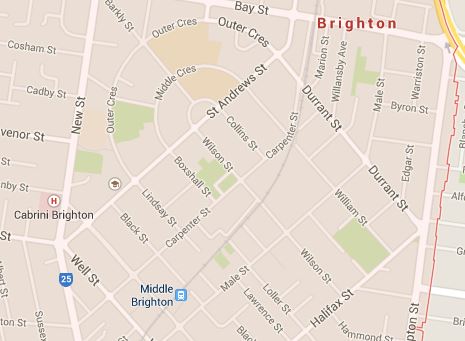
So we downloaded a historic walk (St Cuthbert’s trail) onto our phones from the very helpful Bayside City Council site and off we went. I had a yen for a cemetery (as one does), so we got off the train earlier and walked down to Brighton cemetery first.
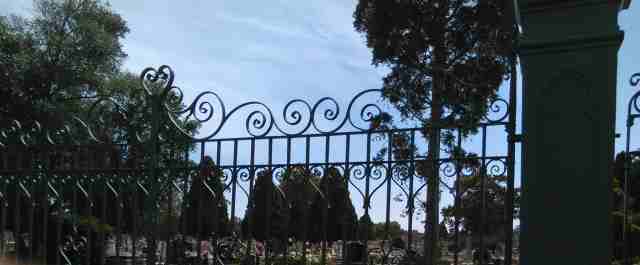
Brighton cemetery (which is actually in Caulfield South) is an old one, with land put aside in 1853 and possibly the first burial in 1855. According to a talk given by Jan Rigby from the Brighton Cemetorians to the Port Phillip Pioneers Group the very earliest graves were laid out at odd angles to the path, and I must confess that we found it hard to orient our way around the cemetery. Unfortunately the box containing pamphlets showing graves of interest was empty, and although I’d downloaded a map of the cemetery on my phone, it was difficult to read in the bright sunlight. Nonetheless, we found some interesting graves:


We were mystified by this tall memorial, with a beautifully rendered copper sculpture on the top.
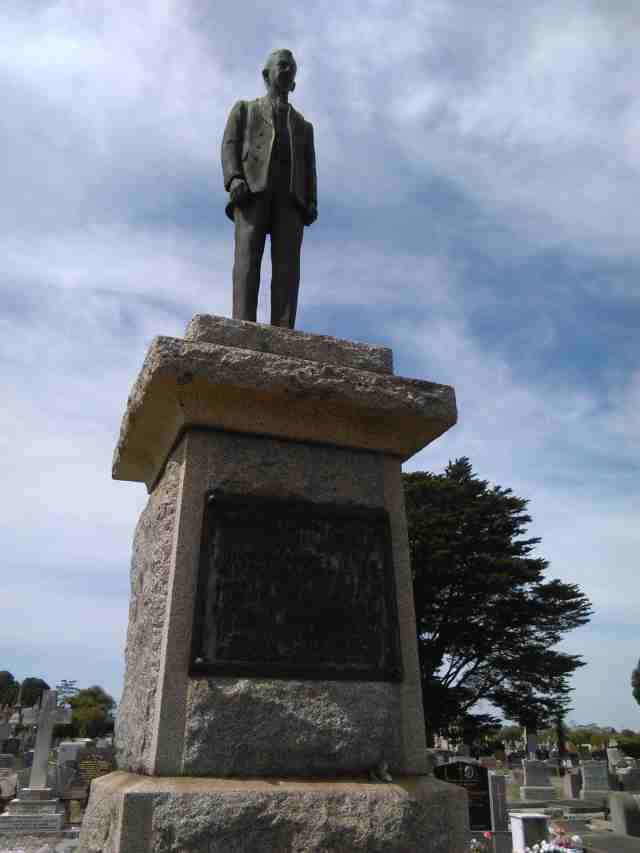
James Coppell Lee? Who was he? I looked him up when I returned home and found that he was the 19 year old son of the owners of the James Coppell Lee copper foundry, which is still operating- amazing! His workmates crafted the copper statue based, apparently, on his cousin because they had no photographs of him.
From the Argus, 29 December 1919
FISHING BOAT OVERTURNS.
YOUNG MAN DROWNED.
Forced by a blinding rainstorm to abandon a proposed fishing expedition off Mornington early on Saturday morning a party of youths attempted to turn their boat shorewards when the light craft was over whelmed by a big sea, and one of its occupants was drowned. Two other members of the party were rescued in an exhausted condition after a stem struggle in the surf
Thc victim of the accident was a youth, James Coppell Lee l8 years of age, whose parents reside at Pyrmont, Barkly street, St Kilda. He had been spending the holidays at Mornington, and with two companions, J Cook, l8 years of age, who lives in Fitzroy street, St Kilda, and P Ratchford, 20 years of age residing m High street. St Kilda, he decided upon a fishing cruise in the Bay. With this object the three youths hired a 15ft. rowing boat at 5 o clock on Tuesday evening. Setting out before dark, they cruised along the shore as far as Grice’s beach, four miles from Mornington, and pitched a camp there so as to permit of an early departure on Saturday morning for the schnapper grounds. Though a rather choppy sea was runnig the party pulled out to the reef and remained fishing there for considerably over an hour.
Under the influence of a fresh northerly at about 8 o’ clock on Saturday morning the sea rose, and as the driving rain began to sweep over this part of the Bay, the youths decided to run tor the shore to avoid the squall that appeared imminent. Their light boat tossed about to such an extent in the confused sea that a great strain was imposed on the rowers on the return journey. Nevertheless good progress was being made until the boat was opposite Mills’s beach Here an attempt was made to run the boat as closely as possible to the boat sheds but the prolonged rowing under such arduous conditions had weakened the rowers. Near the mouth of Tanti Creek, where large rollers were sweeping inshore, the boat was seen by people on the beach to be m a perilous position. Despite the efforts of the crew to keep its bow to the shore the incoming sea buffeted it broad side on, and a second later tho little craft was engulfed in an unusually large roller. Striking tlie boat abeam the wave spun it over and drove it swiftly into the shallows about 25 yards out from the beach
All three occupants were thrown into the water and the boat sank. Cook and Ratchford found bottom in about 5ft of water, but it is evident that Lee in some manner became entangled in the boat or some of the tackle, and went under with i.t A powerful undertow was running at this point but Cook made a plucky effort to drag Lee from under the boat. With water neck high, however, and the under current threatening to sweep him off his feet, the task of extrication was too much for Cook, who by this time saw that his other companion Ratchford, was in distress. A man whose name was ascertained to he Martin ran into the water and brought Cook and Ratchford to the shore. Several young men swam out in an endeavour to find Lee but their efforts did not meet with success It is understood that a second man helped in the rescue of Cook and Ratchford, but his name could not be obtained.Lee was said to have been the strongest swimmer in the party
Telegraphing on Saturday night our Mornington correspondent said that up to then Lee’s body had not been recovered. He was the son of Mr T Conpell Lee brass founder of La Trobe Street
Enough sadness. We caught a tram down to the Nepean Highway and had a very nice lunch at a deli place, then headed off for Middle Brighton. It was further than we thought, so we caught the bus. Dammit, it was an all-day ticket- we were determined to make the most of it.
From there we followed the St Cuthbert’s walk, which you can is online here anyway, so I won’t repeat it. It meandered around the curved avenues in Middle Brighton, around Firbank Grammar. One of the sites described on the walk was a house at 12 Middle Crescent, described as a single-storey Victorian villa built for a dairyman in 1877, when more conventional villas replaced the early 1840-50s cottages.
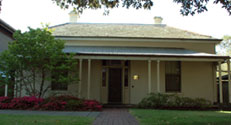
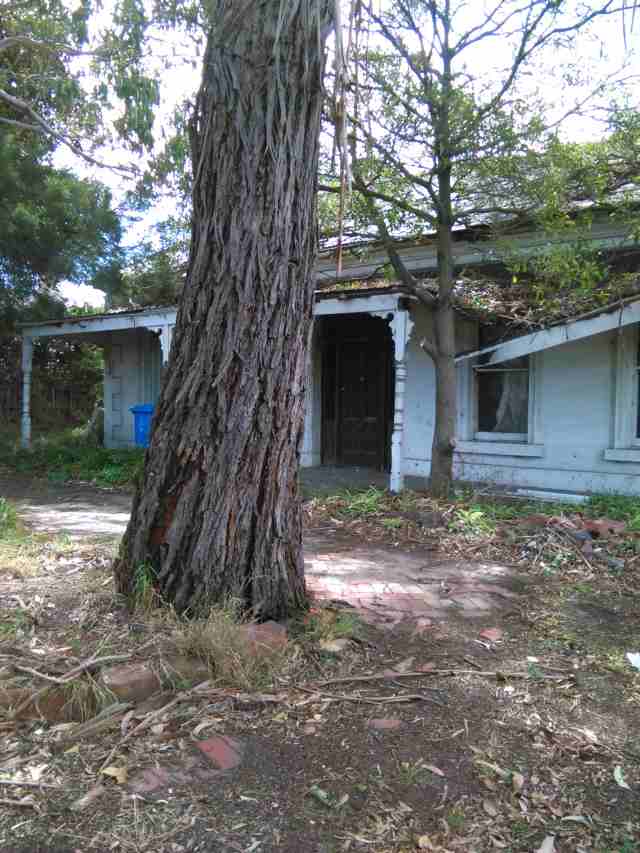
The house itself was unremarkable but I was struck by the house next to it, which was very similar and obviously being allowed to fall into disrepair sufficient to undermine any value of the house (as distinct from the land, that is, which was in a very prestigious spot).
The heritage-listed Brighton Civic Centre was a curious-looking building, erected in 1959 and probably more valued now than it might have been in the mid 1980s, I’d say.
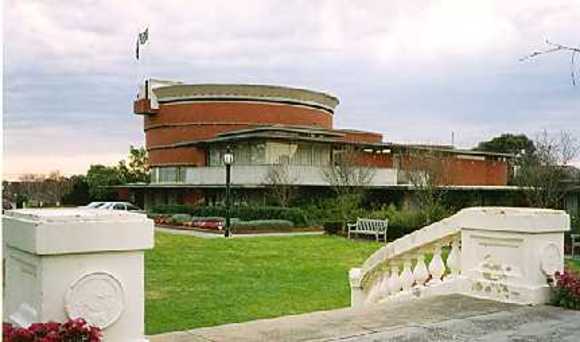
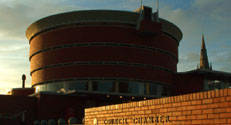
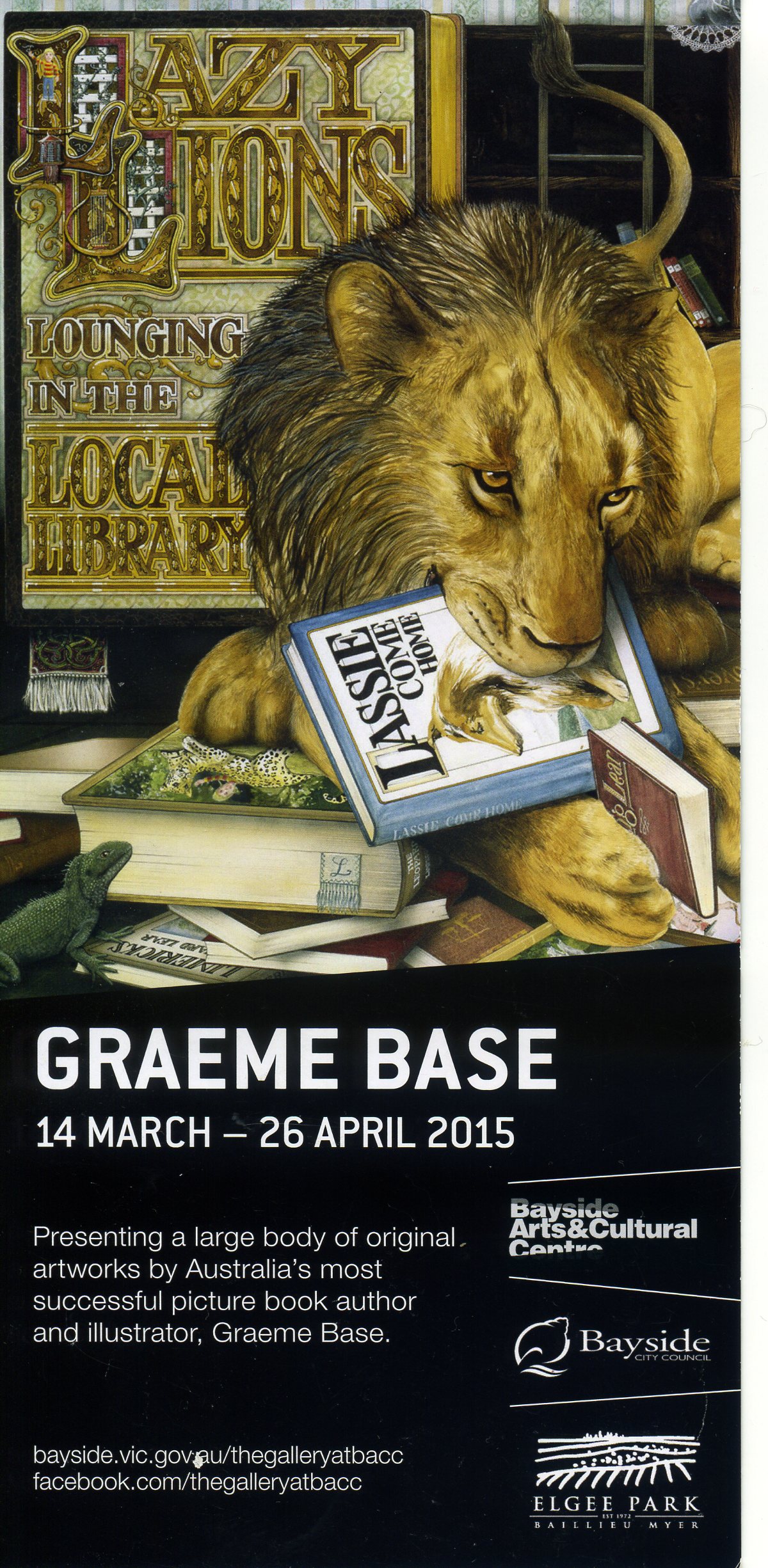
The Brighton Town Hall was featuring a free exhibition of works of Graeme Base, the writer and illustrator of the Animalia book which I remember reading to my children. The exhibition has several of the original paintings from that, as well as the many other books he has illustrated. The video of him from the 1980s talking about Animalia is worth it just for the mullet hairstyle! The exhibition is on until 26th April, but closed over Easter until Wednesday 8th April
Back onto the train, then “Home James and don’t spare the horses”. We’d had value from our day ticket- four trains (two each way), a tram and a bus, and a pleasant day was had by all.
There’s a fantastic exhibition on display at Bundoora Homestead called “Coming Home” that commemorates the use of the homestead as a convalescent farm and repatriation mental hospital between 1920 and 1993. Even though it’s ostensibly an exhibition about the use of a house, it’s a sad and very human exhibition. There are none of the brass bands and official ceremonies that we saw last week at Albany , but this exhibition is an act of commemoration nonetheless.
As I’ve written about previously, (here and here) Bundoora Homestead was built in 1899 by the Smith racing family as their residence and stud farm. In 1920, immediately in the wake of WWI the Commonwealth government negotiated the purchase of Bundoora Park estate as a convalescent farm for returned soldiers from the WWI front. As Marina Larsson wrote in her book, Shattered Anzacs (review), the families of returned servicemen with mental illness were keen that their loved ones not been seen as ordinary ‘lunatics’, but housed and treated in repatriation facilities in recognition of their war service. Bundoora Repatriation Mental Hospital was sited across the road from Mont Park as a separate, soldiers-only hospital that could draw on the facilities of the civilian asylum nearby.
The exhibition focuses on individual men, most particularly Wilfred Collinson and Harry ‘Lofty’ Cannon, who spent decades of their lives at Bundoora.
Wilfred Collinson was a British migrant, who arrived in Australian in 1914. He hadn’t been here long, working as a farm labourer with a friend that he’d met on the ship over, before the two lads volunteered and were returned to Europe to fight in WWI. He had a long war, and was gassed four times. On his return to Australia he and his friend, Eric Brymer, boarded in South Melbourne, and Wilfred soon married the girl next door and embarked on a family life. His children grew up with a father affected by “nerves” who became increasingly delusional, and eventually he was committed to Bundoora in the 1930s. As Larsson points out, families often had to battle the government for pensions and recognition that illnesses and injuries were war-based, and Wilfred Collinson’s wife is a case in point. His friend Eric Brymer, who was the only person who could testify to what Wilfred had been like before the war, wrote a letter in support of his wife’s application on her husband’s behalf. Then followed another thirty-five years, and two generations, as his wife and daughter, then daughter and his granddaughter, went out to visit ‘Dad’ at Bundoora. He died there in 1972. His war, in effect, was never over. (You can see the video of his daughter and granddaughter on the exhibition site here. The video is also running at the exhibition).
Harry ‘Lofty’ Cannon was a medical orderly with the 2/9 Field Ambulance and Changi POW. We’ve all heard about Weary Dunlop, but I’d not heard of Lofty Cannon. He was a tall man- 6 foot six- but it was a shrunken life that he returned to after WWII. He’d married just six days before leaving for the front, he fought in the Malay campaign and was captured as a prisoner of war in 1942. While he was at Changi he met Ronald Searle, an English prisoner-of-war, who later credited Lofty with saving his life, nursing him through beri-beri and malaria. Lofty wasn’t in much better shape, with ulcers, malaria and dysentery and the after-effects of beatings from the Japanese guards. He was hospitalized at the Repat. in Heidelberg in 1946 on his return to Australia, where he received ECT and insulin coma therapy. By 1947 he and his wife were living on a soldier-settlement farm near Swan Hill but by 1960 his wife and adopted son returned to Melbourne and Lofty went to Bundoora. From Bundoora he wrote letters to his wartime friend, Ronald Searle in England, by now a noted artist and illustrator, probably best known for his St Trinian’s illustrations. Much of the display shows Searle’s sketches that he made of Changi, several featuring Lofty. These are in the possession of the State Library of Victoria, and you can see them online if you search slv.vic.gov.au for “Cannon, Harry (Lofty)”. He died in 1980 at Bundoora. Rachael Buchanan wrote a terrific essay about him in Griffith Review 2007 freely available here.


Bundoora Homestead is beautifully restored and such a peaceful place today that it’s hard to believe that so much sadness seeped through its walls and the now-demolished wards that once surrounded it.
The exhibition runs until 7 December at Bundoora Homestead Art Centre, 7-27 Snake Gully Drive Bundoora, Wed-Friday 11.00-4.00 p.m and Sat and Sun 12.00-5 p.m.
Website: http://www.bundoorahomestead.com/
From my study window, I can see everyone who walks along our street [cue maniacal laughter]. The room has an L-shaped window, so I can watch walkers as they pass several houses either side of me. Unfortunately for my thesis writing, I seem to spend an inordinate amount of time looking out the window.
I’ve just seen a young man walking past the house across the road. It has a white picket fence, behind which is a beautiful array of old, multicoloured roses.
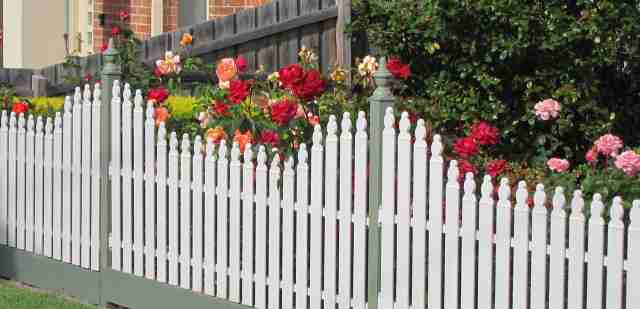
He stopped, put his bag down, and smelled the roses. Then he picked up his bag and kept going.
Somehow I don’t think that anyone will ever stop to enjoy a pebble garden with cordylines.
Posted in Heidelberg, Life in Melbourne, Macleod
There’s an art installation on the steps leading up the State Library. You might think of it as a garden, but it’s not. (Click on the photos to embiggen)


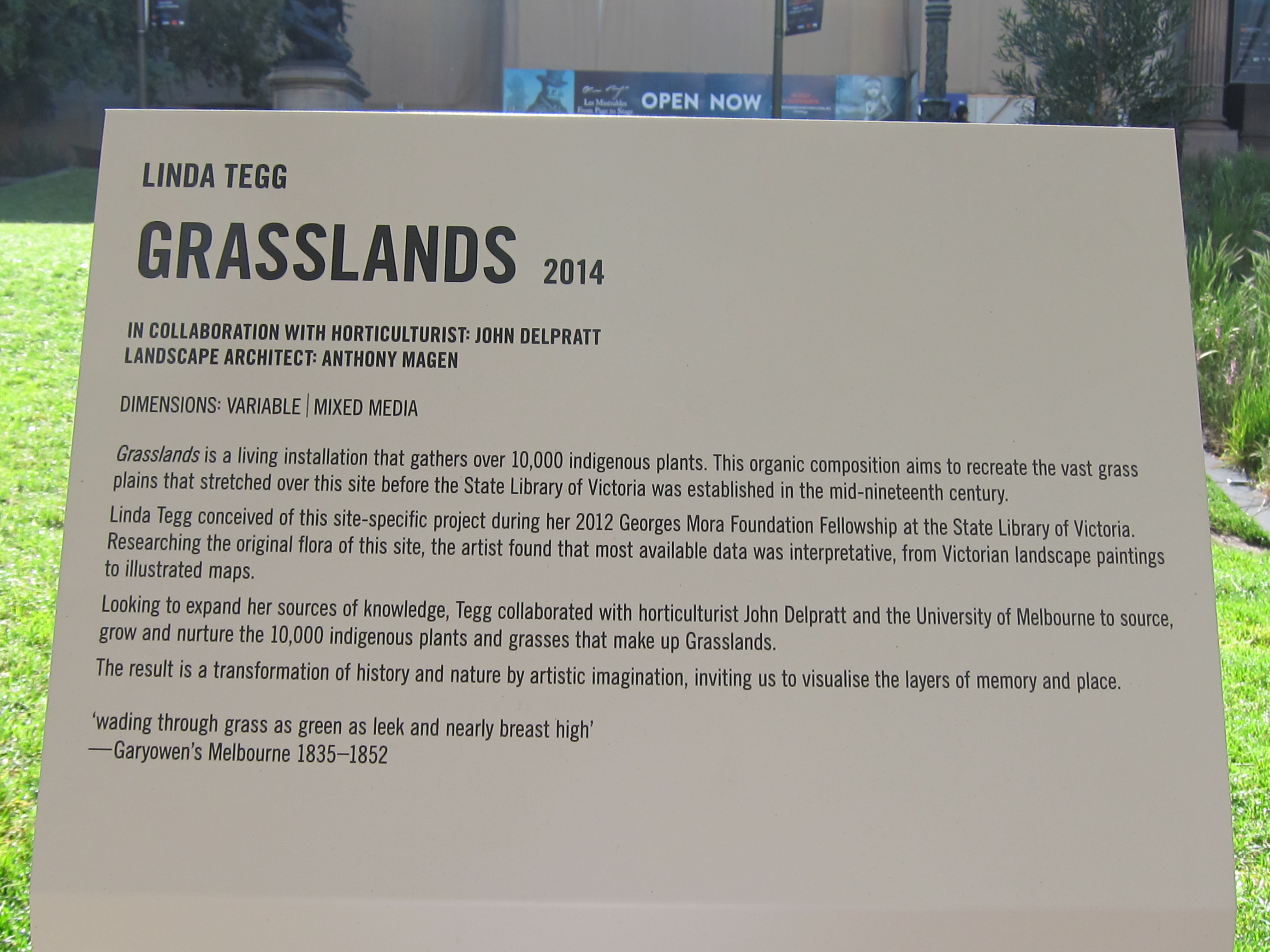
Created by Linda Tegg and titled ‘Grasslands’, it is
a living installation that gathers over 10,000 indigenous plants. This organic composition aims to recreate the vast grass plains that stretched over this site before the State Library of Victoria was established in the mid nineteenth century…. The result is a transformation of history and nature by artistic imagination, inviting us to visualize the layers of memory and place.
It’s a good place for it. I think of the grass outside the State Library as being the real heart of Melbourne. As soon as the sun’s out, there we are, stretched out on the lawn with our shoes off, wriggling our toes. The former City Square on the corner of Swanston and Collins opposite the Town Hall is now a gritty unpleasant desert since they sold half of it off and covered the rest with granitic sand. And don’t get me started on Fed Square that alternates between icy blasts and baking heat. I’m horrified that there could even be any consideration of letting high-rise buildings block the State Library forecourt: a planning restriction that we were told was sacrosanct (huh!). Just like the overshadowing of the south bank of the Yarra, which it seems is another no-go zone that becoming somehow negotiable.
Back to Grasslands. It’s not intended to be a permanent installation. When you look at it closely, the grasses are still in their containers, laid out in pallets directly onto the concrete.
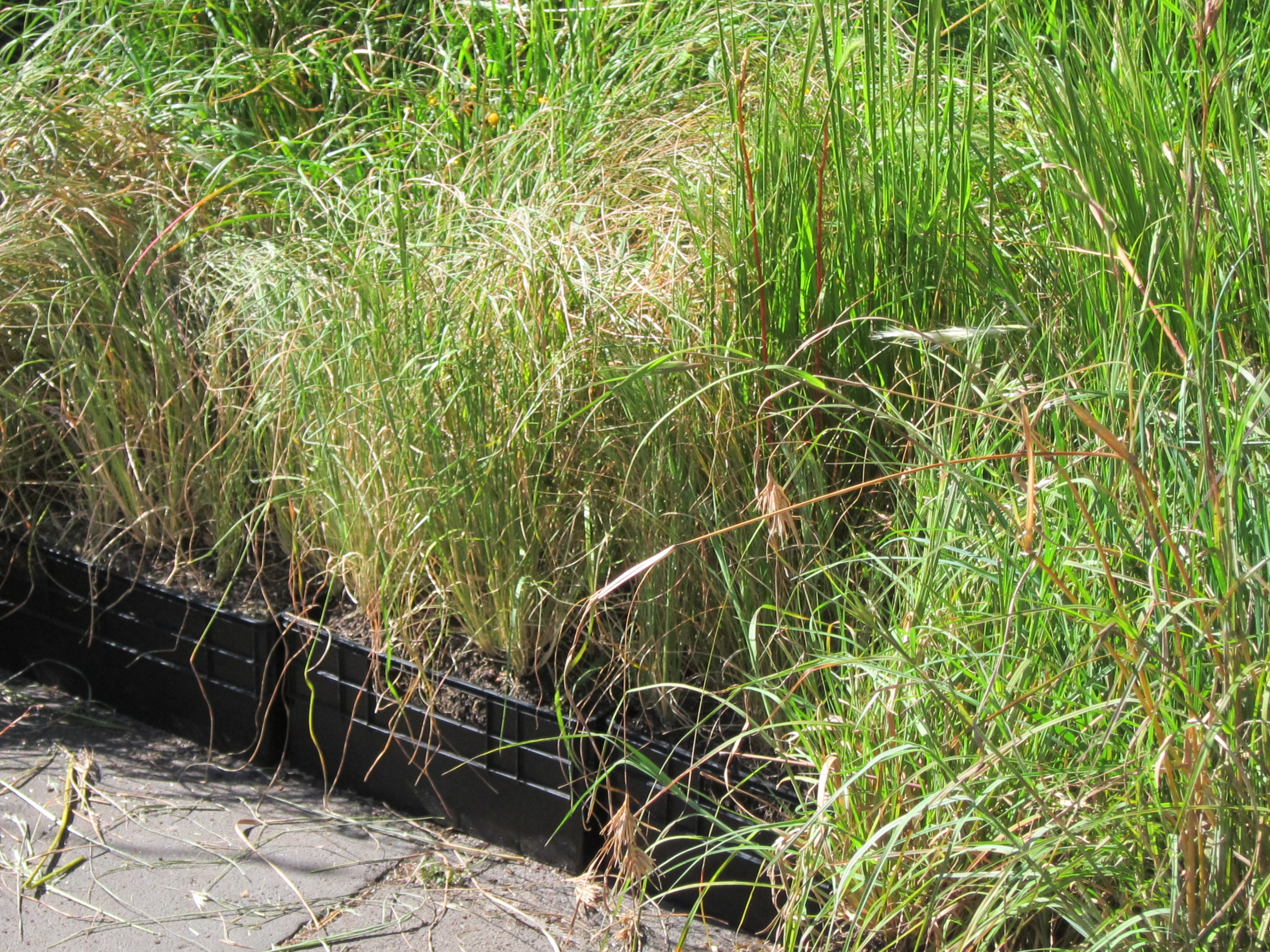
It’s only intended to be there for six weeks.
There’s a fantastic little timelapse video of it being installed. Watch it- it’s good! And just as I said, you can see people coming to sit and lie on the grass either side of the installation.
http://media.theage.com.au/news/national-news/timelapse-grasslands-by-linda-tegg-5868696.html
Having read Bill Gammage’s The Biggest Estate on Earth, I’m seeing my city differently. A good history does that. Gammage takes seriously the writings of early settlers when they described the land around them.
Here’s John Helder Wedge, Letter to Mr Frankland on settlement at Port Phillip, VDL Magazine, 1835 :
The country between the rivers [Maribyrnong and Yarra] extending to the north forty or fifty miles, and to the east about twenty-five miles… is undulating and intersected with valleys; and is moderately wooded, especially to the east and north-east; to the north there are open plains… The surface is everywhere thickly covered with grass, intermixed with rib-grass and other herbs. (cited in Presland, p. 27)
Or here’s the gardener James Flemming, who along with Acting-Lieutenant Charles Robbins and Charles Grimes the acting-surveyor-general sailed to Port Phillip in January 1803, prior to the Collins settlement at Sorrento. They sailed right round the bay- the first of the British visitors to do so.
4th February 1803. Started at six and came to the branch we passed before [junction of Maribyrnong and Yarra] at the entrance the land swampy; a few miles up found it excellent water, where we saw a little hill [Batman’s Hill] and landed… went on the hill, where we saw the lagoon seen from the hill where we first landed. It is a large swamp between two rivers; fine grass, fit to mow; not a bush in it [West Melbourne Swamp]. The soil is black rich earth about six to ten inches deep, when it is very hard and stiff. About two miles further went on shore again, the land much better and timber larger. (cited in Presland p. 13)
Although, then there’s George Arden’s report from his Latest Information with Regard to Australia Felix, the first book published in Melbourne. He claims to be an eyewitness
When the writer first saw this settlement (Melbourne) in January 1838, a few months after its authorized establishment, it presented more the appearance of the villages he had seen in the interior of India; a nucleus of huts embowered in forest foilage and peering at itself in the river stream that laved the thresholds of its tenements, than any collection of buildings formed by European hands. (p. 68)
Hmmm. Don’t know quite what to do with that description.
And finally, good old Edmund Finn (writing under the pen-name ‘Garryowen’). Linda Tegg used this quotation on her explanatory panel:
From the spot whereon Melbourne was afterwards built to the Saltwater River confluence, the Yarra Yarra flowed through low, marshy flats, densely garbed with ti-tree, reeds, sedge and scrub. Large trees, like lines of foliaged sentinels, guarded both sides, and their branches protruded so far riverwise as to more than half shadow the stream… As for herbage, it luxuriated everywhere, and two persons still living, who walked through un-streeted Melbourne in 1836, have informed me that in the places now known as Collins, Bourke, Elizabeth and Swanston Streets, they waded through grass as green as a leek and nearly breast high (Garryowen, Chronicles of Early Melbourne p. 497)
References:
Garryowen (E. Finn), The Chronicles of Early Melbourne, vols 1-2 (Melb, 1888)
T. O’Callaghan, ‘Fictitious History’, Victorian Historical Magazine, vol 11, no 1, Mar 1926, pp 6-37 (accessible through the SLV site)
Gary Presland Aboriginal Melbourne: The Lost Land of the Kulin People, 2001
A.G.L. Shaw A History of the Port Phillip District: Victoria Before Separation, 2003
Posted in Current events, Life in Melbourne, Melbourne history, Port Phillip history
Tagged Linda Tegg, State Library
My youngest child is walking her feet off for the Oxfam 100km Trailwalker today. And was I there to support her? Why, no – I was off into town to catch one exhibition before it closes and to see two others that I’ve promised myself I must see. I’ll do supportive mother tomorrow.
The first exhibition, which closed today, was ‘Learning from Surfers Paradise’ which was displayed in the lobby to RMIT’s Design Hub at 100 Swanston Street (corner of Victoria Street).
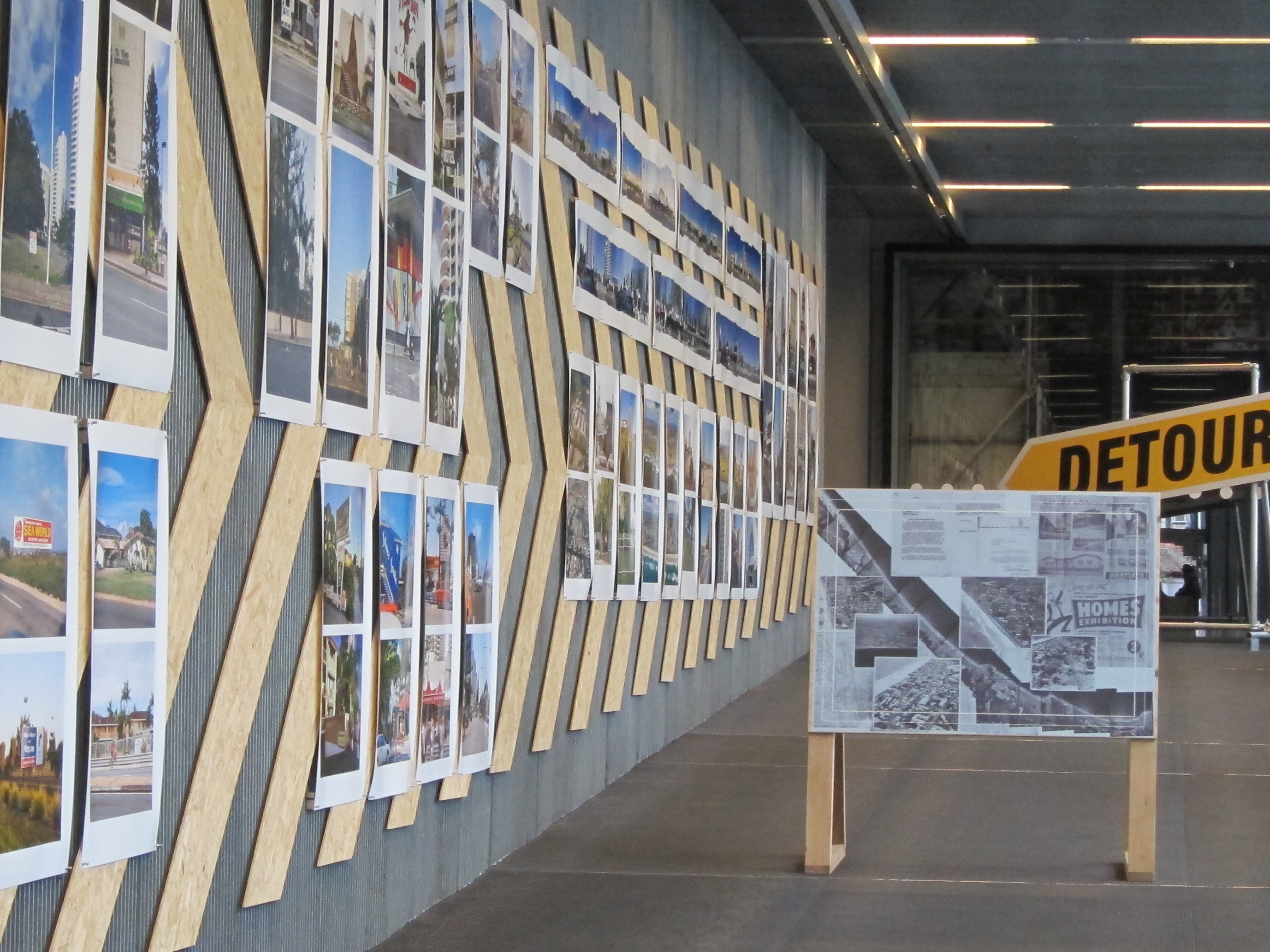
Architectural photographer John Gollings, along with three others, arrived in Surfers Paradise in 1973 to undertake a project photographing Surfers Paradise. Forty years later he returned and took the same photographs again from the same spot. So what do we learn? Many of the buildings in 1973 that had been cutting edge in the 1950s and 1960s were looking a little tatty by then. There’s a sameness about many of the buildings that have replaced them. Certainly there is more greenery in the streets. Some buildings from the 1950s and 1960s quite frankly were no loss at all. Others, however, were a loss- especially the Surfers Paradise Hotel which had such a distinctive outline and was replaced by a very ordinary entrance to a shopping centre. We used to holiday up there from about 1975 onwards, so many of the places were very familiar. There were a couple of places in the recent photographs that I recognized that are still there.
Then off to the Ian Potter Museum at the University of Melbourne.
They have an exhibition ‘Secret Lives, Forgotten Stories: highlights from Heritage Victoria’s Archaeological Collection’. I was attracted to this exhibition (which is on until 12 October) because it has artefacts that were collected from excavations at Viewbank Homestead. Viewbank, which was demolished in the 1920s, was situated close to Banyule Homestead, and there was a close association between the two houses through Robert Martin and his family. There have been several digs at Viewbank which have uncovered pottery, crockery, toys, bottles etc. One rather amazing find: a cup with ‘Robert’ written on it. All of a sudden, these jagged shards of crockery seemed very personal.
Most of the material came from Viewbank, but there are other archaelogical digs featured as well: the coffins shifted from the Old Melbourne Jail to Pentridge that included Ned Kelly’s bones; Cohen place near the Little Lonsdale Street excavation; the Eureka lead; a Chinese brick kiln from Bendigo; the Sorrento settlement, and two shipwrecks.
Finally off to the NGV for their Blake exhibition. Plenty of time to see this one too- it closes 31 August.
Did you know that Melbourne has the largest share of the 102 watercolours created by Blake to illustrate Dante’s Divine Comedy? They were purchased in 1918 by a consortium arranged by Robbie Ross (Oscar Wilde’s close friend) that comprised the National Gallery of Victoria, The British Museum, the Tate Gallery, Birmingham Museum and Art Gallery, the Ashmolean Museum at Oxford and two private collectors. The watercolours were to be sold as a set and there was much anxiety that they remain ‘within the Empire’.
The National Gallery of Victoria was a major player amongst these illustrious organizations because it had been recently enriched by the Felton Bequest. The prosperous Melbourne businessman Alfred Felton had left 383,000 pounds as an investment fund, with the earned income to be divided equally between nominated charitable causes and the NGV for purchases of art. So, all of a sudden the little art gallery from the bottom of the globe, with all its wealth, was welcomed with open arms.
Dividing up the set was conducted through a carefully pre-arranged system, whereby the watercolours were divided into three categories depending on how finished they were (because some were still very rudimentary sketches). Depending on their contribution, each consortium member could select in turn from the three categories in a round-robin arrangement. National Gallery Victoria and the Tate each ended up with 36, the British and Birmingham museums six and the Ashmolean and private collectors three each. Despite the plan to keep them within the empire, twenty three ended up at the Fogg Museum at Harvard University.
Melbourne’s thirty-six are on display in a large darkened room on the ground floor. In fact, you can see them all here on your computer but they’re much, much better in real life. There is also a digital display of the whole 102 watercolours at the exhibition, along with a brief description and explanation of the scenes from the Divine Comedy that they are illustrating. I felt a little guilty looking at the digital version while the real thing was hanging just a few metres away, but I really didn’t know much about the Divine Comedy, and I appreciated them more having seen the whole collection. I find it amazing that Blake was working in the early decades of the nineteenth century: they are striking pictures.
All these exhibitions were free. How blessed we are. Along with a good coffee or two, a tasty lunch while resting our feet, it’s been a lovely day. Speaking of resting one’s feet, I wonder how that daughter’s getting on….
 The Resident Judge of Port Phillip