Category Archives: History writing

Uplifting Quotes for the Uninspired Historian #19

Image

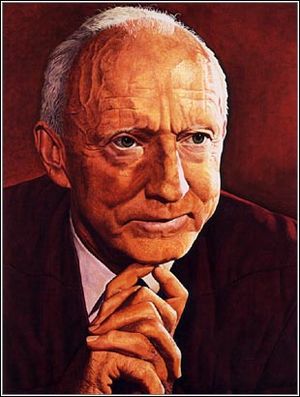
Roger K. Newman, ‘Writing Hugo Black’s Biography’

To be honest, I had no idea who Justice Hugo Black is. My interest is not so much in him as in the advice given by his biographer, Roger K. Newman in a chapter called ‘Writing Hugo Black’s Biography’ in a collection of essays with the rather utilitarian title The National Conference on Legal Information Issues: Selected Essays.  His chapter is about the process of writing a judicial biography, although his advice is applicable to any type of biography, judicial or not.  Indeed, much of it applies to any writing, biography or not.  And, I suspect, the chapter is more relevant to writing a book than a thesis.  Nonetheless-

The cardinal rule- call it Newman’s first law of biography- is to show the reader what happened, not just tell him.  Dramatize dialogue and set scenes- even the most flat-footed facts can be presented appealingly. Indulge in metaphor, vary sentence length and structure. Foreshorten perspective, summarize when necessary and recapitulate (some things are important enough to remind the reader). Pace the narrative- a biography is a story, not an argument.* Drop hints.  Planting my pistols early, I was able to use flashbacks.  I took to calling this “closing the circle”. (p.208-9)

*Me: A story, not an argument? Mmm. Not sure that I agree.  Especially in a thesis/biography.

Newman’s second law of biography is to omit almost anything that does not bear directly on the central protagonist… The point is that a biography should be shaped and molded. Condensation is indispensable.  Even in this egalitarian age, not everything is of equal importance.  Just because something happened, and we know about it, does not mean it should be immortalized.* (p. 210)

* Me: This is a real temptation when you have only a limited amount of source material of a particular type.  You’re so grateful for the scraps that you have that you feel that you want to make as much as you can of them.  But, to be honest, they don’t really advance the story (or is it the argument?) much.

Thus comes Newman’s third law of biography: Use spirited prose and humour… A biography is, after all, about people, and people want to read about other people  It is the most humanizing of all literary ventures, especially at a time when heroes have been taken off the pedestal and defrocked. (p. 210)

And so-

Portraying character in action lies at the heart of biography. A biographer must look for the telling incident, the revealing detail.  He is the unseen hand- the biographer as Adam Smith- shuffling, dealing, reassembling the deck, his active imagination dealing with malleable facts.  Like a director, he changes the scenes and brings supporting figures to the fore as needed, dressing them as needed and then sending them backstage.  He is present everywhere yet seen nowhere- only in his choice of materials and language.  I could have written almost every chapter in at least one other way. (p. 212)

Roger K. Newman, ‘Writing Hugo Black’s Biography’ In Timothy L. Coggins The National Conference on Legal Information Issues: Selected Essays. (American Association of Law Libraries) AALL Publications Series No. 51, Colorado,  Fred B.Rothmann & Co, 1996.pp. 201-214

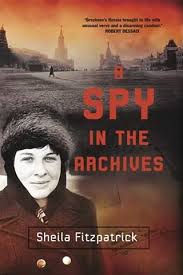
‘A Spy in the Archives’ by Sheila Fitzpatrick

fitpatrick

2013,  345 p.

I have been the first person in my immediate family to go to university, although several of my cousins did as well.  I find it hard to imagine what it would be like to grow up as the child of academics and intellectuals. Part of my fascination with this book was reading about the child of historians becoming a historian herself.  Sheila Fitzpatrick’s father was the left-wing historian and public intellectual Brian Fitzpatrick and her mother Dorothy Fitzpatrick taught history at Monash University.

This book is the second memoir written by Sheila Fitzpatrick, noted Soviet Historian, and now Honorary Professor at the University of Sydney after a long academic career overseas. Her first memoir was called My Father’s Daughter  which, from the title,  I assume explores the generational issue further.

In this second memoir we are taken on the first steps of the author’s academic journey as she travels first to Oxford University to undertake her doctorate in Russian history. Her dissertation topic was Anatoly Vasilyevich Lunarcharsky, the Russian author and politician who was appointed Commissar of Enlightenment between 1917 and 1929.  Her thesis was titled ‘Lunarcharsky as Philosopher  and Administrator of the Arts’ and it ended up being published by Cambridge University Press as The Commissar of Enlightenment in 1970.  It was the stepping stone to Fitzpatrick’s eminent career as a historian of Russia.

It was not surprising that a daughter of Brian Fitzpatrick would be attracted to such a topic, but she claims that “Becoming a Soviet historian wasn’t a foregone conclusion, even with a left-wing father and a bit of Russian” and that from the age of about 13 she had become “less of a true believer in my father’s causes than earlier” (p.7).  Fitzpatrick’s father had died by the time she embarked on her academic career, and yet one senses that she continued to have an intellectual argument with him in her head at least.  The book is not so much a ‘ coming-of-age ‘story , as a story of  ‘coming-as-historian’ as she finds her own mentors and develops her own confident intellectual stance as a historian.

In the 1960s it was common for first class honours students in history to undertake their doctorates overseas, and so she trod a well-worn path. She was not terribly impressed with St Anthony’s College at Oxford and the supervision she received there.  In 1966 she applied for a British Council exchange scholarship to enable her to live in Moscow and to use the archives there for her research. Her application was refused initially but eventually received after she embarked on a rather utilitarian marriage to a fellow British student.  As part of the preparation for her stay in Moscow, she and her cohort of fellow researchers were warned against spies- indeed, against friendships with Russian people, full stop.  Like her fellow students  she ignored this advice, and this book describes her friendship with Igor, a middle-age friend of the now-dead Lunarcharsky, and Irini, Lunarcharsky’s daughter,  that developed as she delved deeper into her research.

This book emerged from a long article that she wrote in the London Review of Books, and you can get the flavour and much of the content from reading this article alone (which is often the case with LRB articles).  In fact, it’s such a detailed article that you barely need to read the book!  I must admit that, with little knowledge of post-revolutionary and Cold War Russia (or at least, I’ve forgotten what I ever did know), I found the content aspects of this article easier to follow than the book.  But it’s well worth going to the book itself because her research is only one facet of her story: it’s also about friendships, authenticity, insecurity in a clandestine world, and history-writing.

She writes of the joy that all historians feel when working in archives, but to her, working in the Soviet archives was particularly pleasurable- in fact, she pitied those British historians who would roll up to the PRO, ask for a file, and have it handed over instantly.  In Moscow, not only was there the challenge of even getting access to the archive,  but once admitted, there were strict limits on what was made available because the thesis topic is treated like a straitjacket.  There’s no chasing off down rabbit holes and false leads and serendipitous rainbows here: if a file was not directly related to the topic as you first conceptualized it, then you couldn’t see it.  Foreign researchers were not given access to catalogues,  so there was no way of knowing what to ask for.  Contact between foreign researchers and  their Russian counterparts was strictly forbidden, and the archivists held enormous power over what you could see and what you could not.  It all became a bit of cat-and-mouse, albeit playing with a cat with sharp eyes and sharp claws that you could not always assume would remain sheathed.

However, one aspect in the book that does not come through in her article is the process of the historian writing a memoir.  She mentions at one stage that one of her husbands had returned the letters she had written to him, in order for her to write this memoir.  She uses the correspondence between her mother and herself as well, triangulating it against the diary that she wrote at the time.  She often says that she cannot remember certain events that are documented, and is often nonplussed to explain things that she had written at the time.  As a result, it is a careful memoir that has a sense of distance between the writer and what she remembers  (or does not remember)  about the events she experienced.

And was she a spy?  In the end the Soviets thought so and clumsily ‘outed’ her, and she herself is not completely sure. She certainly was not an MI6-type spy but, as she admits, it would have been plausible for her to have turned out to be one after all:

Was I, in some sense, a spy? If the Soviets couldn’t make up their minds, it’s not surprising that I had trouble.  I can certainly recognize some spy-like characteristics in myself, starting with my intention to find out everything about Soviet history, including the things that the Soviets wanted to keep hidden.  If a spy is a chameleon who can speak two languages and doesn’t know what his ultimate allegiance is, that partly fits. (p. 342)

I enjoyed this book, and the undercurrent of Cold War tension that runs underneath it. I liked the reflexivity of her writing and the caution with which she treats the memoir genre.  I wish that I knew more about Russia, because I did find the details of her research rather overwhelming at times but not so much that I was ever tempted to give up.  I resisted the temptation to Google, trusting her to take me on the journey, and she did not let me down.

awwbadge_2013I’m posting this to the Australian Women Writer’s Challenge under the History/Memoir/Biography section- and, for this book at least, it fits all three categories!

AHA Rethinking Indigenous Histories podcast

You might remember that I blogged about the Rethinking Indigenous Histories panel at the recent AHA conference that I attended in Wollongong.

The podcast of the session is now available at Radio National’s Big Ideas page.

The panel, chaired by Richard Broome, Emeritus Professor of History at La Trobe University  included:

Professor John Maynard
Director of the Wollotuka Institute of Aboriginal Studies, University of Newcastle. He is a Worimi man from the Port Stephens region of New South Wales and currently holds an ARC Australian Research Fellowship (Indigenous).
Professor Tim Rowse
School of Humanities and Communication Arts, University of Western Sydney
Professor Marcia Langton AO
Foundation Chair of Australian Indigenous Studies at the University of Melbourne
Professor Ann McGrath
Director of the Australian Centre for Indigenous History at the Australian National University.

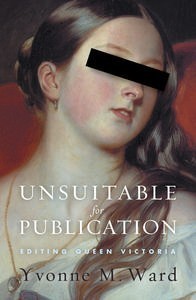
‘Unsuitable for Publication: Editing Queen Victoria’ Yvonne M. Ward

ward2013

2013,  173 p.

We’re told that it’s all about controlling the narrative.  Politicians all do it, it seems; and we risk losing control of our narrative by putting too much of our lives onto the internet, we’re told.  All this might seem far removed from good old Queen Victoria, but on reading Unsuitable for Publication, I’ve realized that it isn’t.  Then and now, it’s all about image creation and the interplay between the image we think we have constructed and the image that others might massage or manipulate from our words.

Queen Victoria was a huge correspondent.  She wrote 122 volumes of her diaries over her long life and she maintained a large correspondence with her family  members so widely dispersed amongst the royal families of Europe, as well as a vast network of communication amongst politicians, and other notables. It has been estimated that she wrote an average of 2500 words each day of her adult life, and perhaps sixty million words in the course of her reign (p.9).  What to do with all this writing?  Her daughter Princess Beatrice thought that she knew.  Queen Victoria had appointed her as her literary executor, and after her mother’s death and over 30 years she copied the entries of the 122 diary volumes into 111 thick exercise-books, altering and censoring anything liable to ‘affect any of the family painfully’, then burnt the originals.  Interestingly, Victoria herself had published extracts from her own journals while she was on the throne, so she wasn’t beyond a bit of image-creation herself. Continue reading

‘Writing Lives Forwards: A Case for Strictly Chronological Biography’

MappingLives

2002, 360 p.

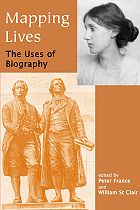
As you might know if you’ve been following this blog for any length of time,  I’ve been thinking and grappling recently with the narrative form that biographies can take- chronological, thematic and novelistic- and wondering how much latitude the thesis genre allows in adopting these approaches.  As part of this,  I’ve been reading a book of essays on the writing of biographies called Mapping Lives: The Uses of Biography, edited by Peter France and William St. Clair.

I was particularly taken by an essay in this volume by Mark Kinkead-Weekes called ‘Writing Lives Forwards: a Case for Strictly Chronological Biography’.  Kinkead Weekes was a D. H. Lawrence scholar and the lead author for the Cambridge University Press three-volume biography of Lawrence,  for which he wrote the second volume dealing with the years 1912-1922 of Lawrence’s life. This biography adopted a straight chronological approach, as Kinkead-Weekes notes, “following his life forwards, miming the way it was lived, and banning all hindsight” (p.236).   David Ellis, the author of the final volume, wrote in his obituary of Kinkead-Weekes in 2011 that Kinkead-Weekes’ forte was infinitely painstaking and sympathetic exposition of an author’s processes and intentions” and I think that you can see this in Kinkead-Weekes’ chapter  that praises “strictly chronological biography”.

Kinkead-Weekes

There does seem to me to be something rather workmanlike about a chronological account and so I was interested to read an argument in support of it.   Why did he choose to write Lawrence’s biography this way?

The main reason for adopting a chronological method however was to resist the urge, so powerful in biographers, to structure a life too early and too simply into some overall pattern and explanation. (p.238)

He does qualify his support for chronological method somewhat by upholding its usefulness particularly at first draft stage.

Of course, biographers who have been researching for years do already know the general shape of the story they have to tell and how it will end, before they write the first word; and of a course a life could not be written week by week, let alone day by day, even if enough data were available, without insufferable tedium.  What is possible, however, at the crucial first-draft stage when a general sense of things begins to develop into an organized story, is to work on, and then narrate in, time-spans small enough to allow all the evidence to be freshly commanded at once, with nothing but space ahead.  This approach brings immediate advantages.  Misconceptions show up, puzzles can be clarified, unexpected connections appear, simply through careful attention to the exact sequence and context of events…” (p. 236)

But even beyond the first draft, there are other advantages as well:

Above all, strict chronology allows some miming for a reader of how a life may have felt to live, at the time.  There will be too many spaces, unknowns, opacities, for this to be more than partial, and frustrating, as biographers know only too well; but the strictly chronological method also tends to show up the gaps in the evidence which confident analysis conceals.  It constantly throws the emphasis on the experience of the biographee rather than on the commentary of the biographer.  It is also a way of inviting the reader in on more equal terms, watching the life unfold rather than having its significance anticipated, or being enclosed in the biographer’s analytic structure, or for that matter the subject’s own retrospective imagining.  In try to make change and development more manifest, it also affects the treatment of relationships, aiming at greater complexity and changefulness in other characters too.  Finally- although an avidity for judgement is one of the less admirable reasons for the fascinations of biography and no biographer can be wholly free from presupposition and prejudice- the chronological method does tend to delay verdicts until there has been sufficient exploration of process and development. (p. 251)

However, he was aware that a strictly chronological approach had its drawbacks as well.

The price that has to be paid for strict chronology, however, is also huge.  Every one of its gains will increase the length, slow the pace, and involve a degree of repetition when the eventual bearing of previous developments becomes clearer (p. 251)

The result, he feared, is bagginess, and you’d have to say that the Cambridge biography (which I haven’t read) in three parts at a total length of 2,349 pages might fall into that category!  Makes a thesis look a mere bagatelle!  And, unfortunately, undercuts completely his argument about his usefulness for a strictly chronological approach- at least for the final product- I’m afraid.

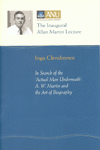
“In Search of the ‘Actual Man Underneath’: A. W. Martin and the Art of Biography” by Inga Clendinnen

martin_clen

2004, 33p.

Sometimes you read the transcript of a paper given to a conference or seminar some time ago and wish with all your heart that you could be there to witness it, not so much for the paper itself (which, after all, you have a copy of) but to sense the response to it at the time.  That’s the way I felt reading Inga Clendinnen’s inaugural Allan Martin Lecture, delivered at ANU on 4 May 2004.  The title of her paper was “In Search of the ‘Actual Man Underneath’: A. W. Martin and the Art of Biography”.

Inga Clendinnen knew Alan Martin from his decade at La Trobe University as Foundation Chair of the School of History, when he appointed her to a tenured lectureship at La Trobe  to join the 33 other historians he hired within three years to establish the department.  In this paper she speaks of him as administrator and mentor as head of school, but also as an academic and writer – and this is where I wonder if the audience started to lean in and listen a little more closely.

Allan Martin conducted an honours course in biography, and staff members were welcome to attend.  Clendinnen did, and she characterized it in 2004 as “probably the most sustained intellectual adventure of my rather long life”.  She attended every class over two years where they discussed the psychological theorizing then being pioneered by Gregory Bateson and Gordon Allport, and they worked on real documents, sequences of letters and confessional writings.  Martin was working at the time on his biography of Henry Parkes, the colonial politician, and when the class was ready, he gave the class some of his toughest Parkes material.  

Then some years later Martin’s work, Henry Parkes came out.

In the preface to ‘Parkes’ Allan made a remarkable apology.  He apologized to his biography class for something not there: the matter discussed in those enthralling sessions.  He acknowledged that he had initially planned ‘to explore Parkes’s life history under other categories’, to expose ‘those intersecting patterns of experience, personality and circumstance which mould a man’s response to the contingent and hence lie under the existential surface.’  Instead he had chosen to adopt ‘a rigid chronological framework’ (which was, he granted, ‘in some ways an intellectual and artistic defeat’) because it was the political Parkes he was determined to pursue- although, he said, he would also ‘try to tell the story of the man’s personal life as far as the documents would permit it to be glimpsed’- as if the story were there, as if ‘the documents’ spoke in a simple tongue- as well as ‘Parkes’ successes and failures in mastering his political environment.’ (Parkes, xi) Clendinnen, p. 13-14)

She was disappointed and she told him so.

On that first reading, I thought that any unusually good and judicious historian could have written A. W. Martin’s ‘Henry Parkes’.  Where was the brilliant essay into the art of biography I had been expecting? To me it was seeing a bright sword sheathed.  True, you could look up every light-footed political manoeuvre, every tricky little factional dance, and it would be there.  But where was the grappling with Parkes’s beguiling personal complexities?… A. W. Martin says in this foreword, ‘because one person cannot attempt everything’, and that’s true.  But only Allan Martin could have unraveled this strange, secret, public man.  He also claims to have been ‘defeated by structuring problems’, and that I simply don’t believe.  Allan had preternatural literary skills.  He could make his prose do anything he wanted, while his mind was as sensitive, as penetrating, as intrepid as any I have encountered.  So why did he choose to step back- and for him, truly, it was a step back (why else the apology?)- to pursue a conventional public-political biographical model?  Why didn’t he write the international state-of-the-art biography of which he was capable?  ( Clendinnen p. 15)

She suggests three reasons.  The first was Martin’s criterion of ‘good’ history:  that you could look something up, it would be there; and it would be right.  I was reminded of the writer’s ethical statement that Tony Birch talked about at the Past Matters festival at Montsalvat, and I wonder, as I suspect Clendinnen did, whether Martin’s own ethical statement served him, and his writing, well.  Historians hold facts in different degrees of reverence: military historians in particular have a grasp on detail and dates that I could never master (and to be honest, I don’t really know if I would want to) and my own certainty on dates in my own work is often slippery and vague.  Yet I veer between annoyance and exultation when I find a mistake in work that I’m familiar with- the academic ‘gotya’ moment. But it’s a hollow and rather demeaning victory: often the error relates to such minutiae that it is  ultimately irrelevant to a bigger picture.

A second reason, she suspects, was Martin’s own Calvinistic mistrust of his own talents, that he would have classified as self-indulgent; and finally, she concedes there was the inadequacy of biographical models that were available at the time- most particularly Jerome Bruner’s idea of self-narration, encapsulated in his book Making Stories: Law, Literature and Life (I reviewed it here) , – which emerged in the years after Henry Parkes was published.

Yet Martin did not immure himself completely in his strictures for ‘good’, fact-based, accurate history.  In an article published in Historical Studies in 1974, Martin tiptoed towards an exploration of the ‘Actual Man Underneath’- a phrase used by Henry Parkes himself, and apostrophized in Martin’s article title (‘Henry Parkes: in Search of the “Actual Man Underneath”, Historical Studies, vol 16, No 63, 216-234.)  After drawing on a myriad of sources to describe in some detail a period of years where Parkes’ political career seemed finished, Martin inched towards the approach that Clendinnen looked for, but did not find, in the book.  It’s there, right in the last paragraph, dangling tantalizingly at the end:

…one needs also to observe in the documents we have discussed the manifold hints that a life might fruitfully be conceived in more dynamic terms- from the inside a range of self-identifications held in fragile tension, personality a process rather than the unfolding of a given core of self-hood, and action the fruit of a traffic between circumstance and these unseen worlds.  It may be that such a perspective could melt the discrepancies between actor and man underneath, to merge the two and reveal in the individual’s struggle for their reconciliation the sources and character of motivation- and hence, for the outside observer, important keys to explanation. (Martin, 1974, p. 234)

Clendinnen rues that Martin came so close to the ideas that Jerome Bruner later articulated, but that he chose instead to work within the existing frames for political biography.  She admits, too, her doubts that even if Martin had had  Bruner’s ideas available to him, his choice of biographical model was deliberate:

So… at the end, despite contingencies of the availability of particular theories, the time of writing and so on, I have come to think Allan’s biographical model was fully deliberate: that it mirrored his moral temperament- as it had to.  Writing being the solitary business it is- sitting alone, making the dozens and hundreds of tiny choices of emphasis and selection we must make- I doubt if we could effect an enduring divorce from ourselves even if we tried.  That mass of barely-conscious choices figures forth the most intimate processes of our thinking. (Clendinnen, p. 23)

I very much enjoyed reading this small booklet and its exploration of the book not written.  It’s made me think a great deal about my own writing and the relationship between an academic’s personality and the type of history they write, and the ethical tenets she holds.  And gee, I wish I could have been there for the response that followed when Inga Clendinnen stopped talking and sat down.

Is there a book in this thesis?

One of the dreams that is secretly cherished by Ph.D candidates is that perhaps, one day, they might have their thesis or a work arising from their thesis published.  Given my advanced age (!) and shrivelled career prospects (!!) the pressure is not as strong on me as it is for my much-younger doctoral candidate colleagues, but there is certainly strong encouragement to accrue research points for the faculty through publications arising from your thesis and ‘the book’ is the most highly sought trophy of all.   Quite apart from any career benefits, there’s the personal passion for your topic which has had to flicker sufficiently to light your way through the thesis, and the conviction that you have a story worth telling that makes publication such a magnet.

The advice we as PhD candidates receive about writing with an eye to future publication is somewhat contradictory.  Some academics encourage us to write in the way we want to and with an eye to a larger audience than just the examiners who are obliged to read our thesis. One of my fellow-PhD candidates, for example, wrote a very ‘brave’ thesis that has been snapped up for publication largely unaltered.  Others caution that a thesis has its own genre rules that must be obeyed and that a book for publication is a different creature entirely.  I’ve heard a historian I admire, who had a contract for publication before she’d even submitted, admit that she published her thesis too early.  I’ve seen another colleague work really hard for about two years after receiving her doctorate, rewriting her work and actively pursuing a contract- in this case, with success.  I’ve heard publishers and many academics say that you in effect have to throw the whole thesis out and rewrite from scratch for a new audience.

Complicating all this is the requirement that universities now have that theses have to be placed online.  There’s some merit in the argument: after all, taxpayers’ money has gone into supporting your candidature, and a hard copy of the thesis just sits there on the shelf, largely unavailable to a wide audience who are not likely to know of its existence anyway.  I know that I have certainly been deeply grateful for the theses on Upper Canada that I have been able to source electronically that would otherwise be unavailable to me.  On the other hand, though, publishers are wary of- and even refuse- taking on a work that is accessible in the public domain in digital form.  I’ve been interested to compare novels that have been published commercially with the academic product available online in an earlier incarnation as part of a creative writing course through a university (see my posting on I Dream of Magda where I also discuss this) .  I’m also wary and disappointed to see big publishing conglomerates like EBSCO swallowing up theses and putting them behind a paywall with, I assume?- no payment to the author.

It is possible to embargo your thesis for a number of years, and I know several people who have done this.  I was interested to read the American Historical Association Statement on Policies Regarding the Embargoing of Completed History PhD Dissertations (a title almost as long as a thesis!)

It’s all rather fraught with difficulty and still in flux.  Often in pursuing a wide commercial readership, historians are forced to give up much of the academic scaffolding of footnotes and bibliographies that makes their work a history instead of a generalized non-fiction book.  University press publishers are more accommodating, but you wonder how they will survive in such a cut-throat, commercialized environment.  Many are moving to e-texts: I wonder if there’s the same frisson of excitement at seeing a web-page that has your book compared with seeing it physically on a bookshelf and being able to pick it up and sniff its bookishness?  Other histories are published by prestigious overseas academic publishers at an exorbitant price that ensures that only an academic library could afford to purchase them, thus making the work almost as inaccessible as the hard-copy thesis.

Still, I don’t know why I’m thinking about all this.  I have to write the damned thing first.

Others have written about this as well:

The Thesis Whisperer writes about publishing an academic e-book


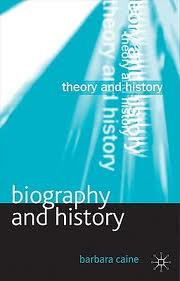
‘Biography and history’ by Barbara Caine

caine

2010,  124p & notes

This is only a small book and would have fitted well into that ” Very Short Introduction to ….” series put out by Oxford University Press.  As it is, it is part of Palgrave Macmillan’s series on ‘Theory and History’ which aims at introducing undergraduate students to themes like transnationalism, gender, narrative, postmodernism etc. and history.   It is very clearly written, and while the experience of reading it is enhanced if you are familiar with some of the biographies that she describes (as I am) , it stands in its own right as a review of the methodological and narrative questions raised by the relationship between history and biography.

Barbara Caine was Professor of History at Monash University and is now at the University of Sydney.  Many academics working in biography come from the literary studies area, rather than history.  Her projects and publications testify to her long and deep experience with biography, autobiography and history, and the ways to approach an individual life as an exercise in historical methodology. Continue reading

Uplifting Quotes for the Uninspired Historian #18

Actually, a whole article this time.  And not so much ‘uplifting’ as ‘sobering’.

How not to write a PhD thesis by Tara Brabazon.

Judicial biography and Pamela Burton’s From Moree to Mabo.

Lurking under the general heading of ‘biography’ are a whole range of particular genres of biography that have their aficionados but are rarely found on the best-seller lists.  Judicial biography is one such genre.  Because my research interest is a nineteenth century judge, I’ve been delving into quite a few judicial biographies and becoming even more certain that my work could not usefully be described as ‘judicial biography’ at all.

The celebratory judicial biographies of the early Victorian era (e.g. Campbell’s Lives of the Lord Chancellors) were described by Phillip Girard (2003)  as “partisan, gossipy, cavalier with facts and delightfully titillating.”  Certainly John Raithby, who wrote The Study and Practice of the Law considered, in their various relations to society in a series of letters (2nd ed, 1816) felt that we would all be better men if we read judicial biography

  ‘When I look back upon the history of my own country, or search the records of those which are no more, I rejoice that the most elegant ornaments of the one, and the noblest monuments of the other, are to be found in the fame of those men who have studied the laws, and directed the jurisprudence of their respective nations … . Look up to these exalted characters, and resolve to imitate, if you cannot equal them. … [N]ot only their works but their actions ought to be the objects of investigation. Endeavour to mark their feelings while you peruse the accounts of their lives; see how the ambition of this man has led him too far, or the immoderate love of repose too greatly restrained him … how the intemperance of lust has destroyed another, or his want of social affection rendered his powers and acquisitions useless.” (p. 17, 28)

More recent judicial biographies are lighter on the moral lessons, but sometimes they do still tend to be rather hagiographical and worthy.  They are often written by judges and lawyers (and to a certain extent they need to be if the courtroom aspect of their life is to be examined critically)  but they are often permeated by a sense of deference that emerges, perhaps, from a life spent within a hierarchical system. In this regard, they remind me of military biographies, where everyone is named, lest offence be caused by omitting someone important; and there’s a masculine clubbability that underpins them as well.

James Thomson in 2007 wrote that:

Judicial biographies must provide explanations and analysis of, at least, the major cases; explore the judge’s interpretive strategies and decision-making processes; expose intra-mural relationships— collegiality, collaboration and confrontation—with other Justices; trace the origins and development of the judge’s character, beliefs, views and motivations; and delineate the influences—public and private—on the judge’s opinions and decisions.

Phillip Girard imposed another requirement:

“which is that the time spent by the subject in judicial office, as opposed to doing other things, should be of more than passing interest to the biographer.”

So, hedged with all these exhortations and injunctions, how does Pamela Burton’s From Moree to Mabo: The Mary Gaudron Story stack up?

For a start, that masculine clubbability is challenged from the outset. Mary Gaudron was Australia’s first female High Court judge, and her biographer is a woman as well.  There is still just a hint of that professional in-groupness that is so impenetrable to outsiders, but because it is interwoven with the personal and political, it does not skew the whole worldview of the book.

The author Pamela Burton is a barrister herself, and as well as founding her own law firm, was a Senior Member of the Commonwealth Administrative Appeals Tribunal and was legal counsel for the Australian Medical Association.  Her experience serves her (and thus, us) well.  As Posner, Chief Judge U.S. Court of Appeal (1995)  wrote, it is difficult for a non-lawyer to write a judicial biography.

This is not only because judges deal with technical legal issues but also because the role of the judge is difficult for nonlawyers to understand. Nonlawyers tend either to be credulous about judges’ self-serving rhetoric of disinterest or to assume that judges are merely politicians (“statesmen” if the nonlawyer shares the judge’s politics) in disguise, whereas the truth usually lies somewhere in the middle….Judges are great bluffers, and it is particularly difficult for nonlawyers to penetrate the bluff unless they are highly cynical. (p. 513)

A quick flip through the index to the book highlights the heavy use of court records and case reports.  There is no doubt at all that this is a life spent in the law.  She presents the cases well, with enough background for someone unfamiliar with them to make sense of them.  It’s a difficult line for an author to tread: enough evidence from the judge’s behaviour in court to support the observations made in the biography, but not so many that the reader- particularly a non-lawyer reader- feels engulfed.

To my way of thinking, a biography is not just a chronicle of events.  While the elapse of time does impose a certain chronological shape to the subject’s life, it is the author’s decision where to place the emphasis and how much space in terms of pages to devote to various aspects of a life.  The author is an active agent in the telling by crafting an argument about what this life means.  Burton grapples with the issue of politics and the law by exploring the nature of ‘political connections’ as a means of progressing a career and yet resisting being captured by one side of politics.  She takes the issue of judicial logic and intellect very seriously, and in this regard the book could be just as easily conceptualized as an intellectual biography as a judicial one.  She balances the personal, the political and the professional.

Gaudron did not co-operate in the writing of this biography: in fact she said that she had a horror of biographies.  The bibliography of this book shows where the author mined to gather her material.  There are three boxes of her papers at the National Library, but these only go up to 1979 and the Conciliation and Arbitration phase of her career.  There are three oral histories, but one of them is closed to research and public use until 5 January 2043.   Gaudron herself has written the foreword to others’ books and some articles, but the bulk of the primary material is drawn from Gaudron’s speeches and court transcripts. The author undertook extensive interviews with Gaudron’s colleagues, although not all wished to be named.  As the author herself admits “A measure of boldness is required to write a biography of a living person who is not enthusiastic about it being written.” (p. xviii).  I must admit that I would quail at the thought.

References

Girard, Phillip  ‘Judging Lives: Judicial Biography from Hale to Holmes.’ Australian Journal of Legal History  Vol 7, No. 1, 2003 p. 87-106

Posner, Richard ‘Judicial Biography’ New York University Law Review, Vol 70, No. 3 1995, p. 502

Thomson, James ‘Biographies and Biographical Writing’ in  Michael Coper, Tony Blackshield and George Williams (eds.), The Oxford Companion to the High Court of Australia, 2007 p.