Category Archives: Exhibitions

Exhibition: A History of the Future

history-future

There’s a terrific little exhibition on at the City Gallery, off the Melbourne Town Hall at the moment. It’s called ‘A History of the Future’ and it’s on until August 12.

I’ve always been drawn to things that didn’t happen. While I tut-tut at ‘what-if’ and speculative histories, deep down I enjoy them.  This exhibition displays the plans of grand dreams that planners and architects have had for Melbourne that weren’t even built- and in most cases, I’d have to say “….and a good thing they weren’t, too”.

So there’s a giant hand-shaped building planned for what is now ACMI, between St Pauls and the Forum, with its index finger pointed skyward.  “Nothing remotely like it in all the world!” proclaims the plan. That’s for sure.  The finger nail of the index finger would contain an observation deck, while the thumb could contain a restaurant.  “The hand is particularly beautiful from its palm side, conformed thusly with three fingers clasped and one pointing heavenward, it symbolizes nothing specifically, but many things generally.” Unlike a middle figure pointing heavenward.

There’s several plans for pedestrian walk-way elevated above the footpath, with escalators running up from road level.  Or Robin Boyd’s plan for Bourke Street on five levels, the bottom consisting of public transport, then two levels of car parking, then finally cars going east and west.

For grand buildings, there could be a huge pyramid built beside the State Library (not unlike the one at the Louvre) or – most topically- a plan for the Queen Victoria Market in the 1970s that would have seen it enclosed completely, with a highrise government building erect on the Victoria/Therry Street corner.  It doesn’t sound all that much different to what is being proposed by the City of Melbourne right now.

It’s a fun little exhibition, so spend a spare half-hour looking through it the next time you’re in town.  It’s free and opening hours are Mon: 10am – 2pm ; Tue – Friday: 11am – 6pm and Sat: 10am – 4pm (closed Sunday) For a taster, here’s a slideshow:

http://www.melbourne.vic.gov.au/arts-and-culture/city-gallery/Pages/current-exhibition.aspx


Exhibition: Somewhere in France

SWIF_eventbrite-top-banner-01

Baillieu Library’s current exhibition ‘Somewhere in France: Australians on the Western Front’ is on show until 26 June 2016.

Our commemorative attention has been directed towards the Western front this year,  now that the Gallipoli commemorative caravan has moved on. This exhibition is not, as you might expect, mired in the trenches but instead looks at life away from the front, as young soldiers, nurses and volunteers explored villages, attended theatre performances and encountered new food and culture.  There’s a particularly chilling gas mask on display in one of the cases which reminds us that the front was always present, and the mention of listening to a gramophone while in the trenches highlights the paradox of a war fought along such a small ribbon of contested land.

The exhibition displays contemporary diaries and letters, photographs and ephemera drawn from the University’s collection of material donated by former students, most particularly Ray Jones and Alfred Rowden White. Current day students have researched the material and created two short video presentations based on the stories of Melbourne soldiers and Red Cross workers who ended up ‘Somewhere in France’.

For more information see here.


Exhibition: The Irish Rising:’A Terrible Beauty is Born’

I called in to the State Library of Victoria to see their small free exhibition The Irish Rising: A Terrible Beauty is Born which is on show until 31 July 2016.  It is indeed a small exhibition, taking up only one wall and a small number of cases in the small room outside the Manuscript Reading Room in the Cowen Gallery.  There’s quite a lot in it, though, with a strong Australian, and particularly Melbourne, focus.

The exhibition starts with a quick chronology of the Uprising, and there is a video presentation of images taken from an Irish book that was rushed off the presses shortly after the Uprising, showing the destruction of central Dublin.  The booklet was accessioned by the Library in October 1916, some six months after the events and would have no doubt been of great interest given the large Irish-born population in Melbourne.  There is a 1917 reprint of the proclamation of Irish Independence, the only one known in Australia, and copies of newspapers, both Irish and Australian, reporting the news.

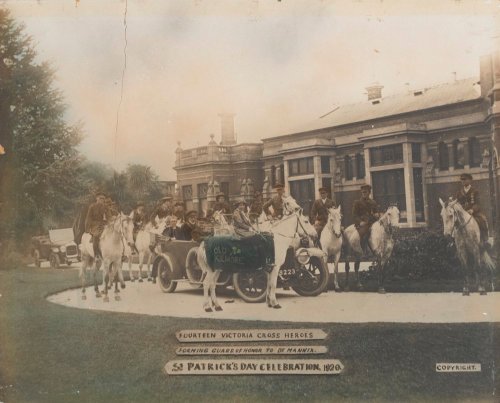
I was fascinated by a lengthy film (some 80 minutes) that was thought to be funded by John Wren, the Catholic underworld figure and ‘entrepreneur’  as his ADB entry delicately puts it. The film, which had been abridged by the censors cognizant of the sectarian ill-feeling stirred up by the conscription debates in the War, has been restored to the full version. It  shows the 1920 St Patricks Day March, where 100,000 Australians, including returned soldiers, demonstrated their support for Irish independence.  Archbishop Mannix, who played such a pivotal role in the conscription debate, plays a large part in the exhibition.

mannix

Fourteen Victoria Cross Heroes forming guard of honor to Dr Mannix, St Patrick’s Day Celebration 1920,  State Library of Victoria

http://handle.slv.vic.gov.au/10381/87200

As I say, it’s only a small exhibition that doesn’t take much more than half an hour to view, unless, like me, you become transfixed by the images of the photos and the film and end up spending far longer than you planned.

A Capital Idea Day 2

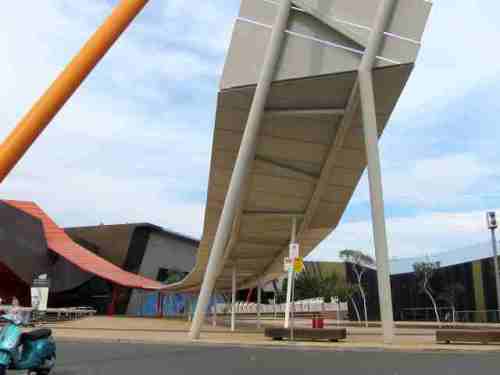
The other drawcard that lured us to Canberra last week was the Encounters exhibition at the National Museum of Australia which was also slated to close on 28 March 2016.  Once again, to my regret I find myself writing about an event that has already concluded but I wanted time for my thoughts to percolate about it before putting fingers to keyboard.
IMG_2248a

Encounters presents a large, beautifully curated exhibition of artefacts sourced from the huge British Museum collection, supplemented by current-day responses crafted by living indigenous artists and craftspeople from the regions where the artefacts were originally ‘collected’. I use the inverted commas deliberately: some were given as a sign of respect; some were purchased, and others were quite clearly stolen and appropriated.

It is a very well-mannered exhibition.  As you enter, there is a large video welcome and introduction by representatives of the many tribal groups who have been involved, and it has truly been a continent-wide consultation process (as you would hope it would be). The artefacts come from twenty-seven communities right across the country, reinforcing the ‘national’ nature of the museum.  The explanatory panels surrounding the artefacts are very well done, describing the mobility of the object and explaining the means by which it came into the British Museum’s collection. In many cases, artefacts are accompanied by a video with a present-day community member explaining the importance of the artefact as a reaffirmation of identity or as prompt to new learning about production techniques that had been forgotten or changed in the generations since the object was first collected.  Several of the speakers expressed gratitude that at least the object had survived to be seen by later generations, an ironic consequence of its appropriation and removal to the museum environment.  Others expressed joy at the continuity of knowledge within their community, despite a policy of repressing traditional language and crafts. Others again mourned for the loss of the object and yearned to have it literally re-placed and brought back to where it came from.

The most discussed item in the exhibition is the shield collected by Captain Cook in 1770, dropped by a Gweagal man after the ‘encounter’ on the beach turned sour. The hole in the middle of the shield was caused by a spear, generations of White custodians and curators told themselves.  I’m not convinced.  That hole speaks volumes.  The sight of it literally made the hair on the back of my neck stand up.

Much of what this exhibition did was done very, very well. But what of my comment that it’s a ‘well-mannered’ exhibition?  Many questions bubbled under the displays: how many of the people of the community are going to see this artefact?  Why does it belong to the British Museum? Why does it have to be returned?  The questions were asked sotto voce but the exhibition was too polite to ask them out loud.

One of the exhibitions is the Dja Dja Wrung bark etchings which were last seen in Australia in 2004 as part of the Etched on Bark exhibition under the auspices of the Museum of Victoria.  As that exhibition drew to a close, activists Gary Foley and Gary Murray launched a series of emergency declarations under the 1984 Aboriginal and Torres Strait Islander Heritage Protection Act in an attempt to keep the etchings here in Australia.  Eventually a court decision found in favour of the British Library and the etchings returned to London.   There’s an interesting article written by the curator of that exhibition in 2007 here.

It comes as a surprise, then, to see the Dja Dja Wrung etchings back in Australia again, just over ten years later. An act of good faith on behalf of the British Library perhaps?  Or a provocative gesture now made from within the safety of the Protection of Cultural Objects on Loan Act of 2013? This Act was initiated at the behest of Australian cultural institutions that wanted to be able to give a water-tight guarantee to their international counterparts that items would unequivocally return to the lending institution. The etchings have travelled here because the British Library knows that they will be returning to London.

In an article in Overland (21 March 2016), Eve Vincent reflects on the display of the Dja Dja Wrung etchings:

Also on display are the Dja Dja Wurrung bark etchings that last visited Australia in 2004. They were on display at the Museum of Victoria when Dja Dja Wurrung activist Gary Murray joined with Gary Foley and others to prevent them from leaving the country. The fact that Dja Dja Wurrung representatives ‘unsuccessfully’ sought to stop the return of these objects to England is carefully acknowledged. Press a button and Murray’s soft voice starts talking about his aspiration to have the bark etchings stored in Melbourne, closer to home. ‘We beg the British museum to return our cultural materials.’

And then the visitor moves to the next exhibit.

This exhibition is actually one half of a matching exhibition called Indigenous Australia: Enduring Civilisations  which was on show at the British Museum in London between April and August 2015. An excellent article by Penny Edmonds in The Conversation in 2015, reviewing the British exhibition,  highlights the curatorial challenges faced by in the British exhibition for a British audience. The British Museum is not unfamiliar with disputes over provenance and custodianship – after all, they’ve been fighting over the Elgin or Parthenon Marbles for decades and decades.  While the issues of collection and colonialism, ownership and custodianship were discussed in the abstract in London, there was an expectation (fear?) that the conversation would be more pointed when the Australian exhibition opened.

But it hasn’t happened in this strangely decontextualized exhibition which says little about the international politics, or the emotional and intellectual motivations in act of ‘collecting’ that lie at the heart of this particular display. I think that it is an opportunity lost. It was almost as if we were on our best behaviour, not wanting to cause a fuss. I’ve read a few articles about the “conversation” that is being had here about such issues, and it evokes for me the insistence by the Irish government on the “maturity” of the discussions surrounding the commemoration of the centenary of the Irish Rising this week. No-one wants to seem “immature” and the  insistence that things are kept within the bounds of “conversations” and “dialogues” are curbs that can only be made from a position of power.

So, my response to the Encounters exhibition? Beautifully curated and thought-provoking but at its core timid and polite.

But maybe I speak too soon? Now that the exhibition is being packed up and taken away again, the whispered question is being voiced aloud- see a recent article in the Guardian here;  on The Conversation website here and an ABC report from the very day I am writing this here.  Perhaps, now that it’s finished, we don’t have to be on best behaviour any more.

Other articles:

Quentin Sprague The Monthly Bringing Them Home’


Exhibition: Oil Paint and Ochre at Yarra Ranges Regional Museum

Oil_Paint_and_Ochre_web_338x285_image_medium

Oil Paint and Ochre: The incredible story of William Barak and the De Purys, Yarra Ranges Regional Museum 29 August 2015- 22 November 2015. Free.

Historian Jan Critchett reminded us in her excellent book A Distant Field of Murder (my review here) that ‘the frontier’ was a very local phenomenon and that

The “other side of the frontier” was just down the yard or as close as the bed shared with an Aboriginal woman (p. 23)

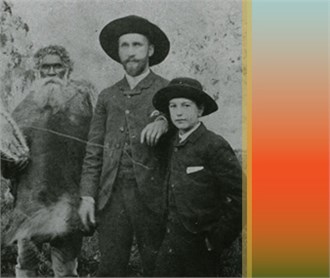
As we can see in this excellent exhibition, the frontier could also be just across the river. The de Pury family ‘took up’ (to use the euphemism) land adjoining the Coranderrk reserve where William Barak and his cousin Simon Wonga led a community of Daung wurrung and Wurundjeri indigenous people in an independent and largely self-sufficient community managed by European John Green. This exhibition displays photographs, letters and artefacts donated to the Yarra Ranges Regional Museum by the wine-growing de Pury family that reveal  the neighbourly interaction between Barak in particular and the neighbours across the river.

The exhibition tells two intersecting stories: those of Barak and the Coranderrk community, and that of the de Pury family and winegrowing generally in the Yarra Valley.  At times the stories come together in photographs and paintings, but there is also confluence of the narrative in de Pury’s presence on the ‘Board of Enquiry into the future of Coranderrk instituted by the Central Board Appointed to Watch Over the Interests of Aborigines in the Colony of Victoria’, which in effect brought the community to a close.  De Pury had initially declined to sit on the board, but later did so, in a reminder of the power relations that constrained ‘neighbourliness’, after all.

Coranderrk was a particularly visible indigenous community which attracted photographers and artists and which in turn churned out souvenir paintings and carvings  for purchase. One of the objects that fascinated me most was a painting that Barak did of the de Pury vineyard, long after Samuel de Pury had left for Europe, on the back of which he wrote:

The English name is Bald Hill this is all your Vineyard and trees this all belong to you there your house above with the vineyard where you yous to stop before… I send you this paper I still remember you all the time…

This is a beautifully curated exhibition in a well-funded, purpose-built building.  The exhibition was of particular interest to me because my family ‘took up’ a Crown Land grant at Chum Creek, near Coranderrk on what would have been assuredly a tribal resting-place and food source on the river flats of the Chum Creek at much the same time that Coranderrk was established. The two events are, I’m sure, related – a fact which I find uncomfortable.

A handsome book has been produced to accompany the exhibition. There’s a very well-presented exhibition upstairs on the Yarra Valley, and a very good cafe downstairs overlooking the park.  The exhibition is on until November, so don’t miss it- it’s beautiful weather for a trip to the hills!

Exhibition: Masterpieces from the Hermitage

hermitageNGV

Well, it’s not Winter anymore but the NGV exhibition of Masterpieces from the Hermitage is on show at NGV International until 8th November 2015.

I must confess that I wasn’t particularly anxious to see this exhibition and I came away from it feeling somewhat jaded.  It evoked in me that ambivalence that Australian tourists tend to feel when you’re visiting one of the ‘big’ Art Galleries overseas. You’re all too conscious that you’re not likely to pass this way again soon so you mentally ‘tick-off’  the famous pictures that you’ve seen in books all your life. Eventually you feel deadened by the surfeit of masterpiecedom (another Rembrandt?) and you too quickly leave, thinking that you’ve “done” that gallery.  Well, that’s a bit how I felt after the Hermitage exhibition without even leaving my own home town.

That said, the focus in this exhibition is not so much on the paintings (famous and masterpieces though they may be) but on the act of collecting itself.  Catherine was a patron of the arts, but was not an artist herself. Her buyers sourced collections that in many cases had been collated by others and bought them as a job-lot,  if that’s not too crude a term to use for such magnificence. The first room contains her collection of cameo gems, architectural drawings and her 797-piece Sevres dinner set. Thereafter the exhibition rooms are organized by country of origin: the Italian Room, the French Room, the Flemish Room.  There is a beautiful website that follows the layout of the exhibition and features particular objects under the ‘Themes’ heading on the exhibition website: http://www.ngv.vic.gov.au/exhibition/masterpieces-from-the-hermitage/

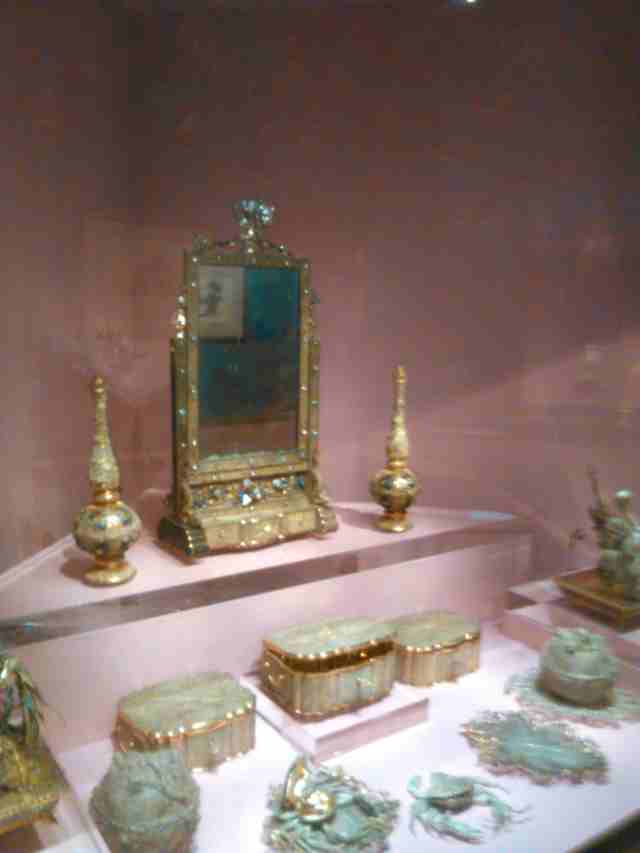
My favourite pieces were found in the China room, most particularly the silver filigree work in (one of) her dressing table sets.

hermitage_set

The label said that Catherine had ordered that diamonds and pearls be added to it. Were they real diamonds on it? It felt strange to catch sight of my own reflection in the mirror and to realize that Catherine would have seen herself in it too.  Of course, this was just one of her dressing-table sets. Such wealth; such excess.

You can download Virginia Trioli’s commentary on the website. It’s not particularly closely tied in with the exhibition, focussing more on Catherine herself and her collecting habits.  It’s an engaging podcast nonetheless.

‘Nail Can to Knighthood’ exhibition RHSV 15 July-18 December 2015

Lady-with-rose-hat-and-MacRob-milk

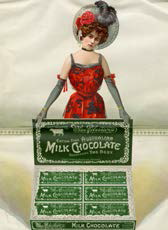
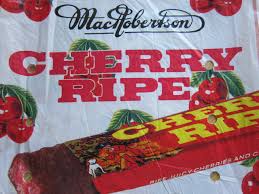
The Royal Historical Society of Victoria have a fantastic exhibition at the moment that draws on their collection of material about Macpherson Robertson – the source (bless him) of Australia’s oldest, and my very favourite chocolate bar: The Cherry Ripe (now produced by Cadbury)

MacRobertson

Cherry-Ripe-Wrapper-Small

Titled “Nail Can to Knighthood”, this exhibition covers the life of Sir Macpherson Robertson and the significance of his factories in Fitzroy, Melbourne.   Australians, it seems, are always being berated for their lack of philanthropy, especially in comparison with the American tradition, but Macpherson Robinson was a Philanthropist with a capital P, and several Melbourne landmarks associated with the centenary of Victoria in 1934 bear his name to this day.

A child of the goldfields, Macpherson Robertson was born in Ballarat in 1859 to a Scottish father and Irish mother.  The family returned to Leith, Scotland when his father moved to Fiji in search of work and as a photograph in the exhibition shows, this was not a wealthy family at all. To help the family finances, Macpherson took odd jobs, including working in two confectionery factories.  When the family returned to Melbourne in 1874, he started an apprenticeship at the Victoria Confectionery Company.  At the age of  21 he started his own business in the family home in Argyle Street Fitzroy, using a nail can and tin pannikin to boil up the syrup that he poured into moulds and rolled in sugar that his mother wrapped in paper cones.  Macpherson  went on foot to distribute his lollies for sale.  From these humble beginnings (and the original nail can and pannikin are on show), he built up a huge enterprise that dominated the suburb of Fitzroy and made him enormously wealthy.

He certainly had entrepreneurial flair and knew the benefits of good advertising. He realized that the name ‘Macpherson Robertson’ was too long to fit onto a lolly wrapper, and so he shortened it to ‘MacRobertsons’.  Often his advertising and personal interests converged.  When promoting chewing gum (which he brought to Australia after living in America for several years) he spruiked it as being of particular benefit to cyclists.  He established a Cycling School, presided over by “Professor Eckenstein” who had taught no lesser luminaries than the Prince of Wales, the Duke and Duchess of Connaught and Lord Lennox! He was fond of cars and sponsored the Round Australia Competition in 1928, and established MacRobertson- Miller Airlines.  A croquet aficionado himself, he contributed the land from his own estate in Station Street Fairfield to establish the Fairfield Bowling and Croquet Club, and the MacRobertson Shield is still the most prestigious tournament on the International Croquet scene.  He knew how to market his own story as well, with several publications issued during his lifetime that drew on the legend of the nail can.

His philanthropy really hit its straps during 1934, the Centenary of Victoria.  He sponsored the London to Melbourne International Air Race in 1934, Mac.Robertson Girls’ High School, MacRobertson fountain near the Shrine and MacRobertson Bridge.  As you can see, he was not shy in having his name attached to his gifts, and Sir Douglas Mawson likewise thanked him for his sponsorship of the Antarctic Exhibitions of 1929 and 1930 by naming MacRobertsonLand in Antarctica after him.

The RHSV has a wonderful collection of material, supplemented by material on loan from a variety of sources.  As well as the original tin can, there’s a cabinet of lolly samples which are displayed one drawer at a time for conservation reasons, showing the different sorts of lollies produced by MacRobertsons in test-tubes. There’s some fascinating video footage, complete with sound, and I was interested that, considering he left school at such a young age, he had acquired over his lifetime an upper class, albeit completely Australian, accent.  Most intruiging of all was a bust of Macpherson Robertson that turned out not to be as it seemed.

The exhibition will be open until Friday 18th December, Mon-Thurs 10.00-4.00 and Friday 10.00-3.00.  Gold coin donation entry

If you can’t make it, there’s an excellent site (so excellent, in fact that I wonder if it doesn’t pre-empt the exhibition?) at  http://www.culturevictoria.com/stories/built-environment/macrobertsons-confectionery-factory/

‘War Pictures: Australians at the Cinema 1914-1918’

If you have another sixty-three minutes to fill in (after seeing the School Days exhibition), there’s another interesting free feature on show until 26 July 2015 down at ACMI in Fed Square.   It’s called War Pictures: Australians at the Cinema 1914-1910 and it aims to replicate the experience of cinema-goers during World War I.  Presented on a continuous loop, it is a chronological collection of snippets of advertisements, newsreels, shorts and both Australian and international films  that screened at the neighbourhood cinema in suburbs and small towns throughout Australia during WWI.  There are links to some of the film clips shown on the NFSA blog.

It’s very dark in the cinema, so you need to grope your way to the folding chairs- it’s a pity that they couldn’t source some authentic cinema chairs that have that distinct ‘cinema-y’ smell and solidity.  However, there’s a satisfying undercurrent of whispers and comments that helps provide a frisson of authenticity. The loop starts from 1914 with a notice to ladies to remove their hats (the early 20th century version of asking you to turn off your mobile, I suppose) and a rather embarrassed rendition of God Save the King (the same treatment as Advance Australia Fair today).

The majority of film clips come from 1915 and 1916 with a smattering of advertisements, many rough animations, for a “Warner’s Rustproof Corset”, “Hoadley’s Barrackville Cocoa”  and “Indasia Soap” (an interesting advertising concept given the White Australia Policy being promoted at the time).

There are several newsreels showing the Front, extracts from which we’ve seen many times.  There’s a power, however, in seeing them in a more extended form and learning that, for example, a frequently used series of images showed British soldiers, just half an hour before battle.  I wonder if people went, hoping to catch a glimpse of ‘their’ boy? Did the families of those men mown down less than an hour later see this film? Oh, the tragedy.  Again and again, there’s the silent gaze of the troops into the camera, men watching it, us watching them.  In what ended up being an unintentionally WWI-heavy day, we left the ACMI to head up to Cinema Nova to watch Testament of Youth, and there was that same steady gaze replicated for a twenty-first century movie.

The cinema was used by the government as a medium by which it could broadcast (literally) its own message, and so there are government-sponsored films and propaganda advertisements. Slides that divide the years depicted explain that cinema audiences responded with increasing cynicism and even hostility to the more heavy-handed government propaganda.  There’s a segment (silent of course) of Billy Hughes addressing an unseen crowd supporting the ‘Yes’ vote in the first referendum, with quotations from his speech interspersed between the visual clips of him speaking.

It’s on until 26th July 2015.

School Days: Education in Victoria

If you have a spare hour in Melbourne city, pop along to the Old Treasury Building at the top of Collins Street to see their exhibition ‘School Days: Education in Victoria’.  Drawn from the voluminous archives of Education Department material placed at the Public Records Office of Victoria, the exhibition runs until 31 August, open Sunday to Friday (ie. closed Saturday) 10.00 a.m. to 4.00 p.m. and entry is free.

PROV, VPRS 14517 / P1 / Unit 17 / E82839129

PROV, VPRS 14517 / P1 / Unit 17 / E82839129

Victoria has good cause to be proud of the 1872 Education Act which provided for “free, compuslory and secular” education for all children aged between 6 and 15 years of age.  It set the pattern for the education acts of the other colonies with Queensland and South Australia passing similar legislation in 1875, NSW in 1880, Tasmania in 1885 and Western Australia by 1893. Ironically, by the time the later legislation was passed, the Victorian act itself had been altered to allow more religious influence and the leaving age had been lowered to 13 years.

Prior to 1872, public education in Victoria was provided through a dual system of denominational schools run by the churches, and government-assisted schools which charged a small, but nonetheless significant, fee.  The huge increase in population during the 1850s resulted in a demographic bulge of school-aged children in the 1860s, and there was much public anxiety about the number of children not receiving any schooling.  Charitable schools had been started by Hester Hornbrook, whose ‘Ragged Schools’ followed the model of the English Ragged School Union to provide a basic education founded on biblical and ‘practical’ education.   At its peak the ragged schools educated 1000 children at twelve schools. An article from Trove in 1859 lists eight of them: one in Simpson’s Road [originally Victoria St Abbotsford/Richmond], three in Collingwood, two in Little Bourke St, one in Little Lonsdale Street [near O’ Brien Lane] and one in Prahran [a second school in Prahran was the forerunner of the present day Hornbrook Childrens Centre]. In fact, there’s a picture of one of the Hornbrook Schools in the exhibition, but taken in 1900 when it had become the Cremorne Street School in Richmond.  But by the 1860s, the anxiety about the connection between lack of schooling and crime compelled the government to step in.

higinbotham

As it happened, before we went into the Old Treasury Building, we’d commented on the statue of Chief Justice Higinbotham  that stands on the plaza at Treasury Place.  I was well familiar with this statue. As a child, I used to go to an orthodontist in Harrison House, the former home of the VFL, in Spring Street. Being a strictly-brought-up child, I wasn’t allowed to say “bottom” but I was able to surreptitiously utter that naughty word by pointing out the statue of Justice “Higginbottom”.

Higinbotham was not only Chief Justice: he was also the driving force behind the Education Act of 1872 even though he was no longer in Parliament when it actually passed.  He had, however, been chair of a royal commission of enquiry into education in 1866 and from its findings, introduced a bill into Parliament in 1867 that largely anticipated the 1872 bill.  In his speech to Parliament Higinbotham made no secret of the class-based aspect of ‘free, secular and compulsory‘ education. To the working class he said:

You have accepted the vote; now, in the national interest you must accept middle class culture.  You will have to change your own way of life and adopt ours. Maybe you will find this difficult, but at least give us your children.  In fact, we will remove your children from you for several hours each day by compelling you to send them to school, where they will be imbued with middle-class culture, we will raise them from the savages that they are to become civilized human beings, and for this you should be grateful. (Bessant, 1984, p. 9)

Even though the idea of free schooling stuck in the craw of both conservatives and liberals who wanted a ‘price signal’ so that working-class parents would appreciate the schooling [some things never change], it was recognized that unless education was free, the parents they were targetting  wouldn’t send their children.

But if the government was going to make this huge financial commitment- and it was huge- then it was going to be efficient, damn it! A fundamental part of the Education Act was that it created a direct line of oversight from Cabinet to the Minister to the Schools. Control of teachers, control of students.  This is made very clear in the exhibition which focuses particularly on the position of young female teachers who were often sent to isolated schools and expected to lodge with local families who resented the imposition.  Marriage resulted in instant retrenchment.

Attendance was carefully monitored.  There are letters from parents beseeching for a school to be built in a small settlement, promising the attendance of twenty, thirty children from the surrounding district.  If a school was granted, it was likely to be built from one of the template-based designs of Henry Bastow, the Chief Architect and Surveyor who was responsible for the construction of 615 schools in five years.  The more opulent of these schools were of hawthorn brick with steepled roofs and included his favoured  neo-gothic features (you can see a video feature in the exhibition here).

I was fascinated by a video of Ascot Vale Primary School in about 1910 I suspect. It shows the school ground, assembly (complete with flag-raising and oath), marching,  ball games, folk dancing (oh, how I loathed folk dancing) and boys doing push-ups.  It all seems so physical and martial.  There’s a strap on display- a fearsome looking thing which, as a girl I never encountered fortunately.  School children joined clubs, and there are the beautiful certificates that we were given for the Gould League, for example.  Did you know that I won the state award for the Temperance exam in Grade 6 and received a beautifully embossed certificate that I wish I’d kept  (and I’ll thank those who know me not to snort with derision).  Girls knitted during the war; male teachers enlisted; female teachers donated (?) a percentage of their wages for the war effort.

It’s only a small exhibition- just two rooms- but there’s much to look at. They have a good public program of talks and events too.  Well worth a visit.

Some references:

Bob Bessant “Free, Compulsory and Secular”  Paedogogica Historica, Vol 24, Issue 1, 1984, p.5-25  [available from University libraries]

E-Melbourne website  http://www.emelbourne.net.au/biogs/EM00507b.htm

There’s a fascinating case study of a disciplinary action taken against a teacher at Baringhup State School by Carolyn Woolman in Provenance (the journal of the Public Records Office) ‘The State of Feeling in the District’ Provenance, Issue 11, 2012

Medieval Moderns

MEDIEVAL MODERNS: THE PRE-RAPHAELITE BROTHERHOOD

National Gallery of Victoria (International), Until 12 July 2015

There’s a lovely small, free exhibition of pre-Raphaelite paintings on show at the National Gallery International until  12 July.  The exhibition exemplifies the fallacy in trying to carve off ‘Australian’ from ‘International’ art because it includes artists like Edward La Trobe Bateman (in Australia between 1852-69) and Thomas Woolner who worked in Australia in 1852-4 after arriving for the gold rush.  He, like Bateman, associated with the Howitt family who were the centre of cultural Port Phillip in a reminder to us of the transnational nature of artistic and cultural interests.  Many of these works- particularly those of William Holman Hunt, Dante Gabriel Rossetti, Ford Madox Brown and Edward Burne-Jones- were purchased as part of the Felton Bequest.

The Pre-Raphaelite Brotherhood was a group of artists in the mid -19th century who eschewed the current trends in art and the increasing industrialization of production, and consciously turned to older styles of painting and imagery – hence dubbing themselves ‘pre’ the painter Raphael (1483-1520). Many of their works, created in the last half of the 19th century harked back to a quieter medieval milieu and a mythical forested, European setting. They marked their paintings with a small PRB logo in the corner. They came to the attention of the wider public through their illustrations of Tennyson’s poetry which was itself steeped in the mythological realm. Reproductions of their works were circulated throughout the Empire, with the Maitland Mercury noting on 26 September 1885 that a reproduction of Holman Hunt’s “The Shadow of Death” on show in a shop window had formed the basis of the local vicar’s “very eloquent” sermon.

An unusual window display for Maitland - Holman Hunt's 'The Shadow of Death'. I wonder what they were advertising?

An unusual window display for Maitland – Holman Hunt’s ‘The Shadow of Death’. I wonder what they were advertising?

When we were in Birmingham we heard a lecture about Lizzie Siddal, whose long red hair and pale, thin features adorn many of these paintings, and she (and others visually similar to her) can be found in several of these paintings. As well as paintings and sketches for paintings, there are woodcuts, furniture, photographs, book bindings and wallpaper produced by the PRB, marking the extension from painting into the decorative arts and production methods, especially through William Morris’ influence with his company, Morris & Co.  Men predominate, of course, but there are photographs by Julia Margaret Cameron

We downloaded a PDF of the wall-panel labels used in the display before visiting, which I thought would be a good way of avoiding having to cluster up close to the painting, squinting at writing in the dark before moving back to view the picture. Unfortunately there seems to be no order at all to the PDF- or at least, I couldn’t detect it, and it seemed to be completely unrelated to the layout of the exhibition. A good idea poorly executed.

All-in-all, it’s a lovely little exhibition that reminds us of the riches that the Felton Bequest has brought to Victoria.