Category Archives: Current events

‘The High Price of Heaven’ by David Marr

1999, 287p.

This is a collection of David Marr’s Sydney Morning Herald essays from 1999, extended and revised into a collection that critiques fundamentalist Christianity and its attitudes towards sex, censorship, drugs and pleasure more generally.

It’s vintage Marr- witty, brittle, bitter and bombastic. He certainly doesn’t hold back at all on his dislike for John Howard, George Pell, Peter Jensen and the Sydney religious elite.

Of course, a book of “current” essays from 1999 becomes dated, and yet many things remain the same. Howard may be gone, but the religious influence is still with us- unchanged in the case of Jensen and Pell; dominant still with Rudd but somehow, I sense, taking a slightly different direction.  I haven’t read Marr’s latest book on the Hensen controversy, but I suspect that it takes up where this book left off.

So, I was interested in Juliette Hughes’ review of David Marr’s new book The Henson Case.  She writes, in an observation that is equally applicable to The High Price of Heaven:

Marr is as ever a pleasure to read even when you largely disagree with him about the subject, as I do. But it’s difficult when you disagree with much of the other side, too. The trouble is that most people are well meaning and the subject is incendiary. You’re either a pedophile voyeur or a prudish ignoramus; nothing in between…Marr’s fervid advocacy admits of no equivocation; this discussion begins mezzo-forte, crescendoing rapidly to fortissimo and stays there, attacking predictable targets, the dullard Christian right, the unspeakable Sydney shock jocks

Much of Juliette Hughes’ review resonated with my own uneasiness about the Henson controversy.  I was surprised that so many people so quickly adopted such clear-cut and definitive opinions.  Almost a year on, I’m still undecided- and think that I may remain this way- about the photographs, the dividing line between art and exploitation, and the contract (if any)  between the creator and the beholder.

An economic downturn 1840s style

What strange times we live in.  Each night, the news bulletin starts off with the financial report, extending over about ten minutes, then briefly the “other” news, then a return to the usual financial report, sport and weather.  Each morning I unwrap the paper and marvel at the increasing size of the headlines reporting on the latest falls on the Australian Stock Exchange, or Wall Street, or the FTSE,  or the Hang Seng.  How do I even know about such entities?  I think it’s probably indicative of the recent financial bubble that we’ve all been caught up in over the past 10 years,  that even before this crisis, every news bulletin has  the financial report as a staple item each night- I really don’t particularly remember it having such prominence, say, twenty years ago.  Ah, but we’re all investors now-unwittingly and sometimes unwillingly through our compulsory superannuation, and cajoled to “unlock the equity in your home” by drawing back on our mortgages to spend on the sharemarket.

And of course, it’s all on such a global scale.  There’s no shutdown period at all on a sharemarket somewhere- Australia wakes up and looks at what America has done overnight, responds by a rise or a fall on the ASX, the day moves on, that night the UK market responds, the US market responds to that, and it all goes around again.  There’s no sigh of relief of “thank God that’s finished”- although at least the weekend allows a global breather, until the whole merry-go-round starts again on Monday.

Our whole system is predicated on credit in a way that is largely unconscious and invisible to us.  With just-in-time manufacturing, there are no storehouses any more of goods waiting to be sold- instead the credit system balloons forward to buy in a consignment as it is needed right now, retracts when it’s sold only to balloon out again to replenish the shelves next week.  We’re bombarded with “buy now, no deposit!!” advertising; we’re asked as a matter of course for every transaction with a swipe card “will that be on credit?”

And so, conscious of all this, I’ve been thinking about the recession (depression?) in the early 1840s in Port Phillip, and the way it impinged on the worldview of people there at the time.  I surmise that, like me, their understanding at the time was incomplete:no doubt more so, given the four-month delay in any information from Britain compared to our instantaneous communications now, and the dependent state of a colonial economy within the Empire as a whole. What they understood of the financial situation was filtered through the newspapers, gossip, and lived economy of their own experience.

Contemplation of this- and I’m doing quite a bit of reading on this which I shall, dear reader, share with you- is not completely irrelevant to my Judge Willis thesis work.  As sole Resident Judge, he heard all of the civil cases that came to the Supreme Court; he oversaw (but was not directly involved in) the Insolvency Court, and his own propensity to “sift to the bottom of things” characterized his approach to the bankruptcy cases that crossed his bench.  I feel sure that the general ‘anxiety’ and ‘excitement’ of Port Phillip reflected both the economic and political currents of the day, and directly fed into his dismissal.

So how did the Port Phillip communications of the day portray the financial crisis?  Newspapers had always carried a column showing the price of goods on the local market -wheat,  bread, spirits, sperm candles, parsnips etc. (The parsnips have particularly taken my attention because at my local supermarket they have been $5.95 per kilo for the last few months.  For bloody parsnips!!!!! Fine words may butter no parsnips, but obviously $5.95 a kilo will!)  The shipping reports were often followed by correspondence from the wool agents in London, reporting on the wool sales- generally chiding the Australian suppliers for lack of quality, and sighing at the dearth of buyers.

Much of a four-page Port Phillip newspaper of the 1840s was devoted to Court reports, and as the judicial system expanded in Port Phillip, so did the scope for court reporting- the Supreme Court, the Insolvency Court, the Police Bench, Quarter Sessions, the Court of Requests.  The tales of drunkenness and violence that ran through these courts were increasingly supplemented by stories of insolvency, defections from debt, unemployed immigrants, forced sales etc. as we move from 1841 into 1842.

And increasingly as we move from late 1841 into 1842 there are also  the required advertisements of bankruptcy posted in the newspaper, notifying of the first, second or third creditors’ meeting of one bankrupt after another.  By April 1842 (which is where I’m up to at the moment), the Port Phillip Herald regularly published a table of insolvent debtors, their assets and liabilities, and the dates of their scheduled meetings with creditors.  Real estate advertisements spruiked  “we’re at the bottom of the market- so buy now!!” . Occasionally there would be a high-profile insolvency case that demonized a particular individual, surely read  and gossiped about with a sense of schadenfreude by the subscribers to the newspaper.

And all of this occurred within the bullishness and heightened expectations of people who thought they were coming to “Australia Felix” to make their fortunes!

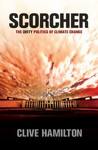
‘Scorcher: The Dirty Politics of Climate Change” by Clive Hamilton

2007, 230p.

This book exposes the names and organisations behind the Greenhouse Mafia- the group of Australian energy and resource producers who lobby the government ( in particular the Howard Government, but given the uneasy shuffling of feet I suspect the Rudd government ministers too) to act in a way that privileges their own interests over all.  He gives this shadowy group definite names and identities: the climate change skeptics (William Kininmonth, John Zillman), the industrialists (Hugh Morgan), the lobbyists  (the Lower Emissions Technology Advisory Group) and the press (the Australian, Michael Duffy etc).  For this alone, I’m glad I read this book. Sometimes, when I read the newspaper I feel as if it’s nothing but an arena for lobbyists and PR consultants to buy space for whatever they are pushing; the mantra over “balance” means that undue exposure can be given to minority views, and the anodyne, deceptive and largely interchangeable names given to “groups” and “bodies” with widely varying agendas become almost meaningless.

But he also exposes the duplicity and paradox in the Howard government’s position on Kyoto. He argues that the Howard government, as the ‘cover’ for the Greenhouse Mafia, consciously sabotaged Kyoto because it didn’t want China- a major energy export market- to limit its emissions while at the same time arguing that Kyoto is unworkable and unfair because they are not limiting their emissions.

At times, and as the book progresses, he becomes increasingly shrill, particularly against Murdoch’s Australian , which detracts from his argument.  The book highlights that ordinary Australian’s concern about climate change stretches back deades, and that at the time of writing (2007), this commitment looked as if it were about to be activitated.

But I very much doubt that the Greenhouse Mafia has disappeared.  I fear that the fine-tuning of the response to the Garnaut report in response to “business export fears” is evidence of the Greenhouse Mafia flexing its muscle against the Rudd government as well.

Pardon my faulty expressive vocabulary

I see that Barak Obama has selected Joe Bidden as his vice-president.

I’m a well-informed person. I know who Joe Bidden is. I’ve heard of him.

Well, actually, I realised that I haven’t.  Joe Biden? Bye-den? Is that the same bloke that I’ve been mispronouncing Joe Bid-den in my internal soundtrack while reading? Oops. I guess it’s another case of the old receptive-vocabulary-outstripping-the-expressive-vocabulary syndrome.

Deep in my literacy researcher past, I remember that it took five plus or minus two utterances of a word that you’d read, but not actually said out loud, until it moved from your receptive vocabulary to your expressive vocabulary.  How versatile that ‘five plus or minus two’ formula is!  But there’s always a bit of a risk when you’re using a word for the first time.  Are people going to snicker because you’ve mispronounced it? Is it really a word, or is it something you just dreamt up?  Is this the right context?

Because, yes, Reader, I have snickered at those who speak of eppy-tomes  (epitomes) and mack-a-bers (macabres). In fact, I think I may have used eppy-tome myself until I recognized the error of my ways. And it took me several attempts until “apotheosis” just tripped off the tongue when discussing the chapter so titled in Russell Ward’s The Australian Legend with first year history students.

I wonder if the gap between expressive and receptive vocabulary is wider or narrower among adults who read a lot compared with adults who do not?  I’ve just done a quick Google and can find lots of incomprehensible research about children, especially with communication and reading difficulties, but not adults.  I think, as a hunch, there would be more of a gap with good readers.  I always pull out the dictionary when I encounter a new word, although if I’m reading someone like John Banville, sometimes there are just too many unfamiliar terms and it becomes distracting.

I heard both Obama and Joe Bye-den speaking on the radio. It’s interesting how American politicians always have to have a story that encapsulates something about the American national narrative.  I don’t think we do to the same extent in Australia- although then again, Kevin has his dead father, Bob Hawke had the bottle,  Paul Keating had Bankstown, Mark Latham had his ladder of opportunity, Johnny Howard had his father and grandfather meeting on the battlefield.  But I can think of other examples of Australian politicians without a personal/national narrative and they didn’t seem to suffer for it.

So, good on you, Joe Bidden/Biden.  Already I’m forgetting that I ever thought your name could be pronounced any other way.

Dancing diplomacy with Kevin

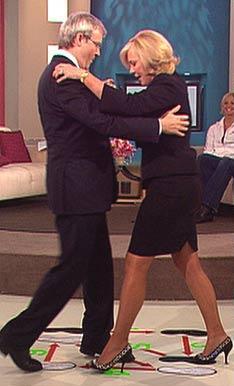
According to Kevin PM,  when we’re dealing with China, it’s two steps forward, one step back.  And when we’re dealing with Pyongyang

…it’s two steps forward, one-and-a-half steps backwards, if not two steps backwards or two-and-a-half steps backwards…

(Age, Aug 12 p6 “Rudd pins deadlock on North Korea”)

And he thinks HE can dance????  Come on, Kev…we’re just GOING FORWARD.

How do you like your history? Sliced or threaded?

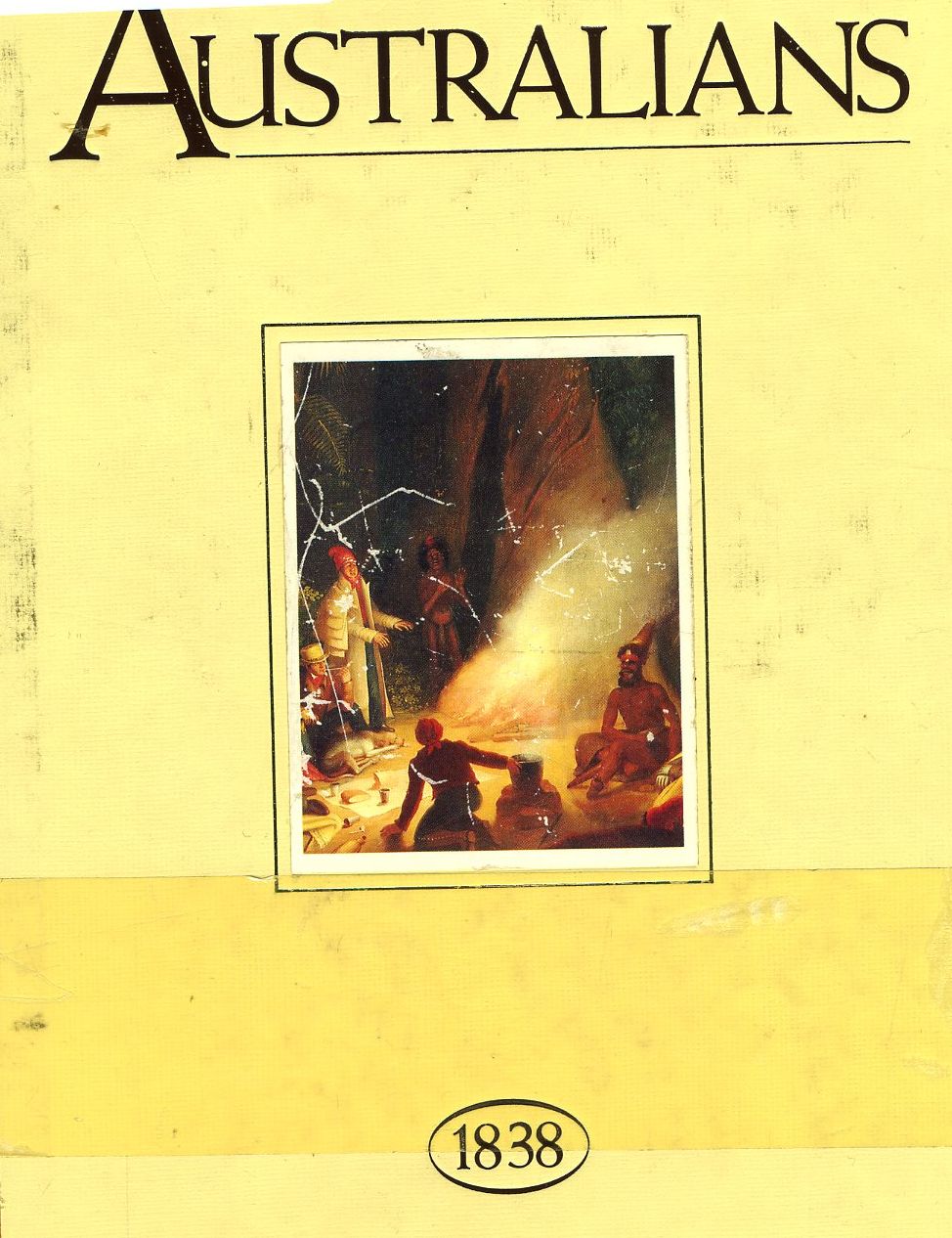
A couple of days ago I finished reading Australians 1838.  This book is part of a series of reference books published for Australia’s Bicentennial in 1988. As well as a dictionary, atlas, book of statistics and separate bibliography, each volume is devoted to a ‘slice’ of Australia’s history at 50 year intervals- 1788, 1838, 1888, 1938 etc.
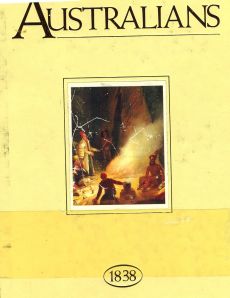
1987, 474p.

The process of developing these books is almost as (if not more!) interesting than the final product.  The project did not receive money from the Australian Bicentennial Authority, relying instead on funding from research grants and university support.  The project involved literally hundreds of scholars, and in the case of the 1838 volume, spawned its own accompanying journal ‘The Push from the Bush’ which took on a life of its own.  Although described as a ‘collaborative history’, closer examination of the contributors to specific chapters shows that the main authors were Alan Atkinson, Marian Aveling, and  S. G. Foster, along with sections by Lyndall Ryan, Joan Kerr, Richard Neville, Beverley Earnshaw, Margaret Anderson, Barrie Dyster, Jillian Oppenheimer, Frank Broeze, Sandra Blair, Rob Linn, Frances O’Donoghue, Mimi Colligan, Elizabeth Windschuttle, Elizabeth Webby, A. J. Rayer, Laurel Heath, Tony Rayner and Martin Sullivan.  And who said you can’t write history by committee?

By deliberately adopting a ‘slice’ approach, the series steps out of the mould of the “traditional Australian catechism” of Convicts, Squatters, Gold, Land Acts, The Kelly Gang, The Anzacs, The Depression and World War II.  As Alan Gilbert and Ken Inglis wrote in the Preface:

By writing about one year in people’s lives…historians could avoid creating the most common illusion conveyed by narrative approaches: that history is a stream, carrying people towards a predetermined destination clearly visible to us, if not to them.  Slicing through a year, we might hope to see and hear people living as we do, taking some things for granted- the sun rises and sets, the seasons pass, people grow older- but at the same time surrounded by choices and uncertainties.  We might recognize people more easily as our own kind if we met them living out the daily, weekly, seasonal, annual and biological rhythms of their lives; and we would certainly understand them more fully by grasping the truth that the future that beckoned or alarmed them was not necessarily our past- what actually happened- but rather a hidden destiny, a precarious vision of probabilities, possibilities and uncertainties. p.xiii

I’m not sure that this rather subversive view of history is actually realized by the book. It certainly achieved a panoramic view of what it was to live in 1838, but the sense of contingency, false starts and misconceptions doesn’t come through particularly strongly.  As a reader, it felt rather blinkered by focussing just on the one year with no  antecedents and consequences- there was no scope for that very human act of  wondering what happened next.  It was if the book was shut with a resounding clap and a “no more now, time for bed!”

I do, too, find myself wondering about the intended market.  In Macintyre and Clark’s 2006 (2nd edition) book The History Wars, the series is noted as being marketed as a heritage item, in terms of its design, production values and cost.  The reason that I read it was to find an insight into what it was to think like an 1838 Australian ( a rather anachronistic concept- more correctly, NSWman, Van Diemen’s Lander, South Australian and West Australian).  Why would anyone else read it?  It doesn’t have a strong narrative thread: nor is it a reference book per se.  It is beautifully produced with copious and lavish pictures.  Perhaps it’s intended to just sit on the shelf??

Which brings me to a different way of taking one’s history- threaded.  I see in Saturday’s Age that the National Museum is again in the news- this time, with the second iteration of the multimedia display ‘Circa’, a revolving theatre that leads from the entry foyer to the museum’s interior.
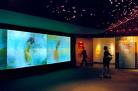
A controversial review of the museum by sociologist John Carroll , also described in The History Wars and Graeme Davison’s chapter in Macintyre’s The Historian’s Conscience (2004), criticized this particular display as a “paradigm for what is weak in the parts of the museum that are weak, in that it leaves confusion rather than clear, engaging narratives…. It’s far too much a jumble of snatches of opinion, one after another, which have no coherence together…”.  As Katharine Murphy notes in the Age article:

The new version can’t be accused of failing the chronology test.  It ties up 40,000 years of Australian history in a neat narrative bow, highlighting key elements of the museum collection- Phar Lap’s heart, the Banks Medallion featuring botanist Joseph Banks, and the prototype handmade Holden from which all modern Holden cars descent- in an effort to connect the visitor more directly to the place, rather than engaging them with a more abstract, and at times political, discussion about the experience of being an Australian. The contrast between the old and the new, on any analysis of tone and substance, is stark.  There is now a clear beginning, middle and end, and a location of history in time and place.

I would feel a little more comfortable about this if Howard’s cultural warriors on the National Museum Council (headed by Liberal Party president Tony Staley,  John Hirst, Howard biographer David Barnett and right-wing columnist Christopher Pearson) felt a little less comfortable.  I’m not opposed, however, to the importance of chronology and narrative- it’s something that I’m grappling with in my own telling of Port Phillip.  I’m very much aware of the need to have ‘befores’ and ‘afters’ in the way that we, as humans, impose a narrative structure on events.  I’m fascinated, in Judge Willis’ case, by the distortion of time and distance in the Colonial Office’s attempts to manage what was, after all, a personnel crisis in one of their overseas branches.

But the ‘neat narrative bow’ of this display disturbs me.  It sounds rather like an advertisement for the ‘must-sees’ of the museum- perhaps it’s not necessary to go any further but just sit on the floor and watch what you could see without all the walking? Perhaps I shall just have to bestir myself and hie myself hither to Canberra to see it for myself.

Hey, I used to work there!!

I see from an article in the Age that the Fitzroy artist Alexander Knox has created a light installation on the old Royal Mail building, on the corner of Bourke and Swanston Street.

Wow! That looks better! By light of day it really is a rather unprepossessing modernist building. Whenever I see that AC/DC film clip of the band travelling down Swanston Street on a flatbed truck, I notice ‘my’ building and try to imagine that it was ever viewed as anything except ugly.

What was there before? Apparently, the Royal Mail Hotel, built in 1848 and named because its owner E. B. Green had the contract for carrying mail by stagecoach throughout Victoria. Its second licencee was William Johnston Sudgen, previously Melbourne’s Chief Constable – nice little career shift there.

According to Robyn Annear’s A City Lost & Found, construction works to modify the building during the 1930s uncovered a wall containing bricks bearing thumbprints- generally considered to be a mark of convict manufacture. The brick-clay was examined by a visiting Tasmanian, who asserted that it was of Port Arthur origin, and the bricks were declared to be among Melbourne’s oldest.

(I am ashamed to confess that I have wasted nearly half an hour investigating when convicts were withdrawn from Port Phillip- a wild-goose chase prompted by my failure to finish reading the paragraph in Robyn Annear’s book! Stopping mid-sentence at the words “convict manufacture”, it struck me that 1848 was very late to have convicts still working in Melbourne. Half an hour later: I was right. Convict transportation from UK to New South Wales was suspended in 1840, and on 28 Oct 1843 Governor Gipps instructed LaTrobe to send the remaining convict gangs in Port Phillip up to Sydney. But they were still here 0n 13 December 1844 because Gipps again proposed withdrawing all the convicts, in exchange for the receipt of a cargo of Exiles- prisoners who had served 1-2 years in Pentonville prison before being issued with conditional pardons to take up as settlers (not prisoners) in New South Wales. A.G.L. Shaw writes that 1727 Pentonville exiles had landed in Port Phillip between 1844 and 1849 until popular protest against them culminated in the turning away of ships containing exiles and redirecting them to Sydney. So- Port Phillip convicts didn’t make the bricks in 1848. As, of course, Robyn Annear went on to say, had I read further.)

According to the excellent Walking Melbourne site, the old Royal Mail hotel was sold to the British company Hammerson Property and Investments Trust for 455,000 pounds. In October 1960 the hotel was demolished and this wonderful structure erected in its place.

I worked on both the fourth and third floors from about 2003-6. At first I was on the third floor in an office without windows located just behind the blue billboard at the bottom of the picture at the top of the page. At the time, there was a television screen mounted on the building, and I used to fantasize, in moments of extreme boredom, of sticking my head through the wall and emerging in the middle of the screen to survey the people below. I later moved onto the fourth floor to the rear of the building where my window overlooked the rooftops of the rather unsavoury cafe/restaurants fronting Swanston Street. However, it did give me a new appreciation for the copulatory habits of pigeons who inhabited the ‘pigeon brothel’ there.

On the other hand, working there did give a wonderful view of Melbourne. The Melbourne Cup march would go straight past, and political marches would stream by. Unfortunately the AFL Grand Final march turned up Collins Street instead, so I couldn’t watch that one. There’s a great little ‘structure’ of a pig with wings mounted on a pole on the corner which you can only see if you look up, but was directly in our line of sight. When the building across the road (that in my childhood had a rather evil Santa beckoning children onto the Foy’s rooftop garden each Christmas) was owned by Nike, we would watch spellbound as huge advertising posters were erected obscuring the building completely. However, the metal-man busker with his synthesizer loses his appeal after listening to him all day, and dog-lover though I am, a bait would be too good for the cattle dogs who bark twice at the end of each line of ‘How much is that doggie in the window?” sung ad nauseum for hours by the Slim-Dusty lookalike on the corner opposite.

So, good on you Alexander Knox. It looks beautiful, and I can’t wait to see it.

Obama-talk

Perhaps it’s all this reading about mumbo-jumbo, but I have never been completely won over by Barack Obama. There’s something that disturbs me about the lack of content in his rhetoric- what is he actually talking ABOUT? “Hope” and “change” could be easily interchanged with “love” or “freedom” and his speeches would still soar and the crowds would still roar.

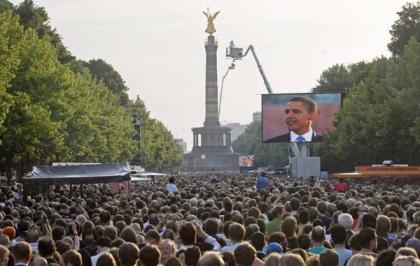
I was transfixed by this picture of his speech at the Victory Column in Berlin’s Tiergarten Park.

There’s a screen, and another screen, and then right in the middle, under the column is a tiny little dot that is Obama himself.

An edited version of the speech was reproduced in the Age. I’m quite interested in the rhetorical speech as a genre with its techniques and cadences, and this is a brilliant example.

People of the world- look at Berlin! Look at Berlin, where Germans and Americans learned to work together and trust each other less than three years after facing each other on the field of battle.

Look at Berlin, where the determination of a people met the generosity of the Marshall Plan and created a German miracle…

Look at Berlin, where bullet holes in the buildings and the sombre stones and pillars near the Brandenburg Gate insist that we never forget our common humanity.

People of the world- look at Berlin, where a wall came down, a continent came together, and history proved that there is no challenge too great for a world that stands as one.

“People of the World- look at Berlin”, repeated over and over, enough for us as listener/readers to realise that there’s a pattern at work here.

From Kiev to Cape Town, prison camps were closed, and the doors of democracy were opened.

Nice alliteration there- Kiev, Cape Town….but I’m not quite sure of the causal relationship though. And a bit more alliteration- “the doors of democracy”. Democracy has doors?

The terrorists of September 11 2001 plotted in Hamburg and trained in Kandahar and Karachi before killing thousands from all over the globe on American soil.

Hamburg…hmm how inconvenient. But at least we’ve got the K-places, Kandahar and Karachi where all this nasty stuff really comes from. It’s all really their fault.

As we speak, cars in Boston and factories in Beijing are melting the icecaps…bringing drought to farms from Kansas to Kenya.

Yep, that alliteration works a treat….

This is the moment when we must defeat terror and dry up the well of extremism that supports it. This threat is real and we cannot shrink from our responsibility to combat it. This is the moment when we must renew our resolve to rout the terrorists who threaten our security in Afghanistan and the traffickers who sell drugs on your streets. This is the moment when we must build on the wealth that open markets have created, and share its benefits more equitably. This is the moment we must help answer the call for a new dawn in the Middle East. This is the moment when we must come together to save the planet…..

This is the moment he should stop saying “this is the moment”.

People of Berlin- and people of the world- the scale of our challenge is great. Let us answer our destiny, and remake the world once again.

And here we back at the beginning with the people of the world looking at Berlin again. A carefully crafted, absolutely honed rhetorical performance. Not that there’s anything wrong with that. But just remember, folks, it’s still a performance.