Category Archives: Book reviews

How do you like your history? Sliced or threaded?

A couple of days ago I finished reading Australians 1838.  This book is part of a series of reference books published for Australia’s Bicentennial in 1988. As well as a dictionary, atlas, book of statistics and separate bibliography, each volume is devoted to a ‘slice’ of Australia’s history at 50 year intervals- 1788, 1838, 1888, 1938 etc.
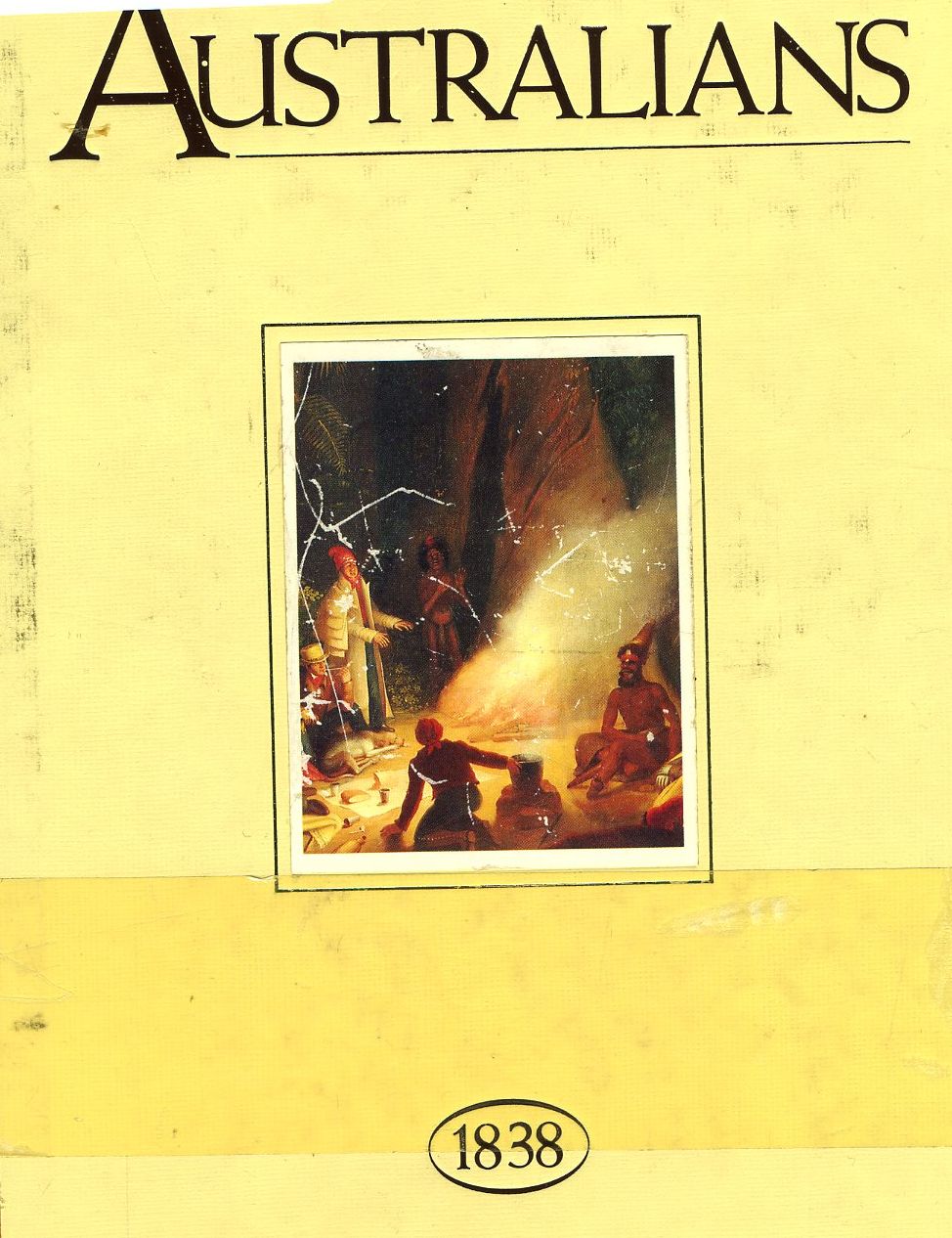
1987, 474p.

The process of developing these books is almost as (if not more!) interesting than the final product.  The project did not receive money from the Australian Bicentennial Authority, relying instead on funding from research grants and university support.  The project involved literally hundreds of scholars, and in the case of the 1838 volume, spawned its own accompanying journal ‘The Push from the Bush’ which took on a life of its own.  Although described as a ‘collaborative history’, closer examination of the contributors to specific chapters shows that the main authors were Alan Atkinson, Marian Aveling, and  S. G. Foster, along with sections by Lyndall Ryan, Joan Kerr, Richard Neville, Beverley Earnshaw, Margaret Anderson, Barrie Dyster, Jillian Oppenheimer, Frank Broeze, Sandra Blair, Rob Linn, Frances O’Donoghue, Mimi Colligan, Elizabeth Windschuttle, Elizabeth Webby, A. J. Rayer, Laurel Heath, Tony Rayner and Martin Sullivan.  And who said you can’t write history by committee?

By deliberately adopting a ‘slice’ approach, the series steps out of the mould of the “traditional Australian catechism” of Convicts, Squatters, Gold, Land Acts, The Kelly Gang, The Anzacs, The Depression and World War II.  As Alan Gilbert and Ken Inglis wrote in the Preface:

By writing about one year in people’s lives…historians could avoid creating the most common illusion conveyed by narrative approaches: that history is a stream, carrying people towards a predetermined destination clearly visible to us, if not to them.  Slicing through a year, we might hope to see and hear people living as we do, taking some things for granted- the sun rises and sets, the seasons pass, people grow older- but at the same time surrounded by choices and uncertainties.  We might recognize people more easily as our own kind if we met them living out the daily, weekly, seasonal, annual and biological rhythms of their lives; and we would certainly understand them more fully by grasping the truth that the future that beckoned or alarmed them was not necessarily our past- what actually happened- but rather a hidden destiny, a precarious vision of probabilities, possibilities and uncertainties. p.xiii

I’m not sure that this rather subversive view of history is actually realized by the book. It certainly achieved a panoramic view of what it was to live in 1838, but the sense of contingency, false starts and misconceptions doesn’t come through particularly strongly.  As a reader, it felt rather blinkered by focussing just on the one year with no  antecedents and consequences- there was no scope for that very human act of  wondering what happened next.  It was if the book was shut with a resounding clap and a “no more now, time for bed!”

I do, too, find myself wondering about the intended market.  In Macintyre and Clark’s 2006 (2nd edition) book The History Wars, the series is noted as being marketed as a heritage item, in terms of its design, production values and cost.  The reason that I read it was to find an insight into what it was to think like an 1838 Australian ( a rather anachronistic concept- more correctly, NSWman, Van Diemen’s Lander, South Australian and West Australian).  Why would anyone else read it?  It doesn’t have a strong narrative thread: nor is it a reference book per se.  It is beautifully produced with copious and lavish pictures.  Perhaps it’s intended to just sit on the shelf??

Which brings me to a different way of taking one’s history- threaded.  I see in Saturday’s Age that the National Museum is again in the news- this time, with the second iteration of the multimedia display ‘Circa’, a revolving theatre that leads from the entry foyer to the museum’s interior.
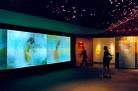
A controversial review of the museum by sociologist John Carroll , also described in The History Wars and Graeme Davison’s chapter in Macintyre’s The Historian’s Conscience (2004), criticized this particular display as a “paradigm for what is weak in the parts of the museum that are weak, in that it leaves confusion rather than clear, engaging narratives…. It’s far too much a jumble of snatches of opinion, one after another, which have no coherence together…”.  As Katharine Murphy notes in the Age article:

The new version can’t be accused of failing the chronology test.  It ties up 40,000 years of Australian history in a neat narrative bow, highlighting key elements of the museum collection- Phar Lap’s heart, the Banks Medallion featuring botanist Joseph Banks, and the prototype handmade Holden from which all modern Holden cars descent- in an effort to connect the visitor more directly to the place, rather than engaging them with a more abstract, and at times political, discussion about the experience of being an Australian. The contrast between the old and the new, on any analysis of tone and substance, is stark.  There is now a clear beginning, middle and end, and a location of history in time and place.

I would feel a little more comfortable about this if Howard’s cultural warriors on the National Museum Council (headed by Liberal Party president Tony Staley,  John Hirst, Howard biographer David Barnett and right-wing columnist Christopher Pearson) felt a little less comfortable.  I’m not opposed, however, to the importance of chronology and narrative- it’s something that I’m grappling with in my own telling of Port Phillip.  I’m very much aware of the need to have ‘befores’ and ‘afters’ in the way that we, as humans, impose a narrative structure on events.  I’m fascinated, in Judge Willis’ case, by the distortion of time and distance in the Colonial Office’s attempts to manage what was, after all, a personnel crisis in one of their overseas branches.

But the ‘neat narrative bow’ of this display disturbs me.  It sounds rather like an advertisement for the ‘must-sees’ of the museum- perhaps it’s not necessary to go any further but just sit on the floor and watch what you could see without all the walking? Perhaps I shall just have to bestir myself and hie myself hither to Canberra to see it for myself.
David Roberts PATERNALISM IN EARLY VICTORIAN ENGLAND

1979, 278 p

One of the frustrations that I’ve faced in trying to understand Judge Willis has been to try to understand his mindset. Why did Port Phillip society of the time find him so unacceptable and demand his dismissal? Was he too radical? Was he too conservative? Was he neither of these things? This book focusses on early Victorian England which, although a hemisphere away from Port Phillip, was the milieu that informed the thinking of colonial judges and civil servants and was the lens through which their patrons and superiors back in the metropole viewed their actions.

In this book, Roberts attempts the heroic in trying to define and illustrate the workings of an unnamed-at-the-time set of varying beliefs and attitudes which he, along with other 20th historians, identifies as ‘paternalism’. He argues that, bolstered by Romanticism and literature, paternalism reached its apogee in 1844. It’s a slippery concept, though, despite his attempts to pin it down through analysis, for example, of the backgrounds of the contributors to the major ‘paternal’ journals and quarterlies of the day, or by the speeches and voting patterns of ‘paternalist’ MPs in the 1840s. He divided these parliamentarians into 6 categories: the Romantics, The Peelites, The Churchmen; the Country Squires; The Whigs and the Anglo-Irish, but even he admits that there is no consistency between their espoused position in speeches, and their actions. Paternalism, it seems, is only one of several influences. In fact, his concept is so hemmed in by qualifications and disclaimers that you start to wonder if what he is describing exists at all.

But, despite his difficulties in defining it, he posits that after 1848 ‘it’ was no longer functional: rendered less relevant by the rise of urbanisation, a self-conscious middle and working class and the mid-century intellectual developments of science, rationalism, empiricism and belief in progress.

I’m not sure that this book has taken me much further in understanding Judge Willis. It’s interesting that his major patrons are categorized as either Peelites or Whig paternalists- but I’m not really sure yet what, if anything, that means.

Kevin Rabalais THE LANDSCAPE OF DESIRE

2008, 280 p.

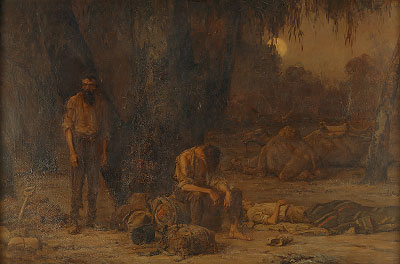
As a newcomer, you’d have to be pretty brave to write a fiction book about one of another country’s iconic stories. The author of this book is American-born and now living in Australia. Quite apart from the narrative draw of the Burke and Wills expedition in its own right, it’s obviously the sort of story that attracts writers from other countries. The English writer Sarah Murgatroyd with The Dig Tree also mined the Burke and Wills story with, I think, more success than Rabalais has had. And of course, Alan Attwood with Burke’s Soldiers and Alan Moorehead ‘s Cooper’s Creek also tell the Burke and Wills story- and they’re just the ones that I’ve read! Generations of Australian school children have heard the story; the highly glorified Burke and Wills statue has been shuffled to and fro around Melbourne streets and now overlooks the corner of Swanston and Collins Street, and the imagery is strongly reinforced by the Longstaff painting in the National Gallery of Victoria.

So how then, does a writer who has not grown up immersed and inured to all this mythologizing deal with the story? This is a fictional account, and focusses on the love interest between Robert O’Hara Burke and the actress Julia Matthews which he expands by having William Wills fall in love with her as well. I’m not aware of this twist- but hey, it’s fiction. The story is told in small snippets, disconnected in time and location and has the feeling of being at times over-written. As an Australian reader, it is familiar to me: I can’t imagine how a reader new to the story could possibly follow it.

If he is writing for an Australian audience whose knowledge of the expedition can cope with these narrative discontinuities, then he has even more responsibility to get things right. I always understood that they reached the mangroves of the Gulf of Carpentaria, observed the tidal flow, then turned back. I have never heard, as Rabalais asserts, that they stood in the foamy sea. This gives the expedition a triumph that it was denied, and there’s something very Australian in that. We are comfortable with our heroic failures- we like them that way.

There’s a sniff of the writing exercise about this book. Many sections are only 3 or 4 pages long (a good length for ‘workshopping’), and there is an appalling, anachronistic interjection of an authorial reflection about photographs which, thankfully, starts and ends abruptly never to be seen again.

The Moorehead book is the ur-text of Burke and Wills stories. Sara Murgatroyd, who died of cancer at the age of 34 just after her book’s publication, gets a good look in and has left a strong legacy. Other than that, I don’t really think the world NEEDS another Burke and Wills story.

Rose Tremain RESTORATION

1989, 371p

I have rather mixed feelings about historical fiction.  On the one hand, it was probably historical fiction that led me to my love of history in the first place, and the type of history that attracts me always has a strong human and imaginative thread to it.  When there is a basic fidelity to the setting and the mentalities of the main characters, then I love it.  It can be playful with the facts, but not earnestly wrong.  I really relished Peter Mew’s Bright Planet set in- surprise, surprise- 1840s Port Phillip, and Patrick White’s historical fiction (e.g. Fringe of Leaves, Voss ) is solidly grounded in research and yet nuanced and sophisticated in its themes.

But I have my reservations too.  I agree with Inga  Clendinnen (my heroine) with her qualms over Kate Grenville’s The Secret River and the issue of historical fiction attempting to contribute to a historical debate. I am annoyed when something is just plain wrong- the research has been done and exhibited, but it’s WRONG! I dislike the arrogance of projection of modern mentalities onto characters set in the past.  I sometimes feel as if the story is suffocated by meticulous research that the author can’t bear to let go of.

Which leads me to Rose Tremain’s Restoration.  It is set, as you might guess, in Restoration England, complete with Charles II, the Great Fire and the Plague.  There’s a certain predictability about this- of course they are all such write-able events that no author writing a book set at the time could resist them!  I thought that Tremain captured the voice of a 17th century male writer well, and my admiration for it increased even more when I returned, as I do from time to time, to www.pepys.diary.com to read Samuel Pepys’ diary entry for the day.

But of course, ventriloquism is not the same as creation, and it added to my sense that I was reading a set piece, with hackneyed settings and events and a reproduction of a 17th century voice.  This probably sounds more scathing than I mean it to be: I enjoyed it well enough, happily persisted to the end, but I only rate it as a  ‘good enough’ read.

Francis Wheen HOW MUMBO JUMBO CONQUERED THE WORLD

2004, 312 p.

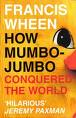
It was the week-long World Youth Day in Sydney that prompted me to read this book, although I was, I confess, disconcerted by the big yellow chicken on the front and Jeremy Paxman’s acclamation of it as “hilarious”. I don’t really know that “hilarious” is the apt description- certainly the author swipes both left and right in his tirade against mumbo jumbo.  He attacks post modernism (saving special venom for Julia Kristeva- I’m with you on this one, Francis!), Thatcherism, New-Ageism, Blairism (particularly), globalism, fundamentalism- really, there isn’t an “ism” that he doesn’t turn on.

At its core, the book is an argument for “truth” and the principles of the Enlightenment, but in all this slaughter of sacred cows, it’s difficult to detect what he is in favour of.  He is rather cavalier with his quotations and footnoting- he is careful about one quote on a page, but completely silent about another more outrageous quote from another source on the same page- which makes me a bit distrustful of his  academic thoroughness.  And I find myself still wondering HOW mumbo-jumbo conquered the world.

John Banville THE SEA

2005, 263 p

This won the Booker Prize, and it’s very much like his other books.  There’s his care, deftness and sophistication of language and vocabulary; a deluded and unreliable narrator; and allusions to an artistic and professional life in which the main character immerses and obscures himself.

Banville’s handling of three timelines is masterful.  A widowed art historian returns to a childhood holiday spot, where he reflects on his wife’s recent death from cancer and recalls his infatuation with the mother of a childhood friend in a golden summer of his early adolescence.  In this regard, the book reminded me of Ian McEwan’s  Atonement and L.P. Hartley’s The Go-Between. Banville slips effortlessly between these three storylines and there’s a dishonesty about his narrator’s telling in of all of them, through a mixture of naiveté, pomposity and emotional blindness.  Banville writes so well- his descriptions are often so beautiful and apt that you stop to savour them.  The ending was, perhaps, a bit of an anticlimax but it’s the language and sheer virtuosity of the author’s writing that is the real strength of this book.

Helen Garner “The Spare Room”

2008, 195 p.

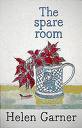
This is Garner’s first avowedly fiction book in over a decade, and was greeted with wide acclaim.  It is a beautifully presented book, right from its crisp front cover and its interesting face boards.  This care in presentation is amplified in the opening pages where Helen is preparing her spare room for the 3 week visit of a friend from Sydney who is seeking alternative therapy for advanced cancer.  Nicola’s death is not really the core of this story: instead the drama of the book is Helen’s rage and inadequacy in the face the demands of friendship, and her frustration at her friend’s relentless faith in a “cure” that Helen feels is quackery.  I suspect that Garner herself is ashamed at her own behaviour, and is seeking absolution from herself and her readers in this thinly disguised memoir.  I loved the embeddedness of this book within Melbourne suburbia, and her confidential and warm tone- like a good, satisfying talk with an old friend.

“A Thinking Reed” by Barry Jones

2006, 528p.

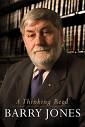
Barry Jones has been typecast, to his chagrin, as a “lovable eccentric”, and is best remembered for his appearances on Pick-a-Box quiz shows during the 1960s and has recently reprised his quiz-show persona on “The Einstein Factor” on ABC television.  His contribution to public life, though, is much wider than this.  He served as both a state and federal Labor politician, he was ALP President, a delegate to UNESCO, the author of “Sleepers Wake” and a major contributor to the since-discarded  (but probably more pertinent than ever) Knowledge Nation policy.  He can often be seen around Melbourne and has the status of National Living Treasure.

In many ways this book reflects its author very accurately: rather pompous and yet awkward, fact-bound and passionate.  At times its very didactic and rather strained writing style frustrated me but by the end of the book, I was absolutely won over by the innate goodness and complete authenticity of the man.  He has much to be bitter about, and he does not hide his disappointment and sense of betrayal, but he keeps on giving- and there is his true nobility.  His last chapter is the most passionate, but at the same time the most disillusioned- I hope that since November last year he has more cause for optimism, although I’m not really sure that he has.  There is no “front” in this book- Barry Jones just is as he is, and we are all the better for it.  8.5/10