Category Archives: Book reviews

‘Journey from Venice’ by Ruth Cracknell

cracknell

2000, 271 p

Ruth Cracknell was a much-loved Australian actor- sharp, eloquent, funny, rather patrician in an ‘older woman’ sort of way. Although, of course, her character Maggie Beare in ‘Mother and Son’ (where she plays the devious elderly mother whose hapless adult son returns to live with her)  was none of these things!

I had to keep flicking to her picture at the back of the book to remind me that she was the author, because her celebrity is almost inconsequential to this story.   It’s not so much Ruth Cracknell here, but Mrs. Ruth Phillips, mourning the death of her husband Eric.  It’s as woman and widow, mother and grandmother that we meet her, not as a ‘star’.

This is a beautifully constructed memoir.  The preface starts with Eric’s funeral,  written in italicized third person, as if she is watching herself going through the ritual.  She then moves back in time to their arrival in Venice for a holiday together and the pace of the narrative moves to a slow sort of travelogue, overshadowed by the certain knowledge that death  is hovering over them like an unseen, malevolent force.  This sense of foreboding permeates the book, even when Eric is finally well enough to fly home to Melbourne where cancer is diagnosed.  The title is well chosen: I kept thinking of Mann’s ‘Death in Venice’, but Eric does not die there. He recovers sufficiently to be medi-evacuated back to Australia, has two precious trips back to the family home for Sunday lunch, and some weeks later dies of the cancer, not the bleeding that initially threatened his life.  And so, by the end of the book, we return to the funeral and we, too, grieve.

While waiting in Venice for him to recover sufficiently for the trip home, the tourists leave as the summer season ends, the deeper water laps at the floor of her ground floor flat, and Ruth becomes aware of the sheer inconvenience of living (as distinct from visiting) Venice.  That holiday, so eagerly anticipated, so richly enjoyed for the first few days becomes instead a stark, lonely, bewildering exile.

This is, instead, a journey from Venice, not to it, and in the weeks they have together, they fall in love again- a different sort of love, suffused with the knowledge that it is all they have left.  They truly do live “in the moment”: the sharing of a blood orange is a sensuous joy, and she sees and loves anew the stripped down, solid core of the man she has been married to for over 40 years.

It was interesting to read this book after recently finishing Caroline Jones’ book about her father’s death.  This is a much more grounded, sane and adult book, and one that gives much more comfort.  It is beautifully written and constructed, and it shares the poise, groundedness and authenticity of its author.

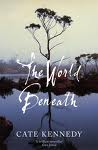
‘The World Beneath’ by Cate Kennedy

kennedy

2009, 342p.

Rich and Sandy are 40-something leftovers from the 1980s, still stuck in the victory of the Franklin River blockade that they look back to as the high point of their lives.  They met on the campaign and shifted to a small hippy country town together but their relationship broke up while their daughter Sophie was very young.  Sandy immersed herself in the companionship of her earth-mother friends, while Rich headed off around the world as a photojournalist.  Neither has moved on at all from their dreams of the early eighties: Sandy’s dreamcatchers and pottery are now tatty, dated and twee, while Rich’s career in photojournalism finds him washed up in the dead-end of editing  infotainment  segments for morning television.  The story opens as Rich re-establishes contact with his moody, anorexic, goth 15 year old daughter Sophie, and suggests a bushwalk to Cradle Mountain as a new start to their relationship.

Sandy is reluctant to let him back in to their lives; Sophie is curious and at first attracted by his footloose approach to life, especially compared with Sandy’s smothering neediness and flakiness.  But Rich, in his own way, is just as stuck in the 1980s as Sandy is,  just as blind to Sophie’s anorexia and just as flawed as a parent, whatever his initial attractiveness.  When he encourages Sophie to go for a walk off the tourist trail, they get lost and Sophie loses her illusions about him.

These are very human characters, and Kennedy teeters of the verge of parody, especially with Sandy.  She hones in on Sandy’s ineffectual, rather vacuous new-age, earthmother persona and Rich’s self-deception, cynicism and lack of commitment.  Sophie is a sullen, sneering adolescent, cocooned in her technology and affected world-weariness.  But there’s a recognizability about them all too, and an element of send-up that lacks the venom of  Christos Tsiolkas’ The Slap, to which this book has been compared.

This gently-skewering parody is acutely done, but after a while it didn’t seem to be going anywhere. But the second half of the book picks up pace and it becomes a real page-turner: I was literally sitting up in bed, wanting to finish it but despairing at how late it was becoming as I kept reading.

There are some fantastic interviews with the author: one on the Radio National Book Show and another at The Ember, and good blog posts by Lisa at ANZLitlovers and Kerryn Goldsworthy at Australian Literature Diary.  I must admit that, particularly after reading the interviews, I found nuances and depths in the book that I hadn’t picked up on at first reading.   I’m not sure why this is- I was aware of the references and paradoxes in the book, but almost needed to listen (or read) someone talking it over for them to coalesce for me.  I’m not sure whether this reflects a weakness in the book, or in me as a reader, or whether this is the sort of book that is best shared with others and talked about as much as read.

This is a good book.  I wonder if its references to MySpace and ipods will date it, but the observations of character and the wonderful descriptions of landscape will sustain it even when Sophie is just as dated and twee with her early-21st century technology as Sandy and Rich are with their 1980s idealism.

‘Hobson: Governor of New Zealand 1840-1842’ by Paul Moon

hobson

1998,  307p

If you ask a Melbournian about William Hobson, most of us would mutter something about Hobson’s Bay or the Hobson’s Bay City Council.  I hadn’t really thought about who ‘Hobson’ was: I assumed that he was an old sea-dog living down somewhere around Williamstown, and when I thought hard about it, I wasn’t even really sure if I knew where Hobson’s Bay was.  “Somewhere in Port Phillip Bay” I would airily gesture- thereby setting my Uncle Peter’s teeth on edge over the tautological use of  Port and Phillip and Bay in the same phrase.  (“It’s Port Phillip, Janine, – the Port named after Governor Phillip; not Port Phillip Bay”)

Hobson’s Bay is the bay immediately at the mouth of the Yarra River, with Williamstown on its west shore and Port Melbourne and Middle Park round to the east.  And Hobson, for whom it is named, was not a long-term Melbourne resident but instead spent a three-month stint between September and December 1836 surveying and charting the coastline of Port Phillip, returning to Sydney before a second brief trip accompanying Governor Bourke for an official visit and exploratory expedition in March 1837.  Hobson  was impressed with Port Phillip and was already dreaming of the fortune that could be made there.  In his letters to his wife he expressed hopes of perhaps being appointed Governor there in the future.  That didn’t happen.  Instead, he was sent off to New Zealand to investigate conflict there and on the basis of the report he submitted to the Colonial Office, he was appointed Consul to New Zealand in August 1839.  There seems to have been some slippage in the terminology of Consul/Lieutenant Governor/ Governor that probably signalled much about precedence and status at the time, but which is less significant to us now.  After meeting with the recently-appointed Governor Gipps in Sydney in December 1839, he sailed off to New Zealand arriving 29th January 1840 and was not to leave the country again before his death in 1842.  He didn’t muck around when he arrived: the first copy of the  Treaty of Waitangi was signed  on 6th February, just over a week after his arrival.

Which is, of course, where my interest comes in.  On the flight over to New Zealand, I read a review of Paul Moon’s latest book The Edges of Empire: New Zealand in the mid-Nineteenth Century.  I hadn’t heard of Paul Moon- not that that necessarily means anything- but I had heard of Claudia Orange and other historians who have written about the Treaty of Waitangi.  From his Wikipedia entry, he seems to be a prolific and at times controversial historian from Auckland University of Technology- perhaps an unusual location for an academic historian?

Certainly in his preface he distances himself from other historians, their methodology and their debates.

In preparing this biography, I have cautiously avoided trying to make the subject conform to a particular theme or line of argument, and any themes that do arise tend to be incidental…Consequently, many of the episodes in this work have been retraced in the way that they unfolded for Hobson at the time, rather than with the didactic and ‘superior’ sort of hindsight that necessarily distorts as it attempts to simplify and clarify. (p12)

In his eschewal of historiography and debate, he relies heavily on fairly lengthy slabs of official correspondence and primary sources predominantly from the New Zealand end.  The Colonial Office is depicted as a lumbering, compromised body ‘over there’- a simplistic approach which overlooks the contested nature of lobbying politics and the machinations of individuals and factions.  These political currents are well described by Adams in Fatal Necessity and more recently in Zoe Laidlaw’s analysis of the Aborigines Select Committee, the lobby group that lay behind much of the Colonial Office approach to indigenous affairs right across the empire.   Moon does, despite his protestations, engage with historical debates, most particularly over the Treaty of Waitangi, but does not extend what I conceive to be the courtesy of naming the historians or their arguments-  instead prefacing his own sallies with “It has been suggested that…”  It’s also striking how few recent references he cites in his bibliography: there is a heavy reliance on works from the early 20th century or the 1960s.  He critiques Paul Scholefield’s ‘hagiographical’ and ‘apologetic’ (p. 12) treatment of Hobson in 1934, but doesn’t take up any of his points in detail beyond this blanket condemnation.

By concentrating on the time 1840 to 1842, Moon does not pick up on the significance of Hobson’s naval background, a theme explored so well in Greg Dening’s Mr Bligh’s Bad Language and in Jane Samson’s Imperial Benevolence: Making British Authority in the Pacific.   He also skips over the significance of the patronage of Lord Auckland, after whom Hobson named the town he chose as capital city.

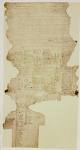
However, his approach does shed light on the contest  between the missionaries and the Wakefieldian-influenced land settlement company New Zealand Company, both of which vied for Hobson’s attention and decried his limitations to their patrons back in England.  Add to this the corrosive influence of self-serving and canny civil servants,  plucked from obscurity in Sydney on  Hobson’s way to New Zealand, who were just as avaricious as any land entrepreneurs in London or in Port Nicholson, the rival North Island city settled by the New Zealand Company.  Then, if that’s not enough, overlay this with Hobson’s own evident ill-health, evident even to me 160 years later,  looking at the shaky and at times child-like signature of Hobson’s name on different versions of the Treaty of Waitangi.

References

Peter Adams Fatal Necessity: British Intervention in New Zealand.1977

Greg Dening Mr Bligh’s Bad Language, 1994

Zoe Laidlaw ‘Integrating metropolitian, colonial and imperial histories- the Aborigines Select Committee of 1835-7’ in Tracey Banivanua Mar and Julie Evans Writing Colonial Histories: Comparative Perspectives, University of Melbourne 2002.

Claudia Orange The Treaty of Waitangi, 1987.

Jane Samson Imperial benevolence: making British Authority in the Pacific 1998.

Paul Scholefield Captain William Hobson: First Governor of New Zealand 1934.

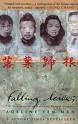
‘Falling Leaves’ by Adeline Yen Mah

fallingleaves

When this was distributed as the next month’s read for my CAE bookgroup (a.k.a. “The Ladies Who Say Oooooh”) my heart sank.  “I’ve read this”, I thought.  But as I read further into it, I realised that it was not a clone of  Amy Tan 3-female-generation saga, as I expected it to be.  I had not, in fact, read it and now that I’ve finished I wish I hadn’t anyway.

This is a grubby, self-serving, vindictive book.  The author has left her (now deceased) parents’ names unaltered, along with that of her husband.  She did, however, change the names of her siblings.  I think that the issue of changing or not changing names in an autobiography really highlights the sore spots and anxieties in an author’s telling of their story.

The book is one long howl of wounded dignity and pain.  The author’s mother died after giving birth to her, and her father remarried a young, beautiful French-Chinese woman that the family called ‘Niang’, an alternative form of “mother”. The besotted father is putty in her hands, and betrays his allegiances to the children of his first wife- although admittedly, the relationship between a widowed father and the child whose birth precipitated the mother’s death must always be a fraught one.

This is a toxic family.  Niang certainly does appear a cold, manipulating, scheming woman who sows jealousy and dissesion amongst her children and their half-siblings.  They are all- parents and children- dominated by the love of money, ruthless in their determination to get ahead; remorseless in their own quest for parental approval.  The author, as narrator, portrays herself always as the innocent victim of others’ perfidy- a rather self-serving and perhaps not always accurate assessment.  There is no loyalty to family, and certainly no loyalty to country among the immediate family- they collect and discard nationalities at will in their thrust to get ahead.

Why did she write this book?  One can only think that it is her revenge, served cold and in print.  And wait- there’s more!  Not only did she write this book, but she rehashed her revenge  in her second book Chinese Cinderella which from its description, sounds like the same book fictionalized.

I feel complicit in her vindictiveness by even having read this book.

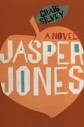
‘Jasper Jones’ by Craig Silvey

silvey

2009, 299 p.

Set in 1965, this book opens with a dilemma.  Charlie Bucktin, the bookish, nerdy, teacher’s son is startled by a knock at the louvres of his sleep-out when Jasper Jones, the town ‘bad boy’, calls him out into the backyard.  Somehow or other Jasper Jones cajoles him into assisting with the disposal of the body of a young school acquaintance that Jasper found hanging from a tree in his special place in the bush.  This young girl was Jasper’s secret girlfriend and Jasper is terrified that he will be blamed for her murder.  For me, one of the main problems with this book started at this point: I just didn’t buy into Charlie’s involvement and why two innocent boys would dispose of the body.  Hence, the whole premise of the plot was shaky for me as a reader.

For me, the book didn’t start well.  It took almost 25 pages for young Charlie to be faced with his opening dilemma.  The book then spooled into an equally long conversation between Charlie and his Vietnamese friend Jeffrey about the respective qualities of superheroes.  There is a self-indulgence about the length of these digressions and internal dialogues, and an indulgence too in the number of themes the author crams into the book: first love, friendship, bullying, police brutality, racial prejudice, marriage breakup, incest, youth suicide, social exclusion.

As if this wasn’t enough (and it is!) the book is framed within a homage to Harper Lee’s To Kill A Mockingbird.  This, too, is rather heavy-handed.  We have the hermit misfit, the childhood taunts and dares about ‘raiding’ his house, the trips through the forest at night (albeit, not dressed as a ham) and the revelation of a mild father standing up to a bully, evoking Atticus  shooting the rabid dog.

All of this suggests to me a lack of good editting in curbing an energetic young author.  And he IS young- his Wikipedia entry claims that Craig Silvey was born in 1982.  At this point, though,  I have to doff my hat.  He is writing about small town life set 17 years before he was even born and he doesn’t put a foot wrong.  He captures beautifully a world where television was incidental, where kids’ consumerism was limited by pocket money, where community events were not so strictly segregated and segmented by age brackets and where kids had a wider geographic zone not necessarily under the constant surveillance of their parents.  He portrays well the anxiety about disappearing children and the perceived, if brittle,  authority of community figures like mayors and police officers.  There must have been careful research here and the book carries it effortlessly.

I’d be really interested to know how readers much younger than I respond to this book.  It would lend itself well to film, and the coming-of-age aspect and the nostalgia for a simpler time would endear it to baby-boomer viewers- in fact, possibly more than to the young adolescent readers for whom it was probably written.

‘Fatal Necessity: British Intervention in New Zealand 1830-1847’ by Peter Adams

waitangi

When considering early Australian and New Zealand history, you have to keep your bifocals on. Isolated ‘down here’,  ten thousand miles from ‘home’, with at the least a six month round trip for any official communication,  it’s possible to view events and people through a local lens with a type of nonchalance about pronouncements and edicts that arrived from the other side of the world.   But taking a broader view, the network of relationships and communications between the colonies themselves and the Colonial Office formed another type of reality- not as immediate perhaps, but imbued with the finality of ultimate veto.  But both local and distant views have the illusion of solidity: neither is as straightforward as it appears.

The “Fatal Necessity” described in Peter Adams’ book refers to the mission creep that accompanied the creation and signing of the Treaty of Waitangi in New Zealand in February 1840.   The Colonial Office developed the treaty from a theoretical duty springing from the legal bond between subject and state, in order to control and protect British subjects who had chosen to go to New Zealand.  A second imperative was the increased humanitarian concern for the aboriginal people already there.   A third imperative, more urgent from the Antipodean perspective than that of the Colonial Office, was to prevent Maoris selling their land to strangers- particularly the French who were perceived to have designs on New Zealand.  The Colonial Office originally planned to gain sovereignty over only parts of New Zealand, but when the New Zealand Company despatched large numbers of settlers under systematic colonization, the Colonial Office realized that the whole colony had to be annexed.

This book shifts between the motivations and actions of individual men at the local, antipodean level- Gipps, Busby and Hobson- and the political manoeuvering of pressure groups and politicians to influence Colonial Office policy in London.  In particular Adams concentrates on the Church Missionary Society and its president Dandeson Coates, and the New Zealand Association- later the New Zealand Land Company- a group of investors influenced by Wakefieldian ideas of systematic colonization.   Diametrically opposed in their objectives, these two pressure groups circled around the main political and bureaucratic figures in colonial affairs, conducting meetings, petitioning and lobbying all as part of the game of politics and patronage.

Ten thousand miles away, Gipps, Hobson, Busby and Wentworth may have thought that they were key players and that their actions and submissions were influential, but this was a delusion. More important was the political make-up of British parliament and the always-present imperative to retain power.  Hence we see the clash of the Lords – Lord Howick, Lord Durham, Lord Melbourne, Lord Glenelg – doing deals, appeasing, jockeying and saving face as part of another dance of politics far removed from the lawn of the Resident’s House overlooking a quiet bay on the other side of the world.

treaty house

‘Owls Do Cry’ by Janet Frame

1961, 179p

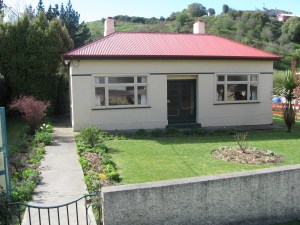
You may have detected a New Zealand theme in my reading lately.  This is because your Resident Judge is currently in the land of the Long White Cloud, and I often enjoy reading a book about or from the places I visit on holiday.  I’d already packed this book to bring with me, and was even further inspired to bump it up the “To Be Read While On Holiday” pile by visiting Janet Frame’s house between Christchurch and Dunedin.

IMG_2772

This book is very similar to her autobiography because it shares many autobiographical elements.  However, it is written as fiction with the barely disguised Frame family- the older sister who dies from burns (as distinct from drowning); the mentally troubled second sister (Janet herself); the epileptic, miserly brother, and the flighty and materialistic younger sister.  I’m not sure what her family thought about this book, which was one of the most warmly acclaimed of her novels, as they are certainly all identified quite clearly here.  I did read a biography of Janet Frame by Michael King some years ago, and I can’t remember what the family’s response was.

Although Frame’s autobiography was filmed by Jane Campion as “An Angel at My Table”, film of course always transforms an autobiographical source into something different.  The main character is the observed in a film, along with the other characters,  rather than the observer in the book who sees from the inside out.  In this regard, probably Owls Do Cry and the film are closely linked, more than the autobiography and the film that bears its name.

Frame writes beautifully with a real poetic sensibility.  At times her imagery is oblique and somehow distorted, but because of this it feels crisp, clear and somehow innocent.  It is truly original. The first section tells of the children’s poor and straitened childhood, and their grief after the death of the older sister.  Then the book splits into three strands, tracing the narrative through the perspective on each of the three remaining children in turn, twenty years later.  Toby, the brother, suffers from epilepsy and is “a shingle short” and lives an unhappy, frustrated, cloistered adult life with his parents. Chick (or Teresa which she now prefers to be called) is married with two children in the North Island, and her narrative is presented in the form of a diary as she and her husband strive for respectability and acceptance in a socially stratified community which sees through their materialism and anxiety about possessions and impressions.  The final strand is from Daphne (Janet’s) point of view and is fey, unhinged and lyrical.  There is a short epilogue that jumps ahead a further number of years, with a “what happened next” summary approach.

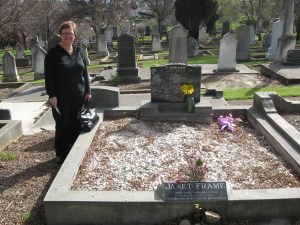
IMG_2780

I’ve really enjoyed reading this book, having now seen the Oamaru that she fictionalized as Waimaru in this book.  She captures so well the cold and greasy poverty of working class rural life,  the anxiety of adolescence, the fug of family and the pain of being human.

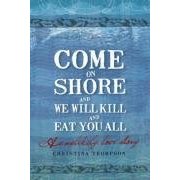
‘Come on Shore and We Will Kill You and Eat You All: An Unlikely Love Story’ by Christina Thompson

thompson

288 p.

I’ve been fascinated by the title of this book for some time, after hearing the author interviewed on Radio National’s Book Show.  An intriguing title, I thought, but rather long and unwieldy.  But having now read the book, I can see the nuances in the choice of title, and I think it a good one.

But I came to read this book immediately after reading Caroline Jones’ Through a Glass Darkly and here again, I find myself confronted by a book that is not just an autobiography taking a life lived across a long period of time, but instead a slice of the author’s life that examines a dilemma or situation faced by the author.  In this case, Thompson writes of her marriage to Seven, a Maori man and the three children she has with him.  She is an American academic, based in Melbourne to write her doctoral thesis, and when she meets and marries Seven, she finds herself enmeshed in Maori family and community obligations that she both observes and critiques as a border-crosser.  She is quite open about the fact that there are values and responses that she does not share, or even completely understand, and she feels conflicted about the historical trajectory that has seen her New England family amass wealth and status over another disenfranchised people, the American native.  She can see the parallels in her own story, and that of the history of Seven’s family and culture.

I liked the way that in several chapters, she chooses an emblematic episode or object and uses it as a focus around which to embroider observations, history and politics.  Her story ranges across the world- New Zealand, New England, Melbourne, Hawaii, and explores different aspects of border-crossing and contacts.  I’m not completely convinced by her writing style, though.  It is certainly readable enough, but in spite of the general notes at the back – not too academic lest they frighten the reader- the book veers between accessibility and colloquial chattiness.  She is obviously a careful observer and incisive yet wide-ranging thinker, but it’s as if she has subjugated her erudition- perhaps at her publisher’s suggestion? Or is it perhaps a reflection of the compromise she has had to make more generally in her life?

For her academic career and her marriage seem two completely disconnected, compartmentalized aspects of her life.  She hops from one postdoctoral fellowship to another, and obviously has a respected if not lucrative academic career.  Academia is often peripatetic  by nature, but there’s also an element of nonchalance that Seven seems to bring to this as well.  I am unsettled by the whole precept of the book and her foreword, where she explains that she has changed the names of Seven’s family but not other aspects of the story, suggests an uneasiness on her part as well. What is the authority by which she writes this book?  Is there an element of trophyism and appropriation going on here?  And, as with Caroline Jones’ book, I ask myself: do I have any right to criticize the choice that another person makes, just because I would have chosen differently?  But a part of me answers: but SHE wrote this, she put it out here into the public domain, she has invited her readers to observe her and, by extension, critique what they find.

The quote from which the book takes its title is from Charles Darwin who, tired and homesick after his long journey on the Beagle, misquotes from journals during Cook’s voyage written decades earlier. Cook and Banks realised that the taunt “Come on shore and we will kill you” was a performance and  a posturing stance towards any stranger that a Maori group might encounter, and was not necessarily acted upon.  The suggestion of cannibalism was added by Darwin himself.  It works well as the title for this book: it too is a challenge, and reveals layers of truth, representation and contact between cultures at the political and personal level as well.

‘Through a Glass Darkly’ by Caroline Jones

jones

224p. 2009

Caroline Jones is probably best known as one of the presenters of  Australian Story the long-running ABC documentary series on a Monday night.  The stories featured on Australian Story are human-interest, generally uplifting and ‘inspirational’ features of half an hour in length, combining a narrative, flashbacks, and interviews with friends and family of the person featured.  Caroline Jones comes across as an older, wiser, immaculately groomed, sensitive presenter.   As an English judge was moved to say of Lady Archer (huh!)  “Has she fragrance?  Has she elegance?” and the same question could well be asked of Caroline Jones.  I’ve always found her rather cloying though, and after reading this book, I am even more wary of such unmitigated ‘niceness’.

The book appears to be taken from Jones’ own diary, written after her 93 year old father had undergone heart surgery.  It traces though his time in intensive care and eventual death after a number of weeks, then with her devastation in dealing with his death.  She draws no comfort at all from the idea that he had ‘a good innings’ and, as she is an only child without children herself, she finds herself completely bereft of family.  She finds that her spirituality brings her no comfort at all and her pain seems to abate only with time.

I feel rather uncomfortable writing about her book, as to criticize the book is to criticize her. And yet, she is the one who wrote the book (for whatever reason); she is one who has chosen to expose herself in this way; she is the one who has put her own actions and responses into the public domain.   It’s a strange genre- not memoir as such, which is a construction in itself;  and by focussing on just one aspect of a life lived, it lacks the completeness of an autobiography.  It’s almost an argument of sorts; a point of view over a particular event, and I think that by writing it, the author invites challenge.

There seem to be many things that Caroline Jones has NOT spoken about with her father:  whether he should even have the surgery at the advanced age of 93 (and to my way of thinking, there’s something decadent about a society that even offers this option) and  whether Caroline has the right to say ‘enough- no more treatment’.   Jones herself says that she and her father have never really spoken about Caroline’s mother’s suicide when Caroline was a young girl- surely a huge,  unresolved (and unresolvable) ache in both their lives. For all her assertions of closeness and love between them, there are many things unsaid that should have been said.

Despite her “niceness” Caroline is filled with rage at her father’s predicament-  the breathing tube, the continued surgeries, the poor outcome- and she is watching like a hawk.  She is there every day: she does not leave until the night staff come on so that she knows who is on duty.  On the rare occasions when she leaves to fulfil firm obligations, she yearns to be back by his side.  It is a long drawn out nightmare for them both.

Her spirituality leaves her cold, and yet she brings many of her own spiritual mentors in to visit her father, even though he does not share her Catholic faith and has not expressed any particular personal faith.  Like many a loving father, he is content to let her have her own religion; but as a loving daughter she does not provide him the same space.

The book closes with two appendices, written by her friends in response to reading an early draft of the book.  I think that they are a self-serving addition, acting only to bolster her own world-view.  The second appendix, written by a doctor at the hospital where her father died, assures her that she was “controlled”, not “controlling”.  I can only assume that someone must have made this comment sometime about her.  I disagree.  She is very controlling.

To be honest, this book angered me.  I don’t think that I want to write any more.

‘Sex and Suffering’ by Janet McCalman

mccalman

1998, 368p

I’d already worked out what I was going to say in reviewing this book.

I am not keen on institutional histories.  I dislike their celebratory nature and the way that their authors obviously feel compelled to doff their hats and gush over the institutional big-wigs and stalwarts.  You can often sense the shadowy presence of the steering committee in the back-ground and that a publicist and risk-management expert are hovering in the wings.

However, I was drawn to read this history of the Royal Women’s Hospital after hearing a Radio National Hindsight program on it, available for download hereJanet McCalman, from the University of Melbourne ( I see that she, at least still works there, given the University’s decimation of its Arts faculty) wrote Struggletown: Public and Private Life in Richmond 1900-1965 – a history of the working-class suburb of Richmond,  and Journeyings: The Biography of a Middle Class Generation 1920-1990, which followed the No 69 tram through the middle-class suburbs of Melbourne.  She’s obviously drawn to writing larger social histories by focussing her lens on a small patch of inquiry.

And so Sex and Suffering: Women’s Health and a Women’s Hospital carries on an approach that she obviously feels comfortable with.  As the title might suggest, this is not just a history of an institution: instead it deals with sex and the experience of being woman, health and institutions.

The experience of childbirth is intimately woven into the hidden parts of private lives and soon overlaid by the other experiences and achievements of a growing person.   It is common to us all, and for a short period of time is overwhelming in its effect on the mother at her exposed, most basic core and on the people closest to her.   So it was fascinating to consider the act childbirth- that most intimate and personal of events- as part of a social phenomenon that can be handled at the structural level in so many ways.

The book itself follows a chronological approach, with seven sections covering roughly 20-30 year periods.  The emphasis varies in the sections, from the clinical (particularly in the sections discussing sepsis and antisepsis) to the social and structural (where the judgments of upper-middleclass doctors and the Board of Management were trained onto the predomiantly working-class and migrant clientele).   Throughout most of the book, she draws on the case notes of individual women- helpfully supplemented with a glossary of medical terms in the margin- to make real her discussion of anaesthesia and surgery and its effect on horrendous labour situations, the horror of clostridium welchii which could kill a woman in hours, and the changes in attitudes towards labouring women and their partners.  Ye Gods- some women had enormous babies- particularly in the post-Gold Rush period when women who had suffered malformations of the pelvis through malnutrition themselves as children, especially in Ireland,  gave birth to large babies when their own diets had become carbohydrate-heavy in a new country.  There’s something stark in reading the case notes reproduced at the end of the book that chart the death over a number of days of a woman, knowing that there are mothers and fathers, husbands and other children who have been left bereft.

I know that when I was in labour with my children, I was very conscious that I was part of a chain of labouring women in my family and thought -even then!- about how absolutely dreadful it would be to die in childbirth. Hormonally, physically and from an evolutionary sense, every sinew of your being is focussed on giving birth to that child then and there, even if it is your twelfth or illegitimate.  I felt as if I was surrounded by generations of women who had given birth before, and that I was stripped down to my essential female-ness.  In reading this book I was made conscious of the effects of bad births- those fistulas you now only know of in Third World countries,  the lifelong invalidism that followed some births, and the amount of pain that lingered on year after year.  It made the knowledge of my maternal grandmother’s seven births and several miscarriages, and my paternal grandfather’s first wife’s death in childbirth, more meaningful.

There are wonderful photographs and diagrams in this book.  The photographs of Melbourne in the early chapters from both the La Trobe Picture collection and the Royal Women’s Hospital Archives are clear and showed perspectives of my city that I hadn’t seen before.  The internal photographs of the hospital, again from the hospital archives,  while deliberately posed, speak volumes about hospital discipline and nurses’ roles.

A second thread that runs through the book is a commentary on class and gender in Melbourne. The more feminist, women-centred  Queen Victoria hospital stands as a counter-point to the more traditional, male-dominated Royal Women’s Hospital, and the class perspectives of the charity-oriented upper-middle class female board members run through the attitudes towards sexually-transmitted disease, abortion and adoption that the hospital had to deal with.

Well, this is what I was going to say until I got to the last part of the book.  The last section, unfortunately, descended into that boosterism and oily fulsomeness of the standard institutional history.  Probably for privacy reasons, the case histories dropped out of the narrative.  Although they were replaced by oral history reminiscenes of experiences in the Women’s, they lacked the immediacy and contingency of those earlier case notes.   Judgments about individuals who are alive and likely to read this book need to be tempered, and as a still-operating (though re-located) hospital , there is the equivalent, I guess, of the doctor’s  “do no harm” in writing about the institutional culture.  The management-speak of the final pages reflects the funding and political milieu in which institutions now exist, but I also suspect that it has been carefully vetted by the current hospital administration as well.

So, if you read this book- and I exhort you so to do- you might want to stop after Section VI in 1970.  To that point, it’s fascinating.