Category Archives: Book reviews

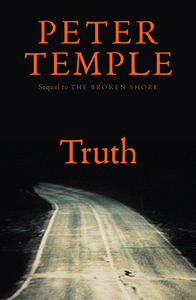
‘Truth’ by Peter Temple

2009, 387 p

If this book wins the 2010 Miles Franklin award I shall be seriously disgruntled.

I enjoyed Temple’s The Broken Shore, which was long-listed for the Miles Franklin in 2006 and which I thought a subtle analysis of masculinity and aboriginality, wrapped up in a murder mystery.  This book lacks the nuance of the earlier book (to which it is tangentially linked) and instead reads very much like a film script.  Its sentences are short, almost monosyllabic and its descriptions read like a string of observational comments.  Conversations drive the narrative, often shooting back and forth like a ping-pong ball.  The masculinity that was so fragile in The Broken Shore is too macho here: the women are just props.

Temple establishes the Melbourne setting on the first page, when he backfills a little on the history of the West Gate bridge, and then alludes to the Black Saturday bushfires a few pages further in.   It felt clumsy and a little gratuitous.

I’m probably not the best person to read or comment on crime fiction.  Every Friday night Mr Judge and I settle down in front of the ABC for our weekly dose of crime, forensic science and forensic psychiatry (e.g. Wire in the Blood; Silent Witness; Body of Evidence etc. etc. etc.) I sit there and watch it unfolding before me and almost without fail half an hour later in bed, I’ll say “But I don’t get it- who DID it??”

Which is the way I felt at the end of this book.  Peter Temple has been quoted as saying “I hate things being spelled out” .  Don’t feel that way Mr Temple, spell away!  There were so many characters in this book, the plot-lines were so tangled,  too many themes were squeezed in- the last pages of the book just passed in a blur and once again I’m asking “But I don’t get it- who DID it?”

‘Hunters and Collectors’ by Tom Griffiths

1996, 282 p

I finished reading this book, sitting up in bed.  I clapped it shut and burst out “Bloody brilliant!”. Now I love my history books as much as anyone, but I don’t always react with such enthusiasm.  The book came with high credentials- the string of medals across its front cover indicated that it was going to be pretty special ( winner of the NSW Premiers Literary Award 1996, the National Book Council’s Club Banjo Shortlist 1996, the winner of the Premier’s Literary award- not sure which state- 1996, and the Eureka Science Book Prize 1996.)  I wasn’t disappointed one little bit.

The book’s full title is “Hunters and Collectors: The Antiquarian Imagination in Australia”.  Griffiths describes the antiquarian imagination as  “a historical sensibility particularly attuned to the material evidence of the past and possessing a powerful sense of place”. (p1).  His book explores the tensions between two groups of people in relation to history: Aboriginal and non-Aboriginal Australians, and amateurs and professionals.

He explores these tensions by focussing on a handful of 19th and early 20th century Victorian (as in the state of Victoria) antiquarians and collectors.  For example – R. E. Johns collected a huge number of Aboriginal skulls and his drawing-room collection ended up at the Beechworth museum.  Alfred Kenyon was a collector of stone artefacts and involved in societies like the Anthropological Society, the Prehistoric Club, and was heavily involved in Port Phillip history. For the family historians among you, you’ll know that  the  Kenyon index in at the State Library is a well-thumbed card index of the pastoral pioneers of the district.  Then there were the nature writers of the early 20th century like Donald McDonald  who wrote nostalgia-based nature columns like “Village and Farm” or “Nature Notes and Queries” for the Argus, or Charles Barrett who wrote for New Idea and the Victorian Naturalist.

We might feel uneasy about gentlemen amassing aboriginal skulls and artefacts for their drawing-room collections, but Griffiths points out that as well as the acquisitive aspect of their activities, there was a political and intellectual strand as well.  Although they were not academics – indeed many were hostile and suspicious towards academia as a whole- they did correspond with other collectors internationally and were particularly  interested in the classifying aspect of anthropology.  For the collectors based in Victoria, there was a tension between their interest in “real” Aborigines, preferably far distant in central Australia, and their eagerness to distance themselves from urban and what they would see as “half-caste” Aboriginal political activism in the present.   For example, Barrett and Kenyon’s book Blackfellows of Australia, written in or around 1936 in available online here.  It’s well worth a look, and sobering to consider that it’s being written at about the time of the Aborigines Advancement League, William Cooper and  the  Day of Mourning.

Then there’s the issue of amateur and professional historians, and the tension between memory and history.  This was of real interest to me, because as I may have mentioned, I am fairly heavily involved with my local historical society.  It was established in 1967, just in advance of the flood of historical societies that commenced between 1970 and 1990.  Local historical societies are grounded in a powerful sense of place and at first tend to revolve around key people and a “keep it under the bed” mentality.   This section of the book was particularly pertinent to me, as Kenyon lived in Heidelberg with his daughter, and I’ve caught several references to him in our collections.   There has always been, as Griffiths points out, an uneasy relationship between universities and local historians, and I confess to feeling that tension from time to time, overlaid as it now is by friendships and local loyalties.  And as Griffiths also points out, universities too have increasingly been repackaging their course offerings into  “public history” as a more saleable income stream in the face of decreasing funding.

I hadn’t particularly considered before the proliferation of history and nature societies and mentalities that still lingered in the 1960s education system that I grew up in.  For example, many of the antiquarians he writes of were involved in the different commemorative days that school children were involved in (Wattle Day, Arbor Day etc) and groups like the Gould League of Bird Lovers.  In particular, there was a link with the School Paper that all Victorian school children received regularly as a supplement to their School Reader.  There’s copies of the April 1911 School Paper devoted to Australian History on the SLV site here– again, well worth looking at-  for its emphases in telling Australian History.

Griffiths brings the antiquarian imagination right up to the present day with his description of “history towns” like Maldon in Victoria, and planning and demolition battles over what bureaucrats vs. locals might regard as significant buildings.  He writes of the modern wilderness movement and the contradictions of attempting to maintain a “pristine” environment which is nothing of the sort.

He closes his book with a personal reflection of his own role as a collector for the Museum of Victoria, and how it intersected with the activities of the earlier antiquarian collectors he describes in this book.  In this epilogue you can detect the influence of the historian Greg Dening in particular, whom he names almost first up in his acknowledgements.  The epilogue really is masterful: it returns our gaze to the men and their intentions on which the book is based, and reminds us how they have been interwoven into our own history-making today.   And, in case you haven’t picked it up, this really is a bloody brilliant book.

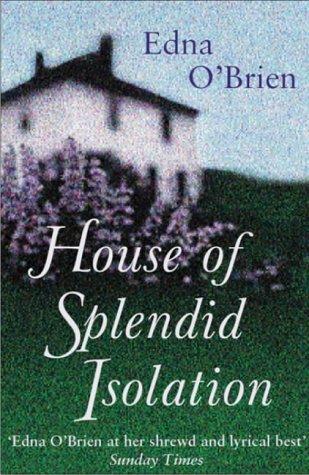
‘House of Splendid Isolation’ by Edna O’Brien

1994,  216 p.

Oh dear, oh dear.  I don’t know if I understood this book.

History is everywhere.  It seeps into the soil, the sub-soil.  Like rain, or hail, or snow, or blood.  A house remembers.  An outhouse remembers.  A people ruminate.  The tale differs with the teller.

From these opening words, this seems like a book I’d really enjoy.  It is set in the Irish countryside- 1970s maybe? – where an elderly widow Josie O’Meara lives alone in her increasingly decrepit old house.  Her solitude is invaded by McGreevy, an IRA gunman on the run, who hides there.  I suppose that you could say he has taken her hostage, but it doesn’t feel that way as they co-exist in the house and eventually draw closer to each other.

The book is told with sharp, cut-away snippets told from multiple perspectives.  The narrative slows down when Josie recalls her unhappy marriage to one of two brothers, who brings her to live in the family home.  It is a violent marriage that drags itself along in unhappiness.  Her life is brightened by the arrival of a handsome young priest, but he leaves.  When McGreevy arrives, it’s as if she has been enlivened again by his masculinity, which is wound up into her delusion and confusion.

A book about the IRA is political by its nature, but Josie is not an IRA sympathizer. It  is more that she, and the other villagers around her, are tired of the killing.  Indeed, it is the Garda, lying in wait for McGreevy who seem the more brutal.

But all of this is gleaned in snatches, and the reader has to work very hard to string together the narrative in this book.  Rather too hard, I think.  I closed the book with a “What???” at the end, completely bewildered by the last pages.  I still am none the wiser.

‘Aborigines and Colonists’ by R.H.W. Reece

Aborigines and Colonists: Aborigines and Colonial Society in New South Wales in the 1830s and 1840s

I was speaking to a fellow postgrad of close proximity (wave!)  the other day and he commented on the deluge of research amongst our postgraduate colleagues in Aboriginal history now, compared with the 1970s, when he first dipped his toes into the historical waters.   It brought home to me the distinctiveness of  Reece’s Aborigines and Colonists, published in 1974, where it joined a handful of books written after Stanner’s Boyer 1968 lectures that spoke of  “the great Australian silence”.  There was John Mulvaney’s work, and C.D. Rowley’s trilogy, and Henry Reynolds had published a book of sources and some journal articles- but not yet the books that he was later to become famous for.

In fact, it’s difficult to read Reece now without peering through the dust raised by Reynolds, Windschuttle etc. in the history wars of late last century.  There was such a heightened moral fervour in that debate that Reece’s work seems very cool and dispassionate in comparison.

The aim of his book, he says in the introduction, is to examine the “Aboriginal problem” as seen by philanthropists, squatters and colonial administrators, and so it locates itself very clearly on “one side of the frontier” as Reynolds might have characterized it.  The early chapters of the book explore the mindset of  “improvers” and “officials”.  Among the “improvers” he identifies those who wanted aborigines separated from white society as distinct from those who opposed segregation; those who thought that the introduction of Christianity was the main priority; those who saw “kindness” as a sign of weakness, and those who were repulsed by the sight, the smell and the sensational anecdotes that surrounded the Aborigines.  He traces through the changing emphases of official policy and the influence of evangelicals on Colonial Office policy, particularly in the mid 1830s, and the changes during Gipps’ tenure up until about 1844.  He sees the brief period between 1838 and 1844 as the time of genuine, but ill-informed attempts to bring Aboriginal and white relations under the framework of the law and to improve the spiritual and material welfare of Aboriginal people.

He focusses closely on the Myall Creek Massacre of 1838 which he contextualizes as one of a series of massacres in the Liverpool Plains district at the time.  It is here that I most clearly noticed the sober tone of his writing. He does not underplay the death and cruelty of Myall Creek but nor does he sensationalize it, and the writing is more powerful for it.  He also injects  field research (quite literally) when he writes of  Len Payne and Cecil Wall traipsing around what had been the Myall Creek stockyard, digging up hinges and fence posts.  Cecil Wall had been the last of a succession of Walls who had worked on Myall Creek.  You can read more about this here, in a rather idiosyncratic site.

Reece also spends quite a bit of time on the Port Phillip district, which was being newly settled at the time of the Myall Creek massacre.  It was in Port Phillip that the evangelical vision of Aboriginal Protectors was trialled, and found wanting.  He is particularly critical of La Trobe over his unfavourable reports of the Protectorate which made no recommendations to Gipps and provided little insight into the problems they faced.  I’d take issue with this: I see La Trobe as a benign but ultimately impotent figure in relation to the Protectorate.  Within the tenor of the deferential relationship he had with Gipps, I don’t think he could be anything else.

Nearly forty years after publication, this book still stands strong but it was a product of its time.  It would be wrong to chide it for the perspectives it does not explore- aboriginal resistance, aboriginal agency- because these historiographic themes did not emerge until decades later, and no doubt will be themselves overtaken.  As a trailblazer in its field, this book might well have been drowned out by the flood of later research, but its dispassionate tone serves it well.


‘Butterfly’ by Sonya Hartnett

2009, 215 p.

I don’t think I want to live in Sonya Hartnett’s worlds.  They’re brutal places where damaged children are lacerated by cruelty and neglect, and where as a reader you start to feel as if you have no skin.  This is the third Hartnett I have read and I feel as if I am reading the same book over and over. I’m starting to wonder if there’s something rather unhealthy about her work.

This has been shortlisted for the Miles Franklin and as my annual torment, I  try to read the shortlist before the winner is announced.  I doubt if I’ll succeed this year, but I’ll give it my best shot.  This is not the first time Hartnett has been shortlisted for major awards- she was shortlisted for the Miles Franklin for  ‘Of a Boy’ in 2003 which at the time I wondered about, and was shortlisted for the Age Book of the Year for ‘Surrender’ in 2005, and at the time I thought that she had a real chance of winning.

And now ‘Butterfly’.  Again I find myself raising a quizzical eyebrow and wondering “Mmm- Miles Franklin?”.  The book started off badly for me because I loathe books that start off with a character regarding themselves in the mirror then proceeding to describe everything they see.  In my list of writing sins  this comes pretty close to the top, followed closely by describing food and Hartnett does quite a bit of that too.  I’m as entranced by the “lyrical” novel as much as the next reader but her images and metaphors just sit on the page, indigestible and distracting.  Even the name annoys me:  “Plum”. I felt very much as if I was reading a Donna Parker book from my early adolescence and despite the frequent references to the heat, I felt as if it was set in 1960s America- perhaps it was the double storey house that did it? It’s written in the present tense which is another narrative technique that makes me fidget.

For probably 2/3 of the book I was very close to giving up on it- and that’s from someone who rarely fails to finish a book.  I kept reading and finally, in the last part of the book it did click, after all.   But I’m not convinced that a book shortlisted for the Miles Franklin should take 130 pages to engage its reader.

I’m no longer an adolescent girl of course, and thank God. Yes, I know that friendship is hard, and that hanging round with a large-ish group of girls as I did in high school had its own perils and insecurities.  It hurts to think back, and I’m pricked by my own embarrassment and shamed by times when I behaved just as badly to others.   Would it have helped to read about it at the time? I don’t know.  Do I want to read about it now? No.

‘Connecting the dots’ by Judith London

2009, 204 p

I haven’t really plunged very deeply into the pool of Alzheimers literature.  There’s an element of consciously shutting my eyes here.  Just like a car crash that you’re witnessing, it’s all happening faster to my mother than I want it to, but at the same time it feels as if the pain is being drip-fed, drop by drop, so slowly.

My beautiful, laughing, smiling, very talkative mother doesn’t say much any more- just a few words here and there, difficult to catch.  It’s as if she’s retreated smaller and smaller into a body that I barely recognize now.  And so, this book that looks at communication as Alzheimers advances into its mid-to-late stage is the right book for now.

It’s written very simply, in large print, with short chapters.  These things are not so much important for me, but they may be for my father.  It says a great deal for this book that I handed it on to him saying “I found this useful- perhaps you should read it”.  I suspect that he’ll only dip into it gradually and that he’ll only be able to read a little bit at a time, and the layout of the book lends itself to that style of reading.

It is written by an American therapist who does group work with patients with Alzheimers, encouraging them to communicate their feelings.  As a result, there’s a clinical bent to the work: she quotes recent research, and her emphasis is on getting her patients to talk to her about their own emotional world as their disease progresses. As a daughter, I often wonder what it’s like to be Mum now- are the days long? is she frightened? is she lonely?  I can imagine that all these things are true, but she doesn’t tell me.   I’m scared of asking because I don’t know what I would do with the answers.   But this book reassures that the feelings are there and can be expressed in some ways.

The patient has her pain: we, as the husbands/wives/daughters/sons- or as she phrases it the ‘loved ones’-  have our own pain.   London stands on the professional side of the fence rather than on the family side.  For example, when she is working clinically,  tells her patients ten minutes before, then five minutes before, she actually leaves so that the patient can have an opportunity to express grief.  And yes, I know that the ‘loved one’ has much more power in the situation, and that there’s a travesty in not giving a space for the one with Alzheimers to express what they feel, but it’s all so hard.  But I don’t think I have strong enough shoulders to plan to bear the grief ten minutes, then five minutes, then as I actually leave.  Once is difficult enough: three times is just too hard.  It’s at places like this that the professional vs ‘loved one’ divide becomes clear.

There’s a bit of an Oprah-ish tone to the book- a bit of mawkish sentimentality and mushy spirituality- but not so much that I found it unbearable.  Perhaps this says more about me than the book.  Mainly it was good to hear someone who had such confidence that there is still a space for communication at all as Alzheimers progresses.  The book is sprinkled with anecdotes and case studies which made me realize that even though at first I’d scoff “Well, her patients aren’t as advanced as Mum is”, that in many ways they were and that she was drawing from them things that I haven’t heard, or helped, my mother to say.

The advice is short, practical and realistic.  There’s a dot-point summary at the end which is a good reminder of what has gone before.  Perhaps it could have come at the start of the book for those loved ones who are resistant to reading anything at all- although perhaps then they wouldn’t go on to read the whole thing.

So yes, I did find it useful.  Very useful, and in a way even affirming.  I hope my Dad does too.

‘We are all made of glue’ by Marina Lewycka

2009, over 400 pages but large print.

As I may have mentioned, like nearly every 50 plus, middle class suburban woman, I belong to a book club.  I’m very fond of my Ladies Who Say Ooooh.  That’s my daughter’s name for  the group after listening to us chortling and “oooohing” when the meeting was held at my place once.  We have good discussions.  Although we might go off-topic occasionally, we always answer the questions in the booklet that comes with the book , which yields us a satisfying conversation of  well over an hour.   I always read the book, or re-read it if I’ve read it before and I’ve never once abandoned a book club book. But with this book, I was sure tempted.

We had read A Short History of Tractors in Ukranian previously, and enjoyed it well enough, so I was happy to read this one too.   I couldn’t tell at first if it was a parody of bad writing- it was, after all supposed to be a comedy- but unfortunately, I don’t think that was the case.

I’m not even going to try to describe the plot.  Just a few words, then.   Marriage breakup; sonky teenaged son; batty old lady; the Holocaust; a mystery;  tangled identities; Israel; nefarious real estate agents; old people’s homes; Palestine; apocalypses; cat poo.  Holding all this together is the metaphor of glue, and if you don’t get the metaphor, I’ll tell it to you again because Lewycka sure did.  Glue.

There are just too many threads in this story and the book cries out for a good edit.  It’s touted as “black humour”- are you supposed to laugh at black humour?  Or is it slapstick?- certainly not a genre I’m fond of.  I kept reading, expecting that at some stage it might all come together and that I’d be overwhelmed by how cleverly the author had disguised her intentions behind this implausible, overburdened storyline.  By page 350 I had resigned myself to the likelihood that it just wasn’t going to happen.

When, at the end of the discussion we awarded our notional stars out of five, I gloomily intoned “ONE”.  The others, to be fair, stretched to three, and one Lady even gave it four.  “You don’t HAVE to finish it, you know, Janine” they said.  Ah, but I do!  It’s a book club book!

‘The Multiple Effects of Rainshadow’ by Thea Astley

1996, 296p

Thea Astley’s book was written fifteen years ago about an event that happened in the 1930s but this historical fiction has turned out to be tragically prescient.

It begins with the cyclone that annihilated the Aboriginal settlement Mission Beach and led to the establishment of a new mission on Palm Island and it ends with the 1957 strike of the Palm Island men against the menial tasks they were expected to do- an industrial action that was severely repressed.  And though Thea Astley didn’t know it, we could add another post script to her story with the Palm Island death of Mulrunji Doomadgee that Chloe Hooper has described so sensitively in her book The Tall Man.

The central action in the book is the massacre inflicted by the superintendent of the island, Robert Curry (known in the book as “Uncle Boss Brodie”) who, crazed by the death of his wife and suffering from neuralgia, torched his own house killing his children,  shot and wounded the Doctor and his wife (mistress in the book), set fire to the other houses and blew up the buildings on the reserve.  He was eventually shot by one of the Palm Islanders on the orders of one of the white officials.

At first I thought that the book was going to unfold as a series of Rashamon-like chapters, each telling of the killing from different perspectives.  The book started with an Aboriginal English telling of Palm Island’s history – a technique that non-Aboriginal writers might flinch from now.  Then the narrative voice shifts to Mrs Curthoys the hotel-keeper;  then Morrow the inept Works Manager;  and finally Brodie himself.  But then it jumps ahead some fifteen or so years and picks up on other characters who had been there on the island that night: the teacher, the Catholic priest, and even beyond them to the children of those witnesses who had not even been born at the time of the massacre.

Brodie dies; the Aboriginal boy who shot him is jailed but then released.  At one level it is over, but the witnesses and their children are drawn back to it like a web.  The jobs they take, the marriages they make, the choices their children make are all set wobbling onto a different trajectory by what happened on Palm Island in the 1930s.  On Palm Island, too, Brodie is replaced by other administrators who, like their predecessor, become crazed with their own authority and the tension builds again.

I had mis-read Astley’s metaphor of the rainshadow.  I had in my mind those billowing afternoon clouds of tropical Queensland that build like towers in the sky until the rain pours down, the skies clear overnight and then the whole cycle starts again the next day.  I thought that she was referring to the oppressive humidity, or the fury of rain.  It seemed apposite:  Palm Island’s recent history seems to have been a succession of crises that build, burst, abate then begin to build again.

But a rainshadow is a desert, not a jungle.  It’s the phenomenon by which rain falls on one side of a mountain range but it remains dry on the other side.  Now that I know this,  the rainshadow metaphor works well too.  There is a cataclysm; it occurs, then there is parched emptiness. There is a dessication about the people in this book: they move out from Palm Island onto the mainland where they live unhappy, meaningless lives.

The book ends in despair and hopelessness.  There’s no redemption here for anyone. Even less for the Palm Island that Chloe Hooper brought us some eighty years later.

Postscript

If you read the comments below, you’ll see that Whispering Gums and I both wonder if our reviews (her review is here) emphasize strongly enough that the book is fiction.  As I look at my posting, I think that’s a valid point.  The bookends that frame the book- the rampage and the strike- are both factual events, but she has fictionalized the characters.  Even Brodie/Curry (a factual character) has been filled out from the imagination, as he did not survive to give any account of his motivation.  So- look for Astley on the fiction shelves, not the non-fiction! and tease out a little more that eternal conundrum about history and fiction…

The newspaper reports of the day provide a sobering illustration of the imaginative space that Astley had to roam in- they are stark, skimpy reports that read as if they were coming from outer space or a distant, distant frontier .  From the National Library newspaper site, here’s an article about Palm Island that will make you cringe written prior to the event;  and here’s one about the rampage itself.  There’s others too- just search “Palm Island”, narrowing the dates to around 1930.

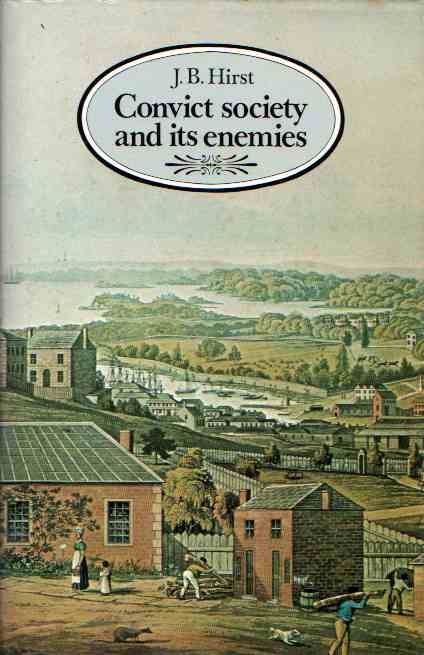
‘Convict Society and its Enemies’ by J.B Hirst

1983 , 217 p

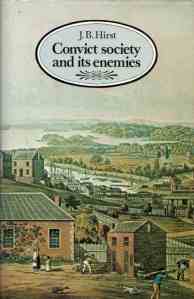
This book has been recently re-released, along  with its companion volume The Strange Birth of Colonial Democracy as a new book called  Freedom on the Fatal Shore.  In the foreword to the new version, Hirst writes of his affront at the wealth of  publicity that Robert Hughes’ book The Fatal Shore attracted, compared with the muted attention that his own book had received.

The phrase ‘the fatal shore’, originally in a convict ballad, has been made famous at the title of Robert Hughes’ magnificent book on the convict system. The advance publicity for The Fatal Shore had no need to tell lies about it, but it made the claim that this was the first book seriously to examine the convict system in Australia.  I was ropeable.  Why was my book Convict Society and its Enemies, then four years old, being overlooked?   When this claim was repeated in a quality newspaper, I determined to write a letter-to-the-editor to correct this error and push my own claims.  My wife told me I should not think of doing such a thing until I had seen the Hughes book.  I am very pleased to have followed her advice  (p.vii)

Because in the introduction, Hughes acknowledges Hirst’s book upfront:

Colonial Australia… was a more ‘normal’ place than one might imagine from the folkloric picture of society governed by the lash and the triangle, composed of white slaves tyrannized by ruthless masters.  The book that best conveys this and has rightly become a landmark in recent studies of the system is J. B. Hirst’s Convict Society and its Enemies. (Hughes ‘The Fatal Shore’ ,1988, p.xiv)

Yet although Hughes agreed with many of Hirst’s arguments about the normality of the system, the overwhelming “takeaway” from Hughes’ book was that the Convict System was a cruel, dehumanizing, oppressive system.   Although Hughes admitted that the secondary punishment system he describes was not the norm, it is his depictions of  the lash and the triangle that a reader remembers.

Hirst argues instead that, right from the beginning- even at the planning stages of the First Fleet- there was an intention for something other than a harsh, punitive penal society.  Women and children were included on the First Fleet, complicating from the start the creation of a strict penal system;  convicts were encouraged to marry; there was an unfulfilled intention to pick up more women from the islands on the way (and what a what-if scenario that gives rise to!) .  The overall concern of the British authorities was that they not return to England; hence they were given grants of land and known as ‘settlers’ once their sentences had expired.  Because it was intended that they become part of a British capitalist economy, they had more legal rights than they could have had in England- the right to sue, the right to give witness in court- and there was no bar on their economic activities once freedom was attained.  The early food shortages amplified the imperative that an agricultural sector be developed as quickly as possible. When convicts were turned over to private landholders they were called ‘assigned servants’;  they refused to work all day and insisted on “own time” after their tasks were completed;  they often lived in huts separate from the owner’s house compared to the suffocating oversight of servant life in England; even flogging was controlled by law.

So who were the “enemies” in Hirst’s title?  The  “exclusives”  spring immediately to mind:  emigrants with capital who came to the colony and resented the wealth and social acceptance of the ex-convicts who surrounded them.

But Hirst complicates this simplistic explanation.

First there were the Benthamites back in England, whose own commercial proposals for the Panoptican-style penitentiary were thwarted by the settler-model penal scheme that underpinned the First Fleet.  They had a vested interest in promoting their own model, and had increasing influence from the 1820s on in making the system more uniform.

Then there were the liberals and humanitarians themselves (not necessarily the same thing), particularly in England, who decried the dehumanizing effect of convictism and its parallels with slavery.   Ironically, in their efforts to overturn transportation, they themselves had to demonize the system by highlighting its inequality, cruelty and degradation.  It was also a rather tenuous line to tread, because in many ways British labourers during the Industrial Revolution had more difficult lives than transported convicts in the colonies.

Third, by the turn of the century there was an increasing group of native-born white Australian who, unlike both exclusive emigrants and convicts, were born in the colony.  They were shaping up as a fine generation: good food and the beneficiaries of an emphasis on education that far outstripped that in Britain. They grouped together both emigrants and ex-convicts as British, not Australian like themselves.

It was the mooted re-introduction of transportation that galvanized these groups into action.   The supporters of transportation- the wealthy squatters with large pastoral properties- wanted to portray the benefits and normalcy of the convict system.  The opponents of transportation- many of whom were free emigrants who wanted to protect their high wages and respectability-  needed to  develop a narrative of convict society that highlighted its aberrant features and suppressed its successes.   They needed to distance themselves from the convict past.  In agitating against the revival of transportation, the blurred edges and compromises of the system had to be downplayed and convict society had to be framed as a de-humanizing system, steeped in cruelty and violence.   The irony is, Hirst argues, that even today our understanding of convict society is based on the assumptions of its enemies.

This is a punchy book.  Its footnotes are utilitarian: there is no alternative narrative being played out in the notes at the back of the book.  Its argument is made upfront, and pursued relentlessly throughout the body of the work.  From a structural sense, there are two fairly short opening chapters, then a long third chapter that examines convict society in terms of the economy, the law, rebellion, status and the politics of dependence.  The book closes with a short but succinct conclusion.

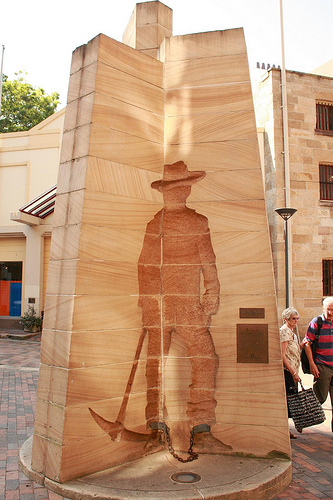
It’s also fairly pugnacious book, determined to convince, and it does not take a backward step at all.  This becomes rather strained in the section on flogging, which is written carefully but insistently.  It is unashamedly  a book of the head rather than the heart.   At times this can be rather exhausting, but in its sheer doggedness it raises some interesting questions.  For example, Hirst notes the convict sculpture at The Rocks in Sydney.
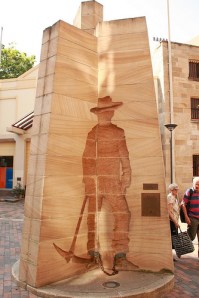
Hirst’s caption to the photograph is interesting:

A persistent symbol: ‘The Convict’ is put in chains though, as the plaque on this modern sculpture explains, only incorrigibles suffered this fate. (p. 214)

His decision to persevere with the illustration and to caption it in this way  makes me pause.  He has done the right thing in acknowledging the plaque on the sculpture, and thereby undercutting its usefulness to him as an argument. The plaque has done the right thing in pointing out its artistic licence in depicting the unusual. However,  I’m not sure whether the plaque was there from the start, whether it was itself part of the artist Bud Dumas’ creation, or whether it was added later perhaps even in response to Hirst’s criticism.

For as Hirst pointed out in his book, visually convicts and free labourers were indistinguishable from each other.  He cites an episode from Alexander Harris’ book The Emigrant Family where a magistrate rides up to make enquiries amongst a group of farm workers who have come onto the farm to collect their rations.  When rebellion breaks out and the magistrate is brought in to intervene, he calls for those who are prisoners to stand on one side and the free men on the other.  The magistrate could not tell, just by looking or by the men’s activities, who was bond and who was free.   Convicts were not chained; they dressed like free men, and collected the same rations.  Fencing and clearing stumps was work exclusively undertaken by free men although labouring with a hoe was performed almost exclusively by convicts because that was all that smallholders could afford to employ.  In all other categories of work- shepherding, shearing, ploughing, clerical work, school teaching- convicts and free men worked alongside each other. (p. 104)
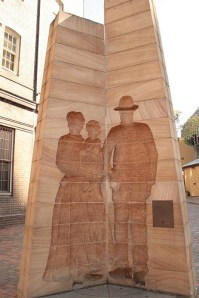
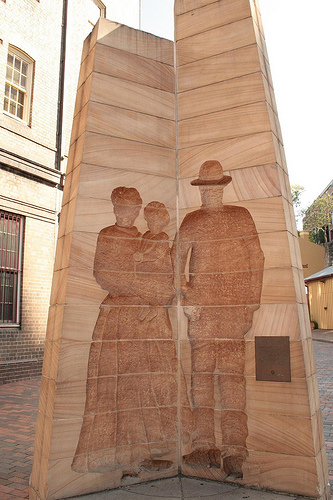
It is the chains that mark out the “Convict” from the man in the “Immigrant Family” sculpture above.  In this sculpture, the immigrant man stands with his family, but he was just as likely to wield a mattock in a sunhat when he was at work.   But when we take the chains away from the convict, what are we left with visually? Just men.  And that’s the conundrum.

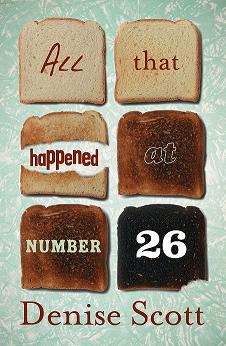
‘All that happened at Number 26’ by Denise Scott

2008, 257 p.

So what does one turn to after finishing reading Hilary Mantel’s stunning Wolf Hall? Why, an autobiography written by someone who feels like a very funny friend, that’s what.  And neither book suffered by the juxtaposition.

Denise Scott is one of the two comedians that I love seeing on Spicks and Specks on a Wednesday night, and if Hamish Blake is on as well then even better!

Denise Scott is my age and she lives a couple of suburbs away.  My stepchildren were involved in some of the episodes of the book, and reading the book is like reading my own life through the eyes of someone much funnier than I am.  I laughed out loud often in this book, much to the disgruntlement of Mr Judge trying to sleep on the other side of the bed.

Nothing really happens in the book- it’s more a series of anecdotes and yarns about family life, marriage, motherhood and daughterhood.  Family is at the heart of this book, but there’s barbs too:  the marriage falls apart at one stage; her mother suffers from Alzheimers; her closest friend Lynda Gibson dies.   She obviously enjoys having young children around her but feels that she is being left behind in her career.  Money was really tight at one stage and you feel a rush of gratitude to whoever it was who left an envelope with $500.00 to tide them over.  She embarks on her comedy career, nauseous with anxiety, but withdraws from the overseas trip that her  fellow-comedians undertake when their act is successful because she doesn’t want to leave her children.

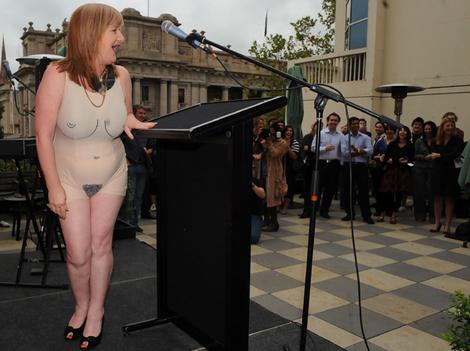
She fears that now that her children have grown up that she has lost her well of family anecdotes, but I don’t think she need worry.  She has that wonderful ability of sniffing out the ridiculous in life and she makes me feel good about being a 50plus year old woman living in Melbourne. And hey, anyone who’s game to appear in public like this will always have a place in my heart!