Category Archives: Book reviews

‘Roughing it in the Bush’ by Susannah Moodie

When I first started thinking about expanding my thesis to include Upper Canada and British Guiana, I thought that I’d read a bit of Canadian literature to ease myself into it.  I asked around a bit and several people suggested Susanna Moodie and her sister Catharine Parr Traill.  To be honest, I hadn’t heard of either of them.
It’s strange jumping into another country’s history with as little background as I have.  I find myself wondering about parallel books in Australian history and literature- do they exist? have I read them? did I like them?  I expect that Roughing it in the Bush would be categorized as biography/autobiography/emigrant literature.  Emigrant literature was very important to Upper Canada which was consciously trying to attract as many British migrants as possible to bolster the British identity of the colony, which was challenged by the French/Canadians of Lower Canada to the right and the Americans from the south.  Was there such a thing in Australia, I wonder?  I can think of edited books of diaries and letters, but these are not necessarily crafted as literature (hmmm.)  Flipping through Project Gutenberg Australia, there are all those travel books like A Lady’s Visit to the Gold Diggings of Australia (never read it) or My Experiences in Australia: Being Recollections of a Visit to the Australian Colonies in 1856-7 (never read this one either) or this sounds good Cooee: Tales of Australian Life by Australian Ladies (and no, I haven’t read that either).   But I’m not really sure whether these qualify as emigrant literature- written specifically for people back home who are considering emigrating, as distinct from merely visiting, to Australia.

For this is what Roughing it in the Bush declares itself to be, right from the outset.  And a rather gloomy prognostication it is, too

In most instances, emigration is a matter of necessity, not of choice; and this is more especially true of the emigration of persons of respectable connections, or of any station or position in the world. Few educated persons, accustomed to the refinements and luxuries of European society, ever willingly relinquish those advantages, and place themselves beyond the protective influence of the wise and revered institutions of their native land, without the pressure of some urgent cause.

Emigration may, indeed, generally be regarded as an act of severe duty, performed at the expense of personal enjoyment, and accompanied by the sacrifice of those local attachments which stamp the scenes amid which our childhood grew, in imperishable characters, upon the heart. Nor is it until adversity has pressed sorely upon the proud and wounded spirit of the well-educated sons and daughters of old but impoverished families, that they gird up the loins of the mind, and arm themselves with fortitude to meet and dare the heart-breaking conflict.

The ordinary motives for the emigration of such persons may be summed up in a few brief words;–the emigrant’s hope of bettering his condition, and of escaping from the vulgar sarcasms too often hurled at the less-wealthy by the purse-proud, common-place people of the world. But there is a higher motive still, which has its origin in that love of independence which springs up spontaneously in the breasts of the highsouled children of a glorious land. They cannot labour in a menial capacity in the country where they were born and educated to command. They can trace no difference between themselves and the more fortunate individuals of a race whose blood warms their veins, and whose name they bear. The want of wealth alone places an impassable barrier between them and the more favoured offspring of the same parent stock; and they go forth to make for themselves a new name and to find another country, to forget the past and to live in the future, to exult in the prospect of their children being free and the land of their adoption great.

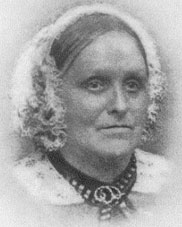
Susanna Moodie emigrated to Upper Canada with her husband John in 1832.  In the depression that followed the Napoleonic Wars, and as part of joint Colonial Office/local government encouragement of British immigration,  half-pay military officers were lured to Upper Canada on the promise of land grants.  This she saw as particularly unconscionable

A large majority of the higher class were officers of the army and navy, with their families–a class perfectly unfitted by their previous habits and education for contending with the stern realities of emigrant life. The hand that has long held the sword, and been accustomed to receive implicit obedience from those under its control, is seldom adapted to wield the spade and guide the plough, or try its strength against the stubborn trees of the forest. Nor will such persons submit cheerfully to the saucy familiarity of servants, who, republicans in spirit, think themselves as good as their employers. Too many of these brave and honourable men were easy dupes to the designing land-speculators. Not having counted the cost, but only looked upon the bright side of the picture held up to their admiring gaze, they fell easily into the snares of their artful seducers.

Certainly she and John were inexperienced, but it surprised me that at first they came into contact with several people who had emigrated to New South Wales for a couple of years, returned to England, then come across to Upper Canada.  I am aware of serial migration as a more recent phenomenon (I’m thinking here of Jim Hammerton’s work) but I hadn’t been particularly conscious of it for the 1820s and 1830s.   They were heavily reliant on their servants and in a small cabin they were forced into closer intimacy than they may have wanted.  I’d heard that Upper Canada had been denigrated as a place where gentlemen had to share their table with their servants, and that was certainly the case here.  Just as in Australia, there were complaints that servants were scarce, ‘uppity’ and too ready to seize their own opportunities in a new land.

The early part of the book involved travelling up the river to their destination- there’s that river-consciousness again– and their horror of the cholera that raged in the settlements they passed.  Cholera?!  I obviously labour under a misapprehension about Canadian weather- there’s heat and bushfires here, as well as snow.  I hadn’t been conscious of this same concern about health in early Australia.

Their first block of land certainly didn’t seem to be in what I think of as ‘bush’: they were deluged by their neighbours, mostly Yankees, who were boorish, acquisitive and relentless borrowers.  It was with some relief that they shifted further into the bush, even though there they had to battle with bushfires (a quite exciting chapter!) and isolation.  Her difficulties were compounded by her husband’s absence when political dislocations during the 1837 Rebellion caused half-pay officers to be enlisted for military duty, leaving her to cope with the farm alone with her servants.  There is a degree of familiarity and ease with the surrounding Indians which contrasts strongly with the wariness and repugnance of Australian settlers to the Aborigines whose lands they had appropriated.

Chapters in the book are topped and tailed with poetry- rather awful stuff- and halfway through the book her husband jumps in with his perspective.  The final chapter was odd, too- it was written by her husband, by now a public servant in Belleville,  full of facts and figures about Canadian progress and some interesting (for me) political analysis.  But frankly, I enjoyed her chapters much more.  Her descriptions of landscape are deft, and she conveyed well the heat and the cold, the loneliness and the sense of community at logging bees and their social interaction with their ‘equals’ (as distinct from those Yankees).

I can’t really think of an Australian parallel book to this.  I haven’t read Louisa Ann Meredith’s books My Home in Tasmania, during a residence of nine years or Over the Straits: A Visit to Victoria, which sound similar to this, but these were written in diary form as a stylistic choice.  The book that it reminded me most of, albeit in a different time and read many, many, many decades ago, is Mrs Aeneas Gunn’s We of the Never Never. Both Moodie and Gunn wrote in the first person, with dialogue, description and an emphasis on relationships.

Australian readers- can you think of other early, autobiographical novelistic books that might be similar?

E-reader update

This is the first book that I have read on my E-reader, and this is exactly the sort of text that I bought it for- an old book now in the public domain, which would nestle in the ‘special collections’ library of anywhere I could borrow it from here in Australia.   The reason I purchased an I-River Story was to have a keyboard for notes, and that function worked well enough, although it was clunkier to shift between memo and book than I anticipated.  I found it good for reading in bed- none of that grappling with the left hand page when reading lying on your side, and I certainly felt more relaxed reading it in this format than gingerly turning pages in an old volume.
‘Snake’ by Kate Jennings

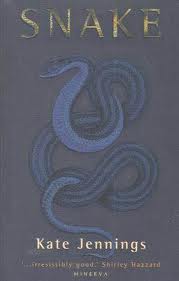
Kate Jennings Snake,  Melbourne, Minerva, 1996, 145 p.

Snake is a short book: only 145 pages and easily readable in one sitting.  It is a sharp, gritty book and you know from the opening pages that this is not going to be an easy reading experience.

The layout of the book is interesting.  It is in four unevenly sized parts, each divided with an engraved version of the snake of the front cover.  Part 1, only nine pages in length, is written in the second person and addressed to Rex, the father of the family. Immediately you are plunged into Australian Gothic:

Everybody likes you.  A good man.  Decent. But disappointed. Who wouldn’t be? That wife.  Those Children.

Your wife.  You love and cherish her.  You like to watch her unobserved, through a window, across a road or a paddock, as if you were a stranger and knew nothing about her.  You admire her springy hair, slow smile, muscled legs, confident bearing.  If this woman were your wife, your chest would swell with pride.

She is your wife, she despises you.  The coldness, the forbearing looks, the sarcastic asides, they are constant.  She emasculates you with the sure blade of her contempt.  The whirring of the whetstone wheel, the strident whine of steel being held to it, that is the background noise to the nightmare of your days  (p. 3)

Part 2 moves into third person, and is only a little longer- 11 pages and it takes us to their wedding, and already the ashes are in our mouth as we move through the unvoiced thoughts of the unlovely people who make up their extended family.

The longest section of the book is in Part 3, where there are short vignettes of the pettiness and the cruelties of everyday life in this blighted family:  Irene’s love letter to ‘the other man’ intentionally left where her husband Rex would find it; her moodiness and favouritism, the dog tragically left to die in a car. You know- as you’ve known from the opening pages, that this isn’t going to end well.

The final Part IV returns to the second-person voice, but this time it is addressed to Irene.  It is short- the shortest part of the book- and bitter.

All of the chapters in this book are short – in some cases the title is almost as long as the chapter itself!  The relationship of the title to the chapter is often oblique, as is the image of the snake that slides through the book both graphically and structurally.

Sue at Whispering Gums wrote a fantastic post about ‘taker-outers’ in books, and this book is just about as spare as you could get.  It is as dry and dessicated as the family it is describing, and all the more powerful for that.

‘Molotov’s Magic Lantern: A Journey in Russian History’ by Rachel Polonsky

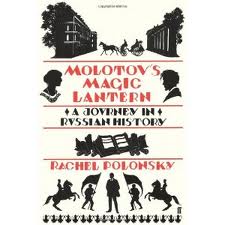
Rachel Polonsky Molotov’s Magic Lantern: A Journey in Russian History, London, Faber and Faber, 2010, 369 p.

One of my fellow students is writing a thesis about the status of family history and genealogy  within historiography more generally.  Is the  distinction always clearcut? I wonder.  After all, there are historians who write books that,  while not academic histories as such, combine elements of family history and broader history (Henry Reynolds’ Why Weren’t We Told? and Anne Summers The Lost Mother spring to mind).  In fact, just today I read a fascinating study by Cassandra Pybus of the negro ‘Commodore’ of Port Jackson (see citation below) where Pybus pursues, and  then interrogates, all those archival minutiae that are the family historian’s quest.  Richard Holmes’ Footsteps of a Romantic Biographer, which I enjoyed so much and have cited so often,  is a long reflection on methodology, arranged through the device of a journey.  Then  there are those popular historians/journalists who write books that combine history and travel (Simon Winchester Outposts, Bill Bryson even?).

So when I read a  glowing review of Rachel Polonsky’s  recent book Molotov’s Magic Lantern: A Journey in Russian History, I snapped it up.  Rachel Polonsky, Rachel Polonsky- where have I heard that name?  Then I remembered: she was involved in the recent academic brouhaha over Orlando Figes and Amazon reviews- see her perspective here.

Two personal libraries are the pillars of this book.  One of them was the library owned by Molotov, kept intact and largely untouched  (more through inertia than intent) in his apartment at the Romotov Lane building,  where Rachel Polonsky herself lived in while she was in Moscow many years later.

‘Have at it,’ the banker had said in his charming smoky drawl, dangling from one finger the keys to his apartment.  He had rung our doorbell early as he passed on his way down the stairs. ‘You’re the scholar, you’ll know what to make of it all.’

We had met the evening before at his welcome-to-Moscow party in one of the other Romotov apartments.  Over my champagne and his Jack Daniel’s, I told him, in my fumbling way, that I was some kind of fugitive academic, not really a journalist, working on a novel.. (p. 1)

…Our conversation picked up animation when he told me about Molotov’s library.  I already knew that the apartment he had moved into (immediately above our won) had been the Moscow home, in the last years of his long life, of Stalin’s most loyal surviving henchman. I did not know that some of Molotov’s possessions had remained in place- left there by the granddaughter who now let the apartment to international financiers- including hundreds of books, some inscribed to him or annotated in his hand, now apparently forgotten, in the lower shelves of closed bookcases in a back corridor. (p. 2)

And there it was- Molotov’s wood-paneled library- with a magic lantern in the corner that, when you cranked the handle, showed a succession of slide images; a carpet from the Shah of Iran on the floor, and books, books- some with the pages left uncut;  some inscribed to him; others underlined and annotated.

The second library was that of the Russian scholar, Edward Sands, who died a few weeks before the author took up her Cambridge fellowship.  He had died intestate, and not knowing what to do with the chaos of books and papers piled in his room among old shoes and half-empty medicine bottles, the bursar asked her to sort through them, working out which should go to the university library, and which should be given or thrown away. (p. 6)  Three years later, her husband called her from Moscow, encouraging her to join him.  She told herself and the fellowship that she would be back after a spell of 18 months working in the great libraries of Moscow and studying orientalism in Russian poetry.  Her eighteen months became ten years.  (p. 10)

These two libraries, then, are the foundations on which the book rests.  In her travels throughout the streets of Moscow,  down around the sea of Azov, up to the Finland border and across to Siberia and the Mongolian border, she reflects back on the  books and authors represented on the shelves of these two libraries.  There are many of them, but some are repeated again and again: Mandelstam, Akhmatova, Chekov, Dostoevsky, Pushkin, Shalamov, Marina Tsvetaeva.   Events and historical figures appear and re-appear as well: Molotov himself, Stalin, Lenin, Napoleon Bonaparte, Peter the Great, Tsar Alexander I, Catherine the Great- and with a burst of currency, Putin, Medvedev and the assassinated journalist Anna Politskovskaya.  Underpinning all this, like a ghastly merry-go-round tune is the repetition of repression, exile, and cruelty, repeated by the Cossacks, the Tsars, the Bolsheviks, Stalin- and she suggests, Putin too.  The reference of the rotating magic lantern in the title is apt- people and events flash before our eyes, disappear, only to reappear again later.

There are many, many names of people and places and Polonsky has supported her readers as much as she could with clear maps and a generous index. Ah- but there are so many names and I felt as if I needed to be taken up to the linchpin ones,  formally introduced to them and told “Remember this person- she’s going to be important”.   Unlike  more journalistic travel books (e.g. the Winchesters and Brysons), Polonsky did not give a rationale for the journeys she undertook, and so there was a sort of aimlessness to the book.  It could have been three chapters longer: it could have been three chapters less- the end came because she chose to end it there, but the journey itself did not demand it.

Her final chapter, however, does bring it all together.  By the end of the book, I realised that names and stories had become familiar, almost without my being aware of it.  I’m not particularly well-versed in Russian literature: I find myself becoming anxious over the profusion of characters and the similarity and length of the names, and this same concern that perhaps I’m not ‘getting it’ did steal over me at times with this book. But I closed it with a feeling that the deficit lay more in me than my guide, and I was sorry to leave my perceptive, erudite travelling companion.

References:

Cassandra Pybus ‘ The Old Commodore: A Transnational Life’   in Desley Deacon, Penny Russell and Angela Woollacott (eds) Transnational Ties: Australian Lives in the World, ANU e-press, 2008 available online at the publisher’s website [It has nothing at all to do with Russia, but it’s a fascinating read!]

Margaret and Maggie

Some time ago, in reviewing Peter Cochrane’s book Colonial Ambition, I made an offhand reference to Margaret Kiddle’s book Men of Yesterday and had obviously intended writing a more considered post about Kiddle’s book at some later date.  Now that I come to write about it, I find myself flicking through my reading journals that predate this blog (which has largely usurped their function) and I am surprised and regretful that I didn’t write an entry about it.  It was a book that deeply affected me at the time and the only explanation I can think of for its omission is that I must have considered it ‘work’ reading as distinct from ‘leisure’ reading.  I’m increasingly finding that there is no boundary between the two- I don’t know whether that’s a good thing or not!

Men of Yesterday is framed by the poignancy of the circumstances by which it posthumously reached publication.  Its author, Margaret Kiddle was a tutor at the University of Melbourne, but described and downplayed herself as “not an academic”.  She died of renal failure, after years of illness and a decade of dialysis, at the age of 44 with her manuscript finished but unrevised.  She left for her literary executors (including Max Crawford and John Le Nauze)  a list of what she saw as essential revisions and this note:

I guess this is just another ‘Melba farewell’ but if not-

Max, as you will be going to Wisconsin, I suggest that if he will, John takes over the revision.

John- I should be very grateful if you would do it for me.

Acknowledgements: The file correspondence and comments on notes will help you- don’t forget to thank yourselves!…This book has been finished in dramatic circumstances- for publicity purposes cash in on them as much as you like- it may earn some money!  (cited in MacKellar, see below)

But this was no ‘Melba farewell’– it was the real thing, and the book needs no cashing in.   Margaret Kiddle was proud of her pioneer ancestors, and the book is almost an act of love to the experiences of her forebears.  It is a very human book and it has attracted its share of critique. As the pointedly-titled thesis What Kiddle forgot reminds us,  aboriginal dispossession and women’s roles were kept in the  background,  and it has attracted (perhaps unfairly)  a reputation  as  a book of its time and historiography.

I’ve been reunited with Margaret Kiddle through a beautifully written opening chapter in a book by Maggie MacKellar called Strangers in a Foreign Land.  It has been generously- indeed rather TOO generously??- downloaded into Google Books and the opening chapter, at least, is a cracker.  MacKellar describes her  rediscovery of Kiddle’s work as part of her own project on the Niel Black diaries and the book that follows is an edited and interwoven transcription of Niel Black’s diaries.   In her introductory chapter she reprises early Port Phillip and Western District history, interweaving it with Major Mitchell’s acclamation of Australia Felix as the culmination of his journey that started just several kilometres from her own home.  She explains, as all historians experience and many (too many?) describe, the rush of emotions in dealing with primary documents, with her consciousness of what she is reading heightened by the elemental summer smell of bushfire that seeps into the cloistered space of the State Library reading room.  Despite my own as yet unresolved feelings about historians’ use of themselves in the history they are telling,  I have no such qualms about  edited diaries and letters.  It is in the historian’s interaction and shaping of the primary documents that the engagement with larger historical questions emerges:  it is obtuse to pretend that the historian is not there reading, absorbing, making connections and talking back to the material.

Just from the extracts available online, this looks a beautifully presented book.  Time, and an awareness that I am becoming distracted,  prevent me from reading further, but the opening chapter is a delight in itself.

References

Kiddle, Margaret Men of Yesterday: A social history of the Western District 1834-1890 Melbourne, Melbourne University Press, 1961

MacKellar, Maggie Strangers in a Foreign Land: The Journals of Niel Black and Other Voices from the Western District,  Carlton Vic., Melbourne University Publishing, 2008

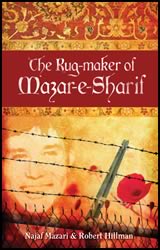
‘The Rugmaker of Mazar-e-Sharif’ by Najaf Mazari and Robert Hillman

2008,  262p

Right wing commentators have been insidiously successful in characterizing refugees as “illegals”- a term that is both inaccurate and dehumanizing.  The few images we see from detention centres reinforce the characterization of angry, defiant and confronting young men and their ‘demands’ often evoke a bristle of resentment.   It has struck me that the people I know who are most strident in their denunciation of refugees are often those people who would bribe and bully their way to the top of any putative ‘queue’ if their own families were under threat.

This is the first book that I have read about an Australian Afghan refugee, although I suspect that others will follow, just as the life-stories of Vietnamese boat people and Jewish refugees have before them.  The book is written in conjunction with Robert Hillman, whose book,  The Boy in the Green Suit I read recently with my bookgroup ladies- indeed this too, was a bookgroup choice. It was a happy coincidence: having read the two books in close succession I can see why Robert Hillman would have been attracted to his story, but also it reinforced for me that it is indeed Najaf’s voice that we are hearing here.

I suspect (on the basis of no evidence whatsoever!) that Hillman’s contribution came in the structuring of the book, rather than in the words or sentiments uttered.  The language itself is simple, and occasionally captures that shard-like truth that comes because the writer is not a native-speaker: “I did not know that I could feel this much sorrow without a body to bury”.  The book is not a straight chronological narrative- and here, perhaps Hillman’s familiarity with an Australian audience and the Australian publishing market comes into play- because it starts with Woomera which is well known, albeit somewhat uneasily among Australian readers, before returning to Afghanistan and the beginning of his journey.  A rather incongruous outburst of foreshadowing near the start of the book reassures us that there will be a wife and daughter in suburban Melbourne one day in the future, and the draw of the book is to find out how he gets to that happy situation.  His journey through Indonesia and onto the boat does not emerge until close to the end of the book by which time you are won over by his goodness and humanity.   The logistics of the financial transaction with the people smugglers is somewhat glossed over, but the journey on the small, overloaded boat is well described.  Perhaps, too, this is a statement that even though the means by which refugees arrive is a red-hot issue for Australians, it is only a small part of the overall story and by no means its defining feature.

As a reader, I was aware throughout that Mazari was not of my own culture.  His belief of God’s will, his acceptance of mystical explanations and the tenor of  his family and marriage relationships made this plain.  On the other hand, though, people obviously warmed to him as a person and there were small acts of kindness that changed the trajectory of his life.  There were petty cruelties too. I am appalled by the vision of women floating in those perversely ethereal blue burkas, but had not particularly considered the plight of young boys growing into adolescence who would be hoovered up into the politics of warfare.  No-one could be unaware of the civilian deaths, but seeing them played out within one family, over an extended period of time, brought home the drawn-out nature of this ongoing conflict.

You can read more about Najaf Mazari here and it makes me smile to see him there in his rug shop- I feel as if I know him.  I find myself reading about Afghanistan again with more interest and it has put the human back into these reports for me.  Quite an achievement.

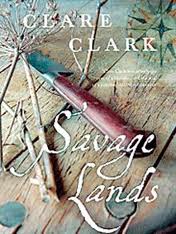
‘Savage Lands’ by Clare Clark

2010,  374 p.

Okay- I confess that I was attracted to this book by the cover, and by the blurbs by Amanda Foreman who assured me that “Clare Clark writes with the eyes of a historian and the soul of a novelist” and Hilary Mantel who told me that [Clark] “meets the eighteenth century on its own terms; knocks the wig off, twists its private parts and spits in its eye…”.  Twist and spit on, I say.  I’ve since found that it was longlisted for the 2010 Orange Prize.

In his book  Replenishing the Earth: The Settler Revolution and the Rise of the Angloworld 1783-1939, James Belich emphasizes the importance of not the  ‘founding fathers’ but the ‘birth mothers’ in ensuring the demographic progress of a settler society.  This book has the birth mothers of Louisiana as its focus, and women’s bodies are at the centre of its focus, as sexual partners,  wives, women in labour, women as objects of desire.

Its main character, Elizabeth Savaret is one of the ‘casket girls’ sent out from France to find a husband amongst the French settlers in Louisiana.  She is a sensitive, educated woman as the frequent (and possibly unnecessary) references to Montaigne throughout the book attest.  In this government-sanctioned marital lottery any husband will do, it seems, but in one of the breathtaking jumps in plot that Clark negotiates, Elizabeth falls deeply, passionately in love with her husband Jean-Claue Babelon.  We do not read about their first meeting, their courtship, their marriage- only that she has been awakened to her own sexuality and that she adores every part of the man who is now her husband.

At this point, I may have been a little sceptical about such slavish adoration. But, having just turned from reading the article about Lucy Peel’s journal, I was struck by the similarities with Lucy’s own declaration of her love for her husband (albeit in a letter to her mother):

the separation of husband and wife must be dreadful, for the love between them is, or ought to be, “Strong as Death” and the longer they live together the harder it would be to part, at least I feel it would be so, for much as I loved Edmund when I married him I have treble the affection for him now, I did not know half his good qualities, he has never spoken an angry word to me and manages my hasty temper so well that I almost fancy at times that I have become a most amiable person.  (J.I. Little ‘Gender and Gentility on the Lower Canadian Frontier: Lucy Peel’s Journal, 1833-36, Journal of the Canadian Historical Association, 1999 Vol 10 p. 66)

It is not just Elizabeth who has fallen in love with Jean-Claude, however.  A younger man, Auguste Guichard, encountered the trader Jean-Claude in the tangled wilderness of Louisiana. Auguste had been left by earlier explorers as a hostage to an Indian tribe while they were passing through the territory and he spent years there, growing up learning the language and observing the tribal practices, neither part of the tribe but no longer completely French either.  When Jean-Claude stumbled onto the scene, Auguste too fell in love with him, not necessarily in a home-erotic way but more as a type of hero-worship.  He returned to ‘civilization’ with Jean-Claude where, in the glow of Jean-Claude’s presence, he fell in love with Elizabeth too in an inchoate fashion.

In this love triangle, it is Jean-Claude who is the least fully realized character. He does not deserve the love of either Elizabeth or Auguste as they both come to recognize, and they are both implicated in his betrayal and suffer for it.  This brings the first part of the book to a close, and as I turned over to Part II (portentously titled ‘After’) , I found myself aware that something momentous had happened in their lives, but I wasn’t quite sure what it was.

In another of her breathtaking plot parachutes, Clark then fast-forwards fifteen years and gradually colours in the circumstances and consequences of the act that closed Part I of the book.   Life has continued on for both Elizabeth and Auguste, but they are bound by their mutual guilt.  The changing circumstances of the Louisiana settlement and its relationship with the Parisian metropole bring them again into each other’s constellation.

This is a very female book, with heavy emphasis on childbirth, miscarriage and sexuality.  The women in the book are drawn well, not just in their own individual characters but in the nature of female companionship and rivalry.  Auguste is more inscrutable and shadowy, but that could be a response to his marginal status between French and Native American communities.  But the main character of this book is the Louisiana forest and swampland, and here Clark’s writing is quite beautiful.  Perhaps it is a little overdone and at times repetitious, but for me it acted as a reminder of the contingency of the settlement by dragging me back to the hostility and sheer dominance of the landscape:

In the wilderness savages lurked in the shadows and the prodigious forest nosed and slid and crept and coiled upward without ceasing.  The licentious suck of it rotted the roots of the trees and pushed blindly up through the decaying luxuriance of its half-digested self, an eruption of snaking coils and crude excrescences bursting from the thick black slime.  Its fecundity was as grotesque as it was shameless.  It throbbed in the ceaseless thrum of the cicadas, in the suck and gasp of the reed-choked bayou.  It draped itself from the trees, smearing their trunks with velvet, hanging in gluttonous hanks from their branches and exploding into pale, fleshy mushrooms at their roots.  There was no shape to the forest, no order.  There was only the ungovernable profusion, blotting out the light, gorging on the lush compost of the dead. (p. 299)

Swamp-porn anyone? (Oh dear? Will that attract spammers and dodgy search terms?)

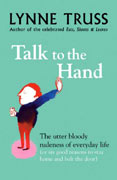
‘Talk to the Hand’ by Lynne Truss

2005,  210 p

Lynne Truss is  right in many ways: we are surrounded by obnoxiousness, rudeness and aggression every day, exemplified by the Jerry-Springeresque “talk to the hand coz the face ain’t listening”.  I must admit that no-one has ever said that to me directly, but unhappily I know exactly what it means.

Truss herself admits that the book is a “big systematic moan about modern life” and that’s what it is.  It is only a short book, which is a blessing in a way- it’s a bit like sitting through a boxed DVD set of “Grumpy Old Women”  and even for me there’s a limit to such unmitigated grumbling.

Her six good reasons to stay home are:

1. the absence of ‘thank you’ or ‘sorry’ (one of my own moans is the ubiquitous “if anyone takes offence…” )

2. the way that companies push their demands back onto you as your responsibility ( my contribution: the con of ‘self-serve’ in petrol stations which is slower for everyone and means that my oil is never checked and my tyres are always flabby)

3. the invasion of personal space (yes, the mobile phone in the train).

4. the “F### off” response ( I hate it but must also confess to being too ready to drop the F word myself. It’s a bad habit that I would like to work on)

5.  Disrespect and non-deference  (I agree: I don’t necessarily want my first name used by everyone)

6.  the idea that someone else will clean up your messes (my own teeth-grinding trigger- junk food packaging thrown out of a car window).

We can all add our own-  for example, it makes my blood boil when an unsolicited phonecall rings you then puts you on hold!!!  I don’t thank John Howard for much, but tougher gun laws and the do-not-call register are two good things.

She makes the point that her book is not an etiquette or manners book, and now having read about the 19th century literature of this type, she’s right about that too.  An etiquette book is premised on helping you as an individual to join the  others, by doing the right things.  The 19th century version was based on the precept that you could judge an individual by the way they behave, and that there is a connection between manners and morals.  The outside world and the people in it was a world that the reader desperately wanted to be part of. If changes had to be made to one’s behaviour and demeanour in order to be accepted, that was a price gladly paid.

All this is reversed here.  As she says, many people think that it is harmful, unhelpful and simply wrong to judge a person by the way s/he behaves (p. 193).  Instead of the outside world being something we want to join, it’s them out there who are the problem.

It’s ironic that the 19th century version of the etiquette book was based on making “me” part of “them”. In the 21st century version,  it’s all about me- with  our ‘i’pads, and ‘My’ spaces and, heaven help us, ‘My’ school (which I still haven’t looked at because I don’t want my visit to count as approval of the whole concept).  But now it’s me against “them” who are so obnoxious because they all care only about their own “me”. And let’s face it, who’d want to be them?

All these pronouns are confusing me (or I).

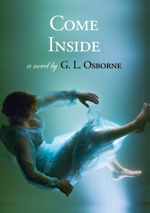
‘Come Inside’ by G. L. Osborne

2009, 170 p

I hadn’t heard of this book until I read Lisa’s review at ANZLitLovers, but I see that it has attracted quite a bit of attention with shortlistings at both the Commonwealth Writer’s Prize First Book of Fiction and the Age Book of the Year.  It’s only short- just the right length really, because she teases her reader and as we know, it’s a narrow line between teasing and tears.

It’s an unusual and risky book.  A young girl is rescued by a young man after being swept ashore as the only survivor after a shipwreck in 1887.  She is  unable to remember her earlier life, and her story becomes part of the local folklore, heavily mined by the press at the time,  a series of oral histories in the 1940s and then centenary publications a hundred years later.   There’s shades of the Loch Ard here, but not quite; the small seaside town of Colego seems as if must exist somewhere in Western Australia, but it doesn’t seem to, either.  The slippage between fact and fiction starts on the flyleaves, where the author thanks “Ken and Claire Stewart” for the extracts from an unpublished manuscript by Caroline Stewart held at Colego Public Library.  It is this manuscript that forms one strand of  the narrative: the other strand is the drugged delirium of a woman on what appears to be a ship.  Woven around these two main strands is an assortment of tangentially-related ‘evidence’- press clippings and letters from 1887,  extracts of books, interviews with Colego inhabitants in 1946, a collection of letters by Isobel Smith, a book by the same Isobel Smith, then an edited anniversary edition of the same work.

There’s much here about memory and history, as layer upon layer is built up over the story.  Caroline Stewart, the author of the manuscript, works in the small Colego museum where she works cataloguing the objects,  and although her instructions are to label the materials empirically, the edifice of objectivity is just as tottery for the ‘fact-based’ local museum as it is for the other retellings. The curator of the museum is fiercely protective of the artefacts and the version of local history that the museum promulgates but there’s a flatness and deadness about the history it embalms, especially compared with the other stories we are given based on people rather than things.

A risky book? Sure is.  She has assembled it all carefully, but it is the reader who puts it together.  I’m not sure if I understood it, and that’s an uncomfortable reading experience.  At 170 pages it is short and as the number of pages diminished,  I found myself wondering how she was going to draw it to a close, and even why it ended at that particular point.  It is beautifully written, and she deftly catches the tone and cadence of many different genres in the material that she lays out for us.   And yes, I know the adage about judging books and covers, but that is a truly lovely photograph on the front.

I mentioned a couple of posts ago a book called Pistols! Treason! Murder! which, labelled “History” on the back cover, uses a similar methodology.  I’ve borrowed it and I’m interested to see the technique used in non-fiction. I wonder if I’ll experience the same sense of floating anxiety (yes- that front cover is well chosen)  about whether I’m putting it together “properly”.

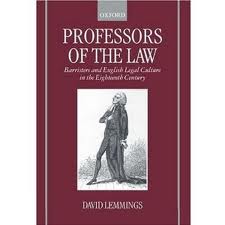
‘Professors of the Law: Barristers and English Legal Culture in the Eighteenth Century

2000, 418 p.

I’m not sure how my cogitations about Writing the Second Book First apply here.  This is a second book, and at first glance it seems to be very similar to the author’s first, Gentlemen and Barristers written ten years earlier.  But this is not a matter of writing the first book again. The earlier book focusses on a  50 year period between 1680 and 1730 while this book spans the eighteenth century and beyond.  Moreover this volume is much broader, and much more people-based than the first.

Both his first and second books have a strong empirical bent, with the main grunt-work in this book carried out through two fifty-name random samples selected from those barristers called to the bar in two triennia, 1719-21 and then again in 1769-71.  These fifty barristers were then investigated in detail,  drawing on biographical dictionaries, genealogies etc. to provide a potted trajectory of their careers over their lifespans.  Another appendix traces through the names of barristers who appeared in the records as Leading Counsel in the King’s Bench, Exchequer, Common Pleas and Chancery over four soundings in 1720, 1740, 1770 and 1790.  This has yielded a statistical analysis of the cohort, which is sprinkled throughout the text.

I’ve come across this prosopographical approach previously in Cell’s analysis of the Colonial Office in British Colonial Administration in the mid-Nineteenth Century: the Policy Making Process and again in Daniel Duman’s  The Judicial Bench in England 1727-1875. Given my own research topic, the prosopographical works that I’ve encountered have centred on the professional identities of groups within 19th century bureaucracies and legal systems, but when I look at Oxford University’s Prosography Portal, I see that it has been used for a range of studies- chess players up to 1914,  American prose fiction debut writers 1940-2000, Classical Roman martyrs and Worcester Cathedral Bedesmen. (What a strange site- there is a Prosopography for Beginners Tutorial if you’re so inclined…)

The final chapter differs from the other chapters in that it moves beyond the 18th century proper to explore the increasing bureaucratisation of the law and the ascendancy of Parliament.  It’s a strong, well-argued chapter.  The book  is generously illustrated with satirical cartoons and caricatures of the day that provide a witty, contemporary critique that often supports but sometimes challenges the text.

There is a huge amount of research in this book- not just combing through records to plotting characteristics and life-events of a group, but delving into the papers and correspondence of individual lives as well. While I find the statistics and data-sets useful for tracing the contours of a group- in Lemmings’ case of 18th Century barristers- what really brings it to life for me is when he focuses on particular individuals.   He did this in the 1990 book as well, but there seemed to be much more of it in this later book, and it is  richer for it.   The letters and vignettes in the book give a humanity to the barebones of a work-life, and allow him to build up a picture of a legal culture that men actually lived rather than just passed through.

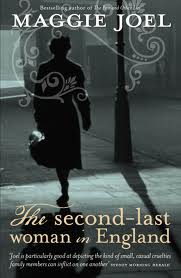
‘The second-last woman in England’ by Maggie Joel

2010, 345p.

This book had me in, right from the first page.  The book and its marketing is a little more chick-lit than I’m usually attracted to but hey- what’s wrong with just sinking into a book and going with it?  I often wonder how much of my reaction to a book is framed by the books that I might have read immediately beforehand.  Perhaps with this book  I was burned out after reading about gentlemanly characteristics and judicial personalities.

The book opens on Coronation Day, June 1953 as Harriet Wallis shoots her husband dead.  We are told from the start that she hangs for the crime- the second last woman in England to do so.  The book then winds back to 1952, nine months prior to the shooting and it creeps up, in fairly short chapters, to the shooting which occurs in the final pages of the book.

What I really enjoyed about the book was the setting of post-war, affluent London and I realized that I don’t think I’ve read many books set in this time or place.   Beneath the social  functions and respectability, this is an unhappy household- a barbed wire Mary Poppins!  I know that Lisa at ANZLitLovers felt that the relationships were hackneyed and stereotyped, which may be true,  but when I thought about it I couldn’t identify from where I might have absorbed this stereotype .   It came over as a carefully researched book and although at times I baulked at the detailed listing of particular brands and possessions, it seemed consistent with the status-consciousness of the characters and their milieu.

I was annoyed by at least three typos that I noticed- just not good enough. (It is a Pier 9 book, part of the Murdoch stable. Sniff.)  But, to be honest I found myself turning the pages avidly, but trying to slow down too because I was enjoying it so much.  I can’t say that I’ve experienced that with my gentlemanly characteristics and judicial personalities recently.