Category Archives: Book reviews

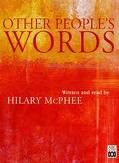
‘Other people’s words’ by Hilary McPhee

2001, 312 p.

Most people writing an autobiography (or even more risibly, having it ghost-written) announce that it is ‘in their own words’.  The title of this book is a little disingenuous.  The book certainly is in the words of the author, Hilary McPhee, but it is the story of her time dealing with other people’s writing as editor and proprietor of McPhee/Gribble books- a small, relatively short-lived, but influential publishing house in Australia.

As you might expect from someone immersed in other people’s words, the book is very well written.  It is divided into two parts.  Part I is largely biographical, pulling on a few family history strings, and contextualizing McPhee’s life as an Australian, swept up in the political and social changes of the Whitlam era and afterwards.  It establishes her as an intelligent, middle-class, educated young woman who seemed to fall into the publishing industry almost inadvertently, although her love for reading was a constant throughout her life.

Part II commences many years later as she settles down in the Melbourne University archives, reopening the files of the defunct McPhee/Gribble company which had been donated to the university.  As she does so, the emotions evoked by memories sweep over her- elation, bitterness, cold disappointment.  The company was started by two Australian women, in a male-dominated industry still hidebound by the copyright and marketing constraints of the colonial publishing market.  And for a golden moment, it worked. They were young, they had children, it was exciting and new and different.  Somehow, in a less performance-driven time, they managed to combine what sounds like a creche with the sensitivities of working with authorly egos and wading into an international industry where Australia was only a minor player.  It ended in tears, of course and quite literally, as most people reading this book would probably know.

In this regard, I find myself wondering whether the first part of the book was even necessary.  Apparently McPhee herself found the arc and voice for Part I only after writing Part II, and while it helped to contextualize the story of the company and its main actors, I would have been quite happy just to have had Part II.

This is a real reader’s book.  McPhee/Gribble developed an enviable list of writers- Helen Garner, Tim Winton, Murray Bail spring immediately to mind- but there are other writers here too that, after reading this book several years ago, I rushed out to read (e.g. Glen Tomasetti’s Thoroughly Decent People). Or at least, I bought their books to add to the to-be-read pile (e.g. Rod Jones’ Julia Paradise, and Gerald Murnane).  She occasionally gives the opening paragraphs of the most famous of the books they published and the words hit you with a rush of familiarity and affection, as if they are old friends from way back that you  weren’t expecting to see.  I haven’t read all the books she mentioned by a long shot, but I’d heard of most of them, and while the book could descend into name-dropping in less skilled hands, I certainly didn’t feel that way.  I found myself scouring my bookshelf, and pouncing on the McPhee/Gribbles I found there – “aha! there’s one”- and perusing the little logos on the spine in a way that I hadn’t before.

The book ends wistfully and rather pessimistically as the book industry becomes more depersonalized and more market-driven. I hadn’t realized the consequences of industry policies before globalisation- I was aware of the difficulties of Australian authors getting published, but less aware that the British dominance of our industry meant that American titles were rarely released here.  And since globalisation, she describes a scenario (that one suspects in drawn from real life, unfortunately) of a young writer’s first book being rushed through into a marketing schedule before it was ready and sinking silently as the next product was pushed through.  I suspect that things have not improved, ten years later.

Look- she has a blog where you can read a chapter of the book, a transcript of a 2006 interview and there’s a 2010 interview on Radio National’s bookshow.

My rating: 8.5/10

Reason read: Face-to-face bookgroup (the ladies who say oooh, except that they don’t anymore.)
‘Collected Stories’ by Carol Shields

2004 (posthumously), 593 p.

For someone who doesn’t like short stories, I seem to be reading quite a few of them lately.  This book is actually an omnibus edition of three short story collections: Various Miracles, The Orange Fish, and Dressing up for the Carnival.

I’ve read several Carol Shields books- The Stone Diaries, Larry’s Party, Unless and her biography of Jane Austen.  Sadly, she died  in 2003.   These short stories draw on the same wellspring as her longer works,  capturing the broad sweep of individual lives through the almost pointillist rendering of small details.

The stories I most enjoyed here were about the act of writing, and biography in particular. ‘Mrs Turner Cutting the Grass’ is about an ordinary woman, living an unexceptional life, oblivious that she was the butt of a satirical poem that cemented the academic reputation of a professor of literature. Another story ‘Edith-Esther’ is about a writer resisting the shaping of her life-story by her biographer.

But there are stories about other things as well- several stories about mortality (made more poignant by the author’s early death from cancer), and a sad story, ‘Fragility’ about grieving parents looking for a new house after their disabled adult son has died.  The stories are not always told by a female narrator, but the narrative voice is similar across them- an educated, mature, self-deprecating, sensitive voice- someone you’d want to spend time with.

I loved these stories.  She has a way of capturing a shard of reality, and she can sweep across years and decades effortlessly.  She’s such a skilled, human writer.

Rating: 8.5/10

Read because: I’ve enjoyed her longer works; she’s Canadian and I’m on a Canadian reading kick at the moment, and I’m sometimes too tired to read anything too heavy at night.

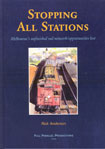
‘Stopping All Stations’ by Rick Anderson

2010, 155 p plus 59 pages fascinating notes!

I have some news for you next time you’re sitting on the Eastern Freeway with a long ribbon of red brake lights ahead of you.  Or perhaps if you’re stopping and starting, stopping and starting behind one of those grey and orange Smart Buses travelling -why! from Altona to Mordialloc- shucks, the journey only takes four hours.  And here’s the news- Melbourne almost had the makings of an inner circle railway that would delivered efficient east-west rail travel – and we ditched it!

I like trains, actually.  I live close to a station and on quiet nights if the wind is blowing the right direction, you can even hear the beep of the train doors closing and the station announcements.  I’ve always enjoyed looking at the inner-city backyards as you speed over Collingwood and Richmond on the limited express between Jolimont and Clifton Hill. They’ve changed over the decades: the outside dunnies have all disappeared and backyard living-room extensions leave just a small courtyard with enough room for an outdoor dining table and that’s it.

Stopping All Stations is a history of Melbourne’s trains, written by a suburban train driver.  He starts with the early private railways of the 1850s, bubbling along with the riches of gold-rush Melbourne.  There’s a string of acronyms here: The Melbourne and Hobson’s Bay Railway (MHBR) , our first, that ran to Sandridge (Port Melbourne) which had been so inconveniently distant from the settlement on the Yarra;  the Melbourne, Mt Alexander and Murray River Railway Company (MMA&MRR) that never really got off the ground;  the Geelong and Melbourne Railway Company (G&MR) that only lasted four years before being taken over; the Melbourne and Suburban Railway (M&SR)  that operated between Flinders St and CremorneAfter myriad re-combinations of their acronyms, they, along with later railways to St Kilda and Brighton, and Essendon had all been swallowed up by the  Victorian Railways  by the early 1880s..

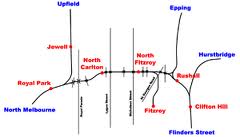
The book is subtitled (rather clumsily) “Melbourne’s unfinished transport work/opportunities lost” and this was the most fascinating part for me- the little railways and circuits that emerged and then disappeared.  There was the Outer Circle Railway that in 1892 ran between Fairfield Park and Oakleigh (map here) and an Inner Circle that existed between  1901-1942, on paper at least, that connected Rushall, North Fitzroy, North Carlton and Royal Park.

You can just detect the remnants of these lines at Fairfield, near the paper mills; and along the bike track in North Fitzroy.

Closer to home, there’s the Mont Park rail spur that connected to Macleod station, battling manfully up the hill to what is now a new housing estate. Lost opportunities indeed- LaTrobe University, which opened within a year or two of the Mont Park spur closing, would have provided the patronage that the small line lacked. Our three 1960s universities- Melbourne, Monash and La Trobe, have all been poorly served by train services, and I note that there are plans for a Melbourne University station under yet another grand transport scheme that will probably never see the light of day.

One of the real joys of this book are the little hand-drawn maps that show these now-you-see-it, now-you-don’t lines.  There’s a terrific graphic of the boa-constrictor nature of Victoria Railways as it swallowed up smaller private lines, and the text is sprinkled with the author’s own paintings of trains, signals and stations.  The book is a real labour of love, and Melburnians- even those not enamoured of trains per se- can find plenty to regret when considering the public transport that could have been.

I bet you thought that I couldn’t find a connection between Judge Willis and Melbourne’s train system which, after all, was not even thought of until some ten years after he left.  But in the spirit of Six Degrees of Separation between Judge Willis and the Railways,  the house that Willis leased while in Melbourne (which, incidentally was next door to my childhood home- hence my initial interest in him)was owned by Malcolm Macleod.  Macleod provided land to the railways on condition that the station was named after him- hence Macleod station.

Read because: I wanted to learn more about the Mont Park spur line. And because I really do like trains.

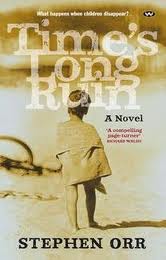
‘Time’s long ruin: a novel’ by Stephen Orr

2010, 422 p

It seems to me that most recently-published Australian fiction books  hover around the 300 page mark, and it’s relatively rare to have a book that extends over the 400 page range.  So, at 422 pages, Time’s Long Ruin  is a lengthy book,  reflecting the title that is drawn from one of the three lengthy epigraphs on the opening pages.  As a book, it felt long too.  Part I, which was 179 pages in length, functioned to set the scene and introduce the main characters.  Part II at 243 pages traced the slow-motion disappearance of the children at the centre of the narrative, then the long unspooling of a fruitless  investigation and the unresolved grief of family and friends- a grief, anxiety and perplexity that still lurks behind parenting and child crimes today.

The plot is loosely based on the Beaumont children who disappeared in 1967 but the author relocated the timing to the early 1960s instead.  Given that the author himself was born in 1967, the rendering of 1960s Adelaide is drawn from research rather than memory, which is quite an achievement in itself.  Much of the book has the elegiac feel of a wistful memoir, with details and sensations piled on heavily- a little too heavily, I think, because it felt at times like a lengthy oral history.  There is an element of slippage in the narrator: at first it is an adult Henry, still living in his family home many years later looking back on his childhood, but then the ‘memoir’ voice morphs into the child’s eye view of  Henry, the nine-year old next door neighbour of the Riley children who disappeared.  This child’s-eye view of suburbia and the tapestry of local shopkeepers, teachers, doctors and neighbours is both perceptive and oblivious at the same time.

Perhaps the fact that the author himself is younger than the events he is describing accounts for a major infelicity that troubled me in the book.  The minute, step-by-step description of the children’s trip to the beach by train suggests that neighbours and incidental witnesses noticed the children heading off to the beach, as if there were something unusual or incongruous about it.  I’m not sure that there was.  A group of three children, especially, would have the run of the neighbourhood, and a train-line was just an extension of that neighbourhood.  I’m sure that the parents of the real-life missing  children blamed themselves and each other afterward, and I think that the blood every parent of a child of the 60s- of which I am one- ran cold at the Beaumont case (and still does). But  at Beaumont-time and even after,  children continued to roam the streets in little groups, returning home only when the street lights came on,  going from one friend’s house to another, catching buses and trains with little parental oversight- I know, because we did.  There was nothing so unusual in the latitude given to the fictional Riley children.

The author is quite clear, even by the subtitle of the book that it is fiction, and by warping the time-frame in the way he has, he gives himself licence to evoke other Adelaide-based mysteries and insecurities as well-  the Somerton Man case of 1949 (which I’d never heard of- I thought that Taman Shud were a band !) and hints of the Snowtown murders of the 1990s by placing one of the main characters there at the time of the children’s disappearanceIn this regard, I felt as if my Adelaide-buttons were being pressed to trigger my knee-jerk reactions to Adelaide mythology-  disappearances, dead bodies, and Don Bradman.  It seems a little too easy to do.

In the lengthy second half, the author of course is faced with the dilemma that having based his plot so closely on the Beaumont children, of course there could be no resolution.  Much of the narrative in Part II involves disclaimers “I couldn’t know, but I imagine that it went like this….”. Combined with the long scene-setting in Part I, this contributes to a nebulousness about the whole endeavour, which is offset to some extent by the meticulous detailing of place and milieu.

The book was long-listed for the 2011 Miles Franklin Prize but did not make the cut into the very short short-list.  I think that this is appropriate on both levels- it does deserve recognition as a careful depiction of Australian life, but I’m not sure that it is the highest expression of this.

Some other reviews of this book include Deborah Orr’s review in Transnational Literature, a review by Liz Ellison at Culture and the Media, David Whish-Wilson and Lisa at ANZLitLovers.


Rating: 7/10

Read because: it was long-listed for the 2011 Miles Franklin.

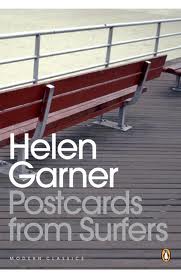
‘Postcards from Surfers’ by Helen Garner

1985,  106 p.

I don’t really know how to review a book of short stories.  I find myself making several assumptions.  I assume that it is a selection from a corpus of work developed over a period of time:  it is common to find that several stories in a collection have appeared in other compilations previously.  I assume that someone–  author? editor?- had a vision for a book of short stories as a self-contained piece of work.  I assume that one story was accepted as ‘right’ but another put aside for now, and  that the ordering of the stories was a conscious and carefully thought out decision.  There’s an arbitrariness about the whole process  that makes it hard to think about a book of short stories as a single object: would it be any less satisfactory if one of the stories had been omitted? would it be a different entity with one of the stories that was rejected  included instead?  For me, even the act of reading a collection of stories differs from my normal reading habit.  I prefer to read them just one at a time, but often they’re so short that I find myself thinking “Well, what now?” Sometimes I cram in another one straight away (which I don’t like doing), or else turn afterwards to another full-length book that I might have on the go at the same time.  When I come to write about them here, I’m not sure how to proceed- do I treat them individually (which might become rather tedious and might place a heavier burden on a few pages of writing than it can support)? Do I just hold onto the one or two that stay with me even without opening the covers again? Or do I embrace it instead as a collection without peering too closely at the component parts?

I’ll go with the memorable stories, without looking at the book again.  The first one, which gives the collection its title fitted in neatly with another book I’d read recently- Life in Seven Mistakes.  It is uncanny how often one book seems to ‘speak’ to another.  This short story is located in Surfers Paradise too, but the narrator is more mature and thus easier to spend time with, and Garner adeptly uses the device of postcards written over a period of time to quickly shape the contours of a larger plot that stretched over a longer expanse of time.  Good, sharp, clever writing.

Her story ‘Little Helen’s Sunday Afternoon’ captures a child’s perspective well, and evoked for me those visits to my mother’s friend’s houses, where there were other barely-known children and mutual wariness and showing-off.  In ‘All Those Bloody Young Catholics’ she nails the drawl, condescension and prejudices of the slightly-tipsy narrator of some thirty years ago when sexism and sectarianism were threaded unselfconsciously and largely unchallenged through overheard conversationsIn ‘Did He Pay?’ she describes vividly the washed-up, unattached old rock-star, indulged by friends and committed to no-one.

I’ve always seen Helen Garner as a perceptive observer, who has gone to places that I never dared, several years ahead of me.  There’s an innate authenticity in what she describes, and I can see why so much of her more recent work straddles the conjunction of non-fiction/reportage/fictionAs a Melburnian, I love the very local context of her narratives, although she ventures overseas, particularly to France, in these stories as well.  It’s like looking through someone else’s eyes at the things, people and situations that surround you, and thinking “Yep, she’s got it!”

It’s interesting that this book has had so many lives.  My copy is an early 1986, and there is a 1992 one as well; it was republished in 2008 as one of Penguin’s Modern Classics with the cover above, and most recently it has appeared as one of the orange-and-white retro (and cheap!) Popular Penguin reprints.

Rating: 8/10??

Reason read:  Australian Literature Group (Yahoo Groups)


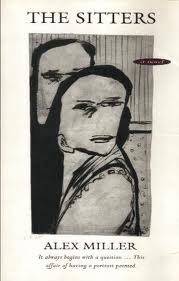
‘The Sitters’ by Alex Miller

1995, 131 p.

The Sitters is only a small book- 131 pages- and as with other Alex Miller books, its simplicity is deceptive.  Its narrator is an elderly, somewhat self-deprecating and yet emotionally frozen painter who has not been able to return to his painting after achieving success with an earlier portrait The Tan Family.  I felt as if I had met this character before in other of Miller’s works the voice is similar to that in Lovesong and Miller has written about painting before in Prochownic’s Dream.

The narrator paints only portraits of other people, never his own family,  but

… a portrait’s always a portrait of the artist.  Except that nothing’s ever as simple as aphorisms.  Whenever we’re tempted to try them on, we discover that their general truths never quite fit our particular realities.  All the untidy bits are left hanging out, the important bits, the inexplicable stuff that nothing resolves, and we discover again that those explanations don’t help because they don’t belong to our present reality but belong to something in the language, to that other dimension.  The cover- up.  (p.71)

Language and silence are brought up against each other again and again in this small work.  Early on, the narrator comments

There are things that are impossible to express with words.  Language employed to express emotion is a perversion.  The records of commerce is the only honest use of written language.  The rest is a cover-up.  It’s not words that shape our intuitions.  It’s not in what we say but in what we leave unsaid that we reveal the shape of our deepest motives. In the places between the words.  In the tacit and the implicit. In the silence beyond words.  That’s where we hid our truth.  Behind the endless buzzing of language.  The sovereignty of silence is its ambiguity.  Silence is a power greater than speech. (p.16)

Spoiler alert:

Presence is brought up against absence as well.  The painter meets, fleetingly an expatriate academic, Jessica Keal,  who has returned to Canberra on a fellowship, and he is instantly attracted to her.  After a commission to paint a series of sketches of women, including her, he asks if he can paint her portrait- not just one, but many studies of her, over an extended period of time.  Yet when he does paint his first portrait of her, he finds that he leaves her out of the painting: the room, the bed, the furnishings are there, but she is absent.  He does not need his subject to be present, and when she is, he doesn’t necessarily paint her.  He had earlier in his career painted a close, recently deceased friend as a corpse, just died, and years later he will paint Jessica again, rubbing her chest in heart-pain. Some years earlier he had painted the back view of his agent.  His agent perceived this painting as a joke, which on one level it was, but it also revealed something about our narrator as painter.In a portrait-sitting, he is painting from life, but the life is not necessarily present in that moment.

He has never painted his family: indeed, he lives in a vacuum with his memories of his family intentionally suppressed, and his relationship with his son detached and observational.  He lets us know early in the book that he has distorted and embellished his memories of his father as some type of artistic mentor and influence.  He has extended his memory of a single pre-WWII day painting outdoors with his father into a golden-tinged lifetime of paternal artistic inspiration, and this benign memory has been overshadowed by the words and actions of the bitter, damaged man who returned from World War II.  His sister, from whom he had become estranged through inattention rather than intention, had written to him that she’d come to see one of his art shows but left without speaking to him, not wishing to intrude.  She had since died, and it was in painting The Tan Family, the painting that brought him the greatest praise, that he painted his grief for her, even though he didn’t recognize that.

The book is titled The Sitters (plural) and although ostensibly it is a slight story about an elderly painter and a younger female sitter, the ghosts of his childhood are sitting, too.  There are multiple sitters, not just one, and he is painting them present from their absence.

The book makes much of silence, but there’s much in it about language.  The sentences are short and pared-back, and although his narrator professes to eschew words, there is a joy in them as well.  The description of his sister as “ungainly, angular, gangly, ugly” betrays a joy in the sound and shape of words.  It is a reflection on the act of representation and capturing the essence, whether it be through words or through art.

This is a carefully crafted little book with nothing superfluous.  There are no chapters and the reader has to work a bit in following its leaps back and forward.   It sustains a sexual tension well, but is tinged with regret and vulnerability as well.  It was shortlisted for the Miles Franklin in 1996 (a year with a majority of female authors, by the way); pipped by Christopher Koch’s 450 page Highways to a War.  You’d be hard-pressed to find two more dissimilar books.

8.5/10

Read because:  David recommended it.

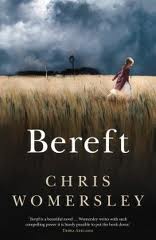
‘Bereft’ by Chris Womersley

2010,  264 p.

There are eras in Australian history which, in my imagination are flooded with light- the gold rushes is one; the time around Federation is another- when Australia seemed open to opportunities, hungry for change and with the future opening up before it.  Then there are other low, muted,  hold-your-breath times, and I think that immediately after World I would have been such a time.  So much death and absence, felt so keenly at the intimate and everyday level and yet played out so far away: men returning broken, damaged and strangers to themselves, and the incomplete, unresolved grief about those men who failed to return.  Then, overlaying all this is another winnowing as the Spanish flu sweeps the country, as if Death has been brought home from across the sea.

Bereft is set in this time.   Quinn Walker returns from the front to his childhood town, Flint, in western New South Wales.  There is no homecoming celebration: instead he skulks in the bush, too frightened to appear in public.  Ten years earlier he had fled when his sister was found raped and stabbed, and he was accused of the crime that his father and uncle swore to avenge.  Watching his house from a distance, he realizes that his mother is very ill, probably with influenza, and that his father, frightened of catching it too, spends little time at the home, sitting on the verandah outside his dying wife’s window.  And so he is emboldened to approach the house when his father is not there, and his mother, not sure whether he is a hallucination or not, speaks with him.  She has lost everyone- her husband to bitterness and the quest for revenge, her daughter to the slaying, her eldest son to Queensland.  Quinn had just disappeared, confirming the rumours of his guilt and then was reported dead from the front- but now her younger son returns.  There is the word ‘orphan’  for a child who has lost its parents, she says, but no word for a parent who has lost her children. Or, thinks Quinn, for a brother who has lost his sister.  They are all just bereft.

He is being watched while he hides out in the bush.  Sadie Fox, a dishevelled, fey little orphan knows many dark things, and Quinn does not know quite what to make of her- changeling? spirit? urchin? hallucination?  In the face of so much bloodshed and pain, the line between life and death seems tenuous.  It is a time when clairvoyants feed on unresolved grief, and when many people are open to spiritualism.  Quinn’s own experience of the mud and the gas of the Front leaches into his present, and his own long absence from his home town means that his own identity is a vacuum.

Although Womersley has worked very hard in embedding the narrative within a particular time, I can see why this book has been described as ‘rural gothic’,  along with other Australian novels that span right up to the 1970s and 80s- think Craig Silvey’s Jasper Jones,  Elizabeth Jolley’s The Well and Sonya Hartnett’s Surrender.   I do wonder, though, if the easy interchangeability of this book with others set some 70 years later suggests that (a) country life and country people do not change at all, and/or  (b) that he hasn’t quite captured early twentieth century relationships and interactions very clearly.  Did people speak, move and interact in a qualitatively different way in 1919 compared with 1969?  I’m not sure.

I can see continuities, too, with his first book The Low Road, in that they are both stories of escape and hiding.  In both of them there is a sense of pursuit.

Bereft is one of the three books that have made the cut as the short-list for the Miles Franklin prize. All up, Bereft is  a book that weaves many strands- historical fiction, a type of crime fiction, the supernatural, and small-town claustrophobia- and it does it well.  So far for me, though, That Deadman Dance is the front-runner- although my record in picking the Miles Franklin winner is, so far, abysmal! I was right but disgruntled in 2009 and wrong and outraged in 2010.

7.5/10  (I think I prefer scoring out of 10)

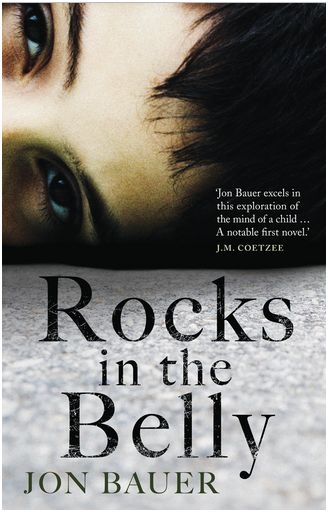
‘Rocks in the Belly’ by Jon Bauer

2010,  296 p

I’m not going to give this book a star rating (something I’ve only started doing recently anyway).  I really don’t know what I’d give it.  I very nearly didn’t finish reading it, and that is unusual for me: I usually hang on to the bitter end once I’ve started a book.  But I found this book very disturbing and unrelievedly painful and I did not enjoy the experience of reading it at all.  Is that powerful writing? Probably.  Did I want it to go on for even one page longer? Definitely not.

The story is written in two strands.  One is in the voice of eight-year old boy, an only child, whose family fosters other children as well.  They have been recently joined by Robert, an older boy.  The second voice is that of the same boy, now twenty-eight, returned from Canada because his mother is dying of brain cancer.  Significantly, we don’t ever learn what the narrator’s name is, and although the voice of the child and the man are distinctive, the pain, injury and jealousy throbs through both narrative strands equally.  A damaged and damaging child: a damaged and damaging man.

In the acknowledgments at the back of the book Bauer mentions that the book had an earlier incarnation as a short story.   Maybe a book so lacerating  should remain in a small format- a 190 page novella perhaps.  I did not want to keep reading, and I just wanted the pain, all round,  to stop. I tired of the scatological references to wee, the poo and doodles by the young boy and I shuffled uncomfortably at the violence and warped thinking of the man.  I didn’t want to be with any of these people.

I see that it has been long-listed for the Miles Franklin.  I’m not sure.  In fact, I was quite positive that it was set in England- to me it had all the hallmarks of the archetypal ‘gritty BBC mini-series’- and I was surprised flipping through the book later to find that there is no real indication of where it is set.  Its oppressiveness, the hedged garden, the upstairs bedrooms, all signalled England to me.  I don’t think that the Miles Franklin is the right award for this book.

I am sure, as Lisa at ANZLitlovers point out, that this book would spark a lively discussion in book groups.  However, thinking of my bookgroup ladies, I suspect that if I, not usually so disturbed by a book, found it difficult to continue then they even more would baulk at such unmitigated pain.

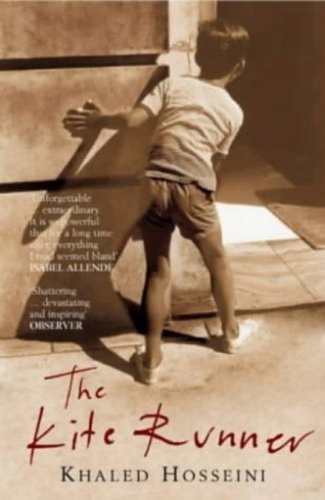
‘The Kite Runner’ by Khaled Hosseini

2003, 324 p.

(3.5/5)

I think that I must be the only person in the planet not to have read this book or seen the movie- and maybe that’s why I hadn’t.  It topped the bestseller lists in many places in the world, and it seems to be a book that people have taken to their hearts.

And why not?  I’m not going to summarize the plot- it’s been done exhaustively here. For the first two-thirds of the book, it was so authentic that I was beguiled into treating it as autobiography–and yes, yes I know that first person narrator does not necessarily mean autobiography, but it was imbued with an authenticity that swept me along and made me forget that.   And then, all of a sudden, at the point when the narrator receives a cut on his lip that mirrored the repaired cleft lip of his companion Hassan, the bones on the plot started to jut out.  With the literary equivalent of ‘jumping the shark‘, it seemed to me that all the coincidences warped into absurdity and the attempts at parallels collapsed into contrived and heavy-handed plot manipulation.  To his credit, the author resisted the temptation of an unequivocal happily-ever-after.

I can see why so many people have embraced the book, though.  It is story-telling, pure and simple.  I’m satisfied in a narrative sense when things ‘click’ as the chronology of the book catches up with something foreshadowed, and when events vibrate in a careful balance. There’s something emotionally filling about the goodies being recognized even if they’re not vindicated; the baddies being punished; redemption and the fulfillment of destiny.     The book is a fable, well told.  I’m only sorry that by overplaying the plotting, it became all too obvious that there was a plotter behind it- a literary Wizard of Oz, so to speak.

This book joins a group of best-sellers about Islamic countries that have been embraced by a Western mainstream audience, primed and curious perhaps by the ‘Coalition of the Willing’ (and isn’t that a term to make us squirm now) and the mess in Iraq and Afghanistan.  Because of the audience they attract, such books have much weight placed upon them.  And so I am uncomfortable with the piling of stereotype upon stereotype onto the Taliban villain here- Nazism, child abuse, hypocrisy, corruption.  Let fanaticism be evil enough.

One last thing, though.  As a person with a cleft lip herself, I was gratified to find that the depiction of Hassan’s cleft was probably the most accepting and matter-of-fact that I have read (despite the fact that it was called a ‘harelip’ throughout). I sometimes wonder if I’ve been targeted through internet data trawling, but I have seen more pictures  of older children with unrepaired clefts on the internet through Smile Train advertisements than any first-world inhabitant would ever see in real life.   By the time I reached the end of the book I had inured myself against the tear-jerking moments that seemed just a little too  obviously crafted, but I will admit that I cried like a baby when Hassan looked into the mirror after his surgery and gently touched the stitches on his swollen lip. I’ve been there myself, and as a mother, and I know what a big, wonderful thing that is.   I don’t know why, as author,  Hosseini gave him the cleft – being a Hazara in Afghanistan, undersized, in a menial position in a rich household, bullied, degraded and betrayed as he is,  would surely be enough.  But the cleft was there, it just was, and that’s probably the way it should be.

So- a mixed response.


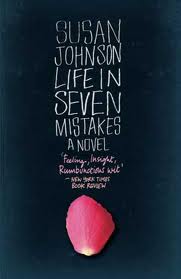
‘Life in Seven Mistakes: A Novel’ by Susan Johnson

2008,  344 p.

(4.5 out of 5)

One of the two epigraphs that grace the opening pages of this book quotes Shakespeare’s As you Like It

All the world’s a stage,

And all the men and women merely players;

They have their exits and their entrances’

And one man in his time plays many parts,

His act being seven ages.

I’m not sure that it was a particularly apposite quote, and it complicated rather than illuminated the title of this book, which for the life of me I can’t quite make fit with the story itself.    Doesn’t matter really: I enjoyed it anyway.

There are two intertwined narratives in the book.  The first, written in the present tense, is told from the perspective of Elizabeth, a middle-aged ceramicist on the verge of her first international exhibition. She has travelled up to Surfers Paradise with her third husband Neil and her children to spend Christmas, and to celebrate her parents’ 50th wedding anniversary four days later. Her  brother and his wife and  children have done the same.     Ah- families- you’ve gotta love them, don’t you- with all that jealousy and love and rawness and spite mixed in together.  There they are, in their parents’ large air-conditioned penthouse at the top of a Gold Coast hi-rise: Bob the patriarch a boorish, loud bully; Nancy his tense, controlling,  hyper-critical wife; Robbo the younger brother who just rolls with the punches and his rather intrusive and opinionated wife, and a brood of disengaged, self-absorbed grandchildren.  Then there’s  Elizabeth, our entree into this family,  who despite her own status as mother, artist and adult woman feels as if she turns into a little girl again around her parents.  Her brother Robbo is spot on about her:

You’re pathetic.  Still bleating about what Mummy and Daddy did to you when you’re almost old enough to retire.  Next year you’ll qualify for one of those over-fifty retirement places.  Are you still going to be blaming your parents when you’re seventy? Life’s too short, Liz (p. 108)

Then there’s the missing youngest brother, Nick who is in jail after a long history of drug use with all the betrayal, defiance and hurt that this brings.  He’s barely spoken of, only briefly encountered in the book,  and yet a presence nonetheless.

How did this family get to be like this?  The other narrative strand takes the young Bobby and Nancy as they meet in the 1950s, begin courting, marry, have children, become increasingly affluent as Bob (who drops the ‘Bobby’) moves up the corporate ladder  into private schools, prestige cars, Surfers Paradise penthouses etc.  But all of this comes at a price- expectations of gratitude and performance- and Bob becomes angrier at the world and the sense of entitlement that he himself has fostered for himself and his family; Nancy tries to make herself and her children smaller targets;  and the three children in their own ways negotiate this spreading emotional mine-field.

Both narrative threads were strong and well-made, and I didn’t find myself regretting when I turned the page to find that the narrative was about to switch again.  The dialogue was particularly good, and the author obviously has a sharp, observant eye.   The ending had an emotional authenticity, at least for this middle-aged reader at the time I am in my own life, although other readers may judge it a cop-out.  The book had the groundedness and edge of Christos Tsiolkas’ The Slap, and felt a little like Jonathan Franzen’s The Corrections down under.  This is perhaps a little flippant: all three of these books have a truth at their core about loyalties, judgment and the emotional mess of just living.  All three are more than the “human comedies” that their blurb writers have pigeon-holed them as.

Oh, but that title- it’s turning me into a numerologist.  There’s seven main characters- is that it?  Or is it, on p. 106 when Elizabeth lists all the things that people tell her not to be take too seriously: love, art, university, jobs, children, her parents, life itself–  there’s seven of them too.  I wish I hadn’t been so hung up on looking for a reference to the title while reading, and I wish I could let it go now too, but Elizabeth-like, I can’t.  Perhaps that’s the mark of a good book- that it turns YOU into its protagonist??!! ( now that’s  a dangerous thought….)

Some other blog reviews:

Kimbofo at Reading Matters

Lisa at ANZLitLovers

Reeling and Writhing

And other reviews:

The Sydney Morning Herald review by Louise Swinn

The transcript of Jo Case’s review on RN’s Book Show

Felicity Plunkett’s review in The Age

The Australian review by Jennifer Levasseur