Category Archives: Book reviews

‘British Colonial Policy in the Age of Peel and Russell’ by W.P. Morrell

First edition 1930; reprinted 1966, 554 p.

When you change the government, you change the country” Paul Keating once said.  You mightn’t detect it from the title, but this book is not only about colonial policy but also about the ramifications of a change of government on an issue of such importance to 19th British politics and imperial identity.

You’ve got to hand it to the historians of the 1930s when they chose their titles- there’s no tricksy double-barrelled postmodern titles with colons and parentheses here.  What you’re promised is what you get- British colonial policy under the conservative Prime Minister Sir Robert Peel (1841-1846) , and then under the Whig Prime Minister Lord John Russell (1846-1852).  There is some slight blurring of the lines though because the cabinet responsibility for the colonies rested with the Secretary of State for War and the Colonies, rather than the Prime Minister .  Although the Secretary of State  position was a bit of a revolving door during the 1830s with Secretaries coming and going in quick succession,it was more stable under the Peel and Russell administrations.  Lord Stanley acted as Secretary of State for nearly all of Peel’s time as Prime Minister, and Earl Grey was Russell’s Secretary of State for nearly the whole Russell government as well.  So the title could just as easily have been ‘British Colonial Policy in the Age of Stanley and Grey’, although of course the Prime Ministers held the ultimate authority.  Then of course, there was the Under-Secretary of State in the Colonial Office, Sir James Stephen, the civil servant who worked behind the scenes during both administrations.  Perhaps the title could expand to encompass Peel, Russell, Stanley, Grey and Stephen- but try fitting that onto the spine of the book!

Morrell identifies two main lobby groups who also exerted pressure on colonial policy. The humanitarians are well known because of  their influence on indigenous policy, and their anti-slavery and later anti-transportation activities. But the second lobby group, the Wakefieldians or the ‘Colonial Reformers’,  is less visible, and probably less appealing to 21st century activists.  Their systematic colonization cause is tied up with land policy, immigration and labour supply, and their intermixing of commercial and altruistic motivations is problematic for us today.  Their figurehead, Edward Gibbon Wakefield, was controversial and enigmatic then and now.  He had particular influence over a string of British politicians, including Earl Grey, Goderich, Molesworth, Gladstone and Lord Stanley, and because of their positions at the heart of the colonial debate in both conservative and Whig governments, his ideas were promulgated throughout the empire and especially in South Australia and New Zealand.

Structurally, the book is divided into two parts: Peel and Russell.  Within each part  there are chapters  devoted to a single colony- New Zealand, Australia, North America, South Africa, the Sugar Colonies, interspersed with more general chapters dealing with economic policy and transportation. Reflecting the author’s admiration for Earl Grey, the book closes with one chapter on his relationship with the Colonial Reformers and another on Grey’s place in imperial history.

Both Peel’s and Russell’s  administrations were united by a bipartisan acceptance of free trade economic policy, and this thread runs throughout the book.  It was a striking feature of the Peel administration, and it continued during Russell’s time as well.  So was Paul Keating right about a change of government changing the country? Yes, in that Peel’s administration strongly resisted self-government for the colonies and generally took the side of the plantation owners in the sugar colonies, and the Loyalists in Upper Canada.  Russell’s administration, on the other hand, was receptive to Wakefieldian ideas and amenable to discussions of representative and then responsible government,  even though Wakefield and the Colonial Reformers later turned against Earl Grey who had been their great hope as a fellow Colonial Reformer.  The analysis of colonial policy under the two administrations is a nuanced one that recognizes continuity but also detects difference, even if it is a matter of degree rather than stark contrast.

William Parker Morrell was a New Zealand historian, and he died in 1986. I sometimes wish that it was possible to take a book written many decades earlier- (and remember that this book was written in the 1930s) – and using the same structure and question, revisit it again in the light of more recent scholarship and interests.  Not rewrite the original, mind you, but just to look again from a different perspective, to see what has changed and what parts have taken on even more significance.
‘Tartar City Woman’ by Trevor Hay

1990, 178 p

I must admit that my heart sank a little when we received our November book for The-Ladies-Who-Say-Oooh bookgroup this month. Yet another book about a Chinese woman growing up in Communist China, I thought.  I’m over all these three-part family saga with grandmother, mother and daughter full of co-mingled admiration and resentment, alternately solved and exacerbated by the magical escape to the Wonderful West.  Well, there were elements of this here, but because this is a memoir of a woman, related by a man (rather than an autobiography), it thankfully lacked some of the emotional tantrum of such books.

Wang Hsin-Ping  grew up among the old gentry class in pre-Communist Peking.  Her father had emigrated to Australia and rather unaccountably disappears from the story completely, and after her mother died, she was brought up by her grandmother.  Members of the family seemed to be able to leave for the West fairly easily, and it was these family connections overseas that compromised her reputation during the various twistings and turnings of  Communist Party ideology as she grew up.  She was a forthright, intelligent young woman, thwarted in her career aspirations by her ambivalent attitude and suspect family allegiances.  Although she lived in a community of suspicion and fear- and I am not under-estimating the effect of this- she was not denounced; not sent out into the country; not beaten or starved or any of the litany of outrages that we often read of in totalitarian societies.  In fact, she testifies to a low-key subversion of authority, albeit over minor details. The peasant village sent her exiled 70 year old grandmother  back to the city because she was useless with her bound feet, and students sent to work in villages simply  returned to the city, in spite of the fact that without their ration books they would be dependent on others for food.

The book opens Trevor Hay’s own reflections on his attitude to China, particularly in the 1970s as he travelled there with an enthusiastic wide-eyed, left-leaning tour group, completely oblivious to Hsin-Ping’s journey in the other direction as she emigrates, seemingly easily, to Australia.  He meets Hsin Ping working in a Melbourne restaurant, and I can only assume that the book is the product of her reminscences and their conversations.  It is not co-written as such, at least in the authorship.

Yet there is a real distance between the teller and the recorder of the narrative. It is a rather cold, bloodless tale, with emotional relationships dispensed with in mere sentences.  Perhaps this is Hsin-Ping’s choice, but Hay does not problematize this in any way.  There is much detail about pedagogy and curriculum, and this ‘teacher’s eye’ view of the world perhaps mirrors the shared professional bond between Hsin-Ping  as an erstwhile classroom teacher and Hay’s own profession as academic in the education faculty at the University of Melbourne.  The book was useful in explaining the U-turns and contradictions in Chinese government policy.

Overall, I found this rather disappointing. It was not the family saga I expected, and for that I suppose I should be grateful, but it felt a rather stilted and incomplete picture of growing up in Communist China.

My rating: 6/10

Read because: it was the November for my face-to-face bookgroup AKA ‘The Ladies who say Oooohh’

Sourced from: CAE bookgroups.

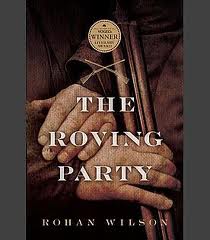
‘The Roving Party’ by Rohan Wilson

282 p. 2011

As a historian, there’s often a jolt when you encounter in fiction a character that you know from your own research.  This is the case with John Batman, one of the main characters of Rohan Wilson’s The Roving Party. Alongside the mirth that his name evokes he has become an emblematic figure, in the same vein as Captain Cook and Ned Kelly. His is a name attached to a picture-book depiction, freighted with a cargo of abstractions: discovery, dispossession, duplicity.  Bain Attwood’s recent book Possession:Batman’s Treaty and the Matter of History looks at the man and the mythology around him in more detail, and Melburnians continue to travel along Batman Ave, and pass Batman Park etc. etc.  For myself, I encountered John Batman in Judge Willis’ Melbourne- or more correctly, I encountered the legal proceedings involving his wife and children in Willis’ courtroom after Batman died with syphilis, insolvent and leaving seven children who were taken into the care of their guardian, Rev Thomson, the Church of England minister.

But the Batman of Wilson’s book is a younger man, employed in Tasmania as the leader of a roving party, funded by the government to capture and remove Aboriginal people from the settled districts as a means of conciliation between the settlers and the dispossessed tribes.  Batman himself offered his services  to Governor Arthur, citing his own familiarity with the countryside and his contact with Aboriginal people who would help him in his task.  These are the men and the situation we encounter in this book: Batman, four convicts, two black trackers from Sydney, a bumbling farmhand and Black Bill, a Panninher man brought up from childhood as a white man, battling the sodden and chilled Tasmanian bush in June 1829, charged with finding and bringing in the remnants of the Plindermairhemener people.

Black Bill is the central character in the book. He has thrown in his lot with John Batman, but, Manalargena the head warrior and Taralta the law-man of the Plindermairhemener have called him, asking him to join them.  They tell him-

…You listen my story.  Three wallaby near the river you see.  Not two and one but three.  Them brother lost, you understand.  They see plenty wallaby.  But no see brother.  Three wallaby near river eat the grass and drink the water but they forget.  Who is brother.  Who is hunter.  They forget this thing.  Now three wallaby.  No one sing.  Them all lost.  All same you see. (p.8)

Who is brother, who is hunter?  Other books sprang to my mind while reading this.  One is Cormac McCarthy’s All the Pretty Horses with the relentless drive of pursuit/escape, and the need to keep going day after day through a hostile and unforgiving environment.  The other is, rather curiously Moby Dick which, although as different in setting as it is almost possible to be, is driven by the same sense of obsession and fear. For having rejected  overtures to join the Plindermairhemener, Black Bill takes the pursuit and capture of Manalargena as his own personal quest and object, irrespective of the  official intent of the expedition.

All three books- McCarthy, Melville and now Wilson- are steeped in blood. In fact, I found it hard to pick up the book again each time, with each chapter opening with another dank Tasmanian winter morning, the cold, the bone-weariness and the hunger.  The violence is always present like mist, even though this is ostensibly a ‘reconciliation’ party.

Much is strange to us as 21st century white readers.  As with Kim Scott’s That Deadman Dance, we encounter Aboriginal language that is presented without translation, and at the end of the book we are brought face-to-face with the essential aboriginality of Bill’s wife “Katherine”, despite her English name.  In fact, there is an unknowingness between us as readers and all these characters.  Wilson does not attempt at all to get into their heads, to explain, to exonerate, to complicate as Kate Grenville tried to do in The Secret River.

Of course, this is Tasmanian Aboriginal history.  After Keith Windschuttle’s intervention, it is probably the most heavily politicized,  contested and trepidacious history there is.  Batman’s leadership of his roving party is part of the official record and Wilson has woven his story out of this ambiguous and shadowy byline in Batman’s larger life-story.  He makes no claims to truth beyond this and does not ask us to identify or judge.  The book’s relentlessness, violence and moral coldness has a nightmarish quality, and the writing is sure and powerful.  No wonder it has received such acclaim.

My rating: 9/10

Read because: my interest in early 19th century Australian history

Sourced from: La Trobe University library.

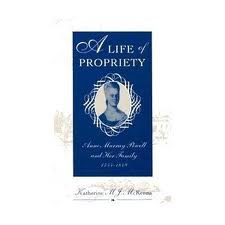
‘A Life of Propriety’ by Katherine M. J. McKenna

Katherine M.J. McKenna A Life of Propriety: Anne Murray Powell and her Family 1755-1849 , Montreal & Kingston, McGill-Queen’s University Press, 1994 , 260 p. & notes

Judges’ wives don’t tend to get much of a look-in in the judicial biographies written about their husbands. As you might expect, in such books the emphasis is on the judge and his interactions on the bench and amongst his judicial peers and government officials.  The wife and children- if they are acknowledged at all- tend to cluster off-stage in the folds of the curtains.

Not so in this book, which consciously focuses on Anna Murray Powell, the wife of  Chief Justice William Dummer Powell, of the Kings Bench Upper Canada. It was her husband’s position that gave Anna Powell her own prominence within York (Toronto) society, but I suspect that she would have been the subject of biography in any event.  The Powell family were prolific letter-writers, and more importantly, the letters were saved and now are scattered between archives in Ottawa, Toronto, Boston, New York and Washington.  Anne herself generated about 2,500 pages of letters alone, written over a span of 50 years, most particularly to her brother George Murray in New York.  These are rich letters for the social historian- full of family news and waspish commentary about York society- and they provide a solid basis for a study of Anna Powell and her family in her own right, not just as the wife of the Chief Justice.

Anna Murray Powell was born in Wells, England in 1755 to parents of a middle class background.  She emigrated at the age of 16 with her Aunt Elizabeth, who had herself emigrated to the New World at the age of thirteen and established a thriving millinery business in Boston.  On a trip back ‘home’, Aunt Elizabeth was horrified by the new ideals of middle-class female domesticity becoming popular in England, which did not sit well with her own ideas about female independence and business activity.  She did not have children of her own, and as seemed to be common at the time, ‘adopted’ her nieces and brought them back to Boston to manage her business.  What might have been a good solid business experience for a young man was greeted by Anne and her sister with reluctance and resentment.  She was mortified by working in ‘trade’ and she carried this sensitivity about her pre-marriage working life throughout her life, and indeed it may have contributed directly to the stiff-necked and inflexible ‘propriety’ that she demanded of her family, and all other York inhabitants in her social circle.

The book is divided into four parts. Part I ‘Learning and Living the Lessons of Propriety’ is largely biographical, tracing Anne’s childhood and adolescence, prolific childbearing years (nine births) and her establishment of her status within York society.  The narrative then bifurcates into a gender-based analysis of her family relations.  Part II ‘The Intersections of Male and Female Gender Roles’ examines Anne’s relationship with the men in the family: husband, brothers and sons.  Part III ‘The Transmission of Female Gender Roles’ examines education, marriage and childbirth within women’s lives in Upper Canada, and closes with a fascinating analysis of the lives of her three daughters.  Part IV ‘Conclusion’ deals with her life as widow and elderly matriarch- an aspect of women’s lives that is often dismissed in a few sentences- a life-stage which, as we (I) embark on an increasingly-lengthened old age will probably attract more historical scrutiny than it may have received in the past.

The book draws heavily on Barbara Welter’s 1966 article ‘The Cult of True Womanhood’ (American Quarterly, 18, 1966 p.151-74), a fairly dated article for such a recent book, and a choice that was questioned by several of the reviewers I have read.  McKenna cites Davidoff and Hall’s Family Fortunes, but it is the True Womanhood trope that she returns to most often.

Despite Anne’s strict insistence on ‘propriety’ and her incorporation of it into her own identity, you have to admit that her children were a bit of a disappointment.  The ‘good’ sons tended to die tragically, leaving the family with the duds.  Among her daughters, there was one ‘good’ daughter who trumped her mother in the fertility stakes, popping out ten children in an alarming succession. Another daughter remained the unmarried maiden aunt, a companion to her mother and built-in helpmate to her spawning sister.  The most fascinating chapter was that concerning the ‘unnatural’ daughter, Anne Murray Powell Junior.  It is  a very nineteenth-century take on the difficulties with parenting a wilful and troubled adolescent daughter.  The story of Anne Jnr.’s infatuation with John Beverley Robinson, the future attorney-general, has been told by other historians, but I suspect not with the sensitivity that McKenna brings to the situation.  It all ends tragically, and although the expectations and language of these unyielding 19th ‘pillars of society’ in their treatment of their daughter might not sit well with us today, the experience of parenting, loving, and losing transcends these differences.

Anne Murray Powell’s voice through her letters to her family is strong, censorious and inflexible.  Her letters are laced with a religious sentimentality which does not quite cover the snippiness, complaint and smugness that she expresses in almost the same breath.  Through the richness of the family archive, and through McKenna’s own insightful treatment, you feel as if you have been in the presence of a formidable woman.  I think I prefer her at a distance.

Sourced from : La Trobe University Library

Read because: it’s set in York at a time very close to my own research interest.


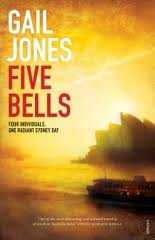
‘Five Bells’ by Gail Jones

2011, 216 pages

I don’t always read the epigraphs that grace the front pages of a book.  To be honest, I’m not really sure what purpose they serve- are they an encapsulation of the book in someone else’s words? are they a nod to writers who have come before? or are they a window into the texts that served as inspiration for the writer?  Probably all of the above, and I suspect that in this case, the latter is close to the mark.

The quotation from which the book takes its title is Kenneth Slessor’s poem Five Bells,  one of his best known poems, written after the death of a friend.  Gail Bell has chosen from the poem these lines.  The author has chosen:

Where have you gone? The tide is over you,

The turn of midnight water’s over you

As Time is over you, and mystery,

and Memory, the flood that does not flow.

‘Five Bells’ is a nautical term that measures the elapse of a four-hour watch on board ship, and the focus of time elapsing is pertinent here because we are very aware of it in the structure of this book.  The book is set on one summer Saturday, around Circular Quay (there’s that water theme again- and it emerges again throughout the book) as four people converge there from somewhere else, and the narrative swings from one character to another, in a sequence, not unlike the chiming of bells.  Round and round it goes, from Ellie to James to Catherine to Pei Xing then back to Ellie again as the day breaks clear and blue and creeps on to one of those night-time storms  that Sydney summers are noted for.  In this regard, it reminded me very much of Virginia Woolf’s The Waves, which took six friends, each writing from their own stream of consciousness.  However, here the characters in this book are observed minutely,  yet from a distance, rather than speaking in their own voices. Nonetheless,  it is very much an interior description, ranging over their memories, fears and disappointments across decades and continents.  In another nod to Woolf, there are echoes too of Mrs Dalloway in its single-day focus.

Her characters are each suffering loss of differing degrees: loss of relationships, loss of brother, loss of freedom, and exposure to tragedy.  Their stories are revealed gradually, as the spotlight of the narrative swings onto them before moving on to the next character.  There are resonances between the stories with multiple allusions Pasternak’s Doctor Zhivago,  eight year old girls etc. which at times felt a little forced, but I suppose evokes the same sense of connectedness and chance that we feel with the concept of ‘six degrees of separation’ and other such life coincidences.

Despite the rhythm and symmetry of the structure, the characters are not equally well-developed.  Catherine, the Irish tourist, never really became real to me, and although Pei Xing’s story was touching, I found it difficult to actually understand and thus accept her motivation for acting the way she did.  I think that Ellie and James, meeting again after twenty years, were the most clearly defined characters.

I must admit that I only made the connection with the maritime use of five bells when I googled it for this posting.  While I was reading it, I assumed that it referred to the characters and the circular way of telling their stories, like the rounds of a church bell.  There are four of them- who was the fifth? For much of the book I wondered if it was Sydney itself,  which with its harbour, the ferries,the Opera House,  Luna Park and Circular Quay is almost a character in its own right.  But then, in a marked change of pace near the end of the book, two other manifestations of what could be fifth character come into view.  This comes as rather a jolt.  I had been lulled into the almost soporific rhythm of the narrative and all of a sudden it changed direction.  I’m not really sure, though whether this sudden plot development was wise, or necessary to the book.  It changed the trajectory of the book and made some plot scenarios possible, but I think weakened the overall effect.

It is only a short book at 216 pages, and that is probably exactly the right length.  It is very carefully written with almost every phrase and image carefully burnished.  Perhaps a little too polished for my liking- I found myself almost  smothered by such intense, artistic writing- and so, while unsure about the necessity of the change of pace near the end, I greeted it as an escape into open air from a rather oppressive, perfumed interior.

I have set this post aside for a couple of days, unsure of how to sum up my response to the book.  Ambivalent, I’d have to say.  I admire the cleverness of the endeavour and the complexity of her allusions to other works of literature and acknowledge that there are some beautiful images and phrases.  But I need to balance that with my misgivings about the plot development at the end of the book, and my feeling of overload from a surfeit of fine writing.  Not sure.

My rating: Mmmm. 8/10??

Read because: My Australian Literature Online group had it as the September read

Copy sourced from: Yarra Plenty Regional Library and then, when I was unable to renew because it had a hold placed on it, La Trobe University Library.

‘The Paper War’ by Anna Johnston

Anna Johnston The Paper War: Morality, Print Culture, and Power in Colonial New South Wales,  Crawley Western Australia,  The University of Western Australia Press, 2011.226 p. Plus notes

Now that my thoughts are actually turning to writing my big baggy monster of a thesis (stifle those snorts of laughter, please) I’m finding myself conscious of the way other writers are treading the tenuous line between ‘straight’ biography and something that’s not quite biography.  The Paper War by Anna Johnston is one such book.  Her focus is on Lancelot Threlkeld, the NSW missionary, and the texts he generated  by and about  his colonial experience. But it’s not a biography of Threlkeld as such, and the author is at pains to reinforce this distinction.  Her work is not history, or biography, but a literary/cultural study which

examines the archive as a set of writing and reading practices, seeking to make different meanings than a historian might.  The Paper War retells stories found in archives as well as revealing modes of construction, in order to create new narratives. It foregrounds the complexity (perhaps the impossibility) of efforts to establish coherent, credible narratives from partial sources  (p.4).

This means that, as well as looking at the content of a particular source, she also asks about the source itself : how did this document/series of documents come to be created?  What are the institutional structures, and individuals within those structures, that created them? Can we rely on these texts as stable and authoritative guides to the past? (p.4)   She is insistent on maintaining this emphasis on text as a mediated material when her reader’s attention might drift into the biographical corridors of  chronology and lifestory instead.

Her book focuses on the writings by and about Lancelot Threlkeld, the missionary in charge of the Lake Macquarie Aboriginal Mission in New South Wales in the 1820s, a man rather unkindly described as one of the “perpetual blisters” that the London Missionary Society (LMS)  seemed “destined to carry”.  He certainly seemed a rather pugnacious and belligerent character as a missionary and his writings to attack his adversaries and defend his own position generated what could well be described as a “paper war’.  As is often the case, his own irascibility was  in response to, and elicited, similar traits in his main clerical adversaries: the equally combative  Rev. Samuel Marsden and the protestant cleric John Dunmore Lang.  What a combination!  I’m particularly interested in this combustible 19th century character type, because our own Judge Willis himself exhibited many of the same traits.

Surrounding the Threlkeld/Marsden/Lang sparring ring were representatives of the broader 19th century  humanitarian network.  Daniel Tyerman and George Bennet were missionary agents charged with overseeing Threlkeld’s establishment of the mission at Lake Macquarie under the auspices of the London Missionary Society and thus his immediate supervisors.  James Backhouse and George Washington Walker were peripatetic Quaker investigators whose opinions were valued by metropolitan humanitarian networks for their independence and clarity.  The Paper War is very much embedded in the historiography of the ‘networked’ image of the British Empire (Zoe Laidlaw, Alan Lester, Kirsten McKenzie etc) and these agents and investigators exemplify the way that ideas were circulated throughout the empire by missionaries, intellectuals and London-based groups like the Ethnological Society of London.

The book itself has five main chapters, an introduction and a conclusion.  The first chapter, ‘Colonial  Morality’ gives a brief biographical account of Threlkeld’s career along with the careers of his major protagonists and the circumstances that led to the intersection of their careers with his.  The second chapter ‘Colonial Linguistics’, looks at Threlkeld’s pioneering work in researching the language of the tribes surrounding Lake Macquarie, and she traces the evolution in his thinking about how language can be studied and depicted.  His earliest work in 1825 was an attempt to develop an orthography (spelling) for an Aboriginal language, mainly in the form of question and answer phrases, strongly based on Europeans assumptions about categories and sentence structure by imposing  an artificial  one-to-one match between English and Aboriginal words.  In 1834 he changed his methodology to investigate the grammar of the language, followed by another work in 1851 written for the Great Exhibition in London called A Key to the Structure of the Aboriginal Language.   As was common at the time, colonial collectors were expected to scoop up the raw materials of plants, animals, languages and ethnography, which were channelled to the ‘experts’ in London for ‘proper’ classification and analysis.  She traces the use of his work by such ‘experts’, especially the way that it was posthumously re-published and co-opted as part of late 19th century racial theories.

Chapter 3, ‘Colonial Press’ shifts its focus to the newspaper record generated by and about Threlkeld, especially in relation to the execution of Tommy, an aboriginal prisoner for whom Threlkeld acted as interpreter.  This execution itself became subsumed within a broader sectarian argument, and in February 1828 Threlkeld wrote a series of letters to the editor- a common feature of colonial newspapers- against the Catholic Church.

Chapter 4 ‘Colonial Respectability’ takes up Threlkeld’s Statement Chiefly Relating to the Formation and Abandonment of a Mission to the Aborigines of NSW; Addressed to the Serious Consideration of the Directors of the London Missionary Society, written to justify his actions as missionary at Lake Macquarie.  Despite its title, it was not aimed at the directors of the LMS alone: he had at least 270 copies printed and distributed it to every director and missionary in the LMS network.  It is a 72 page document, largely composed of letters written and received in relation to the Lake Macquarie mission. Threlkeld’s adversary J. D.  Lang waded into this documentary swamp with his own series of newspaper articles criticizing the mission and Threlkeld’s character as a missionary, culminating in a civil court case Threlkeld v Lang in 1836.

Chapter 5 ‘Colonial Legality’ remains in the courts, but here investigates Threlkeld’s work as an interpreter in the courts, and his position and increasingly critical stance over questions of the amenability of Aboriginal people to British law, the use of Aboriginal evidence and questions of sovereignty.

The  conclusion of the book picks up themes from the introduction by returning to the question of historians’ uncritical use of the colonial archive.  Both Henry Reynolds and Keith Windschuttle as combatants in the ‘History Wars’ share, she claims, a “remarkably simple” view of the archive as unmediated primary source material that can be drawn out to construct a narrative. She picks up on Kevin Rudd’s championing of Thomas Keneally for the background in literary fiction that he brings to his retelling of Australian history (an issue also pertinent with Kate Grenville’s recent works). And here we are returned to the question of the heart and the affective world so prominent in the humanitarian world view, including that of Lancelot Threlkeld.

As I mentioned earlier, I was particularly interested in the structure of this book for my own work, given that it takes an documentary archive deeply imbued with questions of personality and temperament.  I ‘m interested by the decision to place Chapter 2 where it is- perhaps because Threlkeld’s linguistic work has been somewhat overlooked?- because it seems more related to Chapter 5.  I’m impressed by the way that her strong, minimalist chapter structure forces the reader’s attention on the form rather than the content of the archive. The book is on one level about Threlkeld , without being a biography as such, but on another level it works on a much larger canvas.

You can download a generous extract of the book here.

‘Untold Story’ by Monica Ali

2011, 345 pages

My off-duty reading life seems to be rather bi-polar at the moment: fluff (The Book of Rachael) followed by depth (The Eye of the Storm) and now back to a bit of fluff again.  I really enjoyed Monica Ali’s Brick Lane,  and the television adaptation it spawned, so when I saw her new book at the library, I snapped it up.  Reading the blurb at the back, I wondered if I should put it straight back onto the New Books shelf for some other reader to enjoy because it didn’t really sound like the sort of the book that I normally read.  Sure, I’m happy to catch up on the adventures of the royals as I sneak a peek at the magazines at the check-out, and I’m a sucker for remaindered books with glossy pictures of the royals.  But I wasn’t sure about making the investment in time to read a 300 page book exploring WHAT IF Diana didn’t really die but faked her death in order to start a new life in America.  I borrowed it anyway.  I was interested to see what a talented writer would do with what must be the chick-littiest theme of them all.

Ali doesn’t actually name her character as Princess Di, but you’re expected to make the connection. The story is told in alternating slices.  The first slice is a  2007 narrative of a group of friends in small-town America who have welcomed Lydia as a newcomer to their midst.  Lydia is English, mysterious and unforthcoming about her background, and on the verge of falling in love with a good local man.  Rewind, then, in the second slice, to the 1997 diary of Lawrence, an academic and secret service man who once served as Princess Diana’s private secretary.  While he is penning his entries, Lydia (Diana) is writing to him, as her only confidante after faking her own death, leaving her sons to grieve her loss.  In the third slice, the  2007 narrative steps back a couple of weeks  to the arrival of an ex-paparazzi photographer who unwittingly, and rather implausibly, stumbles onto the biggest scoop of his life when he recognizes the disguised princess.

Does it work?  It’s trashy, it’s light, it’s contrived and it’s also rather unputdownable once you stop scoffing and  just go with it.  If I wanted to intellectualise it, I would say that it explores similar themes to Brick Lane: exile, displacement, identity.  But that would be to put too much freight onto a very light vessel. It’s an indulgence all round: Ali probably didn’t need to write it and I certainly didn’t have to read it.  But she did, and I did, and I can probably think of worse ways to spend an afternoon.

My rating: a rather abashed 7/10

Sourced from: Yarra Plenty Regional Library

Read because: I’m a supermarket check-out royal watcher deep down. Obviously not deep enough.

‘Family Life and Sociability in Upper and Lower Canada 1780-1870’ by Francoise Noel

2003, 384 p.

Family Life and Sociability in Upper and Lower Canada 1780-1870’ by Francoise Noel, 2003

In this case, the book’s title tells you exactly what the book is about- family life, sociability and Upper and Lower Canada.  Because my research interest is Upper Canada, and for such a limited period of time (i.e. 1827-9), I’ve tended to restrict my reading as much as I can to that small canvas. I haven’t really explored Lower Canada (i.e the French-speaking part) at all.  This book, which draws on diaries and letters as its source material, straddles both the Upper/Lower Canada divide. Its focus is  on family and social life, which are  not constrained by political borders  and so I am venturing into new geographical regions in this book!

The diaries she uses are mainly general records of daily activities, including visits received and made, family and community events, daily work and weather.  They are the sort of diaries that often pass off the details under the terse phrase “the usual”.  There’s not a lot of introspection in them, and they focus more on the social than the individual.

For the individual focus, she turns to family correspondence, which became increasingly important in the 19th century as part of the rise of the middle class, heightened in the case of Canada by the waves of migration and distance.  Letters were the key to maintaining family links, exercising patronage and sharing family culture and information.  Again, they were not necessarily personal confidences, as they were often handed around the family.  Although she did not consciously limit the study to any one social group, the nature of the sources resulted in a bias towards writers with more education and the ability to write.  She also draws upon portraits of the period, but this too leans towards those with the wealth to either encourage drawing and sketching within the family, or to commission portraits commercially.

The book is organized in three parts.  Part I, ‘The Couple’ takes a chronological life-stage approach, starting with courtship and engagement, moving to marriage, housekeeping and married life.  Part II ‘Parents and Children’ traces childbirth and infancy, childhood, and parent/child relationships as children approached adulthood and started the cycle again.  In this regard, the book reminded me of Amanda Vickery’s  Behind Closed Doors: At Home in Georgian England.   Noel  highlights those aspects which reflect specifically Canadian conditions: the ready availability of land for all children which influenced English hereditary patterns more tailored towards preserving a limited estate for the eldest son;  the shortage of women; the frequent absence of husbands; and distinctions between English advice literature on childrearing appearing in the newspapers and the ‘Republican Motherhood’ ideal being promulgated in the nearby American states.

Part III departs from the focus on the immediate family and moves into ‘Kinship and the Community’.  One of the most striking impressions she noted was the wide extent of social networks over great geographical areas.  As she says:

The social networks that supported individuals and families were composed of [these] overlapping categories of friends, neighbours and kin, and to focus exclusively on any one would make us lose sight of the complexity and extent of these networks. (p. 132)

The degree of socializing is startling- constant coming and going, visiting, staying over for weeks and months. New Year was particularly important- more so than Christmas- and social activity focused on the Jan-Feb winter season.  It is strange to my Antipodean sensibility to think that you would deliberately choose to socialize during the coldest, most snow-bound  time of the year, and that snow made transport easier through sledding across a smooth surface rather than more difficult along unmade roads.  Otherwise, though, social life amongst the elite seems fairly similar to that in Australian colonies – subscription balls, governors balls, picnics, fairs, horse racing, sermons.  But the extended family was central to this sociability, and in this, I suspect, Australia and Canada differed, at least in the early years of Australian free settlement. Siblings might travel out to the Australian  colonies in pairs, or one by one to join their family already here, but networks of cousins, aunts and uncles developed gradually. The injection of single-male travel to Australia through the pastoral industry and later the gold rush deferred the highly complex integrated family pattern found in Canada for some decades.There are extended families In Australia of course, but in comparing 1840s Canada and 1840s Australia, family connections and sociability seem much stronger in the former.

The author is largely content to let the writers speak in their own words, and there is not a great deal of theorizing in this book. I was interested in this book to see how Noel would deal with her informants.  She introduces the main ‘characters’ early in the introductory chapters, especially in establishing their identity as discrete families with their own family trajectory, interspersed generously with portraits then and there (rather than saving up for an insert later in the book).  It surprised me a little that in the closing chapters she seemed to backfill on the Papineau family in particular, who to my reading, seemed very well established earlier in the book.   For other, smaller family groupings, I found myself wondering “Hold on? Have I met this person before?”  A very good index, which not only listed the family, but also life-stage details (e.g. marriage, children) and page numbers, helped to re-establish the family in my mind when I’d forgotten them.  She  also has sources that are particularly useful for one particular theme (e.g. childbirth) but who provide little information in relation to her other themes.  These informants tended to star in one or two sections, but then disappeared from sight entirely.  I found myself wondering what happened to them.

The portrayal of life-story and wider sociability that she stitches together here is so rich that I found myself forgetting that , by her own admission, many of the diaries especially that she dealt with are rather humdrum documents.  Here she has the advantage of being able to range over several sources, picking the eyes from them.  In this regard I envy her-  when you are focussing on an individual you have to content yourself with the documents you actually have (terse, scrappy and incomplete though they may be), rather than the full and densely informative ones you crave.


‘The Eye of the Storm’ by Patrick White

1973, 609 p.

After finishing reading the dissatisfying The Book of Rachael,  I felt like reading something astringent and masterful.  The pre-publicity for Fred Schepisi film was gearing up, so I thought I’d have a quick read of the book before seeing the film. What was I thinking? There’s no such thing as a ‘quick read’ of a Patrick White: he’s magisterial, allusive, dense and uncompromising.  But, after overcoming my aversion to him after being subjected to Voss  as assigned HSC reading (what were they thinking?), I now consider him to be challenging, but well worthwhile.

Nonetheless, it is just as well that I saw a blurb summarizing the plot of the upcoming film because even on p.195 I hadn’t quite realized what the book was about.  You could say that it took some little time to get going. I don’t know whether the nutshell synopsis of the film helped to focus my attention, or whether the book itself tightened at that point, but from about p. 200 on, I found it  compelling in a grubby, voyeuristic way.

When I was a child, one of my favourite stories was Hans Christian Anderson’s The Snow Queen.  I think that, like Kay in the fairytale, Patrick White has a splinter of glass in his eye too, and it lacerates everything it sees.  His characters are often flawed, ugly and marred by their physicality; there is the whine of weakness or the throb of madness about them, and their mannerisms are coarse and grotesque.  And yet White also stretches out for beauty and transcendence as well, in the midst of an ugly and petty world.  The same clearness of eye that strips his characters naked also washes clean our view of the natural world.  Here’s the tropical rainforest, that will soon be lashed by the cyclone in the title:

Now [the island] hushed the strangers it was initiating. At some stage of the journey the trees were so densely massed, the columns so moss-upholstered or lichen-encrusted, the vines suspended from them so intricately rigged, the light barely slithered down, and then a dark watery green, though in rare gaps where the sassafras had been thinned out, and once where a giant blackbutt had crashed, the intruders might have been reminded of actual light if this had not flittered, again like moss, but dry, crumbled, white to golden. (p. 375 Virago edition)

The emotional stillness of the book- the eye of the storm- is the dessicated,manipulative matriarch, Elizabeth Hunter.  She surrounds herself with nun-like nurses who cater to her petulant, fretful demands as everyone waits for her to die.  Circling her, sweeping in from their European lives are her two children, the celebrated actor Sir Basil who has probably seen the best days of his career, and her brittle daughter, Dorothy, the Princess de Lascabanes, whose marriage into minor European nobility had failed. Despite their platitudes, they despise their mother for her beauty, her promiscuity, her self-centredness and her casual, but deliberate, cruelty.  Her children are both failures in their different ways, and in need of money.  They decide to curtail the expenses of their mother’s home-based nursing care by placing her into a home in order to access the income from the sale of her home and effects.

And that’s all there really is to the plot itself, although it’s a story that has been told many times before as the frequent allusions in King Lear attest.  In many ways, the whole scenario is a staged performance, and the characters themselves are conscious of the theatricality of the situation- indeed, the narrative breaks into scripted dialogue in places.  At times I really wasn’t sure what was happening, or whether what I thought had happened actually did.  There are whole paragraphs of images tumbling one on top of the other as a rush of disjointed memories floods Elizabeth’s mind,  and events on which the whole book turns seem to occur in that half-world between sleeping and waking. White’s narrative style continually unsettles your confidence in yourself as a reader.

I’ll be interested to see the film, because given the fairly slight plot line, I wonder how the nuances and complexities of the interior world of the characters will be portrayed.  White himself barges into carnival and parody at times with his crudely named nurses Sister Manhood and Sister Badgery, and the exaggerated grossness of his characters’ behaviour is probably better left imagined than depicted on the screen.  Still, if anyone can carry this off, it would have to be the cast assembled for this film version- so watch this space.

Snap! Lisa at ANZLit Lovers has just read the book before seeing the film too (and I strongly suspect she’ll see it before I do)- her review is carefully-referenced and well worth reading.

My rating: 9/10

Reason read: to read it before seeing the film

Book sourced from: my own bookshelves! Purchased second-hand from the now defunct Printed Treasures bookshop in Macleod.

‘The Future of History’ by John Lukacs

2011, 177 p

There’s a new John Lukacs book out, I see.  I like books about history, written by historians. As a reader, they make me feel like an eavesdropper and novice rolled into one. This small book felt as if it were perhaps compiled from a series of lectures, similar to Margaret Macmillan’s The Uses and Abuses of History or Inga Clendinnen’s True Stories. But no- these are chapter-length reflections on historianship as a way of viewing the world and as a profession, and its relationship with literature.  They are written for their own sake.

I don’t really know all that much about John Lukacs.  I have only read one of his books- Five Days in London: May 1940- and I was very impressed by its close attention to just five days spent before and after Dunkirk, when Churchill decided that Britain would continue the war against Hitler after the fall of France.  It was a closely-focussed history that looked at just a few days (although VERY important days to be sure) while addressing big questions and issues.  After reading this latest book, I realize that it exemplified two of the big themes that Lukacs has explored over his long publishing history. First,  Five Days in London was an analysis of the personalities who were involved in the choice to stand up to Hitler, and the aspect of choice is important to Lukacs.

“Choice” is the operative word: because people, as well as their individual components, do not “have” ideas; they choose them. (p.30)

There is an emergent quality in events and decision-making as well: that perhaps the question is not “why” something happened, but “how” and “when” something became to be as it was:

Notice the emphasis on process in the syntax: not how “was” but how did it “become” (p. 39)

His second theme, again exemplified in Five Days in London is that of public sentiment. In the case of Churchill’s decision in 1940, it was set against the perceptions of the British people that were being monitored through the Mass Observation project.  He draws a distinction between Public Opinion which ostensibly can be measured and quantified and Popular Sentiment which is a more subtle and less graspable thing. I guess, in an Australian context, this would be the difference between  a Newspoll with its stark black and white choices, and a Hugh McKay survey .  He notes the dangers to democracy of government driven entirely by public opinion- and don’t we all know about that in Australia at the moment.

Lukacs is dismissive of statistical-based history, psycho-history and counterfactuals, and even more scathing of recent gender,  subaltern and other “faddish” histories.  However, it’s rather a cheap shot to mock journal papers from their titles alone, which are often framed to attract interest through their quirkiness.  There’s an element of grumpy-old-mannishness over the use of computers in research as well. He notes that there has always been more of a problem with spurious papers being inserted into an archive than papers being removed and that technology makes falsification even easier. He warns against the “insidious” practice of

“the presentation of a scholarly apparatus, listing or citing microfilm numbers or other archival “sources” that are not easily ascertainable- or, even if so require careful reading by a professional historian to eventually reveal that they do not prove the  “fact” or statement that they are supposed to confirm”. (p. 58)

To my mind, false claims can be made for both digital/technological and paper-based sources, and digital data-banks of journals and digitization have brought otherwise obscure journals and sources into a brighter light.  A microfilm is more accessible to many more sets of eyes than an individual archive will ever be, especially on the other side of the globe.

He notes that history is not science, and that it is much closer to literature.  Fact and fiction are related to each other, but not identical, and he champions not so much the fictional nature of history, as the historicity of fiction- that “every novel is a historical novel in one way or another” (p. 120)  He is open to the work of amateur historians and aspects of what-if histories that acknowledge the potentialities that lie in any situation.

“…the historian’s recognition that reality encompasses actuality and potentiality reflects his propensity to see with the eye of the novelist rather than with the eye of the lawyer” (p 124).

He closes the book with an Apologia and a greeting to his ‘good, serious’ historians.  He is, indeed, an “old” historian- eighty six years old, and by his own admission he spent much of his career working in small universities.  Although his list of publications is exhaustive, many were published by ‘trade’ presses with an eye to a wider audience and  he senses the ambiguity in the term “prolific” that his academic peers use to describe him. There is, as he admits, an element of  vanity in his chagrin at his marginalization.

Lukacs has elsewhere described himself as a reactionary and certainly elements of this come through here.  He is dismissive of the shortsightedness of American liberal historians, and there is an implicit assumption that the historians and the profession are male.  But I sense that he does not fit easily into any one political box.

He describes his book The Thread of Years as his “most extraordinary book”. It has 69 chapters, each consisting of two parts- the first a vignette about episodes in the lives of various imaginary people existing because of the historical realities of their places and their times.  The second part of each chapter is Lukacs’ own dialogue with an imaginary conversant who challenges either the historicity or the accuracy of the vignette.  He says that it is not a new kind of history, because almost all the men and women within it are imagined, but the times and places are not. He sees it as neither a history nor a novel.  And it’s sitting over there on the shelf, third row down, eight from the left.  I think he would want me to read it.