Category Archives: Book reviews

The conference you have when you’re not having a conference

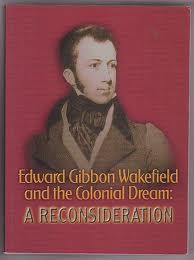
Friends of the Turnbull Library, Edward Gibbon Wakefield and the Colonial Dream: a Reconsideration,  Wellington, GP Publications, 1997, 200 p.

There’s a lot to be said for an edited collection of conference papers, particularly if the conference was held seventeen years ago in another country.  Think of it- you don’t have to make choices between clashing streams when you’re interested in both, or having to summon up a shred of enthusiasm for a session where nothing is of any earthly interest at all.  You can read the argument in its entirety, rather than having the speaker say “Oh?! My twenty minutes is up already?? Oh well, I’ll leave it there”.   The published chapter is often longer and more detailed than the 3000 word maximum paper that can be read aloud in 20 minutes, and it has all those delicious and helpful footnotes hanging off it.  It’s faster to read it than to listen to it.  Of course, not all papers are published, and it’s very possible that the one paper that had everyone buzzing  and which became a touchstone for extempore comments and questions throughout the conference is not represented in the printed collection.  But it might be.

In August 1996 the Friends of the Turnbull Library convened a conference called Edward Gibbon Wakefield and New Zealand: 1830-1865 to mark the bicentenary of the birth of Edward Gibbon Wakefield.  Apparently one commentator referred to the seminar as “the most politically incorrect event of 1996”, and you can see why s/he would say that.  A Wakefield seminar could have been quite unremarkable in the 1950s, when Wakefield was still celebrated as the father of New Zealand settlement. But in 1996, the Waitangi tribunal and the work of historians like Michael Turnbull (The New Zealand Bubble), John Miller Early Victorian New Zealand: a Study of Racial Tension and Social Attitudes 1839-1852) had dulled the lustre of Wakefield entirely.

Papers from the seminar were published under the title Edward Gibbon Wakefield and the Colonial Dream: a Reconsideration, and as with all seminars, the title, themes and streams that are presented are as much a reflection of the historiography of the present as they are of the subject matter itself.  The papers are divided into five parts:  Wakefield’s Life;  Wakefield’s Thought; Wakefield’s Historical Influence; Views of the Land and Wakefield’s Cultural Legacy.

Wakefield’s Life covers biographical aspects of Wakefield’s career, and here Philip Temple gives a taster of his then-unpublished book which eventuated as A Sort of Conscience.  Ged Martin presented a far more damning perspective of Wakefield, which is repeated in a different but similar paper here.

A more positive view is found in the section on Wakefield’s Thought, especially in Erik Olssen’s paper which marks out Wakefield’s place within the wider field of Scottish Enlightenment thinking by looking more closely at Wakefield’s published annotations on Adam Smith’s Wealth of Nations. This paper picks up on Olssen’s Sinclair Lecture, delivered in 1995 and available here.

Graham Butterworth examined Wakefield’s thought in terms of the Quaker tradition, while acknowledging that Wakefield himself did not identify as a Quaker even though there was a strong Quaker influence on his mother’s side.

Part III on Wakefield’s historical influence looked at historians’ depictions of Wakefield in Australia,  in terms of labour history, and in relation to the Scottish settlement at Otago- a paper that was too regional for me to make much sense of.

The Views of the Land section picked up on the ecological and spatial approach to history that is still influential today.  Marian Minson’s paper examined pictures and lithographs that were produced for investors and potential immigrants still in England and they are reproduced in the volume.

The final section of the book, Wakefield’s Cultural Legacy takes a cultural theory approach to his work, – look! Here comes Foucault again!- examining Wakefield’s corpus of writing as artefacts existing within a particular fantasy/polemic genre, and drawing links with a 1986 novel Symmes Hole.

The book commences and closes with papers by Maori presenters, both condemning the loss of Maori land.

So, all in all, I enjoyed my day at a conference held 17 years earlier in Wellington.  All I needed, really, was some stewed percolated coffee and a blueberry muffin for morning tea, a  ribbon sandwich with incongruous and mysterious fillings  for lunch, and a piece of chocolate caramel slice and a lemon tea tea-bag for afternoon tea and I’d be right!

‘The Voyagers: a love story’ by Mardi McConnochie

2011, 268 p.  Extract here .

I was drawn to read this book, the first as part of my Australian Women Writers Reading Challenge 2012, through encountering the author previously in her earlier book Coldwater, and by the promise of a book that traversed different settings during World War II-  Sydney, London, Shanghai and Singapore. It was ironic then, that the treatment of the breadth of its canvas was what I found to be its weakest feature, even though it was what attracted me in the first place.

In the opening pages Stead, an American sailor, returns to Sydney in 1943 hoping to spend his leave with Marina, a musician  he had taken up with for three days before the war.  When he retraces his steps to her home, he finds that she has been missing for almost five years.  The book then zig-zags back and forth in time, jumping forward and back, tracing between Marina, then Stead as they traverse their own journeys in a ruptured world, oblivious to each other’s experiences, and gradually honing in on their search for each other.

The complexity of this plot was handled well, and I found myself drawn through the book, wanting to know what would happen next and whether they would, eventually, find each other.  The strong emphasis on plot means that I am reluctant to say much more, lest I spoil your enjoyment of the book.

Yet in making these large leaps from location to location, and event to event, the book at time lapsed into an almost documentary flatness.  It was almost as if each new section was introduced by a film-reel summary (think Movietone News) that skated across events, evoking familiarity with images of historical events without actually tying them into the consciousness of her characters.  Big things happened,  in particular in the final part of the book, and yet they were compressed into a rather disengaged, almost saga-like retelling, tumbling quickly one after the other into an “and then…and then….” string of events.  Things happened to Marina especially, but it seemed that it was in the smaller, more intimate events that she seemed more present as a character.

It’s interesting that the author has marked out so clearly in the title that this is “a love story”. In an interview about the book with Angela Meyer on the Literary Minded website, the author explains that the book sprang from a discussion with her book group ladies about the paucity of contemporary literary love stories.  When I saw this, it explained some of the unease that I felt about it- that it seemed almost written-to-order for a female-dominated bookgroup, raising as it does issues of motherhood, careers, loosening boundaries and the artistic life. It was as if it was writing to a genre or niche.

Like the author, I am resistant to the big all-lived-happily-ever-after ending.  In this regard, I think that the heightened  pace and the emotional distancing in the last third of the book worked against the ending.  I did not cry for the Marina we have at the end of the book, but I may have for the Marina we found half-way through.

On the other hand, I think that the title and the cover of the book work well as a marketing strategy in that they mark it out as a love story, if that’s the sort of book you’re looking for.  But I think of other love stories that I have enjoyed- the same love stories that McConnochie herself identifies in her interview (Cold Mountain, The Shipping News, Possession, Captain Corelli’s Mandolin) and with all of them the love story crept up on me unawares, and I think that I appreciated them all the more for that unexpected delight.

My rating: 7.5/10

Sourced from: Yarra Plenty Regional Library

Read because: I wanted to read an Australian woman author as part of the Australian Women’s Writing Reading Challenge

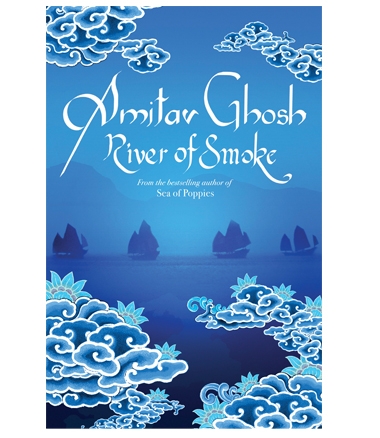
‘River of Smoke’ by Amitav Ghosh

2011, 517 p.

River of Smoke is the second book in what will be The Ibis Trilogy, a work examining the British-fostered Opium trade in India and China. On the back cover of my version of the book, it quotes a review from the Sunday Times about  the first book of the trilogy Sea of Poppies:

A glorious babel of a novel…marvellously inventive…utterly involving…The next volume cannot come too soon.

That may be so, but for me this next volume came too late for me to remember Sea of Poppies,  even though I very much enjoyed it at the time.  I’m not going to get caught out like this again: fully completed trilogies only for me in the future.

The basic conceit of the Ibis Trilogy is a storm in 1838 that catches up three ships: the ‘Ibis’, carrying indentured labourers and convicts to Mauritius; the ‘Anahita’ carrying a cargo of opium to Canton, and the ‘Redruth’ on an expedition to collect rare plants from China to take back to England.  Sea of Poppies dealt with the ‘Ibis’; this book takes up the ‘Anahita’ and ‘Redruth’.

The structure of River of Smoke  reminded me of the advice about paragraph-writing my second-form teacher imparted to me: “an opening sentence that links to the previous paragraph; then- new information; then- a final sentence that sums up where you have been and leads onto the next paragraph”.  River of Smoke opened by plunging back into the world of the earlier book.  Names flashed up at me- did I remember them? Should I remember them?  Am I going to understand this book if I can’t remember them? The reader is immersed again in language rich in foreign patois, for which no definition is given- there’s no glossary in this book.  I found it an anxiety-provoking way to start and I wonder how someone who had not read the earlier book would cope.  However,  with the second chapter the book quickly moves onto new material that is only tangentially related to the earlier book, and this middle part is the heart of this story.  It is only in the closing pages of the book that it returns again to the opening scenes, and hints at unfinished business that will no doubt be addressed in the final volume.

It was confronting for me to remember that this book, set in the late 1830s and early 1840s is exactly the same period that I am studying.   Although newspapers provided news from across the Empire, the Colonial Office of that era organized its correspondence strictly by colony (New South Wales; Van Diemen’s Land; Canada) and thus you tend to develop tunnel vision, seeing only ‘your’ colony.  The more prestigious Indian civil service and ‘the rest’ (i.e. settler colonies, Africa, West Indies) seemed to operate on two separate tracks, and although it sometimes occurred, it was not common for civil servants to cross from one to the other during the course of their career.  Notwithstanding the ultimately ruthless treatment of indigenous people across the empire( which was at least cloaked in humanitarian and philosophical rhetoric), it comes as somewhat of a shock to see the blatant opportunism, cynicism and manipulation of the imperial economy as it operated the opium trade under the mantle of Free Trade.  Free Trade was the mantra of the day, and although some readers may think the frequent references to it in this book are overdone, I’ve seen the way that it was used as a fundamental operating principle and philosophy in the primary sources I’ve used too.  Just as our own globalized political and economic debate is framed today in the language of ‘the market’ and ‘free enterprise’, so too Free Trade was the mainstream political orthodoxy of the day, and the lens through which all social and economy policy was viewed.

One of the two narrative threads of this book centres on Bahram Modi, a Parsi opium trader from Bombay, who needs his large consignment of opium to sell well to entrench his position amongst his in-laws.  He is a complex character.  He has been living a double life, dividing his time  between his traditional marriage in Bombay and his lover and son in Canton.  He is painfully aware of his marginal, and ultimately dispensible status between the British agents of the opium trade and the Co-Hong merchants who deal with them.  In the opening salvoes of what will culminate in the Opium Wars, a new provincial governor  is determined to put a stop to the opium trade, and Bahram is compromised between loyalty to his business contacts and acquiescence in and support for the British-dominated system that he knows exploits and degrades all those who participate in it.

The second narrative thread picks up a second manifestation of British imperialism: the trade in flora, fauna and botantical knowledge as the red areas on the map increased and further inroads were made into their interiors.  I’ve seen this in my own research too, where to cement and further the relationship with their patrons back home, minor colonial civil servants would package up specimens to send across the world.  In this book, it is played out through a one-sided correspondence from Robert Chinnery, a rather dubious and self-important artist to Paulette, the daughter of a French botanist who, barred from China because of her gender, sends him as an emissary to search for a rare plant, known only from a painting.   These letters are voiced in the bombastic, jolly-hockey-sticks language of the colonial milieu, overlaid by a campness that crossed the border into parody.  I’m not sure that this narrative thread advanced the novel particularly, and I felt somewhat stymied when the book left Bahram’s story to return to these letters. However, it was interesting watching the two storylines converge geographically and chronologically, so that the same events were reported from two different perspectives.

This book is exhaustively researched and it has a huge array of characters, many of whom shifted names and loyalties as they traversed the lines of colonial life. To be honest, I found it hard to keep up with them, and yearned for a list of characters along with a glossary of terms, and even a chronology of real-life events?  Am I too reliant on such crutches? Maybe, but their absence sells short the huge amount of work and ambitious scope of this trilogy.

This book has made it onto the shortlist of the Man Asian Literary Prize of 2011. There’s good reviews among a group of bloggers who are tackling the longlist for this prize here and here.

My rating: 8/10

Read because: I enjoyed the first book in the trilogy and because it was a contender for the Man Asian Literary Prize and was more readily available than some of the others.

Sourced from: Yarra Plenty Regional Library

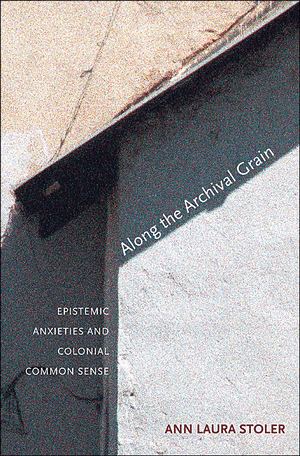
‘Along the Archival Grain’ by Ann Laura Stoler

Ann Laura Stoler Along the Archival Grain: Epistemic Anxieties and Colonial Common Sense, Princeton & Oxford, Princeton University Press, 2009, 278 p & notes.

It was only when I googled the title of this book that I realized that I’d been thinking of it under the wrong name: it was not, as I thought “against” the archival grain, but “along” the archival grain.  It’s an important difference, as the author points out.  While previous historians concentrated on compiling records from the archives in an accessible form- and this is particularly true of 19th century Australian historians like Frederick Watson and the Historical Records of Australia- now we are exhorted to read against the archive and to resist its hard-won accessibility.  But Stoler writes:

Some would argue that the grand narratives of colonialism have been amply and excessively told.  On this argument, students of colonialism often turn quickly and confidently to read “against the grain” of colonial conventions.  One fundamental premise of this book is a commitment to a less assured and perhaps more humble stance- to explore the grain with care and read along it first. (p. 50) …Reading along the archival grain draws our sensibilities to the archive’s granular rather than seamless texture, to the rough surface that mottles its hue and shapes its form.  Working along the grain is not to follow  a frictionless course but to enter a field of force and will to power, to attend to both the sound and sense therein and their rival and reciprocal energies.  It calls on us to understand how unintelligibilities are sustained and why empires remain so uneasily invested in them. (p. 53)

When I first returned to postgrad study in history after an absence of some thirty years, I was perplexed by other students’ references to “the archive”.  Where was “THE archive”, I wondered?  Was it some huge Borgesian labyrinth that had somehow escaped my notice, like Platform 9 3/4 in Harry Potter?  I’ve since realized that “the archive” is not so much a place, as a mental construct of the primary material that we draw on as historians.  Approaching “the archive-as-subject” worthy of scrutiny in its own right, rather than “the archive-as-source” that needs to be mined and extracted, reflects the “archival turn” captured  by Derrida’s book Archive Fever.  The link with Derrida and cultural theory might suggest to you that, in many ways, the writing in this book is rather dense and self-conscious, and it certainly is.  But it is also very careful, poetic writing.  The author weighs her words carefully, reveling in alliteration and paradox, and I found that I had to slow down and subvocalize while I was reading  to let the pleasure of the language wash over me.

The title hints at the theoretical emphasis of the book, but it makes no mention at all of the Dutch East Indies context in which it is applied.  I think that’s probably intentional.  Stoler has been writing about the Dutch Indies for decades- the earliest of her works that she cites was written in 1985- but this is a book borne of long years of immersion in a historical context and it moves far beyond that region.  It is a tribute to the accessibility of the book that I could read and enjoy it with minimal knowledge of the Dutch Indies, and come away feeling that I had learned a great deal (although I really would have appreciated a good map!)

The book itself is divided into three parts.  She starts with a two-chapter reflection on the archive itself and methodological and epistemological responses to it.  Part I which follows is headed “Colonial Archives and Their Affective States” where she examines three small, or even non-existent events in Dutch colonial historiography.  The first was a protest meeting held in 1848 against an edict that the upper echelons of the civil service would be restricted to young men who had been educated in the Netherlands; the second was a series of blueprints of state fantasies for solving the ‘problem’ of the Inlandesche Kindern, a shifting category that included Indies-born Europeans, and mixed bloods; and the third examined two commissions that were held into poverty amongst poor Europeans in the Dutch Indies.  Part II entitled “Watermarks in Colonial History” focusses on Frans Carl Valck, a lowly ranked assistent-resident whose unwelcome report on the murder of a plantation-owner’s family led to his hasty removal to another colony and eventual dismissal and subsequent complete disappearance from the official record. In this section she juxtaposes and interrogates two different archives- the official and the family- against each other.

Interestingly, she suggests in the prologue that

some readers may want to turn directly to these last two chapters that trace the biographies of empire, and may find it more compelling to read them first. (p. 51)

Ah- there’s a problem: when the author herself is not secure in the structure that she has,like all authors, eventually have to settle for.  Which to go for? Compelling reading or the structure that won out? I stayed with the chapters as laid down, but I wonder if it would have been a different book if I had read the last chapters first.  As it was, each chapter was quite self-contained, but it’s an interesting question.

I very much enjoyed this book.  It is a dense read, and at times I found the references to Derrida, Foucault, Rorty etc. rather overwhelming.  Check out the Amazon look-inside feature first, and you’ll quickly sense whether it’s a book that will appeal to you or appall you.  But it came at the right time for me, and it has stretched my thinking about my own work and even spurred me to WRITE a paragraph or two!

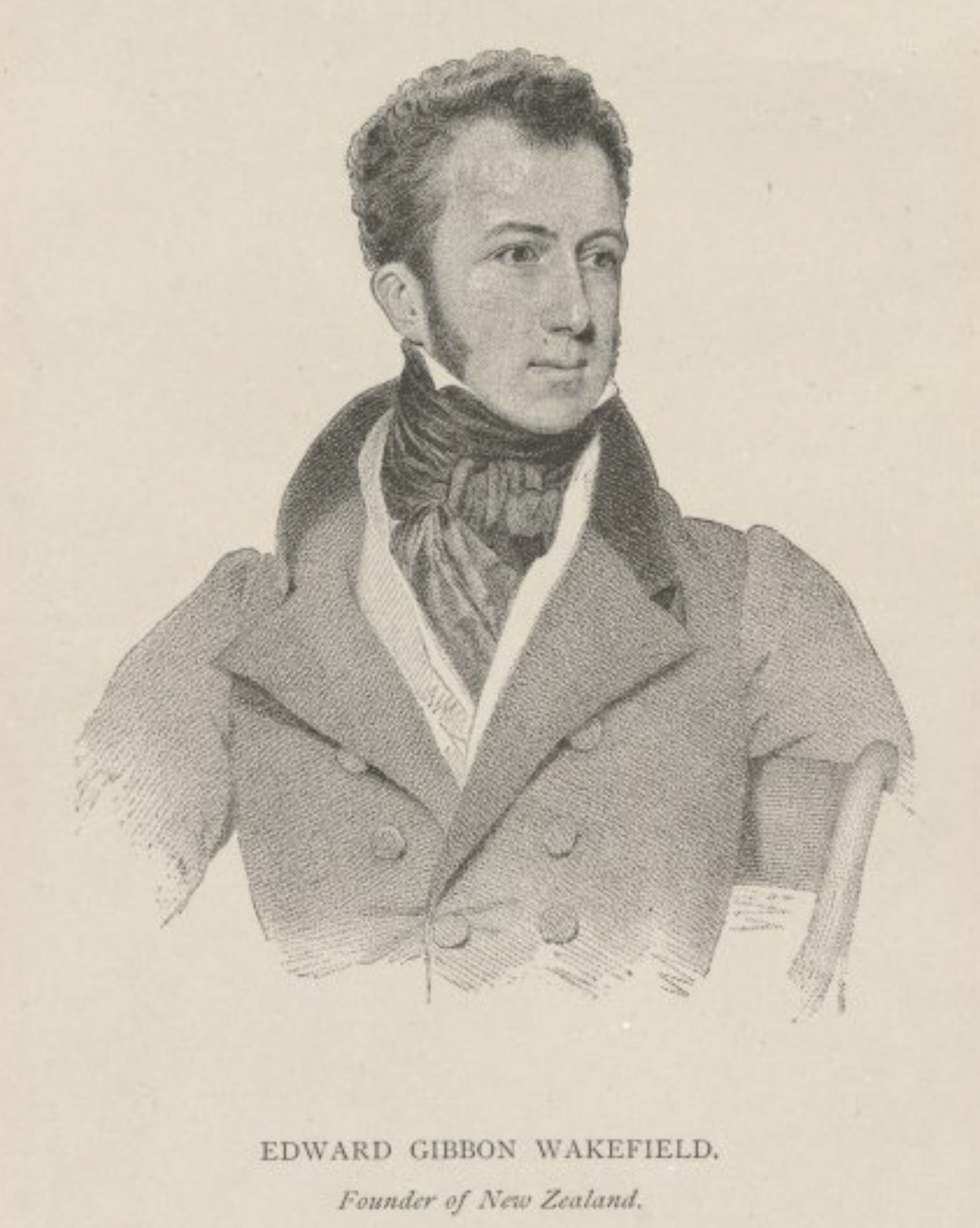
Edward Gibbon Wakefield and all the other Wakefields.

One of the joys of research- and yes, it IS still a joy- is that sometimes you are led into a direction that you didn’t anticipate.  I’m not talking about the siren-songs of distraction that keep your head turning from side to side, but a genuine surprise that makes you stop to re-evaluate what you’ve already found from a different perspective. The other day  I was speaking with a friend who is a librarian, who enjoys the act of finding and building order into material, and he said that he could not tolerate the anxiety that the next resource he turned over might upend the whole thing. I don’t see it that way (yet?): I am still open to surprise and fluidity.

As a result, regular readers might have detected that I am wandering recently into the swamps of colonial constitutional history- not a destination I would have expected or relished-  and it is here that I have stopped for a little while with Edward Gibbon Wakefield (EGW from hereon) with two books that I’ve just read.

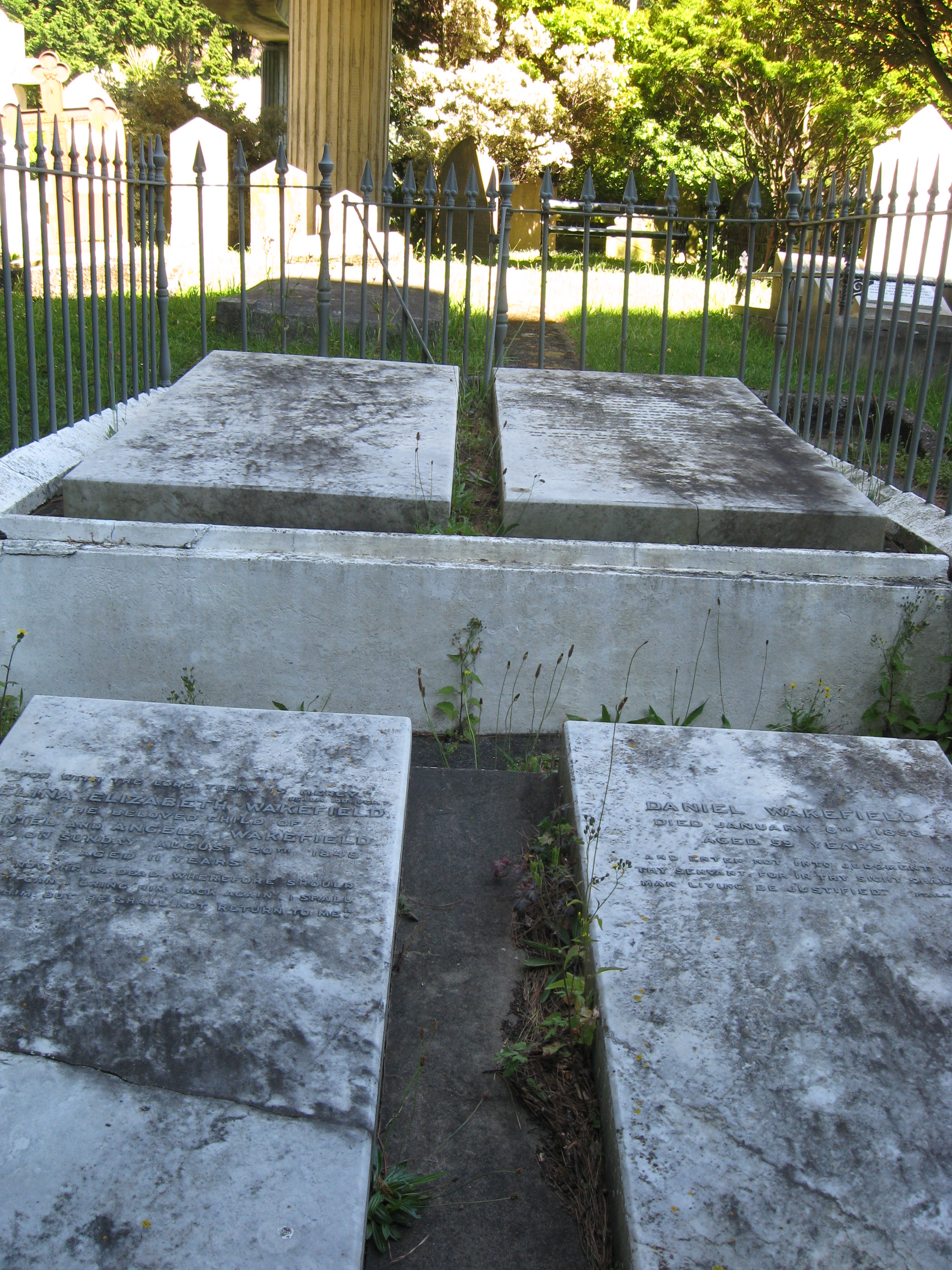
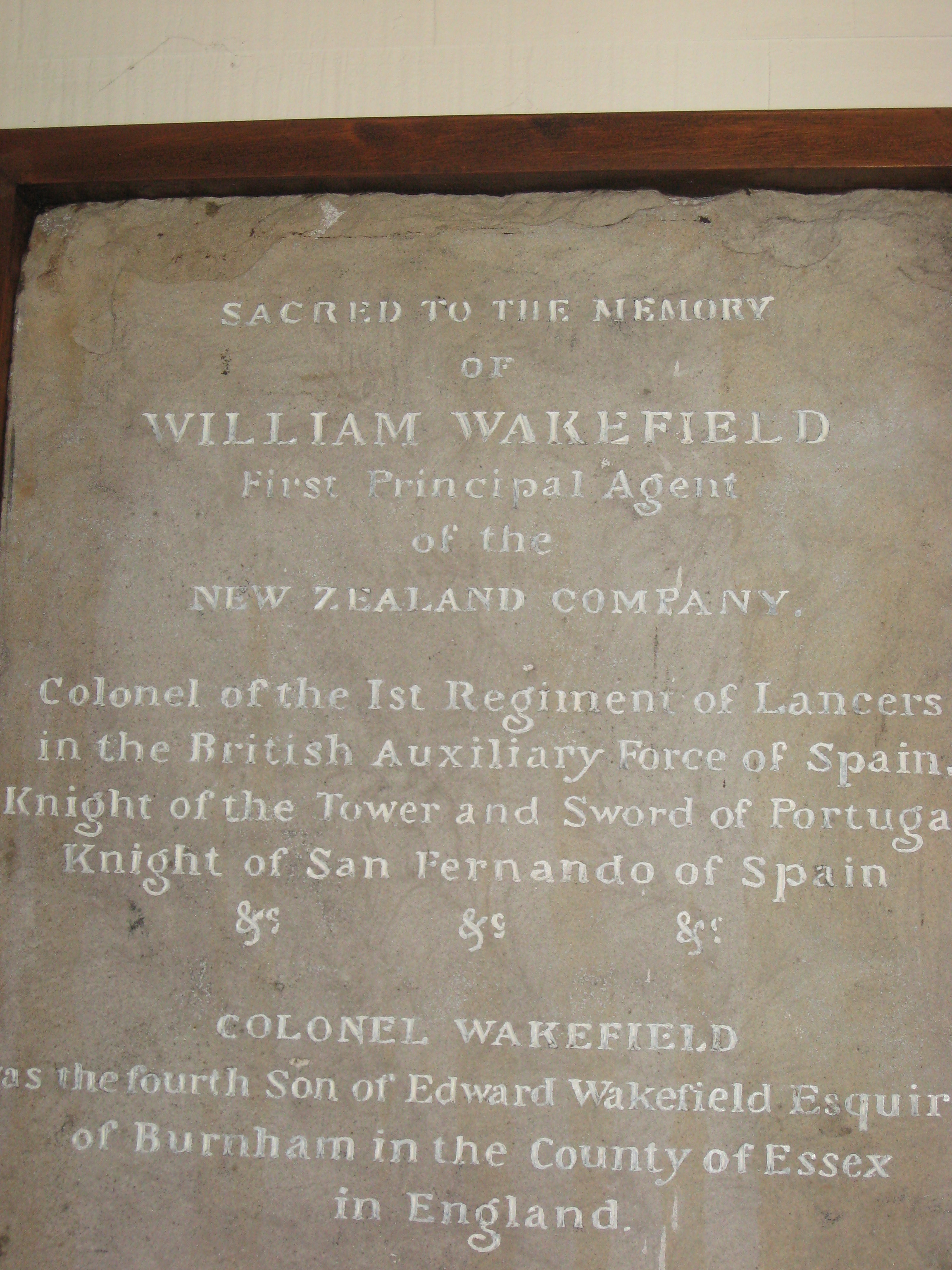
Edward Gibbon Wakefield (to the extent that he is known at all)  is most often associated in Australia for his connection with the settlement of  South Australia in 1836 under his theory of ‘systematic colonization’.  Put very briefly, this involved encouraging immigration to the colonies across all strata of British society, but ensuring that labourers remain available as a mobile labour force by selling land at a “sufficient price” that too high for them to purchase until they had been in the colony for a number of years. I was aware that there were Wakefieldian settlements in New Zealand, in Christchurch in particular, and so I was rather bemused by all the Wakefieldian graves in Wellington.

Wakefield family graves, Bolton St cemetery Wellington

Memorial plaque to Col. William Wakefield, Bolton St cemetery.

The works that I have read on New Zealand, namely Paul Moon’s Hobson  and Peter Adams’ Fatal Necessity portray the Wakefieldians as insistent self-interested lobbyists, who needed to be watched carefully. I was also aware that Wakefield had been imprisoned for kidnapping an heiress- indeed, it was during this period of incarceration that he wrote his Letter from Sydney (penned from his cell in Newgate!) which spelled out his systematic colonization theories.

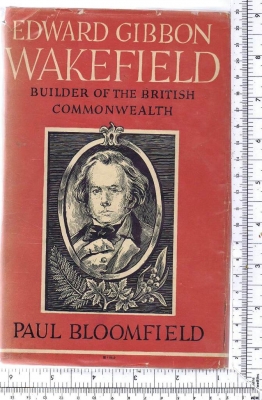
Paul Bloomfield: Edward Gibbon Wakefield: Builder of the British Commonwealth, London, Longmans, 1961, 378 p.

The first of the two books I have read recently is Paul Bloomfield’s Edward Gibbon Wakefield: Builder of the British Commonwealth. This book, written in 1961, has been described in a paper by Ged Martin as “the high-water mark of uncritical admiration of Wakefield and his work ” as the title might suggest. He starts his book with the abduction, told in racy and engaging prose- and why not, because it’s a good story.  It was, however, an episode that cruelled Wakefield’s career from that point on, as the scandal attached to it ensured that he could never put his name to any official policy that drew on his principles, and  he had to content himself with background lobbying and influence instead.  There are relatively few footnotes, although there is a bibliography and useful index, and there are frequent references to novels and literary characters, as if Wakefield himself sprang from fictional origins.  This is something that I find myself having to resist in my own work.  The 19th century novel is so pervasive and its representation in film and television provides such a ready visual backdrop that it’s easy to switch to a fictional shorthand.  As such, Bloomfield depicts the abduction as a youthful aberration that denied Wakefield the acclaim he deserved.  The emphasis is mainly on Wakefield’s lobbying in England amongst Parliamentarians, although it does follow him to Canada and New Zealand as well.

He made an interesting observation (especially in light of my recent posting and resultant comments about Christmas with the cousins)

One day someone will publish a study of the difference made in English sentiment by the change from a fifteen million population composed of large families to a fifty million population in which most parents have no more than two children.  We have only to look into the lives of the prolific Quaker cousinhoods, including the Wakefields, to see what an advantage their special community-sense was to them, what a source of strength it was to them to live in a clime of mutual aid. (p. 205)

The second book that I’ve read recently on Wakefield does just this.

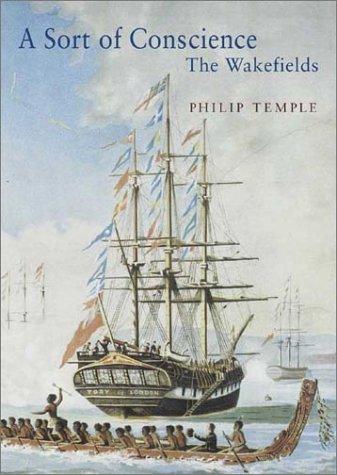
Philip Temple, A Sort of Conscience: The Wakefields, Auckland, Auckland University Press, 2002 (paperback edition 2003), 541 p.

A Sort of Conscience is more nuanced than the Bloomfield account, and it spreads its analysis further into the Wakefield family as a whole- the brothers and sisters, nieces and nephews, many (but not all) of whom ended up embroiled in one way or another with Wakefieldian enterprises.  Although fundamentally positive towards Wakefield, Temple acknowledges the flaws of personality amongst many of the Wakefield siblings and while not dismissing the abduction completely, argues that even more disquiet amongst influential people was prompted by  Wakefield’s involvement in a dubious legal case about his first wife’s lucrative will, some ten years prior to the abduction escapade.  Like Bloomfield, Temple shows that Wakefield was forced to operate in the background when his policies were implemented, but this seems fortuitous as he was overbearing, interfering and careless of details.

Temple draws heavily on family correspondence, which seems to be voluminous, especially once the family spread across the globe.  Many of the letters were addressed to Edward Gibbon Wakefield’s sister, Catherine, who married a minister and stayed behind in England- in fact, Temple quips at one stage that his book could easily have been called “Dear Catherine”.   You can detect in the family a bifurcation between the family members who moved from the Quaker to Evangelical affiliations, and those who became caught up in the entrepreneurialism and politicking of EGW as he sought to have his theory of systematic colonization embedded into colonial policy.  However, you’d have to say that the politicking won out, as more and more siblings and nephews travelled overseas to New Zealand in particular, where Wakefieldianism was implemented in its purest form.  EGW himself ended his days there, although in Wellington rather than Christchurch (the settlement which most closely approximated his theory. )

Wakefieldianism is often presented as a monolithic and inflexible policy, although frustratingly vague in important details like the price that should be charged for land to make sure that settlers remained labourers for a few years instead of moving straight on to being self-employed farmers.  I was interested, then, to see that Wakefield himself was more pragmatic and open to change than I expected once he actually moved to the colonies settled under variations of his theories.

This book is, like Bloomfield’s, ultimately sympathetic to Wakefield, although with more serious qualifications, as the ambivalence of the title suggests.  By following him more closely to the colonies, and by broadening the scope to the Wakefield family as a whole,  Temple captures well its mobility and the emotional tenor of lobbying and patronage in early 19th Britain and its colonies.  The book has been very well received, winning the Ernest Scott Prize in 2003, the Ian Wards prize for historical writing, and the Biography category of the 2003 Montana New Zealand Book Awards.

‘The Bean Patch’ by Shirley Painter

2002, 310 p

Spoiler alert. 

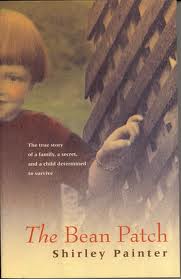
The author of this book was 83 years old when this book was published.  It was the product of a writing course undertaken at Holmesglen TAFE in her later years, and its narrative voice is just a little stilted.  But she is conscious that she is crafting a narrative, as well as relating it and so she makes the decision to withhold and complicate information so that the reader experiences the same partial and confused state that she did for so many years:

Because memories are often disjointed, I had two choices in dealing with them.

The first was to tidy them all up into a neat chronological order, with a beginning, a middle and an end.  But a lifetime of reading wonderful books has made me a highly critical reader, and I feared that choice might make for a very flat narrative.

The other choice was to present the reader with the same gaps, the same clues, and the same dilemmas as I had, so that the effect would be the same: What’s going on? Who in this dangerous and contradictory world can be trusted? Who are the goodies in white hats and who are the baddies in black hats?

Tough, reader! I have chosen for you the hard option   (p. vii)

This stylistic choice works well, and it is the promise that it will all come clear that draws the reader through the narrative.  There seems to be such a disconnect between what seems like an ordinary-enough life with husband, children, career, house, brothers and sisters, juxtaposed with a nightmare existence of extreme brutality.  This disconnect becomes even stronger in part 2 where, tangled in amongst the narrator’s story of breakdowns and therapy, details of the abuse are released in jerks and flashes- as indeed, such searing and painful memories must be.

But the reader is left with the final question of credibility, and here I find myself in uncomfortable territory.  I had let suggestions of the paranormal go through in Part I, but with the litany of abuse and crime in Parts II and the Epilogue  of the book, drawn out through extensive therapy, and encompassing recovered memories at and before birth, I found myself stepping back and asking “Do I really believe all this?” Although I feel almost disloyal to the narrator in distancing myself from these recovered memories,  I just cannot credit the bloodshed and crime without external corroboration.

I’m obviously not alone in my hesitation as this Sydney Morning Herald review shows.  The Bean Patch was awarded the Dobbie award in 2003 for a first book by an Australian woman writer.  The book is marketed and publicized as ‘memoir’.  Deborah Adelaide, one of the judges for the award is quoted in the review as saying that the truth or otherwise of parts of the memoir is immaterial:

Because we know it is based on her life, and the thrust of the story is true, to me the details don’t really matter

Ah, but it’s more than just details- it’s the whole premise of the book.  All memoirs are constructed narratives, and the reader takes on the author’s part in this construction as part of the memoir genre, aware that these choices are an inherent part of what is being offered.  There is always the question of fidelity and soundness of the architecture by which the author has chosen to structure the narrative, but if the whole intent of the endeavour is suspect???  I’m not sure.

Update 27 August 2014

The Age this morning published a beautifully crafted obituary for Shirley Painter (3-11-1918 – 29-07-2104) written with the assistance of family members.  It notes that:

Shirley was dux of both her primary school and MacRobertson Girls’ High School and earned an honours arts degree from Melbourne University.  She married and raised three children.

She taught Latin and English with diligence and care at St Catherine’s Secondary School for Many years. .. She was supported financially to go on to university by a bursary created by her teachers who recognized her extraordinary ability.  As a teacher she gave her tireless support and encouragement to young women seeking to find that spark in knowledge and thought that might enliven them.  She felt angry, in recent years, that free education had become a thing of the past….

Shirley was a lover of art, film and literature and a member of book clubs, film groups, bridge clubs, ACSA (Adult Survivors of Childhood Sexual Abuse) and Probus…

Shirley is survived by her three daughter, four grandchildren and the legacy of hope and love she embodied.


‘Shadowboxing’ by Tony Birch

2006, 178 p.

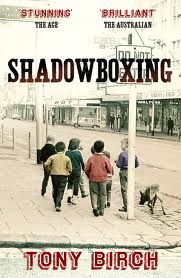
Shadowboxing is a collection of ten linked, largely autobiographical short stories set in Fitzroy during the 1960s.  As such, it ticks all my boxes: Melbourne-based, baby-boomer, cumulative stories.  They stand alone quite well, while building up into a longer-term, more nuanced work, and indeed apparently several had been published previously and were reworked for this collection.

The stories are written in the first person by the fictional Michael Byrne, looking back as a young father on his own childhood.  He was brought up in one of the sidestreets in Fitzroy where the houses were demolished as part of a slum-clearance program in the 1960s.  As such, it is a vanished landscape, and many of the attitudes of the people living there have vanished too.  Children had their own world, largely divorced from that of adults; people looked the other way from domestic violence in their own families and the families of their neighbours; there was an expectation that boys needed a good slap around the ears from their peers and older men to be a ‘real man’; mothers were alternately put onto a pedestal and abused.

The relationship that lies at the heart of these stories is that of Michael and his abusive, wounded, father.  Indeed, many of these stories are observations on masculinity and fatherhood and Birch resists the temptation to give easy, feel-good answers.  Redemption and forgiveness are here, but they are both fragile and deeply ambivalent.

The Melbourne depicted here, while in many ways more closely aligned with working-class slum suburbs across the world, is clearly recognizable to Melburnians.  I’m surprised that ‘The Return’ hasn’t been picked up in an anthology of  Australian Christmas stories because, while it describes a December Melbourne well known to Melbourne baby-boomers, it also captures the tenderness that can exist between an older brother and his little sister.

These are terrific stories, honing in on small details and events and yet able to take big strides across a family’s history-  indeed, across the history of a suburb and a generation- as well.

Update: You might be interested in the Radio National Hindsight program about the slum clearances in Fitzroy that Andrew mentions in his comment below.

My rating: 8.5/10

Read because: it was the December read for the Yahoo Groups Australian Literature group

Sourced from: La Trobe University Library

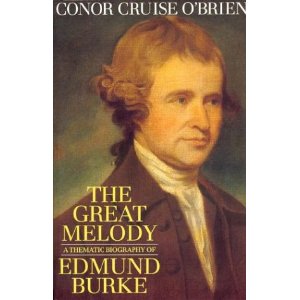
‘The Great Melody’ by Conor Cruise O’Brien

The Great Melody: A Thematic Biography and Commented Anthology of Edmund Burke

1992,  618 p

I’m not in the habit of reading 600 page tomes about eighteenth-century history in bed before sleep, and I must admit that it took me about six weeks to get through this book.  The eighteenth-century is a foreign country to me in a way that the nineteenth-century isn’t, and I have a towering pile of other books that I should be reading instead- so why was I reading this?

One reason was the subtitle “A Thematic Biography”.  I find it hard to clearly say what my own writing is- I can say what it isn’t  (not a straight biography; not a judicial biography) but somewhat harder to say what it is.  I wasn’t quite sure what a “thematic biography” is, or how it differs from any other biography.

The second reason was that I keep coming across quotations from Burke, or people who quote him.  Edmund Burke (1729?-1797) was a statesman, orator, writer and member of the House of Commons. He was known as a “Rockingham Whig” at a time when there were not so much political parties as constellations of politicians who would cluster around a particular individual- perhaps similar to the “Petro Georgiou Liberals”- not a party in its own right, but a political flavour exemplified by one person. I know that he came to be associated with conservatism and yet I’ve heard him described as a classic liberal as well.  On consulting my Penguin Dictionary of Quotations, I find him well represented (more than George Bernard Shaw and Macaulay; nowhere near Milton, Pope and Shakespeare!) although it seems that he didn’t say that “All that is necessary for the triumph of evil is that good men do nothing” even though it is often attributed to him.  What he did say was

When bad men combine, the good must associate;else they will fall, one by one, an unpitied sacrifice in a contemptible struggle. (Thoughts on the Cause of the Present Discontents).

  I’m aware of ‘Burke’s Law’ that could be used to remove colonial officials and -importantly for my work- judges from their colonial posts.  I knew that Burke was a great orator, and that he had been bitterly critical of the French Revolution right from the start….and that’s about it.

O’Brien identifies this book as a thematic biography because it is not so much about Burke as a man – certainly his intimate family life, his marriage, his friendships are almost completely absent- as about the four main political issues on which he became known as spokesman.  O’Brien picks up on two stanzas of a W. B. Yeats poem ‘The Seven Sages’

American colonies, Ireland, France and India

Harried, and Burke’s great melody against it

and argues that ‘it’ is ‘ abuse of power’. Burke saw, and deplored, abuse of power exemplified through Britain’s declaration of war on the American colonies, the Catholic question in Ireland, the widespread admiration of the early days at least of the French Revolution, and in the failure in Parliament of his attempt to impeach Warren Hastings in India.  It is a thematic biography in that the chapters circle between Ireland, America, India and France in a roughly chronological fashion, darting back in several places to revisit the idea of the ‘great melody’. The book assumes familiarity with these issues, and the minutiae of British Parliamentary Politics  and I struggled with the Indian section in particular.  I do now, however, know what Barry Jones was getting at with the Governor General of Bengal question on Pick-a-Box

O’Brien suggests that, despite identifying himself as a member of the Anglican communion of the Church of Ireland, Burke actually followed his mother’s Catholicism, and although claiming a Quaker school as the site of  his first education, he may have instead attending a Catholic hedge-school.  Burke’s sublimated and unacknowledged Catholicism, he argues, was the lens through which he decided his stance of the issues of American, French and Indian political events, even though he never clearly identified it as such.

The second theme that runs through this book is O’Brien’s own dispute with historians, particularly those influenced by Louis Namier who have questioned Burke’s significance and highlighted the inconsistencies in his approach.  He certainly doesn’t hold back against these “pullulating insects of trivialising calumny” (p. 306) and he does so far too often.  At times he draws a very fine line.  He criticizes, for example, Lucy Sutherland and others of the Namier school for conflating  “documentary gaps” and “silence”-

But the two are not the same; not by any means.  A documentary gap often reflects a period of particularly intense communication. The people concerned are not in correspondence, because they are in daily conversation…What an eerie place, …is eighteenth century London, once it has undergone Namierisation! This is a world in which no one ever talks to anyone else.  All communication is in writing.  The spaces between the bouts of penmanship are filled with silence. Anything that doesn’t get written down doesn’t happen. (p.333)

Yet O’Brien himself makes much of Burke’s silences, especially over Ireland, both as a revealing political stance and as a sign of Burke’s inner psychological tension.  I’m a bit uncomfortable about extrapolating from the utterances and silences of the public record in Burke’s own writings and in his Parliamentary speeches-  ‘performances’ for a specific political and strategic purpose- and psychological explanations of the inner man.  However, in trying to capture the inner man O’Brien is constrained by his material, given that Burke himself destroyed all personal papers, and this work is rooted deeply in the public arena.

The other part of the subheading is “commented anthology”, and much of the book quotes directly and at length from Burke’s own words.  There was a great deal of this, and while bristling with lacerating observations and wit in places, there was also a lot of high-flown rhetoric that flew right past me propped up in bed with my eyelids drooping.  Alas, I found nothing about ‘Burke’s Law’ but I do think that I have a more nuanced perception of Burke and his influence both on parliamentarians at the time and later.

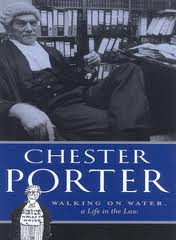
‘Walking on Water: A Life in the Law’ by Chester Porter

2003, 309 p.

One of the high points of my CAE bookgroup meetings (a.k.a. The Ladies Who Say Ooooh)  is when the book for the upcoming month is fished up out of the plastic box and brandished with a flourish. I’ve found recently that one advantage of actually doing some work on my thesis is that I am no longer likely to look at the next month’s offering and think “Damn, I’ve already read it!”. When our book for our final meeting was revealed last month, I found myself thinking “Good grief, who on earth chose this?” because it was Chester Porter’s memoir Walking on Water: A Life in the Law.

At first I thought that I’d never heard of the man, but I soon realized that I had without realizing it.  Most famously, he worked as Counsel assisting the Royal Commission into the convictions of  Lindy and Michael Chamberlain case, and he successfully defended Det. Sergeant Roger Rogerson on a bribery charge. He was known as “the smiling funnel web” and the title of the book comes from a quip directed towards him that “Chester Porter Walks on Water”.

Even though I encountered this book as part of my “off-duty” reading, I was very happy to read it in relation to Judge Willis.  The little gremlin of self-doubt that lives in my head regularly derides my ability to write about a man of the law (albeit a 19th century colonial man of the law) when I have no experience of that milieu at all.  The 19th century judicial culture is something that I am deducing for myself, largely from negative evidence of Willis’ breaches of judicial etiquette, rather than from any deliberate exposition of it by an insider.   So what did this book, written by a late twentieth century Australian barrister show me?

First, that even though a man might be a highly educated, brilliant barrister, he is not necessarily a successful memoirist.  Although Porter clearly expresses a number of opinions about the law, they are hedged with qualifications and nimble logical footwork. The book reads like a series of mini-essays which, from a reader’s perspective, made it easy to abandon a chapter or two if one’s attention was wandering.  There was no discernible overarching structure or motif to tie the book together.  In several places it was quite repetitious and the prose was doggedly careful. His daughter is the late poet Dorothy Porter, but whatever else she gained from her father- and I am sure that there is much- there is little poetry here.

Second, the book shares with military memoirs that felt need on the writer’s part to doff one’s hat (wig?) to learned colleagues, by praising them, rather formulaically, in passing.  Hence, many of his associates are named with the bracketed annotation (now SC; now QC, now Supreme Court Judge).  Given this emphasis on naming his colleagues, it seemed strange that there was no index.

I found myself wondering about the audience for the book. The frequent greetings-in-print that he gives to his colleagues suggests that he sees them as one readership, but the careful explanations and observations about the law are aimed at a more general lay readership.  The author comes over as a somewhat stilted, and rather old-fashionably decent man, able to look back at his life and acknowledge mistakes, and reticent about his family and private life.

Nonetheless, a book can work on one level while being perhaps less successful on another.  Despite my qualms about the structuring and language of the book, I found myself listening carefully to the radio report of evidence given recently by Ian Macdonald  at the recent Independent Commission Against Corruption hearing. It was another cross-examiner at work because Chester Porter retired eleven years ago, but as I listened I found myself thinking about the construction of a chain of questions and responses as an intellectual and rhetorical exercise. And as I read about the successful appeal of Jeffrey Gilham a few days ago, Porter’s warnings about expert testimony, the demeanor of witnesses and the shortcomings of police evidence loomed large in my mind.

My rating: 6/10

Read because: it was a face-to-face bookgroup choice

Copy sourced from: Council of Adult Education Book Groups

‘James Stephen and the British Colonial System 1813-1847’ by Paul Knaplund

If ‘Yes Minister’ were true (and who’s to say it isn’t?) ‘The Policies of Rt. Honorable James Hacker MP’ might more correctly be described as ‘The Policies of Sir Humphrey Applebee’.  Likewise, when considering the colonial policies of Peel and Russell, as I did recently,there is a Sir Humphrey-like character at work there too: Sir James Stephen, the Permanent Undersecretary of State for War and the Colonies.  He acted as Permanent Undersecretary between 1836 and 1847, but his involvement with the Colonial Office extended from 1813 when he commenced work as legal counsel there.  As a result, he served under, by my reckoning, thirteen different Secretaries of State, several of whom had multiple rides on the ministerial merry-go-round.

The Stephen family is a prominent English family, many of whom worked as colonial judges and legal officers, and hence moved in the same orbit as Judge Willis.  Another branch of the family extended into ‘arts and letters’ through Sir Leslie Stephen (of the Dictionary of National Biography fame) and his daughter Virginia Woolf.  The family ethos was strongly Evangelical, with links to the Clapham Sect and the anti-slavery movement.

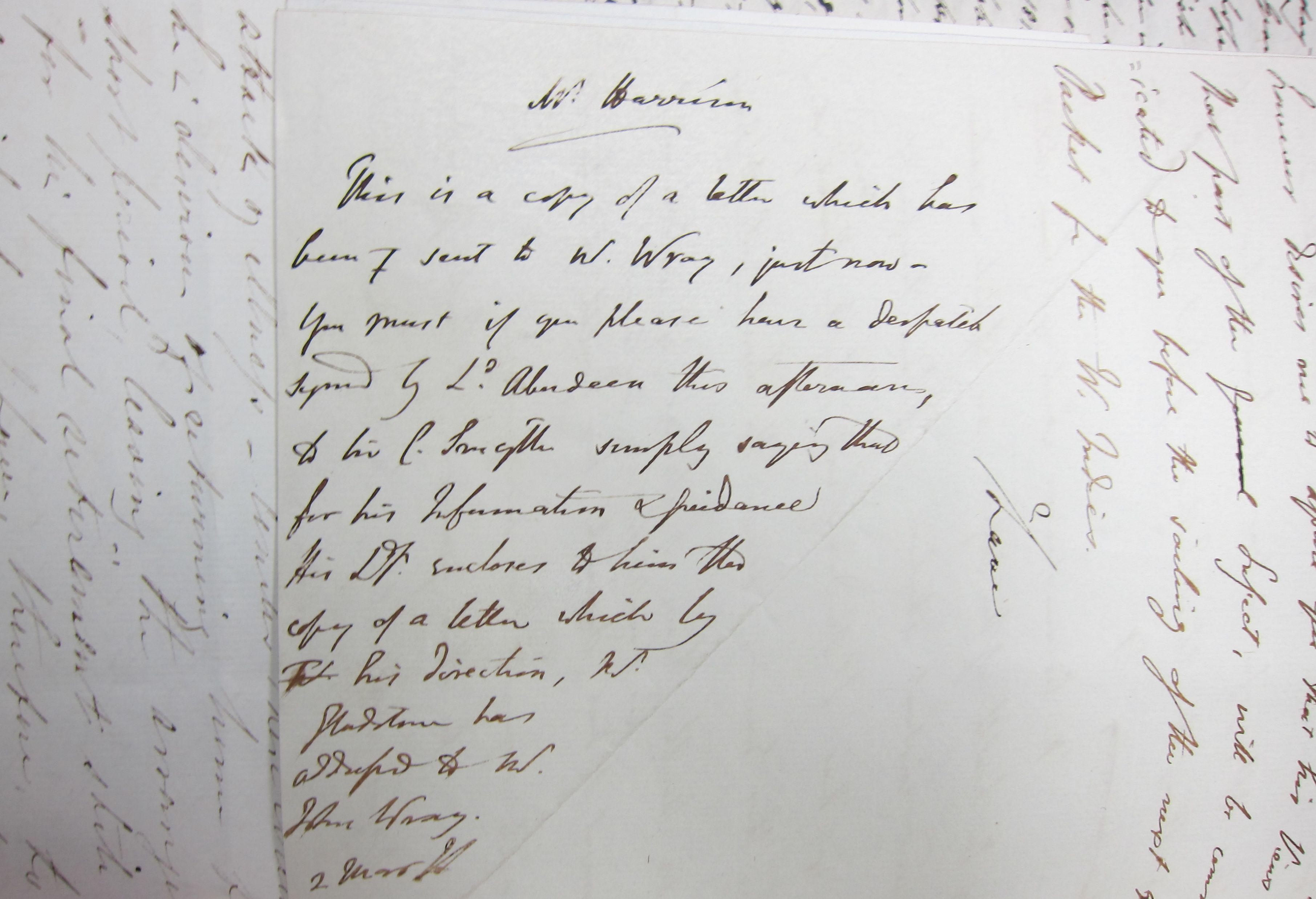
When you’re looking at the Colonial Office records, there are little glimpses of Sir James Stephen in many places.  As part of his drive to introduce more efficiency into the Colonial Office, he introduced a stamp system by which a document would move up and down the bureaucratic ladder, from civil servant to civil servant, up to the Secretary of State and back down again, with each initialling and dating in the designated spot on the document as it made its progress through the Colonial Office.

Where it was felt that a comment should be made, the edge of the document was turned over to make a dog-ear, and the civil servant or politician would make an annotation written at right angles to the rest of the document,  asking a question, or making a comment to the next person up the chain.  If the issue raised was a curly one, it might bounce back and forth between two civil servants with comment and counter-comment until it moved further up or down the bureaucratic ladder.

On occasions, James Stephen would write a longer memorandum that would be attached to the document in question.  In the archives today, these memoranda stay with the original correspondence, each carefully hived off into the files for the each specific colony.   This colony-specific focus tends to obscure the fact that, in any given week, the Colonial Office was dealing with the small dramas and mind-numbing minutiae of British colonies across the globe.  Yet there were commonalities among the types of issues that crossed the CO desks, and the response to them was underpinned by a broader, consistent theory of empire, largely embodied in Sir James Stephen’s bureaucratic contribution.

This book takes as a whole James Stephen’s attitudes and advice on colonial policy across the portfolio and over the thirty-odd years that he was at the Colonial Office.  There is, of course, contradiction and change in his opinions as the empire itself changed: I’m sure that Stephen would have agreed with the aphorism attributed to John Maynard Keynes (“When the facts change, I change my mind. What do you do, sir?”). Nonetheless, there are  bedrock beliefs in James Stephen’s annotations and memoranda that Knaplund draws out in this book.

One of these was his suspicion of colonial adventurers on the lookout for quick profits.  In particular, he was wary of the Wakefieldians who returned his distrust with the sobriquets ‘Mr Mother Country’ and ‘Mr Over Secretary Stephen’ and very public ridicule.  He was insistent on safeguarding humanitarian principles in relation to slavery, transportation and prison policy, and indigenous policy.  He was particularly distrustful of the West Indian plantation owners and their influence on the local legislature and judicial system.

His mode of operation was to always support the governor on the ground in the colony rather than laying down prescriptive policy from the Colonial Office.  As long as no-one other than the colonists were being hurt by what he perceived as bad policy, he was happy to let it stand.  The colonists themselves would realize their own error, he reasoned, and the Colonial Office would be in greater odour for intervening rather than letting the colonies reap what they sowed legislatively.

He was also supportive of self-government, probably moreso than his political masters.  He viewed self-government as an inevitable developmental process, arguing that the colonial children would soon grow into adolescence and demand a more adult relationship with the mother country.

He was, apparently, a painfully shy man, describing himself as “virtually without skin” and rather ascetic by nature, eschewing cigars after having just one and enjoying it too much.  He was a prodigiously hard worker and the breadth of his knowledge of events and personalities across the empire is mightily impressive.  He was in many ways the corporate memory of the Colonial Office, even though the Secretaries of State that he served under sometimes disregarded or over-ruled his advice.  Nonetheless, his is another voice in the chorus of Colonial Office policy, and one that cannot be overlooked.