Category Archives: Book reviews

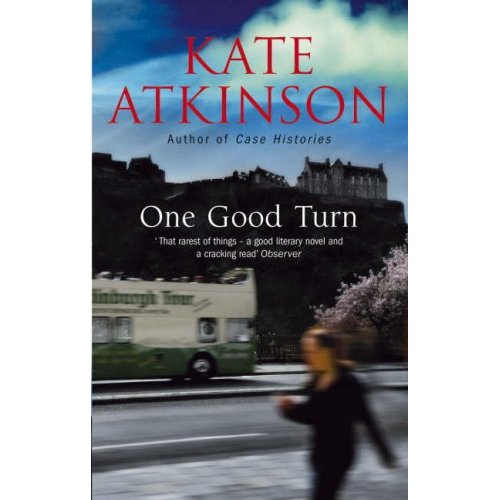
‘One Good Turn’ by Kate Atkinson

2006, 527 p

I don’t even LIKE crime novels as a rule, but I’ll make an exception for those written by Kate Atkinson.  This book follows on from her earlier novel, Case Histories by bringing to us again  detective Jackson Brodie, but it’s not at all necessary to have read the first book.  In the earlier book, there are three crimes that seem unrelated but become increasingly interwoven. This book is similar to its predecessor in that Jackson is searching desperately for “a tangible connection, not just a coincidence”, but it is more straightforward in that there is just the one crime initially that involves, in different ways, the many characters.

The book is set during the Edinburgh Festival, and the author turns a wry eye on the literary events and art-house performances that are part and parcel of such productions.  The crime occurs in the opening pages- always a good start, and in Rashamon-fashion the book moves from character to character in the lead up and fall0ut from the crime.  Her characters are full-bodied, and there’s enough romance to pep things up (and enough to induce deep groans in Mr R.Judge, should he ever read it, because he doesn’t like all that “love-stuff” mixed in with his crime stories).  Atkinson doesn’t take any of this too seriously, and there’s a cheeky humour that runs through the book.

The plot itself, while convoluted as crime novels tend to be, is easy enough to discern in retrospect, which is just the way I like it. Many’s the time that I’ve watched the credits roll on yet another ABC Friday night crime show, and I’ve twisted myself up on the couch and said “But I don’t get it…who?  why?…” and I can barely piece the plot together coherently enough to even formulate a question.

But this is a thouroughly satisfying crime novel, with a laugh or two along the way, several twists in the plot, and I can even tell you what happened!

My rating: 9/10 (I seem to be particularly generous at the moment. Perhaps I need to read a dud or two to get myself back into balance)

Sourced from: The Council of Adult Education

Read because: It is our March book in my face-to-face bookgroup

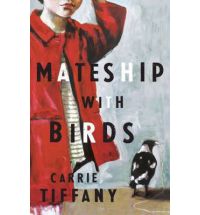
‘Mateship with Birds’ by Carrie Tiffany

2012, 208 p.

This is a quirky, sly book that had me closing it with regret, with a smile on my lips.  It is set in Cohuna in the 1950s and is redolent of long grass, cow-pats, and dusty roads, set to a soundtrack of magpies and kookaburras, country dances and a slow, masculine drawl.

Harry is a shy, lonely dairy farmer who lives next door to Betty, a single mother, who works in the local aged-care home and lives with her adolescent son, Michael and young  daughter Little Hazel.  They are neighbours: they turn to each other in need; they keep an eye out for each other, and as Michael grows older, Harry decides, in the absence of a father,  to teach him about the opposite sex.

But the boundaries between sex, breeding, fertility, physicality and nature are fluid in this strangely sensual context.  The book, too, is a scrapbook of conversations and episodes, birdwatching observations about a kookaburra family, reflections on the physicality of milking cows and washing withered old men, and a chronicle of illness and injuries.  It is a book of the rhythms of country life, and it is both hard and pragmatic and yet watchful and sensitive.

The author is not, as you might suspect, a dinky-die, true-blue Aussie country girl. Instead, she migrated from Yorkshire with her family as a child, grew up in Perth, and works as an agricultural journalist.  The amount of research that must have gone into this book- set in the decade before she was born in another hemisphere- is prodigious, and yet so lightly worn.  As with her debut book Everyman’s Rules for Scientific Living, it is a deceptively simple work with good people and big themes.  I hope that it gets the recognition it deserves.

My rating: 9/10

Sourced from: Yarra Plenty Regional Library

Read because: it’s my fourth book in the Australian Women Writers Challenge

‘Alexander Macleay: from Scotland to Sydney’ by Derelie Cherry

2012, 415 p & notes  (Review copy)

What a beautiful book! was my initial response on opening this book.  Like Alice in Wonderland’s sister, I am accustomed to my colonial biographies arriving without pictures or conversations, and if by chance there are pictures, it is usually a set of black-and-white pictures inserted in two or three places in the text.  But this book is a well-bound hardback, complete with ribbon place-keeper, with a coloured and gold-embossed dusk-jacket that envelopes an even more beautiful cover underneath.  It shows Conrad Marten’s painting of the landscape surrounding Elizabeth Bay House, built by Alexander Macleay, and possibly the best known association that many of us have with Macleay today.  The fly-leaves of the book are patterned with thistles, reflecting Macleay’s Scottish origins, and the book is replete with vividly coloured photographs.  The book has many of those features that publishers seem to begrudge these days: footnotes AND a bibliography, index and timeline.

I’m not accustomed to such luxury in my history books, although two other recent beautiful publications in Australian History spring to mind: Grace Karsken’s The Colony and Bain Attwood’s Possession.  But both these books, written by noted and established historians, dealt with the founding of the two largest cities in Australia, and while being strongly academic texts, could be expected to- and did- attract a broad readership and both garnered significant history awards.  Who, I wonder, is the audience for this beautiful book?

Alexander Macleay (1767-1848) was born in Scotland and did not arrive in Australia until 1826 at the age of 59 to take up the position of Colonial Secretary, alongside the new governor Ralph Darling.  By this time, he had a large family (17 children!- although only 10 survived to adulthood) and he was accompanied to Sydney by his wife and six daughters and an extensive private collection of insects and objects from all over the world. As Secretary of the Linnean Society in London, he had contacts with scientific boards and their gentleman collectors across Europe, and his interest in botany and natural history continued in NSW where he not only served as patron of the fledgling societies established amongst the colonial gentry here (including the Museum and the Botanic Gardens), but also maintained his networks with the natural history community back home.  His daughters married into the colonial elite of Sydney society, and his home Elizabeth Bay House was noted for its extensive and exotic gardens, through which he introduced many plants into Australia, including the wisteria.  His close association with Governor Darling meant that he had to share the increasing acrimony directed at Darling, and his career ended ambiguously and unhappily under Governor Bourke, with whom he never established the same rapport. However, with the granting of a limited degree of self-government in 1842, Macleay offered himself for election to the Legislative Council where he was voted Speaker, a position in which it was acknowledged, even by his political opponents, that he served well.  But despite (and perhaps because of) the rapid accumulation of land,  he fell victim to the widespread depression of the 1840s, and was forced to move from his Elizabeth Bay House, estranged from his eldest son William who had taken over his finances.  His scientific collection was eventually transferred to the Macleay Museum at the University of Sydney, where it still rests.

So which of these aspects of Alexander Macleay- civil servant,father, naturalist and collector, owner of one of Sydney’s grandest colonial homes, patron and politician- might attract readers to this book?  A well-rounded biography would incorporate all of them, of course, but an insightful, scholarly biography would do more than  enumerate achievements: it would also mount an argument about the individual that is woven into a broader approach to a society, a movement, a time.

The approach that a book is adopting is usually foreshadowed and shaped in the introduction, which in this book takes the form of a literature review, emphasizing that this is the first comprehensive biography of Alexander Macleay and questioning in particular the depictions of Macleay in the works of Stephen Roberts and Manning Clark.  The author takes up where an earlier researcher into the Macleay family, Annabel Swainston,  left off, citing frequently from Swainston’s papers which are now placed in the Macleay Museum.  Reading as an historian then, I found myself wishing that she would move back from her subject, and integrate her observations into a broader scholarly context.  Macleay is a prime example of the collector-networker described in the work of Zoe Laidlaw and Lambert and Lester, and yet this whole approach to empire is largely invisible.   Macleay’s prominence as a conservative is noted, but not taken any further.  A large portion of the book is devoted to Macleay’s gardening and horticultural significance and yet the work of Katie Holmes and others about the meaning of the colonial garden is nowhere to be found.  The blurb from Professor Stephen Garton from the University of Sydney describes her work as a “path breaking piece of forensic research”, and “forensic” is exactly the right word to describe this very close-up, detailed analysis.  However, I found myself craving a bit of distance, and a broader sweep that pointed out the ways in which Macleay was acting as a man of his time and place, and where, if anywhere, he was distinctive.  Having said that, though, her description of the Colonial Secretary’s office was illuminating, bringing to life the men behind the different scripts that you note in reading the primary sources, and her analysis of the financial entanglement that so damaged his reputation was insightful.

What, then, of Macleay’s activities as collector and horticulturalist?  In these sections, the fine-grained approach serves her well, resonant of the painstaking minutiae of the collecting and classifying mindset.  At times, however, the detail and connections seem rather laboured and indulgent: a glorious photograph of a dahlia from her garden that Alexander “would have been among the first to grow” and sweetly-scented stocks that the Macleays “certainly would have included” in their garden, perhaps moves the book towards the ‘significant garden’  market.   Given the prominence of Elizabeth Bay House as one of the foremost homes overseen by the Historic Houses Trust in NSW, I found it strange that the house itself played a minor part in the book if it is directed towards the gift-book buying public who may have visited the house, or those who may appreciate the importance of Elizabeth Bay House amongst our colonial architectural heritage.

And so, I find myself somewhat confused over how to appraise this book. It is a close-grained biography that could have benefited from more distance and a broader sweep.  It is also a particularly beautiful publication, that reflects no doubt the author’s experience in publishing over many years, and her own love of gardening and her family connection with Paradise Gardens and Nursery in Kulnura, west of Gosford.  The combination of the two is rather puzzling- appreciated, but puzzling nonethess.

This book was provided as a review copy by Paradise Publishers, Kulnura.  Available at www.alexandermacleay.com

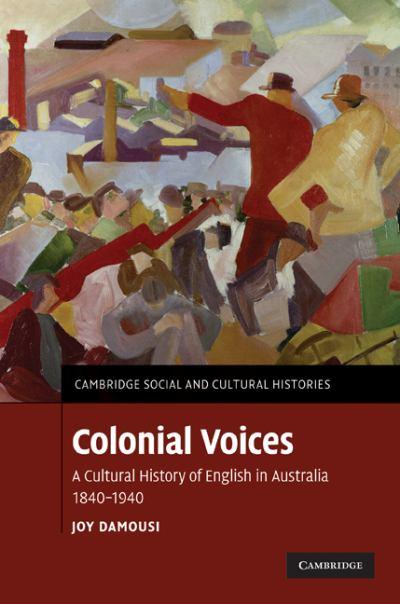
‘Colonial Voices’ by Joy Damousi

Joy Damousi, Colonial Voices: A Cultural History of English in Australia 1840-1940, Cambridge University Press, 2010, 295 p.& bibliography

Historians have always privileged the written over the spoken, and the visual over the aural.  It’s no wonder: few of us consciously document the sounds around us, and it is only occasionally that we become aware of their passing. Think, for example, of the flash of recognition that you probably experienced the first time you heard that current mobile phone ring tone that replicates the echoing, mechanical bell of an old fashioned, black, dial-up telephone.  I think of the little ‘tune’ that modems used to play when you were connecting to the Internet: it was a sound unheard twenty years ago, and probably will no longer be heard twenty years hence.  Then there are familiar childhood sounds that time and development have erased: the ‘chuck-chuck’ of a rainbow sprinkler on the front lawn, the sound of the milkman’s horse.

Joy Damousi’s book Colonial Voices focusses on the Australian voice in particular.  As I trawl though my 1840s Port Phillip documents,  I’ve found myself wondering about the actual, physical voices that would have accompanied the words that I am reading.  How, for example, did speakers get themselves heard at these rowdy meetings in support of, or against, Judge Willis?  In a new community supplemented  constantly with waves of new immigrants especially from Britain, and the stream of colonists from New South Wales and Tasmania (some of whom were native born), did people lose their accents within a generation as seems to occur today- or is that only with NESB people?  Did the Australian-born child of a Scots family sound different to the Australian-born child of an English family?

Colonial voices were not superimposed into a silence: Aboriginal voices were raised, and then largely suppressed.  The first chapter of this broadly chronological book investigates the role of missionaries and educators in teaching English to Aboriginal children in an attempt at first to make them  English, become English, and also as a way of drawing a dichotomy between savagery and civilization.  The second chapter examines the emergence of public speech in Australia during the 1840s in the male-dominated political and public arena- and here of course, I read closely, aware that the controversy over Judge Willis was carried out in this milieu.

Chapters 3, 4, 5 and 6 examined the phenomenon of elocution, which was promulgated through books, classes, speech nights, eisteddfods and  paid performances.  At this point of the book, I felt as if I was stuck in a bit of whirlpool.  Many of the examples quoted seemed rather repetitious, and although she distinguished between expectations exhorted from overseas and those that emerged from within Australia itself, their content seemed pretty much the same.  While at pains to emphasize the celebrated status of various practitioners, their names mean nothing today and although this section of the book covered about 60 years, there did not seem to be much difference from one decade to another.

The narrative picked up, however, from Chapter 7 onwards. Vita Goldstein and Alfred Deakin were used as two examplars of public political speech, at a time when political speech was a way of agitating for political change, and when the relationship changed between speaker and audience from one of recipient to participant.  During WWI, in Chapter 8, there was a move towards a less formalized form of public speech, and elocution was now seen more as a distancing mechanism.  Mourning and commemoration ceremonies, soldiers’ slang, and school-based patriotism encouraged a distinctive Australian eloquence.  She picks up on the debate about the “Australian sound” in Chapter 9 that was carried out in literacy circles and etiquette manuals.

This debate was heightened by the introduction of radio, discussed in Chapter 10, both as a form of connection to the wider British Empire, but also as a way of creating and promulgating an Australian Sound.  The introduction of sound to film and the dominance of American film in particular, is discussed in Chapter 11, leading us up to the 1940 cut-off for the book.

This book took me into byways and places that I did not expect. I liked the emphasis on gender that ran throughout the book, especially in the chapters on political speech.  However, I was puzzled by the relatively slight treatment given to the bush nationalism evoked by Lawson and Banjo Patterson which, even today, are the backbone of a particular form of oral performance.  I think of the School Readers,  produced between 1927-30 and still in use even within my own educational history during the 1960s,  and how poetry in those books formed the basis of  oral performance in schools.  I was also disconcerted by the prevalence of small proof-reading errors, especially in a book published by Cambridge University Press.  I counted six which seemed to cross some sort of threshold for me, making me hyper-critical of editorial foibles.  It was all rather paradoxical (or was it some form of reflexivity?) , given that much of the book was devoted to concepts of ‘correctness’.

However, a marker of whether a book is working on you, might be the way that you notice things with new eyes, or in this case, ears.  I was sitting reading the book, conscious that a workman was talking loudly on his mobile phone in the driveway of the street across the road.  Likewise, I could hear a construction worker on a block in the next street on his phone.  I could not catch every word, but had I concentrated I could have followed the one-sided conversation.  I set Mr Judge, who is fond of such puzzles, to work out how many people would be able to hear a speaker in a crowd without amplification.  He estimated that to speak to a crowd of 20,000 people, you would have to be able to project your voice to a distance of 60 metres.  Take it from me, the chippies and builders of Melbourne can do this with bells on.

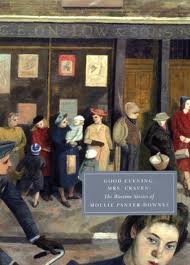
‘Good Evening Mrs Craven’ by Mollie Panter-Downes

203 p. 1999

I admit it: I was attracted to this book by its cover ( a topic discussed in Sue’s Whispering Gums blog recently). I picked it up, noted that it was a collection of short stories written during WW2, and conscious that I should really be doing some ‘proper’ reading, put it back on the shelf.  “Damn it! There’s plenty of time for the thesis!” I thought the next day and promptly borrowed it.  There’s not really plenty of time, but I’m glad that I did borrow it after all.

Mollie Panter-Downes was the London correspondent for the New Yorker. Between 1939 and 1945 she wrote a fortnightly “Letter from London” – 153 of them at 1500 words a week, as well as 18 long articles and twenty-one short stories. She also wrote five novels, all of which she disowned except her final novel One Fine Day, which was republished in 1985.

This is a collection of the wartime short stories published in the New Yorker, and they reflect her journalistic bent: who, what, when and where; with an optional why and how.  To meet the constraints of the magazine short-story, they are of a fairly uniform short length (about 9 or 10 pages), and I often found myself wishing that they were longer.

Think O.Henry meets Midsomer Murders.  Nearly all of these stories are set among the rural upper middle class, and mostly from womens’ perspectives.  Her characters are not evacuees, but the rural host families whose houses and larders are stretched by slum families, stiffly uncomfortable in strange settings, or by fey elderly and wealthy spinsters, who drift from one distant relative to another.  Many of the women are alone. Some are in adulterous relationships, where the pain of separation is just as acute but publicly unacknowledged.  They are the women of the Ladies Sewing Circle; they are often hungry in a most lady-like fashion;  some cling tightly to the past while others are liberated by the social changes that war has brought.

And so we have one story about the painfully slow last days, hours, minutes counting down before deployment; or another story about a mistress distraught that her lover may be killed and that no-one would know about her in order to convey the news.  They are slices of life, quickly and deftly sketched, sharp and affecting.  In a word: I loved them.  Because the milieu remained the same, it was easy to finish one story and turn to the next, and one or two characters appeared in more than one story.  They are arranged chronologically, as the war moves through different phases, and the collection is bookended by her Letter from London that marked the beginning and the end of the war.

Perhaps I’m turning into a short-story reader after all.  I gobbled these up so avidly that I’ve borrowed a collection of her Letters from London as well. After all, there’s plenty of time for the thesis…isn’t there?

My rating: 10/10 (yes!)

Sourced from: La Trobe University Library

Read because:  there’s plenty of time for the thesis (not).

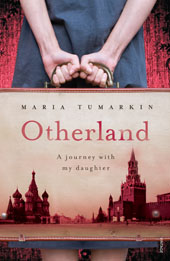
‘Otherland’ by Maria Tumarkin

2010, 301 p & notes

“What IS this book?” I wondered half-way through. Travelogue; a reflection on literature and historical methodology;  a history of nations and a history of family; a reflection on the mother/daughter relationship- how would all that be summed up in the one-word descriptor that you often find on the back cover of a book?

“Memoir” .  It seems a little incongruous to me that anyone born in 1974 could write a memoir yet, but if a memoir is a literary construct through which the writer represents a lived experience, then yes, this is a memoir- but I’d qualify it by adding “and much more”.

The author is a Melbourne-based historian, who emigrated from the Ukraine with her parents and sister in 1989, a month after the fall of the Berlin Wall,  at the age of fifteen.  She had returned to Russia  previously, but had not made it to the Ukraine.  On this trip she takes her twelve- year old daughter, Billie, largely because she feels that it is the last chance she will have to do so:

Right now is my last chance to go back with her and still be the centrifugal force of our journey, exercising the course-setting and veto powers.  It is, in other words, my last chance to have Billie follow me around, however begrudgingly, as her mother’s tail.  In a year, maybe a few months, the tail will drop off, or the tail will be wagging the dog, and such a trip, if even possible, will be a different proposition altogether. (p. 28)

It is the journey that ties this memoir together, but it is a layered journey. Mother and daughter are travelling, but Tumarkin is making her own journey back to the relationships that were ruptured when she and her family left so abruptly, and she is making a journey into her own parents’ and grandparents’ experiences as well.  But it is not her story alone: she interweaves the journey with the stories and observations of writers, historians, poets and political dissidents.  In this way, it is an intellectualized endeavour- indeed, I had not heard of many of the writers she cited- but it is also highly personalized.

It is much more than the story of a mother and daughter, and yet this is important too. We read excerpts from Billie’s diary- am I the only one who felt slightly grubbied and complicit in this?  The mother/daughter relationship generally is often fraught, and here I found myself judging the author rather harshly for her own intrusion into her daughter’s perceptions of her experience, where she so much wanted her daughter to see and feel certain things. Ah, but in terms of judgement and criticism Tumarkin was often there before me, aware of her own shortcomings.  There is a stringent honesty in her writing, as when she describes her daughter opening up the piano to play in the apartment of an elderly woman herself the cultured, brilliant daughter of a revered dissident:

In this apartment at the very heart of Moscow, metres away from the Mossovet and Statira Theatres and the Tchaikovsky Concert Hall,  Billie sits down at the old piano.  She plays what she usually plays- Tori Amos and Coldplay.  How alien they sound inside these walls.  Not in Adorno’s ‘no poetry after Auschwitz’ kind of way, no.  And not in a vulgar popular-culture way.  It is just that here these songs, which evoke places and times that make no sense in the world of this apartment, sound thin, flat and inconsequential in the extreme, like a mobile ringtone underneath a cathedral dome. Momentarily I feel ashamed. Ashamed for both of us. (p. 76)

There are several mothers and daughters here.  It is also a history of a Jewish family, who were part of a much bigger history, and here I found myself hampered by my lack of late twentieth-century history: who came first again? Gorbachev? Yeltsin?  I craved a factual chronology, to juxtapose against this very personalized history.

This is a very carefully constructed memoir.  It opens with a cliff-hanger that is not resolved until after half-way through the book.  The writing is reflective and scholarly in places, and confessional and all too human in other places.  Like all journey narratives, it moves forward and there is a homecoming, in more than one sense.  It is quite a journey.

My rating: 9/10

Sourced from: Yarra Plenty Regional Library

Read because: I read it as my third book in the Australian Women Writers Challenge

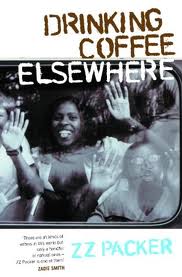
‘Drinking Coffee Elsewhere’ by ZZ Packer

224 p, 2004.

I was aware of ZZ  Packer, and the acclaim that she has garnered, even before I opened this book.  I was still reading Aphrodite’s Hat, and enjoying its understated, mature stillness, and from the little that I knew of Packer, I didn’t want her youth and exuberance intruding onto my reading.  I’m glad that I waited because keeping the two books separate enhanced them both, I think.

Z Z Packer was born in Chicago in 1973, attended Yale University and the Writers Workshop at John Hopkins University, and has been the recipient of several writing fellowships.  The short stories in this collection have appeared in various journals, and this volume received glowing praise.  She sure can write.

The stories are about 30 odd pages in length- just right, as far as I am concerned- short enough to be read at one sitting and long enough to develop character and a span of time. They are taut, confident, and she really doesn’t put a foot wrong.  Many of the characters are African-American (as is Packer herself), mainly they are women, and several of the stories are set in, or refer to Baltimore.  The Pentecostal Church is a potent and often ambivalent influence in her characters’ lives, and her characters are just clinging to the margins- sometimes physically, sometimes socially.

There is real complexity in this book.  There is no clear delineation between goodies and baddies, and life is uncomfortable and painful on the edges. The stories took me to a place and an existence that is completely foreign to me as a white Australian, older woman and she depicted it sharply enough that I ached, fretted and cared about characters encountered in thirty short pages.  Her endings were ambiguous but not unsatisfying.

You can read the short story ‘Drinking Coffee Elsewhere’ that gives its name to this collection in the New Yorker, where it was originally published here.

My rating: 9/10

Sourced from: CAE bookgroups

Read because: It was the February book for the Ladies Who Say Oooh (i.e. bookgroup)

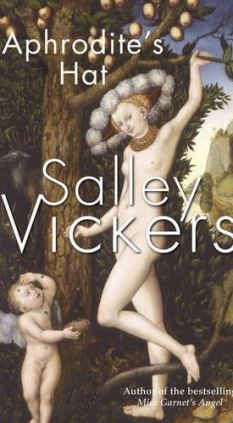
‘Aphrodite’s Hat’ by Salley Vickers

2010, 262 p.

My face-to-face bookgroup has a bit of a Christmas tradition, whereby each of us lends a copy of a book that we have enjoyed from our own bookshelves to another bookgroup member.   It’s a Kris Kringle-y sort of arrangement because you don’t know who donated the book you receive, and you can’t tell where your book is going to end up.  At our February meeting, the first for the year, we talk about the book and try to guess who chose it for us.  It is a bit of a hit-and-miss affair: sometimes you receive a book you’ve already read; sometimes you loathe the book you’ve received and wonder how you’ve managed to sit all year talking about books with the woman who chose it; other times you give a much-loved book (as I did with Kristin Lavrensdatter), only to have it trashed!

February is coming on quickly, so I thought that I’d better get stuck into my ‘present’.  Aphrodite’s Hat,  I see, by Salley Vickers.  I’ve read two of her books, with wildly different responses.  First I read Miss Garnet’s Angel with an online bookgroup and just loved it.  My response to  it was complicated by one of the bookgroup members arguing strongly and fairly (but not completely convincingly) that there was a whole other reading of the book possible that turned the plot on its head.  To this day, I’m still not sure.  When Instances of the Number Three came out, I snapped it up but this time felt that it was twee, repetitive and just plain silly.

But ten years have gone by, and I’m now well and truly of the middle-aged demographic that she writes about.  And, despite my frequent declarations that I don’t like short stories, I was quite happy to see that the book was in fact a collection of her short fiction. I’m finding myself happy to read something light and put-downable just before I go to sleep.

The longest story in this collection is ‘The Buried Life’,  after the Matthew Arnold poem of the same name, which she very helpfully gives at the end of the story (just as the cover of the book helpfully shows ‘Aphrodite’s Hat’ which is the title and theme of another of the stories in this collection). It’s a beautiful poem: this is one part:

But often, in the world’s most crowded streets,

But often, in the din of strife,

There rises an unspeakable desire

After the knowledge of our buried life;

A thirst to spend our fire and restless force

In tracking out our true, original course;

A longing to enquire

Into the mystery of this heart which beats

So wild, so deep in us- to know

Whence our lives come and where they go.

This captures the themes of many of these stories: middle aged people -generally women- often in their second marriages, who are disappointed that this second chance at love has not worked either; unhappy people teetering on the edge of infidelity;  loss of a child through death or intransigence.  They are very still stories that seem calm on the surface but cover a deep well of sadness.  As with Miss Garnet’s Angel,  there is a hint of the supernatural but it is so closely interwoven with love and longing that it pushed my derision to the side.  Many of the stories are set in England, with visits over to Rome or Venice for honeymoons and naughty weekends away, in the twentieth century tawdry version of the Grand Tour- again, shades of Miss Garnet’s Angel.  Most of the stories are very short, with a similar narrative voice, and often even start the same way with a voiced comment in a conversation.  They are very similar to each other, but I enjoyed each one so much that I found myself wanting more and happily turned to the next.

As I said, February approaches, and not only do we talk about our Christmas gift book at our meeting, but we also have our February selection- in this case, a collection of – you guessed it- short stories by Z. Z. Packer.  Somehow, I couldn’t bear to mix up my reading of these two very different authors.  I wanted to let the quiet, middle-aged, introspectivity of Vickers’ stories  have their own space, without being swamped by a younger, more rambunctious writer.

It doesn’t surprise me that, according to Wikipedia,  Salley Vickers is a 64 year old woman, or that she is a psychotherapist, and that she has had two marriages, both finished.  I suspect that there is an autobiographical bent to these stories, and perhaps my criticisms of Instances of the Number Three  could well apply to these stories as well.  Except that I am older, except that there is a clarity about human nature, except that I was utterly charmed by them.

My rating: 8.5/10

Sourced from: Who knows??

Read because: it was a reading gift over Christmas from my bookgroup.

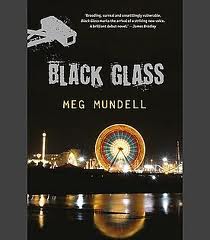
‘Black Glass’ by Meg Mundell

2011, 281p

This book is set in Melbourne, but it’s a dissonant Melbourne- recognizable, yet there’s something wrong.  Locations were familiar to me, and yet I think that inhabitants of any affluent city could recognize their own here: every city seems to have a Docklands with high-rise buildings, a ‘Westgate’ bridge or some variation on a similarly anodyne name, malls, a waterfront, a Casino, tourist Ferris wheels [although, unlike Melbourne, most cities seem to have one that actually works.]

In this future Melbourne, the tourist, civic, retail and commercial centres have been made safer by close electronic surveillance and the requirement for official entry documentation. The inner suburbs have been declared an  ‘interzone’, providing residential housing for those permitted to work in the city centre.  Those without the required documents, or the ‘undocs’ are prohibited from working legally and are thus forced into a marginal existence, scrounging for food, working illegally and squatting in disused buildings and under viaducts, bridges and in tunnels.  The proper place for ‘undocs’ is outside the city, in the Regions, where services are non-existent and civic governance seems to have collapsed.

Tally and Grace are teenaged sisters living in the regions, dragged from town to town throughout the Regions by their drug-dealing father.  They had long been planning an escape to the city, even though they would be ‘undocs’, but when their father is killed in a drug-kitchen explosion, they are separated and unsure how to find each other again.  The book traces their two paths as they search, each struggling to find a toe-hold in this dystopian society.

The structure of the book is interesting.  It is divided into 12 chapters, each announced with a rather excessive unnecessary title page, such as you might see when a book has Part I, Part II etc.  Within the chapters, each scene is headed by an annotation of place and people present, as if part of a dossier. Multiple scenes make up each chapter, and this device  quickly contextualized the episode that followed, but also endowed a filmic quality on the narrative.  The scenes were quite distinct from each other, and the writing was so fresh and careful in each one that you almost felt as if they were written, and should be read, each time as a polished episode in its own right.  I don’t normally like such disjointed writing as it sometimes seems a bit of a cop-out from the hard work of maintaining the narrative and moving it forward.  But in this case, each one was so beautifully written and worked well in inching the story forward that it felt like a considered and well-chosen narrative structure.

Tally and Grace and their search for each other lie at the heart of this novel, but there are other themes woven in as well: exploitation, surveillance, dissent and authoritarianism.  Unlike some science fiction (or is it ‘speculative fiction’ these days?) she does not spend a great deal of time on the logistics and details of this chilling world but instead uses it as a backdrop to the story of these two lost sisters.

My rating: 8.5/10

Sourced from: Yarra Plenty Regional Library

Read because: it is the second book that I am reading for the Australian Women’s Writers Challenge 2012

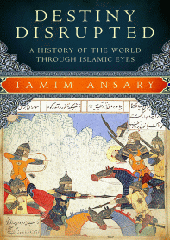
‘Destiny Disrupted: A History of the World Through Islamic Eyes’

2009, 357 p. plus notes.

I haven’t read a book like this before.  It certainly goes some way towards filling a gaping hole in my knowledge of the world. Night after night I watch the television news with Shi’a and Sunni hostilities.  I am aware of Muslim groups in Africa, Indonesia, Central Asia, ex-Soviet Republics and the Middle East without knowing how they fit in with each other. I know about Mohammad (without really knowing when he lived); I know about the man who built the Taj Mahal (without really knowing when he lived, either). How do the Sultans fit in? And the Mongols? I’m only vaguely aware of dates where the Muslim and European worlds intersected- the 7th century and the Crusades (and do I really know when they were?) I lack a chronology: I lack an overarching narrative. And this is where this book comes in.

The book starts by decentralizing us geographically. There is not ‘East’ and ‘West’. Instead there is the Mediterranean World, linked by sea routes and the Middle World, an overland kingdom situated between the Mediterranean to the west and the Chinese World to the east. Each world had more interaction internally with itself than with the other, and each had good reason to think that it was at the centre of human history. And, as he points out, the intersection between these two worlds, along what we now call the Middle East, has been a fault line then and now.

Next we are decentralized chronologically as well: the book starts at Year Zero (622 CE), not with the birth of Mohammad, but with the Hirja- the emigration of Mohammad and the Muslim community from Mecca to Medina. This, in Islam, is the turning point of their fortunes, dividing all of time into before the Hirja (BH) and after the Hirja (AH).

The European world is largely absent in the first half of this book. The expansion into Spain is just a sideshow on the edge of the Islamic world; the Crusades, for all their brutality, do not actually change anything once they come to an end. What does change the Middle World is the brief explosion of the Mongol holocaust around 614AH (1218 CE) and yet even here, the Muslims ended up reconquering them not through territory or warfare, but through conversion. In the next four hundred years there is a rebirth of Islamic culture, with the three Islamic empires – the Ottoman Empire, the Safavid Empire and the Moghul Empire- displaying diverse local customs and a variety of languages- but united by common elements as well into a single, coherent civilization.

It is only at Chapter 11, and halfway through the book that the narrative picks up “meanwhile in Europe” and brings the Western and Middle World narratives together. Although the Muslim world was at a peak, the Western world had been fundamentally transformed by the emphasis on the individual fostered by the Protestant Reformation, science and mercantilism. It was not a clash of civilizations, but the gradual infiltration of traders, business advisors and technical consultants. Reform movements erupted within Islam itself, bifurcating into wahhabism and fundamentalism on the one hand, and secular and islamic modernism on the other. Overlaid by industrialism, constitutionalism and nationalism, Islamic countries found themselves as the playpieces of wider diplomatic tensions during the World and Cold Wars. On Sept 11, the two world histories crashed together, but it was not as Francis Fukiyama famously claimed, the end of history.

Ansary closes his book by observing that

Islam can be seen as one world history among many that are unfolding simultaneously, each in some way incorporating all the others. Considered in this light, Islam is a vast narrative moving through time, anchored by the birth of that community in Mecca and Medina fourteen centuries ago. The story includes many characters who are not Muslim and many events that are not religious. Jews and Christians and Hindus are part of this story. Industrialization is an element of the plot, and so is the steam engine and the discovery of oil. When you look at it this way, Islam is a vast complex of communal purposes moving through time, driven by its own internally coherent assumptions (p. 357)

In the preface the Afghan- born author (now resident in US), Tamim Ansary explains that he is not a scholar or a historian, and that his book is neither a textbook nor a scholarly thesis.  He emphasizes the “story”, and he writes in a colloquial style with minimal footnoting. He admits that he has devoted what might seem like an inordinate amount of time to the career of Prophet Mohammed and his first four successors, but

I recount this story as an intimate human drama,because this is the way that Muslims know it.  Academics approach this story more skeptically, crediting non-Muslim sources above supposedly less-objective Muslim accounts, because they are mainly concerned to dig up what “really happened”.  My aim is to convey what Muslims think happened, because that’s what has motivated Muslims over the ages and what makes their role in world history intelligible (p.xxi)

As a reader, I felt as if the author was leading me confidently and forthrightly through a history that spills out of current day national boundaries and which is studded with confusing and unfamiliar names.There were maps almost exactly at the point where I found myself thinking “Gee, I could use a map here”, and if he signposted that there were three groups that he was going to examine, then there they were 1,2,3.   I don’t know enough to detect whether there were inaccuracies or not, and although some critics were disconcerted by the colloquial tone, I found it a relief that at no point did the narrative bog down.

I’m really pleased that I read this book, and I can’t remember how long it’s been since I read a book that I learned so much.

Some reviews if you’re interested:

San Francisco Chronicle

The Globalist

My rating: 9.5/10  (I do like to leave a little bit of rating up my sleeve!)

Accessed from: La Trobe University Library

Read because: My internet friend SuLu reviewed it on her blog here.