Category Archives: Book reviews

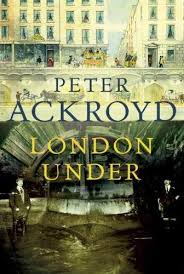
‘London Under’ by Peter Ackroyd

ackroyd

2012,  182 p.

If I bemoaned the lack of poetry in Nick Cooper’s London Underground at War , then I found it- as I might have expected- in the astoundingly prolific Peter Ackroyd’s London Under.

London Under is written as a slimmer companion volume to Ackroyd’s big baggy monster London: A Biography.  In that book, he described London as a palimpsest, alternately destroyed and rebuilt, the same patterns or practices  repeated on the same site, albeit in different manifestations, across the centuries.  This book repeats the same theme, but this time he delves under the surface where layer upon layer reflect similar patterns over time. But there’s also a web-like aspect as well:

In a previous book I have explore the city above the surface; now I wish to descend and explore its depths which are no less bewildering and no less exhilarating. Like the nerves within the human body, the underworld controls the life of the surface.  Our activities are governed and sustained by material and signals that emanate from beneath the ground; a pulse, an ebb, a flow, a signal, a light, or a run of water, will affect us. It is a shadow or replica of the city; like London itself it has developed organically with its own laws of growth and change. (p. 1-2)

His underground world is often a watery one, based on the rivers that flow beneath the streets of the metropolis.  He starts by considering the wells that early Londoners were so dependent upon, and which are often marked by street-names in the world ‘on top’.  In ‘Forgotten Streams’, he traces the thirteen rivers and brooks of London as they entwine themselves with the underground infrastructure which has been superimposed on them in the form of sewers and tube lines.  The pages are sprinkled with black-and-white illustrations, many from the early nineteenth century, which show the presence of these rivers before they were subsumed by development.  The chapter ‘Old Man River’ concentrates on the Fleet, the most powerful of all London’s buried rivers. ‘Heart of Darkness’ examines the construction of the sewers that carried away the filth from London while the ‘Pipes of London’ looks at gas and water piping that brought facilities to London.  The ‘Mole Men’ deals with the Thames Tunnel, which from an engineering viewpoint was the precursor of the Underground, which is dealt with in ‘The Deep Lines’.  Three chapters, ‘Far Under Ground’, ‘Buried Secrets’ and ‘The War Below’ deal with much of the material covered by Cooper’s London Underground at War, although in a more people-focussed manner.  The final chapter ‘Deep Fantasies’ draws out the theme of imagination and the underground which he has mentioned in several places in the book.

There are no footnotes in the book, although it does include a bibliography at the end.  Like so much of Ackroyd’s work, it is atmospheric and erudite, steeped in literature and popular culture, especially that of the nineteenth century.  The language flows seductively and smoothly in a very easy, beguiling read.

And by coincidence, what should be on SBS recently but ‘Secrets of Underground London.’ It’s on SBS Catchup until 25 November 2014.


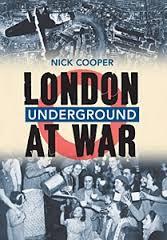
‘London Underground at War’ by Nick Cooper

londonUnderground

2014, 120 p & appendices

Heaven knows that I have a million things that I should be reading, but I found myself returning to the ‘new books’ shelf of the library each day just to have another little browse through this small book. In the end I thought- sod it!- just borrow it! and so I did. From the safety of sixty years on and the comfort of being in another hemisphere on the other side of the world, I’m fascinated by the Blitz.

The book has seven chapters and two lengthy appendices.  The chapters are not long, and they are supplemented with many black-and-white photographs and newspaper clippings.

Chapter 1, ‘Beginnings’ explains the construction of  London’s Underground. I am amazed that it commenced so early, opening in 1863 -( about twenty years after the opening of the little Port Phillip courthouse shown on the top of my blog!)  Privately owned London railway companies linked most large cities with London, but they stopped on the boundary of the city, prevented  either by an act of Parliament from encroaching into the city from the north, or by prohibitive expense from entering from the south.   The North Metropolitan Railway Company was incorporated in 1853 to build a three-and-a half mile underground railway using ‘cut and cover’ where a deep trench was dug down a road, lined with brick then covered over again and the road re-laid.  In the mid 1860s the engineer James Barlow developed a simplified version of Brunel’s huge tunneling shield that had been used to construct the Thames Tunnel between 1825-1843 (and again, I’m stunned, thinking of the technology in Australia at the time). With this new technology, the tunnel could be built in segments using a series of 8-foot diameter rings, without surface disruption.  They were off!!  The creation of the London Passenger Transport Board in 1933 finally brought all public transport in the capital under central control and the lines were given generic names (Central, District etc) instead of the private railway company initials that they had used until then (e.g. CLR, GN&CR)

I must confess that I wish at this point that there had been larger map than the ones provided.  There were two- each taking up half a page, and I think they merited a whole page to each.

Ch. 2 ‘Preludes’ starts in World War I, when German airships bombed London. People sheltered in the Underground tunnels then too, but not enough for the authorities to worry about it or, alternatively, promote it.  During the Spanish Civil War civilians used the underground metro for protection, and the British government resolved that in any future wars, they would not use their Underground in this way again.  The major concern was that the tunnels would flood under sustained bombing and so flood-gates were installed (remnants of which can still be seen in some stations today).

Chapter 3 ‘Sheltered Lives’ explains the arrangements that were made by Councils and Corporations that did, as it turned out,  utilize the Underground stations, despite the pre-war intention not to do so.  There are many photographs here of people sleeping on platforms, storing their bedding etc. and the chapter describes the arrangements made for  sanitation and litter collection. People paid at least a penny ha’penny to enter (how frustrating- WordPress doesn’t show halves- a penny and a half)  which would be the equivalent of 80p today.  I should imagine that buying a ticket would be a form of head-counting as much as anything else.

Ch. 4 ‘Deep Defence’ describes the deep level shelters that were used for official and emergency service provision- offices and troop and firefighter hostels etc.  These deep shelters had liftwells leading down to them as well as emergency staircases, and so at ground level, square boxes were built onto the top of existing buildings to accommodate the lifts.  There are many current-day photographs of these buildings which are otherwise unremarkable, quite ugly and no doubt ripe for demolition without people realizing what they are.

Ch. 5 ‘The Blitz and Beyond’ is a chronological list of damage to the Underground, most particularly between September 1940 and May 1941.  Night time bombing recommenced in 1944 with the ‘Baby Blitz’, followed by the V1 and V2.  There was less damage to the Underground with these later waves of bombing.

Ch. 6 ‘Major Incidents’ describes the major bombing incidents and the infrastructure damage and loss of life entailed in each. Again, they are arranged chronologically

Ch. 7 ‘Aftermath’ is only a short chapter of four pages (two of which are pictures) describing the changes to the lines post war.

A lengthy appendix  lists the names of those killed in the incidents identified in Chapter 6.  It does not claim to be definitive, and the opening paragraph explains the parameters that govern inclusion in this list.  The lists are arranged alphabetically by station.  It is sobering to see whole families lost, particularly in the earlier bombings.  A final appendix discusses the fears of flooding from the Thames, and the arrangements that were made to prevent the inundation of the whole system.

As you can probably detect from this chapter summary, this is very much a book of lists and incidents.  Chapter 3 does describe the conditions in the tunnels and the human response, but it’s all at a rather technical and disengaged level.  There’s not a lot of poetry in the writing: it is very matter-of-fact.  This is a book that focusses on the Underground and its infrastructure, and it is not (and nor does it pretend to be) a social history.  As the author notes on his website,

this new book details the early years of the London Underground, concerns about public air raid shelter provision in the 1930s, and how sheltering in stations and bombing affected the operation of system during the Second World War.

The emphasis is on how the presence of Londoners affected the Underground during the war,  more than how the Underground affected them.  The detachment of the writing does mean that it reads a bit like a report.

There was, however, one quotation at the end of Chapter 6. The bombing of Bank station on 11 January 1941 resulted in, according to most accounts, fifty-six killed and sixty nine wounded.  The only doctor on the scene was a Hungarian refugee, Dr Z. A. Leitner who treated patients for an hour and a half until help arrived.  He gave testimony to the inquiry held afterwards, and even allowing for any ‘buttering up’ in order to stay in the country, his statement is quite remarkable and has the ring of truth:

I should like to make a remark.  You English people cannot appreciate the discipline of your own people.  I want to tell you I have not found one hysterical patient.  I think this is very important, that you should not take such things as given, because it does not happen in other countries.  If Hitler could have been there for five minutes with me he would have finished this war.  He would have realized that he has got to take every Englishman and twist him by the neck- otherwise he cannot win this war.  (p 115)

The author has a website that contains much of the information in this book, and it will give you a flavour of the approach he takes.

http://www.nickcooper.org.uk/subterra/lu/tuaw.htm

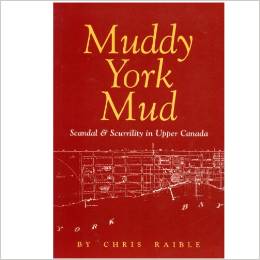
‘Muddy York Mud: Scandal and Scurrility in Upper Canada’ by Chris Raible

raible

1992,  272 pages including appendix.

I came across this book just as I was about to go to Canada in 2011 to research the Upper Canada period of ‘my’ Judge Willis‘ career.  I began reading it and became increasingly excited that it captures the small-town, censorious attitude of a small Canadian outpost of Britishness in the 1820s so well. No wonder an English judge, full of his own importance, fell foul of this intermarried web of government officials!  But then there were bags to pack and planes to catch, and I didn’t finish it. I’ve just returned to reading it, some three years later, and almost at the end of my first draft instead of dabbling around in the shallows of my early research.   On this second and now completed reading, it doesn’t so much open up new areas (thank goodness, I must say), but it does confirm and add colour to the context of 1820s York (Toronto) in a highly readable and informed manner.

The central event of this book is what has come to be known as the Types Riot.  Late on the summer afternoon of 8 June 1826, when the editor of the Colonial Advocate newspaper was away, nine young  ‘gentlemen’ smashed their way into the newspaper office, emptied the type cases from their cabinets, strewed fully made-up printing frames across the office, then carried type cases across the road, along the wharf,  and threw them into the bay.  They were not drunk; they made no attempt to disguise themselves and they were watched without intervention by several bystanders, including two magistrates.

The argument of this book is that there is a direct link between the Types Riot and a series of satirical articles published some weeks earlier  in the Colonial Advocate known collectively as the Patrick Swift commentaries.  These articles, published at very great length over several issues, were a fictitious report entitled ‘A faithful account of the proceedings at a general meeting of the contributors to the Advocate, held in Macdonnell’s Parlour on the evening of Monday, May 1st 1826’.  These ‘contributors’ were ostensibly gathered to select a new editor for the Advocate as, supposedly, the present editor, William Lyon Mackenzie, had resigned.  ‘Patrick Swift’, [described as “a grand nephew of the famous Doctor Johnathan Swift, Dean of St Patrick’s in Dublin” and the author of Gulliver’s Travels]  was selected. The ‘report’ described the debate and ribald comments of this drunken group of fictional characters.

In this way, ventriloquizing through the fictional ‘Patrick Swift’, the real-life editor of the Colonial Advocate, William Lyon Mackenzie launched on a tirade against the pretences of the Upper Canada ‘gentry’. In a thirty page, small-font appendix to the book, Raible reproduces the commentaries, annotating them to identify the victims of the humour:  judges, lawyers, the attorney general, prominent clergymen and even the lieutenant-governor and his wife.

As Raible says:

The notorious “Patrick Swift” satires, published by William Lyon Mackenzie a few weeks before the Types Riot trashing of his Colonial Advocate printshop, contained a number of explicit barbs intended to prick the over-inflated egos of the members of the little York elite.  That he succeeded, and thereby provided a group of men with socially acceptable justification for acting out their personal grievances against the outspoken editor, has been a theme throughout this book. (p. 229)

In the short chapters of this book, Raible ranges chronologically and episodically over a number of grievances and scandals that led to and flowed from the Types Riot.   It’s not an easy task: many of the events occurred in geographically disparate locations, across a long period of time. Although by themselves they are trivial  and petty, together they add up to the abuse of power by a puffed-up and mutually distrustful clique with the levers of judicial power in their grasp.

Raible keeps the tone light, with no apparent historiographical framework. There are footnotes (called ‘Sources’) and a bibliography, but you’re certainly not aware of them while reading the book. There’s a tongue-in-mouth jocularity that runs through the book, and it reflects the rambunctious/nostalgic tone of the antiquarian books that have provided much of the source material.  For Australian readers, there’s definitely a touch of the ‘Garryowens’ about it.

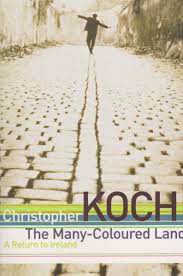
‘The Many-Coloured Land: Return to Ireland’ by Christopher Koch

koch

2002, 244p.

How have I read the hundreds (probably thousands?) of books that I have without encountering Christopher Koch before?  I’ve been aware of the name on Miles Franklin lists (he won it twice) and I’d heard of the film The Year of Living Dangerously, which was based on his book.  But I’ve never read any of his work up until now.

The Many-Coloured Land is part memoir/part travel narrative/part history.  Koch grew up in Tasmania, but his awareness of his background centred mainly on his German heritage – reinforced, no doubt, by questions about his surname- and his Anglo-Irish background that had been thoroughly researched by a genealogy-obsessed uncle.  Suppressed within his family history was another great-great grandmother, Margaret O’Meara, a convict  from Tipperary.  His two Irish great-great grandmothers arrived in Van Diemens Land within five years of each other, in very different circumstances- Margaret O’Meara and Jane Devereaux- one convict, one free; one Protestant, one Catholic; one a servant girl, the other the daughter of decayed aristocracy.  The older Koch became, the more he was drawn to the story of Margaret O’Meara, and this book is, in part, the story of his pilgrimage to a ‘home’ land that he only really acknowledged in later life.

I put ‘home’ in inverted commas intentionally, because Koch is never anything but Tasmanian.  The opening chapters of the book are located in Tasmania and chronicle his growing awareness of his family, and particularly Irish, heritage.  It was in his description of Oyster Bay near Swansea, a childhood holiday spot, that won me over.  I’ve sat on the dunes of the beach myself in a pink-infused sunset, with a warm breeze riffling over the grass at my back, the waves shushing onto the shore, and as I read this description I felt as if Koch had been leafing through my own memories:

Coswell (his holiday cottage) was set on gently-rising ground a few hundred yards from … a beach, looking out over white-gold paddocks and long, drystone walls to the blue expanse of Great Oyster Bay. The paddocks’ open spaces were dotted with a few long gum trees, and dark little Oyster Bay pines grew in the hollows.  The beach was usually deserted, except for Coswell’s few guests.  A creek flowed into the sea there, with a rickety jetty and diving board; an old wooden dinghy lay near the marram grass on a dune, and had lain there for as long as I could remember.  At each end of the beach were great, smooth rocks of pinkish granite; beyond them, to the north, more white beaches could be seen, with a few tiny dots that were people, and occasional beached dinghies.  Set with tall towers of spume, these long, far beaches curved off into mauve and white distances whose features grew tiny and illusory, faint as a distant music: a region beyond Swansea and the common world; perhaps beyond the real world together. (p. 48)

Koch visited Dublin as a young man in 1956 and remembered it as a dismal, grey, sad place.  Returning in 2000 with his friend, the folk-singer Brian, he finds another Ireland.  Ireland has changed- it was at the peak of its Celtic Tiger power of the new millennium- but so had he.  He is unsettled by the brash, surface-level confidence of the new Ireland and it is only when he moves away from Dublin that he finds the layered Ireland that he seeks.

Nothing much happens in this book.  They go from one B&B to another; they drink the night away in the fug of cigarette smoke with the beat of Irish folk music thrumming at their feet; they stand on coastlines; they survey landscapes.  Koch finds the derelict Big House of his ancestor Jane Devereaux and is drawn to the story of the  Young Irelanders who ended up as aristocratic convicts in VDL.  Because all this research re-emerged in  Koch’s fiction work Out of Ireland, which deals with the Young Irelanders,  it reminded me a bit of Kate Grenville’s Searching for the Secret River, without the methodological angst.

There’s an unintended poignancy about this book, because we know, as Koch couldn’t when he wrote it, just how brittle and insubstantial that Celtic Tiger economy was to be.   There’s another poignancy too, in my realization that this writer that I’ve never read  passed away last year, and that all his deep inhalation of life, people and surroundings is at an end.

As a reader, I have little red flags that pop up when authors do particular things. I must confess that when the book started with family history, I inwardly groaned. Family history, while fascinating to the descendant, can be rather eye-glazing for other people, unless it’s contextualized and the author has convinced you that it’s going to be worth your while.  Nor do I enjoy descriptions of food, and I don’t really care what people look like.  This book violated all of these no-go zones at times.  Nonetheless,  I really enjoyed it. It’s a beautifully written plaiting-together of historic research, family history, travel narrative and memoir.  And I’m going to track down his other books as well.

My rating: 8.5/10 (although I know that others haven’t been quite so fulsome in their praise)

Read because: it was a bookgroup choice with The Ladies Who Say Ooooh

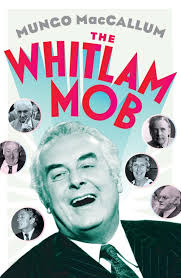
‘The Whitlam Mob’ by Mungo MacCallum

maccallum

2014, 234 p

I didn’t vote for Gough Whitlam in December 1972. I was seventeen, and far too young to vote in those days when the voting age was 21. But if I’d been able to vote for Gough, I would have. The exhilaration, the vision, the feeling of shucking off the grey dust coat of  a seemingly-unending Liberal government  has never left me really, and I’ve never in my life been able to countenance the thought of voting for a Liberal government. There have been individuals in the Liberal party  I could have voted for (Fred Chaney, Petro Georgiou; dare I say Malcolm Turnbull?) but never the party as a whole.

Mungo MacCullum’s book ‘The Whitlam Mob’ makes no pretence at being balanced. Mungo was/is a Labor man in the press gallery and this book is written with nostalgia, affection and loyalty. He is a comic writer, always on the lookout for the quick laugh and the quirky detail. Let’s face it- he’s a gossip and here he’s regaling us with yarns.

The book is written in two fairly evenly weighted parts: The Whitlam Mob and the The Other Mob. Each of the vignettes is fairly short, with the longest chapter devoted to Gough (19 pages) but everybody else despatched with ten pages or less (and as little as two!)

The first thing that struck me about this book was that there is only one woman: Margaret. I think of the Whitlam years as a watershed for women in Australia but when I check Whitlam’s three ministries (counting the first one which comprised just Whitlam and Lance Barnard), there were no women ministers at all.

The second thing that came through was that many of these men had been waiting decades to form government and many of them were old when they got there. Many of them had lived through World War I, the Depression and were WWII veterans; they had endured The Split that had formed the DLP; they had a history of years and years of Opposition. Clyde Cameron, for instance, held the parliamentary record for thirty one years in the House of Representatives, twenty eight of them spent on the Opposition benches.

Reading through this book, I realized that I have many misconceptions about that government over forty years ago (remember, I was only seventeen). The changes wrought by the ALP were (and still are) so BIG, both conceptually and in terms of political courage, that I forgot that Gough was from the Right of the party. I’d not particularly been aware of the struggle between the Left and the Right in the party. I’d forgotten that Jim Cairns had actually been seen as a potential Prime Minister. And looking back, the idea of two men (the duumvirate) forming the whole ministry, as Whitlam and Barnard did between 5-19 December 1972, seems unthinkable today.

I had forgotten how dysfunctional the Liberals were, even though the whole of my VCE Social Studies (i.e. politics) year in 1973 was spent preparing for the absolutely inevitable question on the end-of-year exam “Did the ALP win the 1972 election or the Coalition lose it?” or some variation thereof. What a spiteful man Menzies was. Apparently, one of the first things that Whitlam did on gaining office was to write to Robert Menzies:

It was a courteous, even flattering letter: Whitlam said that Menzies might be surprised to learn how much the Labor leader had always admired him, not only for his mastery of parliament and politics, but also for his resilience in coming back from defeat to shape the Liberal Party into a modern and dynamic force.  This, said Whitlam, was an example he had always held in front of him during his own long battles within the ALP.

Regrettably, Menzies’ reply was terse and dismissive: the Labor Party advocated socialist policies, which were wrong for Australia, always had been and always would be, and that was all that needed to be said. (p. 127)

I wish that there were pictures in this book because, quite frankly, I can’t remember some of the people he writes about. Most of the Whitlam Mob I can remember, although I don’t have a mental picture of Don Willesee. But for the Other Mob: Bill Wentworth, David Fairbairn, Magnus Cormack, Michael Hodgman- nothing.   When I think of Lance Barnard, I think of a grey hat- in fact, I think of hats for many of these men, because they were of the black-and-white generation that wore hats, no matter how much I want to drag them into the bright, full-colour and shiny ‘It’s Time’ frame.

Particularly for the Whitlam Mob entries, there are many times when MacCallum uses the adjective ‘complex’, but his sketches of the Other Mob are more one-dimensional. I don’t know if this reflects the subject, the author, or his access to them- probably a combination of all three. There are many ‘what-ifs’ and good ideas bungled amongst the short Labor grip on power. The Khemlani loans affair, for example- the stuff of pure farce, and yet what vision.

On this day, when I learn of Gough’s demise, I think of myself as very much a product of the changes wrought by the Whitlam government and the vision of a society that it promoted.  Thank you, Comrade.


‘Broken Nation’ by Joan Beaumont

beaumont

2013, 655 p.

For someone who intended to eschew much of the hype about the centenary of WWI, I seem to have indulged rather more than I anticipated.  I attended the RHSV Victorians and the Home Front conference, I read The Kayles of Bushy Lodge (largely because it was written by a woman about the homefront during WWI) and I watched and very much enjoyed The War That Changed Us.   I was aware that Joan Beaumont’s Broken Nation had been well received, but what probably tipped me into reading it was Marilyn Lake’s comment in her ABR review  that

If you read only one book about Australia’s experience of World War I, as the deluge of commemorative publications marking the outbreak of the war becomes a veritable tsunami, make it Broken Nation, an account that joins the history of the war to the home front, and that details the barbarism of the battlefields as well as the desolation, despair, and bitter divisions that devastated the communities left behind.

I agree with Lake’s recommendation; I admire the book for its breadth but…oh, it was relentless reading.

In her opening paragraph Beaumont asks ‘why this book?’ given the already voluminous literature on Australian military history, especially in this centenary year. Her answer is this:

It has been written to provide what is still lacking in the literature: a comprehensive history of Australians at war in the period 1914-19 that integrates battles, the home front, diplomacy and memory. (p.xv)

It achieves this completely.  The book is structured into  six very long chapters, one for each year of the war.  Within these chapters, Beaumont moves chronologically month by month, crossing back and forth between battle, homefront,  diplomacy.  Even within these themes, she shuttles between battle as strategy and battle as lived experience by the men who were there; homefront in a political sense, homefront in a social sense; domestic politics and diplomatic politics on an international stage.

But for me, the battle scenes dominated and they dragged, particularly during the longest chapter ‘1917: The worst year’.  It took me some time to get into the mindset where a death and an injury were both counted as a ‘casualty’ without distinguishing between the two, because the effect of both was the loss of a soldier who could fight then and there.  I found myself inwardly groaning as I turned  page after page to see yet another map with arrows showing lines of attack.  There’s 36 maps in the book as a whole, (16 of them in the 1917 chapter) spread across battlefields at Gallipoli, the Western front and the Middle East, reinforcing the inexorable to-ing and fro-ing year after year.  The battle scenes are interspersed with diaries and letters from the men,  and visceral descriptions of sights, sounds and smells, but for me they were deadened by the weight of strategy and the stilted, chest-puffing language of military commendations.  Charles Bean has a lot to answer for.

But she also  moves away from the noise and shouting to consider  the process by which these sites have been memorialized.  She notes that many of the battles that the soldiers at the time chose to have memorialized through statues are not the ones that are uppermost in national memory today. For example, the 5th division, when asked in 1919 where it wanted the memorial celebrating its wartime achievements to be located chose not Fromelles, but Polygon Wood.  Our emphasis on Fromelles springs from the 1990s and the combined interventions of Prime Minister John Howard’s overseas war-memorial construction scheme and the archaeological persistence of retired schoolteacher Lambis Englezos.  This is true of many of the battles: what we have been moulded to memorialize, is not necessarily what the soldiers themselves wanted to remember and honour.

Even though the military sections weighed heavily with me, she does interweave it with the homefront and the broader diplomatic scene.  Her analysis of the homefront includes the political wranglings with Billy Hughes and conscription, and the effects on the economy and political life of the crackdown on unions and the War Precautions Act.  I’ve imbued the Labor Party lore of Billy Hughes ‘the rat’ but I hadn’t realized how much I dislike him on the broader international stage as well.  I enjoyed the final 1919 chapter very much, and its emphasis on the diplomatic tradeoffs at the end of the war.

Quite apart from the experience of reading the book, which I found draining, Beaumont makes some important points to counterbalance the type of history that is warping our present day politics and being pushed so insistently in this year of commemoration  as demonstrated in Henry Reynold’s recent excellent article Militarization Marches On.  She is at pains to point out that in many of the battles that we have appropriated to our national memory, Australians were not the only troops there.  We were part of the ‘colonial’ forces, for Britain to do with as she pleased, without consultation.

The title of the book is ‘Broken Nation’ which echoes Bill Gammage’s book The Broken Years.  She kicks back against the idea that Australia was ‘made’ through WWI. Instead, she argues, Australia – the Australia the soldiers sailed away from- was broken by WWI.  Not only was there the disproportionate loss of life, and the burden of injured soldiers, but there was “the less quantifiable embittering of public life” (p. 549).  The conscription debates had polarized Australia, and the rift did not heal easily. The war gave rise to xenophobia and insularity and fear of left-wing radicalism. It became an inward-looking society, focused on grief and the rancour of the war years. (p. 551)

The book started with a prologue that spoke of  Beaumont’s own great-uncle, Joe Russell.  He reappears once or twice during the book.  Other individuals pop up from time to time- Archie Barwick, Pompey Elliot- familiar names from the recent documentary The War That Changed Us.  I must confess that I preferred the grounded, person-based approach in the television documentary to Beaumont’s soaring birds-eye history.  But the reality is that we probably need both.  And in this book, the birds-eye history is in very good, sure hands indeed.

awwbadge_2014I’ve posted this review in the Australian Women Writers Challenge

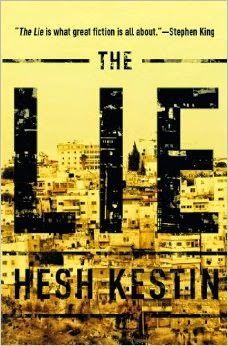
‘The Lie’ by Hesh Kestin

the-lie-hesh-kestin

2014,  229 p.

I don’t normally read thrillers.  I don’t really like the genre, but I did read this book, largely on the basis of a brief review in The Age.  I still don’t like thrillers.

The book is set in Israel, which is what attracted me. Dahlia Barr (even the name annoys me) is a successful Israeli human rights lawyer, the daughter of an even more strident peace activist mother.  She is approached by the Israeli government to become a Special Advisor for Extraordinary Measures, overseeing the application of torture during interrogation.  Rather implausibly, the government figures that if a human rights lawyer gives the go-ahead, then it must be alright. Even more implausibly, she accepts the job, thinking that she could make a difference.

This resolution is soon put to the test when her own son, an IDF soldier, is kidnapped by Hezbollah, along with a Bedouin Arab who as a citizen of Israel, also serves in the IDF.  In a scenario that has become all too familiar in recent weeks, the two boys are tortured and video-taped to pressure the Israeli government into swapping the boys for the recently-arrested Edward Al-Masri, a Canadian professor returning to Israel.  He was apprehended at customs with a large wad of money, and is the first ‘enhanced interrogation’ case that Dahlia is called upon to oversee.  Her amazement on finding that he is, in fact, a childhood friend turns to resentment and flintiness when she learns that he may have information about the whereabouts of her abducted son.

Like many thrillers, this book is structured with a series of short chapters- in some cases, only a paragraph in length, each on a separate page. The action swings cinematically from scene to scene.  There’s a heavy reliance on conversation for characterization, supplemented in Dahlia’s case by a rather clumsy italicized internal dialogue.   Details in the plot are quite technical in places for verisimilitude, which means that they need to be explained in layman’s terms later.    No, I really don’t like thrillers much.

What I did like was the complication of Israeli identity and the setting. There is a twist at the end, which does give the book more depth, although even I guessed it before it was revealed (which, believe me, is a worry).

I don’t often review books that I’ve read from genres that I generally avoid, because (as you can see) most of my responses are to the genre, rather than the book itself. If, however, you do like thrillers, here’s a shout-out to a thriller set in Melbourne –Fire Damage– written by my friend Richard, available on Kindle.

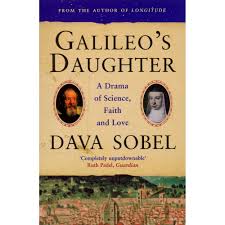
‘Galileo’s Daughter’ by Dava Sobel

galileos daughter

1999,  432 p.

The whole way through reading this book, I was thinking how much my husband (who had read it before I did) must have loathed it.  A man of scientific inclination, given to dot-points and resistant to ‘dumbing down’,  he grumbles when a plot line in a crime show or a documentary becomes clogged up with relationship-type stuff.  This book offends on both counts. Although titled Galileo’s Daughter, it is actually about Galileo and his discoveries and theories in astronomy,  explained simply for the non-scientists among us, and framed through the letters that his daughter wrote to Galileo.

Galileo had three illegitimate children through the same woman.  He was able to ‘buy’ legitimacy for his son, but to circumvent the disadvantages that illegitimacy and lack of dowry would confer on his two daughters, he placed them in a convent.  If you’ve read Mary Raven’s Virgins of Venice, you ‘ll know that convents were used as a way of solving the  dynastic problems of the Venetian (and other Italian state) noble families.  If a girl could not be married successfully and strategically, then a convent provided a means of providing for her, and in a deeply religious society, bolster the family’s heavenly credit through her lifetime of intercession on their behalf.   Convents  were not necessarily stark, isolated experiences.  They were often filled with educated, noble women who maintained an interest and knowledge of her family’s outside activities, albeit from behind a grille.

Galileo placed both his daughters with the Poor Clares in the Convent of San Matteo in Arcetri, Florence.  His eldest daughter, Virginia, took the name Suor Maria Celeste, while the younger daughter became Suor Arcangela.  The book reveals the letters that Suor Maria Celeste wrote to her father, translated by Sobel herself, interwoven with a narrative of Galileo’s development of his astronomical theories and the resultant conflict with the Inquisition.

Here is the historian’s lot writ large: a cache of letters from one party only.  However, continuous archives like this, where the letters were frequent- and these ones certainly were- allow for reconstruction of the missing side of the correspondence.  I was struck by the waste of this lively intelligence.  Although Suor Maria Celeste’s writing is larded with expressions of deference and spirituality that don’t sit comfortably with us today, she was well aware of her father’s work and made good copies of his correspondence.  She assisted him in more quotidian ways too: making repairs to his clothes, cooking jams etc. and making solicitous inquiries about his health.  Certainly this convent was more straitened than those described in Virgins of Venice, with the nuns often going hungry and poorly served by the priests who ‘ministered’ to them.

Although the story of Galileo’s clash with the Inquisition is well-known, Sobel argues that he was, and remained, a deeply religious man.  But she also reveals the rather duplicitous manoeuvres that Galileo made to appear to conform, while ensuring at the same time that his controversial theories, so blasphemous in the eyes of the Church, reached beyond the Inquisition’s grasp.  She creates a nuanced overview of theology, and Galileo’s challenge to it, and a clear (if rather simplified) explanation of his theories.

I must confess that I preferred the letters to the science in the book, and felt tempted at times to skip over those sections.  But I did feel genuinely saddened by the short and constrained life that this intelligent woman lived.  I enjoyed the book, even if my husband didn’t.

My rating: 8

Read because: It was a bookgroup (Ladies Who Say Oooh) selection.


‘Mr Pip’ by Lloyd Jones

mrpip

2006 256 p

Sometimes the challenge in reading a book lies in negotiating its different threads and clambering over complex language that is so clever and slippery that you’re constantly on your mettle as a reader.  But sometimes – ah, sweet relief!- the book itself is so easy to read that you just lie back and let it sweep you along, only to find yourself rewarded with layers and counterpoints that emerge long after you shut the book. Mr Pip, for me, was such a book.

Everyone called him Pop-Eye” is the opening sentence of Mr Pip, echoing Dickens’ immortal opening lines of Great Expectations,

My father’s family name being Pirrip, and my Christian name Philip, my infant tongue could make of both names nothing longer or more explicit than Pip. So, I called myself Pip, and came to be called Pip.

Pop-Eye, or Mr Watts, is the last remaining white man on Bougainville after the implementation of the blockade by Papua New Guinea in 1990 and the descent into civil war between the ‘rambos’ (village boys who joined the rebel insurgency) and the ‘redskins’ (PNG soldiers).  Fourteen year old Matilda lives on the island with her deeply religious mother Delores, her father having travelled to Townsville for work with the Australians and unable or unwilling to return because of the civil war.   Successive raids by the rambos and the redskins have left the village in tatters and Mr Watts offers to teach the school, in the absence of any other alternative teacher.

What Mr Watts brought to these children was Charles Dickens’ Great Expectations: a book which, at first sight, could hardly be more removed from the experience of these village children, or their parents.  Mr Watts invited the parents into the schoolroom, where they shared their own stories with the children, and the parents too, came to know of ‘Mr Pip’, Miss Havisham and Estella through their children.  Mr Watts was always an outsider.  He was quite frankly eccentric, pushing his demented village wife around the village in a shopping trolley.  But somehow he managed to interweave the experience of Pip and his great expectations into the shared knowledge of this small Pacific village.

The book changes direction abruptly and I don’t want to spoil it for you.

There is a coda to the book where Matilda, as an adult, revisits Mr Watts’ hometown, trying to fill in more of the paradox and mystery of ‘Pop-Eye’ and his wife.  What she learns there gives the narrative yet another twist, unsettling much of what has preceded this.

Despite its simple, flowing almost-fable-like language, this book has multiple levels.  I found myself thinking about it long after I’d finished it.

Rating: 9

Read because: CAE bookgroup selection read with The Ladies Who Say Oooh (my bookgroup)


‘The Biggest Estate on Earth’ by Bill Gammage

gammage

Bill Gammage, The Biggest Estate on Earth: How Aborigines made Australia

384 p. 2011

I was aware, while reading this book, that I was reading what could turn out to be one of the really big books in Australian history: a book that changes the received understanding of Australian settlement,eventually rippling out beyond historians to politicians and the media to finally become part of the way we see ourselves and our country.  Maybe.

Gammage’s argument is that, instead of being marginal hunter-gatherers, ‘people’- for that is the terminology he has chosen to distinguish aborigines from ‘newcomers’- farmed prior to 1788.  They were not farmers, which is a lifestyle; but they did farm – the activity of tending and shaping landscape.  They developed what he calls a ‘template’ of landscape, a mosaic comprising open pasture with few trees,  strips of scrub and stubby trees, other plains, then clearly delineated forest.  It was a landscape ideally suited to the growing of tubers and providing both shelter and feed to encourage the presence of kangaroos and animals suitable for hunting. Instead of being forced to keep moving because they were on the verge of starvation,  people were well-supplied with food through this manipulation of their environment.  They moved across country as part of tending it, shifting and imposing the  template, created through careful burning, onto new land at will. They were well aware of species that tolerated or encouraged fire.

It is an argument that forces us to change our view of the landscape around us.  The bushland that we prize as ‘native’ landscape is often not that at all- instead it is product of neglect as the custodians of the country could no longer farm it.   The plains of green ‘pick’ were engulfed by scrub, and forests left unburned exploded into huge conflagrations that were not seen under the care of ‘the people’.

He mounts his argument through repetition, almost to the point of overload.  He draws on the writings of early settlers and explorers who again, again and again, observed and documented the same thing:

The country consisted of open forest, which, growing gradually thinner, at length left intervals of open-plain…Penetrating next through a narrow strip of casuarinae scrub, we found the remains of native huts; and beyond this scrub, we crossed a beautiful plain, covered with shining verdure, and ornamented with trees, which, although ‘dropt in nature’s careless haste’, gave the country the appearance of an extensive park.  We next entered a brush of the acacia pendula, which grew higher and more abundant than I had seen it elsewhere  (Major Mitchell, NSW, cited on p. 219)

And Gammage repeats their descriptions too- twenty, thirty, fifty, more-  explorers and settlers, repeating ‘parkland’ and ‘plains’ again and again.  He is at pains to emphasize that this occurred across the breadth of Australia as he draws together descriptions from each state, identified in brackets. The open spaces were covered in kangaroo grass, a summer-flowering grass that turned tan-coloured in summer, and their horses sank into the soft, flour-like soil.

Gammage reinforces these descriptions with photographs and paintings.  I had always assumed that the similarity of early paintings reflected a shared English sensibility that superimposed an English aesthetic of parkland onto an Australian landscape.  But when you couple these paintings which again and again depicted open grassland fringed with forest, with written testimony that again and again described exactly the same thing,  the supposition that they were blinded by European sensibility becomes shaky.  The blindness is ours.

If you’re not convinced by the descriptions and the paintings, he then moves from one capital city to another, drawing on the same descriptions  that sprang from their earliest newcomer settlers, reinforcing that he is not just talking about one corner of Australia, but the continent as a whole.

I had been anticipating reading this book for some time.  Many people speak of Gammage’s book The Broken Years in glowing terms, and his contribution to documentaries (e.g. The War that Changed Us that is screening on ABC1 now) and public discourse more generally has always been sensitive, articulate and insightful.  This book was awarded the Prime Ministers Literary Prize for Australian History in 2012, and Victorian, ACT, and Queensland awards. Yet I found myself disconcerted by the abrupt and utilitarian tone of the opening chapters.  Chapter 2, ‘Canvas of a Continent’ is replete with colour photographs and landscapes and paintings, but the text reads like a series of separate, lengthy captions. Chapter 3 ‘The nature of Australia’  is divided up into a number of subheadings, enumerating 5 changes, followed by 8 notes.  It felt a bit like reading a speaker’s notes.

But these two chapters are followed in Chapter 4 ‘Heaven on Earth’ and Chapter 5 ‘Country’ by one of the clearest explications of the Dreamtime and its connection with action in relation to land that I have ever read. He made intelligible to me the connection between spiritual and ecological activity on the land, highlighting even more starkly the insult on so many levels that settler activity inflicted on  Aboriginal reality.

Gammage’s beautiful, clear writing seemed to be ribboned with utilitarian, ‘hard’ writing, not unlike the ecological template that he was describing!  I think that I only really grasped what he was doing in the writing of this book when I read Appendix 1.  There he explained that he had been invited by the Department of Geography and Environmental Studies of the University of Tasmania to speak on 1788 land management.  As it transpired, the invitation lapsed.  This book seems to be to be the response he would have given to the scientists with whom he hoped to speak.   In many ways, I feel as if he is not writing for historians, but for scientists.  His footnotes- so beloved by historians- are stripped back and unwieldy, as they give author and page only, requiring a further search within the bibliography. Sometimes the original date of the quote – an important detail in this case- is obscured in the publication date of recent editions .  The footnotes corroborate, rather than carry on a conversation. The dotpoints and headings are part of constructing an argument on scientific terms, and a perusal of his truly extensive bibliography shows his immersion in not only historical, but also scientific, archaelogical and ecological literature.

I read this book after reading Bruce Pascoe’s Dark Emu, and I wondered when reading that book how it compared with Gammage’s.   Although there is some cross-over between the two books, Pascoe’s describes people much more, and their economic practices across a range of activities- fishing, , food storage, shelter, etc.   Gammage’s book, I think, focusses more on manipulation of the landscape.  Pascoe’s has the emotion of political action: Gammage’s is more dispassionate.  Gammage has the academic clout of a long and distinguished career in academe: Pascoe speaks as a Bunurong/Tasmanian indigenous man.  Pascoe reports on the academic debates from the side: Gammage is there, (especially in the Appendix) right in the midst of that academic skirmishing.

Taken together, the two books challenge our conceptions of ‘hunter/gatherer’ and what ‘native bushland’ looks like.  This in turn has implications for our responses to fire and how to act ecologically.  Most importantly, it throws up a direct challenge to the idea of ‘terra nullius,’ not in a legal sense this time, but in a practical and environmental one, by completely reshaping our idea of pre-1788.  It doesn’t fit neatly into a “defining moments” view of history at all  and it should give the lie completely to our Prime Minister’s view that Australia was “um, scarcely settled” prior to white settlement.  That’s what a big history can do.