Category Archives: Book reviews

‘Certain Admissions’ by Gideon Haigh

haigh

2015, 293 p.

Spoiler alert.

Mass journalism and crime have gone together, ever since those lurid, shrieking sensation newspapers of nineteenth-century England.  Certain crimes draw attention, especially those involving children and beautiful young women and  the whole case, from arrest through courtroom to punishment, becomes a media sensation in itself.  Journalists and writers are drawn to such cases: think, for instance of Helen Garner turning up in court day after day for her book on Robert Farquarhson This House of Grief , or John Bryson’s book Evil Angels on Lindy Chamberlain which ended up a feature-length film (and one which bestowed on us Meryl Streep’s classic “a dingo took my boi-boi”).  Gideon Haigh is a prolific journalist with thirty books to his credit. Many of these relate to his great love, cricket, but several examine corporate business life as well, with books on BHP, Bankers Trust and James Hardie. With this book Certain Admissions: A Beach, a Body and a Lifetime of Secrets, he turns to the true crime genre, in a book that echoes Garners’ work, and also that of Senior Crown Prosecutor Mark Tedeschi and biographer Suzanne Falkiner with their books on Eugenia Falleni .

Spoiler

I hadn’t heard of John Bryan Kerr or the murder of Beth Williams on Albert Park Beach in December 1949.  Apparently though, the case is well-known amongst the legal profession and police and it became a trope of popular culture- Graham Kennedy, for instance, joked about it many decades later in a reference that obviously went over my head.  Twenty-four year old John Bryan Kerr- handsome, with a mellifluous voice and confident bearing- was accused of murdering the twenty-year old typist, whom he had met under the Flinders Street clocks and whose body was found dragged into the shallows of Albert Park Beach. A confession was tendered by the police, but refuted by Kerr; the case went to the courts three times; Kerr continued to maintain his innocence throughout his imprisonment where he became a poster-boy for rehabilitation, and he was dogged by notoriety for the rest of his life.

Haigh starts  his narrative on the steps of Flinders Street Station, the quintessential Melbourne meeting place.  Witness statements are able to reconstruct Beth Williams’ interactions with various people as she stood there waiting, but from that point there are two different narratives.  The first is the one produced after questioning by two old-school coppers, Bluey Adams and Cyril Cutter.  It was a  remarkably short confession statement, considering the time that it took to elicit it, and Kerr disclaimed any involvement with it from the start.  The second narrative was the one that he gave the court, three times, with barely a deviation, and the one that he maintained in the many newspaper articles and letters that were written after his release from jail.

The pictures in the middle of the book reinforced the sensational nature of the trial and its aftermath.  People crowded to get into the courthouse and newspapers ran long series publishing his letters to his parents.  Even in jail, where usually the identity of prisoners is suppressed in any publicity, he featured in stories about rehabilitation programs being introduced into the prison system.  Always handsome, he photographed well.

The story is told chronologically over fifty years, but like all good journalists, Haigh teases out complications and counter-narratives.  He looks at the accused and the victim, but also at the police and the milieu in which they operated, and the legal counsel and judges who were involved in all three cases.  As a reader you lean one way and then another (and I suspect, Haigh as an author did the same thing).  There are no footnotes- that would have made it a different sort of story- although he does give his sources at the back of the book, many of which reside at the Public Record Office.

This is very good non-fiction, but it’s not history, nor is it the cutting, reflective, literary rumination of a Helen Garner (see here her July 2015 essay on darkness and crime).  The links between sources and his assertions are not specific enough for history and the narrative rambles off into digressions and asides before returning to the main story.  He offers observations and raises broader questions about the nature of confession and celebrity, but these are not mounted into an overarching argument. Frustratingly, the book lacks the index that would mark out the bare bones of his search, and a ‘search’ is very much the way the story is framed. Increasingly as the narrative nears recent decades, he inserts himself into the story, and it comes as a jolt to recognize familiar names -Ron Iddles, Barry Beach- as the story is brought forward into the spotlight of more recent crimes, most particularly that of Jill Meagher. These are not criticisms: instead, they are the hallmarks of the journalistic approach that Haigh employs so skillfully.

As time goes on, people ail and die; the case splutters back to life with media attention then fades again; there is in the end no definitive answer.  A lesser writer would have seen this as defeat, but Haigh takes this in his stride.  The consummate journalist, he is thorough and clear and  he admits to his limitations, making you feel as a reader that you are in the hands of a professional.  It’s a very good book.
‘In My Mother’s Hands’ by Biff Ward

ward_biff

2014, 288p.

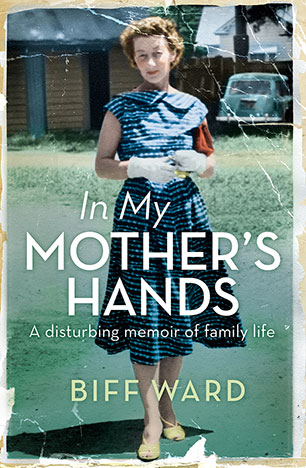
Look carefully at that front cover. A well-dressed, attractive woman stands in front of a suburban house, her hair permed, in a stylish dress with white gloves.  Those gloves are important: they encase the gouged, ravaged hands of Biff Ward’s mother Margaret.  Despite the nostalgia-infused image of Margaret Ward on the cover, this is the story of a troubled and desperate woman and mother, told by her daughter.

Biff ( a childhood rendering of ‘Elizabeth’) Ward is the daughter of Russel Ward, the noted Australian historian who wrote The Australian Legend. This book was a hugely influential study of the Australian Character (the question that keeps on giving), published more than fifty years ago. Although perhaps not so well known today, The Australian Legend and its author were examined anew at a symposium in 2007 (proceedings found in the Journal of Australian Colonial History 10.2 (2008) with a summary here) and re-addressed each year through the Russel Ward Annual Lecture  (see Babette Smith’s lecture here)

Although Biff’s memoir focusses on her mother, it is just as much a study of her father and of the family dynamics that operated when dealing with mental illness, shame and fear in the context of  the 1950s and 1960s. Biff and her brother Mark had always known of the existence of an earlier child, Alison, who had died at the age of four months,but the conditions surrounding Alison’s death were murky. What was clear, though, was that their mother Margaret was a deeply disturbed woman.  Those gloved hands, torn and rubbed raw by Margaret herself, also throttled Biff as Margaret crept to her younger daughter’s bedside one night, and it was when Margaret threatened the lives of her two remaining children while her husband was absent at a conference, that Russel Ward finally had her committed. Although Biff felt that they were dealing with the nightmare of their mother’s illness in secrecy,  many people were aware of it, as Biff herself recognizes later.  In reading a short story ‘Friends in Perspective’ published by Gwen Kelly in a Meanjin article  in 1990 (available for Victorian readers through SLV), Biff realizes that  both Russel and Margaret were the topic of gossip and judgment throughout the small academic communities at ANU in Canberra and UNE in New England.  She has the maturity and grace to recognize that the academic wives may well have been reaching out to her mother as well, instead of just gossiping about her.

She captures small university-town life well, and places her father within the academic milieu of the  communist-phobic 1950s and 1960s.  She draws on Russel Ward’s own letters to his parents and sisters that documented Margaret’s progress, and to a lesser degree on Ward’s own autobiography which largely elides Alison’s death and Margaret’s illness. I found it interesting to read about the smallness of the Australian History fraternity at the time, and the intellectual isolation of local academics in a  world where international conferences and networks were luxuries.

Biff did not write this memoir until both her parents had died. She is well aware that she is exposing her mother, and perhaps from a sense of moral even-handedness, she exposes her father’s sexual addiction as well. Even writing as an adult, as Biff does, it is impossible to tease out cause and effect in this addiction, but it does raise the issue of omission in memoir. Is there more? or less? of an imperative to reveal the flaws of a public figure, as distinct from someone unknown? (I’m reminded here of journalist Laurie Oakes’ exposure of politican Cheryl Kernot’s extramarital affair when she omitted it in her own autobiography).  Although Ward’s revelations about both parents are startling, the tone is wistful rather than vindictive, and while she censures both parents at times, her compassion shines through.

There’s a fairly lengthy extract from the book here, which will give you a taste of the easy  narrative that, at the same time, reveals so much darkness and pain. You’ll spend quite some time turning to that image on the front cover.

Other reviews:

Sue at Whispering Gums and Jonathan at Me Fail? I Fly! have written sensitive reviews of this book

aww2016 I’ve reviewed this as part of the Australian Women Writers Challenge for 2016.
My rating: 9/10

Sourced from : Yarra Plenty Regional Library e-book . Read in one sitting on an international flight!


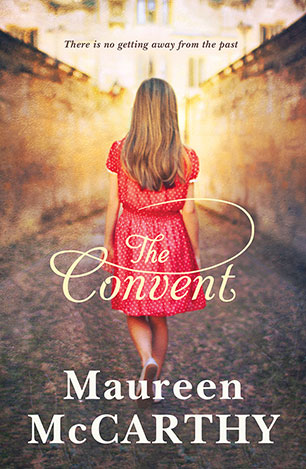
‘The Convent’ by Maureen McCarthy

mccarthy

2012, 418

You know, the tourism industry should fall to its knees sometimes and thank local activists who save significant buildings and places from being privatized and subdivided into exclusive housing that most Melburnians will never set foot in.  Then somehow it becomes a tourist precinct, and money can be made from it, and people forget and wonder that it was ever under threat.

Abbotsford Convent is such a place. On a bend of the Yarra River, the land was valued by the Wurundjeri people who frequently met nearby where the Yarra River and Merri Creeks merged.  John Orr built Abbotsford House there and Edward Curr (who was a prominent opponent to Judge Willis) lived at the nearby St Heliers property  between 1842-1850.  By 1863 the Sisters of the Good Shepherd had consolidated their purchases of Abbotsford House and St Heliers and established a convent there.  In 1900 it was the largest charitable institution in the Southern Hemisphere, housing up to 1000 residents. For a century it provided accommodation, schooling and work for female orphans, wards of the state and girls considered to be in “moral danger”, financing its activities through farming, its industrial school and the Magdalen laundry service.  It was a place of dedication for the nuns who lived there, but many of its residents- particularly those in the laundry- had sad and bitter stories to tell.  In 1975 it was sold and used for the following 20 years by different education providers.  In 1997 it was onsold to developers, who planned to build 289 apartments on the site.  The Abbotsford Convent Coalition fought hard against this plan, and in 2004 it was gifted to the public by the State Government.  It now houses studios, office spaces and cafes and is the site for a lively program of performances and markets.

The Abbotsford Convent is the setting for Maureen McCarthy’s book named, appropriately enough, The Convent.  Based on her own family history, the book covers four generations of women whose lives intersected with the convent and the nuns who lived there.  Nineteen-year old Peach takes up a summer job at the convent when she receives a letter from her birth-grandmother, Ellen.  Peach has always known that she was adopted, and has until now felt no real curiosity about her birth-mother.  We learn that her grandmother Ellen had been raised at Abbotsford Convent after her mother Sadie had been declared an unfit mother in WWI Melbourne.  Ellen’s daughter Cecilia had been a nun at the the same convent.  The book shifts from one character to another, and between time periods spanning the early decades of the twentieth to the twenty-first century.

Books that rotate their focus between characters  call on a certain amount of goodwill on the part of the reader.  I found myself far more engaged by the stories of Cecilia and Sadie, and almost resented being brought back to the rather quotidian life of  19 year old Peach (and is it too trite to complain that I really disliked the name ‘Peach’ even though I know why it was used?) I felt that Cecilia, the nun, was sensitively drawn and McCarthy’s research into cloistered life, although somewhat heavy-handed, made Cecilia a rounded and nuanced character.

McCarthy is best known as a Young Adult writer.  The subject matter of the book transcends that genre, but the book was weighed down for an adult reader by the rather too obvious narrative scaffolding that supported the dialogue, and the rather laboured descriptions.  It reminded me very much of Rod Jones’ The Mothers (which I reviewed here) and it’s interesting that I found both these books, so similar in their content, to be too simply told.  Could it be that because both these stories had their origins in their author’s own family history, the overriding concern was to treat the story with respect, and that this affected the telling?  I have no idea, but with the exception of Cecilia’s chapters, I couldn’t shake my awareness that this book was written for a much younger audience than I.

There’s an interview with the author at:

http://www.abc.net.au/radionational/programs/booksandarts/the-convent/4395928

aww2016 I have read this as part of the Australian Women Writers Challenge 2016.

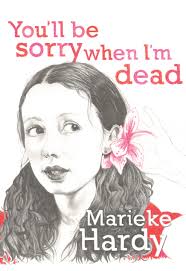
‘You’ll be sorry when I’m dead’ by Marieke Hardy

hardy

2011, 295 p.

Celebrity is a trade-off.   The celebrity figure gaily trumpets “look at me!”, and accrues public recognition, freebies, attention and the aura of self-possession. In return s/he is subjected to the audience’s misplaced sense of identification and friendship, or conversely, approbation and smug censoriousness. And so I sit watching ABC’s Book Club (until a few years ago the First Tuesday Book Club, a handy reminder to tune in) alternately tut-tutting at Marieke Hardy’s fey girlishness with those plaits and tats one minute, and wishing a moment later that I was so winsome and witty myself. It was probably this ambivalence that led me to pick up her book You’ll Be Sorry When I’m Dead. Having read it, I’m still ambivalent, although probably with a more affectionate glow than previously.

As you might expect, it’s well-written and funny. Its chapters are similar to long-form pieces that you might read in a Saturday newspaper magazine  and indeed several of them have been published in that format previously. She’s self-deprecating and self-assured; she delights in being wicked and revels in her exhibitionism. She tells of her obsession with prostitution, her fumbling attempts at swinging, and her mortification at travelling with her parents at the age of thirty-five. Many of her stories are Melbourne-centred, as in her tribute to VFL footy ‘Maroon and Blue’, one of my favourite stories. She flits around the edge of showbusiness through  her family pedigree and her own child-actor CV and laughs at her own adolescent pursuit of one of the ‘stars’ of Young Talent Time. Some stories have more depth: her story ‘Forevz’ reminded me of Helen Garner’s The Spare Room – in fact, there were quite a few stories here which evoked Helen Garner for me, for some reason. The placement of the stories seems quite random, as does the insertion of testimonials from some of the people she has written about (an affectation I could have done without, really).

Like the celebrity persona she projects, there’s a mixture of show-off and razor-sharp penetration. I found myself laughing out loud in places, tearful at times, and rolling my eyes in other places. It’s a good dip-into book, and just as in ABC Book Club, you don’t really know what she’s going to come out with next.


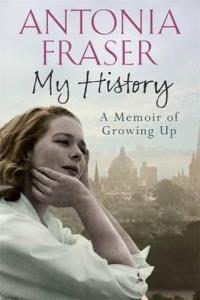
‘My History’ by Antonia Fraser


fraser

2015, 320 p

Clever little title for a historian’s memoir, this. “ My history” in terms of background, family, early life etc and “my history” in terms of Fraser’s professional identity and published works.  I generally enjoy reading historians’ memoirs. They usually have the skills to put together a satisfying narrative arc ( or at least, you’d hope that they do). I enjoy reading about their intellectual and academic growth, and their perspectives on the writing process. I quite like the namedropping if it’s an area I’m familiar with (and read through gritted teeth if it’s not).

I’ve read quite a few Antonia Fraser books, all before I began blogging (Six Wives of Henry XVIII; The Gunpowder Plot; Marie Antoinette: The Journey). Oddly, though, I’ve never really thought of myself as a fan and I find myself recoiling a bit from the very proper and so terribly British persona she projects when I’ve seen her interviewed. However, I also read, and blogged The Perilous Question which I thought was excellent, and because it was based on a phenomenon -in this case, the 1832 Reform Act- rather than a person,  quite a different endeavour to her other books.

She was born in 1932 as Antonia Pakenham, the daughter of the 7th Earl of Longford, named after Willa Cather’s book My Antonia and pronounces her name that way (AN-ton-ee-a). Her parents sound interesting: her mother was a Unitarian and a later convert to Catholicism, along with her husband and children. Antonia’s parents were both Socialists and both well ensconced within the gentry, a combination which I find fascinating. In many ways, she ‘grew into’ her parents as she became older. She attended Dragon School and St Mary’s School Ascot and went to Oxford University through Lady Margaret Hall. However, she describes herself as a less-than-brilliant student and went to work at the publishers Weidenfeld and Nicholson as an all-purpose assistant.

Despite this less than stellar academic career, she was always drawn to history, most particularly the story of Mary Queen of Scots. It was only when her mother, herself a historian, mooted writing a biography of Mary Queen of Scots that Antonia threw herself into what had been until then desultory research, to fend off her mother’s interest in what she saw as “her” topic. It was the first of Fraser’s books, published in 1969, followed by other biographical works with a particular focus on royalty, but she widened her scope over time. She has also written crime novels and an account of her relationship with playwright Harold Pinter, her second husband.

Lady Antonia Fraser is titled three times over: first as the daughter of the Lord of Longford; then through her first marriage to Sir Hugh Fraser, the Tory politician (to whom she says she was attracted because of his politics on the colonies), then finally as the recipient of a DBE (Dame Commander of the Order of the British Empire) in 2011 for her services to literature.

There’s quite a bit of name-dropping in this book, and the first chapter was disconcertingly genealogically-based. Fortunately, it picked up after clambering around in the branches of family trees and I found her account of her racketty-gentry upbringing interesting (although quite foreign to this antipodean reader). At the end of the book she discusses some of the difficulties of biography-writing, most particularly the telescoping of time when the subject’s life grinds to a slow pace. Like all biographers, she speaks of the emotional experience of seeing letters written by her subject, and her love of “optical research” (i.e. touring around visiting places of significance in her subjects’ lives).

In all, a capably written memoir, as you might expect, but one that underscores that Fraser is not firmly ensconced within the world of academia. It gives an interesting perspective on a WWII gentry upbringing, and although it didn’t make me fall in love with Fraser as a biographer (as Richard Holmes’ memoirs did here and here), it did me a new respect for her biographical works.  I’m not sure if she’s still working- born in 1932 she’s getting on a bit- but she certainly has a solid body of work to her name.

‘Histories of the Hanged’ by David Anderson

anderson_hanged

2005, 406 p.

(I commenced this review in November immediately after finishing the book: I am now writing it nearly two months later, drawing mainly on the impressions that I took away from the book. I regret not writing this review earlier, because much of the nuance has escaped me.)

It was been a strange experience, reading this book in Kenya at this particular time.  The city teems with Kikuyu people whose parents (if not they themselves) would have most certainly be touched by the Mau-Mau rebellion in one way or another.  The battle for reparations from the British government now plays out in British courts  (see here and here)  and in September 2015 the British government funded the erection of a commemorative sculpture in Uhuru Park as part of reparation payments.  Most pertinently for me at the moment, the response to Mau Mau described in this book has resonances in the current political and legislative response to ISIS and religiously-inspired terrorism that we’re witnessing today.

So what was the Mau Mau rebellion, or uprising or revolt or Kenya Emergency (which ever term you want to use?) It was a military conflict that took place in Kenya between 1952 and 1960. As David Anderson, the author of this book explained in a short article for History Today:

The end of British colonial rule in Kenya was bloody and brutal. In October 1952 a state of emergency was declared to fight the Kikuyu insurgents known as Mau Mau. The rebellion was defeated by 1956, but emergency powers remained until January 1960.

The British made extensive use of detention without trial and applied the death penalty to a wide range of offences. The official rebel death toll was above 10,000, but the real figure may have been double this, while the rebels assassinated over 2,000 African ‘collaborators’. The story of this struggle has been presented in Kenya as one of nationalist heroism, and in Britain as an episode in the deconstruction of empire: but both views are under challenge. …

This gritty struggle divided the Kikuyu communities of central Kenya: many people were unwilling to support violence, and Kikuyu Christians in particular stood against the rebels. The British nurtured a ‘loyalist’ movement, recruiting more than 60,000 Kikuyu men: much Mau Mau violence was aimed at these ‘collaborators’. Loyalists gained considerably in terms of property, land and political rights, while rebels and their supporters were imprisoned and dispossessed.

– See more at: http://www.historytoday.com/david-anderson/burying-bones-past#sthash.pwr8RgXn.dpuf


Anderson commences his account by contextualizing it within the politics of empire and colonialism generally. World War II had given a huge boost to the settler economy, and capital was flowing into White Highland farm mechanization, boosting the confidence of white settlers to contemplate forcing Kikuyu squatters from what had been their traditional lands, thereby triggering the Mau Mau rebellions. He points out that in the 1950s Britain was moving towards independence generally for the former colonies, but that in both Rhodesia and South Africa, the white minority had managed to entrench its power and it seemed likely that a similar phenomenon would occur in Kenya as well.

Anderson draws upon court reports, both from the Supreme Court and the Special Emergency Assize Courts in order to populate his book with individuals, on all sides.  This emphasis on the individual, instead of the ‘mob’ is important, as it always is when fear of the ‘other’ is being evoked and whipped up.  The names of the Mau Mau generals are well known, but through the meticulously detailed court records, he finds the  shadowy and nameless “subalterns of the movement”: the food carriers, the oath administrators and the ordinary foot soldiers in the forest.

In Anderson’s focus on court records and processes, I found resonances with my own work looking at colonial courts during the 1830s-40s.  In Kenya in the 1950s, as in colonial courtrooms more than a century earlier, the court became the site in which the different political impulses of society were aired, but often shut down just as quickly to ensure that the political dimension of unrest was ignored. As in the 1830s slave colonies, Governors had to use legislation and special tribunals to circumvent settler (or in the case of the slave colonies, planter) dominance of the bench, and a small number of  judges sometimes raised their voices, albeit futilely, against legislative and political overreach. Many other judges, however, acted as the ultimate manifestation of systemic injustice  and repression, and became the state-legitimated enforcers of settler power.  In a foreshadowing of the emphasis of many governments today to ensure that punishments for terrorist offences are not ‘complicated’ by legal ‘niceties’ in the conventional legal system, the Special Emergency Assize Courts were promulgated in Kenya to ensure swift, uncompromising, consistent sentencing intended to quash Mau Mau action.

Local white settlers saw Mau Mau as a savage, depraved tribal cult. Certainly, this was intimate, close-up violence. However, in a foreshadowing of our current conceptualization of Islamic radicalization as an ‘evil’ that can be ‘cured’, Louis Leakey and other ethnographers advised the local and British governments instead that Mau Mau was an illness, innate to the African in transition. Emphasis was laid on confession and rehabilitation, which led in turn, to large-scale detention camps- a prospect not entirely impossible today in our present-day quest to stamp out extremism. The outlines of Abu Ghraib are detectable in the detention camps that swallowed up huge numbers of the population.

As Anderson presents it, there was violence on all sides, including within the Kikuyi themselves . It was, as he says “a story of atrocity and excess on both sides, a dirty war from which no one emerged with much pride, and certainly no glory.” p. 2  He questions the role of Jomo Kenyatta in the rebellion, and notes his influence in shutting down any discussion of Mau Mau in the years immediately following. Anderson is obviously ambivalent about the recent memorialization of Mau Mau as an expression of political liberation.

Anderson’s work in this book, as well as that Caroline Elkins in her book Imperial Reckoning: The Untold Story of Britain’s Gulag in Kenya, are part of the ongoing debate about the nature and scope of  the Mau Mau rebellion. I read this book as an outsider, unfamiliar with the field, and I found Anderson’s writing engaging and easily accessible.  I know too little to assess his arguments, but I very much enjoyed his emphasis on the individual and the myriad influences that led all sides to act as they did. It strikes me as a balanced, nuanced appraisal, grounded in primary documents, with an eye to providing an informed and sober contribution to  current politics.

Bernard Porter has written a detailed review of both Anderson and Elkins’ work in the LRB that is far more erudite and detailed than anything I could hope to write.  There’s also an excellent podcast on Mau Mau at http://www.radiolab.org/story/mau-mau/


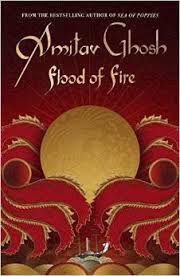
‘Flood of Fire’ by Amitav Ghosh

ghosh_floodoffire

2015, 607 p.

Yes, I know that I vowed after reading River of Smoke that I’d only read trilogies that were finished, so that there wouldn’t be a long gap between volumes. But I’d already read the first two books; Flood of Fire was sitting there on the library shelf;  and I did enjoy the first two, didn’t I?  And so,  having checked my own blogposts, and armed with the Wikipedia synopsis of the first two books, once more I ventured forth into this final, 600 page volume.

I found that I really needed the synopsis because this book draws together the narrative of the first two volumes. Sea of Poppies had focussed on the passengers on the refurbished slave-trader boat the Ibis; the second volume River of Smoke shifted to two other boats in the fleet, the Anahita and the Redruth. In this final volume, characters from both preceding books are thrown together, on opposing sides, in the First Opium War of 1839-1842.  As with the other books in the trilogy, it is exhaustively researched (evidenced by the long reference list at the end) and pointedly political.  As a work of informed, fictionalized history it flirts with the boundaries between fact and fiction, especially with the character of Neel Rattan Halder, who even now,  after I spent ages looking on the internet, I’m not sure was an invention or not. (Ghosh’s epilogue suggests that he is a historical figure who generated a rich documentary archive- but I’m not sure. Is the epilogue part of the story too?)  There’s an interesting interview with Ghosh posted here on his website where he discusses methodology.

As with the earlier books, there is re-invention (such a strong theme in colonial social history, as Kirsten McKenzie had shown in her work) and slippage between racial boundaries, caste and political loyalties. These themes are shot through with a trenchant critique of colonialism and the free trade philosophy trumpeted by British commercial interests to justify the opium trade. Ghosh’s historical argument is more overt in this book than in the preceding ones, where it was played out mainly through his characters.  Nonetheless, here too, he uses characters, most especially Zachary Reed and his illicit relationship with Mrs Burnham, to exemplify the transformation of seduction into blackmail,  a metaphor for the way that opium itself lured, then became an instrument of power and coercion.

Even though I admire the historical thoroughness of the book, I did find myself bogged down in the descriptions of battle, even though Ghosh was John Keegan-esque in depicting the visceral assault of the battlefield.  There was a long build-up to the battle scenes as Ghosh rotated between a small number of key characters, and I was on the verge of finding the long wind-up tedious and wishing that he’d just get on with it.

I think that I’ve had enough of the Ibis trilogy, and I suspect from the afterword that Ghosh might have too.  He leaves the door open for other books with an open-ended conclusion, but he seems to suggest that the whole thing is such a huge endeavour that no one person came finish the huge, complex embroidery that he has begun.  I think that’s how I’m happy to leave it: sated, and full of admiration for the narrative and research sweep that he has laid out before us.

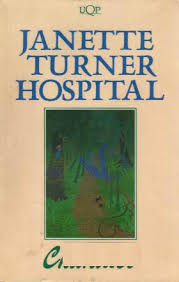
‘Charades’ by Janette Turner Hospital

charades

1988,  345 p

I hadn’t heard of this book at all, although I’ve read several of Janette Turner Hospital’s books previously (see here and here for reviews).  It was written in 1988 which is, after all, quite some time ago, and was included in the New York Times Book Review‘s fifty most notable novels of 1988. It was long-listed for the Booker Prize, and shortlisted for the Miles Franklin, the Banjo and the Adelaide Festival National Fiction Awards.

Stripped back to its bare bones, it’s the story of a rather lecherous Canadian university lecturer in physics, Koenig, who embarks on a relationship with a young student who, between bouts of frantic and sweaty lovemaking, regales him with stories of her search for her father and her unconventional mother.  The stories distract Koenig from his own woes about his wife’s breakdown, the end of his marriage and his son’s conversion to the Moonies.

That’s the simple version.  It’s also a riff on Scheharazade, story-telling and truth.  It’s all a bit contrived: we have the rather twee twist on ‘Charade’ as the young student’s name.  Add to this some rather laboured complications of physics and the uncertainty principle. Hence we have Bea, her mother, or ‘B’ (as in the B-narrative) and Kay, her ‘aunt’ (as in K, the symbol for constant value in physics), Nicholas Truman (true-man) and the mysterious Verity.

It’s not an easy book, and I very nearly abandoned it after Part I. But just at that point, either it improved or I succumbed to it, and I’m glad that I did. As a reader, you have to tolerate leaps between the frame story and flashbacks, and to have one story immediately contradicted by an alternate story.  At this point, you just have to hold on and trust Turner Hospital that she’s going to hold it all together- and she does, largely.

I could have done without all the physics, which nearly tipped me over the edge.  There are elements of this book that she repeats in later work (looking for lost parents; mobility and dislocation; the Queensland setting; bohemianism etc) and I think that she has become more refined and controlled in her writing over the decades.  But the book is worth persevering with, and is a satisfying read as you reach the end.  The word ‘virtuoso’ is often used to describe her work and it’s apposite: she flies high and takes risks.  It’s exhilarating, but not comfortable.

Posted to the Australian Women Writers challenge site as surely my final contribution for the year!

aww-badge-2015-200x300

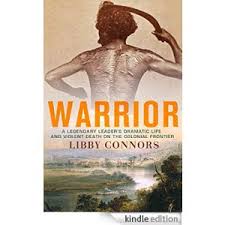
‘Warrior’ by Libby Connors

connors

2015, 280 p.

If you, like many others, watched the ABC production of Kate Grenville’s The Secret River, then you should read this book. Think back to the silent, foreboding presence of indigenous people as they filed past the boundaries of what William Thornhill thought of as ‘his’ land, inscrutable, chilling, ethereal. There was a simple logic at play: settlers wanted the land and the aborigines wanted them gone. Kate Grenville complicates William Thornhill’s response and renders it explicable, even if it’s a response that we’d like to distance ourselves from. But beyond the defence of their country, the actions of the indigenous protagonists, in Grenville’s book and in settler reports of the time, remain fragmentary, apparently random and unknowable. Until now.

Libby Connor’s book Warrior challenges the simple classification of aboriginal ‘outrages’ as random, undisciplined and ultimately futile. Instead, she returns logic and agency to the indigenous tribal groupings in south-east Queensland during the pre-Separation days of the frontier. She does this through the story of Dundalli, a Dalla man who was executed in January 1855 for the murder of Andrew Gregor and his pregnant (white) house-servant Mary Shannon in an attack on the Caboolture River. White justice had taken twelve years to catch up with him. In the meantime, Dudalli had taken on mythic proportions by evading capture repeatedly, and his name became a byword for all ‘outrages’, whether he was involved or not. When he finally faced Supreme Court judge Roger Therry in a Brisbane circuit court hearing, in effect lawman-to-lawman, it was the judge who was intimidated by this tall, imposing  leader, and not the other way round.

Libby Connors is a historian who has written a great deal on the interaction between British law and indigenous people. She is well placed to go through the evidence, the courtroom arguments, the legal principles and the punishment regimes of white settler justice. But the real achievement in her work is in fleshing out Dundalli, so that he is more than one of those silent wraiths of Grenville’s book. Drawing on the memories of a tribal man recorded as an oral history during the 1950s , she is able to reconstruct (albeit through extrapolation) the nature of a Dalla childhood and adolescence than Dundalli is likely to have experienced. Using documents generated by white missionaries, bureaucrats, settlers, anthropologists and historians, she gives Dundalli’s leadership a context by mapping out the intra-tribal politics and strategies utilized by different groups in what is now the Sunshine Coast/ Brisbane area. These politics were instrumental, pragmatic and fluid. One group might encourage the establishment of a mission on tribal land as a means to gain access to technology that ensured supremacy over other groups; another might consciously defer to white justice in order to fulfil the demands of their own indigenous justice. The British and Indigenous justice systems existed, and continued to exist, side by side, and she highlights that both systems of law were mutable and in tension with the other.

The book is beautifully written and imbued with a deep sense of place. A map that appears in the opening pages shows indigenous places superimposed onto familiar Western towns and rivers, highlighting the co-existence of two competing senses of ownership. Her frequent references to present-day Brisbane and Sunshine Coast landmarks would prick the consciousness of residents of those places, reminding them that another history runs alongside the sun, cosmopolitanism and tourism of both those places. When you find yourself overwhelmed by who’s who, and which group is which, you turn the page and there is a table; when you think ‘gee, a map would be handy here’, there it is. The text flows effortlessly, and the footnotes are unobtrusive, but when you look at them closely, you realize just how intricate and painstaking her construction of indigenous polity is.

This book has received the Queensland Premier’s Award for a work of State Significance, and I noticed that it was on the top of the list of recommended reading for Prime Minister Turnbull over his Christmas break issued by the Grattan Institute this year. It’s a tremendously important book. Many historians over the past forty years in particular have written, as Henry Reynolds does, of “the other side of the frontier” surveying the resistance of indigenous people to their dispossession across the frontier as a whole. What this book does is hone in on one particular location; one constellation of tribal groups; a set of named, individual leaders. It will make you pause the next time you read of an ‘aboriginal depredation’ in fiction, see it depicted in film or read it reported in settler testimony. It does what the fictional William Thornhill couldn’t, and white British justice wouldn’t do. It makes sense of what was perceived by settlers as brutish retaliation and gives it a legal, political and environmental logic, embedded in power structures negotiated and contested between intelligent, strategic and courageous leaders of men.

aww-badge-2015-200x300

I’ve posted this review (the last for the year) to the Australian Women Writers Challenge website.


‘Australia Under Surveillance’ by Frank Moorhouse

moorhouse

2014,  298 P.

I was too young and too tightly restrained by my parents to become involved in the Vietnam Moratorium Marches or any other form of political activism during the 1970s. (I waited for middle-age to indulge!)  I think it highly unlikely that I have an ASIO file, although I remember reacting with a jolt when a congregation member at the Melbourne Unitarian Peace Memorial Church mentioned in passing that there was probably an ASIO agent within our midst. He may have been right, and he almost certainly would have been right during the 1950s- 80s.   In recent years, activists writers and performers who were of interest to ASIO have been able to access their files from 30 years ago and found a curious mixture of banal, puerile and chilling reports on their activities.

Frank Moorhouse was one such person of interest, and I was attracted by the subheading to this book “Frank Moorhouse takes a look at the organisation that has been watching him”.  I am rather embarrassed to say that I haven’t read any of his works (I do have them on the shelf though) but I was aware of the essay ‘The Writer in a Time of Terror’ that he wrote for the Griffith Review in Summer 2006-2007.   It was highly acclaimed, garnering the PEN/Keneally Award, the 2007 Alfred Deakin Award for Best Essay in the Victorian Premier’s Literary Awards 2007 and the  Walkley Award for Equity Journalism. Three other essays followed (listed below).

This book draws heavily on the essay- very heavily, I found when I double-checked. I enjoyed most the parts where he spoke about his own entanglement with ASIO (or more properly, ASIO’s entanglement with him) but I did find the rest of the book rather bitsy. It is structured as seventeen chapters, but each chapter has the appearance of being a separate part, with its own title page.  Visually and in an argumentative sense, such overt separation of the chapters disrupts the flow and suggests a significance to each discrete chapter which is not perhaps justified.

There is a rather curious and lengthy chapter entitled ‘The Interview with Director-General David Irvine- My File Keeper’.  Over sixty pages in length, it is a  transcript of Moorhouse’s interview with the  ASIO Director General. It starts with Moorhouse describing how the interview was set up, and noting that he has “smoothed it out- removing repetitions and irrelevancies, completing sentences” etc.   He also includes “interpolations and commentary” in squared brackets which, for me, compromises any attempt at verbatim reporting.  He excuses such methodological untidiness by admitting that while such a practice gives

the advantage..that I have, as it were, the last word.  But this interview is certainly not the last word from either of us on any of the issues discussed. (p. 158)

Nonetheless, it is a chilling chapter, made even more so by the recent appointment of the same former Director-General David Irvine as the new advisor to the new Border Force.  In many ways recent events have raised the temperature even more, especially with the announcement by those black-clothed Border Force officers that they would check the papers of anyone they encountered – a half-baked plan that was abandoned very quickly in response to  immediate community outrage.  I was already unnerved by this development and after reading Moorhouse’s book I am even more so.

In his acknowledgments, Moorhouse notes that this book came together after eight years. The essays that formed the basis of the book were  ‘The Writer in a Time of Terror’ Griffith Review (summer 2006-2007); ‘Beyond Stigma’ (Griffith Review 33); ‘Dark Conundrum’ (Griffith Review 41) and ‘Pocket Litter and Two Jokes’ (Sydney Morning Herald 29 August 2014). He later notes that “The Writing and editing of Australia Under Surveillance was, for personal reasons very difficult”.  He himself describes the book as “an eight-year exploration rather than an argument for a thesis….”. Perhaps, given its unevenness, it is best read that way.

On a related matter, the National Archives in the UK  have just released the files on Burgess and Maclean, part of the Cambridge Five spying ring.

http://blog.nationalarchives.gov.uk/blog/burgess-maclean-revelations/