Category Archives: Book reviews

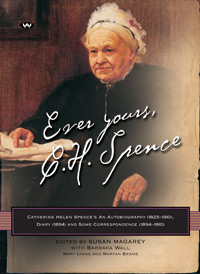
‘Ever yours, C. H. Spence’ ed. Susan Magarey, with Barbara Wall, Mary Lyons and Maryan Beams

everyours

2005, 356 p & notes

The autobiography is a strange beast.  Unlike the diary which may or may not have another reader in mind, there is usually an assumption on the part of the writer that someone is going to read it, one day.  Although the distinction between autobiography and memoir is fuzzy (see here and here), I tend to see an autobiography as a chronological account, driven by the passing of time, where a memoir is a more consciously created ‘literary’ object, shaped by themes and tropes and where time is elastic.

In this book edited by Spence’s major present-day biographers, Susan Magarey and Barbara Wall,  we get autobiography, diary and letters carefully and usefully annotated. Taken together, they build up a vivid picture of the transnational networks that Spence developed and drew upon, confounding our picture of a little old lady in black dress and lace cap.

More than half of the book is devoted to Catherine Helen Spence’s autobiography. It appears to be a good old-fashioned autobiography,  starting at the start and ending at the end.  But it’s not. Only about 2/3 of it was actually written by Catherine Helen Spence herself.  It was always destined for publication in serialized form in the South Australian Register and when Spence died in 1910 she had the first three chapters typeset ready to go, and the following 13 chapters in manuscript.  Indeed, she was working on it when she died. Her friend Jeanne Young, a fellow-activist some fifty years Spence’s junior, completed the other eight chapters after some tussling amongst surviving family members.  In an attempt to make the change in authorship appear seamless, Young completed the remaining chapters in the first person, drawing on Spence’s diaries and her own knowledge of Spence’s movements from their mutual friendship.  It’s not a particularly successful ghostwriting strategy as the autobiography loses its ‘oomph’ as it goes along, and it becomes increasingly bogged down in the campaign for proportional representation, the passion shared by both Spence and Young.  It’s true that many people, including Spence herself, said that she was obsessed by proportional representation, but in Young’s hands it dominates the final chapters of the book, unleavened by the reflection and self-deprecation found in the first chapters.

Of course, Susan Magarey and other writers about Catherine Helen Spence have picked the eyes out of the autobiography, as you would expect them to do, and their approaches are easier reading than this autobiography.  But it’s good to read an extended length of Spence’s writing to pick up on her clear, but very 19th century narrative voice, and to observe the digressions and asides.

Jeanne Young went on to write her own biography of Spence (which I haven’t read), and in doing so she used the diaries that Catherine Helen Spence had kept every day of her life.  However, she refused the entreaties of “Mr Pitt of the Archives” to place them in a public repository, and it seemed that the “diaries had gone out with the newspapers”, once Jeanne Young had finished writing her book (p. 214). However, there was one left -Spence’s diary for 1894- and Magarey (I think – it’s not clear in this book which parts were contributed by Magarey and which by Wall) was able to borrow the diary from the protective and nameless private owners for a week to make notes from it.  However, in a letter to the editor of the Australian Book Review in December 2010, following a review of Unbridling the Tongues of Women, Magarey indicated that the State Library of South Australia had been more persuasive than she herself had been, and that the diary was donated to the library and is now transcribed and annotated by Barbara Wall on the Wakefield Press website.  [I must confess to not being able to find it there].

The diary covers only the year 1894, when Spence travelled to America, the UK and Europe. There’s an entry for nearly every day, and while they list her rather exhausting activities and meetings, there’s not really a great deal of reflection here.

The volume finishes with a collection of Spence’s letters to two of the feminist activists from this time: Alice Henry, who was to go to America where she was joined by Stella (Miles) Franklin, and Rose Scott from Sydney.  These letters are more engaging than the diary, and also reflect the buzz of activity in this indefatigable woman’s mind. They’re also affirming of the network of shared interests that  stretched across distance and age to further the causes that people – women and men included- had as their passion.

Source:  Readings bookstore (where they have this on special for $9.99 in hardback at the moment. Just do a search on their website)

Read because: I’m preparing for a giving a talk on Catherine Helen Spence at the First Unitarian Universalist of Melbourne Fellowship service this week.

This review has been added to the Australian Women Writers Challenge 2018 database.

AWW-2018-badge-rose-199x300


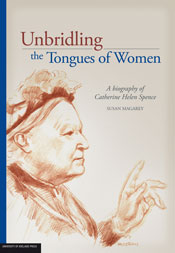
‘Unbridling the Tongues of Women’ by Susan Magarey

Unbridling175

2nd edition 2010, (1985) 214 p.

Available as free PDF at https://www.adelaide.edu.au/press/titles/spence/

Catherine Helen Spence observed once that law and custom had “put a bridle on the tongues of women”. When in 1871 she actually read her own lecture to the South Australian Institute, instead of handing it over to a man to read, she said she did so “to make it easier henceforth for any woman who felt she had something to say to stand up and say it”. (p. viii)

“Stand up and say it” was exactly what she did over her long life.  As a novelist, journalist, board member, preacher, political figure and suffragist, she put her words before the public.  Magarey has chosen her title well in this biography, which highlights the breadth of Spence’s interests and why she well deserves the praise bestowed on her at her 80th birthday party as “the most distinguished woman they had had in Australia”.

Magarey’s second edition starts with a new introduction where she corrects and supplements some of the observations that she made in her original 1985 text.  I suppose that an introduction to a new edition does need to go at the start, so that your antennae can start quivering when you come across a point that she later corrected. But I must say that I found the introduction far more interesting after I had read the book.

The book does not follow a straight chronology as such, because it slices her life thematically. In the Introduction to the original 1985 edition, she gives an overview of Spence’s life, starting with her arrival in Adelaide in 1839, just after Adelaide’s establishment as a Wakefieldian colony. She quickly traces Spence’s career, claiming her as “Australia’s first feminist” – not so much in terms of political action, but through her ability and determination to break into the national conversation.

Chapter 1 ‘Acquiring a room of her own’ backtracks on Spence’s childhood, starting with her parents’ marriage in Scotland and the family emigration to Adelaide.  After her father died, Catherine was spurred to earn money through teaching to help support her mother and siblings.  Although she had two proposals of marriage, she decided not to marry because of the independence and pride earning her own money: a decision which opened up opportunities that might not have otherwise been open to her. But it was an inheritance through her aunts back in Scotland that made it possible for her mother to purchase the house in which Catherine could have the ‘room of her own’ that Virginia Woolf saw as crucial to a writing life, living alongside her mother (with whom she had a very close relationship) until her mother’s death.

It was in her ‘room of her own’ that Catherine began her novelistic career, which Magarey deals with in Chapter 2 ‘The line of least resistance’.  Having not read any of Spence’s fictional work, I found this chapter a little opaque, although I am impressed and fascinated by Magarey’s summary two of her later stories.  Handfasted seems to promote a particularly liberated view of marriage for the time, and A Week in the Future, set in 1988, seems to be a loosely-disguised fictionalization of Spence’s political ideas.

Chapter 3 is titled ‘Faith and enlightenment’, and it was for this chapter that I read the book, as I’m giving a presentation (oh, the presumption!) on Catherine Helen Spence at our Unitarian fellowship this coming Sunday (details below). Spence was a Presbyterian, but she was ‘converted’ to Unitarianism, a verb which does not sit comfortably with Unitarians today.  She was brought to Unitarianism through contact with her friend Emily Clark, and was attracted to Unitarianism’s emphasis on rationalism and faith. Spurred by the example of Martha Turner, the Unitarian minister from Melbourne and the first woman preacher in Australia, Spence was a regular speaker at the Adelaide Unitarian Christian Church.  Her addresses from the pulpit covered a wide range of topics, even if the minister at the church sometimes felt that the politics expressed were not appropriate.

Although she complained that the Adelaide Unitarian church was rather insular, she (and other members of the congregation) moved into secular philanthropic enterprises as an expression of their spirituality. In Chapter 4 ‘Edging out of the domestic sphere’ Magarey addresses the philanthropic work in which Spence was involved which built on her Unitarian connections. In particularly she deals with the Boarding Out Society which took children from impoverished homes and placed them with more respectable working class families.  It’s a strategy that does not sit well with our attitudes today, and Magarey bats off (rather stridently, she admits in the introduction to the new edition) the criticisms of other historians including Kay Daniels who see the scheme as a form of middle class imposition onto working class culture.  It was Spence’s philanthropic work that was to lead to her speaking at the International Congress of Charities, Correction and Philanthropy in 1893 in Chicago,  conducted alongside the World Fair, bringing her to an even wider international audience.

Chapter 5 ‘Learning for the future’ traces through Spence’s work in education, noting the evolution in her views over time from her own work as governess and school-owner, through to her support for the state-run secondary Advanced School for Girls. She wrote a textbook that was used for many years ‘The Laws We Live Under’.

Her public writing is dealt with in Chapter 6 ‘Round woman in her round hole’ where Magarey emphasizes the range of topics that Spence dealt with in her newspaper columns, many of which bore her byline. As she notes in the new introduction, Spence is now recognized as a formidable economic thinker and was an advocate for greater economic equity- although not uniform distribution of wealth.

However, it was her political and economic thinking that led her to become a passionate (to the point of obsession) supporter of proportional representation, dealt with in Ch 7 ‘Prophet of the effective vote’. Her quest for ‘effective voting’ was taken up by the Reform Movement that emerged in South Australia in the 1890s which included the Land Reform League, Single Tax League and Fabians, among others.  She stood for the Federal Convention to discuss the coming federation of Australian states. Although she was unsuccessful, she was the first female political candidate in Australia’s history.

Largely because of her obsession with proportional representation, she came late to the agitation for women’s suffrage, as seen in Chapter 8 ‘The New Woman of South Australia: Grand Old Woman of Australia’.  However, once she turned her attention to it, she was warmly embraced by women’s groups who had been working towards it for years because of her strong and formidable reputation on all sides of politics.  After it had been achieved in South Australia (the first state in Australia), she maintained a strong interest in the suffrage question right up until her death.

When you think about it, there are just so many ‘firsts’ in her life.  I take my hat off to her, and I’m proud of the Unitarianism that I share with her. I wish that she was still there on the $5.00 note as she was in Australia’s bicentenary year.  I take my hat off to Susan Magarey too. This is an engaging biography of a woman with a long and varied life. I’ve been enjoying reading Magarey’s other writing on Spence too, most particularly an essay ‘The Private Life of Catherine Helen Spence 1825-1910) in Body and Mind: Historical Essays in Honour of F. B. Smith.

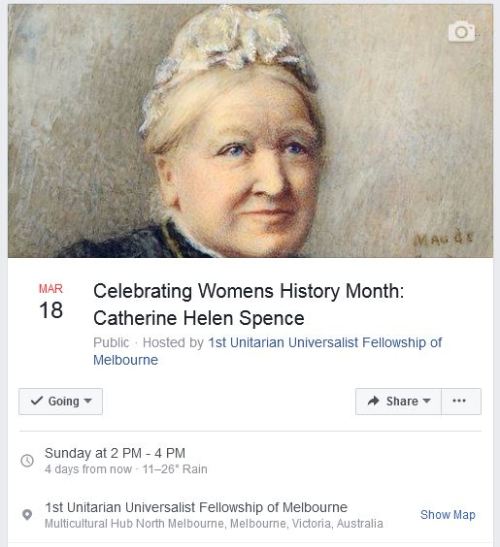
And my talk? It’s on Sunday 18th March 2018 at 2.00 p.m. at the First Unitarian Universalist of Melbourne fellowship, 506 Elizabeth St Melbourne, opposite the Victoria Market. You’d be very welcome to attend.

UUspence


AWW-2018-badge-rose-199x300 And I’ll put this review towards the tally for the Australian Women Writers Challenge 2018.

‘The Neapolitan Quartet’ by Elena Ferrante

A couple of years back the books section of the now much-depleted Age used to publish the independent and chain-store 10 bestsellers for the week.  Month after month both lists were dominated by Elena Ferrante’s books, both in hardback and paperback versions. The Harry Potter books did the same thing, as have Andy Griffith’s scatalogical titles.  What was so good about Ferrante?  Now, long after the hype has subsided and after a year of sporadic reading, I’ve finished all four and now I know why they were on the best-seller lists for so long.

This is a four-part story, released at one volume each year between 2012 and 2015. Set in a poverty-stricken section of Naples in the 1950s, it is the story of a friendship between two women, Elena and Lina. Lina marries young, becomes financially successful, while Elena undertakes an academic and writing career.  Told from Elena’s point of view, Lina is always smarter and more street-smart and, along with Elena, you’re never really sure whether you trust her or not.  Like all long term relationships, there are periods of closeness and distance, and their fortunes ebb and flow, both emotionally and financially.

At times I found myself wondering whether anything really happened in these books. Is the whole thing just a souped-up soap opera, I wondered?

But occasionally, I’d just sit bank and think- Yep, this woman sure can write.  There’s a huge scope of time encompassed in these books, and here’s Ferrante making a masterful transition between a sweeping survey of her own life, and the more minute analysis of her friend Lila’s activities

This is more or less what happened to me between the end of 1963 and the end of 1965. How easy it is to tell the story of myself without Lila: time quiets down and the important facts slide along the thread of the years like suitcases on a conveyor belt at an airport; you pick them up, put them on the page, and it’s done.

It’s more complicated to recount what happened to her in those years. The belt slows down, accelerates, swerves abruptly and goes off the tracks. The suitcases fall off, fly open and their contents scatter here and there…  p. 336

The plotting of the series of books is masterful, clearly planned in its entirety from the opening pages of Book 1 which tie in so neatly with the closing pages of Book 4.  This isn’t a saga with one book added after another once they began to sell well: no, it’s a complete whole, conceived as a unity from the start.   It was always a little difficult to start each volume after a break, but about half way through each one , she’d put her foot to the metal and it was unputdownable.

And what I have enjoyed about reading a series like this is how I’m aware of where I was, as I read each book. Volume 1 I sat up in bed until about 3.00 a.m before leaving for Chile, trying to finish it before I left.  Volume 2 I was reading while the room shook around me in Santiago, and I finished in Cuba.  Volume 3 I read in Dad’s loungeroom, sitting beside him and Volume 4 I read on the balcony up at Marysville.

I have loved these books. They capture so well the ambiguities of a close friendship, and they mark the passing of time and the 20th century development of Naples, with the chains of past family enmities and the allure of modernity.  I flipped through the advertisements for Ferrente’s other books at the back of the volume.  No, I don’t want to read any more.  This was just perfect, just as it is.

‘The Burgess Boys’ by Elizabeth Strout

strout_burgess

2013, 326 p.

The ‘Burgess Boys’ are both lawyers: Jim a hot-shot defence lawyer and Bob, an easy-going, rather aimless legal-aid lawyer, both living in New York.  They are called home by their sister Susan, who needs their legal help after her rather gormless son Zach throws a pigs-head into a mosque, triggering outrage over the hate crime. The family had grown up in the small town of Shirley Falls, Maine but the Burgess Boys had both escaped as soon as they could, leaving Susan a rather embittered, passive single mother after her marriage had broken up. As the title suggests, the family was about The Boys, not her. Shirley Falls had received a large number of Somali immigrants, which had caused tension in the town, which was whipped up further by Zach’s action.

Beside the pig’s head, this is a story of adult siblings who have drifted apart after their parents died. Their father had died while they were young, as a result of a car accident for which Bob felt responsible, and there is a lot of unspoken business between them.

I’ve read quite a bit of Elizabeth Strout in recent years, and I’m starting to wonder if I’ve read too much, because my satisfaction seems to decrease with every book after the brilliant Olive Kitteridge, which I loved. There was too much time spent inside the heads of these rather unattractive people, and the Unitarian minister was so saccharine that I felt ill (AND I’m a Unitarian myself!)  The significance of the  disparity between New York and Maine tended to pass me by, and it felt as if there were just too many issues bubbling away in the pot here.

So, along with writers like Ann Tyler and Sue Miller, whom I’ve enjoyed a great deal in their early books but then felt jaded towards,  I think I need a bit of a rest from Elizabeth Strout.  I’ll come back to her later.

Sourced from: CAE Book Groups

Read because: CAE book group selection (although I missed the meeting unfortunately)

My rating: 7/10

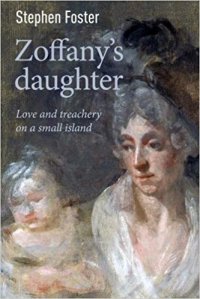
‘Zoffany’s daughter’ by Stephen Foster

Zoffanys-Daughter

2017, 138 p & notes

It must be all those Dickens and Trolloppe BBC miniseries. When you’re reading 19th century colonial letters and newspapers, you’re often engulfed with a sense of deja vu. You’ve seen these dilemmas before; the characters feel familiar- you can even picture the the actor who’s going to depict them when it comes to television…

Except that this feeling of deja vu is an illusion. The past is not just “us in funny clothes” as Greg Dening once said. (Readings/Writings p. 209)  If we’re trying to make sense of people’s actions in the past, there is a whole web of constraints and sensibilities that are largely invisible to us if we’re just relying on imagination and common-feeling. Especially when we’re writing as historians, rather than novelists.

The historian’s methodological self-discipline is exemplified by Stephen Foster’s book Zoffany’s Daughter. As a historian, he encountered a newspaper article from 1825 about the Horne custody case on the Isle of Guernsey.  As he tells it:

 The report seemed irrelevant to the research I was then pursuing – yet I paused, intrigued by a narrative that appeared at once remote and familiar. …Indeed, stories about child custody disputes today seem all too familiar(p.2)

And it is an arresting little story.  After their marriage breakdown, the Rev. Thomas Horne agreed to his wife taking custody of two of his daughters, and paid their maintenance. However, he later changed his mind and demanded the return of his daughters. Cecilia Horne (nee Zoffany – hence the title) hid her youngest daughter Laura and refused to reveal her whereabouts.  This is the story of the case.

As Foster suggests in an epigraph “Most of this story is true.  So far as I know, none of it is false. Much of it is fiction”.  He’s right- if you counted up the pages, much of the book is turned over to the invented journal of Cecilia’s older daughter,  Clementina, who was not part of the court case because her father, after some consideration, allowed her to stay with her mother.  There was a Clementina Horne, but there was no journal. These pages are pure Foster, but as a historian, he operates within the constraints of those invisible sensibilities and the factual parameters of the time.

“Remote and familiar” is how the story appeared to him, and “remote and familiar” is the balance that a historian needs to keep. It’s a balance that Foster explores in reflective chapters that are interspersed throughout this book. In this regard, Foster is very much a present narrator. He strolls onto the stage in these reflective chapters in the first person to discuss various elements of the historiographical challenge.  These are discussed more as discursive, personal, writerly challenges, rather than academic ones. The nature of gossip and its influence on the written record, for example, makes no mention of Kirsten McKenzies’ Scandal in the Colonies, a highly pertinent resource. In his chapter ‘On history and pictures’ he discusses the attempts to find a likeness of Cecilia Zoffany within his self-portraits and portraits of his family.  His chapters ‘On the history of child custody’ and ‘On the rule of law’ explain the colonial law about divorce and custody in operation at the time, and the distinctiveness of Guernsey law.  Methodologically, the most important chapter is ‘On small history’ where he defends the use of microhistory to illuminate a broader picture, pointing to the well-known examples of Ginsburg’s The Cheese and the Worms, Natalie Zemon Davis’s The Return of Martin Guerre (neither of which I have read, I must confess) and Emmanuel Le Roy Ladurie’s excellent Montaillou (which  I have read).

One of the things that Foster does very well was to capture the differences between Guernsey law and society, and the English context which we think we know through Trollope and Dickens.  The French influence was deep-seated, and anti-Catholicism was more nuanced. On the other hand, I don’t know whether Foster gave enough emphasis on the rarity of a situation where a father would grant not only custody but maintenance as well to his estranged wife.  Fathers – or their extended family – kept the children if they wanted them, full stop. Foster acknowledges that the court case split the small Guernsey community, but I think that his sympathies are rather too strongly with the mother, Cecilia.  However, he has the humility to leave judgments about the significance of the case, its lessons (if any) for modern custody cases and the effect on the child to the reader.  Perhaps this is the 21st writer speaking, rather than the historian.

This is a self-published volume, which is an interesting choice by an academic historian, although Foster has also published with Pier9 (a Murdoch company).  Certainly his thanks extend to other well-known historians (Michael McKernan, Alan Atkinson) and the blurb from Ann Curthoys, the author of Is History Fiction? is well-chosen.  I was delighted to find full colour plates interspersed throughout the text, capturing well the Guernsey location at the time, and emphasizing Mrs Cecilia Horne’s connection with her painter father Johan Zoffany.

I was also really pleased to find that the notes at the back made clear the sources and documentary basis of his work as a historian in the book.  I’m sometimes uneasy, I must admit, with ‘creative non-fiction’ and the blurring of lines between history and fiction.  I appreciated Foster’s straightforwardness about what was invented, and what was not.  For me, it’s only when the author has signalled their awareness of the distinction, that I can really relax. And relax I did, with this book, and I was genuinely interested to find out what happened in the end, and satisfied with the fidelity of the ending.

Source: review copy courtesy of the author

My rating: 8.5


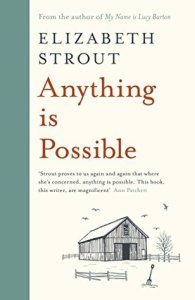
‘Anything is Possible’ by Elizabeth Strout

strout_anything

2017, 254 p.

The front cover of this book announces that it is “From the author of My Name is Lucy Barton“. That’s important, because the books are matching parts of the same scenario: the famous Lucy Barton has written a highly acclaimed book.  In My Name is Lucy Barton, which I reviewed here, Lucy the author is lying in hospital and her estranged mother comes to visit her. They speak past each other, rather than to each other, about the past and much is left unsaid.

In Anything is Possible, the back story is filled in. The events referred to obliquely which strike either Lucy or her mother dumb in My Name is Lucy Barton, are explored here in a series of tangentially linked short-stories. As with Olive Kitteridge (which I reviewed here) there are references between one story and another, and it’s as if a network map is being created here of small-town life in Amgash, Illinois. It’s about exclusion, regret, loneliness and willed blindness, and the inexorable march of one day after another.

The stories stand in their own right, but they’re more enjoyable for having read Lucy Barton beforehand. But there is of course a synergy between the two books, and the technique is very Kitteridge-esque, and I do wonder if Elizabeth Strout is going to break and do something different soon.

Sourced from: Yarra Plenty Regional Library

My rating: 8/10

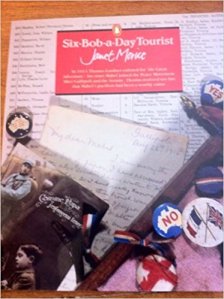
‘Six-Bob-a-Day Tourist’ by Janet Morice

morice

1985,  86p.

It didn’t take long for Thomas Gardner of  117 George Street East Melbourne to enlist in what was to become  the Great War. Due to the time difference, news of Britain’s declaration of war reached Australia on the same day that it was made (5 August 1914). Just three weeks later, Thomas Gardner, aged 33, had joined the AIF, E Company, 7th battalion as one of the ‘Six Bob-a-Day Tourists’, the deprecating term given to the highly paid Australian soldier, whose generous pay outstripped that of many working men at home and the soldiers of allied countries.  Without wanting to diminish it in any way,  Tom’s story ticks all the WWI narrative features that have come to be associated with ‘our ANZACs’ : sent out to the Training Camp in Broadmeadows; the sea voyage; waiting around in Egypt; Gallipoli; Lone Pine; France; hospital in England; back to France; sent home; discharged on grounds of ill-health; dead.  You can read about Thomas Gardner’s war and see pictures of him at the National Anzac Centre website.

I was attracted to reading this book not so much for Tom’s story on the front, but for the interactions with his family back home.  Tom had been rather peripatetic in the years leading up to the war, travelling from town to town as a wood-turner, but he returned often to 117 George Street to visit his mother, sisters Mabel, Adeline and Edith, and niece Cecily and nephew Guy.  His widowed sister Mabel re-married in June 1914, just before war was declared.  She had matriculated from PLC, and after returning to Melbourne following her first husband’s death after just four years of marriage, worked as a secretary, learned Esperanto, and was involved in debating and literary societies.

As Morice notes:

Two months after their wedding, war was declared, and at home the verbal battles raged. Tom was a volunteer and his mother and two of his sisters took the patriotic stance. Mabel and [husband] Will, however, took the opposite view. Will did not volunteer partly because he had just married, but mainly because he and Mabel were both pacifists (p.45)

Mabel and Will were drawn to the lectures and anti-war stance of Dr Charles Strong of the Australian Church.  Mabel, and her childhood friend Eleanor Moore, were present at the inaugural meeting of the Sisterhood for International Peace at the Russell Street Australian Church, and became the correspondence secretaries for the Sisterhood. She also joined the Free Religious Fellowship, an organization with a literary base that included Vance and Nettie Palmer, Louis Essen, Frank Wilmot (Furnley Maurice) and Alan Villiers.  It was headed by Mr Frederick Sinclaire, the former minister of the Unitarian church in East Melbourne.  She used her elocution skills by lecturing on pacifism for the Peace Movement, and hosted sewing groups and letter-writing and pamphlet-printing sessions at her home in East Melbourne. During the conscription debates she attended meetings and marches for anti-conscription.

Her mother and sisters, as strong patriots, disapproved of her political activism but how did her brother Tom – serving in the same way that she was protesting-  feel about this anti-war political involvement? In a letter from November 1916, after the conscription proposal had been defeated, he wrote that he was sorry that politics had led to tension between Mabel and her sister Adeline:

I was very glad to see Hughes’s proposal ousted….If conscription had been carried, goodness knows where it would have stopped.  And you can tell Addie this- that were I a married man in Australia (I am not speaking of Belgium or France) and had children who were depended on me, I would not deem it my duty to enlist until every eligible single male had gone… Re your conscription remarks.  You are very violent, my dear, peace-loving sister.  Well, let me lower “me breff” while I tell you that a fellow named Tom who lived at 117 George Street, East Melbourne, also voted ‘No’. And he knew a lot of other fellows, who knew a couple of thousand other fellows who voted ‘No.’ So I’m blest if I know.  (p. 55)

This book features only Tom’s letters, not those sent by his family.  The book is organized chronologically, with the focus on Tom’s war, intersected by Mabel’s peace activities back home. Through Tom’s letters, we see him becoming increasingly disillusioned by the war, until by June 1918, at the age of 38 he described himself as “so nervy I can’t bother about anything.”  You just know that this is not going to end well.

At only 85 pages, this is not a long book, and it rattles along at a pace.  It combines imagined scenes with excerpts from Tom’s letters, illustrations, and contextual information.  The author,  the grand-daughter of Mabel, has rather delicately omitted the details of Tom’s encounter with venereal disease which is mentioned on the National Anzac page, and as a reader you can sense her sympathy for both Tom and Mabel.

The book is not easily available today, and you’ll need to turn to secondhand sellers if you want to find it.  It puts a very human face on WWI, and it complicates the image we have of the family left ‘at home’.  Family members could love and grieve for their ‘boy’ overseas, and they could campaign for peace back home as well. Some family members expressed their love through patriotism; others through fighting to put an end to war.

AWW-2018-badge-rose-199x300

This is my first review for 2018 for the Australian Women Writers Challenge.

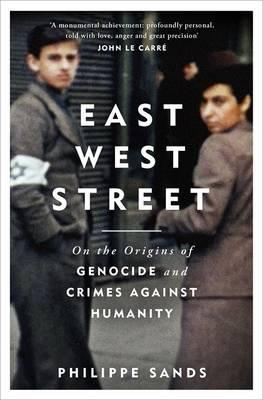
‘East West Street’ by Phillipe Sands

Sands_EastWestStreet

2016, 389 p & notes.

You’ve always wanted to read a book about the philosophical differences between the crimes of ‘genocide’ and ‘crimes against humanity’, haven’t you? No? Ah- but you should and you should read this book in particular.

The author Philippe Sands is an international lawyer who has appeared in all the big international courts: the European Court of Human Right and the International Criminal Court.  He acted as counsel for Australia in its case against whaling in the Antarctic, and for the Philippines in its recent case against China in the South China Sea. He’s spoken out against torture and for refugee rights.

But in this book, he is also a historian as well as a lawyer.  In a narrative rather reminiscent of an extended ‘Who Do You Think You Are’ he is impelled initially by curiosity about his grandfather, Leon. He had received an invitation to speak at a university in Lviv, a Polish town which had changed its name from Lemberg under the Austro-Hungarian Empire; to Lwow as part of newly independent Poland; Lovov when occupied by the Soviets in WWII; Lemberg against under Nazi occupation, and then Lviv when it became part of Ukraine, the name by which it is known today.  He knew that his grandfather Leon had been born in Lemberg in 1904, but little else.

However, his grandfather was not the only person known to him who was born in Lemberg. Hersch Lauterpacht, professor of international law was born in 1897 in the small town of Zolkiew, a few miles from Lemberg, and Rafael Lemkin, prosecutor and lawyer shifted to Lwow from Bialystock in 1921 as a 21-year old. These two men- Lauterpacht and Lemkin- attended the same law lectures by the same professors, but each developed diametrically opposed philosophies about international law. Lauterpacht developed the principle of ‘crimes against humanity’, rooted in individual rights and offences committed against individual men and women. In contrast, Lemkin developed the concept of ‘genocide’, rooted in the rights of groups, where the intention is to annihilate the population or community from which those individuals spring.   Both these concepts emerged in the Nuremberg Trials, attended by both Lauterpacht and Lemkin, when Hans Frank, the Nazi-appointed Governor General of Poland, faced trial.

The book, then, traces mainly through the lives of these three men: grandfather Leon, Lauterpacht and Lemkin. The setting is Lemberg/Lviv , drawn through a fine-grained, street-by-street analysis, most particularly during Governor General Frank’s period in office, when as Nazi henchman he announced the extermination of the Jews in Poland. Woven through these stories are those of other lesser characters:  Miss Tilney of Norwich who organized the rescue of Jewish children into England ;The Man in a Bow Tie – a shadowy character involved with his grandmother; The Child Who Stands Alone – a mystery reference in a letter; and The Girl Who Chose Not to Remember, one of Leon’s nieces. The narrative switches back and forth, with Sands telling of his ‘Who Do You Think You Are’ encounters with descendants and documents, interwoven with a historical account based on archival sources both personal and governmental.  There are black and white pictures throughout the text, embedded in the narrative right where they are most relevant.

The book starts and finishes with the Nuremberg Trials, and here Sands writes as a lawyer, but in thoroughly accessible language.  You may not believe me, but he is able to write about the Trials that underlines their novelty, tension and the uncertainty of both approach and outcomes.  I was perplexed at first to see that John Le Carre had written a blurb for the front cover of the book, but having finished the book, I can see why.  It’s a damned good read that keeps you turning the pages.

I can’t speak highly enough of this book, which won the 2016 Baillie Gifford prize (the re-badged Samuel Johnson Prize).  It draws together personal story-telling, historical narrative and legal analysis seamlessly, and is quite frankly, one of the best books I’ve read in ages.

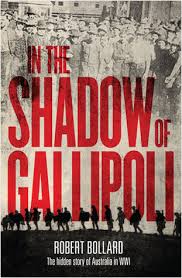
‘In the Shadow of Gallipoli’ by Robert Bollard

bollard

2013, 224 p.

I know that historians often get railroaded into a title for their book by marketing-oriented publishers, and I can’t help thinking that the title of this 2013 book was chosen with one eye on the then-upcoming centenary of Gallipoli in April 2015. There is, in fact, very little about Gallipoli in it at all. The content is far better conveyed by the sub-title ‘The hidden history of Australia in World War I’.  Although even that isn’t particularly accurate either, because much of what is written in this book is not ‘hidden’ at all: Jauncey covered much of it in 1935 and Ernest Scott (available online) covered the rest the following year in his Volume 11 of the Official History of Australia in the War of 1914-1918.

Nonetheless, given the hoopla which surrounded Gallipoli in 2015,  it was important that there be a corrective to the view that the whole of Australia wanted to rush off to fight on foreign fields and the equally erroneous idea that Gallipoli was the ‘birth of a nation’.  This book is an eminently readable counter-balance, aimed at a general audience, that examines the division and acrimony at home in Australia during the war.

There are eight chapters, titled with a quote and descriptor.

  1. ‘To the last man and the last shilling’: Patriotism triumphant
  2. ‘If you want the 44-hour week, take it!’: The strike wave begins
  3. ‘Wherever green is worn’: Irish discontent
  4. ‘I will curse the British Empire with my dying breath’: The first conscription referendum
  5. ‘Fifteen years for fifteen words’: The empire strikes back
  6. ‘Solidarity for ever’: The Great Strike of 1917
  7. ‘We’ll burn the town down!’: The second referendum
  8. ‘Plunge this city into darkness’: The peace turns ugly.

It seems to me that historians write about Australia during the war through a prism which, while recognizing other contemporaneous influences, hones in on one particular focus.  Judith Smart focuses on women; Jauncey focuses on pacifists; McKernan on mainstream churches, and here Bollard picks up on the unions in particular. Chapter 2 takes readers back to the ‘working man’s paradise’, the Harvester judgment and arbitration. He refers in many places to the Broken Hill – or as he terms it the ‘Barrier’ -miners, and his chapter on the Great Strike is probably the strongest in the book. I liked the final chapter, too, where he examines the role of returned soldiers in the strikes that exploded during the wars immediately following the war.

With the focus on unions and resistance, this is a very political book, with few individuals (other than politicians) stepping forward to centre stage.  It is a book of organizations more than people, drawn from newspaper reports and government files.  His reference list is fairly dated, and women don’t get that much of a look-in here, other than as part of a crowd, and there are no families.

But what he does really well is tell a good story. The narrative is chronological, it is very clearly written, and it’s a seductively easy read. It’s a good antidote to the hefty, celebratory WWI books with big single-word titles that have burdened the nation’s bookshelves over the past few years.

Sourced from: Yarra Plenty Regional Library (e-book)

Read because: in preparation for my talk to Heidelberg Historical Society on the conscription referendums of 1916 and 1917.


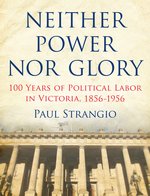
‘Neither Power Nor Glory’ by Paul Strangio

strangio

2012, 392 p.

I was too young to vote at the 1972 Federal election that brought Gough Whitlam to power. Until Gough came along, it seemed to me that politicians were always grey men in hats, exemplified for me by Arthur Calwell, Whitlam’s longstanding predecessor, who seemed to come from a political gloom that seemed to have stretched for decades.  As the daughter of a small business owner, but with much more progressive tendencies than my parents, I would not have dreamed of voting Labor at either federal or state level until the 1970s.  I didn’t  like Calwell, and at state level I didn’t particularly like Clyde Holding (1967-77) either.

While reading this history of the Victorian political Labor Party, written by Paul Strangio, the vision of the grey men in hats came back to me in all their depressing drabness. The author unashamedly wears his Labor sympathies, but it’s not at all a triumphalist history.

Instead, it’s a rather sad one. Even during 1914-5, during the first months of World War I and a high point of Labor Party influence, Victoria was the only state not to have a Labor government. Even though Victoria is often now viewed as the most progressive state in Australia (along with ACT), the Labor party in Victoria has had a chequered and ruptured history.

Although this book starts in 1856, the date of Victoria’s independence from New South Wales, things only start to hot up in the 1890s when Labor members began being elected to the Victorian parliament, albeit in very small numbers.  For the early years of Victorian Labor’s history, there was not a great deal to distinguish the Labor party from the relatively progressive Deakinite Liberal party (a situation that I suspect might occur today should former Liberal premier Rupert Hamer miraculously rise from the grave).

Much of the shuffling in the first 40 years of the 20th century involved the balancing of power between Labor, the Nationalist/Liberal Party, and the Country Party.  The first Labor government lasted all of 13 days in 1913 while the Liberal party patched up a split in its ranks.  In 1924 a Labor government took power with Country Party support, and this time it lasted from June until November, at which point the Country Party again reconciled with the Nationalists, and together they defeated Labor in the Legislative Assembly. Nonetheless, in that small window of government, the Labor party extended assistance to unemployed workers, called Royal Commissions into the police strike of 1923 and the prices of bread and flour, and was involved in the soldier settlement scheme.

There was a brief minority Hogan Labor government in 1927-8 and another minority victory in 1929 when, quite frankly, no-one really wanted to be in government anyway as the Depression loomed. The United Australia Party won the 1932 election, and then there was another little mini-Government headed by John Cain Snr in 1943 that lasted four days- again, until the ructions between the conservative parties sorted themselves out yet again. Cain had a second stint as premier in 1945, but could get little legislation through either house, where he held a minority position. It was not until 1952 that Cain could form his third government. Although he was again hampered by the Legislative Council, he managed to get through progressive legislation in a range of areas. But by then, the Labor party split over the influence of the Communist Party again condemned the ALP to decades in opposition – until 1982 in fact, when John Cain Jnr. won government.

In between these tussles for parliamentary control, and quite apart from being a bystander to conservative party powerplays,  there were two other internal struggles that kept the Labor party roiling.  The first was the influence of  businessman and underworld figure John Wren, referenced in the title of this book Neither Power Nor Glory, which of course alludes to Frank Hardy’s barely fictionalized story of political machinations with the Labor Party, Power Without Glory.  Then there was the split itself over the question of Communist influence in the unions, and Santamaria’s Movement and the formation of the Democratic Labor Party, which by combining with the Liberals, kept Labor in opposition for so long.

This book is full of names and acronyms, and the text is fairly dense. Nonetheless, even though I only intended reading it up until the 1916/17 referendums, it captured my interest sufficiently that I happily read until the end.  As you might expect, it is a very political book, and unless you had an interest in politics, I think you’d find it heavy going.   It’s also a book that absolutely cries out for a list of acronyms at the front.   I found myself using the index a lot, particularly the entries for each year, which acted as a form of timeline.

It’s a fascinating and rather depressing story of the perils of minority government and the tragedy of internal splits.  Paul Strangio spoke about the book at the Royal Historical Society back in 2013, and you can get access his lecture through RHSV’s podcast page (and find some other good podcasts while you’re there!)

Sourced from: Yarra Plenty Regional Library

Read because: I was initially interested in the WWI section, but then kept on reading.

Rating: 8 (but it won’t be to everyone’s taste)