Category Archives: Book reviews

‘Lovers at the Chameleon Club: Paris 1932’ by Francine Prose

prose

2014, 436p.

It’s just as well that one of the rules I set for myself when reading is to give a book at least 100 pages before I give up on it. I didn’t know anything about this book and for the first fifty or so pages I was just confused.

There are multiple narrators here, speaking through different genres. Gabor Tsenyi, a Hungarian photographer, writes long letters home to his parents that do not quite conceal his incessant asking for money. Lionel Maine is an American novelist of the big, baggy, gossipy type who has written a memoir of his time in Paris pre-WWII called ‘Make Yourself New’. Suzanne Dunois Tsenyi, who becomes Gabor’s wife, writes an unpublished memoir of the events, with the instruction that the memoir be burnt at her death. Wealthy art patron Baroness Lily de Rossignol, who has married into an auto company, writes her own jauntily named memoir ‘A Baroness By Night’. The sections titled ‘Yvonne’ are written in the third person by an unnamed omniscient narrator. The heft of the book appears in the fictional biography of athlete and motor racer ‘The Devil Drives: The Life of Lou Villars’ by Natalie Dunois.

Told from these varying voices and agendas, these characters are drawn to the Chameleon club, a Parisian nightclub which attracts gays, lesbians, cross-dressers and artists. As Hitler’s politics begin to filter beyond Germany’s borders, the club increasingly falls under scrutiny, and adapts to fit the political milieu.  The main interest of the book is a regular cross-dressing customer of the club, Lou Villars.  A former athlete and motor racer, she is spurned by her girlfriend Arlette and becomes drawn into National Socialism, becoming a notorious Nazi informant and interrogator.

I only gradually realized that this book is  based in fact, albeit with fictional names and imaged events. The photograph around which much of the action revolves was taken by Brassai entitled ‘Fat Claude and her girlfriend at Le Monocle’ (see here) and Lou Villars is a barely disguised Violette Morris, (see also here) who gave the Germans information about the Maginot Line and members of the French Resistance.

I was conscious that my approach to the book changed dramatically once I realized that it was based on fact. I resisted the temptation to start googling the characters, and instead let the fictional book take me where it wanted me to go. There is a ‘Cabaret’-style artifice to the book, which became increasingly dark as the narrative went on. By having multiple narrators, the author is not bound to ‘explaining’ her Lou Villars character, or her seduction into National Socialism, although the multiple narrators give her scope to speculate.  I’m glad that I didn’t give up at 100 pages in, but I do wonder if my response to the book would have been different had I realized what the author was doing, earlier on.

Sourced from: Yarra Plenty Regional Library

Read because: I had heard of Francine Prose

My rating: 8

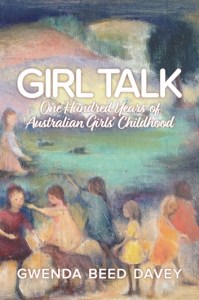
‘Girl Talk: One Hundred Years of Australian Girls’ Childhood’ by Gwenda Beed Davey

girl_talk

2017, 210 pages

As it happened, I started reading this book during International Day of the Girl  (October 11). It’s telling that there is no International Day of the Boy- and nor should there be, considering the straitened and frankly bleak lives that many girls live throughout the world compared to their brothers.

The very first picture in the opening pages of this book, subtitled ‘Group of girls with the Leones and the di Giglio Band, St Kilda, 1911’ shows a musical band of men, with young girls in the background, dressed in white, looking for all the world as if the characters from Picnic at Hanging Rock had turned up at a musical soiree. The text of the book itself starts at a very different place with the ‘sexting’ events of 2016 where young girls texted images of themselves to two boys, only to find their images shared and viewers invited to vote for ‘slut of the year’. It seems hard to even place those 1911 girls, all hatted and demurely dressed in white, in the same analytic frame as those internet images.

This is what Gwenda Beed Davey does in this book. As she writes in her introductory essay ‘Being a Girl in Australia’,

This book looks at the changes in girls’ experiences and behaviour through their own words, their ‘girl talk’. The book will consider what has changed and what has remained the same. Ten women, all born in Australia, have recorded their recollections of their childhood, in decades from ‘around 1910’ to ‘around 2010’ (p.2)

She defines childhood as ending at around 13 years of age, when puberty sets in and childhood games are often abandoned.

In an article for the National Film and Sound Archive, where Davey worked as a Research Fellow, she explains that she more than twenty years ago she had  recorded a number of oral histories for the National Library of Australia. Some of these interviews were made available for the body of this book, supplemented by more recent interviews which brought the book up to 2016.

After the introduction, each chapter is devoted to each interview which is presented as a separate continuous first-person account, with the questions removed. However, the presence of the questions lingers in the topics addressed, with a common emphasis on games played and rhymes recalled, reflecting the author’s interest in childhood games through her earlier involvement in the ‘Childhood, Tradition and Change’ research project (see its fascinating database here). As they are interviews, there is not a lot of narrative shaping, and the endings are rather abrupt. Davey has prefaced each chapter with a paragraph-length introduction, and each interview is seen as being emblematic of a particular decade.

So who are some of the women we meet here? Ethel Carroll, born in 1914, grew up in a series of rented houses with her extended family. Her father was a strong unionist, and worked as a bootmaker. She was brought up in the Methodist church, and through gaining a 1/2 scholarship, was able to attend Stott’s Business College.

Maxine Ronnberg was born in 1920 and lived in Mortlake in rural Victoria until she was thirteen. Her father was a stock agent, and she grew up in the family home where there was a governess, cook and housemaid, as well as the stockmen and drovers.

Jean Phillips was born in 1925 and moved from Collingwood where her father was employed in a boot factory to the nascent Canberra in 1927 where her father worked as a doorman at the ‘new’ Parliament House. They lived in Ainslie in a government house where the rent never changed. She left school at 14 because she didn’t like it and became a dressmaker.

From this point on, the interviews were conducted between 2011 and 2016. Dorothy Saunders was born in Sydney in 1932 and came to Melbourne when she was two. Her father was an industrial chemist educated at Sydney Tech, while her mother was a secretary. She lived at Seaholme, near Altona, which was an undeveloped suburb at the time. During the polio epidemic she went to live in the Blue Mountains for 6 months, and the family later shifted to Ferntree Gully when her father feared that Altona would be bombed during WWII. She had a wide extended family, but her father was very bad-tempered.

Claire Forbes was born in 1940. Her father fought in WWI, and he was left a life-long Pacifist. He was 55 years old when she was born, and he died when she was 15. She was part of a huge Catholic family, and they lived in a small Queensland country town and holidayed in Coolangatta with her large extended family. She had a rural school upbringing, with the Art Train and the Rural School on the ‘rail motor’ bringing extra curricular education to this remote area.

Sue Broadway was born in 1955, if not ‘in a trunk’, then certainly surrounded by vaudeville and greasepaint. Her mother was an entertainer who made the transition to television. Sue herself participated in eisteddfods and followed her mother to the Royal Show and shopping centres. Her father was a teacher and she went on the Moratorium marches.

Patricia Ciuffetelli, born 1961, grew up in Queanbeyan and then Canberra. Her parents were both born in Italy and came to Australia in the late 1950s. She did not speak much English when she started Catholic school. She had a large extended family, the result of waves of chain migration from Italy.

Tara Gower, born in Adelaide in 1981, is a Yawaru woman who dances with the Bangarra Dance Theatre. She was born in Adelaide but shifted to Broome where her father’s grandparents lived, and where many people were ‘coloured’ in Broome’s highly multi-cultural community. She went to St Mary’s, the ‘black’ school but later went to the ‘white’ high school. She considered that her childhood ended  at 12, when her father died.

Jodene Garstone was also of indigenous identity, and 12 years old when this interview was recorded in 2011. This is the only  one of the interviews with an informant who was a ‘girl’ at the time, rather than a retrospective account. She too was born in Broome, but at the time of recording lived in Kununarra, and was at Geelong Grammar on a scholarship. While recalling a childhood eating bush food with friends, she had aspirations to be a surgeon, while her brother was studying law.

I found myself wondering about the author’s role in this book, given that the body of the work is the interviews. An oral history interview is always a shared production. While the questions by the interviewer might steer the shape of the interview, the real wealth of the interview comes from the participant.  In terms of the book itself, as distinct from the interviews from which it is formed, the main contribution of this author lies in the choice of interviews, the selection of pictures, the crafting of the small prefaces before each chapter and her introductory essay ‘Being a Girl in Australia’.

The introduction performs three roles here, and I’m not sure that they combine effectively.  Perhaps if Davey had spelled out more specifically her intent in writing this introduction, it might have been easier to know how to approach it. She has chosen a number of themes, where first she gives a historical precis of the theme across the hundred years covered by her informants; second, she provides a commentary on current (i.e. 2017) events in relation to that theme; then third, draws out illustrations from the interviews themselves.

It’s interesting to look at these themes.  She starts by looking at education, then moves on to health.  There is a long section on past-times and games, which perhaps reflects her earlier research interest in childhood games in the  ‘Childhood, Tradition and Change’  project.  Her discussion then takes a more contemporary approach in exploring ‘The Age of Fear’ and ‘Sexualization, Representation and Experience’. These sections roam far beyond the interviews to discuss helicopter parenting, Bill Henson and Safe Schools. Her theme of families is more firmly rooted in the interviews, but the section on diversity includes the contemporary question of single sex schools and detention centres. She returns to a historical narrative to deal with the 1920s strikes, the 1930s depression and the three major wars. Her section headed ´War, Bereavement and Loss´includes the Stolen Generation and child migrants.

While it is important that the stories revealed in these interviews are placed within their historical context, some of the themes that she identified seem to have been imposed onto the data from a 2017 perspective, rather than emerging from what her respondents said.  Today ‘Class’ sounds rather old–fashioned and 1970-ish as a historical and analytic theme, but it just leapt out from the interviews, as did the influence of extended family. Nor was church observance explored, even though many informants mentioned it. Although class, family and religion don’t have the currency of topics like Female Genital Mutilation, Social Media or Offshore Detention mentioned in the introduction, they are the themes raised by these women, many of whom were middle-aged or older when interviewed.

That said, I enjoyed reading each of the interviews, particularly the ones set further back in the past. Each chapter is between 15 and about 30 pages in length, and the women´s voices come through the narrative. Even though they are mainly told from an adult perspective, they capture the diversity of lived experience across one hundred years, in a range of settings, focused on a life–stage that is too easily overwritten by later events and sensibilities.

AWW-2018-badge-rose-199x300

I have included this book in the Australian Women Writers Challenge.


Source  Review copy courtesy of Australian Scholarly Publishing.

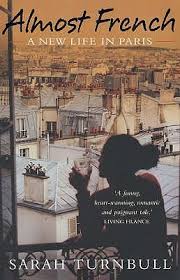
‘Almost French’ by Sarah Turnbull

turnbull_almost_french.jpg

2002, 309 p.

Somehow or other, the deluge of books about women going off to France seems to have rushed past me. I hadn’t particularly been drawn to dip my toes into the flow, but this book was chosen by my bookgroup and so I read it, some sixteen years after it was published.

At the time of writing it, Sarah Turnbull was an expatriate freelance journalist living in Paris. Most of her journalistic work was published in magazines (similar to the Weekend Magazine that comes with the Age), and the lightness of her touch and self-deprecation makes this an easy and very pleasant read. Food, fashion, the joys (or not) of pet ownership are topics that she addresses in the book, and could easily be lifted for lifestyle magazine consumption.

She only intended going to Paris for a week, having met Frederic in Budapest, and accepting his offer of a week in Paris on a whim.  She ended up staying eight years. In this time she came to realize the truth of the words of an elderly man she had met on the Greek  island of Samos on her travels. After migrating to Australia, he had returned to Greece but felt it “a bitter-sweet thing, knowing two cultures”.

She has to learn the language, and she feels excluded by her limited French and frustrated by her inability to assert herself. But more than words, she has to learn the French purpose of language in a social setting as a game, to show one’s quickness and wit. She struggles with the coldness of other French women until she recognizes it as a manifestation of competition. She mocks Frederic’s horror at her donning tracky-daks to go down to the nearby bakery, but finds herself equally affronted by the tackiness of English dress-sense when they go over to England for a weekend.

This book is laugh-out-loud funny in places, for example where Frederic quickly ties his jumper around his waist and affects a dodgy French accent when pretending to be an Australian tourist when they are challenged for trespassing. There are moments of poignancy too, like when she needs to don sunglasses in the plane when leaving Australia, looking at the Qantas advertisement and seeing the landscape curving away from her from her plane window.

This is really just a series of anecdotes, with no great plot shifts or crises. She is insightful in identifying the nuance and yet solidity of cultural difference. It is something that we can and should all be reminded of, going in the different direction, by people who are adjusting to Australia. It’s a light, enjoyable read- and yes, it made me wonder if perhaps I could go to France next year after all…..

My rating: 8/10

Sourced from: CAE bookgroups.

AWW-2018-badge-rose-199x300 I have put this title onto the Australian Women Writers Challenge database.

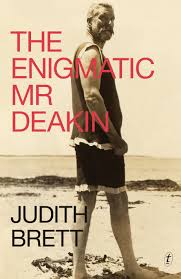
‘The Enigmatic Mr Deakin’ by Judith Brett

Brett_EnigmaticMrDeakin

2017, 434 p.& notes

Much of the commentary about recent Australian politics has decried the cycle of replacement of Prime Ministers over the last ten years, the spectre of minority governments and the congestion of hung parliaments as if they were an aberration. However, reading Judith Brett’s biography of Australia’s second Prime Minister Alfred Deakin, The Enigmatic Mr Deakin, the early years of the Australian federal government were unstable and chaotic as well.

Yet in these years the federal government established some of the most progressive legislation in the world in relation to voting practices, a basic wage, pensions and arbitration, later dubbed ‘The Australian Settlement’ by Paul Kelly (see here and here).  This post-federation ‘settlement’ survived until dismantled by the Hawke-Keating government of the 1980s and 1990s, a process accelerated by subsequent neo-liberal governments.

Alfred Deakin was a ‘liberal’ in the true, nineteenth-century sense of the word;  not as in the so-called ‘Liberal’ party today which has long been the party of big business and is becoming increasingly conservative and faith-based. His biographer, political scientist Judith Brett, has written extensively about Liberal Party politicians, most particularly Robert Menzies in Robert Menzies’ Forgotten People (1992), Australian Liberals and the Moral Middle Class: From Alfred Deakin to John Howard (2003)  and a number of Quarterly Essays, most particularly QE19: Relaxed and Comfortable: The Liberal Party’s Australia (2005) and QE29: Exit Right: The Unravelling of John Howard (2007). She is not  of the right herself, but she is drawn to studies of the middle class and their politics.

And what a wonderful biographical subject Alfred Deakin is! He was a prolific writer and correspondent, much of which is available today. Journalist, lawyer and politician, he wrote professionally, socially and most importantly, reflectively over the length of his career.  A gift to any biographer is his prayer diary, where he mused on spirituality and destiny, and a series of notebooks called ‘Clues’ where he collected epigrams, notes on his reading and reflections on life. In addition, he kept diaries between 1884-1916.

Alfred Deakin was born in Melbourne in 1856, one of the post-Gold Rush  ‘Australian-born’ generation. It was this Australian-born quality that marked him out among the other British-born politicians who drove Federation. He began his profession as a lawyer, but moved into journalism through his contact with David Syme, founder of ‘The Age’. In 1879 he entered the Victorian state parliament as the liberal candidate for West Bourke. He served in a number of coalition government ministries, state politics being just as volatile as the early federal governments were to be.  He was instrumental in establishing factory legislation and initiating irrigation in Mildura. However, with the 1890s Depression, he suffered a kind of mid-life crisis as he confronted the limits of politics and struggled with guilt over investments he had recommended for family and friends. He returned to the back bench and took up his legal career again. It was the push towards Federation that brought him back to politics again, and took him to the international and national stage. He then served in the new, wobbly federal parliament with three stints as Prime Minister within ten years.

Brett’s biography certainly integrates the political, the personal, and the spiritual aspects of this complex man. In an unstable parliament, compromise was necessary, even to the extent of a ‘Fusion’ party with the NSW free-traders, whose economic policies he deeply opposed.  He distinguished between liberals (as he described himself) and Conservatives:

the conflict between the particular and the more universal, between the everlasting Nay and the everlasting Yea, between those who obstructed and those who facilitated the forward movement of the spirit. (p.257)

He was not, however, a fan of the newly emergent Labor Party (the first in the world), because of their allegiance to the working class:

“their platform is selfish and their discipline admirable. They constitute a class in politics, and refuse to support representatives who have not been selected from among their own neighbours” (cited on p. 257)

There is no getting around the fact that one of the first pieces of legislation passed by this new, largely progressive parliament was the Immigration Restriction Act, which formed the cornerstone of the White Australia Policy. Brett warns us against imposing our twenty-first century frame onto this legislation, which while seen by Britain as an insult to their Japanese allies, was intended to maintain high wages and living standards. Deakin was oblivious to women as political actors, and silent on indigenous Australians.

Deakin’s personal life was revealed through his diaries and correspondence. He married his wife Pattie, the daughter of a prominent Melbourne spiritualist in 1882 and they lived in South Yarra. Brett suggests that even though Deakin was affectionate and conscientious, it was not the marriage of true minds that perhaps he might have craved.  However, this did not affect the longevity of his marriage. Indeed, as a demonstration of the ebb and flow of relationships, as Deakin became increasingly debilitated by age and memory loss, Pattie came into her own, much healthier in later, post-menopause life, than she had been as a younger woman.

It is the spiritual aspect of Deakin that is the most fascinating to me, and Brett explores it fully thanks to Deakin’s own frankness in writing about it. Deakin believed in contact beyond the grave and was heavily involved in the Spiritualist scene in Melbourne. While this would have raised eyebrows, it did not render him beyond the pale politically as it would today [I’ve often thought that all  Australia would need today is a shaky mobile phone of Scott Morrison speaking in tongues at his Pentecostal church for his support to evaporate among many voters]. Deakin approached the Melbourne Unitarian Church to explore the possibilities of becoming a minister there, where Rev. Martha Turner (very rightly) told him that his spiritualist leanings would not be accepted by the congregation there. Although in later life he looked back at his more youthful Spiritualist activities with some cynicism, his sense of destiny and acknowledgement of the spiritual wellspring of his identity remained throughout his life.

Brett closes her book with a consideration of Deakin’s place within Australian politics and historiography.

By 2001, when the centenary of federation was celebrated, Deakin had faded to a face on an information board, one of the bearded worthies who had made the constitution and after whom things are named: a suburb, an electorate, a university, a lecture series..Among the political cognoscenti too he had become more of a cypher than a man…He came to represent the now discarded policies of tariff protection, state paternalism, centralized arbitration, imperial nationalism and the racism of White Australia, policies which were shaped in the early decades of the twentieth century and all but gone by its closing (p. 431)

She locates the turn against Deakin within the Liberal Party itself under John Howard’s leadership, where economic issues dominated the agenda and a reactive social conservatism was adopted. Brett highlights Deakin’s statecraft and energy, his civility, optimism, ability to compromise and assumption of the existence of a consensual centre. Oh to have some of those qualities today.

This is an excellent, well-written, fleshed-out biography. No wonder it won the National Biography Award this year.

My rating: 9/10

Sourced from: Yarra Plenty Regional Library

AWW-2018-badge-rose-199x300 I’m reviewing this as part of the 2018 Australian Women Writers Challenge.


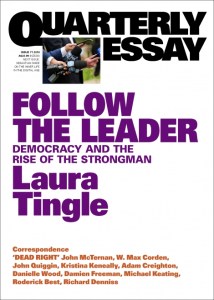
QE71 ‘Follow the Leader: Democracy and the Rise of the Strongman’ by Laura Tingle

tingle_follow_the_leader

2018, 90 p.

How frustrating it must have been to write this book!  The conclusion of the text is dated 27 August 2018, just three days after Australia’s 29th Prime Minister, Malcolm Turnbull, was overthrown for No 30, Scott Morrison. The volume was no doubt planned probably a year in advance (certainly they’re pre-advertised six months in advance) and, being one of Australia’s foremost journalists, Laura Tingle would have wanted the book to be current. As it turned out, the Liberal (i.e. conservative) party decided not to choose Peter Dutton, the closest thing Australia has to a ‘strong man’ as leader – thank heavens. I wonder how much she had to change the book at the last minute to accommodate this change?As it is, the book concentrates more on leadership and democracy, than the ‘strongman’ mentioned in the  title. Perhaps there were whole chapters that ended up in the bin.

This is the third book in a series of Quarterly Essays that Laura Tingle has written over recent years. In 2012 she released Great Expectations: Government, Entitlement and an Angry Nation and in 2015 she followed it with Political Amnesia: How We Forgot to Govern, both of which have been released in a single volume called In Search of Good Government, where she added a new essay on Turnbull in Power (huh!)  Perhaps I’ve seen and heard too much of her elsewhere, now that she’s on the 7.30 Report and Philip Adams still ‘mingles with Tingle’ on ABCRN. I felt as if there wasn’t anything particularly new in this book. After all, others have commented on the obsession with popularity, the search for a strong man,  the ubiquity of ‘stakeholders’ instead of experts, and the deluge of information from a splintering of sources.

There were a few things that were new, though, and I’ve found myself thinking on them over the last couple of days. First, she uses as her analytic frame the work of Ronald Heifetz from the Kennedy School of Government, who published a book called Leadership Without Easy Answers in 1994. In it, he distinguished between leadership, power and formal authority. Leadership he defined as “helping a community embrace change”. This is not necessarily a party thing:  leadership can come from outside the formal power and authority structures, and indeed, this is what she ends up arguing for.

Heifetz defined leadership as helping a community embrace change, offering a map, a clear option to deal with a problem, and corralling factions to a compromise. For him, leadership is about possessing the skills with which to read and push a community (p.83)

Second, she compares a number of different leaders. She cites Miranda Carter’s article in the New Yorker in 2018 comparing Trump with Kaiser Wilhelm II.  Carter noted the Kaiser’s conviction that his one-on-one “personal diplomacy  would fix foreign policy”, just as Trump seems to view whole countries in terms of whether he ‘likes’ a leader, and more importantly that they ‘like’ him too. Like Trump, Kaiser Wilhelm viewed people instrumentally; he lied; he patronized the aggressive nationalistic right, and he was touchy and unpredictable.

Tingle then turns to two European alternatives. The first of these is Angela Merkel, where the cobbling together of coalitions means that she needs to listen and lead from behind. Tingle comments that in Australian politics, political barbs are always personalized against the leader, rather than the government or opposition they lead- note, for example, the almost instinctive response to immediately attack a policy in terms of the leader “But Shorten…” “But Morrison….”. She doesn’t say this, but a coalition of smaller parties would broaden the focus from just the leader.  The second alternative is Emmanuel Macron who leads from the “front, sides and middle” (p.47). He seems to break all the Heifetz rules, and like Trump, in his own way wants to break the system and make France “great again”. However, she says, unlike Trump so far he has been doing this without finding scapegoats, with a clear purpose and a sense of direction. Tingle is not quite sure about him though: there is a danger that he will resort to strongman tactics.

Third, she gives a real life example of Australia acting as a middle power- Turnbull’s “awful” phone call with Donald Trump after his inauguration, congratulating him on the presidency and ensuring that Trump honoured the refugee-swap arranged with Obama. It is a verbatim transcript, and she quotes it in full. I’m not really sure that it advances her argument much, but it’s just too delicious. It’s important, too, because it shows how slippery and self-centred Trump is in those relationships he so prizes with other leaders. I hadn’t seen the transcript previously in full, and she does us a service in reproducing it.  Quite apart from Trump’s childishness, skittishness and self-obsession, it also appalled me to see how little Turnbull was actually asking of him (even though Trump certainly didn’t see it that way). Turnbull was in effect telling Trump that he didn’t have to take a single refugee under the deal worked out with Obama; that all he had to do was go through the motions. In fact, it amazes me that Trump took any refugees at all (he has taken about 400). Even though I knew it at the time, it reinforced how instrumental and risk-averse the arrangement was for Australia to take 12000 Christian-only refugees when the Syrian situation was at its worst.

Finally, she returns to Australian politics and the failures of the leaders we have had over the last ten years.  Her prescription for leadership is bland and obvious, but harder to achieve than it sounds:

To be a leader, you don’t necessarily have to have a vision, but you either have to know what it is that you want to persuade other people to do, or else have the knack of identifying and synthesizing an issue on which people are seeking leadership. You also need to know how you are going to do something about such issues. And you have to know which are the most important things to get done at any given point in time. Then you have to make the rest of us understand why these things are important and what you are going to do about them. This task might simply be an echo of a crystallised or uncrystallised public mood. Or something that involves reimagining all the barriers and structures around a difficult issue. But it does ultimately require you to bring people with you.(p. 81)

She concludes that a large part of the job of political leadership now is “to rebuild the national political discussion after years of it being under assault”, and to recognize that “their own room to move is going to be vastly expanded if there are other leaders in the community with whom they can speak”(p.86). In Heifetz’s terms, this involves protecting the voices of leadership outside the political realm (Human Rights Commissioners and climate scientists spring immediately to mind).

In this, I agree with her.  I inwardly groan when I hear the panellists on Q&A on a Monday night as you see the same old faces and can predict the tenor of the ‘debate’ as soon as the camera sweeps along the table. Sometimes, just sometimes, there’s a new voice from outside, and you wonder “Why don’t we hear more of this person”?

AWW-2018-badge-rose-199x300

I’m adding this to the Australian Women Writer’s Challenge. During the month of October Brona, the convenor of the Non-Fiction round-ups challenged people to read a short non-fiction. This was just the push I needed to actually unwrap some of the Quarterly Essays which sit on my shelf (much to my son’s frustration: I figure that she who buys the Quarterly Essay gets to open the Quarterly Essay, no matter how much he wants to read it).


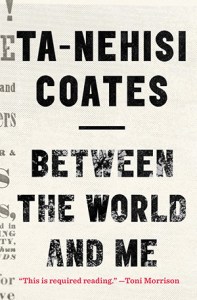
‘Between the World and Me’ by Ta-Nehisi Coates

Coates_worldandme

2015, 176 p.

This is only a small book – an extended essay really –  but it positively burns with anger. It is written in the form of a letter to the author’s fifteen year old son Samori.  Samori had been  watching television with his father, when it was reported that no charges would be brought against the Ferguson police officer who killed the unarmed teenager Michael Brown. Samori left the room, not wanting his father to watch his response.

This letter is a two-way framing device. On the one hand it echoes James Baldwin’s opening letter “My Dungeon Shook: Letter to My Nephew on the One Hundredth Anniversary of the Emancipation” that prefaced Baldwin’s book The Fire Next Time – a book which strongly influenced the author. On the other hand, Coates is drawing on his own bafflement and anger when his own  college friend Prince Jones died at the hands of the police years earlier. This is the letter that he might have wished he had received when he was younger.

This is not an easy read: there are no answers for Coates’ son, and no answers for us either. Coates admits that his son’s experience will be the same as his own: after all, his son had grown up seeing a black President (something that would have been incomprehensible in Coates’ childhood) seeing Afro-American women on television, and knowing real-life women who didn’t straighten their hair (as women did in Coates’ childhood). But, he asserts, deep down nothing has changed.   It is a violent book, in its emphasis on the pain and degradation meted onto the black body, presidents and hairstyles notwithstanding.

There is no uplifting way to say this. I have no praise anthems, nor old Negro spirituals. The spirit and soul are the body and brain, which are destructible- that is precisely why they are so precious….It had to be blood. It had to be nails driven through tongue and ears pruned away…It could only be the employment of carriage whips, tongs, iron pokers, handsaws, stones, paperweights, or whatever might be handy to break the black body, the black family, the black community, the black nation (p. 75)

And this violence on the body is not a thing of the past. It was not cleansed by the Civil War or expunged by the civil rights movement, or muted by Barak Obama. Instead, the construction of white identity  and the Dream of white American life (“perfect houses with nice lawns”) is based on this same, present-day violence on the body. It’s not just adolescents with their hoodies and sagging denims; it’s the four-year old Samori, pushed from an escalator by the white woman behind him. The swaggering insolence on the street is a cover for fear, because all the power lies with White America.

The book weaves together memoir, polemic, history and literature, and it is relentless in its argument. There are no exhortations to action, just the heavy weight of inevitability and impotence.

I read this book after I read his most recent collection of essays We Were Eight Years in Power, which is probably not the way that most people would approach Ta-Nehisi Coates. Having read the most recent book, which comprises essays and blog posts written over the years of Obama’s presidentship, I can see that he has integrated ideas developed over eight years into this essay. It’s not that he has copied-and-pasted; it’s more that you can see the origin and continuity of his ideas.

I also read this book in the midst of the Serena William cartoon controversy, at a time when there was overt and much-discussed emphasis on the black body. It made Coates’ analysis ring even more true. I don’t know how to rate this book. I feel complicit and condemned because, although I live on the other side of the world,  I too am part of the White Dream .

Source: Yarra Plenty Regional Library


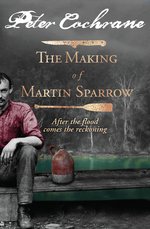
‘The Making of Martin Sparrow’ by Peter Cochrane.

cochrane_martinsparrow

2018, 445 p.

While writers of historical fiction need to wade into history if their work is not to be rendered ridiculous, it’s less common for historians to publish fiction (well – under their own name, anyway). This is not true for historian Peter Cochrane, who has ranged across Australian history with his academic writing, with published works on John Simpson Kirkpatrick (of Simpson and his donkey fame) in Simpson and the Donkey, the struggle for responsible government in Colonial Ambition (my review here), and most recently in The Fight for White Australia about World War I.  These are just the histories of his that I have read (or am reading at the moment): he’s also published a book to accompany the ‘Australians at War’ series and written about Tobruk, among other works.

Cochrane is a fine narrative writer, and this comes through both his histories and also his fiction, of which The Making of Martin Sparrow is his second foray. I was much impressed with an essay he wrote for the Griffith Review on the writing of narrative history (see my comments on the essay here) and I enjoyed seeing him deploying his craft in the fictional The Making of Martin Sparrow.

Martin Sparrow is an expired convict, who has been granted a small holding in early New South Wales. He is no great farmer and in debt, and as the book opens, he has been flooded out as has everyone else along the Hawkesbury River in 1806. Like many other convicts, he is lured by the idea of an internal hinterland to the west, far from the brutality of the penal colony, where he can live free.  He is not a brave man, but in the aftermath of the flood, he decides to take his chances. Events occur suddenly, and the course of events ricochet into different directions as Sparrow acts in ways that he would not have imagined: sometimes led on by others, other times acting on impulse.

Set on the Hawkesbury River, this book instantly invites comparisons with Kate Grenville’s The Secret River.  But this is no domestic drama: for those who’ve read The Secret River, this book is set more in the brutish world of Smasher Sullivan than in William Thornhill’s morally-conflicted travails. Life ‘back home’ in England is only obliquely mentioned, and action is set firmly within the penal colony with its own corruptions and violence, where everyone is scrabbling to find a toe-hold in a ‘new’ country that is very old, with the mindset and practices of ‘home’.

The book has a wide range of characters, and I found myself turning often to his ‘Dramatis Personae’ in the opening pages, helpfully arranged by location and role. The book is divided into five parts, with many (67) short chapters. The book has a filmic quality with a great deal of dialogue and cutting between scenes.  However, I’m not sure that I was convinced by the dialogue. A number of his characters speak with the stiff formality of an educated background and a literary culture and Cochrane has clearly chosen to give them this voice.  While I recognize that transported convicts did come from a range of educational backgrounds, I’m not sure that it would manifest itself in their speech in this way.

His characters, particularly Martin Sparrow, are well-drawn. He is not necessarily your ‘good man who was done wrong’, and at various times he displays duplicity, fear and violence. It is a very male environment, as New South Wales at this time certainly was, and women have a hard time of it. There is settler and indigenous violence, and the book is not overlaid by twenty-first century politics.

Being fiction, there are no footnotes but in an afterword, Cochrane does signpost his influences and support his introduction of several plot-lines that are not part of our commonly-held view of penal NSW, most particularly in relation to women.

He also mentions his own experience of the land west of the Hawkesbury – a rather risky admission given the grief that Kate Grenville was given her when she described licking her salty lips on a rough crossing on the Palm Beach to Ettalong Ferry and extrapolating this to the sea  travel for The Secret River. (See Inga Clendinnen’s Quarterly Essay: The History Question). But here, his own experience of hiking in what are now the Wollemi and Gardens of Stone National Parks  informs his really beautiful descriptive writing of landscape,  which is so evocative that you can almost see it yourself. The sense of place runs throughout the book, from the cold dripping wet, to the mountains that fold one onto the other and the strewn wrack of a flood.

Actually, it would make a damned good film, with an ending left ambiguous enough to be enticing. It is a nuanced portrayal of a penal settlement and human nature.

My rating: 9/10

Sourced from: Yarra Plenty Regional Library


‘We Were Eight Years in Power: An American Tragedy’ by Ta-Nehisi Coates

Coates

2017, 366P.

Well, according to the blurb on the back of the book that describes it as an “essential follow-up to Between the World and Me”, I’ve read these books in the wrong order because I read this book, We Were Eight Years in Power first. I’m rather embarrassed to admit that I wasn’t even quite clear who Ta-Nehisi Coates is, except that I know that he has been speaking at various Writers’ Festivals around the country in the last few weeks.

This book is a compilation of long-form essays, one for each of the eight years of Barak Obama’s presidency.  Each essay is prefaced with a 2018-dated reflection on the article and the circumstances in which it was written.  There is a dialogue going on at two levels: Coates explaining and challenging himself as author at an earlier time, and the laying out of an argument from author to reader in the essay itself.  These prefaces trace through Coates’ own career trajectory. As the years passed, Coates shifted from an unemployed freelance writer to a public intellectual, who is invited to Obama’s White House to engage with his president in debate. Some of his observations made about Obama in 2008 he continued to hold in 2017, while others moderated or changed over time.

The book starts with an introduction ‘Regarding Good Negro Government’ which explains the title “We Were Eight Years in Power”. It was first uttered by South Carolina congressman Thomas Miller in 1895, regretting the loss of the progress made during Reconstruction,  immediately following the Civil War. In this book Coates repeats the lament, noting that

In short, Obama, his family and his administration were a walking advertisement for the ease with which black people could be fully integrated into the unthreatening mainstream of American culture, politics, and myth. And that was always the problem. (p.xiii)

Right from the start of this book, Coates is critical of “respectability politics” which rails against the black community for its lack of personal responsibility.  The opening chapter of the book discusses how Bill Cosby promulgated this form of black conservatism (Bill Cosby had not at this stage fallen from grace.) Throughout the following chapters of the book Coates calls Obama out for a similar philosophy. However, over the eight years of the Obama presidency, Obama also stepped into his own identity as a black president, most particularly in his comment after the death of  Trayvon Martin, to the effect that if he had had a son, he would look like Martin.  This observation, and his comment that police had “acted stupidly” when they arrested Henry Louis Gates sparked up white opposition to the Obama presidency.  In his epilogue, Coates argues that this white outrage about the Obama presidency – an outrage based not on income, or class but racism – led directly to the inauguration of Trump – the “first white president”.

I don’t know whether Coates “grew into” himself as a writer, or whether there is a qualitative difference between the earlier essays in this book and the ones that came later.  Perhaps the opening chapters were more current (at the time), or required a familiarity with Black History which I don’t have.  For me, as a reader, the intensity of his writing really cranked up with his essay from the Fifth Year, ‘Fear of a Black President.’ This chapter was followed by his Atlantic cover story ‘The Case For Reparations’, which was awarded the George Polk Awards. Here, he demonstrates the structural basis of racism in passionate, logical, informed writing. He extends the argument into his Seventh Year article ‘The Black Family in the Age of Mass Incarceration’.  The final chapters reflect the sorrow that twenty-first century ‘eight years’ have led to Trump and such a vulgar reassertion of white supremacy. For this is just how Coates calls it – structural racism to bolster white supremacy – without any liberal loopholes.

These are excellent exemplars of the long form essay, running in some cases to over fifty pages in length. They show the shuttling of an argument from the personal to the political and back again, and the balancing of data and anecdote. Perhaps it’s the academic in me, but I did wish that there were footnotes at times, but these are magazine essays, aimed at a more general readership.  Coates makes no secret of his admiration for James Baldwin (who, to my shame, I have not read), and from the acclaim Coates’ work has garnered, it would seem that he is a worthy successor.

And yes, I am going to read Between the World and Me

My rating:  8.5

Sourced from: Yarra Plenty Regional Library.

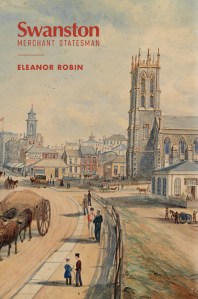
‘Swanston: Merchant Statesman’ by Eleanor Robin

robin-merchant_statesman

Swanston Street is the main thoroughfare of Melbourne, extending from Melbourne University in the north down to the Yarra, whereupon it becomes St Kilda Rd. It’s a rather unloved road, for many years blighted with dodgy discount basements and even dodgier long narrow cafes with desiccated dim-sims. The street is now blocked with huge sheds and scaffolding hiding the tunnelling works for the new metro line that will run under the city.

Swantston Street was one of the original streets on the Hoddle Grid, but the only one of the north-south streets to be named after anyone associated with the ‘over-straiter’ settlement of Melbourne from Tasmania.* It was NSW Governor Bourke himself who suggested naming the street after Charles Swanston, banker, entrepreneur, member of Legislative Council, and ‘merchant statesman’, but Swanston seems never to have actually crossed Bass Strait to see Melbourne for himself.

As Eleanor Robin explains rather late in the text in this biography of Charles Swanston (Ch.15) , Swanston has not been treated kindly by Tasmanian historians. In 1948 W.H. Hudspeth regaled an after-dinner audience with an entertaining sketch of Swanston’s rise and fall that became the accepted view for the next seventy years.  Other historians, like Kathleen Fitzpatrick relied on the evidence of contemporary detractors and the discomfort of colonial settlers over Swanston’s ignominious end to depict him in a negative light. This book, which conceptualizes Charles Swanston as a ‘merchant statesman’, places him within a wider imperial mindset, and assesses his intellectual and social capital against the financial business mores of the time.  Drawing on the archives of the Derwent Bank papers, which were only fully catalogued in 2017,  Robin concludes that Charles Swanston was

a vital cog in the rapidly turning wheel of change. He was a man of the world who played out his life boldly in exotic and far-flung regions of the 19th century British Empire (p.198)

Charles Swanston was born in England in 1789 and at the age of 16 was commissioned in the East India Company army. The wide-reaching networks of soldiers involved in Wellington’s armies have been described by historians, most particularly Zoe Laidlaw and Christine Wright . Importantly, Robin alerts us to a different, parallel set of networks that connected India and Australia, first through military men in the East India Company, and then through them to the trade market between the two countries. This connection with India played out in the lives of two of Swanston’s sons too, when they also joined the Indian army before eventually retiring to England.  There was a strong presence of Scots in the East India Company as well, and if the Indian networks were the warp, then the Scots influence -which also ran through Swanston’s family- was the weft running through his financial and mercantile activities.

Swanston first visited Van Diemen’s Land in 1829 for a temporary visit on leave from the East India Company.  He was quickly embraced by the Hobart ‘genteel’ society, several of whom shared Indian ties with him. He quickly found favour with Governor Arthur who declared that he wished that the colony were stacked with “a hundred settlers such as Captain Swanston from India” (p.24) Even before permanently settling in Van Diemen’s Land, which he was to do in 1831, he purchased several estates, including New Town Park at New Town, and under the patronage of Governor Arthur, purchased shares in the newly established Derwent Bank, which he was to eventually control.

Colonial port cities during the nineteenth century were marked by their cliquishness, gossip, social claustrophobia and instability of ‘respectability’, and this was certainly true of Hobart during Swanston’s time.  As an appointed, non-public-service member of the Legislative Council in a colony with no popular representation, he was embroiled in the partisan politics of governor-against-Council, especially after his patron Governor Arthur departed the colony and Sir John Franklin was appointed in his place. Apart from political maneuverings  Swanston was involved in the gentlemanly pursuits of many other elite public men in a small colony: the orphan school, infrastructure schemes in water, coal and smelting, insurance companies, church warden, board member for the Mechanics Institute and vice-President and Treasurer for the Royal Society. Like many gentlemen of his time and milieu he had a particular interest in horticulture and viticulture.

In her title, Robin identifies Swanston as a ‘merchant statesman’, one of those class of men with the British education and contacts to take up the commercial opportunities that opened up in the colonies.

Those around him recognised his global outlook. He had the eye of an army strategist and, as financier and legislator until his last tumultuous days, he operated in the national interest, as well as for his own good. (p.101)

His control of the Derwent bank gave him contacts with merchants and entrepreneurs, and he leveraged his Indian and Scots networks in the importation of manufactured goods from both India, the Far East and ‘home’. Most particularly he acted as agent for  Edinburgh-based George Mercer, encouraging Mercer to invest in Van Diemen’s Land and to  purchase land and properties for his children who emigrated to Australia, and most importantly, like Swanston, to become involved in Melbourne as a new investment opportunity.

As Robin demonstrates, Swanston provided much of the financial and intellectual muscle behind the Port Phillip Association’s attempt to ‘purchase’ huge swathes of land through a ‘treaty’ with the Kulin nation.  He was “the chief strategist and spearheaded the Association’s campaign for legal title to the ‘new country'” (p. 114) It was probably Swanston, along with Gellibrand or Wedge, or all three, back in Van Diemen’s Land who took Batman’s diary and wrote it up into a more polished report. It was Swanston who acted as a conduit between Governor Arthur and the members of the Association, as a lobbyist with the New South Wales government, and who briefed George Mercer to lobby the British government. The treaty was always legally dubious, but there was a concerted and well-co-ordinated lobbying campaign at local, colonial, and metropole level to have it, and the claims of the Port Phillip Association, recognized.

Even though the treaty was disallowed,  along with other members of the syndicate Swanston lost no time in sending his own flocks over the strait, and arranging for Mercer to deploy his finance in the same way.  He organized the shipping, taking shares in ‘The Adelaide’ to convey the sheep, and organizing all up twenty sailing vessels. The Colonial Government, in rejecting the ‘treaty’ allowed remissions up to the value of £7000 (a sizeable amount!) for any expenditure that had been forfeited. Swanston took up any of the shares in the now-discredited Port Phillip Association and established the Derwent Company, a new entity.

Robin is non-committal about the intent of the treaty for the men in the Port Phillip Association, beyond commenting on the entrepreneurial spirit from which it emerged and pointing out the flaws in their reasoning. It struck me that we tend to think of frontier conflict in terms of spears and guns and the physicality of violence, and not so much the mindset of the capitalists who were financing the expansion. Swanston himself stayed in Tasmania, arguing that his business and legislative commitments precluded crossing the Strait. I have read much about the frontier conflict later in Port Phillip, but I was particularly struck by the violence and resistance to this first wave of men and sheep, including amongst Swanston’s own overseers (p.134) In this recounting of those very early years, focusing closely on the experience of those first syndicate members, there was no period of benign wariness.  The deaths and outrages on Swanston’s own properties made it harder to argue that the ‘treaty’ was an alternative approach that could avoid bloodshed.

As Robin shows, Swanston was a man of his time, and those times were both exhilarating and challenging for entrepreneurs and merchants.  Profits and investments expanded dramatically in the 1830s,  and they contracted the same way in the 1840s.  It is likely that his own actions as a banker contributed to the collapse of the Van Diemen’s Land economy, when he changed the Derwent Bank from a bank of issue to a mortgage bank. He, and bankers in NSW alike, assumed that because land was finite, an investment in land was “safe as houses”- an assumption that was rendered untrue with the opening up of Port Phillip.  Those networks and connections that had bolstered his reputation in Hobart were now a burden as friends and acquaintances who had once approached him for advice now approached him for relief. As Robin says, “With hindsight, the collapse of the Derwent Bank, taking Swanston with it, was inevitable.” (p. 184)

Kirsten McKenzie has pointed out in Scandal in the Colonies, the question of personal integrity in business was vital to economic success (p.79). As economic historian Syd Butlin wrote, while not doubting Swanston’s good faith, “[Swanston] had simply ceased to distinguish the policy and affairs of the bank from his own interests and business”(p.184). Robin admits that his business operations occasionally shaded into ‘sharp practice’, but that this was not unusual. His business model was based on growth,  which could not be sustained in a changed economic environment. (p.196)  Disgraced and depressed after the failure of both the Derwent Company and the Derwent Bank, Swanston left Van Diemen’s Land to join his son on the Californian goldfields. Their paths crossed, and Swanston died at sea, aged sixty. He was not to know it, but the ‘new’ colony which had dominated his lobbying and financial acumen was about to undergo its own transformation through gold.

Robin closes her book noting the lack of acknowledgment of Swanston in the town with a main street named in his honour. She’s right, and her book goes a long way towards filling this vacuum. In a narrative sense, she has walked around Charles Swanston, profiling him from different perspectives: military man, legislator, merchant statesman, Port Phillip Association member, financier and family man.

In recent years there has been increasing discomfort about the role and behaviour of the ‘over-straiters’, most particularly John Batman, as seen by the renaming of the ‘Batman’ electorate to ‘Cooper’ to honour William Cooper, the Yorta Yorta activist and community leader. There is now a question over whether the statues to Fawkner and Batman that previously stood in the now-demolished National Mutual forecourt will see the light of day again.

Additionally, the opprobrium directed towards ethically questionable economic ventures now  tends to extend to the financiers as well, as seen by the pressure on financial organizations not to invest in the Adani coal mine. In Charles Swanston we see colonization in its white-collar guise, and an abstract concept like ‘settler capitalism’ exemplified in an individual. After Robin’s book, Swanston will not be so invisible. Time and politics will tell whether that’s a good thing or not.

Sourced from: review copy Australian Scholarly Publishing

Eleanor Robin will be speaking about her book at the RHSV on Tuesday 16 October.
AWW-2018-badge-rose-199x300


I have posted this review to the Australian Women Writers Challenge 2081.


*[An aside: Spencer St was named after 3rdEarl Spencer, the Chancellor of the Exchequer under Lord Melbourne 1830-1834; King St after Philip Gidley King, 3rd governor of NSW; William after King William 4th who reigned between 1830 and 1837- the years of Melbourne’s white settlement; Queen after Queen Adelaide, William’s wife; Elizabeth after the wife of Governor Richard Bourke (contested); Swanston, Russell after Lord John Russell, then Home Secretary, Stephen after Sir James Stephen Permanent Under-secretary for the Colonies (later renamed Exhibition Street) and Spring for Thomas Spring-Rice, Chancellor of the Exchequer 1835-1839]


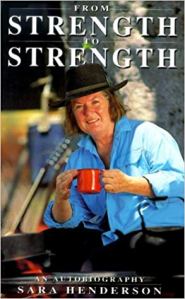
‘From Strength to Strength’ by Sara Henderson.

henderson1

1993, 337P.

This book made me break two of my maxims. The first is that book-group selections must always be finished. My second is that if I find a book unreadable, I generally don’t blog about it at all.  In  this case, however, I found From Strength to Strength so enervating that I didn’t finish it even though it was a book-group selection. And as for the second, well, Sara Henderson has sold enough copies of this drivel that obviously other people found something in it, even though it completely eluded me. My little blog isn’t going to change that.

Born into a fairly affluent family, Sara had dreams of being a world-class tennis player. An accident which left her with serious injuries, put an end to that. She was swept off her feet by an American ex-serviceman, who spirited her away on his yacht. Always a womanizer with big dreams but poor follow-through, her husband Charles brought her and their young daughters to Bullo River Cattle Station in outback Northern Territory, where they lived in a tin shed for years. After multiple affairs, they separated although she nursed him when he was gravely ill, only to find herself a widow with a huge debt for the station. She and her daughters turned the station around economically, and she was proclaimed Telstra Businesswoman of the year in 1991.

The book started relatively well, where the author admits that this is the second version of her memoir, having decided after finishing the first draft that she does have to tell the truth about her no-good, womanizing, irresponsible husband Charlie. But I soon realized that her commentary – it is too kind to call them ‘reflections’- on her husband became engulfed by a tsunami of anecdotes, all told in the chatty, light tone of a Christmas-letter. The cliches and minutiae mounted; important events (like, say, the birth of her children) happened almost in passing, and it was not hard to discern that this book is a completely self-serving endeavour.

And not just this book either. She went on to write another five books. Her daughters, with whom she fell out at different times, wrote their own books, challenging their mother’s narrative.  Suffice to say, I am not tempted to read any more.

My rating: 2/10

Read because: CAE bookgroup.