Category Archives: Book reviews

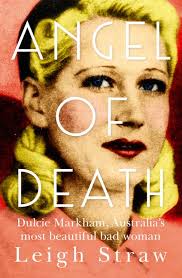
‘Angel of Death: Dulcie Markham, Australia’s most beautiful bad woman’ by Leigh Straw

straw_dulcie_markham

2019, 251 p. & notes

Historian Leigh Straw has been working on the underworld in Sydney between the 1920s and 1950s for some time. This book forms the third part of a trilogy. In The Worst Woman in Sydney: The Life and Crimes of Kate Leigh (2016) looked at underworld figure, sly grogger and cocaine dealer Kate Leigh, while in Lillian Armfield: How Australia’s First Female Detective took on Tilly Devine and the Razor Gangs and Changed the Face of the Force (2018) she looked at Lillian Armfield, the policewoman who, excluded from other types of crime fighting, was charged with chasing down young girls and diverting them from the vices of prostitution and addiction. Working on these two opposing forces – the criminal and the police officer- she kept coming across Dulcie Markham, who was well known to both Kate Leigh and Lillian Armfield. Obviously fond of the long book-title, in Angel of Death: Dulcie Markham, Australia’s most beautiful bad woman, Straw traces the life of this beautiful and notorious woman, who traversed Australia and was completely embedded within the underworlds of the cities in which she lived.

And Dulcie Markham was beautiful: stunningly so. She was known as “Pretty Dulcie”, but she was also known as the “Angel of Death” and “The Hoodoo Girl” as the men with whom she associated were shot and stabbed in a mounting rollcall of violence and death. Born in 1914 in Surry Hills (in Sydney) she ran away from home at the age of fifteen and took up prostitution as one of Tilly Devine’s girls, at a time of rivalry between the two Sydney crime-madams, Kate Leigh and Tilly Devine, and at a time when sly grog, gambling, larrikins and the Razor Gangs made Sydney a dangerous place to be. She first appeared in court as a member of Sydney’s underworld in 1931, when she gave evidence – or more correctly, stalled in giving evidence- at the inquest into the death of her erstwhile lover by her more recent paramour. This was the first of a number of deaths of five lovers and husbands where she was not physically present, but could well have been involved.

It is interesting to see how the sources available have shaped this story. Dulcie Markham was certainly talked and written about, and her police file was bulky, but she herself rarely spoke to reporters and there is virtually nothing written by Markham herself. As a result, Dulcie’s story was completely embedded within the stories of other people. At times I felt as if the author let herself be caught up too much with these other minor personalities, who had crime histories just as sordid as Dulcie’s.  Sometimes the excursions were triggered by some association, for example a sudden jump forward to the murder of a prostitute in the 1980s when discussing whether Dulcie was intimidated – a fairly tangential connection.  Perhaps it’s part of the crime writing genre itself (I’m thinking of John Silvester’s columns in The Age) but there’s a chatty, familiar chumminess and a bit of a chortle that comes through when the excesses of the underworld are being written. It makes me a little uncomfortable.

Yet this intimacy with the underworld is written within the academic framework of sources, academic books and theses, endnotes and bibliographies. The book wears its research lightly.

What these interwoven anecdotes and networks do demonstrate, again and again, is the violence which seemed almost casual, and the narrow line between being a perpetrator and being a victim.  Dulcie was herself shot and bashed, but bound by the code of silence as part of milieu in which she moved.  Surprisingly, although charged and convicted many times,  she spent remarkably little time in jail herself.  Clear, too, is Dulcie’s mobility as she shifts between Brisbane, Sydney, Melbourne and Perth, each time bobbing up in the middle of that city’s underworld, and switching her name frequently. Once in, it was hard to escape.

Straw contextualizes Dulcie’s life well, giving insights into the nature of criminal empires, the specific crime scene in a particular city, the nature of prostitution, and more general social life in Australia across these decades. Her final chapter, when she weighs up Dulcie Markham’s life is strong, where she discusses the trope of the ‘femme fatale’ and assesses her against Anne Summer’s dichotomy of ‘Damned Whores and God’s Police’. As against all the things that we don’t know about Dulcie Markham, Straw concludes:

What we do know is Dulcie May Markham was one of the toughest crime figures in Australia from the 1930s to the 1950s. In the violent neighbourhoods of crime across three cities, she proved herself by utilising the avenues then open to women involved in crime- prostitution, sly-grogging and gambling houses. Dulcie showed great intelligence, resilience and a staggering ability to live through intimidation and violence. She was a survivor in a world that saw few live to retire as she did to a quieter life. (p. 243)

Sourced from: Yarra Plenty Regional Library

My rating: 7/10
AWW2019 I have included this book on the Australian Women Writers Challenge database.
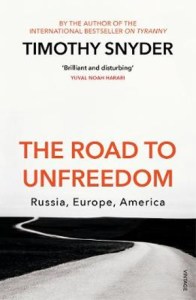
‘The Road to Unfreedom’ by Timothy Snyder

snyder_road_to_unfreedom

2018, 279 p & 60 p. footnotes

Perhaps it’s a function of geography and economics, but here in Australia at this time we are more concerned about the rising power of China than we are about the rising power of Russia. Nonetheless, we’ve been aware of it through reading about the U.S. election and the Mueller Report, through watching with curiosity the Maidan protests in Ukraine, and more tragically through the shooting down of Malaysian Airlines MH17, which prompted particular Australian attention because of the large number of Australians on board.

The subtitle of this book is ‘Russia, Europe and America’ and with its very current focus, it seems a little incongruous that it should be written by a historian, rather than a political scientist.But historian Timothy Snyder is, and he was a close associate and friend of the late Tony Judt, another acclaimed 20th century historian. Echoing the title of F.A. Hayek’s treatise on market liberalization, The Road to Serfdom, Snyder’s book explores the danger posed to the Enlightenment values of reason and reasonableness through two linked historical narrative forces: the politics of inevitability and the politics of eternity.

The narrative of inevitability is the sense that the future is just more of the present, with nothing further to be done, as exemplified by Francis Fukuyama’s hubristic and premature claim of the triumph of Western-style liberal democracy marking “The End of History“.  Communism prior to the collapse of the Soviet Union in 1991 had its own politics of inevitability: “nature permits technology, technology brings social change; social change causes revolution; revolution enacts utopia”. (p.7)

When the politics of inevitability collapses, as it did in 1991 for the Soviet Union and in the wake of the GFC for Western economies, it ushers in the politics of eternity. He focuses on Russia, but any country could slip into the politics of eternity (and indeed, perhaps several other countries are already doing so). The politics of eternity places one nation at the centre of a cyclical story of victimhood (p.8), where progress gives way to doom, crises are manufactured and manipulated, and citizens experience elation and outrage at short interval (p.8). In both forms of politics, history and facts are used in particular ways.

Inevitability and eternity translate facts into narratives. Those swayed by inevitability see every fact as a blip that does not alter the overall story of progress; those who shift to eternity classify every new event as just one more instance of a timeless threat. Each masquerades as history; each does away with history. Inevitability politicians teach that the specifics of the past are irrelevant, since anything that happens is just grist for the mill of progress. Eternity politicians leap from one moment to another, over decades or centuries, to build a myth of innocence and danger. They imagine cycles of threat in the past, creating an imagined pattern that they realize in the present by producing artificial crises and daily drama. (p. 9)

Snyder argues that Russia was the first 21st century power to reach into the politics of eternity, and that it has been increasingly successful in exporting it to other countries.  He points to Vladimir Putin’s championing of the fascist philosopher Ivan Ilyin, an early critic of Bolshevism who was expelled from Russia in 1922. Impressed by the ideas of Hitler and Mussolini, Ilyin proposed a lost, innocent “Russian Spirit” which would throw of the Bolshevism inflicted on an innocent Russia by the West, which would be rescued by a manly, virile redeemer who would unite his people to welcome God to return to the world and help Russia bring an end to history everywhere.  Vladimir Putin identified Ilyin as his chosen chronicler of Russia’s past (even though Ilyin was no historian); he organized the repatriation of Ilyin’s remains from Switzerland to Moscow for reburial in 2005, and he ‘brought home’ his papers from a university in Michigan. His essays were reprinted and reportedly, given to all Russian civil servants.

The purpose of his book, Synder claims, is “an attempt to win back the present for historical time, and thus win back historical time for politics” by “trying to understand one set of interconnected events in our own contemporary world history, from Russia to the United States, at a time when factuality itself was put to the question.” (p.9). His book moves roughly chronologically from 2011 onwards in six chapters titled as opposites: Individualism or Totalitarianism; Succession or Failure; Integration or Empire; Novelty or Eternity; Truth or Lies; Equality or Oligarchy.  He identifies two of Ilyin’s strategies at play: first, identifying enemies to the Russian spirit – homosexuals, Muslims, Jews, separatists, and second, exporting to other countries an attack on truth and facts by outright lies and manipulation, with the aim of using disinformation to divide and polarize democracies (most particularly U.S. Europe and Britain).

We saw the first of these at play in the Breslin school massacre and the Moscow theatre siege, which were blamed on Chechen separatists. With the invasion of Crimea, the poisoning of Alexander Litvenenko and the Skiprals in London, the ‘intervention’ in Ukraine, and the shootdown of MH17 we saw outright lies as the Russian government denied all involvement despite clear evidence to the contrary. We have seen how Vladimir Putin models himself as a hyper-masculine, horse-riding, shirtless ‘redeemer’- and indeed, with the exception of Angel Merkel and Marine Le Pen, women have no place at all in Snyder’s book. And with the Mueller report (which had not been released at the time of publication of this book) we see Russian influence in American politics, even if Mueller did not directly link it with Trump personally. Snyder suggests that Russia is content to use Trump as a ‘useful idiot’, pumping him up as a ‘successful businessman’ and allowing him to sow his own distrust and manipulation of facts. Russia is happy for the European Union to turn on itself and splinter through Brexit,  and it has the computer networks and resources to give prominence to far-right politicians in the West and prod these forces into action.

This book is meticulously footnoted, drawing both on newspaper articles (as one might expect in such a recent history) and academic texts. It is a fairly complex read, and in joining the dots it ranges across countries and events. In doing so, he takes the time to explain the event before weaving it into his broader argument. I found this book chilling and depressing. I’m not sure that individuals are going to have the strength to resist such powerful forces, and everywhere I look – America, Britain, Europe – I find even more reasons to despair.

Perhaps he didn’t want to end up at such a bleak destination because he closes his book by arguing the importance of truth; distinguishing between the true and the appealing, and resisting cynicism. “To seek the truth means finding a way between conformity and complacency, towards individuality.”(p 278)

If we see history as it is, we see our places in it, what we might change, and how we might do better. We halt our thoughtless journey from inevitability to eternity, and exit the road to unfreedom. We begin a politics of responsibility. (p.279)


Sourced from: Yarra Plenty Regional Library

My rating: 9


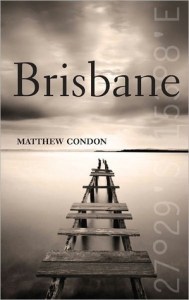
‘Brisbane’ by Matthew Condon

Condon_Brisbane

2010, 314p.

I’ve been in Brisbane for the last week, and it seemed a perfect time to read Matthew Condon’s Brisbane, part of New South’s suite of books  about Australia’s capital cities written by established literary authors who had grown up in that city.  This is the first time I’ve read one of these books about a city other than my own, and you can read my response to Sophie Cunningham’s take on Melbourne (my city) here.

These books are not history books in themselves, but are instead a literary response to the city.  The author can choose her/his own approach.  But history is almost inevitably drawn into the analysis, and I was a little surprised that Condon didn’t draw more on his own work into Joh Bjelke-Petersen’s Brisbane of the 1970s and 1980s, which informs his own trilogy of the time (Three Crooked Kings, Jacks and Jokers and All Fall Down– none of which I have read).

Instead, there are two motifs that Condon uses in his book.  The first is ‘the boy’, who I strongly suspect is Condon himself, who hidden under his Queenslander house in Brisbane in the 1960s, draws a map of the city in the dirt, marking his own significant places.  The second motif is an obelisk placed in the city under the aegis of Frank Cumbrae-Stewart, then president of the Royal Historical Society of Queensland, as part of the centenary of the settlement of Moreton Bay. The odd thing is that the obelisk is placed in a most inhospitable place that is not the right spot anyway. You can read about my own adventures trying to find the damned thing here.

The book moves slowly in a roughly chronological fashion, but there are lots of flash-forwards and backs, with the memories of ‘the boy’ interwoven throughout. The writing is beautiful and evocative, steeped in Brisbane sunshine and a little abashed at Brisbane’s try-hard attempts at sophistication and modernity.  I suspect that this whole series is aimed at readers who are very familiar with the cities described, and I found myself a little frustrated at the lack of a map and the easy assumptions made by the author that a stranger would immediately know suburbs and locations.   But this insider-ism honours the intent of the books to be travel-books-without-leaving-home, written for those ‘at home’ rather than visitors. They are impressionistic rather than instructive.

That said, I think that my experience of Brisbane was enhanced by having read this book, despite being an outsider, and next time I go to another city featured in the series, I’ll read that city’s  book too.

My rating: 8.5

Sourced from: ebook from SLV.

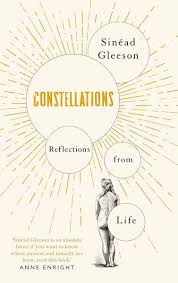
‘Constellations: Reflections from Life’ by Sinéad Gleeson

Gleeson_constellations

2019, 242 p.

It’s strange that the book that annoyed me most this year, Lee Kofman’s Imperfect, and one of the best books I’ve read this year, Constellations deal with very similar subject matter. Like Lee Kofman, Sinéad Gleeson had a childhood marked by illness, and then six months to the day after her wedding, she was diagnosed with leukemia. With a major operation to fuse her severely arthritic hipjoints, she (like Kofman) would have her share of scars, and she, too, has considered other women whose bodies have betrayed them. But where I felt that Kofman’s book was self-indulgent, bitter and almost voyeruistic  in its observations on her own and other peoples’ flaws, Gleeson’s book is deeply human and ultimately optimistic. Reflecting on the metal implants, stitches and  surgical interventions on her own body, she writes

I have come to think of all the metal in my body as artificial stars, glistening beneath the skill, a constellation of old and new metal. A map, of tracing connections and a guide to looking at things from different angles. (p. 17)

And so, with this title, each self-contained chapter is marked out by a star map of the constellations that reference, often obliquely, the content. While certainly some of the chapters deal with her illnesses, she ranges further into a consideration of motherhood, friendship and Alzheimers. This collection of stories looks forward as well as back, with a concern not about the ‘body surface’ as Kofman would call it, but an honest and deeply compassionate appreciation of – and she does appreciate, value, honour – the person inside.

She uses interesting constructs to structure her narratives. In ‘60,000 Miles of Blood’ – the length of all the blood vessels in the human body- different sections of her writing are titled by blood group:  A+, A-, B+, O etc.  In this story she reflects on her own diagnosis of leukemia, blood donation, periods, Blood of Christ, DNA. In ‘Where Does It Hurt?’ she uses the adjectives in the McGill pain index to verbalise pain (Hot/Burning/Scalding vs. Wretched/Blinding) as the headings for small reflections on pain, some in verse, some in prose. ‘Panopticon: Hospital Visions’ is actually written in hospital, a series of very short paragraphs, observing the ward around her.

It’s not all illness. In ‘On the Atomic Nature of Trimesters’ and ‘The Moons of Motherhood’, she writes about pregnancy, birth and early motherhood. She observes other people and their relationships to their bodies- Frida Khalo, Lucy Grearly and Jo Spence in a chapter similar and yet so different to Kofman’s work. There’s a chapter about the Irish referendum campaign to amend the constitutional ban on abortion (which I heard about in a podcast) and she gives us one of the most insightful and respectful stories about Alzheimers that I have ever read in ‘Second Mother’.

These are beautiful stories, detached and yet deeply human, written in crystalline prose. With Kofman’s Imperfect, I could feel myself taking a step back from the author, not wanting to associate with her. My response could not have been more different with this book. Here is a  breathing, loving, compassionate human – ‘body surface’ and deeper – and one that I wanted to stand closer beside, to hear more.

My rating: 9.5 /10

Sourced from: Yarra Plenty Regional Library

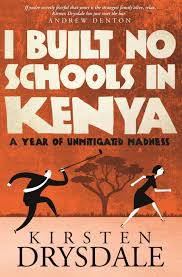
‘I built no schools in Kenya’ by Kirsten Drysdale

Drysdale_BuiltNoSchools

2019, 339 p.

This book leapt out at me from the library shelves as I was walking past – Kenya!! I’ve been there! I didn’t build any schools either: instead I just enjoyed the company of my son and daughter-in-law who were living there at the time, for probably a two month period over four separate visits. And Kirsten Drysdale- I know her! She was on ‘Hungry Beast’ and ‘The Checkout’ on the ABC, and recently on Crikey’s INQ team.  So even though it’s not my usual fare, I snapped it up and found myself devouring it.

In 2010 Kirsten Drysdale had just finished working on the first series of ‘Hungry Beast’ and it was not certain whether there would be a second series. A friend contacted her and invited her over to work with her as a carer for a rich old man in Nairobi. Drysdale’s parents had come from Zimbabwe, and Africa had always been a mysterious part of family lore; the job sounded easy; all expenses and accommodation were provided, and there would be free time to go off on safaris or do some freelance reporting.  So she accepted.

When she got there, all was not as it seemed. Stepping out of the driveway of a fenced, low slung stone house with a large well-cared-for garden, she found herself in a colonial time-warp, as if the Mau Mau were still at the gate and the Brits had never left. [I can identify with this completely. When I was in Nairobi in 2014 we went to Lake Naivasha and visited a conservancy where they filmed Out of Africa. The woman there, beautifully coiffed, white blouse and khaki shorts, seemed to exemplify the old British elite with her clipped English accent and obvious nostalgia for the old Keen-ya and disdain for the new. You can my blog post about her here.]

The old man, Walt, his wife Marguerite and adult daughter from an earlier marriage were locked in a claustrophobic, paranoid battle with each other. The daughter, Fiona, lived in England but micro-managed her father’s care through daily Skype calls and more nefarious surveillance. She was convinced that her stepmother Marguerite was not looking after her father properly, and so charged the ‘carers’ with spying on Marguerite and reporting her shortcomings to Fiona back in England. Walt himself was an old bigotted Kenyan resident, who according to Fiona, would not accept a black carer. Hence, Fiona employed three white women (including Kirsten and another Or-stray-yen) who Walt, in his befuddlement, would think were house guests or perhaps granddaughters. None of these people are particularly likeable, especially Fiona, and it is no wonder that the family dynamics were well known amongst the expats in Nairobi. Walt’s life is very much manipulated by his family and carers, at Fiona’s behest. His condition is worsening, and he exhibits and evokes all of the frustrations associated with dementia.

Alongside this description of life within Walt’s family is Drysdale’s own response to Nairobi itself. I kept feeling little leaps of recognition as she mentioned places and sights that I had also seen. Crime and terrorism are both present, but she also revels in the busy-ness of Nairobi and the dignity and generosity of the Kenyan community that we rarely notice or acknowledge here in Australia.

This is not high literature, and it is not meant to be. I found myself laughing out loud in places, and the whole thing  rang completely true to me – even the dynamics of a family struggling with dementia, which is its own form of madness.  She has an acute eye for the absurd, but also is a keen and thoughtful observer of what is going on around her. Of course, part of my delight in this book was that I was familiar with what she was writing about – a bit like reading a book set in your home town- but I really enjoyed it.

My (admittedly biased) rating: 8.5/10

Sourced from: Yarra Plenty Regional Library.

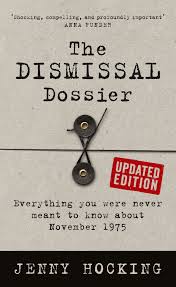
‘The Dismissal Dossier’ by Jenny Hocking

Hocking_Dismissal

Updated edition 2016, 75 pages & notes

Is it only Labor supporters ‘of a certain age’ who remember where they were in 1975 when they heard that the Whitlam government had been dismissed? I was in my second year at La Trobe University, and being November 11, it was in the midst of exams. I remember sitting on the brick steps at the Agora, wondering if the student troops would rally and whether there would be a march on Parliament House. But there was nothing- at least not immediately. I think that people were just stunned.

And, after reading Jenny Hocking’s small book The Dismissal Dossier: Everything You Were Never Meant to Know About November 1975, I’d have to add that not only were people just stunned, they were lied to as well. It has taken over forty years for the truth to trickle out, through vendettas, scribbled notes in archives, interviews, and  re-evaluations. The story isn’t over yet: Jenny Hocking, who wrote the celebrated two-part biography of Gough Whitlam, is still pursuing ‘The Palace Letters’ between the Queen and her secretaries and Australia’s then-Governor General Sir John Kerr, which have been designated ‘personal and private’ by Buckingham Palace, and thus out of the reach of Australians.

So- what weren’t we meant to know and now we do, largely through Hocking’s persistence?  We now know that the Palace did know ahead of time that Kerr was planning to sack Whitlam. Through Reg ‘Toe-Cutter’ Withers’ spilling of the beans after himself being dismissed, we know that Fraser was aware of it too.  We now know that  Sir  Anthony Mason  had been involved even before Sir Garfield Barwick (the Chief Justice) was, and that Barwick and Kerr agreed to obscure his involvement at the time and afterwards.  We also know that Kerr, fearful that Whitlam would sack him first, had shored up his position with the Queen’s secretary and Prince Charles in advance.  We now know that Kerr was anxious that a Royal Commission not be held into the Loans Affair because it would have come out that he had signed off on the minutes of the Executive Council meeting that approved the plan.

There’s a lot, too, that we have either forgotten or not realized the significance of.  The Senate had not refused Supply, but the Liberal/Country party refused to vote on it. Whitlam’s poll numbers were improving, while Fraser’s were plummeting over the stalemate in the Senate. Whitlam had already spoken with Kerr about holding the half-Senate election days earlier and had the agreed papers in his pocket, which would have brought the stalemate to a head. The House of Representatives still sat on the afternoon after the Dismissal, and passed a motion of no-confidence in Fraser as Prime Minister by a margin on 10 votes – the ultimate breakpoint in our parliamentary democracy, which should have seen Fraser stepping down immediately.  There were in effect two dismissals on 11 November: first the dismissal of Prime Minister Gough Whitlam, then later that afternoon, the dismissal of the House of Representatives, which Kerr prorogued to avoid having to do anything with that embarrassing vote of no confidence.

These things have been revealed over the last forty years, but because they have been drip-fed, you tend not to see the whole picture. After Reg Withers revealed that Fraser had been in on it before the Dismissal, Fraser admitted that he had lied. How did I not know that? I remember Sir Anthony Mason’s dismissive “I owe history nothing” but I’d forgotten his role. I remember news of a dinner with Prince Charles, but didn’t make the connection. That’s why this book is so important. It’s only short, but it draws the threads together. It re-kindles the rage.

I was fortunate to hear Jenny Hocking speak last week (and a recording of her presentation can be found here). She reminded us that Gough’s exhortation was to “Maintain your rage and your enthusiasm“. Reading this book reminds me why we should maintain the pressure for a republic, and why Hocking’s own persistence and assiduity has been so important.  After the Federal Court dismissed her attempt to have the Palace Letters revealed, just this afternoon she was granted Leave to Appeal to the High Court of Australia. Those letters will and must be revealed one day: I just hope that she and  I live long enough to see them.

My rating: 5/5 because it’s it’s such an important book. Read it.

Sourced from: SLV e-book. (Did you know that you can download e-books from the State Library if you have a card?)


AWW2019I have included this on the 2019 Australian Women Writers Challenge.


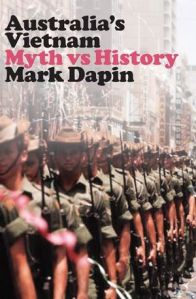
‘Australia’s Vietnam: Myth vs History’ by Mark Dapin

dapin_australia-vietnam

2019, 231 p.

In August 2007 an article about the Vietnam Veterans Motorcycle Club appeared in the  Good Weekend magazine insert that accompanies The Age. Written by journalist Mark Dapin, it was based on interviews with members from the Queensland chapter, hard-drinking men, many of whom suffered with PTSD. They told Dapin of seeing (and even being involved in) atrocities during their tours of duty, of being flown home in the dark in a futile attempt to avoid protestors at the airport, of being spat at, being jeered as ‘baby killers’, having paint poured on them, and smarting from the absence of welcome home marches.  He reported what he heard.

But after over 160 interviews, six years of study, a non-fiction book and a Ph.D. on the topic, Mark Dapin would no longer write that original article in the same way. In a way, this book is a long mea culpa for his easy acceptance of what he had been told. In his opening chapter ‘The myths I helped to make’, he writes

I no longer believe a significant number of people in the 1960s and early 1970s regarded Vietnam veterans as baby-killers, bludgers or morons- although negative stereotypes of the returned men existed in some circles, and those stereotypes altered, mutated and probably intensified from the late 1970s through to the mid 1980s…I do not think Australian students poured paint over returning soldiers in Australia in 1972 – or that they held any protests against returning soldiers that year. I doubt that many – if any- Australian veterans were spat upon. I do not think many – if any – Australians committed large-scale atrocities. I know no serviceman was flown home in the middle of the night specifically to ‘avoid protestors’. But I also know that I wrote my story in good faith. I believed what I was told, and I am certain the men who spoke to me felt they were telling the truth. (p.9)

Dapin’s book addresses the most prominent myths that have arisen out of the Vietnam War. Many of them are not even recognized as myths: most of them circulate in everyday commentary, propelled by politicians, journalists and historians like Paul Ham, whose Vietnam: The Australian War is too enthusiastically embraced by veterans as the definitive history of the war.

In succeeding chapters, Dapin unpacks the various myths attached to the popularly-received image of Vietnam. There have been claims, most stridently in Ham’s book but often echoed by Vietnam veterans themselves, that  no national servicemen were forced to serve in Vietnam and that, in fact, they were all given a chance not to go. In his appendix Dapin publishes the correspondence between radiographer David Wittner and the Minister for the Army Andrew Peacock that makes it clear that national servicemen were sent to Vietnam against their will.

He looks at the ballot system used for selecting National Servicemen.  One of the most widely-distributed myths is that Normie Rowe was falsely drafted into the army (still referenced on his Wikipedia page).  Dapin explains there was no conspiracy to enlist this pop singer: his birthday did come up in a supplementary ballot for men who were out of the country, as Rowe was, during their registration period.

He rebuts the idea that there were no welcome home parades as soldiers returned. It was the perception of a lack of welcome that prompted the Welcome Home Parade and National Reunion in Sydney in 1987, fourteen years after the last soldier returned.  In his appendix is a table of the sixteen welcome homes of the Vietnam Years, listing the estimated size of the crowd and the number of marchers (although I note that there are none in Melbourne?). He cites multiple newspaper articles from the time that laud the enthusiasm of the crowd and make mention, if at all, of only ‘a few’ demonstrators. At the sixteen parades he identifies, there was no blood thrown, although one protester, Nadine Jensen, did smear two men with red paint, kerosene and turpentine, at a Sydney welcome-home parade on 8 June 1966. That was the only incident of its kind. The only time an appreciable number of demonstrators confronted returning soldiers was when 20 demonstrators tried to join the end of the parade with their banners on 9 December 1969 in Adelaide.

Likewise, he could find no newspaper evidence at all of airport demonstrations against returning soldiers, although he did find evidence of a protest against the South African surf-life saving team which was heavily reported, and a small three-person protest against Dr Benjamin Spock, opponent of the Vietnam War when he arrived at Brisbane Airport in 1971. It is true that the soldiers often flew in at night, and the army’s own bureaucratic procedures delayed them until the early hours of the morning. But the nighttime scheduling was not to avoid protest but occurred instead to accommodate the daytime commercial needs of the airline companies who were providing the flights.

To the extent that there was jeering and anti-Vietnam protest, Dapin suggests that this arose later, in the 1980s onwards. There was  a report of spitting directed towards Harold Holt, and another at the May Day celebrations in Melbourne in 1972.  There were, of course, the huge Moratorium demonstrations, and in Adelaide, there was a confrontation between demonstrators and civilian- dressed soldiers from the 3RAR in May 1970.

Even the song ‘I Was Only 19’ has a complex history. Frankie Hunt, on whom the song is loosely based, changed his story about his Vietnam experience as he told it in 1987, 2005 and 2015 increasingly incorporating all the myths and tropes of thrown fruits, epithets, and calls of ‘child killers’. Yet Hunt himself did not ally himself with conservative forces and marched with the anti-nuclear movements.  Dapin does suggest that some of the so-called airport demonstrations were in fact anti-rape demonstrations of the 1980s, prompted by the women’s movement. Caution abounds as he writes:

I might feel emboldened to argue that the Vietnam-era national serviceman symbolized a certain kind of tough, disciplined, militarised masculinity that fell out of favour in the 1970s…that the later drafts of soldiers felt that Australia had shifted socially while they were away in Vietnam, and altered even further once the war ended… (p 202)

It is one thing to disprove myths: it is another to grapple with the question of why his interviewees told the narratives they did.  He cites Frank Bongiorno who notes that history has defined itself as a form of truth-telling in the face of myth (p.205). It makes it easy to condemn ‘oral history’ but he accords with the words of C. P. Stacey, the official historian of the Canadian Army in the Second World War who wrote

One very seldom encounters a deliberate liar [but] there were considerable numbers who lied to me while honestly believing they were telling the absolute truth. (cited on p. 205)

So what has happened here? He suggests that perhaps Australian veterans have incorporated the stories of American veterans, both in their homecoming response, and even the committal of atrocities. Film depictions have taken on the appearance of memory. Events from one phenomenon like the anti-rape demonstrations become merged into others, like the  homecomings. Stories, quoting unidentified sources, are published and become incorporated into individual narratives and become solidified into historical ‘fact’. Historians and journalists are squeamish about rebutting assertions presented as fact by a man sitting directly in front of them, and there is not enough rigour in fact-checking afterwards.  He is perplexed that the story of the conservative, pro-war forces, which dominated politics during the 1960s, has remained untold.

It seems to me now that mythology dogs and distorts the Australian soldier’s Vietnam experience, from its beginnings (for some) in the workings of the national servicemen’s birthdate-lottery selection process – to its end, in the lost memories of the 16 often enormous, enthusiastic wartime welcome home parades…when I talk about some veterans’ stories as mythological, I do not consider them to be mistaken or dishonest, but tales that are based on archetypes- the rejected returning serviceman; the soldier as a dupe of higher powers; the man-hating feminist; the fanatical agitator- and told to make sense of subsequent events. It has been said [by oral historian Alessandro Portelli] that ‘what informants believe is indeed a historical fact (that is, the fact they believe it) as much as what really happened’ but people believe all kinds of things, for reasons that range across the whole breadth of human experience. (p.17, 18)

In many ways, this is a brave book.  He unsettles the territory, interrogates dates, looks to contemporary rather than retrospective reports and makes things much more complex and contestable. Many people, most particularly veterans, politicians and some historians, will not like what he writes. He writes that he hopes that his book might put some of the myths of Vietnam to the sword, but he is not optimistic. Nor am I. I’m not sure that his book will challenge the big fat military history books written by authors whose names are in bigger font than the title…yet.

My rating: 8.5

Sourced from: Yarra Plenty Regional Library

Some good reviews: David Stephens on the Honest History website and Hamish McDonald in the Saturday Paper, whose review prompted me to read this book.


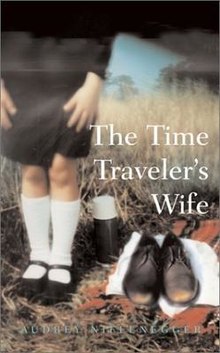
‘The Time Traveler’s Wife’ by Audrey Niffenegger

Niffenegger_TimeTravellersWife

2004, 519 p.

I used to read many more books that I do now, particularly between the years 2000 and say 2007, when I had an extended period of ill health. When this book was produced with a flourish as our July read for book group,  my heart sank a little as I had read it back in 2005. But fourteen years is a long time between reads, and although I remembered the gist, I didn’t remember the details.

It’s a time-travel book. I quite enjoy time-travel books that have a relationship at the heart of them until I try to explain them, and then the whole construct falls apart. It is the story of Henry, who travels back and forth through time, and his love for Clare, who would become his wife. The structure is confusing at first, with the chronology jumping back and forward, with Henry at varying ages as Clare plods through her allotted life span as Henry appears, disappears and reappears again.  I often found myself having to turn back to check the date of the chapter, and there was not enough difference in tone and language between the alternating narratives of Henry and Clare. The book has many references to literature and poetry which don’t really rescue it from what is often very domestic and every-day. The ending was a long time coming, with ‘just one more chapter’ being tacked on to the last.

Did I like it any more in 2005? It seems not: in fact, I seem to have mellowed in my old age. This is what I wrote in 2005:

I should have been warned off this book by the Women’s Weekly Great Read sticker on the front. It’s an interesting idea: a chronodisplaced man pops in and out of the life of the woman who is to be come his wife, but worthy only of novella treatment – not a whole 500 page tome! So much of this was banal: getting dressed, eating, mundane conversation lived by an adolescent randiness and panting and always-wonderful sex.  It will probably make a nice enough movie, but it doesn’t need all this print to support it. It’s a first novel, and one badly in need of a judicious prune.  5.5/10

Ouch! I was surprised by how much sex there was in the book, which seemed rather gratuitous in the end.  Perhaps I would enjoy the movie more? After all, that Christopher Reeve movie ‘Somewhere in Time’ was a favourite when I was about 20.  Still, I’m pleased to see that my opinions about books generally hold firm over more than a decade, and that I won’t have to go back to re-read all the books I didn’t like.

My rating: 6.5 out of 10 (I told you that I had mellowed)

Sourced from: CAE as a bookgroup selection.


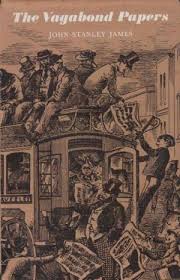
‘The Vagabond Papers’ by John Stanley James


vagabond

1969, 256 p.

John Stanley James (1843-1896) , a.k.a ‘Julian Thomas’ and ‘The Vagabond’ was a journalist, originally of Staffordshire England, who ended up in Australia and the New Hebrides. His most famous articles were written in Melbourne in the 1860s through to the 1880s, where he worked under-cover in what we would now call immersive journalism, which was published in a number of newspapers, most notably the Argus. I hadn’t heard of him, and neither had Jill Giese who featured him in her The Maddest Place on Earth (see my review here) but he has been on historians’  and journalists’ radars for some years. He has even been inducted into the Australian Media Hall of Fame!

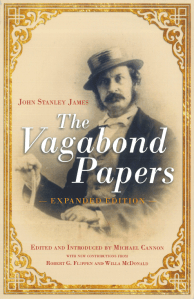
The version I read of this book was published in 1969 with an introduction by historian Michael Cannon. It has been recently republished by Monash University Press, with the original 1969 Cannon introduction supplemented by additional essays by Robert W. Flippen and Willa McDonald. I had heard podcasts of their presentations to the RHSV (see my review here), so having heard about their discoveries about James’ life, I felt comfortable enough with the older edition where Cannon signposts the very absences that Flippen and McDonald were to fill.

Vagabond2

2016

The chapters in this book are taken from his newspaper articles that deal with Melbourne and Sydney only,  illustrated by sketches from Punch, The Australasian Sketcher and the Illustrated Australian News. They have been arranged in six parts, reflecting their content.

In Part 1 ‘Down and Out’, James visits the places where the indigent gathered, often working ‘under-cover’. He pretends to be an outpatient at the Melbourne Hospital, where it takes him four attempts to be attended. He visits the police court (as Helen Garner was to do 140 years later) and visits the refuges and services offered. He compares the lodging houses in Melbourne and Sydney,  and writes about the Waifs and Strays of Sydney where his writing evokes Charles Dickens. He eats at a Sixpenny Restaurant and goes to the Melbourne General Cemetery to witness pauper funerals.

Part II “Life in Prison’ draws on his four-week undercover assignment at Pentridge Prison, where he works in the different divisions of the jail. In  Part III ‘Middle Class Morality’ he turns his attention to the churches including fashionable Scots Church in Collins Street, under Rev Charles Strong (who later formed the Australian Church), the suburban parish church of South Yarra and the bazaar at St Luke’s Church Emerald Hill. He turns a jaundiced eye to ‘Sabbath Breaking’ in Sydney at the theatres and bars.

Part IV ‘Cold Charity’ takes him to the Immigrants Home, the Benevolent Asylum, the Sailors Home, a Ragged School and fostering-houses for neglected children.  He picks up on this theme in Part VI ‘The Demi-Monde’, where he goes to the Magdalen Asylum at Abbotsford (now an artistic and cultural centre), and a Protestant Female Refuge in Carlton.  In Part V ‘Manly Sports’ he describes a football match and boxing rounds.

He often sets up oppositions within these chapters, where he compares organizations of different sectarian and social hues.  His language is often racist, with particular disdain shown for Jews and Chinese. It is disconcerting to hear his praise of the Magdalen Asylum, given what we now know about them, but his writing is very much of its time. In spite of this, his humanity, concern for the ‘underdog’ and his scorn for hypocrisy and cant shines through.

It was only when the end of the book was approaching that I realized that I hadn’t read the one thing that I had borrowed the book for- his expose of conditions in the Kew and Yarra Bend asylums. They are not included, and so I had to turn to the original newspaper sources instead through our wonderful Trove. It was interesting reading them in their newspaper format instead of the reader-friendly reproduction of his articles in book-form in ‘The Vagabond Papers’. (If you’re looking for them, they are in the Argus No I 22 July 1876; No. II 29 July 1876; No. III 5 August 1876; No. IV 12 August 1876; No. V 19 August 1876; No VI 26 August 1876). It made me realize how unaccustomed I am  to reading long-form journalism, especially with such small font and narrow columns.

I’m really pleased that I have met ‘The Vagabond’. He was years ahead of his time in his journalism, which is vivid and engaging, giving a good (if colourful) picture of Melbourne and Sydney from the bottom-up.  And what a fascinating personality, full of contradictions!


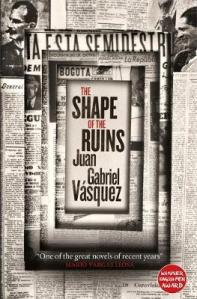
‘The Shape of the Ruins’ by Juan Gabriel Vásquez

vasquez_shape_of_the_ruins

2018 (English translation, originally 2015), 505 p.

When I learned that there was a new Juan Gabriel Vásquez book available, I made sure to put a hold on it as soon as it became available at the library. I had really enjoyed The Sound of Things Falling and looked forward to this new book. But I must confess that for about the first 100 pages I felt disappointed. Was this even a different book? I wondered. Many of the same elements were in both books: the tone of the narrator, who becomes obsessed with a murder at the same time as his partner is undergoing a health crisis; the fictionalization of a real-life event, and the sticky web of crime and conspiracy in Colombia. Is Vásquez only capable of writing the same book over and over?  That question still lingers, even though I was soon won over by the author’s smooth writing (no doubt ably assisted by an excellent translation).

The narrator is Juan Gabriel Vásquez himself, so already the lines between fiction and memoir are blurred. He becomes drawn into his friend Doctor Benevidas’ obsession with the (real life) murder of Colombian politician Jorge Eliécer Gaítan on April 9, 1948, an obsession that was almost handed down from father to son. Vásquez learns that his friend is not the only one obsessed: so too is Carlos Carballo, a former student of Dr Benevidas’ father, who conflates this assassination with other historical assassinations including J. F. Kennedy and the 1914 assassination of Liberal leader General Rafael Uribe Uribe. So there is this whirlpool of assassinations and conspiracy theories, investigated to the point of madness by amateur historian/detectives. Vásquez finds himself drawn into this whirlpool, while at the same time distancing himself from the conspiratorial world-view that propels it.

The book unfolds almost like those Russian dolls, starting off with one assassination, which is then likened to another, and then another.  There are stories within stories, each subtly but recognizably different from the other. The historical detail is rich, as I found when I googled to supplement my sketchy knowledge of Colombian history. This is not a bad way to have your history delivered, but Vásquez plays tricks too. He inserts completely fictional artefacts into the story, and makes references to his own fictional characters in his earlier books, as well as referencing other Latin American writers like Borges and, in a factual sense, Gabriel Garcia Marquez. There are photographs in the text, like a W.G. Sebald text, and the book is permeated with that same elegiac Sebaldian tone. It feels baggy and discursive, but it is always controlled.

So after playing with your head for 500 pages and making you feel as if you are stuck in one long Oliver Stone documentary, where does Vásquez leave you? The line between fiction and truth is blurred for him, as well as for you:

There are two ways to view or contemplate what we call history: one is the accidental vision, for which history is the fateful product of an infinite chain of irrational acts, unpredictable contingencies and random life events (life as unremitting chaos which we human beings try desperately to order); and the other is the conspiratorial vision, a scenario of shadows and invisible hands and eyes that spy and voices that whisper in corners… where the cause of events are silenced for reasons nobody knows (p. 496)…it would no longer be the fictional characters of that novel who would occupy my solitude, but a true story that showed me at every step how little I had understood until this moment of my country’s past, which laughed in my face, as if making me feel the pettiness of my narrative resources before the disorder of what had happened so many years ago. It would no longer be the conflicts of characters who depended on my will, but my attempts to understand truly and for ever, what ..had [been] revealed over the course of several encounters that were now blending in my memory (p. 501)

This is a complex read, but a compelling one. It was shortlisted for the Man Booker International Prize for 2019.  I’m frustrated that it is so similar to his earlier book, and yet I can’t help feeling that this similarity is completely intentional – that it is all part of a bigger vision. And so, when his next book comes out, I’ll be rushing to read that too.

My rating: 9.5

Sourced from: Yarra Plenty Regional Library.