Category Archives: Book reviews

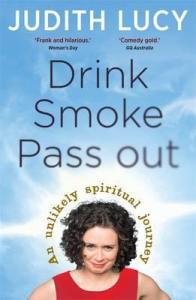
‘Drink, Smoke, Pass Out’ by Judith Lucy

drink-smoke-pass-out

2014, 256 p.

After finally finishing the harrowing The Discomfort of Evening, I needed something to laugh at. I knew that I had Judith Lucy’s book on my shelves, so I dug it out. I had read her Lucy Family Alphabet, which I enjoyed. I expected that this book would be in the same vein, but it took me into more of the same destructive behaviour (albeit in a more adult and benign form) that confronted me so much in Rijneveld’s book. Perhaps it was probably not the best choice of comedy writing after all. 

Judith Lucy has been mining her life for comedy gold for years. She speaks with a rather affected, yet Aussie, drawl which is both annoying and highly distinctive. Her focus is almost entirely on her own life. However, being ten (well, thirteen) years younger than I am, I quite enjoy watching her going through lifestyle changes that I’ve already experienced, and I now champion her as a middle-aged female comedian. The first third of this book is a subversion of the Eat, Pray, Love phenomenon which fortunately passed me by, and she certainly did drink, smoke and pass out, become too involved with the wrong men, and end up needy and full of fragile bravado.

Fortunately Judith Lucy does eventually move on from the alcohol, bongs and unconsciousness. Starting off as a tale of a dissolute life, it ends up as an exploration of spirituality. In this regard, it’s almost like the companion book to her television program Judith Lucy’s Spiritual Journey. I’m not averse to a bit of spiritual tourism myself, but I can imagine that some readers would be rather put off by the change in direction.

So, it was not quite the refuge from The Discomfort of Evening that I thought it would be, given that both books deal in different ways with physical self-harming and religion. But give me Judith Lucy any day.

My rating: 7.5

Sourced from: my own bookshelves

aww2020I have included this on the Australian Women Writers Challenge.


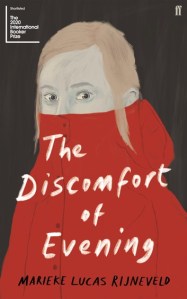
‘The Discomfort of Evening’ by Marieke Lucas Rijneveld

the-discomfort-of-evening

2020,   282 p. Translated from Dutch by Michele Hutchinson

Preamble: I read this because it was shortlisted for the Booker International. I am appalled that it won. Surely there is enough pain and unhappiness in the world.


Ten year old Jas lives on a Dutch dairy farm run by her strict Dutch Reformed church parents. I don’t know if she was disturbed before her family faced a tragedy, but she certainly is afterwards. Not just her: the whole family is cycling into a vortex of wordless despair. She is frightened that her father is going to leave; her mother has collapsed in on herself in grief; her brother is sadistic; her sister is in a similar place to Jas herself.

I spent most of this book flinching from its unrelieved misery and cruelty and self-abuse. Her parents’ Christianity is harsh and emotionally sterile, and it is juxtaposed against a world obsessed with bodily functions. The children are largely left to find their own way through the tragedy, and the depth of mourning over the loss seems unbalanced against the indifference with which the children are treated. In my mind the farm seemed cold, dismal and muddy, with no beauty in anything or anyone.

I found this a really disturbing book, which means that it will probably stay with me. I don’t know if I really want it to. It’s a debut novel: does this mean that it has succeeded? I suppose it does – and it has certainly attracted critical acclaim- but I felt like having a hot shower and seeking out a book to make me laugh, to remove the misery that clung to me as I finished it.

Rating: I have no idea. Would I recommend it? Only for the strong-stomached.

Sourced from: Yarra Plenty Regional Library

Read because: it was shortlisted for the 2020 Booker International Prize.


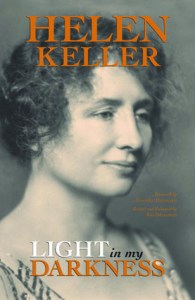
‘Light in my Darkness’ by Helen Keller

keller_light_darkness

Revised and expanded by Ray Silverman, 2000, 146 p.

This book, originally called My Religion, was written by Helen Keller in 1927,when she was 47 years old. She was certainly not the little girl standing beside the water pump in the garden any more. After graduating from Radcliffe College, Helen Keller had already achieved fame through the publication of her autobiography in 1903. Between 1920 and 1924, when money was tight, she and her teacher Ann Sullivan joined the vaudeville circuit, where they conducted two twenty-minute shows each day, as celebrity acts. Her family certainly disapproved of this way of earning money, and Ann Sullivan didn’t enjoy it. From 1924 onwards she became an ambassador and fundraiser for the American Foundation of the Blind- a far more ‘respectable’ role. This gave her a public profile and a platform to publicize the needs of the blind, but also to share her religious beliefs with the wider world.

As she tells it, since making her connection between language and the world, Helen Keller had had a spiritual hunger. She ‘spoke’ with the rector of Trinity (Episcopalian) Church Boston, Phillips Brooks about some of her religious questions but her main spiritual guide was the assistant to family friend Alexander Graeme Bell, Swiss-born John Hitz.  He introduced her to the writings of the famous 18th century Swedish theologian, scientist and philosopher Emanuel Swedenborg when she was in her early teens and he continued to support her spiritual development for the rest of his life. This book of a series of essays was, in a slightly different form, published as My Religion.

It’s hard to know how to read religious writing, especially when you don’t share the writer’s convictions. Keller was often criticized for the “literary-ness” of her writing, and that is certain true here, where she is writing in the devotional-writing genre which by its nature seeks to use words to capture emotion and reflection about the spiritual world.

This re-ordered edition starts with a biography of Helen Keller written by Dorothy Hermann, whose longer biography I reviewed here. It then moves through a series of chapters where Keller writes first, about her own religious development, and then about Swedenborg’s life and writings. I must confess that I found these Swedenborg chapters heavy going. They were fairly lengthy and wordy, and I was not particularly comfortable with her full-throated adulation of Swedenborg’s ideas. I wondered if the context in which I was reading them was wrong, so I decided to read them after my morning meditation, when I’m in a more contemplative mood. They still remained turgid and flat. However, I did enjoy the shorter chapters near the end of the book, which did lend themselves to ‘devotional’-type reading.

I was particularly interested in the editor’s note at the end of the book. Helen Keller did not find writing easy. She admitted that she found it hard to distinguish her own words (i.e.  words that she generated) from words that had been spelled out onto her hand by someone else. She was not able to skim-read what she had written previously, and when she was interrupted, she lost her thread. Parts of this book had been written years earlier and pasted into the manuscript. She certainly was not happy with her draft of My Religion which she handed over for publication, hoping that someone else would be able to do the editorial work that she could not. But it was published unedited and remained in print in its original form until this revision and expansion in 1994 with a second edition in 2000. The editor, Ray Silverman, himself a Swedenborgian from Bryn Athyn (New Church i.e. Swedenborgian- University) rearranged the segments, and put them into more coherent chapters. He added some material from of Keller’s other writings or speeches, and did remove a small amount of the original text.

I must confess that I would never have read this book had I not been preparing a talk on Helen Keller. It’s certainly not light reading in a genre that has a limited audience.

Sourced from: purchased e-book


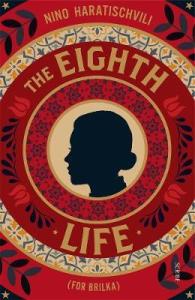
‘The Eighth Life (for Brilka)’ by Nino Haratischvili

eighthlife

2014, 944  Trans. by Charlotte Collins and Ruth Martin 2019

OK , Readings Bookstore, you got me. You included a chapter-length teaser of this book with your Readings Monthly newsletter, I read it and straight away put a hold on The Eighth Life at the library. (Sorry, Readings, that probably wasn’t the outcome you wanted!) But then the rather abrupt first shutdown came, with the book waiting on the hold shelf in the inaccessible library and so I turned to Hilary Mantel’s The Mirror and the Light  instead. I had no sooner picked up this book from the library than the second shutdown was announced, and so I found myself with six – and then nine – weeks to read it. Not that it took that long. Within about 30 pages I was hooked, and I could barely put it down.

It is a huge family saga of 933 pages, spanning from the start of the 20th century through to the 21st century in Georgia, on the fringe of the Russian and Soviet empires. The narrator, Niza is writing the family history for her 12-year-old niece, Brilka whose life will be the eighth in this family story. Book 1 starts with Stasia, who marries a White Guard turned Red Lieutenant after the Russian Revolution; Book 2 introduces us to Christine, her sister, who becomes involved with the ‘Little Big Man’ Lavrenti Beria, Stalin’s secret police chief. In Book 3 her son Kostya follows his father into the Navy, leaving behind a shattered love affair to become the family patriarch and tyrant. Stasia’s  daughter Kitty, for whom Book 4 is named, flees Georgia and becomes a dissident songwriter in the West. Book 5  deals with Kostya’s wayward daughter, Elene, who has two daughters Daria (Book 6) who is Brilka’s mother, and Niza (Book 7) the narrator. Brilka’s story, in Book 8, is yet to be told.

This makes the book sound more linear than it actually is. The women of the family – sisters, aunts-  live inordinately long lives, and they are present in the lives of their great-granddaughters and great-grandnieces. The family memory is long enough that events recur, and resonances in one generation sound in succeeding generations.  It was good to read a book where the matriarchal line carried the real strength, with mothers, aunts and female friends carrying out the nurturing roles and driving the family forward. The atrocities -and there are atrocities- lie at the heart of what it is to be a woman.

At the same time, there was a hint of magical realism with a family chocolate recipe, that is never divulged to the reader but carried from one generation of women to the next. It tastes exquisite but often seems to carry a curse. Does the book need this magic chocolate? Probably not, but it does underline the fairytale narrative of the book.

There is no family tree at the start of the book, as one might expect, but the separate books are long enough that characters are clearly embedded in your consciousness, and I rarely found myself thinking “Hold on, who’s that again?” I certainly learned more about Georgia than I expected I would. The book is somewhat discursive, following other characters beyond the eight lives of the title but it’s best to just go with it and enjoy, instead of becoming impatient to return to the main story.

I just loved this book. It was perfect reading for a lock-down, when you have sufficient time to immerse yourself in a big fat book.

My rating: 10/10

Sourced from: Yarra Plenty Regional Library

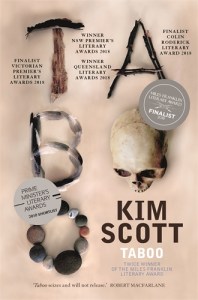
‘Taboo’ by Kim Scott

scott_taboo

2019, 304 p.

Some writers are noted for the diversity of themes and genres they explore. I’m thinking, for example, of Joyce Carol Oates, where each book seems to be completely unconnected to the one that came before or after it. Other writers, in contrast, have themes that they return to again and again, approaching them from different angles, probing them, teasing them out.

Kim Scott is one of the latter. I haven’t read his first Miles Franklin Award winning book Benang (although I can see it winking at me from my bookshelf), but I gather from reviews that he returns to events and places from that earlier book in this, most recent, one. His second Miles Franklin Award winning book That Deadman Dance (my review here) took us back to the earliest days of white settlement, with a wistful ‘if only’ and regret for lost opportunities. In Taboo those ‘if only’s’ are long past, but like That Deadman Dance, the book does hold out possibilities for reconciliation, albeit with a more jaundiced eye. I think of the two books as bookends of a long history of dispossession, neglect and treachery between the 1830s and 2020.

In Taboo, Tilly has only just recently become aware of her indigenous heritage when her dying father asks to make contact with her from jail. She finds that she has half-siblings, aunts and uncles that she not known about, but she is wary in approaching this community which reaches out to embrace her as ‘Jim Coolman’s girl’. She is a damaged young woman, who has only recently escaped from an abusive relationship, described at first just in fragments, adding to your sense of a dread as a reader. The Wirlomin community invites her to return to country for the opening of a Peace Park, sponsored by the Kepalup Local Historical Society, who hope that the ‘traditional owners’ will add some authentic indigenous flavour to the proceedings.

Tilly has her own unfinished business during this visit too. As a baby, she was fostered by a white couple, Dan and Janet Horton, who live on Kokanarup, a station that was the site of a massacre and thus taboo to the indigenous community. She remembers little of the fostering, but Dan remembers her and wishes that his late wife, who had died only months previously, had been there to see her again. Janet Horton had been one of the instigators of the Peace Park project, aware of the history of Kokanarup, but the Horton family and the white community generally have firm boundaries to the ‘reconciliation’ on offer. For white Australia, actually giving the land back is the ultimate taboo.

Nearly two hundred years of colonization have taken their toll on this community. There are the old stories, handed on from generation to generation, but much of the Noongar language has been lost and now culture has to be consciously taught in programs or, as in this 6 day trip, through camps and activities.  Tilly’s own father, Jim Coolman, had started such programs in jail, and he turns to one of his students, Gerry, to make contact with Tilly once her gets out of jail. It is a community finding itself again, holding tight to the things that have remained, and with a determination to rebuild and hand on to the next generation. There is drug and alcohol abuse and crime, but there is also generosity, humour and laughter. The return to Kokanarup is part of this healing. Language is at the heart of it: learning the old  world, binding together through shared language.

The abuse that Tilly has escaped- and is still escaping- is uncovered in the second half of the book, and it has not finished yet. There are bad people drifting around the community – Gerrard, Gerald’s identical twin, is stoned or violent (and sometimes both at once) and a white prisoner officer and drug pusher, Doug, abuses his power at both a community and personal level. There is also the condescension of the college Aboriginal Support Officer, Maureen McGill, who blithely tells the Noongah kids that she has worked with lots of Aboriginal people, “cultural people, still on their country” (i.e. ‘real’ Aboriginals), and is just as keen for the trappings of Aboriginality – the didgeridoos, the dancing- as the Kepalup Local Historical Society.

The book is beautifully constructed, with a circularity that always appeals to me as a reader. Scott has such a good ear for dialogue, and he writes about the land with love and perception. I think that I probably preferred That Deadman Dance, but that was probably a ‘safer’ book, where  the ‘historical fiction’ genre avoids the question of current-day intransigence and inaction on the part of white Australia. Taboo is quietly insistent that there are questions that need to be answered, and relationships that need to be repaired.

My rating: 8.5

Sourced from:  Yarra Plenty Regional Library e-book


‘Truganini: Journey through the apocalypse’ by Cassandra Pybus

pybus_truganini

2020, 336 p.

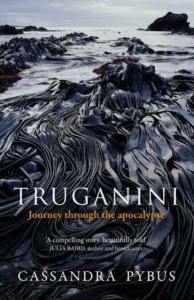
The front cover of Cassandra Pybus’ biography of Truganini shows Peter Dombrovski’s photograph of the sinuous, black ribbons of kelp at Macquarie Harbour in Tasmania. It’s a beautiful and yet unnerving photograph that is just right for this story of a black, evil period of Australia’s history that still congeals and clogs our sense of ourselves as Australians.

Truganini is a story based on historical sources, but Pybus has chosen not to write history here, with footnotes and forays into the historiography and secondary source material about Tasmanian indigenous history. As a historian, I regret that.

The approximately 250 km of Bass Strait that separates Victoria and Tasmania is not a wide expanse of water, but Victorian and Tasmanian histories have tended, until recent years (e.g. James Boyce’s 1835; Lynette Russell’s Roving Mariners ) to have been told as two separate histories of development. This is particularly true in the consideration of Truganini,  for a long time wrongly described as the “last Tasmanian Aborigine” as one story, and the story of the “Van Diemen’s Land Blacks” (as they were described at the time) who accompanied the Aboriginal Protector George Augustus Robinson to the Port Phillip settlement in 1839 as a separate story. I have read of Robinson’s activities in Tasmania through Plomley’s work (most recently revisited in Johnston and Rolls’ collection of essays in Reading Robinson, and in Leonie Steven’s beautifully written Me Write Myself) and I have also read in more details of his activities in Victoria ( most particularly in Auty and Russell’s Hunt Them, Hang Them). But until now, I haven’t read another work that sees the Tasmanian and Victorian experiences as a unified event, part of this unfolding ‘apocalypse’ that swept away all the certainties of a long-established lifestyle in an environment that could be bounteous, but also unrelenting.

Cassandra Pybus’ own life story is tied up with that of Truganini. Her family history in Tasmania starts with the grant of Neunonne land  on North Bruny Island  to her great-great grandfather Richard Pybus, thus implicating her own family directly in the dispossession of Truganini’s own land. She had heard family tales of an old woman picking her way across the land – her traditional Neunonne land, (although the Pybus family wouldn’t have seen it that way) and Pybus herself  purchases and lives in her uncle’s house built directly adjacent the old convict station at Oyster Cove where Truganini spent the last thirty years of her life.

Perhaps because it is a story personal to herself that Pybus has decided to write this as a narrative biography, rather than an academic history. As with any other writer working in this area, she relies heavily on the journals of George August Robinson, the self-appointed ‘Protector’ of Aborigines. Written in an almost illegible scrawl, these journals are a mixture of bombast, ego, information, sketches, occasional introspection and frequent obliviousness.  In her introduction, she writes:

In writing this book, I have deliberately confined myself to first-person accounts from people who saw her and heard her with their own eyes and ears, then – ideally- made a contemporaneous record of it. Such sources are very few and they are all culturally loaded. Robinson’s journals, however narcissistic and ideologically driven, are the best sources available , which bestows on this highly problematic man an outsized role in her story that he doesn’t really merit. (p. xix)

She doesn’t hold back on her own opinion of Robinson- an opinion much more critical than many other historians who are alternately repelled but puzzled by him:

Truganini and her companions are only available to us through the gaze of pompous, partisan, acquisitive, self-aggrandising men who controlled and directed the context of what they described. The challenge I have set myself is to somehow release these people from entrapment in a paternalising and self-serving account of the colonial past.  I want to redirect the lens to find the woman behind the myth (p. xix)

And this is where my regret that she has chosen not to write a history comes in: that without footnotes, and without acknowledging the work of historians with whom she has clearly talked – her friend Lyndall Ryan for just one- as a reader, I cannot tell where Robinson and the other observers end, and Pybus takes up, especially in ascribing Truganini’s motives and responses.

But I am in danger of letting my desire for a different book obscure my pleasure in the book that we do have. In Pybus’ Truganini – as distinct from the ‘last Tasmanian aborigine’ Truganini- we have a flesh-and-blood woman who swims and dives, who struggles through harsh landscapes and complains of having to walk instead of taking the boat, has friendships, loves children, uses her body and her sexuality to get what she wants, and resists being corralled into Robinson’s vision of a compliant, dying race.

I hadn’t realized just how far Robinson and his ‘guides’ walked on the different ‘missions’ between 1830 and 1834. They literally circumnavigated Tasmania, across varied terrains in often appalling weather. Pybus’ writing glows in describing landscape: you can just see them sinking into wetlands, scrabbling up and down rocky slopes.  Then there were the ‘missions’ back and forth, trying to ‘conciliate’ particular tribes – or what was left of them- all part of Robinson’s plan and purpose,  none of which he could have undertaken without them.

By “reading against the archival grain” in Robinson’s journals, you can see how resistant Truganini and his other ‘guides’ were to his mission. There was a whole tribal political and economic network in operation to which Robinson was oblivious and excluded. In a ‘search’, it was dubious who was seeking and who was sought.  Women were ‘rescued’ from the Bass Strait sealers, but refused to go with Robinson, preferring to stay with the sealers. There was a sexual trade in operation – and Truganini was a participant – and Robinson was powerless to stop it.

The two-facedness and betrayal in Robinson’s behaviour is breath-taking. He ‘brought in’ people of the varying nations with promises that he did not keep, often pleading that he had sought permission but been denied.  He promised to rescue daughters from the sealers, but did not (and could not) do so. He held out the promise of fertile land on the north-east tip of Tasmania, near the Bay of Fires, knowing that the eventual outcome was not this rich territory, but instead a windswept Bass Strait island.

His abandonment of his ‘Van Diemen’s Land’ family in Port Phillip, after bringing them over by various ruses, is reprehensible. Robinson had  arrived in Port Phillip well before Superintendent La Trobe arrived, and by then he had virtually washed his hands of their charge, more intent on bolstering his career by building the bureaucracy of the Protectorate in Port Phillip. His ‘Van Diemen’s Land family’ simply just falls out of his journals, and his conscience.

It was Truganini’s longevity that leaves her at the end of a dismal story of betrayal and illness, as gradually the people around her sicken and children are never born. It is difficult to find ‘agency’ in this slow denouement, but there is instead a steady resistance as Truganini refuses to fit into the fairy tale ending of an arranged marriage and a cottage in a simulacrum of “civilization”.

The book closes with a series of short biographies of the various indigenous people who Truganini encountered, either as part of her pre-Robinson days, during the so-called ‘Friendly Missions’ or through their enforced proximity on Wyballenna and Oyster Cove. These are arranged by nation, reflecting the importance of country as identity. They highlight that Truganini, like all of us, played various roles amongst the people she knew: friend, sexual partner, fellow expeditioner on the so called ‘Friendly Missions’. They make daunting and depressing reading.

The book has excellent maps at the start, which I found myself consulting often. The text rarely mentioned places not shown on the map, and it was easy to locate where the action was taking place. There are two sets of colour plates, but unfortunately no index, which made the biographies at the end of the book awkward to negotiate if you were unaware of the tribal origins of each individual. Her primary sources are cited, but no secondary literature at all.

I come to this book as a historian, and so I regret the lack of footnotes and engagement with the huge body of scholarship and the historical debates. The research has been done and her passion is clearly apparent.  Her work is, as historian Henry Reynolds blurbs on the back cover “of unquestionable national importance” but by her choices she has moved it out of the historiographical realm.

But there is no gainsaying the beauty of Pybus’ prose in describing landscape, and her sensitivity to Truganini’s agency and cohesiveness as an intelligent, resilient woman in a maelstrom of disruption and under a burden of grief. Perhaps eschewing the footnotes attracts readers other than historians, and that is important.

As a reader -whether a historian or a general reader-  you leave the book agreeing with Pybus that after all this dispossession, resistance and sorrow, that the “very least we can do is pay attention and give respectful consideration when the original people of this country tell us what is needed” (p 270).  It is, as she says “not too much to ask”. Indeed.

Sourced from: Yarra Plenty Regional Library

My rating: Difficult to say-  commenting as a general reader, 9/10

aww2020

I have included this in the Australian Women Writers Challenge 2020

 

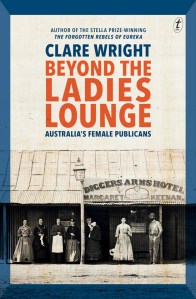
‘Beyond the Ladies Lounge’ by Clare Wright

wright_ladies_lounge

2014, 256 p.

My parents were teetotalers, and even though I’m not  a teetotaler by any stretch of the imagination (cue laughter from my husband), I was certainly influenced by my parents’ distaste for the dull roar and acrid smell of beer that emanated from the corner pubs of my childhood. Growing up in the time of the ‘six o’clock swill’, and with the quaintly lettered ‘Ladies Lounge’ etched into the stained glass of pub windows, the pub seemed a threateningly male place. But as Clare Wright reminds us in this book, this was not always the case. Female publicans have a long history, right back to the earliest days of white settlement, and at the end of the nineteenth century and early decades of the twentieth century, over half of Melbourne’s hotels had a female licensee.

This book, republished by Text Publishing in 2014 has had a longer life than you might think. The original 2003 book was originally drawn from Clare Wright’s PhD thesis from 2002, which itself grew out of her honours thesis which utilized oral histories with female publicans and their descendants. These academic antecedents are still here in this 2014 version of the book, but Wright’s lively writing style, even more pronounced in her later books The Forgotten Rebels of Eureka  and You Daughters of Freedom, ensures that the academic analysis enhances, rather than suffocates, the text.

She starts her book with an evocative pub crawl around Melbourne in 1889, from one hotel to another, where the publican is a woman. Right from the earliest days of convict settlement, the authorities were prepared to condone hotel-keeping by young single women.  During the gold rush, when liquor was ostensibly banned from the diggings, the sly-grog tents that flourished were often owned by women. Some women made sufficient money from sly-grogging to build hotels on the roads to the diggings where they became legitimate, respectable traders.

The legal framework regulating the liquor trade in Victoria was distinctly favourable to women because they were seen to ‘keep orderly houses’, reflected in the language that spoke of the licensee as ‘he or she’.  Most importantly, the requirement for pubs to offer accommodation (something that was not the case in Britain) meant that women were involved in creating a domestic, as well as drinking establishment. Nonetheless, with time, this came under threat.  The 1876 legislation, which aimed at cleaning up the trade after the gold rush, changed the language to ‘he’ and favoured male licensees, and in 1884 there was a courtcase that ruled that married women were prohibited from holding a publican’s licence.  This verdict threw the hotel industry into turmoil, but an Amending Act the next year preserved married women’s rights to renew their licences. Support for married women as licencees came from two unexpected quarters: the Licensed Victuallers Association who were ambivalent at first,  but were swayed by wanting to demonstrate the ‘respectability’ of their profession; and more importantly, the brewing companies who owned a number of hotels outright under the ‘tied house’ system, often using female licensees. In the midst of the temperance campaign around WWI, even the Women’s Christian Temperance Union, which campaigned vociferously against barmaids, was largely silent about female publicans with whom they probably had more in common than they wanted to admit.

‘Respectability’ was used by women publicans as both an attribute to make themselves valuable as licensees, and as a way of embedding themselves and their hotel as integral parts of the community. It was used as a way of controlling behaviour, too, by insisting that men not swear in front of them, and by not drinking with the men (as male publicans were wont to do) in order to maintain a respectable distance.

Because of the requirement for the publican to live on the premises, the pub was a home as well as a business. In the chapter ‘Mapping Elizabeth Wright’, she looks to the inquest records of the aforenamed Elizabeth Wright, who was murdered in her own hotel’s dining room by her business partner. Through these records, Wright (the author, not the victim!) is able to map out the Frankston Hotel spatially, and the dual and ambiguous family/business uses of many of the spaces. Female publicans, bringing up their families within this shared zone, did not have a separate work life but instead their children saw how they operated with authority and efficiency, as oral history testimonies demonstrate. In the final chapters of the book, she brings the female publican into the 21st century, with examples of female publicans in inner-city hotels (e.g. the Curry Family Inn in Collingwood) and  gastropubs (e.g. the Grace Darling, also in Collingwood).

I enjoyed this book. It is written with the same warmth and wit of Wright’s later work on Eureka and suffrage, which tie far more into the bigger historical themes of Australian history. It is not just a paean of praise to female publicans, because it has academic ‘grunt’ as well, although some readers may find this off-putting. There are enough personal vignettes for you to remember that you are reading about real people as well, and the sheer number of examples of female publicans drawn from right across Victoria reinforces that she is writing about a widespread, if overlooked, phenomenon.

My rating: 8.5/10

Sourced from: Yarra Plenty Regional Library e-book


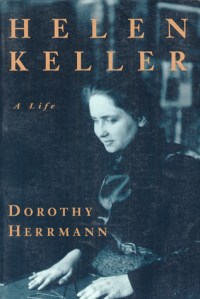
‘Helen Keller: A Life’ by Dorothy Herrmann

herrmann_keller

1998, 425 P

This is the biography that I should have read first, before embarking on Kim E. Nielsen’s The Radical Lives of Helen Keller. It is a much longer book, dealing with her whole life, right from birth until death, and it is not overtly written from a particular theoretical perspective. It draws heavily on the  many works that Keller herself wrote, previous biographies, and correspondence between Keller and many correspondents, and between that network of correspondents themselves. Herrmann points out that a fire in 1946 destroyed much of Keller’s correspondence, which is of course unavailable to later biographers.

Although the focus is on Keller, this biography also examines her relationship with the two women who were the most important in tethering Keller to the sighted/hearing world: Anne Sullivan and Polly Thompson, and to a lesser degree Nella Braddy Henney, who herself wrote a biography of Anne Sullivan. While these relationships are without question fundamental to understanding Keller, Herrmann at times is distracted by telling their stories at some length, to the extent that you wonder as a reader quite where she is going with this.

She casts a critical eye on Anne Sullivan in particular, suggesting that this complex, suffocating relationship brought limitations to both of them. Neither woman would have attained the fame she did without the other. There was one occasion in particular where I wondered how much evidence Herrmann was operating on when she offered a number of rather startling, left-field suggestions for a ‘secret’ alluded to by Helen Keller.

I like how ’rounded’ this biography is. She explores Keller’s sexuality, her politics, her financial situation and her spirituality. She follows through the full length of Keller’s long life, which demonstrated to me Keller’s resilience once she emerged from her grief at the death of Anne Sullivan, and later Polly Thompson. It is clear that Keller had her own politics and her own religion, quite distinct from the opinions of her companions. Perhaps because I’m getting older myself, I’m increasingly interested in the way that people embrace aging, and Keller certainly was active until she was quite old, and I’m glad that Herrmann has stayed with her to the end.

There’s a video interview with Dorothy Herrman here that demonstrates the richness of this biography.

Sourced from: borrowed from the Internet Archive. At a time of lockdown, I was pleasantly surprised to find that I could get this here.

My rating: 8/10


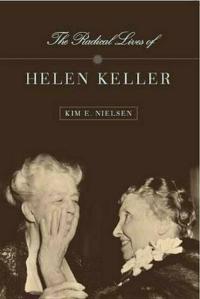
‘The Radical Lives of Helen Keller’ by Kim E. Nielsen

Nielsen_Keller

2004, 194 p.

I’m plunging into some reading about Helen Keller, in preparation for a talk that I’m giving this week at my UU Fellowship. I remember reading the story of Helen Keller standing by the water pump in one of my school readers in primary school, and of course, I saw Patty Duke in ‘The Miracle Worker’. But I hadn’t realized that Helen Keller had such a rich intellectual, political and spiritual life after water flowed over her hands prompting her ‘aha!’ moment and once she became an adult woman- and that’s what I’m exploring at the moment.

I hadn’t realized just how much had been written about Helen Keller. Children’s books, in particular, abound. The Radical Lives of Helen Keller is a relatively recent book, published in 2004, and I’m a little sorry that I hadn’t read Dorothy Herrman’s more conventional biography Helen Keller: A Life prior to reading Nielsen’s book, which is more overtly rooted in a theoretical stance than a ‘straight’ narrative biography.

Nielsen’s book comes from a Disability Studies perspective, which challenges the idea of disability as something to be ‘overcome’ and instead focuses on the social, political, economic and cultural factors that define ‘disability’. As she says, this perspective

”  reveals to historians, such as myself, the depth to which those definitions of disability and normality are ever-changing, are historically bound, and have immense consequence. Using disability as a tool of analysis necessitates a profound rethinking of power and the dynamics which create social power.” (p.13)

While not at all discounting the effects of blindness and deafness on Helen Keller, Nielsen argues that:

As the world’s most famous person with an acknowledged disability in the twentieth century, whatever Keller wrote, spoke or did mattered. The policies and attitudes she espoused regarding people with disabilities had political, legal, medical, financial, cultural and educational consequences.  Her public persona was held up as a standard for other people with disabilities and shaped their personal and political options, whether or not she or they desired it. She understood the political implications of class She also actively involved herself in advocating for people with disabilities. But she rarely explored the political implications of disability. For most of the her life, the disability politics she adopted were frequently conservative, consistently patronizing, and occasionally repugnant.” (p. 9)

It is because of this reframing of Keller’s life through a Disability Studies lens that I wish I had been more familiar with the entirety of her story, before critiquing it through this very late 20th-early21st century lens. Taking a contemporary intellectual stance and revisiting a well-trodden story is valuable and enlightening, but I am a little uncomfortable with the suggestion of blame that sometimes attaches to the project –  “why didn’t she act in a certain way?”

In particular, Nielsen is critical of Keller’s deliberate distancing from other people with disabilities throughout most of her life, most particularly the Deaf community. Keller’s education was recommended by Alexander Graham Bell, an oralist who was fiercely opposed to the use of American Sign Language. Possibly without being aware of it, she was aligned with one side of the cultural and political debates about signing and orality that still run through the Deaf community today. Moreover, she appears to have had little contact with other networks of blind professionals, intellectuals or activists of her own generation. She became a mythologized individual rather than part of an oppressed minority.

Nonetheless, Nielsen admits:

Given the limited practical or theoretical options perceptible to her, her isolation from other people with disabilities, and her inability to politicize disability, her career can be explained as a pragmatic choice. Few viable alternative choices existed. (p.12)

Nielsen explains why she titled her book in the plural:

This political biography is not simply entitled The Radical Lives of Helen Keller because of Keller’s interest in radical politics. She also lived radically different lives at different points in her life. Internal and hard wrought personal decisions effected these changes. External factors…also prompted these changes. The Radical Lives of Helen Keller seeks to recognize the various political lives Keller lived and the reasons for those political and personal revolutions. (p.14)

The book is divided into four chronological chapters, and a concluding chapter. The first chapter ‘I Do Not Like This World As It Is’ covers 1900-1924, thus starting with Keller’s entry to Radcliffe College, rather than the more common opening scene of the pump in the garden. It describes her spiritual conversion to Swedenborgianism and her involvement in socialist politics, something that was encouraged by John Macy, who was originally engaged as an editor/secretary, and ended up marrying Annie Sullivan

Chapter 2 ‘The Call of the Sightless’ covers the years 1924-1937 when she and Annie (now separated from her husband John Macy) focussed on the fundraising activities of the American Foundation for the Blind, a position which required Keller to suppress her socialist activities so as not to spoil ‘the brand’. At the end of this period, Annie Sullivan died, leaving Keller bereft.

Chapter 3 ‘Manna in my Desert Places’ 1937-1948 covers her first visit to Japan, a deathbed promise to Annie Sullivan, and her increasing concern over the rise of Hitler in Germany. She increasingly came under the purview of the FBI, especially for her support of the American Rescue Ship Mission, which planned to take European refugees to Latin America, but the project was scuppered because it attracted communist support. She became friends with the sculptor Jo Davidson who introduced her to many progressive, engaged people.  She returned to Japan in 1948 as part of a tour that planned to visit Australia, New Zealand, Asia and the Middle East, but it was cut short because of the illness of her travelling companion Polly Thomson. She did, however, visit Hiroshima and Nagasaki, and was appalled by the dropping of the bomb.

Chapter 4 ‘I will not allow Polly to Climb a Pyramid’ takes the last 20 years of her life (1948-1968) and her work as a goodwill ambassador for the United States, representing the United States “as a courageous, interesting, vibrant but quirky country that could accomplish virtually anything.”

The political  implications of her actions were implicit, her political opinions left private. Her message was inherently political but her image was of a living miracle. This seemingly placed her above the squalor of international and partisan politics” (p. 106)

The final chapter ‘One of the Least Free People on Earth: The Making and Remaking of Helen Keller’ examines the project to curate the Helen Keller image, both at the time, and since. It was a project that depended on her exceptionality, and it demanded the suppression of political solidarity with both disability activists, and with the progressive politics that might offend donors to the American Foundation  for the Blind.

I enjoyed this book, even though I recognize that I should have read it later, rather than sooner. I am now reading Hermman’s biography, and find myself reading the two books against each other. And I find myself astounded by Keller’s preternatural intelligence, her political involvement and deep spirituality.  Nielsen is right-

Keller is a complicated icon, just as she was a complicated individual, who lived a complicated life. She thrived, however, on complication, on debate, on excitement and on constant movement. She liked Scotch, not tea (p. 131)

Sourced from:  ebook through State Library of Victoria

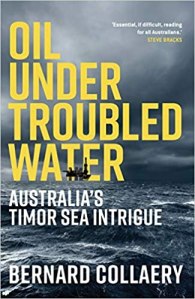
‘Oil Under Troubled Water’ by Bernard Collaery

collaery_oil

466 p. 2020

This blog post is actually an amalgam of two blog posts. The first one explained why I didn’t finish reading this book. This second post is written after I gritted my teeth and did finish it after all.

I’ve become more interested in international politics over the last twenty years. This interest was spurred by my outrage at the oleaginous Alexander Downer’s airy dismissal of concerns about Australia’s behaviour over East Timorese oil resources, waving off the whole question as a merely a matter for foreign aid, rather than principled policy. I decided then that I needed to know more about the world around me.

I still feel that way, particularly about East Timor and West Papua. I watched a Readings ZOOM session where former Victorian Premier Steve Bracks launched this book and decided that I should read it. Bracks describes it in a blurb on the front cover as “Essential, if difficult, reading for all Australians”. I assumed that it was difficult from a moral/political point of view (which it is), but for me it is difficult because of the way it is written. It is very detailed : nearly 400 pages of very dense foreign policy with different departments and diplomats and acronyms. It’s a lawyer writing, not a historian, and fact after fact is rammed through, lest nothing be left out. This is a real insider’s book, for someone who already knows the lie of the land and the big picture. That reader is not me.

Bernard Collaery is a former Attorney-General of the Australian Capital Territory and worked for many years as legal counsel to the government of East Timor. He makes no secret of his admiration for and allegiance to Xanana Gusmao, the first President and fourth Prime Minister of the newly-independent East Timor. The black and white photographs sprinkled through the book, often including the author, show that he is not just a commentator but a participant in the events. In May 2018 he was charged by the Australian Commonwealth Director of Public Prosecutions with conspiracy to breach the Intelligence Services Act of 2001, introduced in the wake of September 11. He, and Witness K, a former senior ASIS agent, have been effectively gagged over a claim that ASIS had bugged the offices of the East Timorese team during negotiations over Timor Sea oil.

This, then, is a history of Australia’s dealings with East Timor and Indonesia over the oil resources- and more importantly, the helium reserves- in the Timor Sea. It moves chronologically, but it is a lawyer’s argument rather than a historian’s. However, as a historian, I learned much: about the way that England’s treaty with Portugal affected how England wanted to hide behind Australia in taking action in Timor during WW2; the strategic importance of the Azores in the middle of the Atlantic for British defence and hence its concerns about getting Portugal offside over Timor; about the Whitlam and later Fraser government assumptions that Indonesia would take over East Timor, in preference to independence. In Collaery’s telling, Australia’s foreign policy reached its high point with H.V. Evatt, and from then on has been underhand and coercive, and largely and inexplicably beholden to the petroleum industry (although, as he points out, Alexander Downer’s almost immediate employment by Woodside Petroleum is telling).

Australia does not come well out of this. The Australian government was quick to act when the new nation of Timor Leste was just finding its feet; it has played hard ball with questionable geological and cartographic ‘facts’ , and yet ineptly managed to lose the benefits of the ‘inert’ helium commodity not only for Timor Leste but for Australia itself.

I did manage to finish this book, but I found it very hard to read. Inexplicably, there is no map until page 362 and in a book that bristles with acronyms, there is no glossary.  It is meticulous, with every fact noted, but it groans under the weight of so much detail. My gut feeling all those years ago was that Australia was acting like a bully, and this book only confirmed it further.

My rating: 6/10

Sourced from: Yarra Plenty Regional Library