I’ve never read The Iliad. I knew bits of it, most particularly the final scenes where the enraged Achilles is dragging the body of Hector around behind his chariot, but I’ve never read the whole thing. I’m not a big audio-book listener either, but in this case I decided to listen to it, knowing that it was originally an oral story. I had audios of the Fagles translation downloaded from who knows where, but they were many separate files and I kept getting lost. So in the end, I succumbed to the prose version by W.H.D. Rouse which felt a bit like cheating. However, I had first been drawn to finally tackle it after listening to a podcast on Achilles, where extracts from The Iliad were read out, and if that narrated version was not prose, then it certainly sounded that way. (The show notes don’t reference the translation). At the same time, I listened to an excellent series of lectures by Michael Dolzani at the Expanding Eyes podcast Episodes 44 to 56, which I have referenced in my I Hear With My Little Ear postings between 23 Oct 2023 and 16 January 2024.
It took me several weeks. Was it worth it? For much of the time, I would have said ‘no’. There are whole books devoted to call-outs to various warriors and their families: you can just imagine the listeners sitting, waiting for their family’s name to be called out, and their triumphant glances when it was. There are many chapters devoted to battles as men are run through the shoulder with swords, eyes plucked out etc etc etc. There are oddly placed chapters that describe ceremonial games held to celebrate a fallen warrior, with the results told in tedious detail.
Above all, there is the image of the hero: brave, fearless, unswervingly loyal. The obverse of the coin: proud, arrogant, stubborn. The image of hero has lured whole contingents of men to their death in its wake.
But there are also moments where we see the heroic ideal held up against other more human traits, most particularly the bond of father and son. This plays out most strongly in the last books of the epic, and these books alone make the rest of the testosterone-driven gore worthwhile.
It has never really occurred to me to question whether Jesus actually existed. There are many things that I doubt about him- miracles, resurrection, second coming for a start- but his actual existence, no. In fact, having spent a lot of the last three years or so catching up on the history of Rome that I missed out at school and university, it seems to me that the sparse references to Jesus himself and the response of Roman authorities to this small apocalyptic sect are just as you would imagine them to be.
However, as this book makes clear, there is a body of thought (albeit small) that asserts that Jesus never existed at all and was instead a myth that conflated Jesus with existing fertility gods and sun gods. According to this view, no textual evidence of Jesus emerged during the 1st century, having dispensed with the Jewish historian Josephus as a forgery. In his introduction Ehrman namechecks the major current proponents of these views: Earl Doherty, Robert Price, Frank Zindler, Thomas L. Thompson and George A Wells. While acknowledging that several of these authors have academic qualifications in classics and the Hebrew bible, according to Ehrman only one of these- Robert Price- has the intellectual chops in New Testament studies to be a serious contender. Ehrman then launches into his own rebuttal to the ‘mythicist’ position by looking at non-Christian sources for the life of Jesus, the Gospels themselves as historical sources, and other Christian writings that did not make it into the biblical canon. He presents what he considers two key arguments for Jesus’ existence: first, Paul of Tarsus’ personal association with Jesus’ followers and brothers especially Peter and James; and second, the common knowledge that Jesus had been crucified. The crucifixion was an affront to any perception of Jesus as a ‘messiah’, not unlike us finding out that David Koresh at Waco was really the Messiah. He then moves to dismantling the mythicists’ claims through either weak or irrelevant argument, and grappling with the ‘pagan myth’ hypothesis for Jesus’ non-existence. In the last two chapters of the book he spells out his own view of the historical Jesus as a 1st century apocalyptic Jewish preacher- a view that I largely subscribe to as well.
Looking at the list of ‘mythicists’ that he is taking on, one thing stands out to me: they are all men. I rarely mentally link the words ‘testosterone’ and ‘biblical studies’, but the first part of the book reminded me of chest-bumping, shirt-fronting, put-up-your-dukes academic skirmishing. The argument, carefully laid out with centred headings and subheadings felt to me like an extended exercise in man-splaining, complete with the repetition and put-downs. All rather unedifying, I thought.
However, I enjoyed the last two chapters of the book, where he stopped attacking and began presenting his own considered and backed-up views of the historical Jesus. Here is where he and I concur:
The fact is, however, that Jesus was not a person of the twenty-first century who spoke the language of contemporary Christian America (or England or Germany or anywhere else). Jesus was inescapably and ineluctably a Jew living in first-century Palestine. He was not like us, and if we make him like us we transform the historical Jesus into a creature that we have invented for ourselves and for our own purposes…When we create him anew we no longer have the Jesus of history, but the Jesus of our own imagination, a monstrous invention created to serve our own purposes. But Jesus is not so easily moved and changed. He is powerfully resistant. He remains always in his own time. As Jesus fads come and go, as new Jesuses come to be invented and then pass away, as newer Jesuses come to take the place of the old, the real, historical Jesus continues to exist, back there in the past, the apocalyptic prophet who expected that a cataclysmic break would occur within his generation when God would destroy the forces of evil, bring in his kingdom, and install Jesus himself on the throne. This is the historical Jesus. And he is obviously too far historical for modern tastes.
Sometimes you just have to shut a book when you reach the end and say “Wow!” That’s what I did when I finished reading Alison Bashford’s An Intimate History of Evolution, a dual biography of Thomas Henry (T. H.) Huxley and his grandson Julian Huxley that also drew in all the ‘little’ Huxleys as well. Not that there was anything ‘little’ about this family: it lay at the heart of 19th and 20th century British intellectual life, with links that extended to other illustrious families of science and letters like the Arnolds, Darwins, Galton and Wells.
While family biographies are nothing new, Bashford shapes her approach through two particular Huxley family members: T. H. Huxley (often known as ‘Darwin’s bulldog’) born 1825, and his grandson Julian, born 1887. This jump between generations, largely skipping the intervening generation, breaks up the linear progression of the narrative:
The younger man constantly fashioned himself after his Victorian grandfather, pursuing those signature Huxley knowledge-quests, some profound, others simply grandiose. They were both remarkable and both, on occasion, tortured. Writing these natural scientists together permits a kind of time-lapse over the nineteenth and twentieth centuries, precisely because they were so similar. We might even think of them as one very long-lived man, 1825-1975, whose vital dates bookended the colossal shifts in world history from the age of sail to the space age; from colonial wars to world wars to the Cold War; from a time when the Earth was 6,000 years old according to Genesis, to a time when it was 4.5 billion years old, according to rock samples returned from the Apollo missions.
p. xxiii
T. H. Huxley was born into an “educated but struggling and socially declining” family (p.xxx) and had only two years of formal education before being thrown on his own resources as an autodidact. He was apprenticed to anatomists in the family, but did not complete his medical degree. He joined the navy and was made Assistant Surgeon on H.M.S. Rattlesnake, which embarked on a voyage of discovery and collection in Australia and New Zealand. (Actually, there are several references to Australia in this very English biography- perhaps reflecting Alison Bashford’s current position at UNSW). His work on jellyfish and other marine creatures gained him admission to the Royal Society but despite the acclaim he received for this work, he still had to fight for his position as professor of paleontology and natural history at the Royal School of Mines. His grandson, Julian, had a much easier path. His father, Leonard, had benefitted from the upward social and financial mobility of his father, and so Julian attended Eton and then Baillol College at Oxford from 1906. He, too, studied marine life, but he made his scientific name in his study of grebes (birds). He was invited to set up a Department of Biology at Rice University before World War I intervened, and he later moved to Kings College London as Professor of Zoology. He resigned this position to work with H.G. Wells and his son on a book The Science of Life before travelling to East Africa to continue his ornithological work . He returned to London to take up a position running the London Zoo in 1935, followed by a role in the creation of UNESCO and the WWF. He was a fore-runner to David Attenborough in popularizing the natural sciences and conservation through radio and television broadcasts and documentaries.
But both men’s work was broader than this. Their shared interest in evolution, albeit separated by the discoveries in the decades between their work, involved them in the intense debates of their times. Darwin’s theory of evolution (which T. H. Huxley was not initially convinced by, despite later becoming one of its major exponents) led to explorations and assertions about Homo Sapiens, anthropology, political biology and finally led to eugenics, of which Julian was a leading figure although distancing himself from its use in Nazism. Julian looked forward to transhumanism: a landscape that we have yet to traverse.
Both men were interested in the psychic and spiritual realm, particularly in later life. T. H. Huxley coined the religious term ‘agnostic’, meaning a humble ignorance and openness to further knowledge rather than its more hard-edged nature today. He approached the Bible as a historical document, and during his life wrote as much on Biblical themes (albeit critically) as he did on some of his natural science interests. He enjoyed jousting on religious matters with his sister-in-law, Mary Augusta Ward nee Arnold, who as well as writing rather dire ‘improving’ literature and being active in the anti-suffrage movement, was also a strong supporter of women’s education and settlement houses as part of the social reformist movement. His grandson Julian also developed an interest in neo-romanticism and was attracted to the ideas of the Jesuit priest Teilhard de Chardin with whom he shared a quest towards cosmic unification.
But both men shared the family inheritance of mental illness, in particular an immobilizing depression which saw Julian committed to psychiatric hospitals at various times during his life. This combination of family brilliance and family mental illness is perhaps what gives the title – An IntimateHistory of Evolution its unusual adjective. Here the theory of inheritance becomes personal.
The structure of the book reflects Bashford’s rejection of a single line of chronological narrative. The book is divided into four parts thematically: Genealogies; Animals; Humans and Spirits, and although dealing first with T.H. and then Julian in each of these themes, the timeline and focus does jump from one man to the other. Nor does the book focus on them alone: the women of the family, particularly T. H.’s wife Henrietta, Mary Augusta Ward, Julia Arnold are also referenced throughout. Other Huxleys especially Julian’s brother Aldous, and the religious writer Francis Huxley are also present. Bashford captures well the network of knowledge and intellectual influence which shaped, and in which the whole family moved.
Bashford’s own grasp of T. H. and Julian Huxley’s work is impressive. As a historian of science, she traces the contours of their scientific work, making it intelligible – and even, when you’re reading about jellyfish, interesting. She is just as comfortable teasing out their philosophical and religious work, which does become rather esoteric at its edges. It is not a particularly easy read, although I made it harder for myself by stopping for about a fortnight to read other things. But she is talking about big ideas – indeed, the biggest of ideas- and as a reader you have to work as well. She is writing about a family who were a tour de force in their intellectual milieu, and this book is Bashford’s own tour de force of biography, science, philosophy and history as well. Brilliant
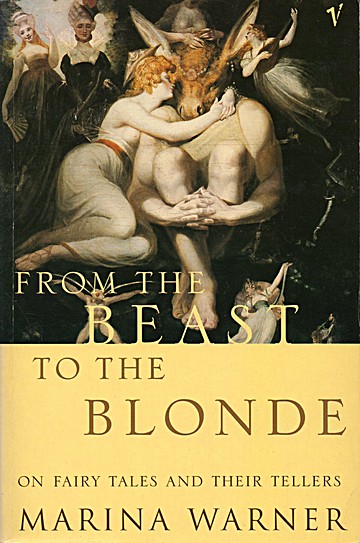
I was rather startled to see that my CAE bookgroup had chosen Marina Warner’s book for our December 2023 read. We’re a rather cosy bookgroup, once condescendingly designated ‘middlebrow’ readers, more drawn to fiction than non-fiction, and I was familiar with Warner’s rather erudite contributions to the London and New York Review of Books magazines. From the Beast to the Blonde is a hefty tome, both physically, and intellectually. I raised an eyebrow at the notewriter’s opening paragraph in the CAE notes that accompanied the book:
Perhaps the book should be approached by reading the lucid and interesting introduction and conclusion, which summarize all the themes developed at length in the main text, then glancing through the text’s handsome and liberal illustrations, which will give a visual impression of the contents.
CAE notes p. 1
Once I felt that I had ‘permission’ to skip bits, I actually ended up reading most of the book, even though I only started reading it about four days before the meeting, as is my usual practice. It was very dense, with long sentences and a forbidding vocabulary (autochthonous? peripeteia?). It was very digressive, as if Warner couldn’t allow a possible association to go unremarked. Most of her material was focussed on European fairy stories. Some Islamic stories do get a look in, but few Asian or indigenous stories are mentioned. In fact, I’m not sure that she ever really defined what a fairy story is, and the distinction between a folk tale and a fairy story.
The book is divided into two parts: The Teller and the Tale. In the first part of the book, she highlights that most fairy stories originated in women’s talk, especially in women-only places like child-bed, washing, kitchens etc, even though they were generally published under men’s names (e.g. Charles Perrault, the Brothers Grimm, Andrew Lang). Wrested into the male realm, they often display a disparagement of the original women tellers, drawing on the imagery of the old crone, or a bird to declare them “Mother Goose’s” tales or a grandmother’s stories.
In the second part of the book she moves on to specific stories, particularly Cinderella and the rather disturbing Donkeyskin fairytale (where a young girl has to disguise herself in a donkey skin to avoid her father’s incestuous designs on her) among others. She discusses the Disneyfication of fairy stories, especially ‘The Little Mermaid’, and the cultural stereotypes of blondness and step-mothers that are conveyed through them. But this division between the two sections is not clear cut. For example, although name-checking Marie-Jeanne L’Heritier, Henrirette-Julie de Murat, and Marie-Catherine d’Aulnoy as women writers of fairy stories prior to their absorption into the male-author canon in Part One, it is only in Part Two that she actually gives biographical details about the women and their part in late seventeenth and early eighteenth century French circles. She reveals her indebtedness to Angela Carter, whose adult fairy stories have extended and subverted the genre.
To her credit, she does give a good plot summary of the various stories and their variations, as few readers would be familiar with them, and she does the English reader the courtesy of translating French quotations from them. But it is still a very dense, difficult text. In the conclusion, she embarks on a discussion about a historical as distinct from psychoanalytic reading of fairy stories, arguing that they need to be read within their historical context in both their authorship and allusions, rather than as representatives of archetypes (at least, I think that’s what she was arguing).
The proliferation of anti-fairy stories, even more so in the decades after this was written, have picked up on the feminist emphasis on this book which no longer seems particularly radical or new. They certainly do not call on the same intellectual fortitude and commitment that this book requires of its reader. And it did remind me to one day introduce the original versions of the stories to my grandchildren (yes, it will probably only be my granddaughters) from my own mother’s ‘The Children’s Treasure House”, which will test their attention spans with its dark themes and its black and white art-deco line drawings. Just like my attention span was tested with this book. I recognize its contribution and I admire its breadth and erudition, but it was hard work.
My rating: 7/10
Sourced from: CAE for my CAE Book Group (AKA ‘The Ladies Who Say Ooooh’)
If I were better versed in chemistry, I would start off with drawing parallels between this book and some sort of chemical reaction where there’s a big confident beginning, petering off into a spluttering little anti-climax. Alas, although I can think of parallels in other spheres (political movements? relationships?), I don’t have the chemical knowledge to think of a chemical metaphor. But that’s how I felt about this book: it started off well, then just sagged into a gloopy sentimental mess.
Elizabeth Zott is a research chemist working at the Hastings Research Institute in the early 1960s, the only woman in an all-male working environment (except, of course, for the admin). We now know enough about the side-lining of women in science through Rosalind Franklin and movies like ‘Hidden Figures‘ to recognize the institutionalized injustices that see Elizabeth’s work appropriated and assumed to be the work of the men surrounding her. Almost against her own better judgement, she falls in love with her co-worker Calvin Evans and when her life suddenly falls apart, she finds herself unemployed, unmarried and with a fractious baby. Fiercely independent, she has to learn to accept help from an older neighbour and the father of her daughter’s school friend when he offers her a job to host a TV cooking show. She makes this job her own by introducing the chemistry that she is shut away from professionally to her viewers, housewives at home watching afternoon television. She does not talk down to her viewers and she attains a cult following.
And at this point, my own chemical reaction starts to fizzle out. Yes, we had our professor Julius Sumner Miller in the 1960s, but it stretches credulity to think about a cooking show veering into academic territory like Elizabeth’s ‘Supper at Six’ does. Then there’s the dog (yes, the dog) Six Thirty who is anthropomorphized to the point of having his own dialogue. And the precocious child. And the angelic neighbour. And the mysterious benefactor. Oh stop.
I liked the tone of this book at the start, but it seemed to get lost by the end. The narrative voice was one of those ‘Voices of God’ commentaries, slightly ironic and comforting and imbuing the book with the sense of being a morality tale, or a fairy-tale. There were many one-liners which were sharp and pointed, and certainly coming from a 21st century feminist-ish perspective. But the ending was just a sentimental ‘everything-works-out-in-the-end’ hash. Elizabeth deserved more.
My rating: 6/10
Sourced from: purchased (!) Only because there were too many holds on it at the library
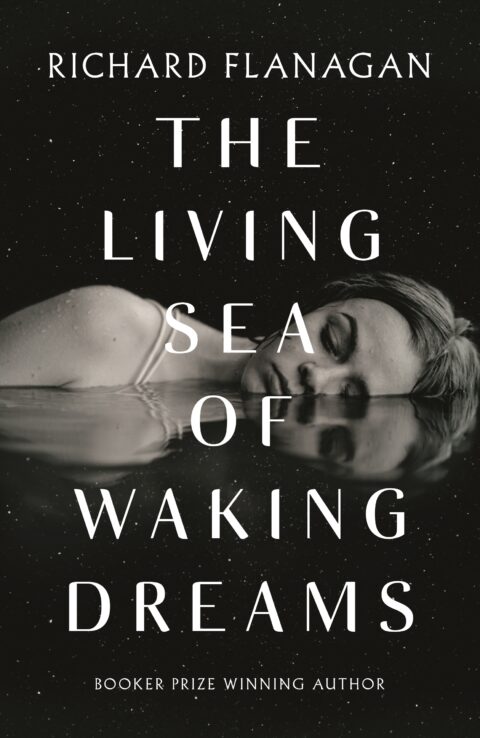
I’m old enough now to have sat beside two dying parents- and who knows if life holds further deathbed vigils for me- and one of the things that struck me even in the midst of it was what a strange time it was. Outside that room, life teemed on oblivious; inside that room, each breath was watched and counted. This strangeness pervades Richard Flanagan’s The Living Sea of Waking Dreams, starting right from the opening pages. It’s summer, and the city is shrouded in smoke, just as we remembered January 2020 to be (although I had forgotten that smoke when we were then catapaulted into COVID lockdowns by March that year). Anna looks down at her hand, and notices that her ring-finger is missing, blurred out, gone. Her mother is in hospital after a “bad turn” following the dreaded “fall”, having five years earlier been diagnosed and treated for hydrocephalus, and then diagnosed with low-grade non-Hodgkin lymphoma. Now she has had a cerebral hemorrhage, which will be followed by liver problems, and the family is asked what their mother’s wishes were.
Not that the siblings – Anna, Tommy and Terzo- are going to respect them, even when their mother Francie, painstakingly spells out ‘GOMELET’ on an alphabet board. “Let me go?” asks Anna, feigning astonishment, “But where are you going to go to?” Because, led by the forceful Terzo, the family has decided that their mother Francie must live, irrespective of cost, irrespective of doctors’ opinions. Strings are pulled, favours are called in, and Francie, becoming increasingly less human by the day, is kept alive by machines, because we can.
Meanwhile, those disappearances… first Anna’s finger, then her knee, then her breast, then parts of her face. No-one else seems to notice. Then her son, the unresponsive gamer locking himself in his bedroom and stealing from his mother, starts disappearing as well.
And at a broader level, there are disappearances too.
The ladybirds gone soldier beetles blue bottles gone earwigs you never saw now gone beautifully coloured Christmas beetles whose gaudy metallic shells they collected as kids gone flying ant swarms gone frog call in spring cicada drone in summer gone gone.
Gradually we learn the history of this family, and come to understand the dynamics between the adult children, starkly drawn in all its steely aggression and wilful blindness. This is a painfully honest book at the human level, and a grimly pessimistic book at the broader environmental level. It juxtaposes the desire to hold on at all costs to some lives and the blithe dispensing of others, power and powerlessness. It is a little heavy handed with the politics – I felt rather bashed over the head by it- but I was won over by his skill in interweaving his up-close personal story with a broader world-level story. Some readers will bridle against the magic realism, but for me it just highlighted the paradox of his argument. In many ways, this book touched on nearly all his previous books – the magic realism of Gould’s Book of Fish, the love for wilderness of Death of a River Guide and the horror of genocide and disappearance in Wanting. He is such an assured, deft writer.
Excellent.
My rating: 9/10
Sourced from: CAE bookgroups for my Ladies Who Say Oooh bookgroup. It was my choice.
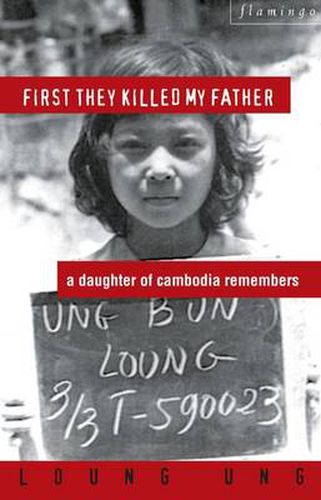
As you might know, some months ago I travelled to Cambodia and am likely to repeat the trip a few times more over the next few years. First They Killed My Father is one of the books that tops the ‘Books You Must Read Before Travelling to Cambodia’ lists, but I felt rather reluctant to read it. In my mind Cambodia was defined by two things: Pol Pot and Angkor Wat, but I want it to be more than that. And yet, having now been there, the influence of both is inescapable. They don’t necessarily define Cambodia, but they have shaped it.
Loung Ung was five years old when the Khmer Rouge swept into Phnom Penh. They were wealthy and of Chinese descent: her mother was ‘full Chinese’ and tall, with almond shaped eyes and a straight Western nose. Her father, part Chinese, part Cambodian, she describes as having “black curly hair, a wide nose, full lips and a round face” with “eyes shaped like a full moon.” Her father originally worked for the Cambodian Royal Secret Service under Prince Sihanouk, and then as a major in the military police under Lon Nol. We don’t actually learn what he did in either of these jobs, but it did afford them an upper-middle class lifestyle in Phnom Penh. She was raised to distance herself somewhat from Cambodia: in the mornings she studied French, in the afternoons Chinese and at night Khmer, and her parents spoke about Cambodian customs as being something “other”.
Not that any of this helped when the Khmer Rouge evacuated the city completely, under the pretense that the US was about to bomb the city, and that they could return in three days. Her mother soon realizes the reality, with her offering money notes to her daughter to use as toilet paper. The family is shifted from location to location, siblings are sent to jobs in different places, and her parents are acutely aware of hiding their middle class origins and pretend that they and their children are peasants. Her parents had reason to fear. I found that one of the most chilling sights in the Tuol Sleng Prison (Security Prison 21), which I visited, was the sight of children, arrested along with their parents, who were questioned and later killed. It was fear of being arrested as a family that led her parents to send their daughters away to fend for themselves. Yet somehow, miraculously, some (but not all) members of the family find their way back to each other when the madness comes to an end. With the family in tatters, she and her brother travel to Vietnam, then use a people smuggler to go to Thailand where they end up in the Lam Sing Refugee Camp, waiting to be taken in by another country. Did her brother’s conversion to Christianity help?- possibly, and she and her brother are granted residency in Vermont.
The book is written in the present tense, and it moves chronologically in a methodical way, with each chapter headed by a date. It purports to be a child’s-eye view, but of course it is being written by an adult. The book has been criticized in Cambodia for inaccuracies, her obliviousness to her privilege, implausibilities and the racism she displays against the ‘base people’ in emphasizing her Chinese origins. You can read several critiques at Kymer Institute – in fact, it’s well worth doing so. Certainly I noticed her disdain of peasants and Cambodians generally, but as for the rest of the criticism- I don’t know enough. I read it partially as a way of trying (unsuccessfully) to understand the Khmer Rouge and how and why they took power with so little apparent resistance. Exhaustion from war and exposure to unyielding and ideologically-driven violence have much to do with it, I suspect. Reading this book while in the country, I enjoyed the descriptions of Phnom Penh (albeit at fifty years remove) and gave context to my ambivalent visit to Tuol Sleng Prison. I’m still looking for books about Cambodia that, while not blithely ignoring the Khmer Rouge years, are not defined by them.
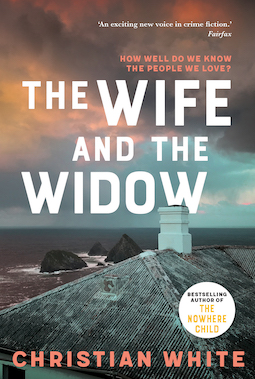
This book won the Ned Kelly Award for Crime Fiction 2020 but given that crime fiction is not one of my preferred genres, it escaped my notice completely. Anticipating by the front cover a Shetland-esque novel, I was surprised to find that it was set in Australia, on a fictional island off the Victorian coast. The island is home to Abby, the “wife” of the title who lives there all year, as the population swells and dwindles with the holiday seasons. Her husband Ray is a handyman, and they live with their two children in an old house that Ray rarely uses his handyman skills to improve. She has a job in the small local supermarket which doesn’t provide enough income during the off-season, and she has embarked on the rather odd hobby of taxidermy in her garage, fed by the supply of roadkill.
The “widow” of the title is Kate, who is perplexed to find that her doctor husband has concocted an elaborate hoax to convince her that he has attended an international conference. Instead, his body is found at their holiday house on the island. Kate and her father-in-law, with whom she has a strained relationship- travel to the island to try to make sense of his death.
The narrative switches between the two women, both of whom find themselves having to re-evaluate what they thought was the truth about their husbands. I can’t say anymore- there is a really clever twist that had me stopping mid-paragraph, then flicking back to see if I had misread. I very rarely re-read books, but I am tempted to read this one to see how he did it. The writing of place is so evocative that you can easily picture the island in your mind, and his rendering of the emotions of the two women is deft and confident. But the twist is the absolute highlight and alone makes the book well worth reading.
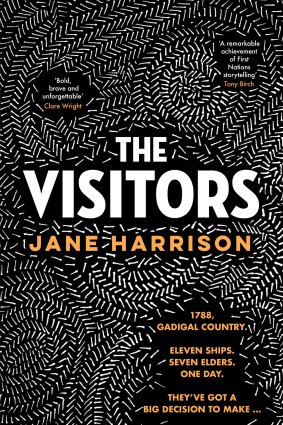
Sometimes it seems that a work written first as a play really struggles to transcend its stage origins. This is the case with Jane Harrison’s The Visitors which imagines the response of local tribes to the arrival of the First Fleet in January 1788. The author, herself of Muruwari descent, ventures where non-Indigenous authors might hesitate to tread and Tony Birch’s blurb embraces it as “a remarkable achievement of First Nations storytelling”.
The book starts with seventeen-year old Lawrence who first notices the nowee on the horizon, its white sails billowing in the wind. His Uncles decide that Elder Gary should be notified, as it is his turn to host the next seasonal meeting of Elders. It is decided that the meeting should be held on the neighbouring Gordon’s land, which strategically overlooks the waters of Sydney Cove. The word goes out to seven mobs who send their Elders to discuss this second appearance of nowees, the first having arrived with Captain Cook eighteen years earlier. Cook departed: surely these ones will, too. Reminiscent of the interminable collection of adventurers in Lord of the Rings, the Elders are gathered in, chapter by chapter, with each given a back-story.
But these Elders, all with non-indigenous names (Lawrence, Gary, Gordon, Joseph, Nathaniel, Walter and Albert) arrive in business-suits, upending our time-frame as readers, and many of their back-stories are Oprah-esque in their relationship detail and more than a little imbued with 21st century values. The dialogue is presented in script form. The ships- eleven by now- show few signs of moving on, and the Elders joined by young Lawrence himself, need to decide how to respond. To fight or to welcome? In a Twelve Angry Men-esque scenario, Elder Walter, gradually convinces the other Elders that they cannot know why the visitors are here, and that they may bring things- like an axe that he found- that will improve their lives. We all know how this is going to end. Young Lawrence, who had disobeyed instructions to paddle out to investigate for himself, is sneezing and unwell and we know that these ‘visitors’ were here to stay.
I think that I would have preferred to see this on the stage, rather than on the page. Apparently the author did a lot of research in converting it to a novel, and the research feels very didactic at times and clags up the narrative. It’s an interesting concept of decentering the First Fleet story- and ‘what ifs’ are my guilty secret as a historian- and while playing with timespans through suits and names, it foregrounds the social complexity and agency of the watchers on the shore. I just wish that the author didn’t feel that she had to ‘educate’ me.
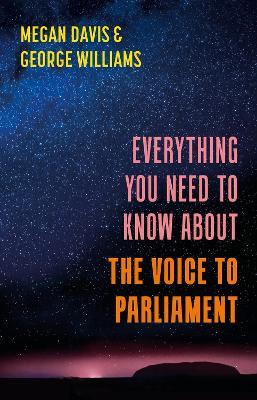
I started reading this before the referendum, and then after the referendum I was too discouraged and flat to finish it. By the time that I broached it again, it was already history – and a history that I believe we will come to regret.
I thought that I was relatively well-informed about the constitution, referendums and The Voice, but I certainly learned things that I didn’t know before. Chapter 1 ‘Making the Constitution’ starts back with the 1901 constitution and the constitutional process that produced it. It explains that Section 127 about counting aboriginal natives (repealed in 1967) was inserted to stop Western Australia and Queensland from using their large Aboriginal populations to gain extra seats in Parliament and higher funding from federal tax revenue. I was aware that the Constitution is silent about many things that we assume would be constitutional e.g. electoral systems, Prime Ministers, parties- in fact, the preamble doesn’t even mention Western Australia because they weren’t sure to join in Federation! But I hadn’t realized that women’s suffrage was not part of the Constitution but was instead legislated under The Commonwealth Franchise Act of 1902 (does that mean that it could be legislated away in a Handmaid’s Tale scenario, I wonder?) Although unable to vote on the Constitution except in South Australia and Western Australia, the womens suffrage movement at the time trusted the promises that female suffrage would be legislated after the Constitution had been passed. As has been pointed out since, had voters demanded the same level of detail in 1901 as they did in 2023, the federal constitution would not have been passed.
Chapter 2 ‘The 1967 Referendum’ looks more closely at the Referendum which white Australians have basked in ever since. It reminds the reader that there was a second referendum held on that day that proposed to break the numerical 2:1 nexus of members in the House of Representatives to the numbers of Senators. It was this second proposal that attracted the most debate. There was overwhelming support for the Aboriginal question, with the ‘for and against’ compulsory booklet containing only arguments for change. Federal law required the ‘against’ case to be written by the parliamentarians who had voted against the change- and not one parliamentarian did so. But the electoral question was soundly defeated; the aboriginal question passed strongly. When Prime Minister Holt left to travel overseas the following day (shades of Albanese heading off OS straight away too?), instead of celebrating the victory on the indigenous question, he labelled it a “victory for prejudice and misrepresentation”. The Sunday Herald recorded the Yes vote on Aboriginals in small type, with a huge headline ‘AUSTRALIA SAYS NO ON NEXUS’.
Chapter 3 ‘A New Era?’ is a rather depressing rundown of events after the high point of the 1967 referendum, and the string of bodies that have been created by governments to consider a treaty or legislation for national land rights. The ‘decade of reconciliation’ commenced in 1991 but after the Native Title Act of 1993, the Indigenous Land Corporation and a Social Justice package created by the Keating government in the wake of Mabo, things stalled. The Howard Government responded to the Wik Decision by the Native Title Amendment Act of 1998 that would pour ‘bucket-loads of extinguishment’ on native title while the Hindmarsh Island Bridge Act 1997 ruled that the Heritage Protection Act applied everywhere except the Hindmarsh Island bridge area- the area in contention. The chapter reproduces the Howard/Les Murray preamble to the Constitution, then the second version written with Democrats Senator Aden Ridgeway that was eventually put a referendum in 1999. The preamble was prefaced by a clause that it had no legal effect, and both versions avoided the term ‘custodianship’ that Indigenous groups wanted. The referendum result was worse for the preamble than for the republic.
Chapter 4 ‘The Journey to Recognition’ looks at the apology, and new attempts to have a preamble – something that indigenous people did not want. Gillard established an Expert Panel to report on options for Indigenous constitutional recognition which made recommendations and wordings but which was put on the backburner because by early 2012 the political environment was not conducive to bipartisan support, and it was feared that a referendum might fail due to low levels of community awareness. At the 2013 federal election, each of the major parties expressed strong support for recognizing Aboriginal people in the Constitution, but when the Indigenous Affairs Strategy led to cuts and disestablishment of programs and activities, there was a backlash to the ‘Recognize’ campaign that specifically rejected a minimalist approach of preambular recognition alone. From the Kirribilli meeting with the Prime Minister and the Opposition leader in July 2015 it was made clear that any reform must involve substantive changes to the Australian constitution and that a preamble would not go far enough and would not be acceptable.
This was reinforced by the Referendum Council, established by Turnbull in late 2015 which asked the question “what is meaningful recognition to you?” The answer, from 12 Regional Dialogues was a constitutionally protected Voice to Parliament. Chapter 5 ‘The Referendum Council and Uluru process’ goes through in detail the consultation carried out, and the resulting Uluru statement. Turnbull’s rapid rejection on receiving the Uluru statement rehearsed the arguments that would later be used in the ‘No’ case (although he himself championed Yes by the time the Referendum came around).
Chapter 6 ‘Voice, Treaty, Truth’ goes through the reasons for the sequence. I must say that I have wondered why Truth-telling came last (although I am less optimistic now that it would make any difference to many white Australians anyway). This chapter points out that there was concern that the energy for grasping the opportunity of constitutional power might be exhausted by a truth-telling process, and that there is no treaty process in the world that required a truth-telling process first. Many communities wanted truth-telling at their pace, at the local level, rather than being compelled to tell your stories without any guarantee of good faith from the listeners.
The chapter ‘The Voice’ brings us up to the election of Anthony Albanese, and his commitment to the Uluru Statement in full (something that I suspect is shakier now). It goes through the Referendum Working Group proposal, which already had the ‘detail’ that the No side called for. The chapter then goes through the myths and misconceptions promulgated by the No case.
The final chapter ‘The Voice Referendum’ has an optimistic tone that – as we now know- was misplaced. It includes a list of the 44 referendums brought before the Australian people and their results. With a final national Yes vote of 39.9% the Voice ended up being one of the least supported proposals ever put forward (although there were 8 that were even less successful). Interestingly, the rejection of the preamble which recognized Aboriginal and Torres Strait Islanders as “the nation’s first people” in 1999 with 39.3% was very close to the Voice result of 39.9%. Does this reflect the hard-baked resistance of white Australia? To be honest, I can’t remember how I voted in that referendum: I suspect that because the preamble was a Howard proposal, I would have opposed it. Nor can I remember how I voted in relation to the Republic: I suspect ‘Yes’ (and today I would even more strongly support the Parliamentary-selected model that was proposed then).
My response to this book was strongly influenced by my sadness at the final result and the misplaced hope that it reflects. Co-written by constitutional experts Megan Davis and George Williams, both were active participants in the campaign, and it needs to be read with that in mind. It is a very clearly written, informative book that gives a clear narrative of the road to the Voice referendum. If only the final destination had been different.


 The Resident Judge of Port Phillip