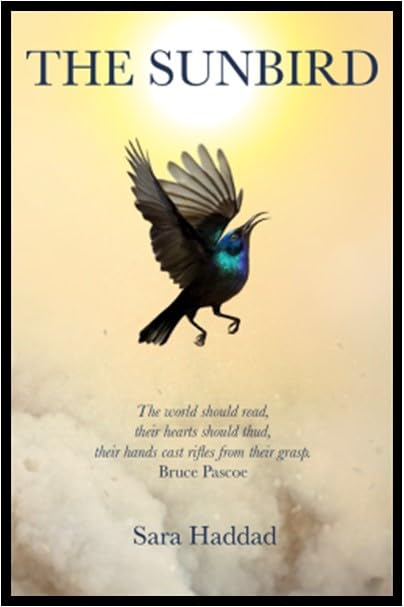
This is a small book of only 112 pages. It focuses on the one character, Nabila, over two separate time periods. The first is when Nabila is a five-and-a-half year old in her village in Palestine, eager to go to school: the second is set in Australia in December 2023 when Nabila is now in her eighties, living alone in a small house in Sydney surrounded by her pot plants. The child Nabila had only just learned to write her name when the bombs dropped on her village, and she and her family were forced to shelter under the olive trees as the air raids continued, before being forced to move on. The older Nabila now goes weekly to the pro-Palestinian protests that take place each Sunday in the capital cities. The story is told simply, with short sentences and a focus on the human.
In her Addendum, Haddad cites Noam Chomsky who wrote in On Palestine in 2015:
The last paradox is that the tale of Palestine from the beginning until today is a simple story of colonialism and dispossession, yet the world treats it as a multifaceted and complex story – hard to understand and even harder to solve
In her preface, she reveals that she wrote this book because so many of her conversations about Palestine ended with progressive friends and acquaintances saying “it’s complicated” before changing the subject. As someone who had grown up in a Lebanese pro-Palestinian family, it’s not complicated at all. The whole Israeli/Palestinian conflict can be played out within the life of one fictional person. There are old people alive today who themselves experienced the Nakbah: it’s not an age-old conflict whose origins are lost to time. She has used clear language, she says, “because the language of liberation is inherently simple: honest, transparent, direct”.
The story itself is simple, but in her addendum she places it within the history of the conflict, starting in the 1880s, going through to the present day, updated further to September 2024. She does not specifically reference October 7, seeing instead that current events are part of the continuing Nakbah that affects people- real, living people, each with their own lives of dignity and identity- individually.
This book can be easily read in one setting. It is named for the Palestine Sunbird, which was named as Palestine’s national bird in 2015, and an enduring symbol of resistance. Haddad places her book within this tradition.
My rating: 8/10
Sourced from: purchased e-book
Read because: it was one of the books distributed to Australian parliamentarians by a number of Australian authors as summer time reading
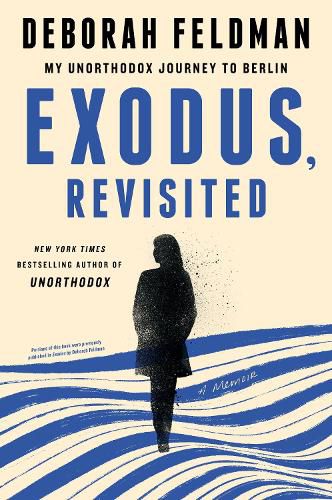
I read this fairly soon after finishing Deborah Feldman’s Unorthodox, written in 2009 which I reviewed here. It is an updating and enlargement of her second memoir Exodus, which was published in 2014 (which I have not read). She could, in no way, be accused of having an ‘unexamined life’ as it has served as the grist for all her writing output to now (in English, at least). I wonder how many memoirs she has left in her: I’m not sure that her life is significant enough to merit three memoirs.
But here we are in 2021, and she’s writing again. The last part of Unorthodox felt rushed, as she bolted towards her present day in 2009. In this book she slows down, and backtracks to describe the process of leaving her marriage and attending college to take her place in the ‘outside’ world. It was difficult for her, and much of the early part of the book involves her tracing through her insecurities and difficulties in establishing a new identity, separate from her family. She does not ever feel properly ‘American’, having been raised in a community with a different language and starkly different lifestyle and religious practices. In order to share custody of her son Isaac, she still needs to live close to her ex-husband Eli, so she exists in an in-between space, separated but still tethered to her previous life through her son. Once her divorce is granted, she can shift further away from New York, still sharing custody of her son, whom she still wants to embrace his own Jewish identity, but without all the rules and prohibitions that curtailed her own life.
It is because she has shared custody that she can carve out large periods of time to travel overseas to Europe, where her American identity is reinforced, but she herself feels more at home. Part of this is the vicarious trauma that she felt she absorbed from her beloved grandmother, who was a concentration camp survivor. She embarks on a bit of a ‘Who Do You Think You Are’ genealogical search, visiting places important to her grandmother’s life, a genre of writing that doesn’t particularly appeal to me, I’m afraid. Nor is the writing is as tight in this follow-up, and her use of adjectives is particularly cloying.
After a succession of relationships with European men (particularly German men), it is as if she is deliberately putting her hand into the flame by being drawn to Germany, the source of the Holocaust. She seeks out anti-semitism and is outraged when she finds it, and is judgmental of societies which she feels have not condemned it sufficiently.
I must admit that at this point, her book runs into present-day politics that did not exist when she wrote it. She follows closely a court-case against an offensively tattooed neo-Nazi whom she saw in her local swimming pool who receives a lenient sentence under Germany’s anti-Nazi laws. She is only satisfied when the court case is appealed by the state prosecution all the way up through the court system until the man is finally jailed (albeit for a short period of time). While she is no Zionist (in fact, she bridled against the theocracy in Israel that prohibited everywhere the consumption of bread during a religious festival), I wonder if she would be as critical of Germany today given what I see as its determination not to condemn Israel’s actions in Gaza. The rise and possible coming to power of AfD perhaps vindicates her consciousness of latent antisemitism : on the other hand, perhaps Germany’s determination to make antisemitism unacceptable has itself given rise to AfD? It’s complicated, and I think that her own attitudes towards Germany and Germans are complicated, and somewhat distorted, too.
It says much about the stringency of the rules of the Satmar community that she leaves her family so completely, even though they are living in the same city. Her determination to pay homage to her grandmother’s experience takes her to the other side of the world, but she seems to have made no effort to see her grandmother again, even from a distance. Is she even still alive? Perhaps she knows that any attempt at contact is futile.
Even more than the first book, this one is very, very different from the Netflix program. She must be quite sure that her ex-husband, Eli, isn’t of a suing disposition because he is not at all the driven, possessive man depicted in the series. On the contrary, he accepted shared custody, and seems to have been a perfectly competent and engaged father. Certainly, she could say that Unorthodox is only based on her life, and that the producers went off on a frolic of their own at the end (something that they admit to in the accompanying Netflix documentary), but the series is unfair and just plain wrong about her ex-husband’s actions and attitudes. But someone seeing only the Netflix version, without reading this book, would be oblivious to that.
All in all, I think I’ve had enough of Ms. Feldman’s memoirs.
My rating: 6.5/10
Sourced from: Yarra Plenty Regional Library
Read because: I enjoyed Unorthodox and wanted to know what happened next.
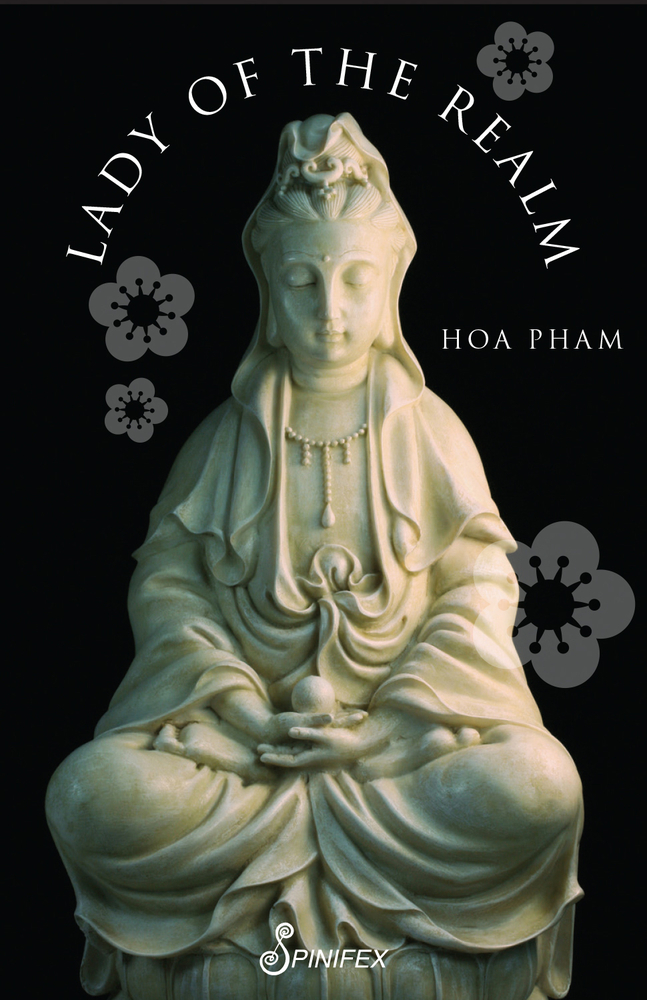
For a book that is riven through with violence, this was a very peaceful and meditative book. Told by an elderly Buddhist nun, Liên, it covers the years 1962-2009 in six chapters, most of which are headed by a epigraph from Buddhist monk and peace activist, Thích Nhất Hạnh. The book starts in 1962 in a South Vietnamese fishing village, where Liên, the granddaughter of the keeper of the shrine to Quan Ám known as ‘The Lady of the Realm’ has a nightmare about her village being ransacked and her loved ones killed. The next day, refugees arrive from a neighbouring village telling of an attack by the Viet Minh, and some time later the Viet Minh arrive at Liên’s village, murdering the men, and raping and kidnapping the women and children. Liên and her family escape into the forest.
The second chapter sees her in Saigon in 1964 at the School of Youth and Social Service, founded by Buddhist monk Thích Nhất Hạnh. She joins as a volunteer working amongst people displaced and impoverished by the American War and meets her mentor, Buddhist nun Hu’o’ng, who warns her against anger at the Viet Minh. Hu’o’ng’s commitment to peace and Buddhism comes with a heavy price.
Chapter 3 in set in South Vietnam in 1980, after the Communist victory. Buddhist monks and nuns are treated with suspicion and a state Buddhist church is established, under government control. Liên joins the flood of displaced people moving towards Ho Chi Minh city passing close to her village. Her grandmother now dead, she finds another old woman in her village, Binh, who deals with seeming impunity in the black market and people smuggling.
In the fourth chapter, set in 1991, she encounters her childhood friend Tai, who is able to tell her what happened in the village after she escaped with her family. When a new Communist cadre arrives, barking orders at the villagers, Tai seeks passage on a people-smuggling boat, and asks Liên to go with him. She refuses.
Next chapter takes us to 2007, where she joins Thích Nhất Hạnh’s Prajna Monastery, where she feels that she has come home. The final chapter, set in the monastery in 2009 sees the monastery surrounded by paid mobs who desecrate the temples and expel the monks and nuns. Under increasing repression, she finally decides to flee to Thailand, as an old woman, taking the peace of the temple and Thích Nhất Hạnh’s teachings with her.
Such an eventful life is told calmly, with a sense of detachment. It gives a completely different perspective on the Vietnam (or American) war and is a challenge to quick assumptions about people-smugglers.
My rating: 8/10
Read because: Sue from Whispering Gums reviewed it in 2017 and wrote about it in another context recently, and linked to Lisa from ANZLitLover’s site. They both read it years ago, when it was first published. I might not have been as interested then, but I am now. I’m still listening to Lachlan Peter’s podcast ‘In the Shadow of Utopia’ which is slowly making its way towards the Vietnam War, and this all seems very real to me.
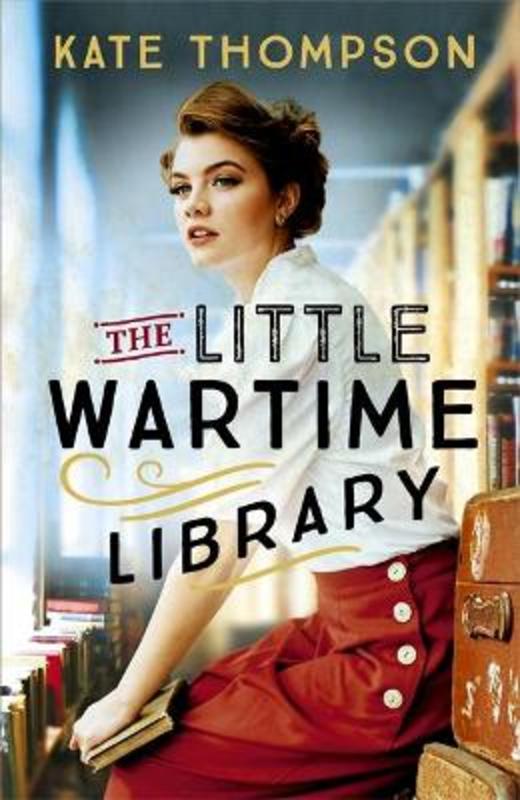
‘Don’t judge a book by its cover’ they say, but they’re wrong. In these days of careful targeting and marketing, publishers know exactly who they are aiming at. Had this not been a bookgroup read, I would have run a mile, and I’d be all the better for it. At 470 albeit largish-print pages, I complained the whole way through reading this book about its tweeness, its mawkishness and its outright bad writing.
Clara is a young widow living and working in London during WW2. She works, despite the disapproval of her mother and her deceased husband Duncan’s mother, in a temporary library established during the Blitz in the Bethnal Green tube station. This station was the site of a dreadful incident in 1943 when 173 people who (incorrectly) thought they were fleeing an air-raid were crushed in the stairwell leading to the station. The Bethnal Green library in the East End had been bombed, and so a library was established in the disused Tube station. Here she needs to battle her sexist and bombastic boss Mr Pinkerton-Smythe, who disapproves of the availability of romance literature on the shelves, especially amongst working-class people who didn’t deserve library services anyway. She meets a conscientious objector, Billy, who is working as an ambulance driver, although he is sending conflicting messages. Her good-time-gal friend Ruby lives with her mother and violent stepfather Victor, trying to encourage her mother to escape. She is guilt-stricken by the death of her sister in the stairway crush, and looks to alcohol and her work as a way of escaping, too.
The characters are one-dimensional stereotypes, with the ‘goodies’ very very good and the ‘baddies’ very very bad.
Thompson pushes a strong pro-library line (not that there’s anything wrong with that) in this book and the interminable end-chapters and she relishes littering her text with the names of popular books at the time, hoping to appeal perhaps on her own readers’ love of classic 1940s texts and children’s books.
For me, it’s always a red-light when an author has to put pages and pages of acknowledgements and thanks. Four pages of thanks seems particularly excessive. This seemed like The Book That Would Never End with an Author’s Note, a historical note about the true story of the Bethnal Green library and the fight to save it, yet another author’s note about libraries, a select bibliography and her four pages of acknowledgements.
The book is predictable and “emotional and uplifting” as the blurb says, although the only emotion I felt was frustration at wasting good reading time on this bilge. Normally I don’t write such snarky reviews as this one, but I suppose that she has had enough Women’s Weekly Good Read- type sales that my negative review will make no difference at all.
My rating: 3/10
Sourced from: CAE bookgroups. I would never have read it otherwise.
I recently watched the Netflix series based on this book, and instantly wanted to read the memoir on which it was based. My curiosity was piqued by a comment in the ‘Making of’ documentary, also on Netflix, that they had changed the modern day part in the television series because the author is still a young living, working, active writer in Germany, and they didn’t want the series to affect her present-day life. When I was about 7/8 of the way through the book, and she was still in New York, I realized that the book and the series were quite different.
Deborah Feldman was raised by her grandparents in Williamsburg, Brooklyn. Her family was part of the Satmar sect of Hasidic Judaism, a sect with Hungarian roots that had been very much shaped by the Holocaust. Believing that God had allowed the Holocaust as punishment for assimilation and Zionism, the group embraced extreme conservatism in custom, dress and language, speaking only Yiddish. Her father, who was largely estranged from his daughter, seemed rather intellectually and socially challenged, and her mother had deserted the sect while Deborah was small. Although her aunts, particularly Aunt Chaya, have an influence on her upbringing and prospects, it is actually her grandmother Bubby and grandfather Zeidy, who bring her up in a loving but strict environment, where family and religion are paramount. Being brought up by elderly grandparents gives her freedoms that she would not have had in a family of siblings: she is well-educated for a Satmar girl, and she becomes an inveterate reader. As she approaches womanhood, the family orchestrates her arranged-marriage to Eli, a man equally in thrall to his own family and religion. Although Eli is in many ways more liberal than some other men, he can veer between domination and permissiveness, and when they cannot consummate their marriage, they are both under pressure from each other and their families.
There are some important differences between the book and the television series. In the book, her liberation comes not through music but through surreptitiously attending higher education, and it occurs in America, not in Germany. She leaves after she has her child, not before; indeed it is her desire to protect her son from the misogyny and strictures of Hasidic Judaism that impels her to leave her husband who, initially at least, seems just as happy to have the marriage fail as she is. She is largely silent about the custody arrangements for their son, Yitzy.
The memoir (i.e. book) was written in 2012, when she was still in the midst of act of leaving. The entire memoir is written in the present tense, but the present becomes closer and closer. As a result, the pacing of the book moves from fairly slow reflection and narrative, to a present-day rush of emotion. Because it is a memoir, the narrative is shaped completely by her viewpoint and her own flaws and strengths. (An interesting critical review of the book by another Satmar woman who also left the community can be found here.) Is it a well-written memoir? Possibly not: there is no overarching theme, beyond that of grievance and longing for freedom, perhaps. For a memoir, it has a lot of dialogue which tips it into some other genre.
Nonetheless, I found this memoir fascinating, and hard to put down. Part of that stems from my curiosity about Hasidic Judaism, particularly within enclaves like in Williamsburg. (There’s an interesting photo-essay about Williamsburg here). Yes, I have borrowed her sequel as well, a recent retelling of her 2014 follow-up Exodus.
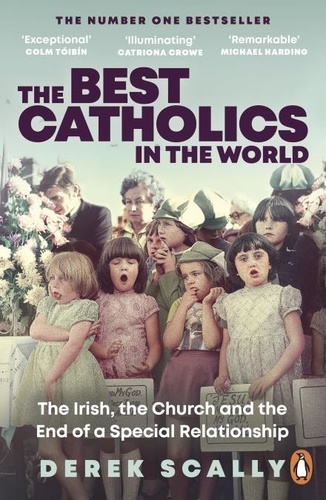
It amazes me that, of all countries in the world, IRELAND should have voted for gay marriage and legal abortion. My impression of Ireland is that it is mired in religion and conservatism, and I don’t think that I’m alone in this perception. In this book, Derek Scally, after many years of living in Germany, returns to Ireland, the land of his childhood, and asks himself how these changes came about. It is a story both of his own personal journey from a weakly-held Catholicism into a consideration of how Ireland, as a country, can come to terms with its past.
The book is divided into three parts. In Part I, ‘The Leaning Tower of Piety’, he writes of his own Irish upbringing and his own contact through St Monica’s Church with Father Paul McGennis, who was later to plead guilty to four counts of indecent assault. In going through the church archives, he learns of the league table on donations that existed between the parishes, and through speaking to old parishioners he learns of the suspicions about Paul McGennis, and the inability of parish priest Michael Geaney to impose any authority on him. In Part I he challenges the perception that there is a special type of ‘Celtic Christianity’, suggesting that this is the result of previous centuries’ public relations, generating important political momentum, emotional comfort and offering touchstones against historical events like the Penal Laws and Protestant/English occupation. It was not enough: he suggests that Irish Catholics perceived themselves the Most-Oppressed-People-Ever. Yet, when he looks back to his own education within the Catholic system in the 1980s by revisiting the text books used at the time, he feels patronized and short-changed by the experience.
Part Two ‘Implosion’ looks at the effect of the clerical sexual abuse revelations in the 1990s. He focuses on Fr. Brendan Smyth, who was investigated in 1975 but went on to abuse children for a further sixteen years. The fallout, when it came, spread beyond his own activities: Cardinal Brady, who was involved in the 1975 investigation, was also accused of cover- up. He interviews Sean Brady, a man whom some see as a modest figure who knew which boats not to rock; while others see him as a coward and an accomplice to a predatory paedophile priest. Australian readers will see parallels with Archbishop George Pell. He goes on to explore the Magdalene laundries and the treatment of inmates in religious-run institutions. He argues that when the Catholic Church lost its monopoly on giving meaning or creating a sense of community, coupled with the sense of betrayal over the hypocrisy and intransigence of the church regarding sexual abuse, many left the church.
In Part Three ‘Among the Ruins’ he talks about the reformulated religion that transformed Famine-era faith into an earnest, Rome-focussed Sacred Heart Catholicism. He draws on his experience of living in Germany to wonder if Ireland does not need some form of national reckoning, as a form of healing and reconciliation. He considers the roles of museum and memorials in this process. At the end of the book he writes:
This journey has taken me from apathy to ambivalence, then anger to acceptance…[For] whatever anger I harbour towards the Irish Church, echoing the anger of those whose lives were ruined by its institutional inhumanity, I see remnants of its noble aspirations through the many ordinary Irish people who tried- and try- to lead better, Christian lives. No one can draw a line under the past, or airbrush away their role in it, but- for perhaps the first time ever- Irish people can approach their history on their own terms. That is, if they want to. (p. 307)
I’m not quite sure how to rate this book, and my reading was interrupted by a two-week holiday and so I did not read it as a continuous whole. I was happy enough to pick it up again, but I don’t know if I really grasped his argument well. In fact, summarizing it here gives me a better shape of the argument than the actual experience of reading the book did.
As we get older, we approach the ‘senior’ category that covers adults from 60-100, a forty-year age range. It would be unthinkable to conflate, say, a 10 year old and a 50 year old, but somehow after 60 all ‘old people’ are lumped in together. I wouldn’t be the first person, I’d wager, to regret that there were conversations that I didn’t have with my parents as a ‘senior’ myself, and questions that I didn’t ask about their earlier lives..
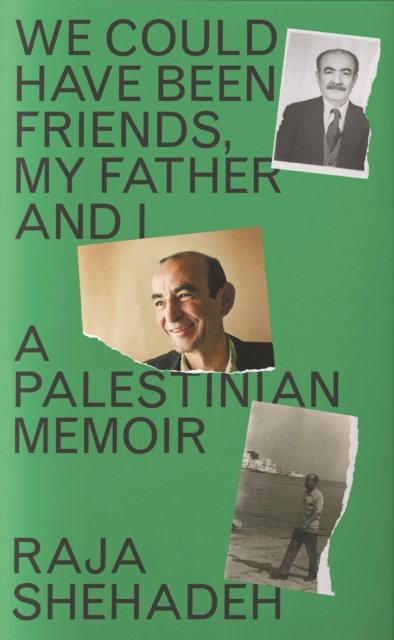
Palestinian Human rights lawyer and author Raja Shehadeh has even more regrets. When his 73-year-old father was assassinated outside his own home by a disaffected litigant in 1985, Raja was 34 years old and working in his father’s law firm. The murderer was a squatter on land belonging to the Anglican Church, and his father was handling the case for his eviction. The Israeli police closed the case, assuring the family that they were doing everything they could to find the murderer, but they knew who the murderer was and did not want to charge him. (p. 13) After his mother nagged him into going and collecting his father’s papers, Raja ended up with a cabinet of papers, which he stored on the bookshelf. He opened them, and found everything meticulously arranged, but felt overwhelmed by it all. The last case they worked together on involved plans for roads to be constructed throughout the West Bank. His father directed him to the documents he should consult, but showed only moderate enthusiasm for the case, which he left mainly in his son’s hands. Still smarting from this rejection, for many years he viewed the documents as nothing more than “a source of years of hardship and trouble”. (p. 17)
It was only when a friend brought him a photocopy of the Palestinian telephone directory for Jaffa-Tel Aviv dated January 1944, a city to which his father could not return after 1948, that his father’s long history of activism became real to him.
When I began reading, I realised with what impressive clarity my father had set forth his thoughts, and how his pioneering ideas were deliberately distorted by Israel, the Arab states and even some Palestinians. For so long his written attempts at setting the record straight had met with failure. I felt guilty that all these years had passed before I could spare the time to study the files in the cabinet and finally do what I had failed to do during his life: understand and appreciate his life’s work. (p. 17)
This book, then, is the story that was revealed through those documents. It is a history of the years immediately surrounding the Nakba. It illustrates the perfidy of Great Britain and Jordan in the establishment of Israel, the intransigence of the PLO and the whole generational cycle of Palestinian history that existed before the author’s birth. His father and other Palestinians at the time, rejected the creation of UNRWA (which is currently in the news now because Israel wants to outlaw it) because it made the Palestinian cause one of humanitarian response rather than justice.
His father took up the cause of Palestinian savings, which were frozen by the banks leaving Palestinian refugees unable to exchange their Palestinian pounds into pounds sterling or any other Arab currency. In February 1949 the Israeli government ordered that Barclays Bank in Britain and the Ottoman Bank formally transfer all ‘frozen’ Palestinian funds to the Custodian of Absentee Property, which after a while proceeded to liquidate the assets as if they belonged to the State. His father mounted a legal challenge against Barclays Bank at the District Court in Jerusalem, which was part of Jordan at the time. He won.
He decided to run as a candidate in the Jordanian parliament, but found himself arrested instead. He proposed the establishment of a Palestinian state next to Israel along the 1947 partition borders, with its capital in the Arab section of Jerusalem. This put him at odds with the PLO, which wanted a secular democratic state over the whole of Palestine, not a Palestinian state alongside Israel. His father was clear-eyed about Israel’s deceptions over various peace initiatives, and always believed that it was preferable for the Palestinians themselves negotiate with Israel, rather than have Arab states negotiate on their behalf ( as occurred during the Trump-inspired Abraham Accords, and is still occurring over any possible ceasefire in Gaza).
Too late, there was so much that the Raja of today could have discussed with his father, had he lived. It’s revealing that, despite their shared interests and objectives, the emotional tenor of the father/son relationship overpowered their intellectual one. He was intimidated by his father and he resented his dependence on him in the office.
For years I lived as a son whose world was ruled by a fundamentally benevolent father with whom I was temporarily fighting. I was sure that we were moving, always moving, towards the ultimate happy family and that one day we would all live in harmony. When he died before this could happen, I had to wake up from my fantasy, had to face the godlessness of my world and the fact that it is time-bound. There was not enough time for the rebellion and the dream. The rebellion had consumed all the available time. I turned around to ask my stage manager when the second act would start and found that there was none. I was alone. There was no second act and no stage manager. What hadn’t happened in the first act would never happen. Life moves in real time. (p. 12)
The language in this book is a little stilted, but any adult child can feel this same remorse for lost opportunities, and the jolt of being alone on the stage, once one’s parents have died. This book gave me a good sense of the generational injustice that is still being fought out in Gaza and the West Bank today, and the pettiness and duplicity of many of the main actors. Colonialism up-close, and without the patina of centennial celebrations and ‘age-old’ traditions is an ugly, ugly thing.
I’m not usually a fan of short stories, but I have read and enjoyed a couple of Claire Keegan’s novellas, and I thought that I’d like to read some of her other writing. I think I’ve finally worked out the best way for me to read short stories, too: just one at a sitting, then put the book away until I find time to read another. And what’s more, I think I’ve finally worked out the best way to write about them too: to acknowledge that some of them will slip by without making an impression, and just hold on to the ones that do.
For me, there were two really strong stories in this collection. The first, ‘The Parting Gift’ is an absolute masterpiece in concise, measured writing and I am in awe of her skill in packing so much backstory and nuance into just 14 pages. It’s written in the second person, present tense – not a narrative style that I’m attracted to, I must admit
In her bedroom your mother is moving things around, opening and closing doors. You wonder what it will be like for her when you leave. Part of you doesn’t care.
Our narrator is packing to leave for New York, and her brother Eugene is to take her to the airport. Her mother orders the narrator to go upstairs to say goodbye to her father, who is in bed (presumably ill). She doesn’t want to: there have been years of sexual abuse, tacitly accepted by her mother. Her mother expects that her husband will give her some money as a parting gift, but he does not. Her brother, who has done his best to protect her from her father, vows that he will leave home too, but she knows that he will not.
The second story that I really enjoyed was ‘Night of the Quicken Trees’ about a wild, unkempt woman, Margaret Flusk who moves into a detached cottage on the outskirts of a rural Irish village. The house was left to her by her cousin, a priest, with whom she fell in love and eventually ended up bearing his child, who later died. She is superstitious and independent, but she gradually yields to the equally independent man in the adjoining cottage, Stack, who lives in filth and sleeps with his goat Josephine. When her periods return, she has the urge to have a child and so they knock a hole between the two cottages, until Margaret leaves him, taking the child with her. The story is told like a fairy-tale, full of portent and warning.
The other stories are mainly set in Ireland, except for ‘Close to the Waters Edge’, which is set in America where a young man celebrates his 21st birthday with his mother and his arrogant, aggressive millionaire step-father. He is gay, but cannot tell his mother and step-father, and so he returns to Harvard, without having told them. With its American setting, this story doesn’t seem to fit in with the others. There’s a unity to the other stories with the sexual indiscretions with priests, the claustrophobia of the small village and many eyes and tongues, and the flat depression of unfulfilled lives.
I’m mystified as to why she (or the publisher) chose ‘Walk the Blue Fields’ as the title. In that story, a priest has just conducted a wedding service where the bride seems unhappy, and there is tension between the groom and his brother, the best man. We learn that in the past the priest had had sex with the bride- the second story in this collection where there is sex between priest and parishioner. But if by choosing one story over another for the title suggests that it is the strongest one in the collection, I beg to differ. For me ‘The Parting Gift’ is the absolute stand-out story, and one that I will remember.
I confess that I started this book warily. “Mad as a Meat Axe” write two daughters on their mother’s medical chart at the end of the bed, sniggering at the thought that the initials MMA might prompt some medical profession to treat their mother for MMA and kill her. The two daughters, who are never named, are visiting their mother in rehab for a broken hip, even though their mother denies their existence, and has had nothing to do with them for eighteen years. I would not want these daughters.
Obviously much has gone on in this family, but we are never told. Our narrator tells us that, for her:
My past is not merely faded, or camouflaged under the dust of years. It’s not there, and I know a blessing in disguise when I see one. I have managed to shake free and flee to far-flung places where I feel reasonably safe because I do not carry a lot of my past. (p.140)
And yet, after 18 years, this Canadian academic returns home to see her father, whom her mother has announced “doesn’t have long”, and her mother whose hip has disintegrated. Along with her sister, who has remained in Canada despite the 18 long years of estrangement from her parents, they arrange (conspire?) for their mother to be moved into some form of care, so that their father can escape from her clutches. Her mother has long since given power of attorney to someone else, and she announces that her daughters are only after her money. Are they? Who is mad as a meat axe here?
It took a while for me to shake my suspicion of the narrator. I wonder if this book is some sort of Rorschach test: I have been the child left (albeit in a completely different situation) and so perhaps I read it differently. As older sister, the narrator has fled to Australia and established a marriage and career there, while her younger sister, just by virtue of being in Canada, carries the memories, the hurt and responsibility. The narrator knows this, but this does not change her actions:
…However different we are and however badly she judges me, whatever gulf already separates us, she is my sister. I do not want the gulf to fill with the seething resentment she will feel because she is doing it all, but I know this will happen. I am telling her that I know this will happen. I know she will feel violent annoyance with me when I suggest something because I’m not there and I don’t know, and I’m not the one doing it and I, on my far away island continent, will sit quietly, gnawed by guilt. (p. 157)
We never learn what has happened in this marriage and family. We have little back-story for her parents, beyond the fact that her father made money through the oil industry and that he fought in WWII. We have no images of a courtship, a marriage or a family life with young children. Everything is refracted through the narrator’s rage- which oddly enough, she deflects onto her sister.
No, I see rage here. A rage expressed by staying on the other side of the world, and by allowing her younger sister to carry this burden. A justified rage, from the snippets that we received, but rage nonetheless, despite protestations of guilt.
This is a memoir, and as such the author has ultimate freedom and responsibility to shape the narrative however she wishes. The memoir starts with a preface, describing the Erratics, huge boulders deposited by the Cordilleran Ice Sheet as it moved through Alberta and Montana. The Erratic that sits in the Canadian town of Okotoks, where the memoir is set, has cracked and fallen in on itself, posing danger to anyone approaching it. On the final pages, we revisit this image of the Okotoks Erratic with the spirit of her mother sitting atop it, beside Napi the Trickster.
To be honest, I’m still not sure who the Erratic is here: mother or daughter. But either way, it feels as if there is some sort of space here for release.
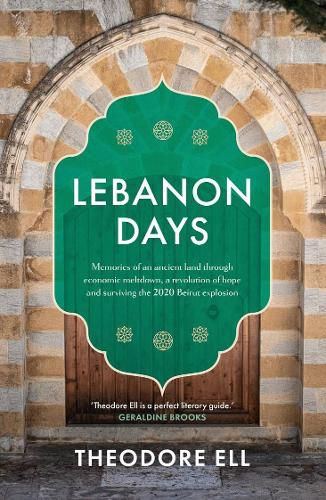
In 2021 Theodore Ell won the ABR Calibre Prize for his essay ‘Facades of Lebanon’ which described the Lebanese revolution and the Beirut port explosion. (I must admit that this essay probably languishes in the towering pile of journals that I haven’t got round to reading yet.) The explosion, caused by a stockpile of nearly 3000 tonnes of ammonium nitrate, dominates his essay which was written in 2020, as part of his way of processing what had happened. As he says:
I wrote an essay ‘Facades of Lebanon’ with the aim of making sense of the abstractions behind the port explosion at the level of personal feeling. If people were to know what the Lebanese knew and what Lebanon had brought me to know, they needed to know what the explosion felt like. They needed an invasion of violence, debris and deafening noise through the window, just as the Lebanese themselves so often had been invaded, over their rooftops and fields as much as over their doorsteps. (p. xix)
But this book, written in the wake of the critical acclaim for the essay, and with more distance of time, deals more with what happened in the periods before and after the explosion. The book is in five parts, and the explosion is just one of these parts. It is the story of the two-and-a-bit years between the end of 2018 and the beginning of 2021 that the author spent in Beirut as the partner of an Australian Embassy official- a time in which Beirut roiled under street protests as part of the thowra (i.e. revolution) which was eventually put down by Hezbollah (or as he writes it ‘Hizballah’) and the COVID lockdowns, during a time of economic collapse exacerbated by government corruption, which in turn laid the conditions for the Beirut port explosion that changed his life.
As the partner of an Embassy employee, he was not allowed to undertake paid employment and so he spent quite a bit of time walking the city, venturing further afield with his wife Caitlyn on weekends, doing odd job volunteer work where he could find it, and writing. As is often the case with Embassy staff, their social circle mainly revolved around other Western diplomatic and aid workers, with most of his contact with local Beirut residents through observation on his travels, and amongst taxi drivers, shopkeepers and businesses catering for young Western expatriates.
Much of this book resonated with me, having spent time with my son and daughter-in-law in both Kenya and Cambodia where they, too, live as expatriates, albeit living (as do Ells and his wife) outside an expatriate enclave. Their description of the succession of new expatriate arrivals and the development, and then breaking apart, of friendships makes sense to me, as does the distance between the expatriate community and local workers in the diplomatic and aid milieu. How clearly I identified with his frustration with learning Arabic which, despite learning basic Spanish and Portuguese, “awed [him] with its complexity” and with which he failed utterly – a feeling I often have when trying to learn Kymer.
The book is divided into five parts, with short unnumbered chapters in each part. Part One ‘Partitions’ explores the 1926 constitution, adopted under French tutelage, which ossified the sectarian divides by designating certain political posts for particular religious and ethnic groups. This arrangement embedded power in the majority Christian group at the time, but given that there hasn’t been another census since 1932, that demographic scenario has been superseded without any corresponding political adjustment. Part Two ‘Phoenicia’ is more travel-based, as he explores regions further afield, and the sway of the historical ‘Phoenician’ culture as part of Lebanese identity. Part Three ‘Thowra’ is his report of the huge protests that brought Beirut citizens out into Martyr’s Square, demanding an end to the corruption that immobilized Lebanese politics, leaving it impotent to deal with the economic collapse. Part Four ‘Shuttered’ describes the effect of the COVID lockdown which Hizbollah and the government leveraged to quell the protests, dwarfed by the Beirut port explosion during which, living in an apartment that directly overlooked the port, they were lucky to survive. There’s some really evocative writing here of the sheer power of the explosion, and its physical and psychic effects. He is clearly suffering PTSD, while Caitlin throws herself into Embassy Emergency Mode. The final Part Five ‘Closing’ deals with the months when they are waiting to return to Australia, which is limiting inbound flights because of COVID. They return to living in West Beirut, where they had first lived when they arrived, imbued with a sense of grief for what had been lost, fearful of Israeli invasion, and yet acutely aware that, as Australian citizens, they can leave, and although able to appreciate the citizens’ fears, they are not their fears.
This is beautifully written, with a fantastic, clear map that lets you locate yourself in the city and in Lebanon more generally. There is a very good glossary at the back for Arab terms he uses frequently, and the whole book supports the unfamiliar reader better than many other books that I have read recently. He integrates travel description, history, political analysis and personal response in what he hopes is a ‘tapestry’ rather than a ‘tableau’ of landscape with figures.
This is a great book. I devoured it on the plane over to Cambodia, and finished it the next day. I can’t wait for the kids to read it- and you should too.


 The Resident Judge of Port Phillip