Category Archives: Biography

Uplifting Quotes for the Uninspired Historian #6

History is made up of a multitude of whispery but insistent voices from the past, each filled with its own imaginings and fond hopes, cynicism or despair, its own way of understanding an endlessly complex world, of explaining the inexplicable, of articulating an imperfect, subjective grasp on an historically determined existence. This conglomerate of contested, contingent meaning making that we call experience must be caught in a finer mesh, in the analysis of the webs of life as lived by individuals in relation to each other, as well as in the broader web of discourses that shaped and sought to define those lives. In analysis of the particular, and in the complexity of its relationship to the general, lies the recurring fascination of history.

Penny Russell, ‘Cultures of Distinction’ in Hsu-Ming Teo and Richard White Cultural History in Australia, Sydney, UNSW Press, 2003  p. 169

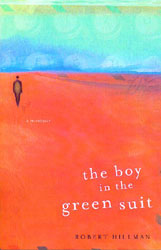
‘The Boy in the Green Suit’ by Robert Hillman

2003, 232 p.

My bookgroup ladies (aka “the ladies who say oooh”) were not unanimous in their opinions of this book.  I liked it though.

For me, a memoir is not the same as an autobiography.  There is not the same imperative to cover all the major bases; it does not have to start at the beginning and end at the end.  A memoir, for me, is more a construction, given its own shape by the author, and truth or completeness are not the major criteria by which it is to be judged.

This memoir was not complete, and some of the bookgroup ladies felt that it was not true either.  It focussed on one year in the author’s life when as a naive and rather pathetic sixteen-year old he left behind his apprenticeship in the butcher’s shop in Eildon and job in the shoe department of Myer Melbourne to embark a Greek ship for Ceylon.  He wore a green suit already too short in the leg that made him look, by his own admission, like a grasshopper, and he carried a suitcase of books and his typewriter.  With no money and no passport, he travelled through Athens, Istanbul, Tehran and Kuwait, ending up in a Pakistani jail.

There are aspects that stretch credulity.  His misadventures are told at a distance, complete with reported conversations which, of course, must be a construction after the event.  The CAE booknotes we used when discussing it quoted Hillman insisting that he remembered conversations word-for-word.  The ladies-who-say-ooh lifted a sceptical eyebrow. This didn’t particularly trouble me.   I found myself more stunned by the naivete  and youth of the lad, and that he survived relatively unscathed. For me, the charmed status he enjoyed in the jail compared with his fellow-prisoners added to the credibility of the book- if the author was inclined to exaggerate or embroider, this Bangkok-Hilton scenario was the place to do it.  But he didn’t.

His narrative is interspersed with events from his emotional life that both explain, and follow through on his travel experience.  His mother walked out on the family when he was very young;  he was uncomfortable with his step-mother and she with him; his father contemplated having his adopted out until dissuaded by Hillman’s older sister; his mother reappeared in his life; he himself had a succession of failed relationships.  These snippets are short, barely two pages and marked with a different font. They raise more questions than they answer.  His relationship with his father is wistful and inadequate, and he seems set to repeat the same pattern.

I thought that this memoir was beautifully constructed, with self-deprecating humour and an ongoing flinch of pain.  It won the National Biography Award in 2005, and I think it was well-deserved.

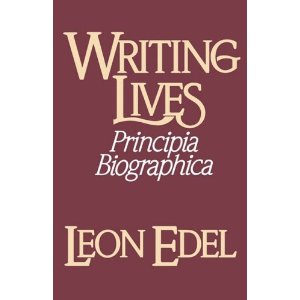
‘Writing Lives: Principia Biographica’ by Leon Edel

1984, 272 p

When I first started on my research on Judge Willis, my intention was to examine his dismissal from Port Phillip in 1843.  I had a bifocal vision: looking at the Port Phillip context and the local trajectory of events that led to his removal, while at the same time evaluating Willis’ own personality and behaviour.  I was often at pains to distance what I was doing from biography.

But now that I’ve upgraded to a Ph D,  I’m looking at his career as a whole, in Upper Canada then in British Guiana, as well as in the interludes ‘back home’ and his eventual retirement as a Worcestershire gentleman.  My emphasis has shifted from a localized event into an analysis of a whole career, and now I find myself more closely drawn into writing a biography.

I don’t know why I find myself squeamish about saying that I’m writing a biography.  After all, I enjoy reading biography , and I have always been attracted to human agency in history whether it be individuals operating within the structure of an institution, or “history from below” that takes the lived experience of humans as its touchstone.  From a methodological point of view, I’ve very much enjoyed reading Richard Holmes’ work here and here, and now I’ve read Leon Edel’s book which Holmes quoted often.   Both Holmes and Edel are literary biographers – i.e. they write biographies about other writers- so they find themselves working both with text and life.  Nonetheless, much of what they say applies to biography more generally.

Edel commences his book with an “Introduction in the form of a manifesto” which over four or five pages encapsulates his principles of biography- a document that will yield up many “Uplifting Quotes for an Uninspired Historian”. He has several biographical heroes, whom he mentions often. There’s Boswell (of course!) who, although denying “melting down” Johnson’s conversations did in fact manipulate his subject by setting up situations where Johnson would display himself.   He quotes Lytton Strachey, Andre Maurois, Van Wych Brooks, and spends a long time on Virginia Woolf, herself the daughter of the Big Daddy of Biographers, Leslie Stephen. In particular he counterpoints her fictional work Orlando, which jibes at biography and mocks chronology, against her ‘straight’ biography of Roger Fry where, like all biographers she bemoaned:

how can one make a life out of six cardboard boxes full of tailor’s bills, love letters and old picture postcards?”

Edel speaks often of the “new biography” (which doesn’t seem so new anymore) which experiments with form, and draws on art and fictional techniques in creating its narrative while remaining true to the sources.  He is open to psychoanalytic techniques and finding “the figure under the carpet”, while acknowledging that of course the biographer and her subject cannot be equated at all to therapist and patient.  Nonetheless, drawing on psychotherapeutical approaches,  he is attuned to the life-myth that drives human action, and the mask that individuals adopt to confound it.

We must consider two kinds of myth: the myth we perceive with our eyes and sense of observation; and the covert myth, which is a part of the hidden dreams of our biographical subjects, and which even they would have difficulty to describe because these are lodged in the unconscious, in the psyche.  The covert myth has to be deduced from the public myth, and from the stray bits of psychological evidence offered us by our subjects, the little hints, the casual remarks, or the poetry or prose set down out of themselves…

….  In an archive, we wade simply and securely through paper and photocopies and related concrete material. But in our quest for the life-myth we tread on dangerous speculative and inferential ground ground that requires all of our attention, all of our accumulated resources.  For we must read certain psychological signs that enable us to understand what people are really saying behind the faces they put on, behind the utterances they allow themselves to make before the world. (p. 161, 162)

Many people have warned me off “psychological history”.  I haven’t read much of it at all- in fact, probably only Judith Brett’s Robert Menzies’ Forgotten People. I’m not particularly comfortable with the language and theory of Freudianism and Lacanism and other “isms” in general- I find them smothering.  But much of what Edel is stretching for in the dilemma of the biographer’s art does ring true in my own research, just in Port Phillip, and I’m excited to see if it is a way of drawing together my story of this colonial servant in three different colonies where there are so many commonalities.  I think that I really do need to swallow hard and admit that, yes, I’m writing a biography.

‘A Manifesto for New South Wales” Edward Smith Hall and the Sydney Monitor’ by Erin Ihde

Who’s Edward Smith Hall, you say?

He was the editor of the Sydney Monitor between 1826 and early 1840, which makes him exceptional among the highly fluid editorial scene in colonial New South Wales.  Many editors lasted only two or three years before their papers either faltered or merged and transformed themselves into yet another entity. So as Erin Ihde points out in this book, the Sydney Monitor under the editorship of just one man provides us with

…not just a newspaper but a most important manifesto, one which outlines a complex social vision as it evolved, on deeply laid principles, over a period of fourteen years.  In it we see revealed more clearly than in any other accounts, including the works of Wentworth and Macarthur, the intellectual problems faced by one person in their quest to clarify their hopes for New South Wales. (p. 244)

Edward Smith Hall was born in London in 1786, one of six sons of a bank manager.  He arrived in Sydney on 10th October 1811 bearing a letter of recommendation from Peel, the under-secretary for War and the Colonies, citing contacts with two other M.P.s   On the basis of this recommendation, he received several land grants but the life of a pastoralist was not for him. He became involved in merchant shipping and banking, then in 1826 established the Sydney Monitor.

Ihde’s book is an intellectual history, and it draws mainly on Hall’s editorials and articles over a 14 year period.  Hall seems to be a hard man to pin down intellectually, given often to puzzling logic and outright contradiction.  In a time without official political parties as such, over such an extended period of time, and under the pressure to generate two, and by 1836 three issues a week, it’s perhaps not surprising that his stance shifted on the hot topics of the day.  Moreover, many of these topics were just as thorny and contested and “wicked” as, for example, climate change and asylum seekers are today.  They were, as our ex-Prime Minister might have said, the great moral challenges of their time.  Nonetheless, Ihde has set out to try to trace Hall’s underlying philosophy and having attempted a similar endeavour with Judge Willis, I have some appreciation of how difficult this can be.

Hall operated from a practical Evangelical, yet surprisingly liberal Christianity- a contradiction right from the start.  He placed more emphasis on moral character than status; he believed strongly in the “moral economy” and the rights of free-born Englishmen and did not accept that convictism cancelled out these rights.  He strongly supported the continuation of transportation, and yet was seen as being an advocate for emancipists.  He acknowledged the Aborigines as the original possessors of the land, and yet accepted as part of the natural order of things that the Aborigines would be usurped- or rather, than the superiority of Englishmen would lead to their ‘adoption’ of the land.

He has been characterized as “changeable” by later historians, but Ihde argues instead that

…Hall’s stances on various issues prevent his easy classification as a supporter of any single ideological or political grouping for any length of time.  The complexity of his views and his struggles to find solutions to fundamental moral problems meant that while on the surface he appeared to be subject to abrupt changes of mind, in reality he was driven by a clash of circumstances and principles.  His contradictions were the result of his search for all-encompassing solutions…Hall has been portrayed by historians as having a very changeable attitude.  Such a view is unfounded. (p 245)

Ihde largely restricts his analysis to the columns of the Sydney Monitor.  His book commences and closes with biographical details about Hall himself, but Hall as a living, breathing Sydney man does not come through clearly through the body of the work.  I suspect that Ihde would say that this was not his intention: the book emerges from his doctoral thesis, and the blurb on the back of the book tells us that he is working on a full-scale biography of Edward Smith Hall- an admission that this book has not told all there is to tell about Hall.   Ihde consciously decides not to enter into Hall’s imprisonment for libel because, as he points out, other historians including C.H. Currey and Brian Fletcher have already ploughed this field.   I found myself disappointed by this.   Along with interest in how Ihde dealt with the intellectual beliefs of a “changeable” public figure, I was curious to see how Hall, bearing the religious, philosophical and intellectual beliefs that Ihde has analysed,  reacted as a man and public figure when they had real-life, physical consequences.  While Currey and Fletcher may have already described the situation, they did so from the perspective of Forbes and Darling, not from Hall himself.

So is it fair to judge a work by what the author has made a conscious decision NOT to deal with? There’s always a tussle between what a reader wants from a book, and what the author him/herself has marked out as the territory in which they want to excavate.  Part of the argument lies in convincing the reader stay with the author in that part of the field instead of gazing over the fence and wondering what’s over there instead.  I’m not sure that Ihde managed to do this with me completely , but in terms of technique, I gained much from watching a historian dealing with inconsistency and contradiction in the search for a philosophical bedrock in a public figure.

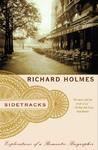
‘Sidetracks’ by Richard Holmes

2000, 410 p.

As you know, I’ve become enamored recently of the writings of the biographer Richard Holmes- in particular his autobiographical works ‘Footsteps’ and now ‘Sidetracks’.  He’s been a prolific biographer over the last 30 years and in the prologue to Sidetracks he lists his major biographical subjects and the outcomes of his work:

1969-70 : Chatterton (an essay, no biography)

1971-74: Shelley (a biography Shelley, the Pursuit)

1973-79: A Gothic Victorian (many sketches, no biography)

1975-79:  Gautier and Nerval (sketches, translations, unpublished biography)

1979-80: Scott and Zelda Fitzgerald (a single sketch)

1980-85: A Romantic Traveller (sketches, finally Footsteps)

1986-87: William Godwin and Mary Wollstonecraft (an essay, no biography)

1982-89: Coleridge (half a biography, Coleridge: Early Visions)

1990-94: Johnson (a fragment of biography, Dr Johnson & Mr Savage)

1994-98: Coleridge (second half of a biography, Coleridge: Darker Reflections)

1999… A Runaway Life (but, as he says “that could go anywhere”)

His book Sidetracks consists mainly of essays that have been published elsewhere (particularly The Times), with 2 radio plays- the one on Nerval I wrote about here, and a second play “To the Tempest Given” about the death of Shelley.  The short-ish essays in this book, as the title of the collection suggests, follow up on peripheral characters and suggestions that he passed by while working on his “main” topics.  As they have been written as stand-alone newspaper articles, they are engaging works that quickly familiarize the reader with sufficient contextual information to make sense of the story- often framed as a single event or problem- that he lays out and then explores, sometimes via a meandering route, with us.

My favourites were the two radio plays on Nerval and Shelley, and a real historian’s delight- the essay ‘Lord Lisle and the Tudor Nixon Tapes’, written in 1982.  This essay describes the cache of over three thousand letters written to and by Lord Lisle, Henry VIII’s civilian governor who served in Calais, the last English outpost on the continent. His correspondence was seized when he was placed under house arrest as part of the machinations of the Tudor state machine.  It is said that he ended up in the Tower, where, as a privileged prisoner he was exercising on the ‘leads’ of the tower and spied the King’s barge floating down the wintry Thames.  He called hoarsely to the King for mercy: the King heard him and pardoned him.  The letters have been compared with Pepys’ diaries as a source of “eavesdropping” on history, and after surviving fire, flood, and the Blitz, they came into the hands of Muriel St Clare Byrne, who worked on them for fifty years, culminating in a six-volume publication of nearly 4,000 pages and close to two million words.

The essays in this book are loosely grouped, tied together by a theme of place (e.g. France and Paris) or tangentially related to one or another of his major biographical characters (e.g. Shelley; Boswell; Gothic authors).  Each part is prefaced by his own statement about the essays that is interwoven with a reflection on his growth as a biographer.  I found myself laughing out loud at his description of watching someone reading one of his newspaper essays on a train.

It was a salutary experience.  Over several minutes an expression of lively interest steadily faded to one of judicial blankness, soon followed by deep and blameless sleep. (p. 136)

He verbalizes one of the biographer’s (and indeed, the historian’s) ongoing anxieties:

This question of how the biographer achieves authenticity, now began to trouble me.  How much is constructed from broken evidence, a scattered bundle of letters, the chance survival of a diary? How much is lost, forgotten, changed beyond recognition? What secret thoughts are never recorded, what movements of the heart are never put into words? And more than this, by the very act of biographical empathy, how much does the biographer create the fiction of a past life, the projection of his- or her- own personality into a story which is dramatically convincing, even historically correct, but simply not the human truth as it happened? (p. 197)

He speaks of biography as a human exchange: “a handshake across time”, an “act of human solidarity, and in its own way an act of recognition and of love.” (p. 198)

There is love in this book; and  so, I found myself going all goo-ey inside when he reveals his relationship with the writer Rose Tremain, with whom he spent four months in Paris, “looking for some literary expression of the passionate understanding which had brought us, so late and so unexpectedly, together” (p. 319).

In fact, I think I’m a little in love with him myself.

Richard Holmes, Nerval, madness and a book not written

Have I mentioned to you that I really very much enjoy Richard Holmes’ work? I think I may have, once or twice.

You might be wondering why I am so enamoured of Richard Holmes at the moment.  I have not particularly characterized my own work as biography- in fact I think that I have consciously resisted the idea of writing biography.  Yes, I am looking at my judge, but I’m even more interested in the reaction to him in the societies in which he operated, the hot-buttons he pushed, and what that suggests about that colony.

And yet I find myself identifying with much of what Holmes says about the biographer’s relationship with the subject.  My family rolls its collective eye and  I often laugh at my ability to play Six Degrees of Separation between any possible event or person and Judge Willis.  I read court reports in the newspaper and wonder “What Would Judge Willis Do?”.  I seem to be able to find some connection, however tenuous, between Willis and practically anyone in Port Phillip in the 1840s.  I walk around Melbourne and I try to “see” it with 1840s eyes.

It was rather reassuring to find that Richard Holmes does this too. In talking about his four-year passion in writing about Shelley, he writes:

The pursuit became so intense, so demanding of my own emotions that it continuously threatened to get out of hand.  When I traveled alone I craved after intimacy with my subject, knowing all the time that I must maintain an objective and judicial stance.  I came often to feel excluded, left behind, shut out from the magic circle of his family… I was often in a peculiar state, like a displaced person, which was obviously touched off by some imbalance, or lack of hardened identity, in my own character… Indeed I came to suspect that there is something frequently comic about the trailing figure of the biographer: a sort of tramp permanently knocking at the kitchen window and secretly hoping he might be invited in for supper.  (Footsteps p. 143-4)

He talks about the biographer becoming gradually more confident about his/her subject’s character.  This is something that I’ve only recently been able to say about myself.  Just recently, I mentioned to a fellow-student something that I felt about my judge, just on the gut-feeling that, knowing what I do about him, I think he would act this way.  I was right, and even though I often bemoan that “I just do not get this man”, I think perhaps I do more than I admit.  Holmes writes:

Yet a biographer does become slowly convinced about his subjects’ characters.  After studying them and living with them for several years he finds that they become one of the most important of all human truths; and I think perhaps the most reliable….   [The subject might act ‘out of character’] Yet the biographer views and witnesses these daily human affairs in a special and privileged perspective.  He gains a special kind of intimacy, but quite different from the subjective intimacy that I had first so passionately sought.  He sees no act in isolation; nor does he see it from a single viewpoint.  Even the familiarity of a close friend or spouse of many years suffers from this limitation.  The biographer sees every act as part of a constantly unfolding pattern: he sees the before and the afterwards, both cause and consequence.  Above all he sees repetition and the emergence of significant behaviour over an entire lifetime.  As a result I have convinced of the integrity of  human character. Even a man’s failings, sudden lapses, contradictory reactions, sudden caprices, seem in the long run to fall within a pattern of character.  One could say, paradoxically, that people even act out of character in a certain way: there is always, so to speak, meaning in their madness, provided one has full knowledge of the circumstances.  (Footsteps p. 173,4)

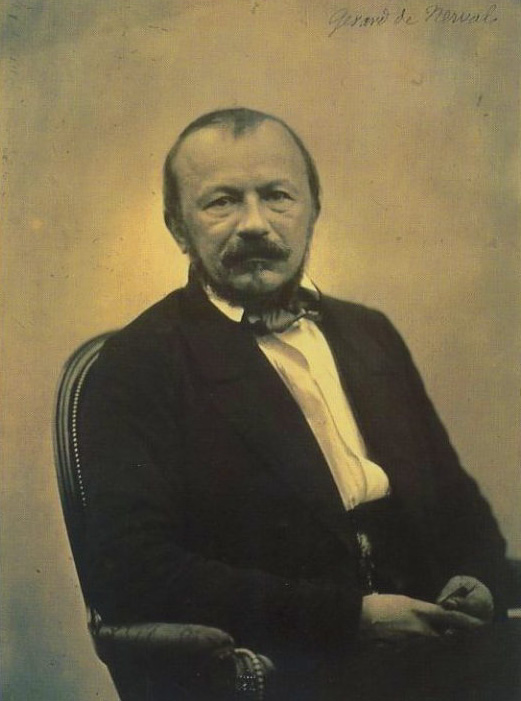
But Gerard de Nerval nearly brought him undone.  In his book Footsteps: Adventures of a Romantic Biographer, he writes of his obsession- and it truly became that- with the writer Gerard de Nerval, a French journalist and writer who was himself floridly insane and ended up committing suicide.

Gerard de Nerval

The biographical problems in writing about Nerval were daunting.  What to even call the man? (given that this was an assumed name).  How much to trust Nerval’s unverifiable telling of own childhood, given that it was written in the grip of madness?  How to write about the madness when it was at the centre of his self?  How to write about a person when Nerval himself often saw himself as two people?

All the logical and traditional structures that I had learned so painstakingly- the chronology, the development of character, the structure of friendships, the sense of trust and the subject’s inner identity- began to twist and dissolve.  It was becoming more and more difficult to tell, or to account for, Nerval’s life in the ordinary narrative, linear way. (p. 249)… As my months went by in Paris, I became more and more convinced that was exactly what could not be done, and that I had reached the limits of the biographical form, as a method of investigation.  Instead, I found myself slipping further and further into a peculiar and perilous identification with my lunatic subject, as if somehow I could diagnose Nerval by becoming him.  As if self-identification- the first crime in biography- had become my last and only resort. (Footsteps p. 264)

Holmes experimented with different techniques.  Could he write a biographical group portrait of the people who surrounded Nerval, using “a central but relatively neutral or unfamiliar figure to tell the story of a famous group of circle”? (p. 208) But the danger is that the “neutral” figure becomes the focus.  Should he abandon any pretence of objective documentation, evidence or chronology and write it as a novel instead? (p.265).  Could he use the Tarot cards that Nerval placed such credence upon as an organizing device for a life that defied chronological and developmental unity? [Personally, I think that this could have worked really well.]

In the end, his major work on Nerval remained unpublished- a book not written, so to say, – or at least, a book not read, although he did contribute an essay to a translation of Nerval’s work in 1985.   Until- voila!- Nerval reappears in  Holmes’ 2000 book Sidetracks: Explorations of a Romantic Biographer,  in the form of a radio documentary called “Inside the Tower” – or as he describes it “a radio drama based on the life of the poet Gerard de Nerval.  All Nerval’s speeches are drawn from his own essays, letters and journals.”  It was broadcast in 1977 by Radio Three, with Timothy West as the voice of Gautier.

Holmes noted:

The discovery of radio, as a vehicle for biographical story-telling, moving effortlessly inside and outside its characters’ minds, shifting with magical ease between different times and locations, was a revelation and an inspiration to me. (Sidetracks, p. 55)

And even moreso now, I would say, with podcasts that can give a program a life beyond its initial airing.  This genre solved so many problems:  he could capture the multiple perspectives of Nerval’s friends by writing commentaries for them as bit-players, so that they contribute to our understanding of Nerval without having to take centre stage themselves.  He could use Nerval’s own words- great screeds of them- to capture Nerval’s own voice, and what an acute and lyrical one it is too!  He starts with the suicide,  in the form of a police report, with eyewitnesses, mortuary assistant, police commissioner; then broadens out to include his friends, his doctors- then finally Nerval himself.  Holmes himself speaks as biographer, but he doesn’t dominate the stage.  Instead, it is Nerval’s voice, unadulterated, honoured.  Brilliant, brilliant stuff.

References:

Richard Holmes Footsteps: Adventures of a Romantic Biographer (1985)

Richard Holmes Sidetracks: Explorations of a Romantic Biographer (2000)

‘Talking Books: Novel History’

I found a terrific site called ‘Backdoor Broadcasting Company’, which contains a number of free podcasts from seminars, many of which seem to have been held in London.

The ‘Talking Books: Novel History’ seminar was held at Birkbeck Institute for the Humanities at the University College, London on 6th June 2009 and what a delight to hear something so current! What wonderful times we live in – I could barely be back here in Melbourne writing this now if I’d actually attended it!  The seminar was introduced by the historian Joanna Bourke who started with a quote from Sir Leslie Stephen that historical novels were either pure cram or pure fiction.  The question is, however, how can historical novelists and the historical profession more generally attempt to remain true to the core, brittle narratives and images emanating from a complex and perplexing past?  She introduced Hilary Mantel and Sarah Dunant, both of whom have recent historical fiction releases.  Hilary Mantel writes about real characters: Sarah Dunant’s characters are composites, but both approaches rely on archival research to flesh out their characters.  The best historical novelists, Bourke said,  like Mantel and Dunant can teach historians that there can be a different kind of fidelity to individuals in history, one that acknowledges the power of motives over the power of institutions, and the role of contingency as well as causality.

Hilary Mantel’s academic background is in law, not history.  Her historical fiction draws on authentic characters- her most recent book Wolf Hall centres on Thomas Cromwell; her Place of Greater Safety (which was released in  1992  but written much earlier) presents different revolutionary characters as a collage throughout the French Revolution:  Camille Desmoulins, Danton and Robespierre.  She dislikes, but grudgingly accepts the term ‘historical fiction’ because it raises expectations that its practitioners will have something in common.  She sees her writing more as contemporary thinking about past events; she writes about real people who happen to be dead.  Historical fiction, she says, is a way of re-creating what has slipped from the historical record and of seeing justice done by giving a voice to the voiceless, and representing the mis-represented.  Her work emphasizes the role of chance and contingency, where historians are more often wedded to causal links.  What she writes of could be true: she excludes impossibilities and refuses to rearrange history to suit the dramatic process.

Sarah Dunant, on the other hand, was trained as an historian at Oxford University some 30 years ago, where she was discouraged from making up what we didn’t know.  She was taught the grand narrative of big events, prior to the changes of historiography beginning with Christopher Hill that raised questions about women, the poor, the other.  This more recent historiography gives rise to the potential for a new sort of historical novel.  Her characters did not actually exist: they are composites, based on deep secondary research which has delved deeply into the primary sources.  As an historian, it is the fidelity of this research that gives her confidence to develop her characters, using her sources as a pointillist painter might in representing a larger painting.

The two historical novelists were followed by John Sutherland, the Lord Northcliffe Professor Emeritus at UCL, author of a number of works on fiction, the fiction industry and best-sellers.  In contrast to the earlier speakers, he questioned whether fiction could recover the past, and claimed that fiction dies if you overload it with too much material (something I tend to agree with).  Good historical fiction, he says, defines our relationship with the past- it tells us about where we are.

I’ve been grappling with the perils and pleasures of historical fiction for some time- some of the posts on this blog reflect this :  the 21st sensibility and unwise (and modified)  claims to better understanding debated with Kate Grenville’s The Secret River; the right to traduce a reputation of a true-life individual while disavowing a work as ‘historical’ in Richard Flanagan’s Wanting; the ‘flim-flam’ of biography in Louis Nowra’s Ice;  the hedgehogs and foxes suggested to Isaiah Berlin by Tolstoy’s War and Peace; the deceptive selectivity of Nicholas Baker’s Human Smoke;  the distinction between ‘voice’ and ‘ventriloquism’ in Rose Tremain’s Restoration.    I keep reading historical fiction because I enjoy it, but every time I’m drawn back to the questions of technique that keep arising and that I never can quite answer.

‘Colonial Improver: Edward Deas Thomson’ by S. G. Foster

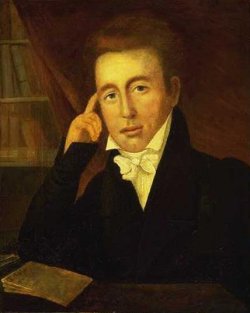
PortDeas Thomas2

Once you’ve got some little way into your research, it’s quite amusing to look back at the things that puzzled or amazed you right at the beginning.  For me, it was coming across so many letters addressed to ‘E. Deas Thomson’.  Who WAS this man, I wondered, who seemed to write with such authority on so many topics- and why had I never heard of him?

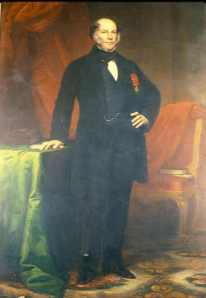
Edward Deas Thomson was originally appointed clerk to the Legislative and Executive Councils under Governor Darling in 1829, then went on to serve as  Colonial Secretary for Governors  Bourke, Gipps, Fitzroy and Denison between 1837-1856.   The term ‘Colonial Secretary’ is a little confusing, as it was used both  for the Secretary of State for War and the Colonies in London (e.g. Marquess of Normanby,  Lord John Russell, Lord Stanley during Judge Willis’ time in NSW) as well as for the chief adviser and second administrator to the Governor here in the colonies.  In my focus on the empire-wide peregrinations of colonial civil servants and judges as they crisscrossed between Upper and Lower Canada, Newfoundland, Cape Colony, the West Indies, New Zealand, Australia, Sierra Leone etc., I have tended to forget that their mobility was supported by an ongoing administrative structure that remained more or less stable, despite the comings and goings of Governors.   This was the case with E. Deas Thomson who served under four governors, of varying political stances and administrative habits.

E. Deas Thomson was born in Edinburgh in 1800 to a family with naval and merchant connections.  His father was  the sometime accountant-general of the Navy, and family drew heavily on the patronage of Sir Charles Middleton (Baron Barham) , First Lord of the Admiralty, and his family after Sir Charles’ death.    His mother was from South Carolina, where Thomson’s father had worked as a plantation agent for his uncle.  After marriage, the couple moved back to Scotland but Deas Thomson’s mother seems to have not settled well and returned alone to South Carolina after suffering a period of paranoia, leaving the 5 year old Edward with his father.  Edward was educated at Harrow, then spent two years in France,  returning to London for a period before travelling to America, then Canada after attending  to business arising from his mother’s death in 1826-7.  The French and American connections, though not necessarily out of the ordinary, do suggest a broader experience than many other civil servants may have been exposed to.

Through his contacts with Sir Charles Middleton’s family, he appealed to Huskisson, then Secretary of State for War and the Colonies for a position in the colonial civil service.  At first he was offered the position of registrar of the Orphan Chambers in Demarara, then a second offer of Clerk of the Council of New South Wales, which he accepted, despite the lower salary, on account of the healthier climate.  This consciousness of the tropical climate, and its deleterious effects, is an ongoing theme in the English imagination of Empire.

He came to his position as Clerk of the Councils via a circuitous route.  The previous incumbent, Henry Grattan Douglass had been removed from the position, and Darling tried to replace him with his own brother-in-law Henry Durmaresq. However the appointment was vetoed by the Colonial Office after complaints of nepotism and Darling was warned against the appointment to public office of  ‘any relative or near connection’.  The position was then open for Thomson’s appointment.

Thomson was not particularly impressed with the drought-striken New South Wales during his first year in 1829, but his perceptions improved as the drought lifted and his friendship with Governor Darling developed.     He maintained a good relationship with Darling’s replacement, Richard Bourke ,and dined frequently with him, despite differences in political stance.  He married Bourke’s daughter Anna, which then placed him in a similar position to his predecessor Dumaresque when Bourke recommended Thomson (his son-in-law) as a replacement Colonial Secretary in place of Alexander Macleay– an erstwhile friend whose nephew ended up marrying Thomson’s own daughter in 1857- ah, the tangled intermarriages amongst colonial ‘gentry’ family!

Despite Bourke’s qualms about nepotism, the appointment went ahead, and as it was, Thomson remained Colonial Secretary for twenty years, long outlasting his father-in-law’s stay in New South Wales.   As such, he acted as confidant, advisor and spokesmen for the succession of governors.  His role changed after the 1842 Constitution introduced a partially-elected Legislative Council, and again with 1856 responsible government when, relucant to engage with electoral politics, he became a life appointee of the Legislative Council where he came to be aligned with the conservative element.

My own awareness of E. Deas Thomson, however, arises from his position as medium between Governor Gipps (the governor in charge during Judge Willis’ time in Port Phillip) and official and individuals in the community at large.   The protocols of communication were an important means of control:  individuals and government officials were instructed to direct all communication with the governor through his Colonial Secretary, and all communication with the Secretary of State in the Colonial Office in London also had to be channelled through Governor Gipps in Sydney (and hence, his Colonial Secretary E. Deas Thomson).   Certainly individuals could, and did, circumvent this process by writing directly to the undersecretary at the Colonial Office , but by Judge Willis’ time this practice, overtly encouraged by Undersecretary Robert Hay in the mid 1820s, had been regularized by the new undersecretary  Sir James Stephen.   Likewise,  there was an off-record back channel of communication within the colonies as well:  Gipps wrote personally to Superintendant La Trobe, and Thomson himself maintained long-standing communications with Denison in Van Diemen’s Land who was later to become Governor of New South Wales.   Indeed,  Thomson became increasingly critical of Governor Gipps’ carelessness in communications with local politicians,  and his inability to recognize when to speak and when to remain silent.  At the same time, leading members of the community recognized that it was better to sound out Thomson before approaching the Governor directly. (Foster, p. 62).

E. Deas Thomson himself has been cast as ‘conservative’ in his politics, particularly when he became a political actor in his own right after representative and then responsible government was granted to the colonies.  Certainly he came to be  seen to represent the interests of the squatters,  and expressed wariness and distaste for universal suffrage and wanted the constitutional backstop of a conservative upper chamber on a restricted franchise.  However, other aspects of his politics are less clear-cut.  He was a lifelong Free Trader, right from his time back in Scotland where he attended lectures by J. R. McCulloch.   He supported the idea of ‘improvement’- a theme picked up on in Foster’s title to his book- through schooling, universities, postal communications, railways, and his involvement in a range of benevolent societies and educational instutions including the Australian Museum and Sydney University.

The lives of E. Deas Thomson’s surviving children illustrate major themes in Thomson’s own life.  His eldest son suffered an ‘unstated ailment’ and could not hold down a job and drew on large sums of his father’s money- shades, perhaps, of Thomson’s mother’s ‘instability’; or maybe just colonial waywardness??? A second son became heavily involved in the Church of England and the temperance movement- the ultimate ‘improvement’ activity.  His three daughters’ marriages are a microcosm of empire: one married a nephew of Thomson’s own predecessor as Colonial Secretary, Alexander Macleay; another married a member of the Indian civil service, and the other married a naval officer.

Thomson’s own early career demonstrates once again the importance of patronage in embarking on a colonial role.   Patronage seemed to make the world go round, but it’s easy to overlook its infantalizaing aspects.  Thomson’s own father, dismissed from his position as accountant-general in the Navy by the incoming Whig Government, turned his attention to a rich widow.  To his son he wrote:

The party I have had in view and still have, if it can be accomplished is a Mrs C a person about 50, being neither (of course) young nor handsome but with more good temper than falls to the lot of most people in life- She is the widow of an army surgeon who has been dead about 7 years- Her father left her about 15,000 pounds which has not been decreased but rather added to… Lord and Lady [B]arham approve the Match  & have visited & paid the necessary attention (quoted Foster p. 36)

Shades of Lady Catherine de Bourgh in Pride and Prejudice??  I suspect, but am not certain, that by now the Barham influence rested with 1st Earl of Gainsborough– or perhaps Lord and Lady Barham are a different branch of the family?  Ah, it’s hard to shake my 21st century perception that there’s something rather demeaning in all this deference and condescension.

Foster paints a picture in this biography of a public servant who was not just a cipher for the Governor but who had influence in his own right.  He was in the mould of 19th century gentlemen improvers: he was concerned to ‘maintain balance’ between the forces in society, and he embraced technology, communications and education as a way of improving society.  His efficiency as public servant and administrator in many ways blunted the calls for responsible government: had the position of Colonial Secretary been filled by someone less capable, there would possibly have been more political agitation for constitutional change, much earlier.

References:

S. G. Foster Colonial Improver: Edward Deas Thomson, Carlton Vic. Melbourne University Press, 1978


‘The Judicial Bench in England 1727-1875’ by Daniel Duman

coleridge

This book is a prosopographical study of the 208 men who ascended to the judicial bench in England  between 1727-1875.  “Prosopographical??” I hear you ask.   My Concise Oxford dictionary defines prosopography as

Description of person’s appearance, personality, social and family connections and career; study of such descriptions.

This is the second prosopographical work I have read, and I really quite enjoy it.  (I just want to show off that I can use such a word- I have no idea how to pronounce it, so I’ll just have to write it. )  The first was a book about the Colonial Office and the governors sent to the various colonies (Cell, 1970). Prosopography is not  so much descriptions of individuals, as a compilation of multiple biographies to develop a broad sketch of a particular career group.   The methodology uses biographies, memoirs, diaries, letters and personal papers to compile statistics about particular life events- birth place, birth order, schooling, occupation, place of residence, income, marital status etc.   From this emerges a picture of the “typical” judge or colonial governor which, although of course a generalization, helps to highlight the exceptional and anomolous.

Duman categorizes his judges into five separate time-spans of about 25-30 years which reflect social and professional changes occuring in Britain at the time.  He argues that, instead of being a ladder to success for men of lowly means, the law was always the preserve of upper middle-class and middle class men.  Landed gentry were not particularly attracted to it as a profession because, unlike the army or church, patronage was of limited use if you were incompetent.  There were more certain ways of maintaining one’s status without entering into the lottery of the law.  Likewise,  lowly families would not have been able to financially support their sons over the decade of insecure and poorly paid idleness, waiting until the briefs started to come in.

Although in the second half of the 19th century the law became more accessible to the sons of merchants and proprietors,  the ‘great public schools’ remained the educational nurseries, and Oxford and Cambridge (and later Dublin) remained the main universities attended.   The men on the bench may not have been so enmeshed in the landed gentry as they had been in the past, but they were just as much imbued with a belief in the sanctity of private property.

There is barely a mention of the colonial judiciary in this book: instead, these judges are the ones who succeeded ‘at home’.  Nonetheless, for colonial judges, the experience of the colonies and the nascent law administrations they encountered was laid over the formative, common experience of the bar back in Britain.

I find this broad-brush depiction of a designated profession in this book quite fascinating.  The statistics and generalizations are interspersed with particular case studies,  fleshed out with letters and diary entries.  The intent is to develop a profile of a class as a whole, which could be a reductionist, disembodying act, but the re-introduction of individuals back into this meta-biography returns it to the realm of the personal again.

References

John W Cell, British Colonial Administration in the Mid-Nineteenth Century: The Policy Making Process, 1970

Daniel Duman The Judicial Bench in England 1725-1875: The Reshaping of a Professional Elite, 1982.

Brigid Brereton ‘Law, Justice and Empire: The Colonial Career of John Gorrie 1829-1892″

brereton

1997

I’ve  often found, when I shut the covers after reading yet another colonial judicial biography, that however much I may have enlarged my understanding of a particular colonial official, there is still an opaque screen of inscrutibility about him.  There’s the judicial mindset that sees nuances and distinctions across all aspects of human interaction, and then it’s overlaid with the expectations and restrictions of the worldview of the early Victorian colonial gentleman.  Whatever humanity or common feeling the biography may have evoked, I’m left with the knowledge that the past is, indeed, as L.P. Hartley famously announced, a different country, and the people who lived there were of a different kind too.

However, this biography by Brigid Brereton, is different.  It came to me well recommended as an excellent example of judicial biography, and it is.   Perhaps it’s the choice of subject.  John Gorrie, the son of a dissenting United Presbyterian Church minister, took from his Scottish education and bar training an emphasis on philosophy, and working from first principles rather than the English reliance on case law- and indeed, though he worked for the Colonial Office all his professional life, was was not ever admitted to the English Bar.  This meant that he was well-placed for those colonies of the Empire where England took over from another European colonial power, where a pre-existing Continental system of justice  was already in place.  Hence his initial placement at Mauritius, the former Ile-de-France, which passed to Britain by conquest in 1810.  Here he worked under Governor Arthur Gordon,  who became confidante, friend and patron, and who was largely responsible for his second posting to  the newly-acquired British colony of  Fiji.  His experience with multi-racial colonies led to his final posting to Trinidad, which was enlarged to include Tobago.

Gorrie was not particularly interested in a judicial career, even though that is what he ended up with.  He had a deep commitment to political action as a way of bringing about change, and was heavily involved with the Aborigines Protection Society.  This led him to involvement with the Governor Eyre case on the part of the mutineers, and a lifelong interest in protecting the imported and native labourers in plantation colonies.   In his youth he had contact with the English radicals, especially Cobden and Bright, stood for parliament himself, and worked as a journalist on their  Morning Star newspaper.

It is in his correspondence with Governor Gordon that we see a man who is more recognizably modern than many of the other 19th century judges I’ve read about.  There’s a intimacy and affection in his relationship with Governor Gordon, and his writing, informed perhaps by his journalistic experience, has more colour and flow than similar correspondence I’ve read. He lived life fully: he enjoyed balls and social occasions, supported different philanthropic bodies, and enjoyed sports with his family.  And, when the political causes he espouses resonate with twentieth century liberal democratic thinking, then he comes over as one of the “good guys”.

But, of course, he was not a democrat as such, and much of his temperament and courtroom interaction is strongly reminiscent of that of Judge Willis.  He rubbed up badly against the entrenched elites in the colonial societies he moved between.  And, as is often the way, they got him in the end, although he died before he had a chance to contest his dismissal properly back in Britain.

This is a wonderfully contextualized biography.  The details of the social, political and historical mileui of each of his postings make each one seem quite distinct, even though there were many commonalities between them.  Gorrie himself comes over as a complete, coherent man who acted  consistently within a moral and political framework.  I wonder if this lies in the teller, or the tale?