Category Archives: Australian history

‘The Trouble With Harry’ Northcote Town Hall

troublewithharry

Allow me to rave.  No- before I do, if it’s before November 9 when you’re reading this,  open a new tab and find tickets and buy them. Right now.  If it’s after November 9, then you’ve missed a wonderful show.  Remember the name and look out for it.

I’ve been fascinated with Eugenia Falleni’s story for some time and have reviewed Mark Tedeschi’s book Eugenia here  and Suzanne Falconer’s book Eugenia: A Man here.  If you’re not familiar with Eugenia’s story, you can see her ADB entry here.  Eugenia Falleni lived most of her life as Harry Crawford in post- WWI Sydney where he worked as a ‘useful’ at various factories. He was convicted and found guilty of the murder of his wife, Annie. This play adopts a different slant to the two books that I have read by placing a queer interpretation onto the relationship between Harry and his wife.  The dramatist, Lachlan Philpott does not give definitive answers: instead he opens up possibilities.

Apart from my fascination with the subject, I was drawn to see this because it stars Maude Davey (who played the minister in the excellent movie My Year Without Sex– one of my favourites) and Caroline Lee.  But, by the end of the show, I really couldn’t have identified any one actor out of the six in the cast as ‘the star’ because they were all excellent. Excellent.

It is staged at Northcote Town Hall which is just like any other 1900-ish town hall- stage at the front, large hall behind.  They do not use the platform at all, but instead utilize about 2/3 of the space at the front of the hall as stage, with temporary raked seating placed in the rear 1/3 of the hall.  The set is minimal: a large wooden box, a wall of panelling which looks at first as if it is part of the fabric of the Town Hall itself, and several steel structures, not unlike the legs of a table with the table top removed.  The actors themselves shift these around the performance space, turning them one way to be a pub bar, another way to represent a front porch; another way to represent a window. The set is fluid and changing continuously throughout the play

You are handed a set of headphones as you enter the hall.  Not only does this give scope for the use of a soundscape to supplement the admittedly sparse set – bird calls, fairground, night sounds- but it also acts to unsettle you as listener when you hear whispered asides that would otherwise have been lost in a more conventional sound production.  The script itself comprises mainly short sentences, often uttered over the top of each other.  There is a ‘chorus’ of a man and woman who comment on proceedings  in short stanzas, like a poem. The headphones help, I think, in keeping the different voices distinct.  It is a strange, disconnected experience, though.  You feel very much as if you’re watching it alone, completely immersed, and it’s not possible to nudge the person next to you and comment on what you’re seeing.  At one stage, people laughed and I’m still not sure if it was the audience around me, or whether it came through the headphones.

This is a fantastic production- one of the best plays I’ve seen in a long time.  It is lyrical and it has emotional depth.  It’s clever.  See it if you can.

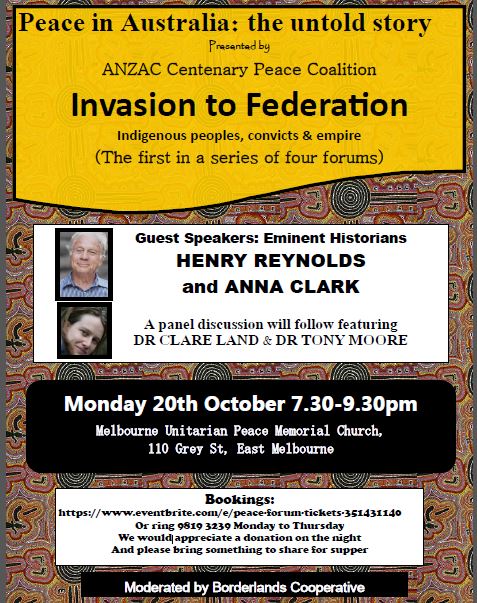
Peace in Australia: the untold story

PeaceConference

I’m going.

‘Broken Nation’ by Joan Beaumont

beaumont

2013, 655 p.

For someone who intended to eschew much of the hype about the centenary of WWI, I seem to have indulged rather more than I anticipated.  I attended the RHSV Victorians and the Home Front conference, I read The Kayles of Bushy Lodge (largely because it was written by a woman about the homefront during WWI) and I watched and very much enjoyed The War That Changed Us.   I was aware that Joan Beaumont’s Broken Nation had been well received, but what probably tipped me into reading it was Marilyn Lake’s comment in her ABR review  that

If you read only one book about Australia’s experience of World War I, as the deluge of commemorative publications marking the outbreak of the war becomes a veritable tsunami, make it Broken Nation, an account that joins the history of the war to the home front, and that details the barbarism of the battlefields as well as the desolation, despair, and bitter divisions that devastated the communities left behind.

I agree with Lake’s recommendation; I admire the book for its breadth but…oh, it was relentless reading.

In her opening paragraph Beaumont asks ‘why this book?’ given the already voluminous literature on Australian military history, especially in this centenary year. Her answer is this:

It has been written to provide what is still lacking in the literature: a comprehensive history of Australians at war in the period 1914-19 that integrates battles, the home front, diplomacy and memory. (p.xv)

It achieves this completely.  The book is structured into  six very long chapters, one for each year of the war.  Within these chapters, Beaumont moves chronologically month by month, crossing back and forth between battle, homefront,  diplomacy.  Even within these themes, she shuttles between battle as strategy and battle as lived experience by the men who were there; homefront in a political sense, homefront in a social sense; domestic politics and diplomatic politics on an international stage.

But for me, the battle scenes dominated and they dragged, particularly during the longest chapter ‘1917: The worst year’.  It took me some time to get into the mindset where a death and an injury were both counted as a ‘casualty’ without distinguishing between the two, because the effect of both was the loss of a soldier who could fight then and there.  I found myself inwardly groaning as I turned  page after page to see yet another map with arrows showing lines of attack.  There’s 36 maps in the book as a whole, (16 of them in the 1917 chapter) spread across battlefields at Gallipoli, the Western front and the Middle East, reinforcing the inexorable to-ing and fro-ing year after year.  The battle scenes are interspersed with diaries and letters from the men,  and visceral descriptions of sights, sounds and smells, but for me they were deadened by the weight of strategy and the stilted, chest-puffing language of military commendations.  Charles Bean has a lot to answer for.

But she also  moves away from the noise and shouting to consider  the process by which these sites have been memorialized.  She notes that many of the battles that the soldiers at the time chose to have memorialized through statues are not the ones that are uppermost in national memory today. For example, the 5th division, when asked in 1919 where it wanted the memorial celebrating its wartime achievements to be located chose not Fromelles, but Polygon Wood.  Our emphasis on Fromelles springs from the 1990s and the combined interventions of Prime Minister John Howard’s overseas war-memorial construction scheme and the archaeological persistence of retired schoolteacher Lambis Englezos.  This is true of many of the battles: what we have been moulded to memorialize, is not necessarily what the soldiers themselves wanted to remember and honour.

Even though the military sections weighed heavily with me, she does interweave it with the homefront and the broader diplomatic scene.  Her analysis of the homefront includes the political wranglings with Billy Hughes and conscription, and the effects on the economy and political life of the crackdown on unions and the War Precautions Act.  I’ve imbued the Labor Party lore of Billy Hughes ‘the rat’ but I hadn’t realized how much I dislike him on the broader international stage as well.  I enjoyed the final 1919 chapter very much, and its emphasis on the diplomatic tradeoffs at the end of the war.

Quite apart from the experience of reading the book, which I found draining, Beaumont makes some important points to counterbalance the type of history that is warping our present day politics and being pushed so insistently in this year of commemoration  as demonstrated in Henry Reynold’s recent excellent article Militarization Marches On.  She is at pains to point out that in many of the battles that we have appropriated to our national memory, Australians were not the only troops there.  We were part of the ‘colonial’ forces, for Britain to do with as she pleased, without consultation.

The title of the book is ‘Broken Nation’ which echoes Bill Gammage’s book The Broken Years.  She kicks back against the idea that Australia was ‘made’ through WWI. Instead, she argues, Australia – the Australia the soldiers sailed away from- was broken by WWI.  Not only was there the disproportionate loss of life, and the burden of injured soldiers, but there was “the less quantifiable embittering of public life” (p. 549).  The conscription debates had polarized Australia, and the rift did not heal easily. The war gave rise to xenophobia and insularity and fear of left-wing radicalism. It became an inward-looking society, focused on grief and the rancour of the war years. (p. 551)

The book started with a prologue that spoke of  Beaumont’s own great-uncle, Joe Russell.  He reappears once or twice during the book.  Other individuals pop up from time to time- Archie Barwick, Pompey Elliot- familiar names from the recent documentary The War That Changed Us.  I must confess that I preferred the grounded, person-based approach in the television documentary to Beaumont’s soaring birds-eye history.  But the reality is that we probably need both.  And in this book, the birds-eye history is in very good, sure hands indeed.

awwbadge_2014I’ve posted this review in the Australian Women Writers Challenge

So, Lady Franklin, now we know…

It was a rather poignant coincidence that I should be over in Hobart when the news broke of the discovery of one of the ships from Sir John Franklin’s expedition to the Arctic.

The discovery was announced by the Canadian Prime Minister, Stephen Harper, who has staked much personally and politically on the development of ‘the North’.  The political edge of his announcement was knife-sharp:

This is truly a historic moment for Canada. Franklin’s ships are an important part of Canadian history given that his expeditions, which took place nearly 200 years ago, laid the foundations of Canada’s Arctic sovereignty

There’s an interesting article about the discovery and a discussion of the political and historical ramifications here. As it points out, the territorial jockeying over the Arctic circle between Russia and Canada has taken on even more significance since the Ukraine crisis.

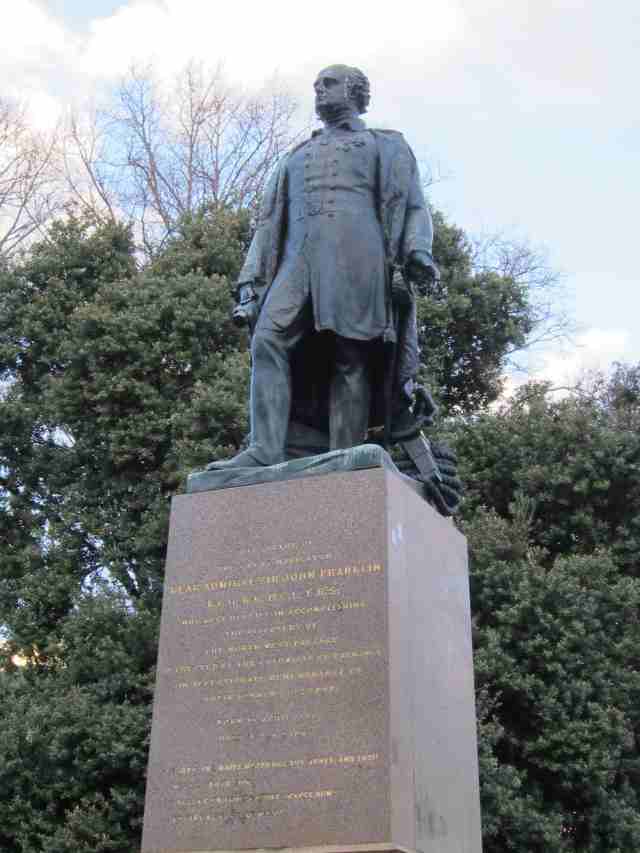
Canada has adopted Franklin as a national hero, but Tasmania has a claim on him as well, as he was Lieutenant Governor of Van Diemen’s Land between 1837-1843. (This time period coincides closely with Judge Willis‘ tenure as judge in the separate colony of New South Wales across Bass Strait). There’s a statue of Sir John in Franklin Park, the site of the original Government House.

IMG_1112a

The inscription, complete with verse by Tennyson reads:

THIS STATUE OF THE GREAT NAVIGATOR

REAR ADMIRAL SIR JOHN FRANKLIN

KCH: KR: DCL: FRS

WHO LOST HIS LIFE IN ACCOMPLISHING

THE DISCOVERY

OF THE NORTH WEST PASSAGE

IS ERECTED BY THE COLONISTS OF TASMANIA

IN AFFECTIONATE REMEMBRANCE OF

THEIR FORMER GOVERNOR

BORN 16 April 1786

DIED  11 June 1847

Not here! The white north hath thy bones and thou

Heroic sailor soul

Art passing on thy happier voyage now

Toward no earthly pole.

Kathleen Fitzpatrick wrote a lively and insightful entry on Sir John Franklin for the Australian Dictionary of Biography.  It’s well worth reading.  And of course, Lady Franklin, who made the search for any trace of her husband her life’s mission, features in several books that I’ve read and reviewed here.  There’s Richard Flanagan’s Wanting,  Penny Russell’s This Errant Lady, McGoogan’s Lady Franklin’s Revenge– and of course A.T.T. (after the thesis) (or maybe sooner) I’ll read Alison Alexander’s National Biography Award winner The Ambitions of Lady Jane Franklin.

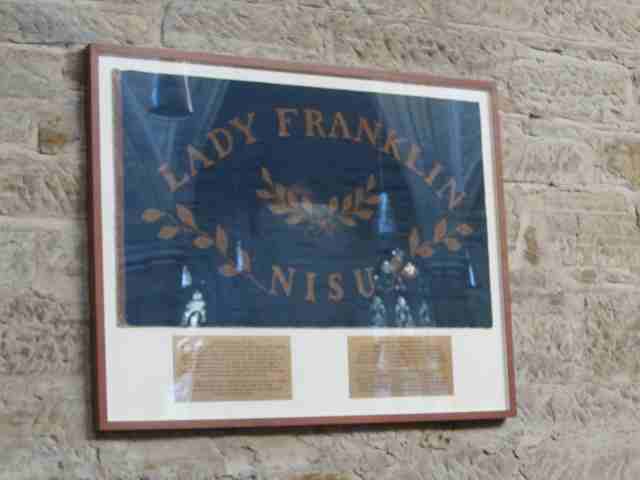
Walking around Hobart after the Transnationalism Masterclass, I stepped into St David’s Cathedral, and what should be hanging on the wall but this flag.

IMG_1109a

The panel underneath reads:

Lady Jane Franklin, respected and influential wife of former Governor Sir James Franklin, gave this simple flag to Lieutenant W. R. Hobson RN in 1857. Hobson was second in command of Captain McClintock’s Franklin Relief expedition, organized by Lady Franklin to search for her husband, lost in the Arctic.  With one sledge drawn by four men and another drawn by seven dogs, Hobson crossed the  Northwest Passage from Cape Victoria [indistinct- to Cape Felix?] on King William Island and on 3 May 1859 came across cairns [indistinct- erected by?] Franklin and his followers, which proved both their discovery of the North West Passage and their eventual fate in 1847.

There’s a short podcast about the flag and how it came to be in the cathedral here.

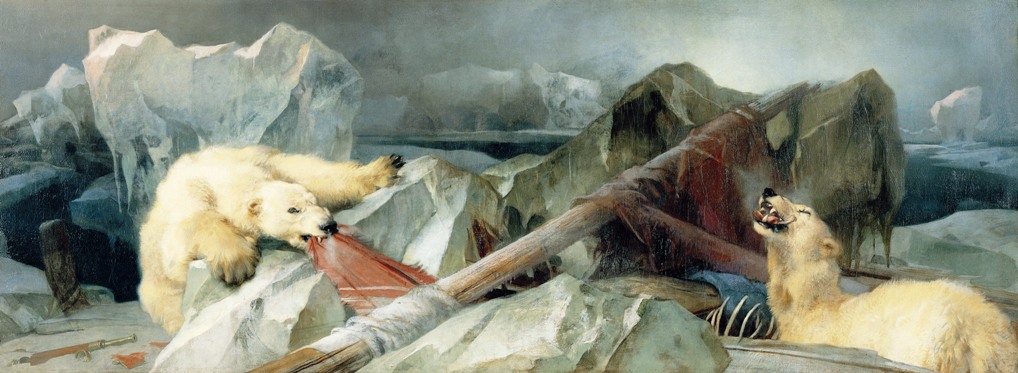
The fate of Sir John Franklin gripped the imagination of Britons, but it evoked anxieties as well.  Stimulated by the recent news of the discovery of the wrecks, Laura MacCulloch, College Curator at Royal Holloway wrote a fascinating article on The Conversation website about Edwin Henry Lanseer’s confronting 1864 painting ‘Man Proposes, God Disposes’ that depicts of  grisly outcome of the doomed expedition.  Gory, yes, but more comforting perhaps than the rumours of cannibalism that so unnerved the British nation.

piv-57-s185-57-r43

On hearing of the discovery of one of Sir John Franklin’s ships- they’re not sure yet which one- I felt rather sad for Lady Jane.  All those unanswered questions; all that fruitless effort; all that time.

[If you have the stomach for it, there’s also an article about the exhumation and thawing of the bodies of three of Franklin’s sailors in 1986,  after 140 years.  The photographs are graphic, but fascinating.]


How illuminating!

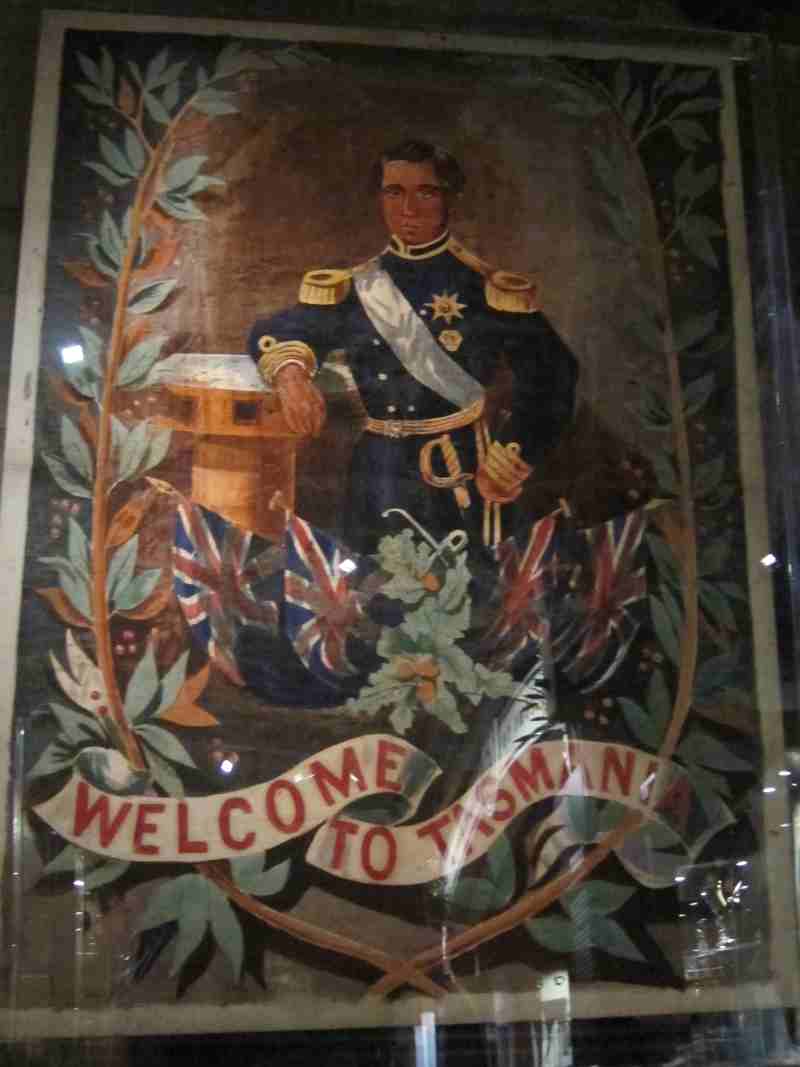
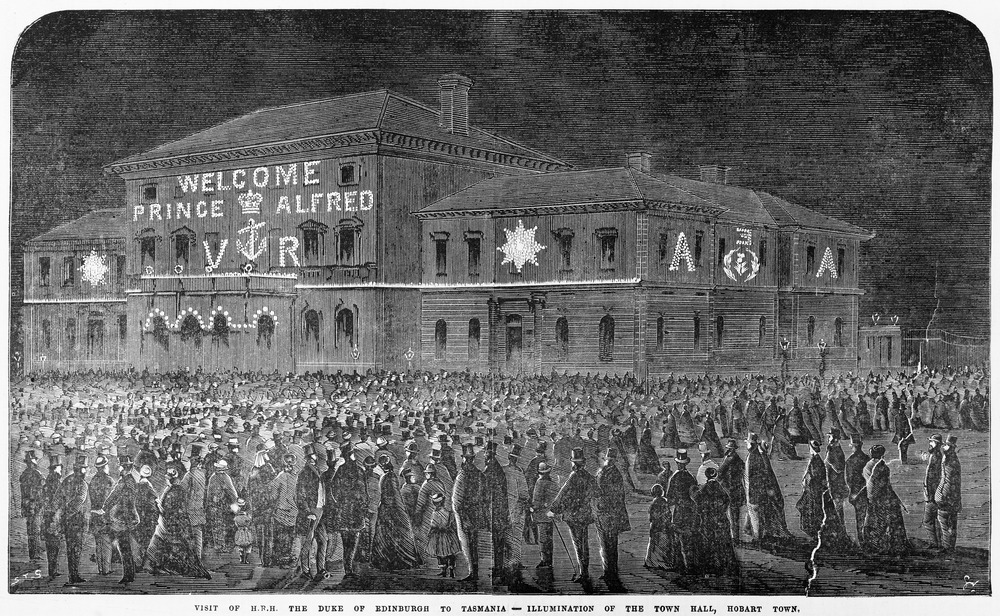
Some time ago, I wrote a post wondering what was meant by the ‘illuminations’ described at Anniversary Day celebrations during the nineteenth century.  I was delighted to find an illumination at the museum at Hobart.  It was created to celebrate the visit of the Duke of Edinburgh in 1868.

Illuminations were painted onto glazed linen and then lit from behind by lamps and candles.

IMG_1072a

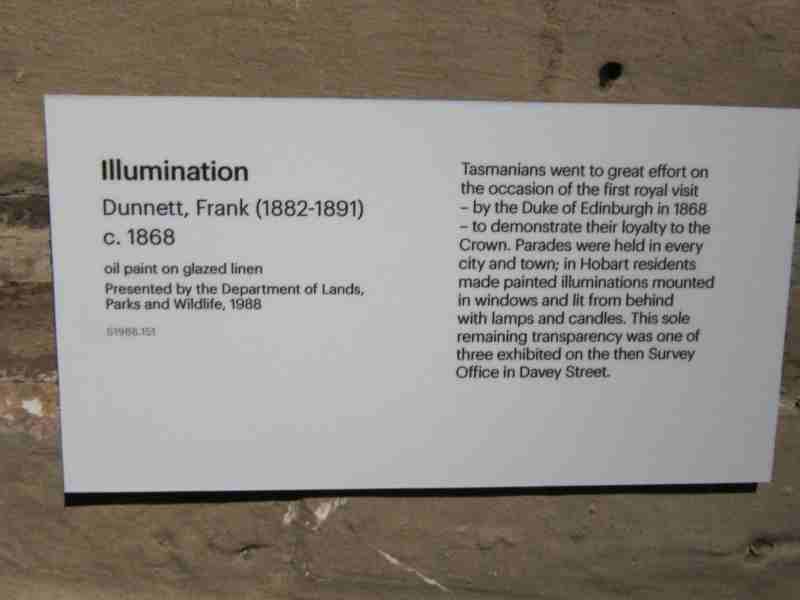
As the panel beside it shows, existing transparencies seem to be relatively rare. It’s the only remaining one of  three that were exhibited from the Survey Office that was then in Davey Street Hobart.

IMG_1073a

The Mercury newspaper of 18 January 1868 had a long article describing the illuminations.  Fortunately the weather cleared sufficiently on the eve of Prince Albert’s departure to the illuminations to proceed, after being postponed on the previous nights.

THE DUKE OF EDINBURGH IN TASMANIA.

THE GENERAL ILLUMINATION.  

After two postponements the general illumination of the city in honor of the arrival of H.R.H. the Duke of Edinburgh took place last night, on the very eve of the illustrious visitor’s departure from our shores. ‘The display, though not such a success as   could have been wished on the one hand, was on the other by no means a failure. The weather was neither perfectly propitious, nor positively unfavorable, but it was at all events a great improvement upon any we have been fortunate enough to enjoy since the day succeeding that of the Royal Duke’s landing. During the early part of the day apprehensions were generally entertained that a continuous full of rain was about to set in, but those fears were removed long before dusk. Nevertheless up to the time of the actual commencement of the illumination, a fresh and very cold wind blew from the south-west, and rendered the watching of the display a matter of some discomfort…

Then followed some criticism of the gas supply, which was obviously insufficient.  Putting carping aside, the article then went on to describe the crowd:

The concourse of people in the streets was quite as large, if not larger, than could have reasonably been expected. The leading streets were in all parts and during the entire time of the continuance of the festivities well filled with curious spectators of all ages and conditions, and at certain points of special attractiveness they were occasionally thronged to inconvenience. Nevertheless there was nowhere any formidable crush, and the demeanor of the crowd was throughout conspicuous for good humor and unselfishness.

Finally, a lengthy description of the illuminations, including those at the Survey Office:

The Survey Office exhibited three large transparencies. That on the right wing was a portrait 8 feet by 6 of Prince Alfred in naval uniform leaning on a ship’s capstan. At the base a ribbon was gracefully entwined, and on it was inscribed the motto ” Welcome to Tasmania “. The entire was encircled in a wreath of laurel On the left wing was a full length portrait of Her Majesty the Queen in Royal robes, surrounded   with a wreath of laurel. This picture was of the same dimensions as that previously described. In the centre of the building was placed a transparency 8 feet by 12, the subject being Tasmania welcoming M R.H Prince Alfred. Her Majesty was represented standing in the centre of the picture on a raised dais in the act of introducing the Prince to a female figure symbolical of Tasmania, and Tasmania as  receiving with extended hand the Royal guest, who in his turn was greeting her with a like display of courtesy. Immediately behind the Prince was seen a sketch of the Galatea in the distance, and lower down were grouped cannons, mortars, cables and other appurtenances of a   ship of war. Behind Tasmania are barrels of oil, bales of wool, and other specimens of the products of the island, and underneath them a cornucopia. A ribbon supported by winged figures above the heads of the central group was inscribed with the words “Tasmania’s Reception,” and a corresponding ribbon at the foot of the picture bore the continuing words ” To tho Royal Duke.” The painting was executed by Mr Frank Dunnett of the Survey Department

Personally, I don’t think that Mr Dunnett should give up his day job- oops, painting and sketch-making was his day job.  The Design and Art Australian Online database provides a biographical sketch, describing  him as

 a painter, lithographer and surveyor. As a chronic asthmatic he was advised to leave Britain and so in about 1856 he migrated to Australia. Dunnett moved to Tasmania and found employment with the Hobart Town Survey Office. In 1866 he exhibited at the Melbourne Intercolonial Exhibition and was awarded a highly commended certificate for a sketch.

Good old Hobart.  They gave Prince Albert a far better reception than he was to receive in Clontarf a few months later….


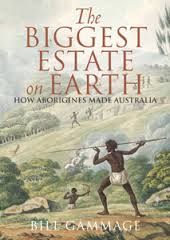
‘The Biggest Estate on Earth’ by Bill Gammage

gammage

Bill Gammage, The Biggest Estate on Earth: How Aborigines made Australia

384 p. 2011

I was aware, while reading this book, that I was reading what could turn out to be one of the really big books in Australian history: a book that changes the received understanding of Australian settlement,eventually rippling out beyond historians to politicians and the media to finally become part of the way we see ourselves and our country.  Maybe.

Gammage’s argument is that, instead of being marginal hunter-gatherers, ‘people’- for that is the terminology he has chosen to distinguish aborigines from ‘newcomers’- farmed prior to 1788.  They were not farmers, which is a lifestyle; but they did farm – the activity of tending and shaping landscape.  They developed what he calls a ‘template’ of landscape, a mosaic comprising open pasture with few trees,  strips of scrub and stubby trees, other plains, then clearly delineated forest.  It was a landscape ideally suited to the growing of tubers and providing both shelter and feed to encourage the presence of kangaroos and animals suitable for hunting. Instead of being forced to keep moving because they were on the verge of starvation,  people were well-supplied with food through this manipulation of their environment.  They moved across country as part of tending it, shifting and imposing the  template, created through careful burning, onto new land at will. They were well aware of species that tolerated or encouraged fire.

It is an argument that forces us to change our view of the landscape around us.  The bushland that we prize as ‘native’ landscape is often not that at all- instead it is product of neglect as the custodians of the country could no longer farm it.   The plains of green ‘pick’ were engulfed by scrub, and forests left unburned exploded into huge conflagrations that were not seen under the care of ‘the people’.

He mounts his argument through repetition, almost to the point of overload.  He draws on the writings of early settlers and explorers who again, again and again, observed and documented the same thing:

The country consisted of open forest, which, growing gradually thinner, at length left intervals of open-plain…Penetrating next through a narrow strip of casuarinae scrub, we found the remains of native huts; and beyond this scrub, we crossed a beautiful plain, covered with shining verdure, and ornamented with trees, which, although ‘dropt in nature’s careless haste’, gave the country the appearance of an extensive park.  We next entered a brush of the acacia pendula, which grew higher and more abundant than I had seen it elsewhere  (Major Mitchell, NSW, cited on p. 219)

And Gammage repeats their descriptions too- twenty, thirty, fifty, more-  explorers and settlers, repeating ‘parkland’ and ‘plains’ again and again.  He is at pains to emphasize that this occurred across the breadth of Australia as he draws together descriptions from each state, identified in brackets. The open spaces were covered in kangaroo grass, a summer-flowering grass that turned tan-coloured in summer, and their horses sank into the soft, flour-like soil.

Gammage reinforces these descriptions with photographs and paintings.  I had always assumed that the similarity of early paintings reflected a shared English sensibility that superimposed an English aesthetic of parkland onto an Australian landscape.  But when you couple these paintings which again and again depicted open grassland fringed with forest, with written testimony that again and again described exactly the same thing,  the supposition that they were blinded by European sensibility becomes shaky.  The blindness is ours.

If you’re not convinced by the descriptions and the paintings, he then moves from one capital city to another, drawing on the same descriptions  that sprang from their earliest newcomer settlers, reinforcing that he is not just talking about one corner of Australia, but the continent as a whole.

I had been anticipating reading this book for some time.  Many people speak of Gammage’s book The Broken Years in glowing terms, and his contribution to documentaries (e.g. The War that Changed Us that is screening on ABC1 now) and public discourse more generally has always been sensitive, articulate and insightful.  This book was awarded the Prime Ministers Literary Prize for Australian History in 2012, and Victorian, ACT, and Queensland awards. Yet I found myself disconcerted by the abrupt and utilitarian tone of the opening chapters.  Chapter 2, ‘Canvas of a Continent’ is replete with colour photographs and landscapes and paintings, but the text reads like a series of separate, lengthy captions. Chapter 3 ‘The nature of Australia’  is divided up into a number of subheadings, enumerating 5 changes, followed by 8 notes.  It felt a bit like reading a speaker’s notes.

But these two chapters are followed in Chapter 4 ‘Heaven on Earth’ and Chapter 5 ‘Country’ by one of the clearest explications of the Dreamtime and its connection with action in relation to land that I have ever read. He made intelligible to me the connection between spiritual and ecological activity on the land, highlighting even more starkly the insult on so many levels that settler activity inflicted on  Aboriginal reality.

Gammage’s beautiful, clear writing seemed to be ribboned with utilitarian, ‘hard’ writing, not unlike the ecological template that he was describing!  I think that I only really grasped what he was doing in the writing of this book when I read Appendix 1.  There he explained that he had been invited by the Department of Geography and Environmental Studies of the University of Tasmania to speak on 1788 land management.  As it transpired, the invitation lapsed.  This book seems to be to be the response he would have given to the scientists with whom he hoped to speak.   In many ways, I feel as if he is not writing for historians, but for scientists.  His footnotes- so beloved by historians- are stripped back and unwieldy, as they give author and page only, requiring a further search within the bibliography. Sometimes the original date of the quote – an important detail in this case- is obscured in the publication date of recent editions .  The footnotes corroborate, rather than carry on a conversation. The dotpoints and headings are part of constructing an argument on scientific terms, and a perusal of his truly extensive bibliography shows his immersion in not only historical, but also scientific, archaelogical and ecological literature.

I read this book after reading Bruce Pascoe’s Dark Emu, and I wondered when reading that book how it compared with Gammage’s.   Although there is some cross-over between the two books, Pascoe’s describes people much more, and their economic practices across a range of activities- fishing, , food storage, shelter, etc.   Gammage’s book, I think, focusses more on manipulation of the landscape.  Pascoe’s has the emotion of political action: Gammage’s is more dispassionate.  Gammage has the academic clout of a long and distinguished career in academe: Pascoe speaks as a Bunurong/Tasmanian indigenous man.  Pascoe reports on the academic debates from the side: Gammage is there, (especially in the Appendix) right in the midst of that academic skirmishing.

Taken together, the two books challenge our conceptions of ‘hunter/gatherer’ and what ‘native bushland’ looks like.  This in turn has implications for our responses to fire and how to act ecologically.  Most importantly, it throws up a direct challenge to the idea of ‘terra nullius,’ not in a legal sense this time, but in a practical and environmental one, by completely reshaping our idea of pre-1788.  It doesn’t fit neatly into a “defining moments” view of history at all  and it should give the lie completely to our Prime Minister’s view that Australia was “um, scarcely settled” prior to white settlement.  That’s what a big history can do.


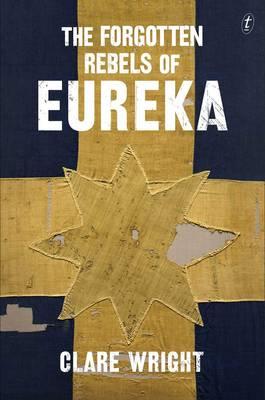
Terrific article about Clare Wright’s ‘Forgotten Rebels’

the-forgotten-rebels-of-eureka

There’s an excellent article by Zora Simic on The Conversation website that locates Clare Wright’s much acclaimed book Forgotten Rebels of Eureka (see my review here) within other feminist Australian histories over the past forty years.  She refers specifically to three other books that sit here on the shelf beside me.

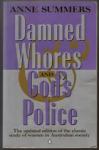
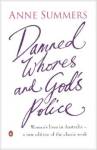
The first, Damned Whores and God’s Police by Anne Summers was published in 1975 (while she was still a doctoral student!) with the subtitle “The Colonization of  Women in Australia”.  This subtitle was dropped from the 1994 and 2002 revised editions.  Its republication decades apart is significant.  The 1994 version included a new introduction and a controversial epilogue “Letter to the Next Generation”.  The 2002 edition included all the material from the first and second editions and a timeline of achievements by Australian women 1788-2001.

dixson1976

1976 edition

the-real-matilda1999

1999 edition


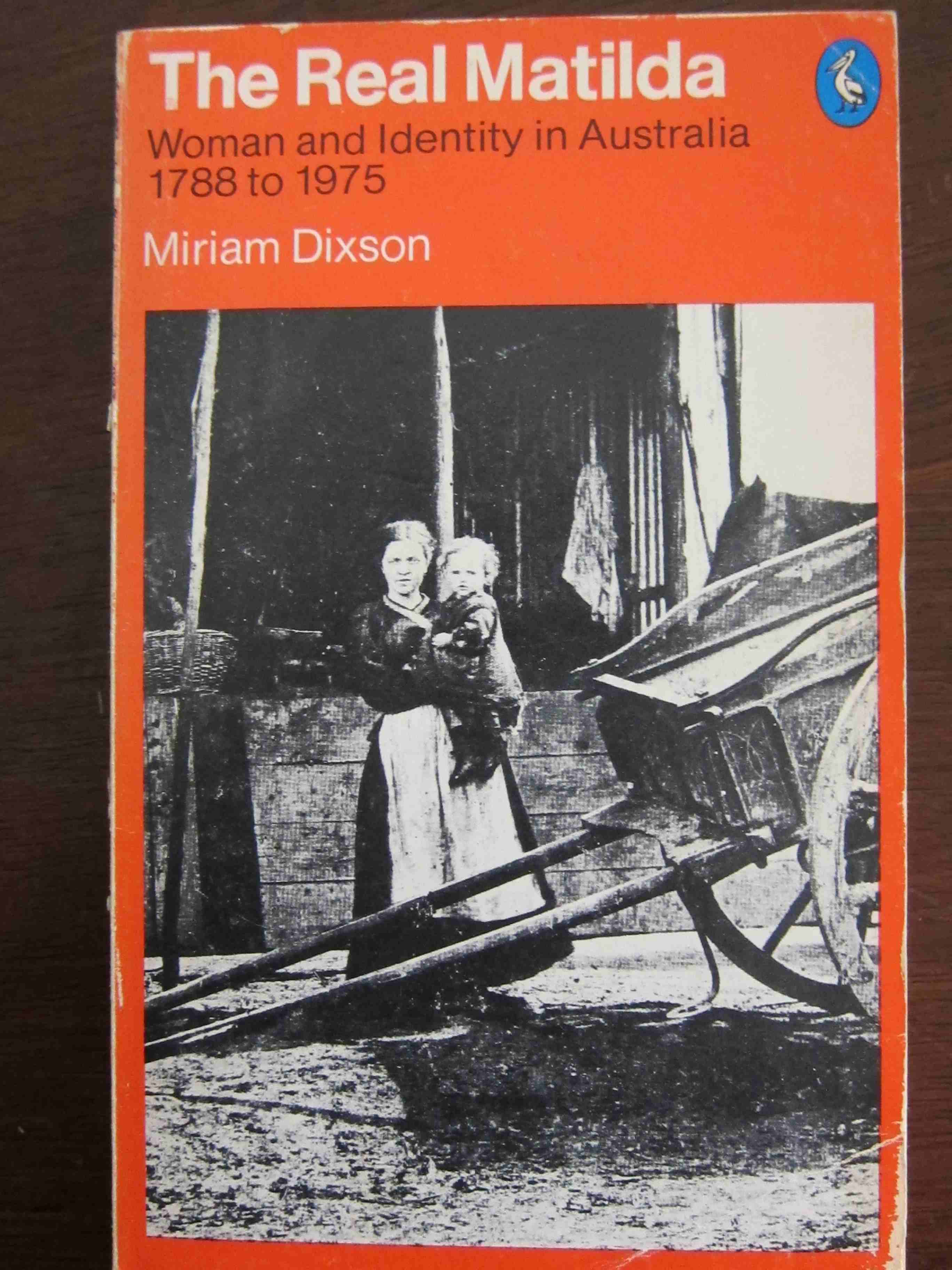
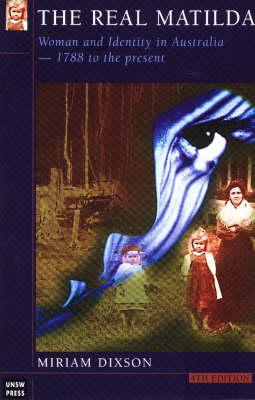
The second is Miriam Dixson’s The Real Matilda: Women and Identity in Australia 1788-1975.  It, too, has gone through several editions.  It was published in 1976, revised in 1984 with a third edition in 1994 and a fourth in 1999. By the 1999 edition it had grown by two chapters, along with a new introduction.  When Ann Curthoys wrote a twenty-year retrospective review of four foundational feminist Australian histories for Australian Historical Review (Vol 27, No 106 pp 1-13) she noted that the the book had an open engagement with international theoriests, with a heavy emphasis on the early colonial period.  However, she was struck, twenty years after its publication, by the emphasis on women’s passivity.

Curthoy’s review also examined Damned Whores and God’s Police,  Beverley Kingston’s My Wife, My Daughter and Poor Mary Ann which examined the unrecognized work of women in the home, and a book I had not heard of- Gentle Invaders which focussed on the regulation of women’s wages.  Curthoy’s article is a good one, and worth looking up if you have access to it (bring out your State Library of Victoria card, people, and read it online).  Zora Simic’s article here is not unlike it yet another twenty years further on.

1994 edition

1994 edition

2006 edition

2006 edition


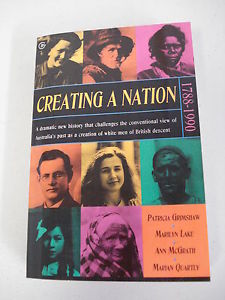
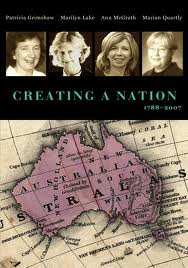
Finally, Simic locates Clare Wright’s book alongside the 1994 book Creating a Nation, co-written by Patricia Grimshaw, Marilyn Lake, Ann McGrath and Marian Quartly and republished in a second edition with an additional chapter in 2006..   In Ann Curthoy’s survey article she had been particularly surprised by the absence of discussion of race in the four texts she reviewed, and this book directly challenges this by the integration of Aboriginal experience into their analysis, with three chapters devoted to this often-dismissed aspect.  It certainly starts dramatically, with an Aboriginal woman going into labour on the beach in 1791. This  imagery is carried throughout the book, giving a new meaning to “the birth of a nation”.

 was prompted by Simic’s review to read Curthoy’s article  just after reading that the gender pay gap in Australia has soared to 18%, the highest in 30 years and since data was collected.  I noted with interest that Curthoy’s survey article made much of the context that the four books she examined were written i.e. in the early 1970s, during the Whitlam government and at a time of rapid increase in female enrolment at universities.  She wrote of the limitations of Gentle Invaders, written by two authors who had met in the heady days of the Womens Electoral Lobby, preparing the case for a minimum wage for women in the 1974 National Wage Case.  On a day when I also read about the threat to the Renewable Energy Target and the further relaxation of 457 visas, all that seems such a very long time ago.

References:

Zora Simic ” Noted Works: The Forgotten Rebels of Eureka” http://theconversation.com/noted-works-the-forgotten-rebels-of-eureka-26584

Ann Curthoys  “Visions, Nightmares, Dreams: Women’s History 1975” Australian Historical Studies  Vol 27, Issue 106  pp 1-13.

The War That Changed Us

Next Tuesday 19th August the ABC will be showing the first of the four-part documentary ‘The War that Changed Us’.  It combines the stories of six real-life Australians involved in different ways with WWI,  with analysis and commentary provided by many of the historians I have reviewed on this site.

It promises to be a more nuanced approach than the ra-ra ‘War that Made Us Australian’ type approach that I find so uncomfortable.  Its six main characters are two soldiers Archie Barwick, Harold ‘Pompey’ Eliot, army nurse Kit McNaughton, anti-war activists Vida Goldstein and Tom Barker, and pro-war pastoralist’s wife Eva Hughes.

The documentary was created and co-written by Clare Wright (whose book The Forgotten Rebels of Eureka I reviewed here) and features interviews with Janet Butler (who wrote Kitty’s War  the much acclaimed study of Kit McNaughton, who features as one of the six characters in this documentary, and reviewed here), Marina Larsson (who wrote Shattered Anzacs, reviewed here) and Bart Ziino (whose presentation to the recent Royal Historical Society Conference The Other Face of War: Victorians and the Home Front I wrote about here).  So, as you can see, this is very much a documentary informed by familiar voices.

You can see a sneak preview of it here:

[And hopefully- surely- it will be more satisfying viewing than Anzac Girls which so far has been bitterly disappointing pap]


‘Dark Emu’ by Bruce Pascoe

darkemu

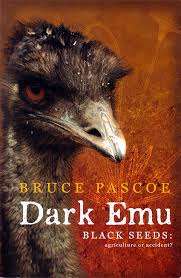
Bruce Pascoe: Dark Emu, Black Seeds: Agriculture or Accident?

156 p. 2014, Magabala books

On July 3rd, just 3 days before NAIDOC week, my Prime Minister (who had dubbed himself the first ‘Prime Minister for Aboriginal Affairs’) made a presentation to the Australian-Melbourne Institute.  In extolling the benefits of foreign investment for Australia he said

As a general principle we support foreign investment. Always have and always will. Our country is unimaginable without foreign investment.  I guess our country owes its existence to a form of foreign investment by the British government in the then unsettled or, um, scarcely settled, Great South Land.

There is a particular argument that could be posed about the word ‘settled’ in relation to the law of colonies, but Abbott here was talking economies, not law. You can almost hear the wheels turning in his brain as he thinks “oops- not ‘unsettled’ because I suppose that they were there, I guess-‘ scarcely settled’- that’ll do”.

Bruce Pascoe’s book Dark Emu argues directly against the idea that Australia was ‘scarcely settled’. It was, he argues, very much settled in a way that forces us to reconsider the ‘hunter-gatherer’ label that is often used to describe pre-colonial Aboriginal Australians.

The start of [the] journey is to allow the knowledge that Aboriginal people did build houses, cultivate and irrigate crops, did sew clothes and were not hapless wanderers across the soil, mere hunter-gatherers. Aboriginals were intervening in the productivity of the country and what they learnt during that process over many thousands of years will be useful to us today. To deny Aboriginal agricultural and spiritual achievement is the single greatest impediment to inter-cultural understanding and, perhaps, Australian moral and economic prosperity. P. 156

Bruce Pascoe has a Bunurong/Tasmanian indigenous heritage, and if you watched First Footprints, (my review here) you will recognize him as one of the talking heads on that wonderful, paradigm-rattling documentary. He is not an academic historian as such, and described himself in his earlier book Convincing Ground (2007) as a “mug historian with no training” (p. 200). His interweaving of personal, current day narrative with historical analysis, in both this and his earlier book, places his work in that uneasy space between local history and academic material.

In his preface, Pascoe says that he conceived the theme for this book in the wake of writing Convincing Ground, when he was inundated with letters and information from fourth-generation farmers and Aboriginal people. These responses, along with material that he had tucked away unused from his earlier book, suggested to him that not only had the Frontier War been mis-represented, but that the whole economy and culture of Aboriginal people had been undervalued. (p. 11)

His methodology was to return to the diaries of the early white explorers, surveyors, pastoralists and protectors. These men (for they were overwhelmingly male) espoused the racial superiority of white settlement, decried the primitivism of Aboriginal culture and predicted the inevitable extinction of Aboriginal ‘nomads’. Yet at the same time, they described large structures capable of sheltering thirty or forty people, stockpiles of ground seed and grain, dams and redirections of water courses, fish traps, and storehouses. They were unconscious wreckers (or at least one hopes they were unconscious): eating the grain that had been carefully piled up waiting for consumption at a later date, gladly taking advantage of a clay-daubed shelter, or rather more ominously, testing the strength of the roof of a shelter by riding over it. It strikes me as deeply ironic that explorers, starving, blinded and maddened by bites and sun, could look at aboriginal people serenely co-existing with the environment, and then write about them as ‘primitive’.   He finds example after example in the words of explorers Major Mitchell, Sturt and Howitt, early colonists Isaac Batey, James Dawson, and protectors and missionaries George Augustus Robinson and Joseph Orton .   He reproduces some of their sketches that, when you extract them out from the scrawled text that surrounds them,  demonstrate much more deliberation and ingenuity on the part of the constructors, than the 19th century authors’ commentaries convey.

Major Mitchell is one of Pascoe’s most heavily used informants, and Pascoe captures well the contradictions within Mitchell’s work, and the ambivalence with which he views him:

Mitchell talked in sorrow about the demise of Aboriginal Australia… but despite this compassion Mitchell writes, a mere two paragraphs later, ‘We again (on the Hunter) find some soil fit for cultivation, and the whole of it taken up by farms’… At one moment he expresses sorrow for the losses of the Aboriginal population but within a page he’s extolling the value of the lands forcibly taken from them.

On his previous explorations Mitchell has seen the use Aboriginal people made of their lands, although some of the food production techniques were too discreet to capture his attention or understanding, but then opines mildly about the future of Australian farming as if Aboriginal food production had never existed. He looks down the valley at the sheds and houses of the settlers where smoke dwindles from the chimney and squares of amber light glow at windows and revels in the domesticity. Only a year before he was envying the warmth and domesticity of the Aboriginal village, but now he prides himself on opening up this land to to his own race.

He’s a good man, Mitchell, but he shares the ambition of every British man in the colony: land… The confidence of Mitchell to assume that the land had been waiting for Europeans and their animals is at the heart of European intellectual arrogance. (p. 141-2)

Pascoe draws also from the work of anthropologists, well known ones like Stanner and Rhys Jones, but also some maverick ones who are challenging established understandings. There are a number of places in the book where you sense Pascoe sitting in on conversations, listening carefully to the debates, and weaving in their work into his argument.  Some of the texts he draws upon are small productions, well outside the mainstream, like a small saddlestitched 70 page book produced by Peter Dargin for the Brewarrina Historical Society, or a similar book by Rupert Gerritsen, published in London for want of Australian interest, and No. 35 on a Google search into ‘Australian Aboriginal Grain Crops.’ He does his own work no favours by including (albeit with misgivings) wild estimates of Aboriginal occupation of Australia going back 120,000, alongside other figures of between 40,00 -65,000 years. Nor does he burnish his own reputation by citing Gavin Menzies’ 1421: The Year China Discovered the World, a book largely dismissed by academic historians.

The book has eight chapters. In the first, ‘Agriculture’, he focuses on the yam and grain harvesting, irrigation, and the harvesting of emu and kangaroo. Chapter 2, ‘Aquaculture’ examines fishing operations, particularly in Brewarrina and Lake Condah, and watercraft on the rivers and seaboard. Chapter 3 is titled ‘Population and Housing’, where he argues that villages marked the movement towards agricultural reliance, most particularly where there were stone constructions. Chapter 4 ‘Storage and Preservation’ explores the use of pottery and stockpiling , while Chapter 5 examines ‘Fire’ in the creation of grasslands. Chapter 6 is a divergence into ‘The Heavens, Language and the Law’ where he explores the theories that posit a qualitative shift in the ‘intensification’ of food production and technology about 4000-5000 years ago. This chapter is largely the representation of other people’s theories, which he views rather sceptically. I found this chapter rather hard to follow, although it seemed to resolve into an examination of concepts of land ownership, and what he called “jigsawed mutualism” whereby people had responsibilities for particular parts of the jigsaw, but could only operate that part so that it added, rather than detracted, from the pieces of their neighbour (p. 138). Ch. 7 ‘Australian agricultural revolution’ is only four pages in length and suggests several Aboriginal crops that could be farmed commercially in the future. The final chapter ‘Accepting History and Creating the Future’ is a plea for an acceptance and re-visioning of Aboriginal agricultural and spiritual achievement, and allowing this to inform the future.

It is perhaps unfair to review a book by making reference to another author’s work, but in this case it is almost unavoidable. Bill Gammage’s The Biggest Estate on Earth (my review here) was published prior to Pascoe’s work, and indeed Pascoe cites him in several places. A beautifully crafted and lushly produced book, Gammage’s work has been debated within academia and received the Prime Ministers Prize for Australian History in 2012. The two books, although mismatched in production values and ‘clout’, cover similar material and arguments. However, having only just flipped through Gammage’s book, it seems that he speaks more of land management, with a particular emphasis on fire.

Pascoe’s much smaller and more modest book, on the other hand, concentrates rather more on economic and social systems, with rather more emphasis on interventions in settled places as a challenge to the ‘hunter-gatherer’ image. A challenge, too, to a Prime Minister who sees the land as “unsettled- um- scarcely settled”.

Posted as part of Lisa’s  ANZLitLovers Indigenous Literature Week.
indigenous-literature-week-2014

Yvonne Perkins has reviewed it as well.

Janet McCalman on the Founders and Survivors Project

A couple of weeks ago, Heidelberg Historical Society was delighted to welcome Professor Janet McCalman to our open meeting to speak about the Founders and Survivors Project.  This is a fascinating partnership between historians, genealogists, demographers and population health researchers who are using the convict records of the 73,000 men women and children who were transported to Van Diemens Land (VDL) between 1803-53 to create a collective biography of the transportation experience as it played out through succeeding generations.   Not particularly “Heidelberg-y”, you might think, but you’d be wrong: from among the records she found three ex-VDL convicts who settled in the Heidelberg/Diamond Creek/Whittlesea district, and in many ways their lives illustrated the ‘lifestories’ approach of the project as a whole.

The Van Diemens Land records are one of the most complete databases of the bodies and lives of an entire population in the world- so unique that it has been placed on the UNESCO Memory of the World Register in 2007.   The Founders and Survivors Project links them with another parallel database: that of those who served in the AIF in World War I.  These two data banks form the bookends of a project that looks at the convicts as a population, rather than as individuals, gathering data on their lives before sentence from which to infer their early life influences, examining their progress through the penal system in VDL, then tracing their lives after sentence.  It moves onto succeeding generations, looking at the  occupations, life span, families, mobility and social location of their descendants ending up, if possible, at the AIF records.

Using the methodology of prosopographical demography, it is a project built up from small records into an over-arching collective biography.  The convict indents are a starting point, but it widens out to genealogical records, shipping records, newspapers and institutional records as these individuals move through different life stages.  As you can imagine, this is a hugely labour-intensive process, involving records from all over the world.  In a way that just would not have been possible twenty years ago, the grunt-work of the project has been crowd-sourced, with local historians, family historians and genealogists from all over the world making their contributions.

You can see a video and read a transcript of Janet giving a talk similar to the one she gave us here at the State Library of Victoria website.

The people of Port Phillip during Judge Willis’ time liked to pride themselves on belonging to a ‘free’ society rather than a penal colony.  However, as I wrote about here, there were many convicts in Port Phillip, and through the Founders and Survivors project,  they have established that many of them were attracted to either Melbourne and its suburbs or the goldfields.  I was not surprised to learn that of the ex-convicts they were able to trace to death (just under half), the majority of men did not marry, but I was surprised to learn that 30% of women did not marry either.  Moreover, the majority of the women they have traced did not have children, although as Janet explained, a large tranche of the earlier female transportees were street-walkers whose venereal disease may have affected their fertility.   One of the criteria that the project has used for ‘success’ in later life is the presence of grand-children. Grandchildren suggest that the former transportee was able to carve out a life that was sufficiently secure to raise children to adulthood, and that those children, in turn,  were able to find life partners with whom to start their own families.  It puts the present-day pride in convict ancestors into another light: as far as VDL convicts are concerned, those who went on to sprout forth large family trees were very much the exception rather than the rule.

Two comments that she made struck me in particular- probably because they have resonances with events today.  The first was that of the punishments inflicted during transportation, solitary confinement seemed to be correlated most strongly with poor life outcomes, with fewer marriages and children afterwards.   Physical punishment (e.g. lashing) declined over time, as the system moved towards more psychological punishment.  Women in particular suffered from transportation (or the life prior to transportation), with their life expectancy some ten years lower than that of  free settler and native born women.

The second observation that Professor McCalman made was that it was government activity that gave many of these ex-convicts a leg-up.  Many were employed on the railways, and moving beyond WWI, those who served in the AIF and received returned-service homes managed to avoid the worst of the depression.  Many from later generations worked on the large infrastructure projects- Yallourn power station; roads etc.  In a world today of for-profit, public-private partnership, it underlines the importance of government activity in infrastructure, not just in its construction but its ongoing operation as well.

This project combines big-picture analysis with fine-grained family stories. There’s a wonderful, beautifully-designed  site called Founders and Survivors Storylines that presents these family stories through video, song and words.  Well worth a look.