Category Archives: Australian history

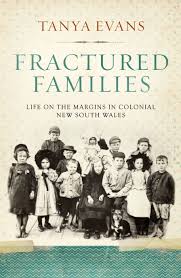
‘Fractured Families’ by Tanya Evans

evans

Tanya Evans Fractured Families: Life on the Margins of Colonial New South Wales,

2015, 252 p & notes

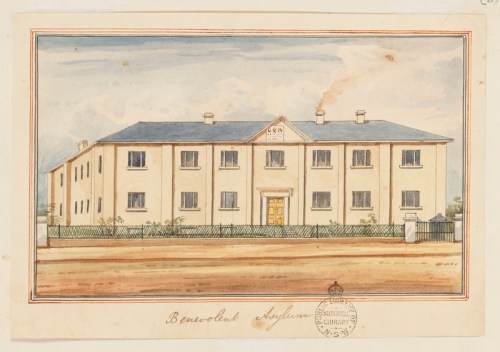
When I picture a ‘Benevolent Asylum’, I have a mental picture of  greyness, thick walls, lancet windows and forbidding ecclesiastical air. It came as surprise, then, when I found this image (below) from the 1840-1850s which did not appear quite as funereal as the name of the institution suggests.

SydBeneAsylum

Sydney Benevolent Asylum Artist disputed c. 1840-1850, State Library of New South Wales

The Sydney Benevolent Asylum was Australia’s first (and oldest surviving) charity, founded in 1813, with the avowed intention NOT to operate like the Poor Laws back in England.  The Poor Laws in 1813 were still based on the old parish system, where the indigent and needy were shuttled back to their parish of origin, to be supported grudgingly by the parish. There were workhouses, but the truly punitive workhouses of our Dickens-tinged consciousness arose out of the Poor Law Reform of 1834, some twenty years after the establishment of the Sydney institution. Unlike in England, there was an acceptance that the State “was responsible for moulding the structural circumstances of the poor in early New South Wales” and without a tradition of elite obligation to the poor, it could be said that New South Wales was ‘born modern’.

Continue reading

‘Caledonia Australis’ by Don Watson

caledonia

1984, republished  1997 (this review) and 2009. 255 p. & notes.

Actually, I hadn’t intended reading this Don Watson book at all.  I was reading the first chapter of his more recent, award-winning book The Bush and found myself reminded that before Watson was a Monthly correspondent, a commentator on public discourse or Paul Keating’s speechwriter, he was a historian.  His book Caledonia Australis was already on my bookshelves, and having recently had the experience of reading two books from the edges of a historian’s career as I did with Michael McKernan (see here and here), I decided to put the more recent book aside in order to return to Watson’s earlier book.  After all, I reasoned, it would do a disservice to the earlier book to read it after the larger, more mature work, honed by over thirty years of writing.  My assumptions were unfounded. I haven’t yet returned to The Bush but Watson’s Caledonia Australis,  a more consciously historical work, stands proudly on its own two feet.  Watson was a damned good writer in 1984, just as he’s a damned good writer in 2016.

We see in this 1984 book the subtlety that Watson would later display in his exploration of Paul Keating in his Portrait of a Bleeding Heart.  It does not have the trappings of an academic text: it does not have footnotes or an index and its reference list is only loosely tied to the chapters.  It does, however, make a strong historical argument which has maintained its currency- has indeed become stronger- since its initial publication in 1984 and reissue in both 1997 and again in 2009.

The first part of Watson’s book is not about Australia at all, but instead the Scottish Highlands.  I’d heard of the Highlands clearances, but I’d assumed that people were shifted directly from their Highland ancestral homes onto ships to the New World as part of a global diaspora.  But, as Watson points out, there was an in-between period where Highlanders were forced onto the coastal edges where they were forced to work in kelp-harvesting. Kelp was prized as an industrial additive for the soap, linen and glass industries and had become lucrative when imports of Spanish barilla (a salt-tolerant plant) were heavily taxed during the 1790s.   The shifting of the Highlanders to the coast and the attempted suppression of the language and culture of this ‘backward’ people was seen as an ‘improvement’ measure that, fortuitously for the large lords, freed up the land for the importation of sheep. When the duties on barilla and salt were reduced in the 1820s, the kelp market collapsed, and it was at this juncture that the ‘improvers’, especially on the isles of Skye and Mull,  looked to emigration and particularly the large, clan-based Scottish emigration schemes in Canada and Australia.

And so, by Chapter 4, we have ‘Highlanders at Large- the Kurnai at Home’. Both by an accident of timing and also as a result of clan networks, Scottish settlers explored and appropriated the lands of the Kurnai people of what we now know as Gippsland but which  Scottish explorer Angus McMillan christened ‘Caledonia Australis’.   Across the seas come the Highlanders, a clan-based culture, where the land was the basis of their identity, where history and legend were passed through song and dance, where the supernatural world co-existed with the natural one. And here in Chapter 4 they meet the Kurnai with a parallel culture, with similar qualities to their own:   clan-based, with land as the basis of their identity, history and legend passed through song and dance, with a co-existent supernatural and natural world. There was, however, no recognition of these affinities. Charged with their Calvinistic faith, the former Highlanders dispossessed the Kurnai, turning over their land to sheep just as had happened to them in Scotland.

In the second half of the book Watson hones in on Angus McMillan,  who has been lionized as one of the pioneers of Gippsland in both myth and physical memorials. McMillan is, in effect, the Highlander in Caledonia Australis writ large.

Angus_McMillan_portrait

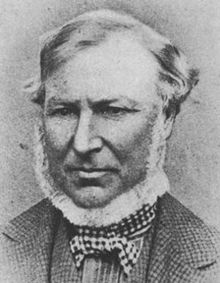
Angus McMillan Wikipedia

Watson traces the rivalry between McMillan and the driven, publicity-conscious professional explorer Strzelecki in their competing claims to have ‘discovered’ Gippsland. The Highland temperament manifested itself in both exploration and frontier settlement behaviour.  Clan connections and a shared sense of righteousness drove the Scots settlers into their dogged but ultimately fruitless search for the White Woman of Gippsland. Their prickliness, pride and sense of mission had a much darker side as well.

Watson writes:

There were three types of squatters on the Australian frontier: those who thought that their right to the land was qualified by an obligation to treat the Aboriginal inhabitants with kindness; those who believed that their right was conditional only on extermination; and those who combined murder with kindness. (p. 223)

The squatters of Gippsland, Watson writes, were fickle and dangerous and McMillan exemplifies this third type of squatter. McMillan

-half steering his way, half being blown-arrived in the new province and from that moment seemed to embody every paradox the frontier could throw up: making its history and being made by it, writing its story and engineering its secrets, living through all manner of triumph and torment and leaving a legend which put his life beyond our reach, ending up a cliche, a block of stone (p. xix)

When the nephew of his patron Captain Macalister was killed by Aborigines, McMillan was most probably responsible for drawing together the ‘Highland Brigade’ of his neighbours and retainers who, bent on revenge, massacred between 60 and 150 Indigenous Australians at the Warrigal Creek massacre, and beyond.  Yet, this same man was also lauded for his “sympathetic interest” in indigenous people and became in the last years of his life the Aborigines’ protector.  Murder and kindness: a chilling combination.

In his introduction to the 1997 edition of this book, Watson writes that his original intent in writing this book was

to give a more sympathetic portrait of the pioneers than any I had ever encountered.  I wanted to give them blood as well as bones; religion, motives, choices, memories, identity, ancestors, an inheritance of their own (p.xxvii)

This doesn’t sound like the aspirations of a historian whose work, through this book,  became associated with those derided by the New Right as promoting ‘black armband history’. We know, from Watson’s later work on the deadening effect of managerial language and ‘Weasel Words’ that he is impatient and dismissive of ‘political correctness’. But, he argues, “It can hardly hurt a mature society to know that its founders were capable of evil as well as good.  An immature society can only benefit”(p. xxvi)

Hence the importance of McMillan:

The harder we look at McMillan the more we see the patterns of our collective experience and the elements of our contemporary dilemma.  The harder we look at him the more signs we see of the kindness and brutality, self interest and charity, memory and amnesia, decency and hypocrisy that has characterised public and private dealings with Aboriginal Australia from the beginning to the present day.  And the harder we look at the society McMillan came from the more we see how the dispossessed everywhere tend to follow the same path to material and spiritual poverty: in the nineteenth century the Australian Aborigines were not the only ones to be first cast as dangerous and unruly savages, and then left stranded between pity and contempt- and then thrown still further adrift from humanity by Social Darwinism. (p. xxviii)

No: this process had engulfed Highlander society, which in turn subjected the Kurnai people to the same fate.  The last words of Caledonia Australis are “..the irony was lost”. Irony, at its most powerful, does not need a spotlight or announcement, but emerges quietly and insistently out of the material itself.  Just as it does in this book.

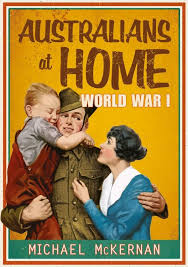
‘Australians at Home: World War I’ by Michael McKernan

mckernan

2014 (original 1980), 224 p.

No, I haven’t come over all ANZAC-y now that the Gallipoli commemorations are over.  I’ve taken over a column in the newsletter of my local Heidelberg Historical Society, which looks at Heidelberg 100 years ago, using the local newspaper. Of course, a hundred years ago in 1916, the newspaper was full of homefront war news and I found myself wondering how typical it was- hence reading this book.

This book was originally published in 1980 under the title The Australian People and the Great War.  In the preface to this new 2014 edition, McKernan, who was a doctoral researcher at the Australian War Memorial when he wrote the original book (rather than its Deputy Director as he was later to become), explains how he was distracted from his official research on Australian churches in the Great War by the newspapers and School Papers in the AWM’s collection.   It seems odd, given the deluge of ANZACery in the last few years, that he was writing in a scarcely-furrowed field. He writes that at least one publisher at the time had shown some interest in the war by publishing Patsy Adam-Smith’s The Anzacs in 1978 but that

Few others were at all interested and I was thought, by academic colleagues, to be a bit strange for working on a war topic. How times have changed! (p. v)

That’s for sure!  But given thirty-six years and the tsunami of publication that has taken place since then, this book stacks up pretty well. McKernan can see its shortcomings:

Many things are missing from this book, but such was the state of my historical understanding then. And the state of the profession, I might add. Today, most obviously, I would seek to include the story of Indigenous Australians on the homefront, as I have done for more recent books. I should also have written about Australian nurses in my chapter on Australian soldiers.  I might also have looked more closely at unemployment and the downturn in the economy that the war caused.  I apologize to those who look to find these important themes, but such were my limitations then. (p. VI)

As he goes on to say, there have been many books since devoted to what he dealt with in a chapter in this book. I think of Janet Butler’s Kitty’s War on nurses (my review here); Rosalie Triolo on Our Schools and the War; Bart Ziino’s A Distant Grief on war graves; Marina Larssen’s Shattered Anzacs (my review here) on injured returned soldiers, as a start.  But as a book “for the broad Australian community” this is a very good broad-brush treatment, well bolstered by identified sources.  McKernan doesn’t need to apologize too much.

In his opening chapter, ‘The War in Australia’ he points out that the war had an immediate effect on the local economy through a rapid increase in prices and a sudden increase in unemployment, with many men placed on reduced hours. He emphasizes the different experience of middle-class and working-class families at home during the war, and announces his intention to concentrate on ‘ordinary people’, drawing on School Papers, parish records, Red Cross reports of local charitable activity, letters, and local papers as a way of tapping into this class-based diversity of experience.

Chapter 3 ‘Seedplots of Empire Loyalty: The Schools at War’ noted the gendered responses expected of children: that the girls would knit and the boys would play manly sports.  Victorian schools, under the influence of Frank Tate, were particularly active in fundraising.  The practice of saluting the flag daily began in late 1917 in Victoria.  Honour boards, particularly in private schools, were a form of pressure to enlist, and he notes that the Greater Public Schools were especially strong on conscription.

In Chapter 4 he examines the role of Australian women in war, and in particular the class basis of Red Cross activity. This is something that I’m noting locally in the Heidelberg district, where the very middle-class Ivanhoe Red Cross quickly outstripped the more working and lower middle-class Heidelberg and Fairfield. Because it was voluntary, unpaid work did not affect women’s status as it did in the United Kingdom, and it ebbed away quickly without trace when the war came to an end, thus confirming rather than challenging the place of women in society.

‘Muddied Oafs’ and ‘Flannel Fools’, Chapter 5, looks at sport and war. Many sports competitions halted for the duration, although class perceptions come in here too. There was strong criticism of working class ‘slackers’ who continued to play rugby and football, but the continuation of  horse-racing, a middle-class sport, was justified on the grounds that it improved the breed of the horse (and thus assisted the war effort). However, despite the heavy use of sporting analogy in promoting enlistment, sport was not a fixation amongst working-class people, and playing footy on the weekend was not the cause of the indifference to enlistment that the middle-class complained of.

Chapter 6 seemed a little out of place in this book which has the home front as its emphasis. ‘From Hero to Criminal: the AIF in Britain 1915-19’ looks at the behaviour of Australian troops in England during the war.  England was culturally familiar as ‘home’ through a steady diet of childhood literature, and the first Anzac Day march was held in April 1916 in London (not Australia)- the only march to honour a specific body of troops held like this during the war (and a cause of some resentment among the British troops who were at Gallipoli too). The march was only just one factor in the increasing wariness between British and Australian soldiers. There were misdemeanors committed in garrison towns by Australian soldiers. Those soldiers in turn were disgusted by the class distinctions and poverty they saw in Britain and the sight of women working.

The seventh chapter ‘Manufacturing the War: ‘Enemy Subjects’ in Australia’ examines the enlargement of the term ‘enemy subject’ to encompass any Australian natural-born subject whose father or grandfather was a subject of a country at war with the King. Many people had wildly exaggerated perceptions of the direct German threat to Australia. This chapter deals particularly with anti-German feeling, and here perhaps we do see the datedness of the book because it could easily have been extended to include peace activists and unionists who also came to be seen as enemy subjects.

Chapter 8 ‘The Other Australia? War in the Country’ questions the idea that country and urban Australia had separate interests. He points out that country regions felt that they had contributed to the manliness of Australian soldiers, but this is not borne out in the figures.  There was slightly higher enlistment from rural areas, but as he points out, in a face-to-face society like a country town, the pressure to enlist would be stronger. In many ways, war unified country and town, with the realization that despite all the bluster, city workers were not ‘soft’.  The referendum on conscription coincided with the first sittings of the exemption courts which highlighted how few men could claim exemption from enlistment and the severity of conscription, which may have contributed to the defeat of the referendum.

‘The Grey Years’ looks at the initial euphoria at the end of the war, but the creeping sadness of the influenza epidemic and the return of so many wounded and damaged soldiers. The celebration of the armistice on 8th November on the basis of a rumour was premature, and they had to celebrate all over again a few days later. A public holiday was called, but there was confusion over whether it was to be on Tuesday or Wednesday, so in effect, there was little work between Friday 8th November and Thursday 14 November. Three faultlines were to break open in society: i) the returned men  ii) the so called ‘patriotic classes’ and iii) the rest.  ANZAC day had a fitful start. In 1921 the Federal Government declared 25 April a public holiday, but state governments did not follow their lead. In 1925 the Victorian government made ANZAC Day a public holiday, but insisted that all shops, hotels, racecourses and theatres be closed lest it be degraded by secular pleasures. The other states joined in by 1928 and the first dawn service was held that year.

I enjoyed this book. It is generously endowed with many black-and-white pictures that take up often 1/2 the page, and I liked the vignettes of individuals and their families that are woven through the text.  It is narrated in a gentle, accessible tone, but well-supported in the footnotes.  It thoroughly stands up to republication more than thirty years after it first appeared.



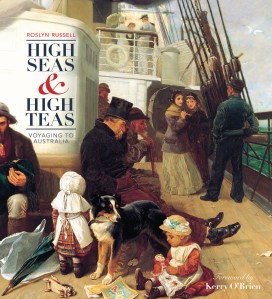
‘High Seas and High Teas’ by Roslyn Russell

9780642278852.jpg

High Seas & High Teas: Voyaging to Australia

213 P & notes, 2016, NLA Publishing

With the recent emphasis on ‘illegal boat arrivals’ in Australia in recent years, it has often been pointed out that, with the exception of indigenous Australians and families who arrived within the last sixty years, all Australians come from ‘boat people’ stock. Rustle the branches of most family trees and there they are: the names of ships, the point and date of departure and the point and date of arrival. Turn to page 2 of the Port Phillip newspapers during the 1840s and there’s the shipping news, identifying the first class passengers by name, numbering the second class passengers, and dispensing with the rest as an undifferentiated group of ‘bounty migrants’ or ‘steerage passengers’.

The inside blurb of this book exhorts family historians to “get a sense of your ancestors’ shipboard experience”, and the foreword by Kerry O’Brien centres on his own family lineage reflecting somewhat of a  ‘Who Do You Think You Are?’ emphasis.  Family historians often have little more than the name of the ship and its departure and arrival dates of their forebears. Sometimes they are fortunate enough to have a diary or letters penned on the journey, or on occasion, a particular trip may be so notorious that it was subjected to the scrutiny of the authorities afterwards. In all these cases,though, there are broader questions in moving from the particular to the general: how typical was this one trip? Is there a commonality of experience that linked all sea journeys to Australia?

Roslyn Russell fleshes out and contextualizes the voyage between embarkation and arrival in her book High Seas & High Teas by drawing on thirty-three diaries penned by passengers and crew during the nineteenth century.  These diaries, chosen from among the 100 accounts of voyages to Australia held in the Manuscripts Collection of the National Library of Australia, are not necessarily an accurate reflection of the demographic makeup of ships’ passengers. As she points out both in her introduction and at other places in the text, most of the diaries are written by men (roughly three to one) and fourteen of the thirty-three diaries were written by first class passengers. The voices of mothers of young children, in particular, are missing. This imbalance, she suggests, may be explained by social factors, but it could also reflect the collecting interests of the enigmatic Rex Nan Kivell and Sir John Ferguson, whose collections formed the basis of the NLA holdings (p.2).

In her brief introduction, she explains that, over time, three main routes were established between Great Britain and Australia. Most early 19th journeys took the High Seas route down to the coast of South America, sometimes stopping at Rio de Janeiro, then across to Africa and down to the south of the Cape of Good Hope and on to Western Australia, Adelaide, Melbourne or Sydney.  From the 1830s an alternative route opened up when passengers travelled across the Mediterranean by steamship to Cairo; by camel and cart to Suez, and by steamship again to Bombay. There they connected with sailing ships that brought them down through Torres Strait. By the 1850s a third, more dangerous route was developed when clipper ships passed far to the south of the Cape of Good Hope to pick up the Roaring Forties, the strong winds that blew between 40-50 degrees S latitude, which yielded a shorter journey but also risked storms and icebergs. Steamships were introduced to the route from the 1850s onwards, and the opening of the Suez Canal in 1869 cut the length of the journey from more than 100 days in the early 19th century to 40-50 days by the 1890s.

Despite these technological and itinerary changes, there was a commonality to the experience of the sea-voyage, just as there is a basic underlying sameness about air travel today.  This commonality even extended to the convict ships which plied the oceans until the 1860s.  Russell has devoted the first chapter to ‘Sailing Under Servitude’, where the surgeon-superintendent played an ambiguous role encompassing both solicitude and discipline. Diary entries in this chapter from crew and surgeons underscore the isolation and fear of insubordination that ran as an undertone throughout the journey, but as her references to convict ships in the later thematic chapters of the book demonstrate, even convict ships  experienced the same combination of boredom, fear, discomfort and self-made amusement that marked the journeys of later passengers of all classes for the next century.

Chapters 2-12 follow the trajectory of the journey from embarkation at port and the often lengthy bureaucratic and nautical delays before actually setting sail (Ch.2); the provisioning and accommodation on board (Ch. 3-5); passing the time (Ch.6-9); misfortunes at sea (Ch. 10-11), and the final arrival at their destination (Ch.12) which could, once again, be delayed by bureaucracy and quarantine requirements.   I was surprised to learn of the emigration depots back in England which acted as a sort of on-land simulation of the steerage experience, with emigrants forced to sleep in dormitories and comply with Royal Navy regulations as a way of familiarizing them with the life that faced them for the next four or five months.  I had seen printed newspapers purporting to be written on board ship and wondered at how they were published. Russell explains that they were hand-written on board ship and, after a subscription was collected from the passengers, the funds were put towards publishing the newspaper on land, after arrival, as a memento. Like Russell, I had wondered about sanitary arrangements- a topic which, unfortunately, few diary-writers explored in much detail.

But the real heart and soul of this book is the diaries.  Each chapter commences with a potted biography and then a transcript of one person’s diary that illustrates the theme of the chapter, followed by a beautifully clear, double-paged image of that page of the diary.  As readers, we encounter the diary writers again in several places, and I came to look forward to Annie Gratton’s (1858) and Edith Gedge’s (1888) vivacious entries, and confess to a twinge of schadenfreude at the sour William Bethell’s whinges and complaints. Some diarists reappear often, while others have a fleeting presence, making highly pertinent observations, then disappearing into the throng of passengers again.

The book is lavishly illustrated with the small sketches that the diary-writers used to embellish their pages and the chapters are enhanced by artworks of the day described as ‘background features’ in the reference section at the back.  It really is a beautiful book to just dip into, with large, full colour illustrations on nearly every page.

I’m not aware that the book is part of any museum exhibition, but as a reader, I felt as if I were viewing a mounted display.  The trajectory of the journey provided a narrative spine, branching off into small sub-themes of just two pages in length, just as a museum display might do.  Overall, the book does not have a historical argument as such- except, perhaps, for the commonality of the voyage experience across time and class- but instead brings the journey to life through images and the voices of the diary-writers.

It was probably because I had become comfortable with the chatter of those voices that the ending seemed so abrupt. Mr W. Barringer, with whom she closes, moves into permanent accommodation and the book ends. I would have welcomed Russell onto the stage herself as author or researcher perhaps, or would have liked the book rounded off with a birds-eye view of the voyage experience more generally, or even just a fonder farewell to Mr Barringer.   I felt as if I were standing on the wharf, and that the passengers I’d met along the way had ridden away from me to their new lives without bidding farewell. We had, after all, been on a long journey together.

Source: Review copy courtesy National Library of Australia publishing.

aww2016

I have posted this review to the Australian Women Writers Challenge 2016.


Vale John Hirst

hirst

Australian historian John Hirst died on 5th February.

I remember seeing his name on his door in the history department when I first did undergraduate history at La Trobe in the 1970s, but I sailed through a B. A. without encountering him.  It was to Dr Hirst that I had to make application, forty years later, when I decided to return to university after a prolonged period of ill-health, determined to do something that I really wanted to do instead of working in a cut-down capacity in my present job. I had addressed my email of inquiry to “Dear Dr Hirst”, and as he opened the door to his office he exclaimed “I knew you’d be a mature-aged student! None of this ‘Dear John’ stuff!”  Dear John was, however, rather stringent in admitting me to the post-grad program at La Trobe, with his eagle-eye detecting the single ‘C’ mark in second-year history back in 1974 (given to me, ironically enough, by the lecturer I ended up working for as a research assistant some years later!) in amongst a CV that included good results in many other post-grad courses.  He enrolled me in an honours course, just to see how I went, and had the grace to quickly waive the requirement after the first assessment task.  By that time, however, I no longer wanted to leave the honours class. I had enrolled in a readings course with John, and I ‘grew up’ as a historian in the six months I sat in his tutorial room.

We read one Australian history book a week, starting with colonial history through to a range of ‘shist’ (Short History) compilations.  I learned to read for the overarching argument as well as detail, to uncover assumptions, to weigh evidence, to notice structure.  Some of my fellow students flagged a bit at one book per week, but I loved it.

I went on to tutor for John in his final presentation of first year Colonial History before retiring from lecturing- a subject he had taught for many years and had honed well.  Each lecture was a tightly woven argument, with none of this trailing-off half finished because time had got away.  You came out, not necessarily agreeing with him (in fact, I often did not agree with him), but having witnessed a historical argument being constructed, and supported, in front of your eyes. At the end of semester, I mentioned to the students how fortunate they had been to have had him, and I sat at the back of the room, proud of these 19 and 20 year-olds who spontaneously gave him a standing ovation at the end of the last lecture.

John wanted me- he wanted all his postgrad students – to write big history, and I’m afraid that I probably disappointed him in that regard.  John had a long-standing interest in the Australian character, republicanism and the democracy of manners.  In recent years as ‘John Hirst’, rather than ‘J. B. Hirst’, he moved out of academe into the public sphere, where he published a number of books under the Black Inc impress.  Although some of his recent books combined span with brevity (e.g. The Shortest History of Europe) several of his other recent publications  were compilations or reworkings of articles he had written in academic journals over the years, and were marked by his trademark punchiness in both language and logic.  He argued with his brain, without rancour or oneupmanship.

I did a search of this blog under ‘Hirst’ to see how many of his books I had reviewed. There was only one, Convict Society and its Enemies, but many, many posts came up where I had referred to him by name.  His own work in Australian colonial history was big history, even though in his chapter-length articles the canvas he worked on may have seemed to be small.  He influenced me deeply as a historian, even though I found his politics frustratingly difficult to pigeon-hole.  He was a man of the mind and  generous in his attention.  Vale, John.

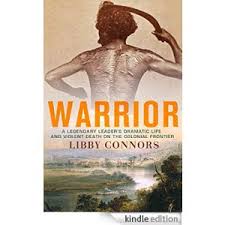
‘Warrior’ by Libby Connors

connors

2015, 280 p.

If you, like many others, watched the ABC production of Kate Grenville’s The Secret River, then you should read this book. Think back to the silent, foreboding presence of indigenous people as they filed past the boundaries of what William Thornhill thought of as ‘his’ land, inscrutable, chilling, ethereal. There was a simple logic at play: settlers wanted the land and the aborigines wanted them gone. Kate Grenville complicates William Thornhill’s response and renders it explicable, even if it’s a response that we’d like to distance ourselves from. But beyond the defence of their country, the actions of the indigenous protagonists, in Grenville’s book and in settler reports of the time, remain fragmentary, apparently random and unknowable. Until now.

Libby Connor’s book Warrior challenges the simple classification of aboriginal ‘outrages’ as random, undisciplined and ultimately futile. Instead, she returns logic and agency to the indigenous tribal groupings in south-east Queensland during the pre-Separation days of the frontier. She does this through the story of Dundalli, a Dalla man who was executed in January 1855 for the murder of Andrew Gregor and his pregnant (white) house-servant Mary Shannon in an attack on the Caboolture River. White justice had taken twelve years to catch up with him. In the meantime, Dudalli had taken on mythic proportions by evading capture repeatedly, and his name became a byword for all ‘outrages’, whether he was involved or not. When he finally faced Supreme Court judge Roger Therry in a Brisbane circuit court hearing, in effect lawman-to-lawman, it was the judge who was intimidated by this tall, imposing  leader, and not the other way round.

Libby Connors is a historian who has written a great deal on the interaction between British law and indigenous people. She is well placed to go through the evidence, the courtroom arguments, the legal principles and the punishment regimes of white settler justice. But the real achievement in her work is in fleshing out Dundalli, so that he is more than one of those silent wraiths of Grenville’s book. Drawing on the memories of a tribal man recorded as an oral history during the 1950s , she is able to reconstruct (albeit through extrapolation) the nature of a Dalla childhood and adolescence than Dundalli is likely to have experienced. Using documents generated by white missionaries, bureaucrats, settlers, anthropologists and historians, she gives Dundalli’s leadership a context by mapping out the intra-tribal politics and strategies utilized by different groups in what is now the Sunshine Coast/ Brisbane area. These politics were instrumental, pragmatic and fluid. One group might encourage the establishment of a mission on tribal land as a means to gain access to technology that ensured supremacy over other groups; another might consciously defer to white justice in order to fulfil the demands of their own indigenous justice. The British and Indigenous justice systems existed, and continued to exist, side by side, and she highlights that both systems of law were mutable and in tension with the other.

The book is beautifully written and imbued with a deep sense of place. A map that appears in the opening pages shows indigenous places superimposed onto familiar Western towns and rivers, highlighting the co-existence of two competing senses of ownership. Her frequent references to present-day Brisbane and Sunshine Coast landmarks would prick the consciousness of residents of those places, reminding them that another history runs alongside the sun, cosmopolitanism and tourism of both those places. When you find yourself overwhelmed by who’s who, and which group is which, you turn the page and there is a table; when you think ‘gee, a map would be handy here’, there it is. The text flows effortlessly, and the footnotes are unobtrusive, but when you look at them closely, you realize just how intricate and painstaking her construction of indigenous polity is.

This book has received the Queensland Premier’s Award for a work of State Significance, and I noticed that it was on the top of the list of recommended reading for Prime Minister Turnbull over his Christmas break issued by the Grattan Institute this year. It’s a tremendously important book. Many historians over the past forty years in particular have written, as Henry Reynolds does, of “the other side of the frontier” surveying the resistance of indigenous people to their dispossession across the frontier as a whole. What this book does is hone in on one particular location; one constellation of tribal groups; a set of named, individual leaders. It will make you pause the next time you read of an ‘aboriginal depredation’ in fiction, see it depicted in film or read it reported in settler testimony. It does what the fictional William Thornhill couldn’t, and white British justice wouldn’t do. It makes sense of what was perceived by settlers as brutish retaliation and gives it a legal, political and environmental logic, embedded in power structures negotiated and contested between intelligent, strategic and courageous leaders of men.

aww-badge-2015-200x300

I’ve posted this review (the last for the year) to the Australian Women Writers Challenge website.


‘The Boyds: a family biography’ by Brenda Niall

boydsfamilybiography

2002, 387p.

In this book we are in the hands of a master biographer.  Not many biographers would have the courage to take on a whole family as a unit, but Brenda Niall does here. The sprawling, artistic Boyd family has representatives in nearly every branch of the arts (literature, painting, architecture, sculpture) and its family tree is studded with seemingly endless iterations of ‘Boyd’ and ‘a’Beckett’ in their names.   Only an experienced biographer would even attempt such a complex group biography across five generations and nearly two centuries,  and she   handles it with consummate ease.

She owes much of her success to the very careful structuring that she has used to organize this unwieldy and voluminous information. She starts with four men: the emancipist-entrepreneur brewer John Mills; the wealthy pastoralist Robert Martin (of ‘Viewbank’ and ‘Banyule’ fame); William a’Beckett the Chief Justice of Victoria; and Captain Thomas Boyd, career militarist and settler. Even though the first section of the book is called ‘The Matriarch’ (referring to Emma Mills, later a’Beckett), Niall firmly embeds these four patriarchs as the founding fathers, so to speak, of the Boyd dynasty.  She takes forty pages to do so in her opening chapter, and she returns to them as touchstones throughout the book. The tainted convict source of the money that Emma a Beckett (nee Mills) brought to the family was a secret, but it  bestowed on its members the time and space to explore their artistic passions across multiple generations.

The second thematic device she uses is that of the house.  Houses were important to the Boyds. Emma’s husband W. A. C. Beckett had the ‘a Beckett coat of arms emblazoned on two houses: the first was The Grange in Berwick (since demolished for a quarry), the second was the lost manor Penleigh House in Wiltshire, England (later sold out of the family). Above the front door of the Grange he placed a stained glass window with the motto “Immemor Sepulchri Struis Domo” (Forgetful of the Tomb, You Build Houses).  Niall uses the house as an organizing device for her narrative, but it was one suggested through the family’s actions rather than the biographer’s imagination.  It works well, both as a means of organizing such an unruly venture, but also in highlighting the paradox that the Boyd family, so embedded and synonymous within Australian cultural life, were also drawn ‘home’ to an earlier ancestral myth of gentry glory. There is a string of Boyd Houses: the light-filled Grange so beautifully captured in Emma Minnie Boyd’s paintings,  the tatty, faded grand Penleigh in UK, Tralee in Sandringham, the architect’s home in Walsh St South Yarra; Open Country in Murrumbeena and Bundanong in Nowra NSW.

The focus is firmly on the Boyds, but it is just as much an exploration of Australian, and especially Melbourne, cultural life as well.  There are connections with other artists and their colonies, architectural commissions for major cultural figures, and networks branching across Melbourne society. At the same time, there is that siren call of “overseas”. Women are certainly present, even if they sometimes subjugated their role as muse behind that of wife and mother.

This is a marvellously complex but disciplined biography. This is how a group biography is done!

aww-badge-2015-200x300I have posted this review to the Australian Women Writers Challenge  site.

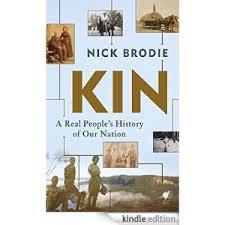
‘Kin’ by Nick Brodie

brodie

2015,  365 p.

In her wide-ranging book on DNA and history, The Invisible History of the Human Race Christine Keneally spoke of the interaction of highly personalized ‘Who Do You Think You Are?’ -type family history with the Big-Data digitization processes currently being undertaken by libraries and genealogical companies across the globe.  No longer limited to Births, Deaths and Marriages, both family and professional historians now browse  Trove (the Australian online newspaper library) and ancestry.com finding within minutes details that would have taken years of research to uncover.

It’s interesting that within the past couple of months two professional historians have released books that contextualize their own family histories into the broader Australian story: one by Emeritus Professor Graeme Davison, and the other by a young historian, Nick Brodie. I heard and very much enjoyed Nick’s paper at the recent AHA conference (in fact, I awarded it my ‘Packer’s Prize’ for the best paper). He struck me as a particularly enterprising and forthright historian and just the sort that television producers would be looking for: young, good-looking, articulate, intelligent.  (As an aside, I note that his book is marketed by SBS….)  I’m interested to see how these  two histories compare, written as they are by historians born forty years apart and at the two extremes of an academic career. Continue reading

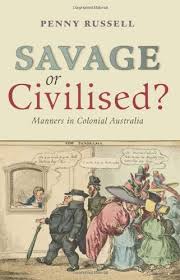
‘Savage or Civilized? Manners in Colonial Australia’ by Penny Russell

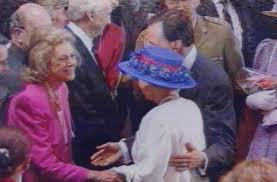
You may remember a number of years back when Prime Minister Paul Keating had the audacity to place his hand on Her Majesty’s back to gently steer her in a crowd.

lizardofoz

He was quickly dubbed “The Lizard of Oz” by the English press, always quick to jump on colonial brashness with a snort of derision at ex-convict temerity (a taunt which carries little significance in Australia itself).  Historically, however, the colonial/convict trope was far more influential, as demonstrated in Penny Russell’s book Savage or Civilized? Manners in Colonial Australia.

This book is about the complicated rules and the even more complicated lived experience of colonial manners (p 5)….Manners are not only about the different observances of form and ritual that make a past (or a foreign) society seem quaintly strange.  They are also about the ways we acknowledge and respect the humanity of others, extending due consideration to their feelings, preferences, prejudices and sense of how things should be done.  The ultimate rudeness is to deny a fellow human being that degree of consideration. (p. 14)

Not everybody cared about manners, but this book concentrates on those who did.  It explores what she calls four ‘contexts’: the pastoral frontier; convict society; the domestic world and the new public space that opened up in the the latter part of the nineteenth century.  The book is not necessarily chronological, as these ‘contexts’ were continuous throughout the late eighteenth and nineteenth century time period, but there is nonetheless a chronological trajectory in the narrative.  She describes this as “layered” rather than chronological, and is at pains to stress that she is not discussing the rules of civility as spelled out by the imported ‘politeness’ literature that flooded the empire, but instead looks at

how manners affected the daily lives of individuals, how they played out not in principle but in practice, not in precept but in people. (p 13)

In other words, the sort of history I enjoy most.

russell_savageorcivilized

2010, 362 p.

In Part One, she starts on the frontier, that site of colonial theatricality so well explored in Inga Clendinnen’s Dancing With Strangers.  Handshakes, in particular, are the focus of attention (as they are also in Tiffany Shellam’s Shaking Hands on the Fringe). In each section, she presents a small number of characters to exemplify the arguments she is making, almost as if she is bringing them onto the stage for us.  Robert Dawson was an employee of the Australian Agricultural Society who was viewed as a “good man” and the author of The Present State of Australia in 1830 where he sought to rescue the reputation of Indigenous people at Port Stephen. It was, however, a respect overlaid by paternalism, praising docility, tractability and goodwill- and in the final analysis, he took their land. Neil Black, on the other hand, felt adrift within the moral wilderness of settler society, rejecting the commonly-held premise that a young gentleman could break out of the expectations of his class and status and then take them up again at will.

Part Two, “High Society”makes the point that British manners were themselves evolving at the beginning of the 19th century. Although there was still a belief in a social pyramid, this view was challenged by the rising bourgeoisie and evangelical domesticity which placed great store on reputation, good name, and ‘credit’.  The networks between the colonies ensured that this strategically reimagined ‘England’ was a common reference point as the colonies erected their own strictly-policed social boundaries to mirror what they conceived to be the situation at ‘home’.  Government House in the colony served as a microcosm of these relationships , as Russell demonstrates with the example of the much-studied Lady Jane Franklin in Tasmania (a theme she also explored in her book This Errant Lady which I viewed here.)  When Sir John Franklin fell out with his private secretary Alexander Maconochie, it not only caused a split in society, but also leached into the personal relationships within the domestic sphere, as the two families lived in close proximity.  Professionalism was another arena of conflict, as she shows with her example of two doctors: Dr Farquahar McCrae (the brother-in-law of Georgiana McCrae in Port Phillip) and Dr William Bland, an emancipist who had been transported to the colonies for a duel.  When the two doctors disagreed about the appropriate treatment for a patient, the dispute was played out through the newspaper columns of the Sydney Herald, spilling into a meeting of the Benevolent Asylum Society, one of those philanthropic organizations through which middle-class men underscored their respectability.

Part Three examines ‘Domestic Worlds’, and while I found this an emotionally engaging section, I did find myself wondering whether enough was made of the effect of colonialism on domestic relationships.  This was not so much with the dissatisfied governess Margaret Youngman, who reminded me of Sybilla in My Brilliant Career, which was itself an Australian working of the governess story.  It was more with the the story of Mary Ann Tankard who was deserted by her older, often-absent husband, and the wife of the Reverend Andrew Ramsay who was left behind to ‘keep up appearances’ while her husband sailed back to Scotland to deal with church business. Both these stories of desertion could have easily been mirrored by deserted women in England.

The final section moves more into the second half of the nineteenth century and the burgeoning of a public and  political sphere where women and aspiring working men  became more visible.  Transport and urbanization brought the courtesies of meeting strangers to the forefront of public discourse, especially for ‘girls’ during the 1890s.  The fiesty Annie Britton, who was arrested for parading in the volunteer uniform of Captain Gilbee, brought the captain’s family into the public arena, while the arrival of the Duke of Edinburgh brought colonial manners under the censure of the ‘home’ reading public- or at least, it was imagined that it would-just as Paul Keating was to do 130-odd years later. In the midst of the celebrations Henry Parkes, chair of the organizing committee, stepped forward to shake the Duke’s hand.  Parkes was himself of dubious background and doubtful morality given the indecent haste with which he married his mistress after his first wife’s death, and the new Governor the Earl of Jersey and his wife later ensured that the new Lady Parkes was excluded from Government House.

As Russell notes in concluding her book, hers is not a discussion of ‘real’ Australian values and nationalism- not then, and not by historians later. Instead, these carefully and sensitively drawn people and their dilemmas and social and domestic dramas

…were telling representations of the hundreds of thousands of individuals who moved into, and sometimes out of, the Australian continent; tiny atoms in the sprawling world of settler colonialism, but constituent atoms nonetheless.  At the end of the nineteenth century, as much as at its beginning, many if not most colonists understood themselves a privileged members of the Anglo world, and yearned to blend unnoticed with a cosmopolitan community upon terms of cultural and social equality, not to be marked out an uncouth barbarians or brash colonials. (p. 259)

aww-badge-2015-200x300My review is linked to the Australian Women Writers Challenge site.

It’s also 1/20 of my TBR20 Reading Challenge- my vow to read twenty of the books I already have on my shelves.

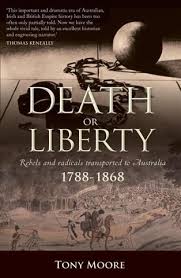
‘Death or Liberty: Rebels and radicals transported to Australia 1788-1868’ by Tony Moore

deathorliberty

2010, 398 p.

Many books, history books included, have a page of acknowledgments.  Along with the usual thanks to colleagues and family, appreciation is often expressed to librarians and archivists who have offered assistance along the way.

In this book, the author Tony Moore makes another acknowledgment.  It is to the commissioning editor of Murdoch Books,  Diana Hill, who selected him to fulfil the brief for this book.  Commissioned books, of course, are nothing new: institutions and individuals have often  paid a writer to document and argue their significance to a wider audience.  But this commission is slightly different in that it was for a narrative concept- transported rebels to Australia- left to the historian chosen to flesh out. When  Tony Moore spoke at the Australian Peace Coalition seminar I attended recently, he noted that the ABC has since commissioned a documentary series based on the book. Certainly the book and the topic is ripe for a television series.  It has, in effect, five self-contained episodes, studded with articulate, interesting people, and ripping yarns of defiance, escape, coincidence and courage.

As Moore notes in his introduction:

This is the story of how the British Government banished to the ends of the Earth political enemies viewed by authorities with the same alarm as today’s ‘terrorists’: Jacobins, democrats and republicans; machine breakers, food rioters, trade unionists and Chartists; Irish, Scots, Canadian and even American rebels.  While criminals in the eyes of the law, many of these prisoners were heroes and martyrs to their own communities, and are still revered in their homelands as freedom fighters and patriots, progressive thinkers, democrats and reformers.  Yet in Australia, the land of their exile, memory of these rebels and their causes has dimmed  (p. 8)

He notes that when he was growing up, Australian history seemed bland and uninteresting, especially compared with European, American, African and Asian history with blood, revolutions, wars etc. He later came to learn that Australia had its own robust history of dissent and resistance to authority, and the blood and war was there all along.

We elide the nuances when we uncritically celebrate the convict trope of the “poor downtrodden peasant transported for stealing just a ribbon!”  and we are largely unaware of the political prisoners transported to Australia: 3600 of them out of a total of 162,000 sent between 1787 and 1868 when transportation finally ceased in Western Australia.  Of these political prisoners, 2500 were from Ireland, 1200 from England Scotland and Wales and 151 from North America.  It is these political prisoners that Moore deals with in this book. Continue reading