Category Archives: ANZAC

‘Coming Home’ Exhibition Bundoora Homestead

There’s a fantastic exhibition on display at Bundoora Homestead called “Coming Home” that commemorates the use of the homestead as a convalescent farm and repatriation mental hospital between 1920 and 1993.  Even though it’s ostensibly an exhibition about the use of a house,  it’s a sad and very human exhibition. There are none of the brass bands and official ceremonies that we saw last week at Albany , but this exhibition is an act of commemoration nonetheless.

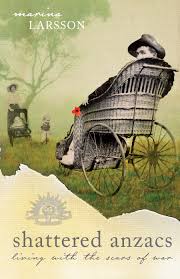
As I’ve written about previously, (here and here) Bundoora Homestead was built in 1899 by the Smith racing family as their residence and stud farm. In 1920, immediately in the wake of WWI the Commonwealth government negotiated the purchase of Bundoora Park estate as a convalescent farm for returned soldiers from the WWI front.  As Marina Larsson wrote in her book, Shattered Anzacs (review), the families of returned servicemen with mental illness were keen that their loved ones not been seen as ordinary ‘lunatics’, but housed and treated in repatriation facilities in recognition of their war service. Bundoora Repatriation Mental Hospital was sited across the road from Mont Park as a separate, soldiers-only hospital that could draw on the facilities of the civilian asylum nearby.

The exhibition focuses on individual men, most particularly Wilfred Collinson and Harry ‘Lofty’ Cannon,  who spent decades of their lives at Bundoora.

Wilfred Collinson was a British migrant, who arrived in Australian in 1914. He hadn’t been here long, working as a farm labourer with a friend that he’d met on the ship over, before the two lads volunteered and were returned to Europe to fight in WWI.  He had a long war, and was gassed four times.  On his return to Australia he and his friend, Eric Brymer, boarded in South Melbourne, and Wilfred soon married the girl next door and embarked on a family life.  His children grew up with a father affected by “nerves” who became increasingly delusional, and eventually he was committed to Bundoora in the 1930s.  As Larsson points out, families often had to battle the government for pensions and recognition that illnesses and injuries were war-based, and Wilfred Collinson’s wife is a case in point. His friend Eric Brymer, who was the only person who could testify to what Wilfred had been like before the war, wrote a letter in support of his wife’s application on her husband’s behalf.  Then followed another thirty-five years, and two generations, as his wife and daughter, then daughter and his granddaughter, went out to visit ‘Dad’ at Bundoora.  He died there in 1972. His war, in effect, was never over.  (You can see the video of his daughter and granddaughter on the exhibition site here.  The video is also running at the exhibition).

Harry ‘Lofty’ Cannon was a medical orderly with the 2/9 Field Ambulance and Changi POW.  We’ve all heard about Weary Dunlop, but I’d not heard of Lofty Cannon. He was a tall man- 6 foot six- but it was a shrunken life that he returned to after WWII. He’d married just six days before leaving for the front, he fought in the Malay campaign and was captured as a prisoner of war in 1942. While he was at Changi he met Ronald Searle, an English prisoner-of-war, who later credited Lofty with saving his life, nursing him through beri-beri and malaria. Lofty wasn’t in much better shape, with ulcers, malaria and dysentery and the after-effects of beatings from the Japanese guards. He was hospitalized at the Repat. in Heidelberg in 1946 on his return to Australia, where he received ECT and insulin coma therapy.  By 1947 he and his wife were living on a soldier-settlement farm near Swan Hill but by 1960 his wife and adopted son returned to Melbourne and Lofty went to Bundoora.  From Bundoora he wrote letters to his wartime friend, Ronald Searle in England, by now a noted artist and illustrator, probably best known for his  St Trinian’s illustrations.  Much of the display shows Searle’s sketches that he made of Changi, several featuring Lofty.  These are in the possession of the State Library of Victoria, and you can see them online if you search slv.vic.gov.au for “Cannon, Harry (Lofty)”. He died in 1980 at Bundoora.  Rachael Buchanan wrote a terrific essay about him in Griffith Review 2007 freely available here.

Bundoora Homestead is beautifully restored and such a peaceful place today that it’s hard to believe that so much sadness seeped through its walls and the  now-demolished wards that once surrounded it.

The exhibition runs until 7 December at Bundoora Homestead Art Centre, 7-27 Snake Gully Drive Bundoora, Wed-Friday 11.00-4.00 p.m and Sat and Sun 12.00-5 p.m.

Website: http://www.bundoorahomestead.com/
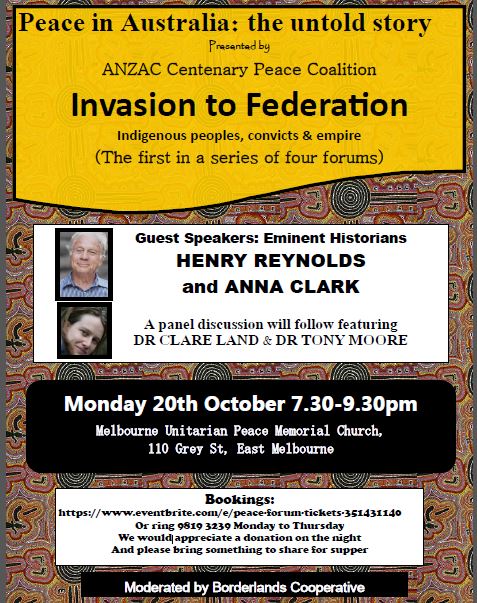
ANZAC Peace Coalition Forum: From Invasion to Federation

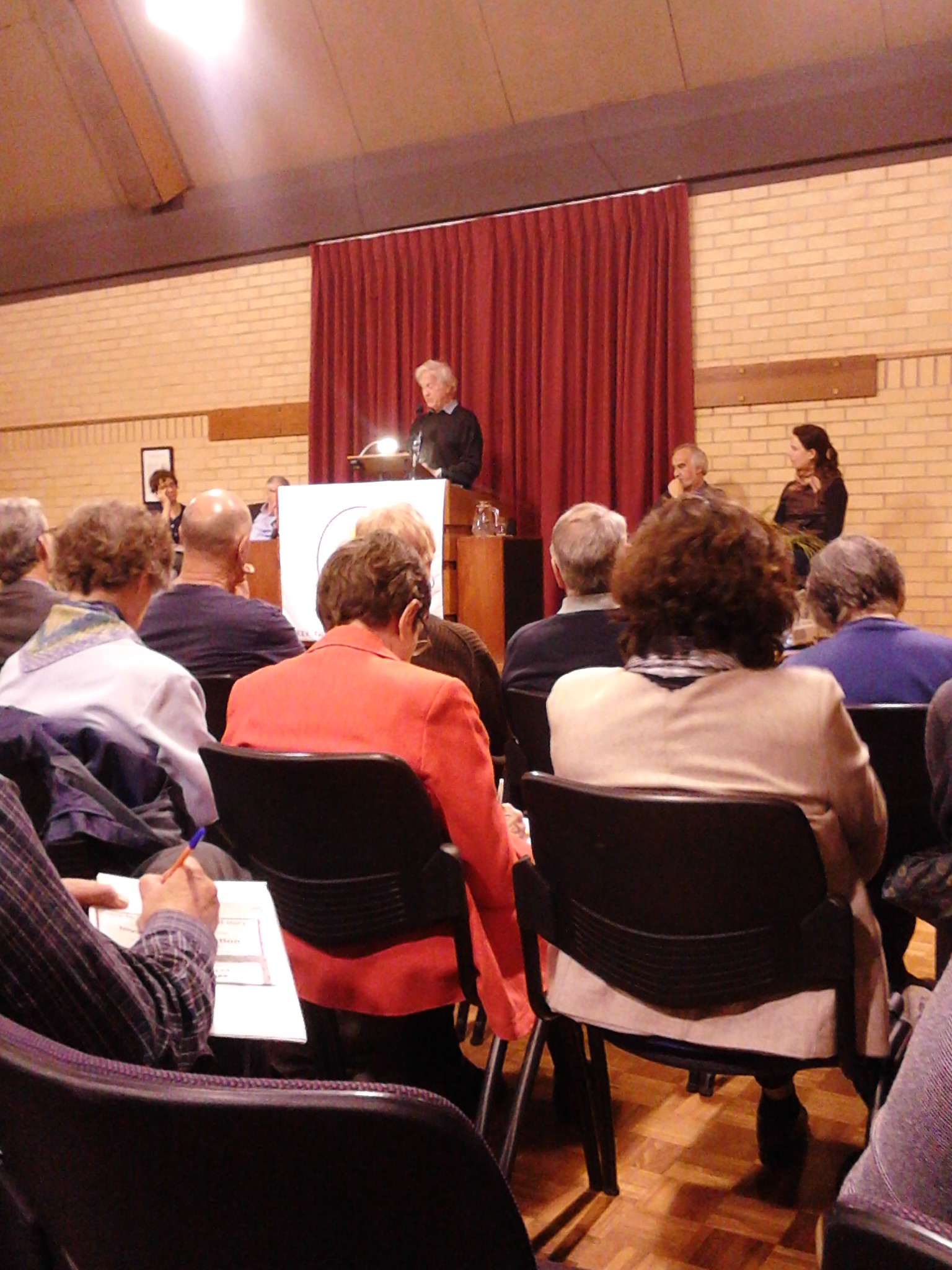
Last Monday 20 October I attended a panel forum presented by the ANZAC Peace Coalition Forum, the first of four that will be conducted over the next year. This first one dealt with the era from Invasion to Federation; the next one planned for March 2015 will look at Federation to 1920; another in August will cover  1920s-60 and in October from the 1960s into the future.  Judging from the first session, the series has certainly got off to a good start.

PeaceConference

Given the time span delineated in this first forum, I expected Henry Reynolds to speak on the frontier wars between settlers and indigenous people, but he didn’t.  Instead, he spoke on the work he is currently undertaking on the Boer War (1899-1902), which coincided with Federation.  His presentation focussed on the Federation celebrations held in Sydney during the first weeks of  January 1901.

Australia had a great deal to celebrate. Along with New Zealand, it had the highest per capita income and better distributed housing and education than anywhere else in the world. It had strong institutions, a burgeoning labour movement that was represented at the political level, and a constitution adopted by referendum twice. It was one of the most advanced democracies in the world.  And yet, it was as if they (we?) didn’t know how to celebrate political achievements.

IMG_20141020_195759

Instead, the celebration was trumped by the military.  The Australian colonial troopers were engaged in the Boer War, the newspapers were full of military news, and when the returned soldiers marched in the Federation parades, it became a celebration of military might rather than political achievement.  The mother country had sent out a large contingent of  grandly decked-out imperial troops in what Reynolds suggests was a deliberate statement.  There was an emphasis on the glamour of war, empire and aristocracy, and the largest cheers were for Lord Hopetoun, the Governor-General.  Even then, there was the anxious pride that we be seen to be ‘punching above our weight’- an ongoing trope of insecurity that we’ve heard voiced again recently.  The newly federated Australia gambled on the permanent continuation of the empire, but it was an empire in decline.  We were a nation defined by race and culture rather than continent.  The sad reality is that India was always more important than Australia.

Reynolds was followed by Anna Clark from UTS who has been working for several years on the process of history-making, particularly in schools. Her interest is “historical inheritance”: not just what we produce, but what we consume.  History is to the nation, she says, as memory is to the individual.  The histories we create are inherently selective, speaking to the concerns of the current generation.

She spoke of her own family history, which she had understood to be that of an honorable pioneering family.  It was only when she realized that a massacre of an aboriginal woman and children on the O’Connell plains occured on her family’s property, that she came to question this family ‘truth’. Five men were charged for the massacre, and all were acquitted. This was her family.

Forgetting and the deliberate withholding of history is never benign, even though it may driven by motives of ‘protecting’ the family.  Especially in light of the recent recommendations about curriculum that call for “imparting historical knowledge and understanding central to the discipline instead of expecting children to be historiographers”, there is a danger that we will forget that histories are always constructed, subjective and incomplete.

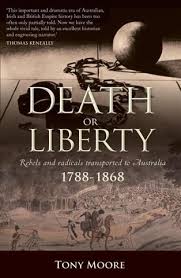
Then, Tony Moore from Monash spoke about his recent publication ‘Death or Liberty’ (review to follow when I finish reading it!), which will form the basis of an ABC documentary next year.

deathorliberty

The European historian George Rude estimated that there were 3000 political prisoners sent out to the Australian colonies, and Moore’s work examines these discontents of Empire who are often revered in their source countries but largely unknown here in Australia.  He emphasized the transnational radical scene of which they were a part, with an emphasis on the Scottish martyrs, which is appropriate given that the forum was being held in the Melbourne Unitarian Church (Thomas Fyshe Palmer, one of the martyrs, was a Unitarian minister).  Some of these political prisoners returned home, published and even became public or political figures in their home countries which had earlier sent them to the 19 century equivalent of Guantanamo Bay.  Some chose to stay in Australia.  The post-federation national focus has blinded us to the internationalism of these political figures.

Finally Clare Land spoke about solidarity between aboriginal and non-aboriginal people in the indigenous struggle in pre-Federation Victoria.  She focussed on two people: Ann Bon, a critic and then member of the Board for the Protection of Aborigines, and John Green, the manager at Coranderrk mission at Healesville.  She questioned what it meant (and means today) to be an ally of the Aboriginal people of south-eastern Australia.  Always it is about land, but also constitutional reform (the referendum then, the Recognize campaign today).

The question-and-answer session that closed the evening was interesting. It is a sobering thought that Australia will be spending $325 million on the commemoration of the centenary of Gallipoli.  That’s two hundred times what the UK is spending and twenty times the expenditure of New Zealand on the same event.   Henry Reynolds left us with the observation that perhaps the ease of returning Australian troops to Iraq today has been made easier by this well-funded, twenty-year campaign to glorify war. (Again, I urge you to read his recent article ‘Militarism Marches On’ available here).  This ANZAC Peace Coalition Forum, and the ones to follow, is just one step in countering this expensive, swaggering campaign.

‘Broken Nation’ by Joan Beaumont

beaumont

2013, 655 p.

For someone who intended to eschew much of the hype about the centenary of WWI, I seem to have indulged rather more than I anticipated.  I attended the RHSV Victorians and the Home Front conference, I read The Kayles of Bushy Lodge (largely because it was written by a woman about the homefront during WWI) and I watched and very much enjoyed The War That Changed Us.   I was aware that Joan Beaumont’s Broken Nation had been well received, but what probably tipped me into reading it was Marilyn Lake’s comment in her ABR review  that

If you read only one book about Australia’s experience of World War I, as the deluge of commemorative publications marking the outbreak of the war becomes a veritable tsunami, make it Broken Nation, an account that joins the history of the war to the home front, and that details the barbarism of the battlefields as well as the desolation, despair, and bitter divisions that devastated the communities left behind.

I agree with Lake’s recommendation; I admire the book for its breadth but…oh, it was relentless reading.

In her opening paragraph Beaumont asks ‘why this book?’ given the already voluminous literature on Australian military history, especially in this centenary year. Her answer is this:

It has been written to provide what is still lacking in the literature: a comprehensive history of Australians at war in the period 1914-19 that integrates battles, the home front, diplomacy and memory. (p.xv)

It achieves this completely.  The book is structured into  six very long chapters, one for each year of the war.  Within these chapters, Beaumont moves chronologically month by month, crossing back and forth between battle, homefront,  diplomacy.  Even within these themes, she shuttles between battle as strategy and battle as lived experience by the men who were there; homefront in a political sense, homefront in a social sense; domestic politics and diplomatic politics on an international stage.

But for me, the battle scenes dominated and they dragged, particularly during the longest chapter ‘1917: The worst year’.  It took me some time to get into the mindset where a death and an injury were both counted as a ‘casualty’ without distinguishing between the two, because the effect of both was the loss of a soldier who could fight then and there.  I found myself inwardly groaning as I turned  page after page to see yet another map with arrows showing lines of attack.  There’s 36 maps in the book as a whole, (16 of them in the 1917 chapter) spread across battlefields at Gallipoli, the Western front and the Middle East, reinforcing the inexorable to-ing and fro-ing year after year.  The battle scenes are interspersed with diaries and letters from the men,  and visceral descriptions of sights, sounds and smells, but for me they were deadened by the weight of strategy and the stilted, chest-puffing language of military commendations.  Charles Bean has a lot to answer for.

But she also  moves away from the noise and shouting to consider  the process by which these sites have been memorialized.  She notes that many of the battles that the soldiers at the time chose to have memorialized through statues are not the ones that are uppermost in national memory today. For example, the 5th division, when asked in 1919 where it wanted the memorial celebrating its wartime achievements to be located chose not Fromelles, but Polygon Wood.  Our emphasis on Fromelles springs from the 1990s and the combined interventions of Prime Minister John Howard’s overseas war-memorial construction scheme and the archaeological persistence of retired schoolteacher Lambis Englezos.  This is true of many of the battles: what we have been moulded to memorialize, is not necessarily what the soldiers themselves wanted to remember and honour.

Even though the military sections weighed heavily with me, she does interweave it with the homefront and the broader diplomatic scene.  Her analysis of the homefront includes the political wranglings with Billy Hughes and conscription, and the effects on the economy and political life of the crackdown on unions and the War Precautions Act.  I’ve imbued the Labor Party lore of Billy Hughes ‘the rat’ but I hadn’t realized how much I dislike him on the broader international stage as well.  I enjoyed the final 1919 chapter very much, and its emphasis on the diplomatic tradeoffs at the end of the war.

Quite apart from the experience of reading the book, which I found draining, Beaumont makes some important points to counterbalance the type of history that is warping our present day politics and being pushed so insistently in this year of commemoration  as demonstrated in Henry Reynold’s recent excellent article Militarization Marches On.  She is at pains to point out that in many of the battles that we have appropriated to our national memory, Australians were not the only troops there.  We were part of the ‘colonial’ forces, for Britain to do with as she pleased, without consultation.

The title of the book is ‘Broken Nation’ which echoes Bill Gammage’s book The Broken Years.  She kicks back against the idea that Australia was ‘made’ through WWI. Instead, she argues, Australia – the Australia the soldiers sailed away from- was broken by WWI.  Not only was there the disproportionate loss of life, and the burden of injured soldiers, but there was “the less quantifiable embittering of public life” (p. 549).  The conscription debates had polarized Australia, and the rift did not heal easily. The war gave rise to xenophobia and insularity and fear of left-wing radicalism. It became an inward-looking society, focused on grief and the rancour of the war years. (p. 551)

The book started with a prologue that spoke of  Beaumont’s own great-uncle, Joe Russell.  He reappears once or twice during the book.  Other individuals pop up from time to time- Archie Barwick, Pompey Elliot- familiar names from the recent documentary The War That Changed Us.  I must confess that I preferred the grounded, person-based approach in the television documentary to Beaumont’s soaring birds-eye history.  But the reality is that we probably need both.  And in this book, the birds-eye history is in very good, sure hands indeed.

awwbadge_2014I’ve posted this review in the Australian Women Writers Challenge

The War That Changed Us

Next Tuesday 19th August the ABC will be showing the first of the four-part documentary ‘The War that Changed Us’.  It combines the stories of six real-life Australians involved in different ways with WWI,  with analysis and commentary provided by many of the historians I have reviewed on this site.

It promises to be a more nuanced approach than the ra-ra ‘War that Made Us Australian’ type approach that I find so uncomfortable.  Its six main characters are two soldiers Archie Barwick, Harold ‘Pompey’ Eliot, army nurse Kit McNaughton, anti-war activists Vida Goldstein and Tom Barker, and pro-war pastoralist’s wife Eva Hughes.

The documentary was created and co-written by Clare Wright (whose book The Forgotten Rebels of Eureka I reviewed here) and features interviews with Janet Butler (who wrote Kitty’s War  the much acclaimed study of Kit McNaughton, who features as one of the six characters in this documentary, and reviewed here), Marina Larsson (who wrote Shattered Anzacs, reviewed here) and Bart Ziino (whose presentation to the recent Royal Historical Society Conference The Other Face of War: Victorians and the Home Front I wrote about here).  So, as you can see, this is very much a documentary informed by familiar voices.

You can see a sneak preview of it here:

[And hopefully- surely- it will be more satisfying viewing than Anzac Girls which so far has been bitterly disappointing pap]


RHSV Conference: The Other Face of War: Victorians and the Home Front

[A personal reflection]

A good  conference has a scope broad enough to bring multiple perspectives to the topic, but it is also defined closely enough for the threads and themes that emerge out of individual papers to weave something larger.  The Royal Historical Society of Victoria (RHSV) conference on Friday 8th August and Saturday 9th August 2014 succeeded on both counts. Continue reading

‘Shattered Anzacs’ by Marina Larsson

larsson

2009,  281 p. & notes.

There’s a striking pamphlet reproduced in the opening pages of Marina Larsson’s book Shattered Anzacs.  It’s a recruiting  leaflet for WWI, enticingly titled “Free Tour to Great Britain and Europe”.  You can see it here.   It spruiks “A Personally Conducted Tour whereby you can see the world and save money at the same time” and advises of the wages and separation allowances provided.  In best Fawlty Towers tradition, it doesn’t mention the war: only the ‘Great Adventure’.  But adjacent to the breezy exhortation to join the tour, it also has a chart of the pensions payable on return to the soldier, his wife and children should there be disablement or death.  The consciousness of injury and life afterwards was there right from the start and became even more sobering as men began arriving home.  For those who survived, it was most often literally ‘home’, to parents, wives, siblings and children who, as the subtitle of this book notes,  found themselves “living with the scars of war”. Continue reading

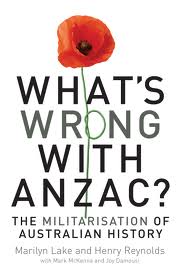
‘What’s Wrong with Anzac?’ Marilyn Lake and Henry Reynolds.

whatswrongwithanzac

2010, 167 p.
I doubt that this book will be reissued in the next two years. I’m sure that the publishers have had an asterisk against 2014 and 2015 as bumper years for military history, with the centenary of WW I in 2014 and the Gallipoli centenary in 2015. This book, originally published in 2010, is not likely to sit comfortably on the shelves with big books with big blokey authors that would have been scheduled specially to take advantage of all this interest. But many of the sentiments expressed by the historians who have contributed to it will continue to bubble along underneath all the ceremony, emotion and hyperbole.  You can find it manifested in the Honest History website.

In 2009 historian Marilyn Lake was invited by the History Teachers Association of Victoria and the University of Melbourne to give a lecture on ‘The Myth of Anzac’ in a series on mythologies. A condensed version of the address was published in The Age soon afterwards.

In it, she argued that in the 21st century Australia should reclaim the values of equality and justice which in an earlier era was thought to define a distinctive ‘Australian’ ethos. She suggested that it was inappropriate for “a modern democratic nation to adopt an Imperial, masculinist, militarist event as the focus of our national self-definition in the twenty-first century.” (p.3)

A furore erupted online- a “mixture of hostility and support, personal abuse and thoughtful reflection”. In her introduction to this book, she briefly mentions the abuse but outlines in more detail some of the more reflective responses posted onto the Comments section of the Age website.

This book is a compilation, then, of chapters written by a number of authors (both male and female) in response to the questions raised by Lake’s article and the commentary that surrounded it. Continue reading

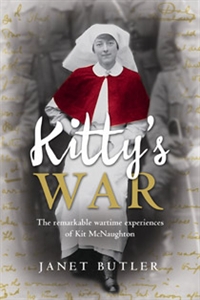
‘Kitty’s War’ by Janet Butler

Butler

2013,  231 p & notes

KITTY’S WAR by Janet Butler

I had forgotten the power of a beautifully written introduction to a history.

Imagine, for a moment, that we are granted an eagle’s eye-view of the fields and villages, the roads and towns of northern France.  It is dusk on a mid-autumn evening.  This is the Western Front, one hundred and eighteen days after the beginning of Operations on the Somme…. (p. 1)

Sister Kit McNaughton was a nurse from Little River, near Geelong who heeded the call for nurses during the First World War.  As did many others, she wrote a diary and this book, by Janet Butler presents extracts from that diary.  But Butler here is not an editor, stepping to the side to allow the diary and the diarist’s voice to take centre stage (as, for example, Bev Roberts has done in Miss D. And Miss N.)  Instead, Janet Butler  interrogates the diaries: she triangulates them against other writing; she supplements them with secondary sources; she looks for patterns and changes over time and she listens to the silences.  Kitty’s own (rather prosaic) entries take up a small proportion of the book – perhaps ¼ of the text, if that.  The majority of the text is the historian at work, always respectful of Kit McNaughton and privileging her perspective, but grappling with the diary as text and the emotional and physical enormity of the unfolding experience that it documents as well.

A diary fills multiple and often changing purposes. The writer often has an audience in mind: sometimes explicit (as in Anne Frank’s ‘Kitty’) or sometimes unnamed but tacitly understood.  As Butler writes about Kit McNaughton’s diary:

There is clearly a ‘you’ addressed in its pages. ‘We often think of the people at home & wonder what you are all doing,’ she writes after describing a concert given by the troops, the first day out of Australian waters, ‘& if you could only see us all doing the grand you would know how we are enjoying our selves’. It is to this audience that Kit’s presentation of herself has to be acceptable. (p. 13)

Kit conceives her writing as a travel diary, but she also is conscious that she is chronicling history as well.

…Kit’s diary intersects briefly, under the umbrella of the travel diary, with another kind of diary: the public chronicle of an historic event, which is more often than not a male prerogative (p. 27)

Kit McNaughton is aware that she is writing for an Australian audience ‘at home’ who will read her diary with a particular consciousness: they will want to see her as the ‘good nurse’ imbued with the discipline, rigour, efficiency and obedience of her professional calling; they will be sensitive over descriptions of Australian suffering and death;  and they will share her sense of Australianness. She  draws from the rhetoric of the Anzac legend, already being honed in the despatches of the war correspondents and seized for recruiting purposes at home, as a way of presenting herself. In doing so, she contributes to our own understanding of the legend 100 years later.

Her use of the ANZAC legend to actively craft her persona shows agency.  The nurses are not simply passive recipients of the identities thrust upon them.  It reveals a desire for a level of freedom denied them at home.  For nurses travelling to war, the Anzac legend opens out the boundaries of acceptable behaviour…. They continued the work they did as civilians, but their journey into war challenged and enabled them to expand their sense of self.  (p. 18)

The book follows Kit chronologically as she starts off in Egypt, as so many WWI soldiers did; is sent to Lemnos,  falls ill and is sent to a convalescent hospital. On going back to Europe, she nurses wounded German soldiers on the Somme, returns to No 2 Australian General Hospital at Trois Abres just six kilometres from the front, goes across to No. 3 Australian Auxiliary Hospital in Dartford, Kent and finally is sent to Sidcup maxilla-facial hospital nearby.  Each separate placement has its own chapter in the book, but multiple themes run across them all: her sense of being Australian; the resentment with which the nurses are sometimes greeted either because they are women or Australian or both; her companionship with the ‘boys’ she met up with in Cairo and her friendship with other sisters (in both senses of the word).  There is much that she cannot say, however.  To complain about the dismissiveness of the doctors would be insubordination (and a ‘good’ nurse is never insubordinate); to speak too much of the death and injury of Australian soldiers is too sensitive.  Nursing German soldiers however- the enemy- is different, and here she can write of the injuries and the smell and the loss in a way that she could not when nursing Australian soldiers:

I have eleven with their legs off and a cuple ditto arms & hips & heads galore & the awful smell from the wounds is the limit as this Gas Gangrene is the most awful thing imaginable, a leg goes in a day. I extracted a bullet from a German’s back today, and I enjoyed cutting into him…the bullet is my small treasure, as I hope it saved a life as it was a revolver one (p. 130)

In many ways Kitty understates her own role.  As we can see, she was entrusted with the scalpel, and she later worked in the operating theatre and administered anaesthetics- all skills that were denied nurses ‘at home’. She was mentioned in despatches; she won a Royal Red Cross.

But soon the silences are not just evasions and glossing-overs but the actual lack of words.  Particularly once she reaches Dartford, her entries become summaries,  widely spaced and sparser, reflecting her own “disengagement  from the war of which she no longer feels so much a part” (p. 197).  Kit is no longer on her journey, and she is no longer writing a travel diary.  There is no adventure, no sightseeing (which she had earlier managed to do), and Butler suggests that she is probably suffering what we would call post-traumatic stress.  Certainly, her photographs show that the war has taken its toll on her. Her hair has gone grey; she has lost two stone; she is in poor health.

As Butler says:

Statistics alone cannot provide a guide to the impact of war on personal lives.  Our journey with Kit has shown biography to be a way of reaching to the level of the personal and private.  Stepping beside Kit, an individual, into the aftermath of her war- reading her life, as we once read her diary- offers the possibility of insight into the effects on women, on the relationships between women and men, and therefore on Australian society, that more objective measures cannot. (p. 216).

The book is written in the present tense throughout.  I must admit that I’m rather ambivalent about the use of the present tense in fiction because it makes me feel edgy and anxious.  (Says she who has written this whole review in the present tense!)   It’s an interesting and striking choice in non-fiction, and one that I haven’t seen used often in history. I’m not quite sure how I feel about it. It makes me feel edgy here too, just as it does when it is used in fiction, but it certainly has its strengths as well.   It brings the intellectual and emotional interrogation of the diary right onto centre stage, and Butler’s frequent use of “we” draws you, as reader,  into engagement with the diary as well.

“Kitty’s War’  is a reverent and sensitive tribute to Kit McNaughton.  It’s much more than a platform for making her diary available to a wider audience.  It shows the historian at work, shuttling between the small detail and wider overarching questions of gender, war, personal identity, Australian identity and the ANZAC legend.

You can read Lisa Hill’s review of this book at ANZLitLovers and Yvonne Perkins has reviewed it at Stumbling Through the Past.  You can also read Janet’s own guest post about writing the book on a nursing blog.

I have posted this review as part of the 2013 Australian Women Writers Challenge.

awwbadge_2013