I didn’t think much of this. Plenty of battlescenes, but it was a pretty thin exploration of Napoleon’s character. There must have been more to him than this rutting dog, trying to impregnate Josephine. There must have been something that inspired enough loyalty in his troops and among the population to accept his return for the hundred days. The whole thing felt thin. And it just seemed wrong having them speak English.
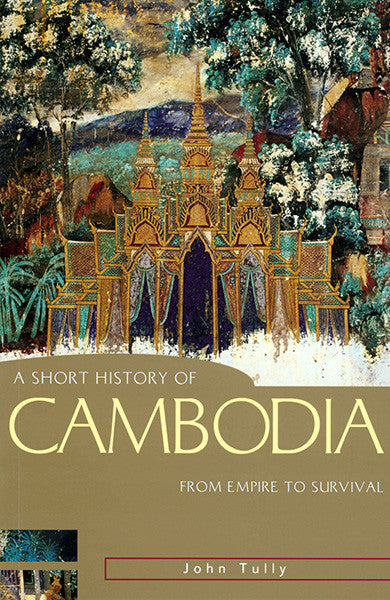
As I was visiting Cambodia, I wanted a short survey history of the country and this book, part of a series of ‘Short History of Asia’ series fitted the bill. John Tully was a professor at Victoria University (now retired), and as well as writing labour history, he also has written on Indo-China generally and Cambodia in particular. It’s a very accessible book, without footnotes but a reading list at the back. It was good start for a reader who wanted the whole sweep of Cambodian history, not just the Pol Pot era which tends to define our idea of Cambodia. He covers 2000 years, from the state of Funan, which predated Angkor right up to 2005, when the book was published.
Chapter 1 ‘The People and their Environment’ starts off with a geographical description of Cambodia, emphasizing its flatness in the middle and the huge Lake Tonlé Sap, the largest freshwater lake in Southeast Asia, and the Mekong River which breaks up into tributaries at Phnom Penh before flowing into the Mekong Delta in Vietnam.
I found Chapter 2 ‘Cambodia before Angkor’ fascinating. There was settlement of hunter-gatherers from the Stone Age onwards, and the Kymer-Mon people settled around 3000 BCE after migrating from the north. By the first century CE there was the Funan civilization, a literate, Indianized society which relied on the trade routes stretching from Persia to China. It was followed by the rise of Chenla, which may have been two principalities- Chenla-of-the-Land and Chenla-of-the-Water. The people spoke an archaic form of the Cambodian language, and they were the ancestors of the modern Kymers. It was king Jayavarman II who decided to shift his centre of power from the Mekong up to the Siem Reap region north of Lake Tonlé Sap.
Chapter 3 goes through the shift to Angkor, and the monumental legacy at Angkor Wat. He discusses how the temples were built, and the sheer manpower that it must have taken to construct them. He goes on to discuss what we know about the common people of Angkor from the inscriptions on the monuments, which detail punishments and provide information about the social structure, clothing and slavery. I thought that he did a really good job here in making Angkor a living, vibrant, populated culture, something which can be forgotten when you’re looking at ruins. He enters into the debate over water, and the contribution of ecological factors to the decision to move back to the Mekong quatre-bras region, although as he points out Angkor Wat was not abandoned as such. He emphasizes the arrival of Teravada Buddhism, displacing the earlier Sivaism and Mahayana Buddhism.
Chapter 4 ‘From Angkor’s End to the French Protectorate’ sees 1431, and the Siamese sacking and burning of Angkor, as a turning point. The Siamese in Thailand to the west (The Tiger) and the Vietnamese to the east (the Crocodile) both threatened to absorb the weakened kingdom completely. By the late 18th century, a Dark Age had descended on the country. The time of grand monument building was over. The road and canal system fell into disrepair, and village life predominated. Siam and Vietnam didn’t want to confront each other directly, so they used Cambodia as a buffer. Although there was a period of relative peace under King Ang Duang who set up his palace at Udong, increasing rivalry between the French (who had colonies in Vietnam) and the British (who had influence in Thailand) saw Duang’s oldest son, Prince Norodom, turn to the French for support in 1863.
The French protectorate lasted between 1863 and 1953 (Chapter 5). The treaty signed by Prince Norodom on 11 August 1863 gave France the right to station warships at the Quatre Bras (Phnom Penh), gave privileges to the Catholic Church, and granted free trade to the French throughout the region. The French embarked on a program of reform including the creation of private property in land, the abolition of slavery, cuts to royal spending, and legal and administrative restructure. I hadn’t really thought about the implications of the fall of France to Germany in 1940. The French Indochina Governor-General Admiral Jean Decoux supported Vichy and set up concentration camps, introduced the fascist salute and the goose-step and ritualized chanting of Petain’s name. He readily agreed to Japanese requests to station troops throughout IndoChina. Norodom Sihanouk came to the throne in 1941 as a baby-faced 19 year old. After the war, France granted some autonomy to Cambodia, but still maintained control over the military and foreign relations, finance and communications. There were elections and the start of political parties, and a constitution was ratified in May 1947. There was a coup in 1952, probably fomented by Sihanouk – Tully really doesn’t like Sihanouk- who assumed power directly and dissolved the democratically elected government.
Chapter 6 ‘Sihanouk, Star of the Cambodian Stage 1953-1970’ looks at Sihanouk more closely. Sihanouk likened Cambodia to an ant under the feet of two fighting elephants- the U.S. and the Soviet Union. He maintained neutrality- or perhaps it was more a matter of playing on both sides- and needed to maintain his own position at home while preserving the integrity of his borders. In 1955 he abdicated in favour of his father, and became more directly involved in politics. He introduced the idea of the Sangkum, a merger of political parties, into a one-party state which set the tone for politics for the next 15 years (and perhaps is still visible in Cambodia’s politics today too). When his father died, he allowed himself to be ‘persuaded’ to become head of state, introducing a form of ‘totalitarian democracy’. He spent heavily on education and health, introduced a series of 5-year plans and state construction. Although he tried to repress the Cambodian communists, his foreign policy moved sharply to the Left, moving away from U.S. support and towards China and Russia.
A brief five years as a republic, in Ch. 7 ‘The Doomed Republic 1970-1975’ saw a coup against Sihanouk, probably tacitly supported by the CIA. Sihanouk joined hands with his former Kymer Rouge enemies to removed the ‘usurpers’. Prime Minister Lon Nol was crooked and second-rate, but he served at various times as both prime minister and president (and later Field Marshall as well). By this time, Nixon had initiated an invasion under Operation Shoemaker, which included massive bombing, napalm and atrocities against civilians particularly (but not exclusively) by Vietnamese troops. Fighting continued, and the Kymers Rouges (Tully uses both in the plural) guerillas took Phnom Penh.
Then followed ‘Pol Pot’s Savage Utopia’ between 1975-1979 (Chapter 8). What I like about Tully’s book is that this four-year period, which so dominates our perception of Cambodia, is just part -albeit a horrific one- of Cambodia’s history. By highlighting the war and disruption prior to 1975, Tully goes some way to explaining why the Kymers Rouges were able to take power: the society and economy had been traumatized by five years of war. Prince Sihanouk became the figurehead of the new regime, although it was made clear to him that he was only a figurehead. The chapter is only 30 pages in length, but Tully captures well the madness and cruelty of the regime. The irony is that it was Vietnam, the traditional enemy, that put an end to ‘Democratic Kampuchea’, rescuing Cambodia from the nightmare.
Chapter 9 ‘Painful Transition: The People’s Republic of Kampuchea’ looks at politics since 1979. Here Sihanouk’s fear of being an ant under elephant feet was realized. The West had such a fear of Vietnam and China, that they continued to recognize the Pol Pot government despite knowledge of what had occurred during their regime. Over time, attitudes towards China thawed, and Vietnam was no longer seen as an expansionary communist regime. How slippery is Sihanouk! Now that Pol Pot was no longer embraced by the West, he started distancing himself from him. We see in this chapter the increasing presence of Hun Sen.
The final chapter ‘Towards an Uncertain Future’ starts with the 1993 elections, overseen by the United Nations Transitional Authority in Cambodia. Sihanouk tried to put himself as the head of a coalition government, acting of president of a council of ministers and commander-in-chief of the armed forces. However, he had to settle for returning to the throne as King Sihanouk, playing a ceremonial role in a regime dominated by Hun Sen, who had emerged as the undisputed strongman.. At the time of writing (2005) 50% of Cambodia’s budget came from overseas aid, corruption was rife, there was an AIDS/HIV pandemic, and a burgeoning ecological crisis. Although wanting to avoid being a Cassandra or an oracle, his conclusion was not particularly hopeful:
Looking back over the past quarter of a century (let alone the earlier Dark Age that beset Cambodia in the first half of the 19th century) it is difficult to imagine that anything worse could befall the Khmers. Cambodia has staggered from crisis to crisis since 1970 and in the absence of a developed civil society there is little check on the arrogance of government and the corruption of the administration. With entrenched rulers primarily interested in their own power and wealth, there seems little prospect of change in the future.
End of chapter 10 – (e-book)
I found this book really useful. It gave me the wide span of history that I wanted, and it was pitched at the right level for someone unfamiliar with the history. It had maps, and a list of acronyms, and it managed the balance between international and internal politics, and the day-to-day experience.
During the last week of November I was involved in letterboxing and gaining signatures on a petition regarding the freeway going through nearby Watsonia. So plenty of time to listen to podcasts!
The Rest is HistoryEpisode 385 The Fall of the Aztecs: The Woman Who Changed the World. So we left Cortez being sent off to Mexico, although Velazquez had a change of heart at the last minute, and rescinded his orders. Cortez ignored that, and went anyway. He was armed with lots of instructions but no instruction to colonize. He immediately went beyond his instructions and took up with Alvorado, one of the many armed entrepreneurs who were in the region at the time. Christianity did matter, and there were lots of legal niceties like reading El Requerimiento – a formality which supposedly gave the Spanish legal cover to proceed , but the main reason they were there was for gold. At the start, Cortez was insecure and fearful of his fellow sailors, especially Alvorado, and others who were still loyal for Velazquez back in Cuba. They came upon Aguilar, who had been shipwrecked there years earlier, and who spoke the Mayan language. His fluency in Mayan was particularly useful when Cortez took up with La Malinche, who had been sold into Mayan slavery and spoke both Mayan and Nahuatl (i.e. Aztec) languages. The Mayans acknowledged God and the Spanish King, and sent the adventurers onto the next village, along with slave girls including La Malinche who provided the crucial chain in the language from Nahuatl to Maya to Spanish. Was she traitor, victim or manipulator? There was no evidence that the Aztecs thought that they were Gods. Cortez decided to disobey his orders by going inland, and supposedly, Malinche must have told him that he would be safe. Before doing so, he founded a town on the coast, and gave themselves legal coverage by starting a town council. He sent treasure off to the King to butter him up, accompanied by Valaquez’s men (to get them out of the way). He didn’t burn his ships, instead he beached them and headed inland.
Conversations (ABC) I am a bird nerd, and I get very excited when one of the grandchildren identifies a magpie or rainbow lorikeet on the BackYard Birds Poster I have on the wall. And backyard birds are featured in Wily cockatoos, bin chickens and spangled drongos, where Darryl Jones talks about urban birds and his book Getting To Know the Birds in Your Neighbourhood. He extols the intelligence of crows and magpies and generally talks about the bird life that you’re likely to find in the backyard or nearby.
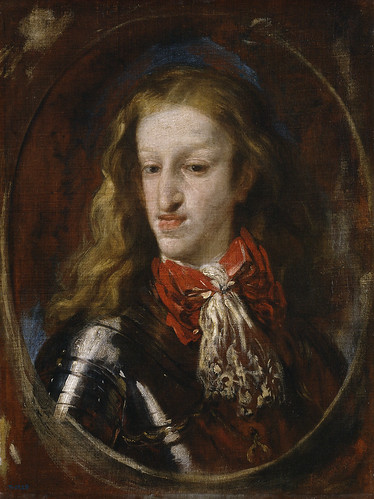
History HitHabsburg Inbreeding with Dr Adam Rutherford. I can remember being fascinated at school when I learned about the Hapsburg Chin, an inherited characteristic that rendered one of the Hapsburg kings/emperors (King Charles II of Spain) unable to eat. And after listening to geneticist Dr Adam Rutherford, that wasn’t half of the health problems that were inherited through interbreeding in the family which resulted in a genetic density even stronger than a brother/sister pairing. As Rutherford points out, mathematically we are all inbred to a certain extent because although we each have 1 trillion ancestors over the last 1000 years (more than have ever lived), some people appear several times on our family tree. All those Who do you think you are? programs that trace everyone back to Charlemagne reflect this presence of common ancestors.
History Listen (ABC) I’ve listened to two of the three part series Dusted: The Human Cost of Mining in Australia, presented by Van Badham, whom I had only seen on television- she’s good on radio too. Part 1 Gold focusses on Bendigo and the prevalence of silicosis as a result of quartz mining which became increasingly important once the alluvial gold was exhausted. At the time, there was no clear distinction between ‘miners phthisis’ and TB, although now we know that silicosis makes the sufferer more susceptible to TB. In 1906 there was a link drawn between the use of machine drills and silicosis, but the miners themselves resisted using the water drills that reduced the danger because of water shortages, use of contaminated water, and the fact that it slowed down their work when they were paid on results. The fear that mines would be closed resulted in an acquiescence to the continued rate of silicosis among miners. Part 2 Coal emphasizes that the Australian coal industry already knew the dangers of coal dust from the experience of coal mining in England, and the unionism in coal mines kept the issue at the forefront. However, the coal companies fought hard to question the dangers of ‘black lung’.
History Extra We held a Thanksgiving dinner with friends, so it seemed appropriate that I listen to a podcast about Thanksgiving. Thanksgiving: everything you wanted to know features an interview with historian Rachel Herrmann who distinguished between the original Thanksgiving in 1621 and its manifestation as a national holiday in 1863. The original Plymouth colonists had nearly starved after their provisions spoiled on board ship, and there had been a 50% death rate during the first winter. The next season they managed to eke out enough food to hold a harvest festival, at which some of the men fired off their guns, as you do. This attracted the local tribes who, on seeing the meagre fare, brought in deer and wild birds to share with them. There were about ten years of relative peace between the colonists and tribes (with whom they signed a treaty) but this was ruptured with the Great Migration when the ships just kept coming. Sounds familiar. The second manifestation of Thanksgiving was in 1863 when Abraham Lincoln declared it a national holiday, after years and years of lobbying by magazine editor Sarah Josepha Hale. However, it was largely rejected by the Southern states, who saw it as a Yankee invention until the 1920s and Jim Crow legislation assured white supremacy – then they could embrace it.
Emperors of Rome PodcastEpisode XCVIII – Caesar’s Gallic War discusses the books that Caesar himself wrote about the wars he waged between 58 and 50 BC. ‘Gaul’ consisted of present-day France, bits of Switzerland, Belgium and Netherlands. He actually wrote 7 volumes, but we don’t know if they were published year-by-year, or whether they were all published at the end. In either case, it gives us a rare glimpse into the mind of the commander of a war. They are written in the third person which perhaps sounds a bit arrogant, or maybe it was because in a predominantly oral culture they would be read aloud, and Caesar didn’t want people to impersonate him when reading if he used the first person. Episode XCIX – Q and A IV was a question and answer session. The questions I most enjoyed were: Was Livia the scheming sociopath that Robert Graves portrayed? (Their answer: there is evidence in the sources that she was, but the sources themselves were hostile. Stepmothers nearly always get a bad rap). How did the Romans picture the shape of their empire? (Their answer: they did have maps, but we have lost them and only have textual descriptions of the empire. It sounds as if their maps were more like those RACV strip maps you used to be able to get, highlighting towns and geographical features rather than being accurate in scale). What were Roman naming conventions? (Their answer: really complex but for women they would use a variation of the father’s name and give the same name to several sisters. Even though women married, their allegiances and identities were still tied up with their father’s family). Would Donald Trump make a good Roman Emperor? (Their answer- even though they were reluctant to give it- no, he would be bad because he is unpredictable and he goes through too many staff).
Expanding Eyes Podcast It’s too hard to listen to Homer’s Iliad through You Tube episodes, so I have succumbed to an audio version from my library which uses the W H D Rouse “plain English” translation. I feel as if I am cheating a bit, but it works well as an audio. Anyway, I’m up to Episode 50 in Mike Dolzani’s Expanding Eyes series Episode 50: The Tide of Battle Turns, The Achaeans driven back to their own defensive walls, a Second Assembly called to deal with this. which pretty much sums it up. He is moving to Book 9, but first he backtracks to books 7 and 8 . In describing the battles (at length), Homer goes a bit historical on his readers because he describes big shields and long arrows, which were no longer in use – although perhaps this is because he was harking back to the golden age of Greek power. In Book 8 Zeus decided that he needed to start to honour his promise to Thetis to help the Trojans (at least for a while), and knowing that the other gods would criticize him, he calls a meeting of the gods and tells them that he’s the boss. There is a long retreat and the Achaean are backed up against their own boats with the Trojans surrounding them. In Book 9 Agamennon is in tears over the situation and decides to throw in the towel – so we see his weak leadership yet again- but Diomedes stands up again, and he and Nestor suggest going to Achilles to try to encourage him again to join the battle for the Achaeans. Agamennon overeggs the pudding with the offer of sweeteners if Achilles will just came back and fight for them, and he sends off Achilles’ friends as envoys to talk to him.
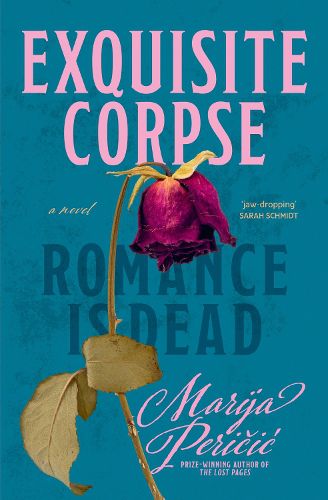
This unsettling novel is based on a true story. Set in Stockholm in 1930, Lina Dahlstrom is dying of tuberculosis and despite her sister’s misgivings, is drawn into the sphere of an eccentric doctor, Carl Dance, who claims that he can cure her. When she dies, his obsession with her grows stronger, and he embarks on a repugnant and criminal scheme to keep her as his own for ever.
I knew, from reviews that I had read of the book, that it was based on a true story, although there is only a single phrase “based on true events” on the back cover. I do wonder how that shaped my response to the novel, because its plot line is so visceral and distasteful that I would have otherwise put it aside as a form of torture porn. The knowledge it was “based on true events” meant that the plot could not be dismissed so neatly.
The story is told in four narratives, each roughly approximate in length, that move the story along chronologically. Part I is told by Greta, a young tobacco factory worker, who is frantic to get medical assistance for her sister Lina, who is floating through tuberculosis, rather indifferent to her fate – apparently one of the emotional manifestations of tuberculosis. With few resources, Greta urges her sister to accept the offer of help by Dr. Dance, even though she feels uneasy around him. Part II is told by Dr Dance as he becomes increasingly unhinged in his obsession with Greta’s corpse, and it is here that my scoffing at the implausability needs to be tempered by my remembrance that there is a kernel of truth here. I think that this is probably the most disturbing, and the best written part of the book. Part III is told by Lina’s corpse – hard narrative trick to speak on behalf of a corpse, but others have done it too- as the sheer perversion of Dr Dance’s actions are perpetrated on her. Pericic gives her a wry humour that is not apparent in the first section, through her sister’s eyes, but perhaps a sensibility that is more 21st century than 20th century. The final Part IV is told from the perspective of Dance’s wife Doris, as she is pressured both by Dance and his friends, into maintaining a veneer of support for Dance when he appears in court. Indirectly, we see another side of Dance here, as he wheedles and manipulates Doris, who is another of his victims.
Apparently ‘Exquisite Corpse’ is a form of drawing game- something that I only learned when looking up reviews of the book. It’s where players each draw a part of an animal on a sheet of paper, unaware of what the other players have drawn beforehand, leading to the creation of a weird, implausible monster-animal. In a way, the four part structure of the book replicates that, with each of the narrators unaware of what the others have said before them. It’s an interesting approach, but one that I don’t think Pericic carried off particularly successfully. Greta and Lina were both working-class girls, but I couldn’t hear their voices. Dance, although his actual profession is opaque in the book, is American and obviously possessed of a strong self-belief, but that does not come through particularly clearly. His wife Doris was presumably of a ‘better’ class and education than Greta and Lina, but that was not apparent.
I must admit, though, that despite the stomach-churning nature of the subject matter, I was drawn in by the book through a mixture of prurience and fascination. It reminded me a bit of Ebershoff’s The Danish Girl both in its time and setting, and also as a glimpse of something intimate that is so dissonant with the surrounding world.
My rating: 7.5 (hard to say)
Sourced from: Yarra Plenty Regional Library, and read because I was fascinated by some reviews.
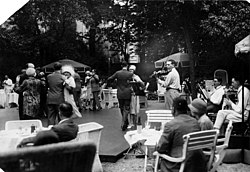
en.m.wikipedia.org A jazz band plays for a tea dance at the hotel Esplanade, Berlin, 1926.
History ExtraWeimar Germany: everything you wanted to know. I must confess that most of what I know about Weimar Germany is from ‘Cabaret’ and Christopher Isherwood’s books. In fact, I wasn’t even sure why it was called ‘Weimar’ until I learned from this podcast that it was named after the town where where the treaty establishing the government was signed. Its early years were marked by hyperinflation, different political factions and several coup attempts, including one in which Hitler was involved. Things stabilized economically a bit with the Dawes Plan whereby US loans were offered to the republic, but it was still politically volatile with 20 different coalitions, 12 chancellors and eight elections in quick succession. Hitler could quite rightly claim that he couldn’t be any worse than some of the later chancellors. The system of proportional representation meant that radicals could be elected. The Social Democrats did try to stop the Nazis, but President Hindenberg didn’t act even though he opposed their ideas. The army hid behind the Freikcorps, a para-military group similar to the Wagner group in Russia today. The fall of Wall Street had nothing to do with the fall of the Weimar Republic- Hitler didn’t even mention Wall Street at the time. The much-vaunted culture of the Weimar Republic only really existed in Berlin, and by the time it fell, people had generally turned against the Weimar Republic.
I went to see the movie ‘Oppenheimer’ and was interested to know how much of it was factual. Quite a bit, it seems, from this episode Oppenheimer: Destroyer of Worlds. It is an interview with Kai Bird, who along with Martin Sherwin, wrote American Prometheus: The Triumph and Tragedy of J. Robert Oppenheimer, on which the film was based. The book took 19 years to write. The interview finishes with Bird observing how politicians seek certainty from scientists, and often turn on them when the scientists demur- observe Trump and Fauci over COVID.
The Rest is HistoryThe Fall of the Aztecs: The Adventure Begins Dominic Sandbrook (one of the two presenters of this very popular podcast) has just released a children’s book about the fall of the Aztecs, and from the introductory reading, it sounds pretty good. I’ve read and listened to a fair bit about the fall of the Aztecs, but this is well worth listening to. As he points out, when the Spanish met the Aztecs, it was the closest thing that we have to meeting aliens. The stories that the Spanish (as the conquerors) tell about it are shaped in the tradition of Alexander the Great, but perhaps they were lying or just misunderstood what they were witnessing. Cortez grew up in Spain during the reconquest of Granada. His family wanted him to be a notary but he travelled to Hispaniola, where Spanish colonization was already underway. Like many other colonists who went ‘island hopping’, he went to Cuba. Cortez was not the first to go to Mexico but when Velázquez, the governor of Cuba, found out that there was gold there (particularly prized because it was portable and divisible), he wanted a functionary who would do what he was told, so he sent Cortez. Big mistake.
London Review of BooksThe Infected Blood Scandal based on a LRB article by Florence Sutcliffe- Braithewaite. In the 1970s and 80s, thousands of hemophiliacs were infected with HIV and Hep C. from infected blood products. At this time, British doctors already knew that blood could transfer hepatitis, although all the government papers about imported blood products between 1970 and 1990 were (conveniently?) pulped. There was particular concern about blood coming from the United States where private companies sourced donations from prisons (large numbers of former/current drug users) or paid people for their blood. However, new innovations in treating hemophilia at home meant that doctors overlooked or downplayed these threats. After this interview, there is a segment with Tom Crewe, who wrote a 2018 article ‘Here was a plague’ about the AIDS crisis and the perceived difference between ‘innocent’ and ‘guilty’ victims.
Background Briefing(ABC) has a series on Whistleblowers at the moment, which is pertinent given the David McBride case underway recently. The Whistleblower who helped catch a paedophile politician is about an electorate officer who became aware of several complaints about the Labor politician that she worked for in the early 2000s. It took more than one complaint before she decided to act. Once she did, she lost her job and was reviled by party members even though the politician was jailed for 10 years. The Whistleblower who captured the nation — and the man who unmasked her as a fraud deals with the convoluted and deeply political case of Kathy Jackson, who was embraced by the conservative party as a whistleblower against key members of the Health Services Union, until her successor blew the whistle on her own financial misappropriation.
Expanding Eyes Still continuing on with Homer’s Iliad- I’ve now finished Book 8. Episode 49: The Complex and Enigmatic Characterization of Paris, the character of Big Ajax in Book 7 and duelling. In the previous episode, he looked at Hector and Andromache, and in this one he looks at the contrasting couple, Paris and Helen. Paris is sitting there, polishing his armour, and Helen bemoans that she had ever been born, and that Paris will always be useless. Is she blaming the Gods, or is there an element of truth in this? Book 7 is puzzling: Hector is pumped, challenging any takers- including Big and Little Ajax. But it’s another inconclusive hand-to-hand combat. But, despite all the bloodshed that his actions have caused, Paris still refuses to hand Helen back.
The Emperors of Rome. Episode CVII Sallust I’d never heard of Sallust, but apparently he was a historian who wrote about specific events, rather than the big broad-scale narrative histories that were popular. He followed the traditional political path, but he wasn’t very successful as a politician. He was seen as one of Caesar’s allies, and was made Governor of an African province, but he was charged with malpractice- which was quite common (both the malpractice, and the courtcases brought by political enemies). Caesar intervened, but Sallust’s political career was over, so decided to become a writer. He wrote about the Cataline conspiracy, which had occurred about 25 years earlier. Why? He saw it as a sign of the division in society and although some his chronology is a bit dodgy, it is generally considered to be well-written. His second book was about the Punic war which occurred in 110 BCE, before he was alive. His third work was only fragments. An interesting idea that it is an ancient source for us, but he was writing about his relatively recent past.
Democracy Sausage. This podcast is presented by ex-Age journalist Mark Kenny, now up at ANU. Responsibilities to Protect is fantastic. Ben Saul has recently been appointed as UN rapporteur on human rights and counter-terrorism, and here he talks about the legalities of the Israel/Gaza situation. It seems strange that ‘legal war’ is hemmed in by so many distinctions. This is really, really good.
In Australia, we’ve recently witnessed the unveiling of the official portrait of a former Prime Minister, Kevin Rudd, ten years after he quit Parliament. It’s certainly ‘different’- almost reminiscent of a Graeme Base picture book illustration with lots of small symbolic details and, yes, a cat. It must be odd, having your portrait painted- especially an official one, which is going to represent you for posterity.
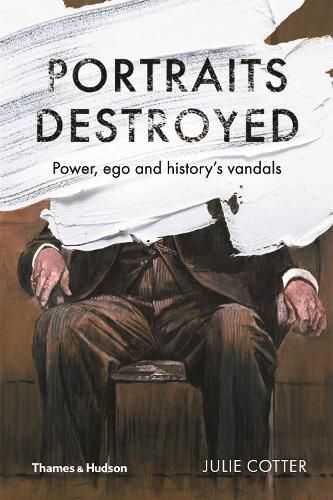
Art historian Julie Cotter’s book Portraits Destroyed looks at the official portrait, or representation, and its reception (generally negative) from either the sitter him/herself or their family, or by later generations. I was not surprised that she has worked on documentaries on Australian art previously, because this book and its chapter structure would lend itself very easily to a documentary series. I can already see her wandering around an art gallery as host.
She starts by considering Winston Churchill, whose now-destroyed portrait is represented on the front cover of the book. I only remember Winston Churchill as a fat, jowly old man and that’s very much the way that artist Graham Sutherland depicted him in 1954. It was unveiled by Churchill himself at Westminster Hall on 30 November 1954, on the occasion of his 80th birthday where he announced it “a remarkable example of modern art” (an ambiguous description, given that Churchill himself was a landscape artist of a very un-modern type).
He would have expected a portrait of a face that flickered with his life: a face that reflected the tumult, the devastation, the glorious victories, the might of the British Empire that the twentieth century had experienced. He would have wanted us to recognize ourselves in his portrait- to hear his speeches to the masses to keep fighting, to remain strong and unite against Hitler, to remember where we were when armistice was declared, to mourn those we had lost. He was his own muse, absorbed by his achievements
Instead, he was faced with the image of himself as a ‘down-and-out drunk who has been picked up out of the gutter in the Strand’ he concluded to his private secretary Anthony Montague Browne.
p. 37
After its unveiling, the portrait was never seen again. It was said that, after his death in 1965, his wife Clementine had burned it herself. This wasn’t strictly true: it was too big for her to take into the garden to set alight to it, and instead Churchill’s next private secretary, Grace Hablin, arranged for her brother to help her move it to his house, where it was burned.
It is fitting that the chapter about Churchill should be followed by a chapter about Hitler, given that they were arch-enemies. In this case, she hones in on an oil portrait painted by Dresden-born contemporary artist Gerhard Richter in 1962, who drew his portrait from an image showing Hitler at Nuremberg in 1934, “in a moment of strangulated shouting, hysterically commanding, his face elongated and distorted” with his right arm across his body (p. 44, 45) It was exhibited for the first and last time in 1964, and then Richter (who had since defected from East Germany) destroyed it himself, probably by cutting it to pieces. Richter himself had joined the obligatory Hitler Youth, and his schoolteacher father Horst, was drafted into the military in 1939. When he returned, he was a broken man, unable to teach because of his Nazi associations. Richter’s uncles were killed, his mentally ill aunt was killed under the Nazi’s T4 program of large-scale euthanasia. Cotter suggests that Richter’s destruction of his own work allowed “the release of a stultifying hatred”, but could also have been because of concern about the work’s impact in 1962, when Nazi ideology still circulated.
Chapter 3 ‘Presidents and Dictators’ looks at American presidents: Hayes, Roosevelt -who had two portraits, one he didn’t like by Chartran, and another which he did by John Singer Sargent- and Kennedy; Stalin; Mubarak in Egypt; and Mugabe. Chapter 4 ‘Royalty and Nobility” looks at English and French royal portraits; portraits of Imperial Roman women, especially Agrippina, and the Egyptian portrayals of Queen Hatshepsut. The Medicis used portraiture to express their power during the Renaissance, with an interesting portrait of Bianca Cappello, who bore The Grand Duke of Tuscany an illegitimate son. Then there are the portraits of Henry VIII, Queen Elizabeth I and the absent portraits of Lady Jane Grey. She then moves to the present day with over 150 official portraits of Queen Elizabeth II, including one by Lucien Freud, and the slashed portrait of Lady Diana Spencer which is now one of the National Portrait Gallery’s most popular exhibits.
Chapter 5 ‘Why Not Mao?’ returns to dictators, and I’m a little surprised that she didn’t place this chapter immediately after Chapter 2 which dealt with Hitler. As she points out, without wanting to lessen Hitler’s atrocities in any way, Mao was responsible for 50-80 million deaths if the Great Leap Forward is combined with the Cultural Revolution. Yet the West has not had the same resistance to displaying Mao’s image, and it is ubiquitous in China itself, (albeit, only by official portrait painters),looming over Tienanmen Square. She then explores Andy Warhol’s images of Mao, prompted by reading in Life magazine that Chairman Mao was the most famous person in the world. There has been little concern expressed about Warhol’s images, given the level of antagonism to portraiture of other leaders responsible for deaths on such a massive scale (p. 146)
Ch. 6 ‘Whitewash: Erasing Black History in the West’ examines the fraught issue of art representing black/white history. There was resistance to white artist Dana Schutz’s portrait of Emmett Till, murdered in the American South in 1955, when the rights of white artists to represent black people was brought into question. She explores the representation of Australian indigenous people by William Westall, who accompanied Matthew Flinders in 1801, and Tom Roberts’ representation of nineteenth century indigenous people in the Torres Strait. She discusses Mount Rushmore, U.S. Confederate statues, and John Batman’s statue here in Melbourne, and their removal or disfigurement, before moving on to the desecration of Eddie Mabo’s image on his grave (I did not know about this). Then there is the destruction of a mural representing indigenous political figures on the side of the Uniting Church’s Wayside Chapel in Bondi in 2016.
In her final chapter ‘Artists Destroy and Destroyed’, she looks at the disappearance of Benjamin Duterrau’s group portrait, the 5 metre long The National Picture, painted in 1840, which I had never heard of (I am familiar with his other paintings of Tasmanian indigenous people). She discusses the rivalry between Degas and Manet, and the reuse of canvases by Van Gogh and Picasso. She looks at the politically driven attacks on artwork, like Suffragette Mary Wood’s slashing of a portrait of Henry James by John Singer Sargent, and a similar attack by Anne Hunt on John Everett Millais’ portrait of Thomas Carlyle. Rolf Harris’ portrait of Queen Elizabeth II has disappeared from public view, along with his other portraits. Then we have the Spanish cleaning lady’s attempts to ‘touch up’ Ecce Homo by Martinez in a Spanish church, and the slow drip, drip of the wax portraits of Urs Fischer, created in order to be destroyed.
As you can probably tell, this is a discursive book that takes us to many paintings. Unfortunately, she has a limited of number of portraits included in the book, so you need to rely on her descriptions (I resisted the temptation to Google them). This was not as much of a drawback as you might think, because the book is more about the context and process of creation/destruction of the portrait, rather than the portrait itself. There is enough theorizing in the book to make it more than just a gallery-hop, and you are always aware that she is an academic/historian writing from a theoretical framework and informed knowledge. But thankfully it eschews the insufferable mumbo-jumbo that clags up a lot of writing about art, and is thoroughly readable and enjoyable. Now I just have to wait for the series on the ABC which I am sure will follow.
It’s Six Degrees of Separation Saturday, the meme hosted by Kate at Books Are My Favourite And Best (see here). The idea is that she chooses a starting book, in this case Anthony Bourdain’s Kitchen Confidential, then you bounce off six other titles that spring to mind. Very rarely have I read her starting book, and this month is no exception.
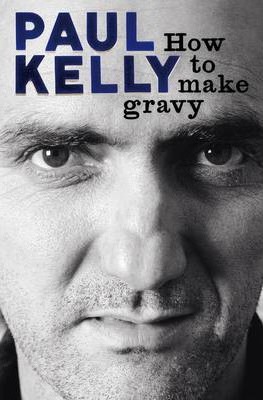
Well, you make gravy in a kitchen, don’t you? (I’m obviously stretching for something to connect with ‘kitchen’). Paul Kelly’s book How to Make Gravy is fantastic. The book is a written version of his A-Z stage show, which extended over four nights, where he would choose 25 songs each night from his repertoire of over 300 songs. The book is in four parts, reflecting the four nights of the performance. The songs are presented alphabetically and the lyrics precede each chapter, bolstered at times by poetry by other poets (Yeats, Donne, Shakespeare), quotations from books, and definitions. Some of the chapters directly relate to the song; others are a form of mental riffing on his childhood and adolescence, a succession of marriages and breakups, drug addiction, diary extracts while on the road, reminiscences of concerts seen and performed. You can just dip into the book, put it aside, and come back to it later. I loved it. My review is here.
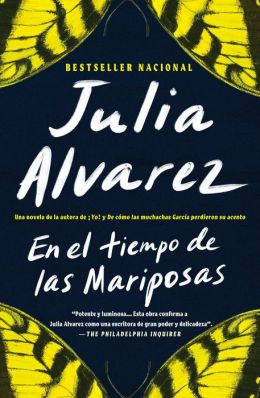
As Australians will know, the song ‘How to Make Gravy’ is about a man in prison ringing his brother a couple of days before Christmas, anticipating the family Christmas lunch that he will miss because he is in jail. My mind skipped to other books about people in jail. I read En El Tiempo de las Mariposas (In the Time of the Butterflies) by Julia Alvarez in the original Spanish, and it was such a strong story that I enjoyed- and understood!- it in spite of my language limitations. “Las Mariposas” was the code-name for the four Mirabel sisters, Patria, Minerva, Maria Theresa and Dede who, for different reasons and to differing extents, were involved in clandestine actions against the dictatorship of Rafael Trujillo (El Jefe) in the Dominican Republic in the 1950s. The whole of the family came under official suspicion, and two of the girls and their husbands and father were imprisoned at various times. The narrative of the book switches between 1994 in the voice of the remaining sister, Dede, and chronological chapters told in the varying voices of Minerva, Maria Teresa and Patria. Although based on historical fact, it is fictionalized. My review is here.
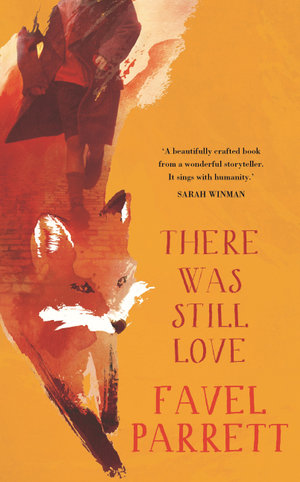
Sisters don’t always have to be geographically close, and that is the case in Favel Parratt’s There was Still Love which seems to be about two cousins in 1980 :- Malá living in Melbourne with her Czech grandparents, Mána and Bill, and Ludek, also living with his grandmother Babi in Prague, completely unaware of his cousin’s existence in Australia. It’s only at the end of the book that you realize the link between these two stories of grandchildren, wrapped in the love of their grandmothers. The two grandmothers were sisters, and by sheer happenstance, one ended up in the West and the other in the East. (My review here).
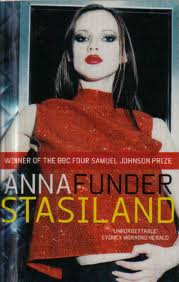
There are any number of books set in post-war Europe that I could have chosen, but I have gone with Anna Funder’s Stasiland. Funder, working as a journalist in Europe after reunification, was first attracted to investigating East Germany when a request for a program on the “puzzle women” was brushed aside by the television producers she worked with. These “puzzle women”, she later discovered, were employed to reassemble the papers shredded by the Stasi as the wall was falling, a task that would take over 300 years at the current speed. Methodical to the end, the papers had been shredded in order and shoved into a bag together, and so it was possible to piece them together and reveal the banality and the all-pervasive intrusion of the Stasi into the lives of East Germans. (My review here).
Bringing the world of espionage back to a more mundane Melbourne setting is Andrew Croome’s Document Z. ‘Document Z’ opens with an image instantly recognizable to Australians-of-a-certain age, even if we were not born at the time. It’s the image of Evdokia Petrov on the tarmac of Mascot Airport, flanked by a burly man each side of her, clutching her handbag, hand across her chest as if she is heaving, with one shoe lost. The book is a fictionally reimagined telling of the Petrov defection from the perspectives of the participants- Evdokia, her husband Vladimir, Michael Bialaguski the doctor go-between and the various agents on both sides. Croome has obviously done his homework (occasionally a little too obviously) and I marvel at his courage in describing a time long before he was born that is still within living memory today- lots of scope for slips and false notes there. He captures well the sterility of 1950s Canberra with the claustrophobic and enmeshed atmosphere of the Soviet Embassy enclave. (My review here).
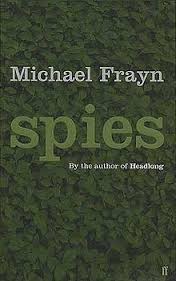
The Petrov Affair was very much an adult, politicized affair, but a more personalized view of espionage is found in Michael Frayn’s Spies. It is imbued with wistful, golden glow of L.P. Hartley’s The Go-Between or Ian McEwan’s Atonement. As in those books, the narrator (Stephen) in Spies also sees too much and yet doesn’t know what s/he is looking at when his friend Keith announces that his mother is a spy. So the boys snoop in her writing desk and follow her, and find more than they had bargained for. The story is told with humour and humility, and the adult Stephen is affectionately kind to his younger self and withholds judgment from him. It’s a very clever book. (My review here).
Well, given that I know absolutely nothing about Anthony Bourdain or Kitchen Confidential, I have travelled to 1950s Britain, East Germany, Czechoslovakia Australia and Dominican Republic- and an Australian prison coming up to Christmas. How fitting.
99% Invisible. This program sometimes features episodes from other podcasts, and that’s what they’ve done here, picking up our very own Marc Fennell’s podcast Stuff The British Stole which is a joint ABC and CBC Canada production, apparently. The Fever Tree Hunt is a bit different from other episodes in that it’s not an artefact or artwork this time, instead it’s the seeds of the Andean cinchona tree. At this time, imperial expansion into tropical areas by the British, Dutch and French empires saw huge swathes of colonists felled by malaria. Despite the Peruvians’ best attempts to stop theft of the tree and its seeds, the European empires were all after it once it became known that its bark was a cure for malaria. In the end, the Dutch got it (although the British had a red-hot go, claiming they were seeking it for ‘botanical research’) and they cornered the market. Ironically, establishing huge plantations has changed the DNA of the plant as the hardiest specimens were all harvested, and it’s not as potent as it used to be. To round out the episode, there is an interview between Marc Fennell and Roman Mars, the presenter of 99% Invisible.
The Ancients Of course, Gaza dominates the news at the moment. I have looked at the devastation of Gaza City and wondered if there were any archaeological or historical monuments or museums there, and whether they are standing. Origins of Gaza looks at its 3000 year history, when it was part of the interconnected Bronze Age world. It has always been a contested landscape, with a string of invasions by the Egyptians, Assyrians, Greeks and more. The sand dunes keep moving and uncovering new artefacts and structures- but who knows what there will be left by now.
The Real Story (BBC)Argentina at a Crossroads. I listened to this before Argentina held its run-off election which was won by El Loco, Javier Milei. What a disaster. But what a basket case, too. 40% of the Argentine population lives in poverty, facing 140% inflation, and Milei presented himself, and had the appeal of being an outsider. Over most of the second half of the last century, there was a populist Peronist consensus, even though it shifted shape over time and different parties were in power, sustained by electoral sweetners like pensions, no tax etc. At the moment, Argentina is facing a brain drain amongst its young people: who knows what is going to happen next.
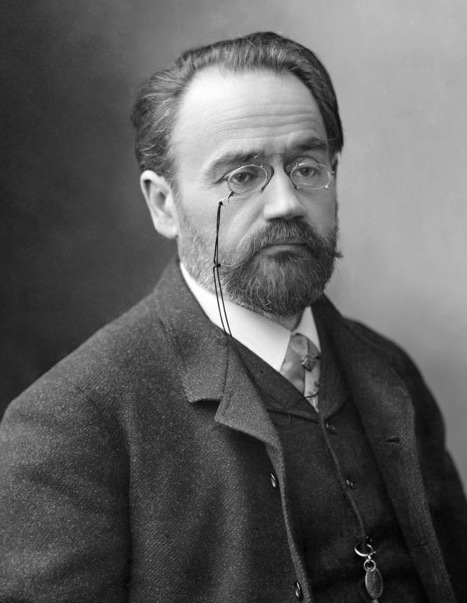
In Our Time. I read Germinal at university, and loved it. One of these lifetimes, I will try to read more of the Rougon-Macquart cycle of books (Lisa at ANZ Litlovers has done so and co-hosted a blog about it). But in the meantime, I listened to Melvyn Bragg (how old is he??) talking with Susan Harrow (Ashley Watkins Chair of French at the University of Bristol) Kate Griffiths (Professor in French and Translation at Cardiff University) and Edmund Birch (Lecturer in French Literature and Director of Studies at Churchill College & Selwyn College, University of Cambridge) on Germinal. Zola began his cycle in 1868, planning to write 10 novels which he saw as a form of documentary on French life in the Second Empire. He worked for Hachette (I didn’t realize it was such an old publishing house), and as well as being personally familiar with the poverty he depicts in some of his novels, he did huge amounts of field research. He chose different aspects of society: banks, markets, mines, the urban poor. Germinal deals with mining and miner’s lives, and in this book in particular he displays a strong sense of the body in such a dehumanizing environment. There has been later debate about whether Zola was a revolutionary or a reactionary, with the guests leaning towards seeing him as a reformist. There have been film and television adaptations of Germinal, which all have different emphases and politics,often reflecting the politics of the time.
Emperors of RomeEpisode XCV The First Triumvirate We call the pact between Caesar, Pompey and Crassus ‘the first Triumvirate’ but there was no formal context for such a thing. They were acting extra-constitutionally, drawing on the influence and authority of their armies and the support of senators to ‘go around’ the power of the senate. Julius Caesar had became consul in 59BCE and sidelined Bibulus, his co-consul, and instead formed a pact with Crassus and Pompey that they would support each other. However, Crassus died in Parthia, and lost the standards (something which brought great shame upon him). Meanwhile, Caesar’s daughter, whom he had married to Pompey, died in childbirth, severing the family connection with Pompey. By the late 50s BCE, there were street gangs, no-one wanted to be consul, and the Senate had been burned down. In 49BCE the Senate ordered Caesar to step down from his military command and come home from the Gallic Wars. Caesar defied their authority, and crossed the Rubicon with his army- that’s the significant thing. Episode XCVI Dictator of Rome saw the end of the triumvirate, but both Caesar and Pompey were looking for one-man rule and that THEY would be the one man. Civil war broke out. Pompey went to Egypt, where he was beheaded, but the Pompeyan resistance to Caesar continued. In 49 and 46 BCE Caesar was appointed Dictator by the people (that’s important). In 45 BCE he was made permanent dictator -which was getting a bit close to being a king. The assassination of Caesar can be seen as a triumph for republicanism, but it only triggered another bout of civil war, this time with Mark Anthony and Octavian against the assassins. Caesar was deified (which was very unusual at the time) and in 27BCE, having defeated Mark Anthony, Octavian changed his name to Augustus as princeps and was given tributarian power. In Rhiannon Evan’s opinion, all of this was extra-constitutional, but that was largely because the political system itself led to blockages so that natural change could not occur.
Expanding Eyes I’m up to Books 5 and 6 in the Iliad. My god, there is a lot of fighting in the Iliad. However Episode 48: Diomedes, the Noble Alternative to Achilles. Hector with his wife Andromache and their son Astynanax looks at the human scenes in these books, starting with Hector, and we finally see some love instead of just war. Michael Dolzani gives a bit of background on the writing of the Iliad. Originally an oral text, it was probably written down during the time of Alexander the Great. There were 14 books in the original, although who knows why they are divided up in the way they are.
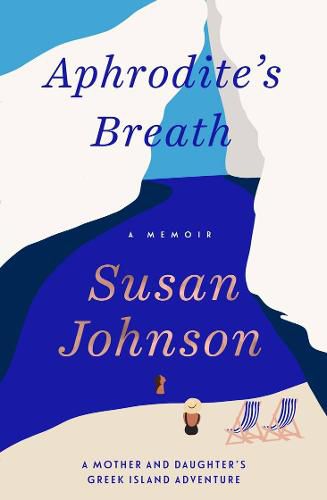
Even though I have very much enjoyed Susan Johnson’s work in the past – I absolutely loved My Hundred Lovers (see my review here) and The Broken Book and enjoyed From Where I Fell (review) and Life in Seven Mistakes (review)- I wasn’t tempted by this book at first. I knew that it was about a writer taking her elderly mother to a Greek island, and I feared that it would be some sort of Eat, Pray, Love book (not that I’ve read it) or one of its many escape-the-quotidian-by-travelling-to-Europe clones.
But I was wrong on both counts. It is a memoir, rather than a novel, and it’s by Susan Johnson, so of course it’s going to be much richer than a travel memoir. I just loved it.
As a long-time journalist and successful-enough author (I think she under-rates herself) she decided to put her hand up for redundancy at the Murdoch-owned newspaper where she had worked for some years. With some back-of-the-envelope calculations she worked out that, with no need to financially support her now-adult sons, she could afford to retire if she lived carefully. She had travelled to Greece as a young woman, and one of the threads of her her novel The Broken Book involved Charmian Clift’s time on Kalymnos and Hydra. Her money would go further if she moved to Kythera, a Greek island that she had fallen in love with, and in her head it was associated with the bright sun of being a young woman with your whole life ahead of you. But she was now over sixty, the promises of her life had not been fulfilled, and as the eldest child and only daughter (as am I) she felt responsible for her now-widowed mother Barbara. She felt that she could not leave her mother, but what if her mother were to accompany her….. She asked Barbara if she went to Kythera, would she come too? And her mother said ‘yes’.
And so they went, but it did not turn out as Susan expected it would (do things ever turn out the way you think they will?) Although Susan fell in love with a house that found online and managed to lease for a full year – quite a feat in a community with a large, lucrative tourist influx ‘in season’- her mother disliked it from the start. Far from being the sunlit, balmy island of her dreams, it was cold and her Brisbane-bred mother hated the cold in a house with no heating. She didn’t like walking, and although neither of them could speak Greek (which surprised me, as Johnson’s text is sprinkled with Greek words), Barbara had no interest in learning it. They managed to break the lease, and took another house further north, which Barbara preferred although, like Johnson, I wonder if it was more that she had a choice over this house instead of her daughter organizing it ahead of time. By this time, spring had arrived and it was warmer and Susan threw herself into the life and traditions of the small village in which they lived, while Barbara participated tepidly and largely kept herself apart. Eventually it is decided that Susan will accompany Barbara to London where she will meet up with her son, and travel with him back to Queensland. While Susan missed her company (because she truly does love her mother), you can sense of sigh of relief.
And so, not really a lot happens in this book. So what kept me opening it up with relish, night after night, and my regret when it finished? Part of it was a rather perverse curiosity about what would go wrong, and when- dementia? the dreaded ‘a fall’? a passionate love affair out of left field for mother and/or daughter? But it was also Johnson’s own self awareness of the Faustian-bargain she had entered into with her publisher that helped to finance their trip: that she would finish the edits on the book that ended up as From Where I Came, and that she would write this book – her memoir of “A mother and daughter’s Greek Island adventure” as the subtitle rather forlornly ventures. How would she depict this stubborn, complaining woman, whom she adored? What if there was no “adventure” but only a grapple between mother and daughter that laid bare all the compromises, micro-aggressions and resentments of many mother/daughter relationships.
The book takes a turn at the end, as COVID makes it impossible to return home as Barbara’s health deteriorates. We all know, unless Fate is perverse, how mother/daughter stories end and so there was an inevitability about the finale, and yet there was a surprise there too. For me, I was left with a sense of a circle closed, a rich love of a daughter for her mother, the psychological integrity of both these two, separate women, and a deepening of my own reflections about mothering and daughtering, aging, travel and home.
Susan Johnson is just slightly younger than I am, and I have always found that her books speak to me, and that they seem to capture where I am at the time of reading. I do wonder how a younger woman would read this book, though. Part of me feels that it is only with age, and the sense of having moved on beyond being a child against an older, more beautiful mother, that a reader can stand outside the Susan/Barbara relationship and observe. For a ‘woman of a certain age’ as both Johnson and I am, this was a really satisfying and perceptive read.
My rating: 10/10
Read because: It was there on the library shelf, and I have enjoyed her other work. But reading about a writer, I felt a bit guilty borrowing it from a library, though (public lending rights notwithstanding). When Johnson talks about her own writing and success, I didn’t quite register how personally an author takes sales figures.
Literature and History. I’ll be doing the Christmas service at my Unitarian fellowship, and even though I know I’ll end up working on the service the night before, I have started thinking about what I’m going to do. I usually have a historical bent to my services, and this time I’m thinking of looking at the historical context into which the Nativity story was embedded. This led me to Ep.76 Judea Under Herod. (You can get the transcript here). Herod was a client king under Roman rule who reigned over the province of Judea between 37 and 4 BCE, at a time when the Republic was tearing itself apart and re-forming as an Empire. We know Herod through the story of Jesus’ birth and death (and to my shame, I thought that it was the same King Herod involved in both, but it wasn’t- they were father and son). None of the historians writing at the time, even Josephus, mention the Massacre of the Innocents, which you’d think they would, if it happened. King Herod was first appointed governor of the backwater territory of Galilee in 47BCE as a result of his father’s connections with Julius Caesar. He was not a popular choice: he was ethnically Idumean and not Jewish, his father had been embroiled in Jewish civil wars and Roman campaigns against Judea. When Herod’s father died and after aligning himself with Mark Antony and Octavian, he was appointed King of Judea, but the Jews didn’t want him, preferring a home-grown Hasmonean king instead. Herod was pretty ruthless: executing his enemies, confiscating their property and even killing family members who threatened him. Apart from that (a big qualification), he put Judea on a strong economic footing, he rebuilt the Second Temple (even though it was still standing albeit profaned by the entry of Roman troops in 63BCE so think of it as Temple 2.5) but it was destroyed by 70CE except for the Western Wall. As a client King, Herod needed to manage competing demands while being essentially powerless. He did manage to keep Judea intact instead of being swallowed into Syria. He had nine wives, and after he died, the kingdom was divided in three and ruled by three sons, one of whom was Herod Antipas, who was the one who ordered the execution of John the Baptist and did nothing to stop the execution of Jesus. It was Herod Agrippa II who ended up dealing with the Apostle Paul. All these Herods! No wonder I was confused.
History This Week Chasing Utopia tells the story of Bronson Alcott (father of Louisa May Alcott) who along with Charles Lane established Fruitlands, a Transcendentalist utopian community, in Massachusetts in 1843. It never really expanded much beyond the two families, and when the men went off to try to get new members, they left his wife Abby May and her daughters to bring in the harvest alone. She increasingly resented Lane’s domination of her husband, and in the end she wrote to her brother, telling him to stop funding the farm and threatening to leave with the children. Eventually, it was Lane who left and a few months later, Bronson and his family left too. So much for Utopia.
Emperors of Rome It’s time to go back to the Emperors of Rome podcast. I take up again at Episode XCIV A Republic Worth Fighting For After Sulla died in 78BCE, the Senate didn’t want to undo his Senate-friendly moves. There was a string of strongmen in the 70sBCE: Crassus, Pompey and then Julius Caesar. Both Crassus and Pompey came up through the military, and both of them had armies behind them. In 70BCE they were made consuls, even though officially Pompey was too young (although by this time, who needs rules?). He was seen as the ‘efficient one’, cleaning up the Slave War, Pirates and King Mithridates, the latter meaning that Pompey finally got the triumph he had been hanging out for. There were extremists in the Senate, like Cato, and the ‘new men’ coming into the Senate. Cataline came from the ‘right’ sort of family, but he was rejected as Consul and so he riled up the disaffected. The existing Consul, Cicero, found out about the plot, and summarily executed the men who were plotting but not Cataline, who escaped. This came back to bite him five years later, when he was put on trial for acting beyond his powers and was exiled.
Conspiracy Theories. (I can’t believe that I’m listening to a podcast called this) Failed Conspiracies: Cataline Conspiracy In the first century BC, there was stiff competition to be consul. Cataline was from an old family but very ambitious and strategic in his search for power. Cicero, on the other hand, was an outsider and a brilliant lawyer. There was rivalry between the two men for a Consul position but Cataline was beaten twice for the position. In 63BCE Cicero learned of a conspiracy to overthrow and assassinate him from letters that had been delivered to Crassus outlining the plot. Cicero had the ringleaders executed but Cataline escaped with his troops, who were attracted by his populist policies, especially amongst ex-military men and heavily indebted farmers. Cataline’s army was defeated and Cataline died a traitor. The presenters then indulge in a bit of ‘what-if’ history that goes too far. What if Cataline had won instead of Cicero? Well, we wouldn’t have had Cicero’s letters, which were all written after the conspiracy and rediscovered by Plutarch. The Roman empire might have turned socialist- and what would the Founding Fathers do with that, given that they modelled America on the Roman Empire. Hmm. Stop already.
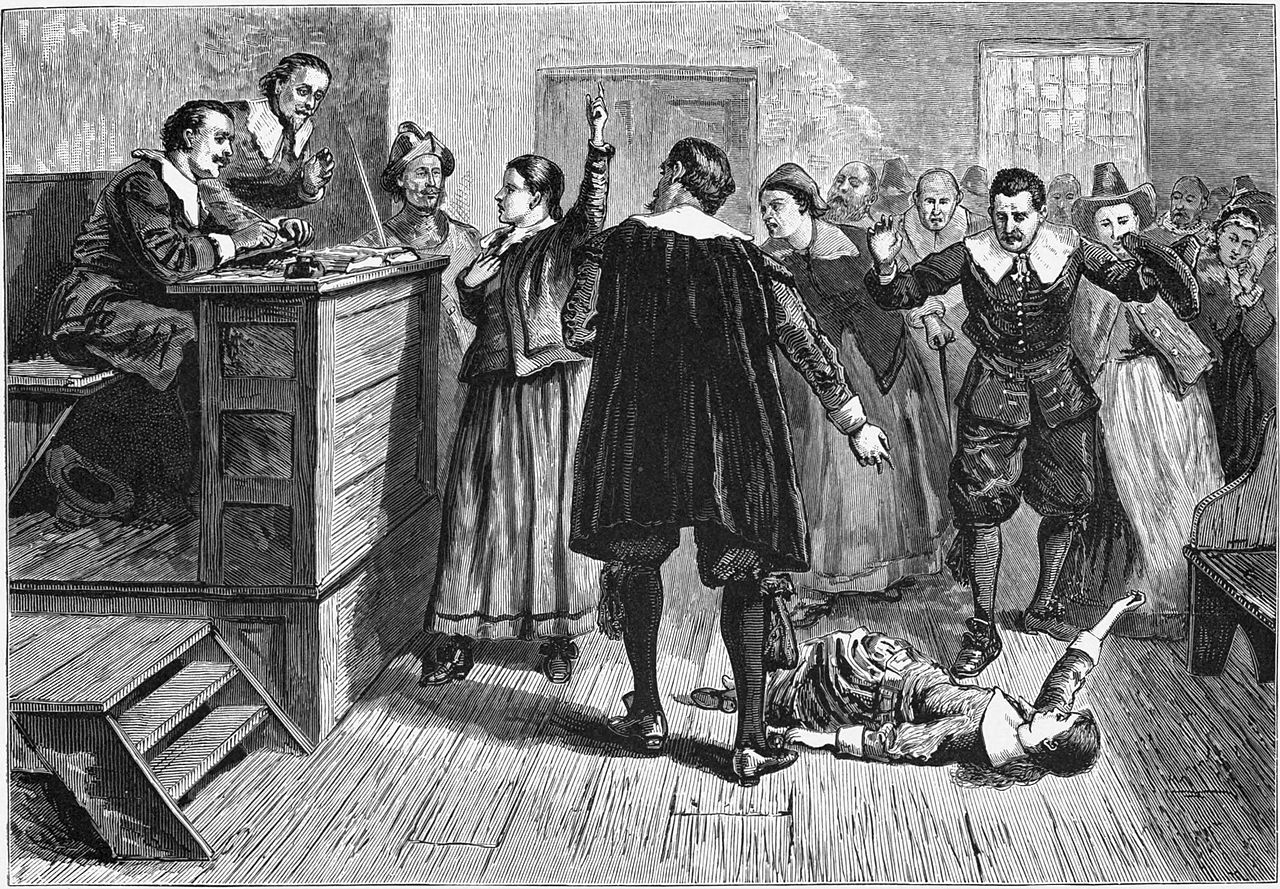
By unattributed – William A. Crafts (1876) Pioneers in the settlement of America: from Florida in 1510 to California in 1849[1], Pioneers in the settlement of America: from Florida in 1510 to California in 1849. edition, Boston: Published by Samuel Walker and Company, Public Domain, https://commons.wikimedia.org/w/index.php?curid=17689791
History Hit. To celebrate Halloween and All Saints Days, History Hit revisits The Salem Witch Trials. Europe had gone through its witchy stage in the 15th and 16th century, especially when the Protestants took up the idea, but after a wave of executions, it went out of fashion in Europe. But not in Salem though, where the Puritans (who were out of fashion themselves) were living on a hostile frontier, didn’t like women and believed in Satan- a bad combination. During the witch trials, 200 people – including some men- were accused and 20 died. Some of the accused were adolescent girls, who were given an otherwise unattainable degree of power through their accusations, and rich widows who had land. Eventually, there was pushback from the legal system when they rejected spectral evidence in 1696, and when Europeans were askance that the colonies were still looking for witchcraft, which they had discarded decades earlier.
Expanding Eyes continuing on with Books 3 and 4 of The Iliad. Episode 47 The Contest Between Paris and Menelaus to settle the issue of who gets Helen. What was Agamemnon thinking at the start of Book 3 where he told his men that he was giving up and going home? He was nearly trampled as the men rushed towards their boats, eager to go home after 9 years fighting the Trojans. He was just testing them, but they took him up on it. Perhaps Homer wrote this to show his weak leadership. Paris was the first to propose that he and Menelaus duke it out between them, but then he chickened out when Menelaus took him up on it and he had to be goaded into action by his brother Hector. When Paris was getting beaten, Aphrodite flew down, swept him up, and deposited him in Helen’s bedroom. Actually, the gods are pretty ambiguous here- no-one actually saw Aphrodite do it- and when Helen decided that she’d gone off Paris after all and wanted to go home to Menelaus, Aphrodite rounded on her and terrified her. Book 4 is mainly of fighting. Dolzani comments on the complexity of Helen: she seems quite regretful about leaving Menelaus but then she gives in and sleeps with Paris. (I don’t see any great complexity here, personally. Women do what they have to).

 The Resident Judge of Port Phillip