One of my reading groups read Demon Copperhead in March. I knew that the writing of Demon Copperhead was influenced by Dickens’ book, and so I decided to re-read it. I seem to have read a succession of recent books that are written well-enough recently but I craved something a bit more complex and convoluted. When I thought about it, I read David Copperfield nearly 50 years ago at university and I thought that it could probably withstand a re-reading at that distance!
It certainly did, although it was a big ask. At 1024 pages in the Penguin edition (and over 2000 pages on my Kobo reader), it took me over 26 hours to read. But it has such a wide cast of characters who have found their way into literary culture that it rewards meeting them again in the original: Mister Micawber, always waiting for something to turn up, and the slimy Uriah Heep.
Fifty years later, I still find bubble-headed Dora and her stupid, snappy little dog Jip tedious and frustrating. Agnes is still too noble and angelic. If anything, Dickens’ depiction of women in this book has become even more problematic than it was back in the 1970s. The steely coldness of his step-father Mr Murdstone is ‘of a type’ more common back in Victorian times, but still conveys the sense of David’s security being stripped away bit by bit.
But what surprised me on this later reading is how much about colonial immigration – particularly to Australia- there is in the book. It’s almost like an advertising brochure for escaping your problems by heading off to the colonies. I hadn’t been quite so aware of Dickens’ social and legal commentary, either, when I read it 50 years ago. I think that I had more sympathy for David Copperfield’s creeping disillusionment with Dora and his marriage, and his dogged decision to keep on with the marriage, even though he was getting so little from it.
So worth 26 hours of my life? (In fact, if you consider that this is a second reading, that makes 52 hours of my life). Absolutely. As you will see, it enhanced my reading of Demon Copperhead immeasurably, and I’m grateful that, age and digital-attention-span notwithstanding, I can still tackle this big baggy monster of a book, and enjoy it thoroughly.
I go with my Unitarian group to the movies on the second Saturday of the month, and this was the perfect movie to see with them, given that we’ve been discussing ‘spiritual practice’ recently. Every day of Hirayama’s life is a spiritual practice, as soon as he opens his door and looks – really looks- at the sky. His job is very humble, cleaning public toilets, but he takes pride in his work. His life is very ritualistic and ordered, right from the sound of a woman sweeping the street outside, through to his lunchtime and taking one photo per day, through to his dinner at the same restaurant, and closing the day with reading on his tatami mat by the light of a single globe. A whole other, previous life is hinted at when his sister comes to collect her daughter but it is left unexplored. I had just seen Groundhog Day the Musical the week before, and there is certainly repetition of day after day in this as well. It’s certainly slow, and probably 15-20 minutes too long, but it’s made me think about finding meaning and beauty in the small things that I encounter each day. I enjoyed this a lot, and I’ve thought about it many times since.
Being Roman In the episode What We Lost in the Fire, Mary Beard tells of the physician, polymath and writer Galen’s loss of his papers and equipment in the Great Fire of Rome, when his lockup at the Spice Warehouse went up in flames. His first medical-type job was looking after the gladiators in Pergamon, which was a source of on-the-spot dissection and much learning about injuries, fat and muscle. He moved to Rome where he undertook public dissections and made a name for himself as physician to emperors. His autobiography ‘On Not Grieving’ was re-discovered in 2005, and despite the title, it shows that he really did grieve the loss of his writing for the rest of his life. Nonetheless, 10% of all the classical Greek writing that we have today was written by Galen.
The Rest is HistoryTitanic: Kings of the World Part 2 Of course, the Titanic was made of stuff that sinks, part of a suite of liners called Olympic, Brittanic and then the rather hubristic Titanic. It was designed by Thomas Andrews, Pirie’s nephew. White Star was famous for luxury and safety, as distinct from Cunard, which concentrated on speed. It catered for enormous wealth, with the best quality berths costing 400,000 pounds at the peak of the season. (Did I hear that right?) But it also accommodated second and third class passengers in good conditions and it had the best safety features of any ship built until then. It had a double hull with 15 bulkheads, and although the number of lifeboats was insufficient, with a capacity of 1/3 of the passengers, it was compliant with standards at the time. After the standard 12 hours of sea trial, it left Belfast for Southhampton, which was the new port for London although it was still overwhelmingly manned by Liverpool shipworkers. However, in an ominous sign, the Captain had been involved in two accidents in the six months prior to the sinking of the Titanic.
Global Story BBC Curse of the World’s Fastest Growing Economy I don’t often hear news from Guyana, the location for part of my PhD’s topic John Walpole Willis’ colonial career. And I don’t often hear from Steven Sachur except as part of his rather verbally aggressive Hard Talk interview quiz on BBC. He has just returned from Guyana with its population of about 800,000 people where oil and gas were discovered 200 km off the coast in 2015. Exxon-Mobil are doing the drilling, and although some is going to government, it is still very profitable for the company. But is it a blessing or a curse? It has led to an increased security threat for the small nation, especially from its neighbour Venezuela which has mounted a large claim on Essequibo. Guyana is especially vulnerable to climate change, with heavy reliance on its sea walls and Dutch-built canals (from Judge Willis’ time). An off-shore spill would be disastrous for eco-tourism. Sackur spoke of his bruising (for him) interview with Guyana’s President Mohamed Irfaan Ali who made a strong argument for it being Guyana’s turn to reap benefits from its resources.
I Survived Las Vegas Shooting, then was convinced it was staged In 2017, Stuart McCormick survived the deadliest mass shooting by a single gunman in US history, while visiting Las Vegas. He was there, he saw it, and yet he came to believe that it was orchestrated by the US government. How could that be? The BBC’s disinformation correspondent, Marianna Spring, suggests that there is a conspiracy theory blueprint, that she saw at work in Stuart’s case. First, conspiracy theories build on a grain of truth, with legitimate fear and worry leading to anxiety. Second, conspiracy theories have their own vocabulary which is recognized by adherents. Third, people then start to wonder what else is staged? Fourth, people holding conspiracy theories become isolated, largely because of the shame and stigma that surrounds them. She notes that Finland includes a study of social media conspiracies in its curriculum, in the hope of fortifying students against them.
Emperors of Rome podcastEpisode CVI The Third Servile War After escaping from gladiator school, Spartacus and his fellow escapees fled to Mt Vesuvius, which hadn’t erupted at this time, heading for Gaul and the Alps. Whatever Spartacus was, he wasn’t a freedom fighter, but on the other hand, his followers had increased from 70 to 70,000 men. It was decided to send in two consuls with two legions, and Spartacus defeated them both, taking 300 Roman soldiers and sacrificing them, striking further terror into the Romans.
Episode CVII The Legacy of Spartacus There was no mucking around now: the Senate sent in Crassus, who had had success during the civil war. He was a tough leader, who punished the whole army (not just a legion) with decimation after a defeat- a harsh and ultimately self-sabotaging action. Spartacus was now heading south with 120,000 fighters but got trapped in the toe of Italy. There was no final confrontation: he just kept fighting and his body was never found. It was a big victory for Crassus but he couldn’t claim a ‘triumph’ because he defeated an internal enemy. The film depiction of Spartacus being crucified is untrue (they never found his body), but there were 6000 crucifixions among his other troops. Spartacus has become a symbol of resistance for other generations, especially through the Spartacus movie, filmed during the 1960s in the midst of the civil rights campaign.
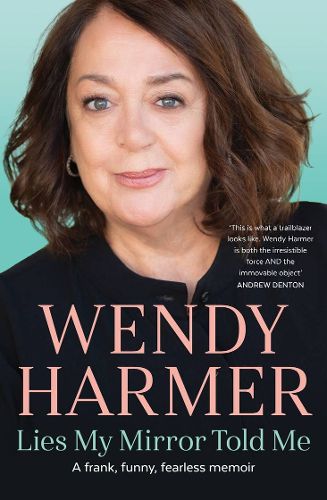
I read this book because it was written by Wendy Harmer and because of the characteristic we have in common: cleft lip and palate.
You know, she’s the only woman with a cleft that I know of in public life. Cleft lip and palate is not that uncommon, affecting 1 in 800 births. If so, where do we all go? I know of a couple of male (but not female) actors, no politicians, no business people, no teachers, no doctors. People with clefts always recognize each other with a quick glance, close attention to the speech, a heartbeat of recognition, but nothing said.
But Wendy Harmer, as one of Australia’s most recognized comedians, is upfront about her cleft, having told her story on television and radio programs many times. In this book, she has the time and space to talk about it without her story being shaped by an interviewer’s questions, and to place it in context among the other varied aspects of her career, now that she, like me, is in her late sixties.
She uses the construct of the mirror as a way of organizing her book, with many chapters starting with a mirror in a different location and the self-talk that accompanies her looking at herself in the mirror. I think that most women in particular (men too?- I can’t speak for them) have a fraught relationship with a mirror: “I’m too fat”; “I have a pimple on the end of my nose”; that close scrutiny of yourself when applying make-up. I think that this ambivalence is probably stronger for people with clefts because you are seeing yourself and your difference from the outside, as others see you. That difference is always a little jolt. I can remember, even as an adult, being fascinated by the three-way mirrors in a triangular dressing room, seeing my asymmetrical profile in a reflection of a reflection, something that I had never seen before. For the child with a cleft, you have sat in a surgeon’s consulting room as your face is scrutinized as a medical problem to be solved; after surgery (once they let you have a mirror!) you stare at the stitches, wishing that somehow they are going to make your life different.
Harmer’s relationship with a mirror was particularly stark when, as a child she complained about teasing, her mother’s response was to say “I want you to go and stand in front of the mirror and when you can find something complain about, you come out here and tell me”. A risky bit of tough-love, I’d say, although Wendy came out saying “I’ve got nothing to be sorry for”. What Wendy only learned decades later was that after she said that, her mother “bawled and bawled my eyes out. Bless your little heart for saying that. I look back and think how harsh that was. I wish I could have been softer.” (p. 378) For in truth, there was something to complain about. Not just the cleft, but also a really difficult childhood, with frequent shifts between schools, an absent mother, a frequently-absent father, a vindictive stepmother and far, far too much responsibility as the eldest daughter.
I hadn’t realized just how varied Harmer’s career has been. She started off as a journalist, first with the Geelong Advertiser in the country, then working for The Sun in Melbourne during the 1970s. The Sun’s features editor sent her off to an ‘alternative comedy’ night at Melbourne University for an article. On stage were Steve Vizard, Paul Grabowsky, Gina Riley, Richard Stubbs and Los Trios Ringbarkus – all of whom ended up being stalwarts of Melbourne comedy/arts scene. She returned to the Sun office, wrote the article and declared that she was going to give up journalist for a crack at comedy.
Here the book becomes much more your standard ‘celebrity autobiography’. I recently saw an interview with comedian Wil Anderson and he spoke about how fundamental Wendy Harmer is to Australian comedy, and even more so women’s comedy, and it’s writ large in this long roll-call of people that she has worked with, both in Australia and overseas. I had only become aware of Harmer through ‘The Big Gig’ and ABC comedy shows from the days when the ABC poured money into locally produced comedy shows instead of a succession of panel discussions and quiz shows. But she has been around for decades, plying her craft in cabaret venues, on TV and in comedy festivals in Australia, Edinburgh and in the US. There’s always a risk that this descends into name-checking and cliché, and the book does suffer from this a bit- there are just so many names! There’s her shift to the bear-pit of Sydney breakfast radio; her many fairly-light novels, her children’s stories; her screen-writing; her ‘Is it just me?’ podcast with Angela Catterns which I mourned when it finished; the Hoopla website between 2011 and 2015. Along with the successes, there are failures as podcasts and websites close, radio breakfast teams churn on to the next iteration of the same formula, and the gig of hosting the Logies devours its next victim. Despite such a varied and full career, there is an element of regret and nostalgia near the end of the book as times change, the media environment becomes crasser and ‘women of a certain age’ become less bankable as media personalities. Her father has died; her relationship with her mother is wary; one sibling has died while another is estranged in the way of families. But Harmer herself is in a good place. As she says,
I search for so many people I loved dearly in the rear-view mirror. But the times I spent with my beloved companions can’t be found in any looking-glass. They are a smell, a touch, sounds and words which cannot be framed and hung on any wall. We see only our own faces when we look into a mirror.
History Extra I recently saw the movie ‘Zone of Interest’ and so I was interested in the episode The Man who ran Auschwitz: the real story of the Zone of Interest, featuring acclaimed history of Nazi Germany Richard J. Evans. He had acted as historical consultant on Martin Amis’ novel on which the film is loosely based, and he approved of the film even though he felt that it smoothed out the sexual dysfunction in Hoss’ family. Hoss was born in 1901 and joined the German Army in WWI as a 14 year old. He was jailed during the Weimer Republic as a right wing fanatic, and once the Nazis achieved power, he became a member of the SS. Along with his colleagues, he believed that the Jews had to be eliminated as enemies of the Government. Auschwitz was originally a labour camp then expanded into an extermination camp- actually it was three separate camps. Hoss came up with the idea of gassing, and his career was seen as a success. He married young and his wife was a strong Nazi. After the war, many Nazis suicided or fled the country and took up false identities. It was the practice for arrested Nazis to be committed, tried and hanged in the country where the crimes were committed. He did admit his crimes (he had become a Catholic), which was unusual, and he was forced to write his memoirs prior to his execution. Evans says that you can’t expect films to be historically accurate and he was more critical of the films of the Boy in the Striped Pyjamas and Schindler’s List (the film) for their distortions.
Nichey History. I’m off to Phnom Penh again, so I thought I’d revisit some Cambodian history podcasts again. I thought that this podcast sounded pretty undergraduate, and it is- the presenter Jessa Briggs is currently an undergraduate studying English with creative writing, History and Global Studies. Listening to her murdering pronunciation of Cambodian names, and presenting in effect an overview of other people’s writing, this is not high-tech or particularly original work. But it was a good refresher for me. Episode 9. Cambodia’s Khmer Empire (aka the civilization that created Angkor Wat, et. al) starts by pointing out that the Khmer Empire was bigger than the Byzantine Empire, reaching its peak between the 11th and 13th centuries. In started in the 8th century, from the east, and reached its apogee with Jayavarman VIIth, their greatest king. Greatest because of his military prowess; his ability to unify Buddhist and Hindu believers and his building program, some of which still stands today. He was followed by Jayavarman VIIIth who followed the Hindu god Shiva, and who destroyed many Buddhist temples. In 1295 the new King took them back to Buddhism. All this back and forth was a big shift, and Kings were no longer deities. She is at pains to point out that the Khymer culture went into decline, but not collapse. Some theories for why: first, the shift from Buddhism to Hinduism and back again; second, foreign invasion especially from Thailand fuelled internal conflict, and third environmental factors. Angkor was a hydraulic city, and once the elites could no longer guarantee two rice harvests a year (and all the wealth that conferred), then they lost power. She suggests that it was a combination of all three factors.
Episode 10. Recovered from the Jungle: Angkor Wat (or the temple that is a city) takes up the story, looking at Angkor Wat itself. It was recovered from the jungle, and as the only Khmer temple that is oriented to the West it is suggested that it was a final resting place for Jayavarman’s ancestors, but there is no evidence for that. It contains 1200 kms of waterways, and water was necessary to make the ground strong enough to withstand all this building.
Global StoryPeople Will Keep Dying: the spread of Fentanyl across the US/Mexican border Fentanyl is 50 times stronger than heroin, and it kills 200 people a day in the US. However, although all the talk is of the effect in America, despite the President of Mexico’s denial, it’s affecting Mexico as well. Ironically a shortage of the ‘wake up’ drug Narcan in Mexico means that Narcan is being smuggled back across the border into Mexico! Drug cartels are behind it, and unlike cocaine or marijuana, it is a completely synthetic drug, so there’s no dependence on growers and crops. It’s portable and is even being smuggled in through tunnels. The cartels and the mafia have tentacles deep into the US.
Things Fell ApartEpisode 5, Series 2 Things Weren’t Going Back to Normal starts off with the gay-hate crime Pulse Nightclub shooting in 2016 then jumps ahead to 2020 in Tallahassee where the mother of a 13 year old girl was worried when her daughter told her that she didn’t feel like a girl. The mother, January Littlejohn, told the school that she would let her daughter take the lead on this. However, when she found that the school had written up a plan, aided by a group which emerged as a response to the Pulse Nightclub shooting four years earlier, she contacted Ron de Santis, who used her example as a rallying call for his ‘Don’t Say Gay’ law. Despite the moral panic, from 33,000 students, only 10 plans had been written, and the panic about young people identifying as cats i.e. ‘furries’ is unfounded. Yes, there are buckets of kitty litter in classrooms, but that’s in case the students are locked in because a school shooter is on the loose. Fix that up, de Santis.
The Rest is HistoryEpisode 1 The Tragedy Begins. Dominic and Tom are embarking on a series on the Titanic which they claim encapsulates bigger themes than just a movie. The sinking of the Titanic is now seen as a metaphor for the coming of the War. They concentrate in this first episode on three men: J.P. Morgan the ‘King of the Trusts’ (whose uncle wrote Jingle Bells no less). Morgan formed a conglomerate with the White Star line, emphasizing speed. The second man is Thomas Ismay, a rough hewn entrepreneur who made money shipping goldseekers to the Australian goldfields, and who owned the parent company. The third man is William Pirrie, who worked his way up at Harland and Wolfe in Belfast, who had dreams of being a politician, but was a supporter of Home Rule. At the end of the Gilded Age, there is competition between US and UK, now joined by Germany, and an emphasis on speed, luxury and modernity.
I am appalled that it is April already, and as it’s the first Saturday it’s time for Six Degrees of Separation Day. This meme, hosted by Kate at BooksAreMyFavouriteandBest involves starting off with one title, then linking six other books as they spring to mind. Kate usually chooses the starting book, but this month we were invited to start with “a travel book”.
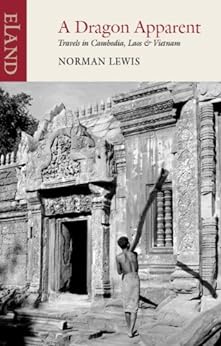
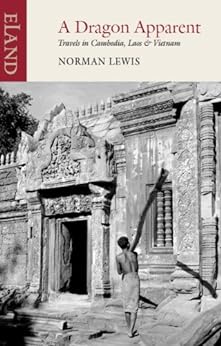
Well, as it turns out, I have just this week returned from travel, having visited my son and his family in Cambodia. This has been my second trip there, and I enjoyed reading Norman Lewis’ book A Dragon Apparent: Travels in Cambodia, Laos and Vietnam (my review here). It was written in 1951 and in parts is racist and stereotyping. So why would I want to read it? Mainly for its descriptions of landscape, the feeling of menace as he aligns himself with the French in an increasingly hostile environment, and the elegiac nostalgia for a lost time and lost culture, given all that was about to happen to these three countries in the following thirty years.
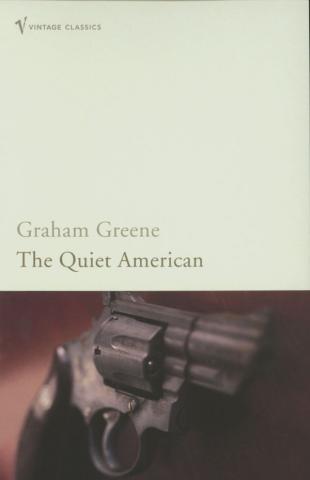
Graham Greene once said that Norman Lewis “is one of the best writers, not of any particular decade, but of our century”. High praise indeed. It is said that Lewis’ book inspired Greene to travel to Vietnam to write The Quiet American which I read before I started blogging. Both books share a reserved, observational tone.
The Quiet American in Greene’s book was Alden Pyle, a CIA agent, posted to Vietnam during the Cold War. Here in Australia we had our own secret agents and Cold War conspiracies, and these are fictionalized in Andrew Croome’s Document Z(my review here).
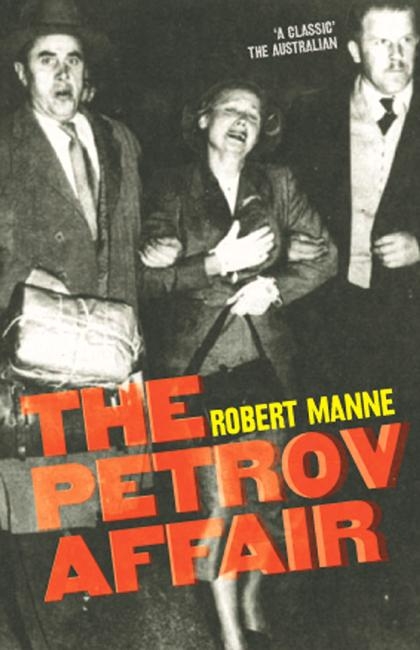
The unfictionalized version is explored in Robert Manne’s The Petrov Affair (again, read before I started blogging). I can’t imagine that anyone could add any more to Manne’s account.
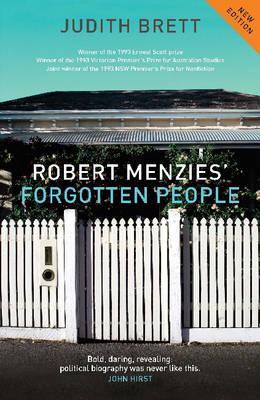
The Petrov Affair fed right into Robert Menzies’ unexpected victory over the Labor Party at the 1954 election. Judith Brett’s Menzies’ Forgotten People describes Menzies’ capture of the ‘middling type’ in Australia through his radio broadcasts and projection of a fatherly-type of Prime Minister that John Howard worked hard to emulate. I would hope that we’ve grown up enough not to need Daddy anymore.
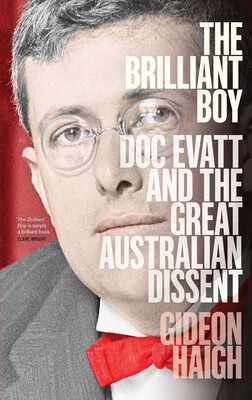
‘Doc’ Evatt was leader of the Opposition Labor Party in 1954, and he appeared as attorney for his staff members when the Petrov Affair culminated in the Royal Commission on Espionage . Gideon Haigh’s The Brilliant Boy explores Evatt’s career as historian, attorney, politician, Chief Justice and President of the UN General Assembly (my review here).
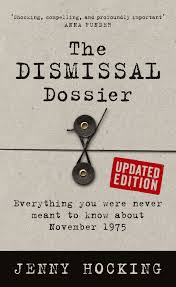
A later Governor-General who immersed himself in Evatt’s historical writing was Sir John Kerr, whose career has been criticized strongly by Jenny Hocking in The Dismissal Dossier (my review here). Hocking has been pursuing the correspondence between Kerr and the Palace for many years – the historian as heroine!
I seem to have immersed myself in politics here, which seems an odd tangent from a travel book!
Any travel book written in 1951 will have aged, and this book is no exception. Indeed, the author Norman Lewis was well-aware that he was writing in the midst of history, noting in his preface that the stalemate in Indo-China had broken after four years, and that as the proofs of his book were being corrected in January 1951, the Viet-Minh were closing in on Hanoi.
It seems certain that before the book appears further important changes will have taken place.
He wasn’t wrong. One of the poignancies of this book is our knowledge, seventy years on, that the world he describes here was about to be obliterated. In the preface to the 1982 version of his book, Lewis writes:
…the greatest holocaust ever to be visited on the East…consumed not only the present, but the past; an obliteration of cultures and values as much as physical things. From the ashes that remained no phoenix would ever rise. Not enough survive even to recreate the memory of what the world had lost.
1982 preface
This meandering book is the story of Lewis’ travels through Vietnam, Cambodia and Laos. By 1951, France had offered independence to its former colonies, but although nominally independent, France still controlled foreign policy, and the French army was stationed throughout. Lewis was not there under the aegis of any press company, and after consulting with the French authorities, he was reliant on their goodwill to enable him to hitch rides under French protection across the three countries. The French Army at the time was at war with the Viet Minh, and so his whole narrative is permeated by a sense of oppression and coercion.
As a British writer, he has internalized much of the colonizers’ racism that sees people as a certain ‘type’. He spends considerable time with different tribes, the Mois, the Meos and the Rhades,distinguishing them from other tribal groups, and there is an elegiac sense that these groups will not survive. He is particularly critical of missionaries and their blithe confidence that they are doing good, and he castigates the planters and their cosy relationship with the French occupiers.
He is reliant on the army to get him from one place to another and he speaks only French and English. There is a lot of waiting around, angling for his next ride. As a result, he interacts mainly with French administrators and residents and those local officials that the French government have been willing to leave in place. He gains access to high places, but always with the permission and imprimatur of the French colonizers. It was almost with surprise that he found a young Cambodian boy who could speak “passable” French, which enabled him to understand more of a local dance performance than he would otherwise. It was only in the last chapter that he gains access to the Viet Minh, through the agency of Dinh, who he met in a doctor’s waiting room. Here he witnesses the influence of China and the Soviet Union in supporting the independence struggle against the French.
It is very much a book of its time in its Eurocentric classifications and descriptions of people and groups. For example, here’s his description of Dinh, his contact with the Viet Minh:
He introduced himself as Dinh- an assumed name, he assured me with a wry smile. I was interested to notice, in support of a theory I was beginning to form, that for a Vietnamese he was very ‘unmongolian’ in appearnce. He was thin-lipped and cadaverous and there was an unusual narrowness across the cheekbones. If not a Frenchman he could certainly have passed for a Slav. There had been many Caucasian characteristics about the other Vietnamese intellectually and revolutionaries I had met, and I was wondering whether whatever physical mutation it was that produced this decrease in mongolian peculiarities encouraged at the same time the emergence of certain well-known Western traits, such as a restless aggressiveness, an impatience with mere contemplation, and a taste for action.
Ch. 20
So what was the appeal for me in reading this racist, 70 year old text? For me, it was his descriptions of landscape. Take, for example, his description of Ta Phrom temple in Siem Reap:
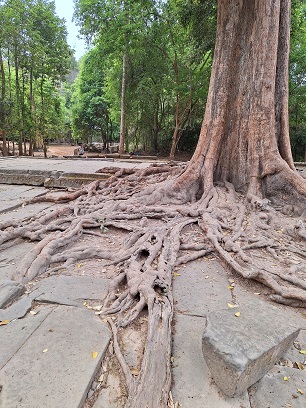
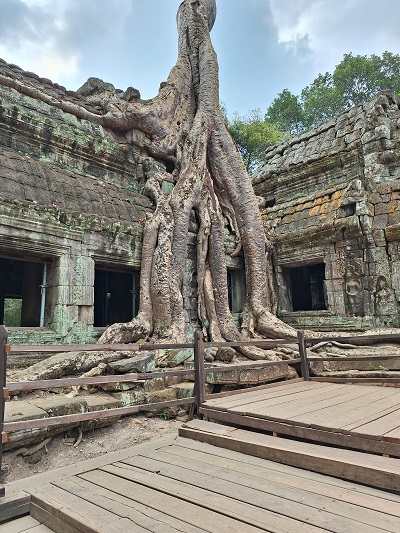
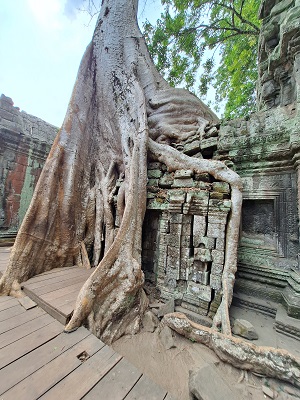
Ta Prohm is an arrested cataclysm. In its invasion, the forest has not broken through it, but poured over the top, and the many courtyards have become cavities and holes in the forest’s false bottom. In places the cloisters are quite dark, where the windows have been covered with subsidences of earth, humus and trees. Otherwise they are illuminated with an aquarium light, filtered through screens of roots and green lianas.
Entering the courtyards, one comes into a new kind of vegetable world; not the one of branches and leaves with which one is familiar, but that of roots. Ta Prohm is an exhibition of the mysterious subterranean life of plants, of which it offers an infinite variety of cross-sections. Huge trees have seeded themselves on the roots of the squat towers and their soaring trunks are obscured from sight; but here one can study in comfort the drama of those secret and conspiratorial activities that labour to support their titanic growth.
Down, then, come the roots, pale, swelling and muscular. There is a grossness in the sight; a recollection of sagging ropes of lava, a parody of the bulging limbs of circus freaks, shamefully revealed. The approach is exploratory. The roots follow the outlines of the masonry; duplicating pilasters and pillars; never seeking to bridge a gap and always preserving a smooth living contact with the stone surfaces; burlesquing in their ropy bulk the architectural [motifs] which they cover. It is only long after the hold has been secured that the deadly wrestling bout begins. As the roots swell their grip contracts. Whole blocks of masonry are torn out, and brandished in mid-air. A section of wall is cracked, disjoint/ed and held in suspension like a gibbeted corpse; prevented by the roots’ embrace from disintegration. There are roots which appear suddenly, bursting through the flagstones to wander twenty yards like huge boa constrictors, before plunging through the upended stones to earth again.
Ch. 15
Absolutely brilliant writing. I found myself rethinking my perceptions -“grossness”- yes, that was the unease that I felt while I was there. Even though many of the villages and landscapes he describes may have disappeared, there is enough remaining that you think “Ah, yes, that’s how it was!” Although I’m not a great aficionado of travel narratives, I think that this is what good travel writing does best: it puts on paper something that you felt, or detected, and it captures it, just right, in words that you wish you thought of yourself.
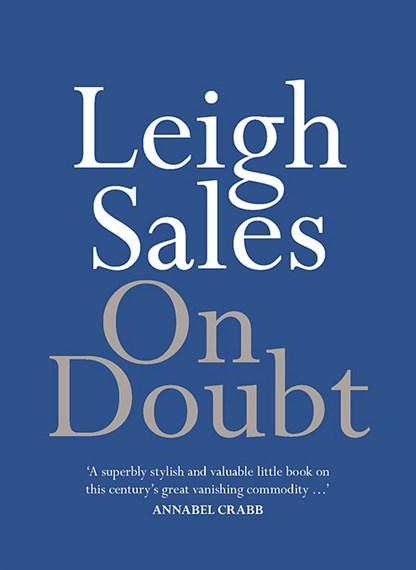
If nothing else, having to prepare talks for my Unitarian fellowship makes me read things I might not have read otherwise. On Doubt, by journalist Leigh Sales is part of the ‘On…’ series published by Hachette, and like the other books in the series, it is only short: in this case only 128 pages.
As a journalist, Sales has had plenty of experience with politicians who come onto her program, pumped up full of talking points and bombast. Her exploration of ‘doubt’ is largely through a political lens, but in Part I she starts by talking personally about her own curiosity and rebelliousness as a child. She rarely accepted anything as a given, and although converting to evangelical Christianity as a teenager, she soon rejected the ‘truths’ of religion that had to be accepted on faith, as well.
In Part 2 she turns to politics, struck by the certainty of Sarah Palin who boasted that she “didn’t blink” when asked to be George W. Bush’s vice president, despite her complete lack of experience. She notes that much of our media today is comprised of commentary rather than research or reporting, marked by point-scoring and moral certitude. This is most manifest in the US television that we receive here in Australia but she reports a similar unedifying spectacle between Gerard Henderson from the Sydney Institute and Robert Manne, who often writes for the Schwartz stable of publications. In the part of the book that was most useful to me, she quotes Pierre Abelard from the 11th century who wrote that the path to truth lies in the systematic application of doubt, and that those who have sought the truth begin from a premise of doubt, not certainty.
However, the expression of self-doubt is not seen as a virtue in politics. She was stunned when former Treasurer Wayne Swan revealed that he (and he assumed, most other people) had times of self-doubt. She compares this with George W. Bush who relied on his gut-feelings, bolstered by his religious faith, to the extent that even the people who surrounded him became uneasy. She talks about gut-feeling, citing Malcolm Gladwell’s Blink which asserts that people who are expert in their field (and that’s probably a very important qualification) use ‘thin slicing’ to instantly identify patterns in current situations, enabling them to make decision in the blink of an eye. But she also recognizes ‘the yips’ that assail someone who is very competent when they start to overthink something that they are already expert in- like playing the piano (for her maybe! Oh, to be good enough to get the yips!)
In Part IV she talk about people like her father, who leave nothing to chance, citing his mantra “Preparation and planning prevent piss-poor performance”. While bridling against the certainty and inflexibility that this approach guarantees, she observes that her own “what if” thinking, shot through with doubt, can lead to anxiety and a lack of all-consuming passion.
She finishes off in Part V with a post-script written in 2017, eight years after the original book. In those eight years, she suggests, we have become accustomed to distortion through social media, and we accept with equanimity the shrugs of corporate bosses and the misrepresentations of politicians. While refusing to divulge her own political leanings, she decries the idea of ‘balance’ which gives equal time to both sides.
As you can see, this book is a bit of a grab-bag of observations, not all of which are closely tied to the theme of ‘doubt’. It could almost do with another post-script, given the rise of deep fakes and AI which frighten me for the way that they undercut even what we have seen (or think we have seen). However, it’s an easy enough read- not unlike a long-form article that remains at a largely surface level and with its main interest in the political realm.
My rating: 6.5/10
Sourced from: borrowed e-book from Yarra Plenty Regional Library.
Emperors of RomeEpisode CV Spartacus the Gladiator. Did you know that I have never watched ‘Spartacus’? He led a rebellion in 73BCE and it took three years for the republic to finally crush it. At first the Romans just saw it as a petty rebellion, but over time they realized that they had to take it more seriously. There had been previous slave wars in Sicily on the large estates during 2BCE but Spartacus’ rebellion took place on the mainland of Italy. Spartacus was from Thrace, and he had previously served as a soldier with the Romans, but he ended up as a prisoner (because of desertion?). He was sent to the Gladiator School in Capua. His uprising had initial success, and originally grew to between 70,000 and 120,000 slaves. There were two other leaders of the rebellion, but you don’t hear much about them.
History ExtraFrom Russia to Texas: the Search for a Jewish Homeland. We’re watching the search for a Jewish homeland (or rather, the assertion of a Jewish homeland) playing out on our screens night after night. At the turn of the 20th century, millions of European Jews were seeking an escape from antisemitic persecution, especially from Russia, where they were restricted to the Pale of Settlement. The idea of Zionism had arisen a few years previously, and there was a flood of emigration to New York, where there were no immigration quotas, and over a million Jews had congregated in the Lower East Side. Things were getting desperate and when Uganda offered a homeland, the Jewish community was split between those who wanted Palestine-or-nothing, and those who saw Uganda as a short term fix. Actually, it wasn’t even Uganda, it was Kenya, which shows how nebulous the thinking was. Australia was approached too, but it rejected the proposal. Galveston had recently been devastated by a huge storm, and when it was suggested that Jewish people could immigrate there, the idea was attractive because so many other people had left town.
The Rest is HistoryEpisode 420 Britain in the 1970s: Thatcher Enters the Ring is the final episode in this 4 part series. Five days before the October 1974 election there was a bomb blast in a Guilford pub. People felt impotent to stop the IRA bombing, even though there were arrests (which ended up being the wrong people arrested anyway). Ted Heath, the Tory opposition leader, presented himself as the leader of a unity government, supported by the very visible Margaret Thatcher, and promised to cap the interest rate on loans at 9.5% (a very un-Torylike action). Liberal leader Jeremy Thorpe travelled on the hustings by hovercraft, and when it sank, it seems a metaphor for the country. It rained all the time, and people were sick of these Heath/Wilson electoral contests- this was the fourth time they went head to head. The Daily Mail did a special on Wilson’s finances, digging up the dirt on school fees and Swiss bank accounts, but they didn’t publish, preferring to leave it hanging over his head. Wilson ended up with a 3 seat majority. Then 5 weeks after the election there was another bombing, this time in Birmingham, and again they arrested the wrong people. Heath refused to give up the leadership of the Conservatives, even though he had lost four times in a row. Another Conservative, Keith Joseph decided to challenge, but after a disastrous speech in Birmingham, he stepped back from the leadership challenge and Margaret Thatcher stepped forward. And literally, the rest is history.
The Daily A Journey through Putin’s Russia This was recorded on the day that Russians went to the polls, but everyone knows what the result is going to be. Even though the West expected Putin to suffer from the deaths in the Ukraine war, and the economic sanctions that were imposed as part of the West’s response, he has a 86% approval rating and 75% of people think that Russia is heading in the right direction- his highest number ever. His generous compensation payments to the families of impoverished Russian men who volunteer for the Army mean that even bereaved families support Putin, seeing it as a war against the West.
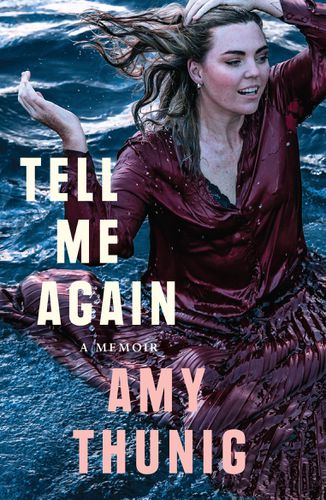
I’m often rather amused by (dismissive of?) a memoir written by someone under 40. However, in this case Amy Thunig has packed a lot of living into her forty-odd years. She is obviously of a different generation to me: I had never heard of her, despite contributions to Buzzfeed,Sydney Review of Books, IndigenousX, The Guardian, Junkee and a lively online presence. She is a Gomeroi/Gamilaroi/Kamilaroi woman, writer and academic and this book is a series of essays on her life.
In her prologue she writes:
I often wonder about timelines and the way a Eurocentric view positions time as linear but as Indigenous peoples we are raised to understand time as circular. Within a circular understanding of life: time, energy and generations coexist. Coexistence with and within Country on lands, within waterways, and skies. Our accountability and obligations are therefore to our ancestors, and our descendants, as well as to ourselves….I do not know the simple way of saying that child-me could see and feel future-me, that our coexistance within circular time meant we conversed and encouraged one another, and as we are one and the same, I knew where I would land even though I could not see how I would journey there. Exchanges of energy and love, across time spent in the locations, encouraged by ancestors.
p.2
This circularity is reflected in her writing, which consists of a large number (28) small-ish chapters of about 4-8 pages, usually introduced by a current-day, or at least a future-me, reflection, before launching back into memoir. This gave the book the feeling of being a series of essays or writing exercises, although perhaps she does not yet have enough distance to impose onto this writing a broader, overarching theme.
It must be that future-me that brought the child Amy through a childhood and adolescence in 1980s Australia that would have defeated many other children. She was the second of four children, and both her parents struggled with drug addiction, and her father spent some time in jail. The family shifted several times although her grandparents, particularly her Pop, remained points of continuity in her life. Despite some appalling instances of racism and classism by teachers, she did well in school and maintained the appearances of an engaged after-school life of dancing, school performances and after-school jobs despite a chaotic and violent home life and poverty. This culminated in being kicked out of home in late secondary school and couch-surfing while continuing to attend classes. She did well, and attended university, moving through undergraduate, graduate and finally PhD level but always aware of the precariousness of the image she was adopting, drawing comfort from other indigenous academics in the academy.
She proudly proclaims her indigenous heritage in the reflections that launch each chapter, as she returns to, and draws strength from Country. She speaks of the influence of her ancestors, and her present-day passages mention the aunties and elders who surround her. However, the discrimination and cruelty that she experiences as a child is not voiced as racism, even though racism underlies it. As a daughter she feels the stigma attached to her parents’ drug-addiction and imprisonment, which applies to all children in similar circumstances (although the high representation of indigenous people in prison means that this would be a more common experience for indigenous children). She speaks often of the influence of her grandparents, but support from her broader extended family seems to be absent, especially when she is homeless. There does not seem to be any involvement at all of formal indigenous organizations. She is largely silent about the political aspects of her aboriginal identity, even though it clearly fundamental to her experience and story.
In one of the last chapters of the book she writes:
The journey of reconnecting with my parents was a slow and clumsy one. It began with a desire to have them there for big moments- I missed them. It involved the realisation that while they had struggles, and sometimes those struggles had hurt me, unlike other people I met when away from them, they never sought to hurt me… Reconnecting with my parents, and understanding them, were two unrelated journeys. I didn’t understand my parents, even when I started to reconnect with them. You don’t have to understand fully to begin to accept in part, and I continued to be deeply resentful for many years, believing that they actively, consciously chose drugs over me. That it was a binary and I was the lesser option.
p. 249
It was only when she was given a synthetic heroin painkiller in hospital in her twenties that she realized that using brought a sense of silence.
That was when I began to understand that the nothingness is the bliss. My parents have experienced high levels of trauma- generational and individual- and all without the supports needed to actively heal…They weren’t choosing heroin over me; they were choosing quiet over the overwhelming noise. It was then that I moved towards understanding, and my resentment began to ease a little.
p.250
Personally, I don’t know if I could overcome my resentment and I wish that she had explored this in more detail. Perhaps her adult relationship with her parents is still a work in progress, and too close to be written about yet. But to even reach this point of understanding and reconnection suggests that she is ready to write this memoir, despite still being relatively young.
My rating: 8/10
Read because: I read a review in the Saturday Paper


 The Resident Judge of Port Phillip