
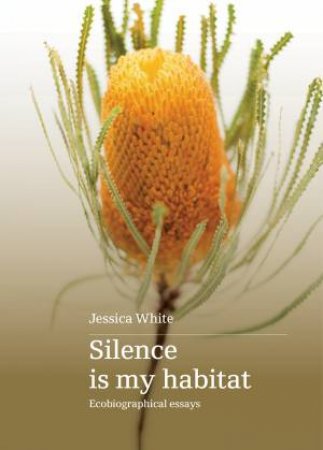
The subtitle of this book is ‘ecobiographical essays’. What a many-stranded thing biography is becoming! Jessica White, the author of these essays and other academic work in the field, defines ‘ecobiography’ on her website in this way:
While a biography chronicles a person’s life, an ecobiography details how a person’s sense of self is shaped by their environment. My forthcoming essay collection, Silence is my Habitat: Ecobiographical Essays, details how deafness shapes my relationship with different environments, such as the bush, bodies of water, archives, and institutions.
This double focus – i.e. deafness or Deafness (she notes the distinctions of that capital letter) as both identity and medical condition, and the physical environment- permeates these essays, which range across both her personal and academic experiences. I admit that I’m not absolutely convinced that her approach needs the specific genre-descriptor of ‘ecobiography’ : is really a separate strand of biography or just a particular consciousness of environment on the part of the subject or on the part of the narrator?. In locating them as essays, she picks up on the etymology of the word ‘essay’ as her attempt to ‘trial’ and ‘try’ her responses to a subject, and to explore her own identity as woman and writer, after the death of her mother.
There are a number of themes that emerge through this collection of eleven essays. The first, as suggested by the title, is that of deafness. “Silence is my habitat” was a comment that the poet Judith Wright made to Heather Rusden in a 1990 interview, one of the few times that Wright discussed her increasing deafness. Reflecting, perhaps, the emphasis on identity in the intervening thirty years, White seems almost frustrated that there are no specific references to deafness in Wright’s poetry, although she and other scholars have detected it in the ‘negative poetics’ of her work- singing the praises of the natural world while acknowledging the inadequacy of words to describe it. When asked why she had not chosen to write about her deafness, Wright replied “Oh, I wouldn’t say it was a choice. I haven’t felt that it was an important part of my life in that way” (p.74). That could not be said of Jessica White. She writes of how meningitis as a three-year old robbed her of all hearing in her left ear, half the hearing in her right ear, and possibly some scarring on her brain (p. 17). She consciously seeks out writers who are conscious of sound and deafness including Fiona Murphy, poet Ilya Kamisky and the online Deaf History Collection of the writing, images and artefacts of deaf people. She explains the difficulties of architecture and the design of academic teaching at university, and how it has exacerbated the workload of a deaf tutor. She titles her essay about the shutdown of borders with COVID as “We Were All Deaf During the Pandemic”.
White shares with Judith Wright a deep environmental consciousness, which she expresses in her essay on Golden Orb spiders in her essay “Quintessence” and bird song- which she can hear- in the essay “On the Wing”. This alertness to the natural world runs through White’s academic work on Georgiana Molloy, the West Australian botanist who arrived in 1830. Molloy appears in the chapters “Intertwining” and ” Unseamed”, while White’s own grappling with her research and writing about Georgiana Molloy filters across different essays. In “Intertwining” where she describes Molloy’s experience in childbirth and loss of infant children, she explores – very honestly- her own yearning for a child, set against her partner’s refusal to have children, and her own awareness that the time for having a child was passing.
“The Breath Goes Now” focusses on her mother’s death: always a confronting event, the tenor of which is often shaped by the relationship between mother and child. In White’s case, it was her mother who was encouraging her to finish her book on Georgiana Molloy before she died- a comment made only half in just as her mother’s chronic lung weakness was curtailing her activities and life. Indeed, these essays emerged as a response to her mother’s death, when she found the architecture of her book and all those words collapsing. Ah Jessica- the death of the remaining parent is another event to be confronted yet, with all the questions it raises about your own identity as child when you no longer have parents.
These essays are beautifully written, as they approach her overarching themes tentatively, circling around them, advancing towards them, then retreating or splintering off to other safer ground before moving forward (literally essay-ing) again. Most of them are between 10-20 pages in length containing many short shards, like a flow of thoughts, asterisked to separate each one from the other, which is a writing style and fashion I am becoming less enthusiastic about, I must admit. They are very honest, especially those describing her relationship with her partner Bruce: perhaps too honest, when she re-reads them twenty years hence? But this honesty is also what gives the reader a feeling of intimacy with the author: a Garner-esque feeling that you have been having a good chat with an intelligent, sensitive friend.
My rating: 8.5/10
Read because: I encountered Jessica in the Australian Womens Writers Challenge a few years back, was aware of her work on Georgiana Molloy, and was interested to see what she’s doing now. Or does that just mean ‘nosiness’?
 The Resident Judge of Port Phillip