
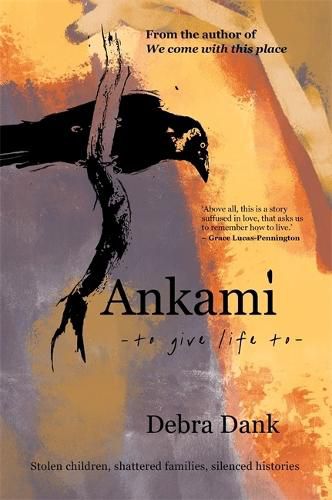
Both visually and in its subject matter, this third book by Debra Dank and her first We Come With This Place (see my review here) are linked. However, the tone of this book is different: instead of being a celebration of family, country and continuity as her first book was, this book is infused with an anger which is moulded into regret. The beautiful writing is still there, but there’s an injury here as well. I wonder if the timing of this book has something to do with this? It was published in 2025, post-Voice Referendum. I see the defeat of the Referendum as a mean-spirited rejection on the part of white Australia of the responsibility to listen – something that Governments seem happy to do with lobby groups, particular religious groupings and big business, but not our First Peoples whose ‘brand’ we blithely adopt at international events like Olympic Games and tourism advertisements.
She herself acknowledges her anger, which she capitalizes with an Upper Case A. As soon as she awakes, her uninvited bedfellow Anger whispers to her and causes her body to tighten. As she tries to locate where Anger comes from, she moves to “the outskirts of my reminiscence”, where she finds
sombre sub-memories that suggest the what might have beens, the sentient breathing of those who did not have the opportunity to make themselves more substantial by their living, but I find them there all the same, prowling like misshapen birds waiting to tell a calamitous story. I know too much about those birds, their earthly form an unsettling combination of shiny black feathers and yellowish beaks, staring eyes… and about their stories. They are often around, the flapping of their wings and their cawing voices adding to the daily rhythms of my living steps, but inside, with my unseen companion, Anger, they seem to offer obscure warnings of imminent and dire happenings. (p. 34)
So what has happened between her first and second books? Certainly in We Come With This Place there is violence and injustice but her Anger/Regret in this book starts as whispers from aunties who tell her of voices “all them kids” that cried at night, and older women in the community who urge her to go up to the islands in the north because her father had family there. When she asked her father, he denied that he had any other unacknowledged siblings. There was an appointment with an Aboriginal agency trying to link up families again that seemed to be fruitless. Then there was the unsolicited and unexpected phone call from a woman who was putting together and thought that they might be related on account of their shared name. There was silence when Debra told her that she and her father were Aboriginal. There was a silence. “Oh well, um, that’s nice. Er, you have a nice day”. (p. 81)
Then there is finally, definitely, the documents that she located in the National Archives.
Time collapsed in those moments of opening the attachments and doing the cursory read that I thought would be adequate to find what I had assumed was waiting to be found. I was looking for an easy telling of names and places and times that I already knew, not this thing that greeted me with a wicked and vengeful eye. In that moment I was so very grateful for those documents but there was an awful, almost hateful, separation too. I discovered that my father had not one sibling but four, who were taken, that my paternal grandmother had given birth to ten children, not the six that I had known about. Those four others seemed to be part of the Stolen Generations, and later, as I sat in silence to process that, I remembered that there had been whispers. (p. 62)
What seems to be particularly galling is that these four children are an absolute void. They are not named, or numbered. The document from the National Archive was a letter advising of the death of her maternal grandmother, the mother of 10 children. Her youngest child had died, and the other living five children were on the Alexandria station. The author of the letter didn’t know where the other children were.(p. 94) When the protector arrived up at Alexandria station, he expected to find the children there, but “I understand it is the practice to trade workers between this one and that”. (p. 87)
In the Redfern speech in 1992, Paul Keating (or Don Watson his speechwriter) spoke of the failure of imagination on the part of White Australia. Despite the bland language of the time, it doesn’t require a great deal of imagination to recognize child removal or slavery.
Here is the ‘Ankami’ of the title: “to give life to”. Her book gives life to these children of the absence. She recognizes that it is not anger, but sorrow at the ‘should have beens’ of these four missing siblings, aunts and uncles, and the web of cousins that might have been wrapped up into the family, as she had been.
I realize that I’m not angry at all, that what I’m feeling is loss, loss that is pervasive and soul deep and profound. I see now that wandering through my body to eventually arrive at what may be close to my soul, that careful travelling gaze found the site that hosts my sorrow. I live with long term loss that is impossible to grieve for because I don’t know who I should miss. I didn’t learn their faces. I didn’t feel their joy or wrath; they never taught me the things they needed to teach me as much as I needed to learn them. Mostly I don’t know how to miss them because they were never there, merely half-imaginings on that opaque edge of my knowing of what should have been, but they’re there in ways that I can never escape because they’re in my blood. And somehow I’m grateful for that because they deserve so much more than to only exist in that horrible arrangement of ink. (p. 177)
Danks spends quite a bit of time in this book talking about fruit cake, which seems a paradox. It is a fruitcake from a recipe brought from Scotland with the ‘settlers’ of her family, that has been handed on from daughter to daughter. She talks about her non-indigenous father-in-law’s stories of his childhood and the perils of surfing and the sea, stories that he had told many, many times before. We all have history, but only one history is told; only one history is recognized.
I think there is a particular kind of superficial living gripped by folk who hear only one history, only one way of thinking…let’s all be truly courageous about owning our entire history and acknowledging all of it, and then be proud- an informed pride, rather than one that is steeped in wilful ignorance. (p. 111-2) …. The central truth in this story is that all Australians now benefit from what was done to my family and to almost all other Aboriginal families in Australia and it can only heal us all to admit that much at least. But I don’t know that such a young country has the maturity to accept that. (p. 179)
It doesn’t. This is what Australia said ‘no’ to.
This book is confronting and asks difficult questions that we don’t want to answer, but it is not bashing you over the head with guilt. As Antonia Pont, who wrote the Foreword notes, the book “circles, spirals, sidles close to, and also confronts legal, political, communal and personal facts and happenings, with a rigorous yet not overplayed scholarly knowledge of the detail” (p.xii) It is a bit like probing the skin around a wound: touch, flinch, but touch again more gently. Such grace in allowing us the space to be so tentative, but still quietly insistent that there is much work yet to be done. ‘Ankami’ has been shortlisted for the 2026 Victorian Premier’s Award. It didn’t win, but it would be a worthy winner.
My rating: 9/10
 The Resident Judge of Port Phillip