
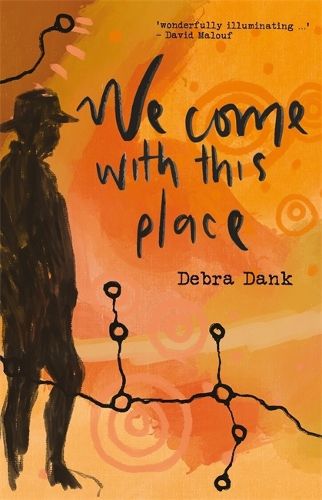
As a local historian and having lived all my life within a 10 km radius, I have a strong sense of place, but I acknowledge that it is not the same as the First People’s sense of Country. That’s Country with a capital C, and there’s no ‘the’. It’s just Country, and I respect First People’s embeddedness in it, but deep down I know that don’t really understand it in the same way. Debra Dank’s We Come With This Place is probably the best explanation and expression of it that I have read.
Dank is a Gudanji/Wakaja woman: teacher, wife, mother and grandmother. She grew up in Camooweal in Queensland but her family, are from the south-western Gulf of Carpentaria and their dreaming is the three travelling Water-women, birthed from the salt water, who became the first tellers of stories and grew the country as they moved through it. The Water-women, and the knowledge of water runs through this book, opening and closing the narrative. This is probably the only conventional part of the telling, as different generations’ stories are interwoven without clear signposting, and as pain and abuse occur over and over again.
The introduction to the Yoorook ‘Truth be Told’ report spoke of putting First Peoples’ Stories against the written, European histories. A number of years ago, historian Ann McGrath wrote a history Born in the Cattle (1989), which used oral histories to tell the stories of Indigenous people living on pastoral stations in the Northern Territory, a ‘no-shame’ job which enabled the cattle workers and their families to live on Country, maintain traditional obligations, and earn a living. It seemed a rather rose-tinted analysis even at the time, and seems even more so thirty years later with our later knowledge of the Stolen Wages, and the Massacre Map. Dank herself gives a different view of the pastoral workers’ life through her father’s story, and through her own as well, as she spent several living on stations with her family, where they were treated with varying degrees of acceptance.
Her father, Soda, was born on the banks of the birthing creek on Wakaja Country, on what became known as Alexandria Station. After witnessing his mother being raped, and accused of poddy (calf) stealing and pursued by white co-workers on the path of vengeance, he escaped the Station and crossed the Queensland border into Camooweal, where he met Dank’s mother and married her and established a family. The indigenous community is not necessarily supportive of marriage between indigenous partners: Soda’s mother-in-law, an Indigenous woman who was protective of her status in a small, tightly-knit Methodist community, reported Debra’s birth to the Aboriginal Protector, who at that time had the power to take lighter-skinned children from their families. It didn’t happen in this case. Debra’s mother, who had benefited from Westernized schooling, put a heavy emphasis on education, and indeed she oversaw not only her children’s education when the family was living on a pastoral station, but that of the station-master’s children as well. Her father could neither read nor write. Her love for both parents is unmistakable, but she is clear-eyed about domestic violence within her family, and the recurrent injustice, racism and pain that recurs across the generations.
Despite her maternal grandmother’s hostility, Dank had a close relationship with her grandparents and from them she learned about Country. Her descriptions of camping, of tramping through desert scrub looking for water, and the vast landscape are beautiful. Through a series of short chapters, she tells of the lives of her grandparents (and further back) and parents but she does not necessarily help the reader by giving a straight-forward chronological account. At times, I found myself flipping back to see whose story it was – her father’s? Her grandfather’s?- but I’m sure that this is intentional. Violence and dispossession seeped through the generations, as did the love and knowledge of Country. It’s a love and knowledge that she is giving to her children, and to us too as readers. The cyclical story pattern reflects First People’s story-telling and its sense of time and patterns. She uses language as well, without the support of a glossary at the back, and so you need to deduce the meanings of words which, ever the teacher herself, she uses several times within a few paragraphs so that you can work out the context.
I was particular struck by one passage where she describes looking for food in desert country with her father, on land that was not their country. I realized that our Acknowledgements of Country embody similar sentiments, but without the promises of benign intention.
We had been cautious when we approached. Dad had been extra careful to talk to that place and to assure the old people there that we were coming to gather some food, and to let them known who we were and where we had come from. He went on to tell them we meant no harm and we would take only enough to feed us on that day, that our country and our people, like us, were grateful to be given food there. We would leave enough to share with the turkeys that would arrive soon, he assured those that dwelt there. And they were kind to us. We had enough to satisfy our needs, but it was always like that. Talk to the country, talk to old people, talk, talk, talk. Talk your story into this place to sit there with the ancestors. (p. 104)
If only we were able to acknowledge country so honestly.
This book was shortlisted for several awards in 2023, and it won four categories in the NSW Literary awards, the Australian Literary Society Gold Medal and the University of Queensland Non-Fiction award that year. It deserved such recognition. It is very, very good.
My rating: 9/10
Sourced from: Yarra Plenty Regional Library
Read because: I borrowed her most recent book about her family story, and I realized that I should read the original book first.
 The Resident Judge of Port Phillip
Pingback: ‘Ankami’ by Debra Dank | The Resident Judge of Port Phillip