
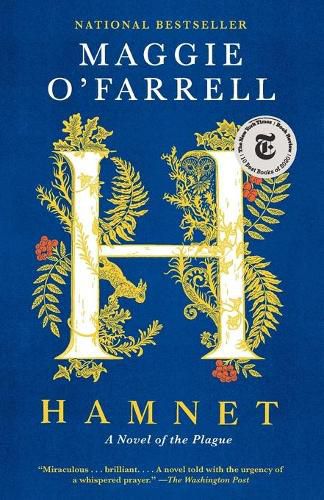
This book has been around for a while, but the recent release of the film starring Jessica Buckley and Paul Mescal has brought it to attention again. There was some surprise that O’Farrell’s book was not longlisted for the Booker Prize in 2020, but it did win The Women’s Prize for Literature, as well as other awards in 2020 and 2021. I’ve read several books by Maggie O’Farrell e.g. This Must Be the Place (my review here), Instructions for a Heatwave (review here) and The Marriage Portrait (review here). On looking back at my own reviews, I seem to have a rather ambivalent response to her writing.
One of the epigraphs to the book quotes Shakespeare scholar Steven Greenblatt’s assertion that in the late 16th/early 17th centuries the names ‘Hamnet’ and ‘Hamlet’ were interchangeable. Just as the book title ‘Hamnet’ is a manipulation of the ‘Hamlet’ we know as Shakespeare’s play, so too this book is a manipulation of a detail from Shakespeare’s life. Not once is Shakespeare named in the book, and although we know that the play referenced at the end of the book is ‘Hamlet’, it is not definitively stated anywhere. But right from the start of the book, where 11 year old Hamnet is roaming his house seeking a family member to help his sick twin sister Judith, echoing the opening graveyard scenes of ‘Hamlet’, we as readers know what O’Farrell is doing.
Ann Hathaway is not Ann who ended up with the second-best bed, but Agnes, a skilled healer and herbalist (in fact, the bed is mentioned). There is little known about her, but O’Farrell is not the first writer to try to flesh her out in more details – Germaine Greer has done so, too- but owing to the dearth of information, this needs to be a work of conjecture and assumption. O’Farrell’s Agnes comes from a wealthier family than her husband does, and they meet when her future husband takes up a Latin tutoring job in order to pay a debt sustained by his violent and feckless father. They intentionally fall pregnant, to force a marriage opposed by both families (although I seem to remember research from my undergraduate days that suggested that pre-marital pregnancy was not unusual, or a source of great shame). Her father-in-law continues to exert his power over his son, who lives in a smaller building adjoining the family home, and it is only when Agnes and her husband contrive to sell the family business’ gloves in London that her husband can embark on his career of writing, producing and acting in the plays that will make him famous.
But this book is not really about Shakespeare, who is absent for most of it, but about grief for a lost child. Both parents keen the death of 11 year old Hamnet, and Agnes is completely undone by her sorrow and her impotence to stop this plague-borne death. Hamnet’s twin, Judith, who looks so similar to him (plausible?) wants to know whether there’s a word for a child who has lost their sibling, as she walks the streets at night, hoping to glimpse him or sense his presence. O’Farrell writes this grief so well, with truth and experience at its core.
The book starts with two interwoven narratives, both voiced in the present tense: the first narrative introducing us to the members of the family, focussing on Hamnet as he searches for someone to help his sister Judith as she collapses with plague, and the second narrative a flashback to the meeting of Hamnet’s parents and their marriage.
The second part of the book is one long chapter following Hamnet’s death. It gradually moves towards the father’s career as playwright and suggests that the writing of ‘Hamlet’ is his way of working through his grief. Although the first 2/3 of this chapter was excellent, I wasn’t particular convinced by this end section, mainly because the play Hamlet has such a tenuous link with the death of a child. I found the argument put forward in the recent BBC three-part series Shakespeare:Rise of a Genius on ABC i-view more convincing where they suggest that it was the death of his father, and his questioning of his own responsibility as an adult son, compounded by the loss of his own son in Hamnet, that prompted his writing of ‘Hamlet’.
However, for me this didn’t particularly matter. There are 21st century infelicities right throughout this book, and although O’Farrell has clearly done her homework about Elizabethan family life, it’s not in the league of a Hilary Mantel. I didn’t read it to learn about William Shakespeare, or his wife Anne for that matter; but as an exploration of grief, it’s excellent.
My rating: 7.5/10
Sourced from: purchased e-book
Read because: I can’t decide whether to see the movie, and I wanted to read the book first if I do.
 The Resident Judge of Port Phillip