
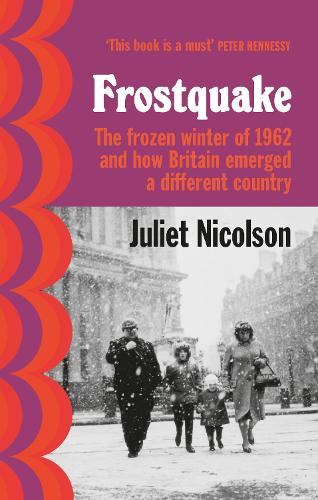
Well, it only took five years between hearing a podcast about this book and being inspired to purchase it, and actually reading it. And even then, I was spurred to read it because I’d like to read Andrew Miller’s The Land in Winter, set in the winter of 1962-3, which was short-listed for last year’s Booker Prize. Interestingly, Miller’s book also won the Walter Scott Prize for Historical Fiction, with the events of sixty years ago now considered history.
Frostquake, on the other hand, positions itself very clearly as ‘history’, telegraphed with the subtitle ‘The frozen winter of 1962 and how Britain emerged a different country’. In it, Nicolson argues that the winter of 62-63, the coldest since 1814, crystallised a tension between the old and the new. The old: Winston Churchill, Harold Macmillan, the continuations of the poverty of the Industrial Revolution, with 15 million people still lacking a plumbed-in bathroom. The new: JFK, Harold Wilson, the Beatles, consumer goods like televisions and refrigerators, glass office-blocks.
There are moments when society, however embedded, shifts on its axis. The long and lingering hardships of the paralysing winter of 1962-3 encouraged, even enabled, change: the very effect of shutting down empowered a thawing. Forces of social change that had been building over many years now found their moment of release as they broke through the icy surface. As the country froze it melted. (not sure about the page number because I read this as an e-book)
So what is a frostquake? One of the epigraphs to her book is a definition from an unnamed source:
Frostquake (n) A seismic event caused by a sudden cracking action in frozen soil. As water drains into the ground, it may freeze and expand, putting stress on its surroundings. This stress builds up until relieved explosively in the form of a frostquake (p. vii)
However, this book is not about weather or geology, although the snow and ice that started falling and forming for 10 weeks from Boxing Day 1962 through until to spring give the book its narrative parameters. Instead, this book is far more about people and their overlap with events on a national and world stage, drawn from conversations, memoirs and interviews. Some of these people are unknown: 19 year old Pauline Stone, driving through the mustard-like fog in her Mini Minor; Terri Quaye a 22-year old black jazz singer, Corporal Dennis Osbourne, travelling with his family on the Liverpool-to-Birmingham Express, which collided with the Glasgow-London express because of poor visibility. They each have a small story, of which the weather is just background.
But many of the people that Nicolson writes about are well known: Joanna Lumley talks about the cold at her boarding school; the Beatles are being transformed from scruffy, rather smelly hack musicians playing the clubs and careering from gig to gig into suited songsters who appear on the television; Mick Jagger and the Rolling Stones are London fixtures- Mick and Brian Jones sharing an Edith Grove flat, and with Mick taking on board the advice of Andrew Oldham, 19 year old window dresser at Mary Quant’s shop and music promoter “If you pretend to be wicked, you’ll get rich”. There’s the eruption of satire on the television, with comedians Peter Cook, Dudley Moore, Barry Humphries and Alan Bennett thriving into the 1970s and later. Author Antonia Fraser floats in and out, as does fellow author Penelope Fitzgerald. There’s a lengthy section on Sylvia Plath, who committed suicide in February 1963, in the depth of this cold winter.
Not only do other people, both famous and unknown, appear, so too does Nicolson’s own family. When she talks about spending Christmas of 1962 at her grandfather’s house at Sissinghurst, the penny dropped- Ah! She’s the daughter of Nigel Nicolson, who wrote Portrait of a Marriage, and the ‘Nicolson’ in the publishing company Weidenfeld & Nicolson. And so, she’s the granddaughter of Harold Nicolson, many-partied politician, who supported the decriminalization of homosexuality and the abolition of hanging, opposed the Munich Agreement with Hitler, published Lolita and disagreed with Anthony Eden’s Suez policy. And the granddaughter of Vita Sackville-West, who had died the previous summer.
Her upbringing in a political milieu is reflected in her attention to the Profumo Affair in particular, and the entanglement of the various characters who appear throughout the book. Nicolson herself received a pinch on the bottom from John Profumo, a one-time parliamentary colleague of her father, when he came to see the garden at Sissinghurst some thirty-years later. The glamour of JFK is here too, a contrast to the dowdiness of the Edwardian-figure of conservative Prime Minister Harold Macmillan whose career was derailed by the Profumo Affair. The anxiety of the Cuban Missile Crisis pervades the book, and Britain is being rebuffed from the European Economic Community by Charles de Gaulle.
The writing is quite beautiful. Here she is waking up on the day after Boxing Day 1962 as the snow begins to fall, the most snow they had ever seen in their lives:
The following morning we woke to the peculiar blue-bright light of reflected now filtering through the closed curtains. Instead of disappearing during the night as we had feared it would, the snow was still there, turning the landmarks of the garden- the walls, lawns, statues, urns- into something unrecognizable but unified. The sight was beautiful, its very transience on this familiar landscape making it even more precious. Snow muffled all sound and the silence felt dream-deep. Outside freezing snowballs melted the second they hit the napes of our necks and we tipped backwards on to the lawn, arms outstretched like acrobats, trusting that the mattress of snow would break our fall. Unlike a sandcastle on a beach, absorbed so soon by the waves, our imprints remained, hollows into which we could flop again and again. (Ch 7)
She returns to the silence of the snow-bound world at the end of the book, writing in the midst of COVID which brought its own silence to us. Writing in the winter of 2019-20, the daffodils and forsythia had just begun to blossom, and suddenly the earth felt lit up by yellow flowers.
Sixty years before the winter of 1962-3 the century had just turned and with it the old Victorian regime was dying. Sixty years after the winter of 1962-3 the world turned again, a little more sharply than it should have, unbalancing the stability we take for granted and throwing everyone into a state of profound shock….In December 2019, on a world map shown on every single news channel, a tiny red dot indicated a town in the heart of China, a million, million miles away from England, as the place where a brand new strain of a deadly virus had emerged, one that targeted the lungs, the enabler of breath, of oxygen and of life itself. Eight weeks later the dots had spread, and much of the world map was coloured red. In the autumn of 1962 many felt we were teetering of the edge of absolute destruction with nuclear weapons capable of wiping out mankind. And now, in the spring of 2020, the coronavirus, constantly visualized on screens as a spiky globe, an exotic species of underwater coral, a logo of frightening change, made us feel we were once again staring into the abyss, looking over the rim…. The country lanes were silent not this time because of the muffling of snow but by the absence of traffic. The world was in lockdown. The skies were blue, blue, blue, devoid of aeroplanes, not through mankind’s choice but for its survival. And the birds were going crazy in the sunshine. Nature seemed to have forgiven us not for doubting but for threatening its resilience and had returned once again with an astonishing beauty….Perhaps every half-century or so we need an intervention that is outside our control, an uninvited pause in order for resurrection to take place.
I enjoyed this book. I’m old enough to recognize the things she is writing about- indeed, the author and I are nearly contemporaries, and I do wonder if someone younger would enjoy it as much. It was not at all what I expected, which was a far more journalistic, meteorologically based account, but enjoyed the political and personal approach much more.
My rating: 9/10
Sourced from: purchased e-book
Read because: I heard a podcast with the author.
 The Resident Judge of Port Phillip