
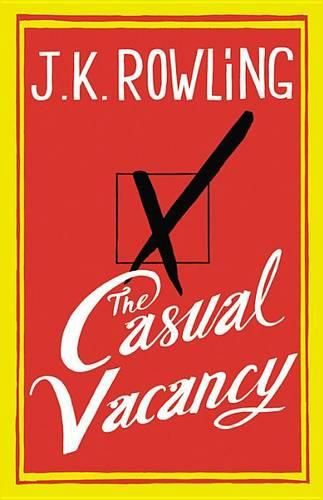
As I have related several times in this blog over the years, when I was young I read Hans Christian Anderson’s The Snow Queen. In that story, a shard from an evil, broken mirror entered the eye of a little boy, Kay, who from then on could only see ugliness in everything. I think that J. R. Rowling may have a similar shard in her eye, at least in this book. It was her first book for adults, written after the Harry Potter series that had captured young readers and accompanied them into adulthood. It is ugly, snarky and ends in a tragic melodramatic conclusion. I was hooked, after a very slow start, but in the closing pages of the book, I just thought “this is ridiculous”.
I’ve always thought that Rowling is very good with her beginnings, particularly in her Cormonan Strike books- three pages and you’re in. She starts well here too, with a death in the first few pages, but instead of jump-starting the book, the impetus dissipates as various people in the fictional town of Pagford learn that their local councillor Barry Fairbrother has died. The ‘casual vacancy’ caused by his death prompts a local election to fill his seat, and Rowling introduces a wide range of people who are taking a particular interest in this election.
Pagford is an older town, established in the days when ‘parishes’ were the backbone of local government, but time has brought many changes. A council estate called rather ironically The Fields, with low-income and social housing, had been built nearby and had been attached to the Pagford Parish. At the time of Barry’s death, the council had been engaged in negotiations to sever The Fields, and have it come under the jurisdiction of the larger, more modern city of Yarvil. For many Pagford ratepayers, this would shift the problem of drug addiction and social dislocation onto another council but Barry Fairbrother, as a former Fields boy himself, was leading the push to have The Fields remain in Pagford. The now-vacant seat on the parish council was a means to influence the outcome.
There is a huge range of characters in this book, and it took quite a while for me to embed who-was-who into my mind. They’re a rather unsavoury lot: the morbidly obese Howard Mollison who is angling to get his son onto the council; Colin ‘Cubby’ Wall, the school principal, who is tortured by the fear that he may have molested students without retaining any memory of the fact; local doctor Parminder Jawanda who supports keeping The Fields in Pagford, although her opinion is possibly influenced by her infatuation with Barry Fairweather; and Terri Weedon, a drug addict and prostitute from The Fields, whose daughter Krystal takes responsibility for caring for her young brother Robbie- among many other characters. Their partners and children resent each of them, all for various reasons, and there is barely a happy person amongst them. It’s all rather sordid in a petty, pathetic way. It’s not surprising, then, when posts under the name ‘The Ghost of Barry Fairweather’ begin appearing on the parish’s online forum, spilling the dirt on one person after another.
The narrative swings from one family constellation to the next, and gradually tightens its focus on two tragic deaths that make the election seem tawdry and petty. By this time, the pace of the book had really picked up and the majority of the characters were firmly established. But I just found myself saying “This is stupid!” as the ending became increasingly fast-paced and melodramatic. The ending was just as bleak as the whole scenario had been, and I felt as if some of the grubbiness of the book had rubbed off on me.
I gather that much of the ire against this book comes from a disappointment that it had none of the magic of Harry Potter. There’s certainly no magic here. Because of its provincial town setting, some have likened it to Middlemarch which likewise has a large cast of characters, going about their small, ultimately insignificant lives. But this is much grittier and nastier than Middlemarch, with its complexity laced through with snarkiness.
My rating: 7/10
Sourced from: a gift.
 The Resident Judge of Port Phillip
Pingback: ‘A Spot of Bother’ by Mark Haddon | The Resident Judge of Port Phillip