
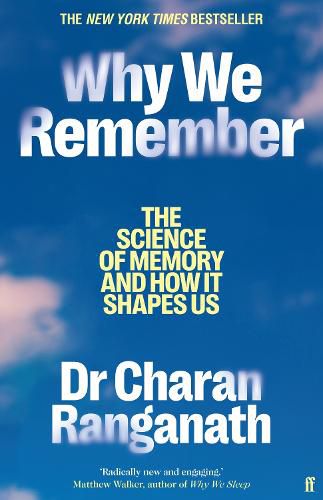
In many ways the subtitle of this book is a better indicator of its content than its headline title. The neuroscientist and memory researcher Dr Charon Ranganath does explore the connection between the evolution of the brain and human social behaviour, but he does this mainly through an exploration of the physical structure of the brain before widening his analysis to a more sociological and legal perspective.
His book starts with the evolutionary ancient structures of the brain: the hippocampus, amygdala and the nucleus accumbens. He then goes on to look at evolutionarily-later developments like the perirhinal and prefrontal cortex and the Default Mode Network. These structural elements of the brain are bathed by neuromodulators like dopamine and noradrenaline. To be honest, I couldn’t really tell you specifically what he argued in relation to these more scientific aspects of his book (I can’t remember!) but while at times he becomes rather technical, the language and approach is fairly low-key so that you don’t feel as if you are reading a science textbook.
What interested me more was the social and behavioural aspects of memory which he also deals with. Memory has evolved to enable us to forget much of what we experience. Instead of being backward-looking, memory plays an important role in orienting us to the new and unexpected, and episodic memory helps us to predict what can happen in the future. It is episodic memory, with its placement of beginnings and endings and its tethering in a specific place and time, that declines most with age, while semantic (i.e. facts and knowledge) memory, which is transferable across contexts, remains fairly constant.
The parts that interested me most were his discussions of memory-construction. A memory is not a grab from a fixed, if sometimes inaccessible, mental film-reel, but is instead the constant retrieval and updating of a memory, with subtle alterations creeping in with every reiteration. Moreover, the story varies depending on the audience for retelling as well, as when family memories are shaped into a story with which to regale listeners. As a local historian who collects oral histories, this is a rather disconcerting thought. And more than merely disconcerting are the implications of evidence in legal cases, where long interrogations and repetitions, and in particular ‘shaping’ questioning, can embed a memory that is different from the original one. Courtroom questioning, which involves retrieval of the memory for an external audience operating on different parameters, shapes memory with sometimes dreadful consequences. It’s all very destabilizing.
I had a recent example of this. I was talking on community radio about our local historical society, and was invited to select two songs and talk about the reason for selecting them. One of them was ‘5.10 Man’ by the Masters Apprentices, which I remember for being presented as a new song by the Masters when they appeared at our school social in 1969. I decided to check the Facebook page for my school, where I knew that there had been a conversation about that social, only to find that other comments made it 1968, and the ‘new song’ being ‘Turn up Your Radio’ (which couldn’t have been right because it wasn’t released then). I found myself questioning my original memory, although self-centred to the last, I’m sticking to my 1969 5.10 Man memory.
Charan Ranganath is no Oliver Sacks. His book is based far more in the laboratory than Sacks’ work, with example after example of rather odd lab tests, often using university students, that add incrementally to the science of memory. I did find his compulsion to praise everybody that he had ever worked with rather cloying as well. He intersperses his analysis with some personal anecdotes that, while being somewhat more ‘memorable’ for me than the scientific parts, were not particularly earth-shattering in themselves, and they lacked the deep empathy of Oliver Sacks’ work. So, interesting enough in its own right, although for me the implications of his work are more thought-provoking than the actual explanation.
My rating: 7/10
Sourced from: Yarra Plenty Regional Library
Read because: I read a positive review in the New Scientist.
 The Resident Judge of Port Phillip