
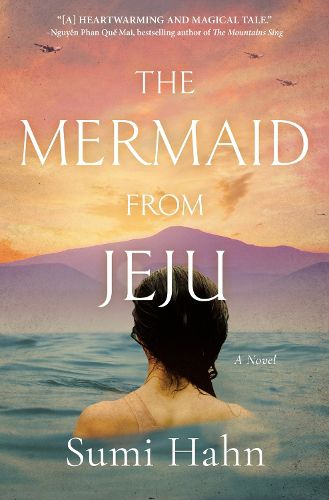
As preparation for my trip to South Korea earlier this year, I read books with a South Korean setting, which is why I ended up reading this book. As it turns out, I read two books based on Jeju, a large island south of the South Korean mainland. It is an oval shaped island, with a large mountain Hallasan in the middle. The Jeju people are indigenous to the island, and have been there since Neolithic times. It is famous for its haenyeo, traditional women fishers who free-dive to gather molluscs and seafood in a semi-matriarchal society, where their wages formed the basis of the family income. Shamanism remained an important part of social and religious observance. Jeju was annexed by the Japanese (as was the rest of Korea) in 1910, and it became a hotbed of independence: a stance that remained when the US-sponsored South Korean government took over from the Japanese after WW2. It was this desire for independence and reunification which led to the South Korean government, led by Syngman Rhee, to see it as a potential hotbed for Communist insurgency. In 1948-9 the government led an ‘eradication campaign’ against these supposed insurgents, arising from the April 3 Incident in 1947, resulting in between 14,000 and 30,000 people (10 percent of Jeju’s population) being killed, and 40,000 fleeing to Japan.
This is the political background of the novel, which focuses on a young girl Goh Junja, who is coming into her own as a haenyeo diver. She encourages her mother to let her travel inland to swap sea produce for a pig, and on this journey she meets Yang Suwol, the son of a wealthy family on the mountain. They are instantly attracted to each other, but on her return from the mountain, she finds that her mother has died from injuries which at first she believed came from a diving accident. As the political situation intensifies, Yang Suwol becomes involved in insurgent activity, and Junja realizes that her own family is more politically involved than she realizes. The whole community is endangered by political currents at a world level that are manifested through cruelty and repression as it becomes increasingly difficult to work out whose side anyone is on.
The book is told in two parts. The first part commences with Mrs Junja Moon in Philadelphia in 2001, wife to Dr Moon, who is about to suffer an embolism. The story then backtracks to Jeju in 1944 as Junja nearly drowns while diving, then jumps ahead to 1948 and Junja’s meeting with Suwol. Part Two returns to Philadelphia, and as a reader you are wondering how Junja ended up being married to Dr Moon. Who’s he? What happened to Suwol? Dr. Moon decides to return to South Korea for the first time in many years, where he meets up with his old friend Dong Min. The book then alternates between 1944, 1948 (when Dr Moon- or more properly- Gun Joo were sent to the island as conscripts) and 2001 as the two men consult a Shaman and return to the mountain to learn the truth of what happened there some fifty years earlier.
The book starts with a timeline of political events, which is important as it frames the story. Unfortunately, it is a fairly sketchy timeline and it does not mention the word ‘nationalist’, even though it is used frequently during the book. The author does give political information, but it feels rather didactic, and I didn’t ever feel that I really understood the politics. The dual timeline, which is becoming rather hackneyed in historical fiction, made the book feel as if it were two separate books- as if she started writing one book, scrapped it, then started on another.
That said, the relationship between Junja and Suwol was well-handled and I found myself caring about what happened to them both, and pleased that it wasn’t tied up with an easy ending. However, the book seemed to be lacking something and I doubt that I would have persevered had I not had an interest in the setting.
My rating: 6/10
Sourced from: ebook borrowed from Yarra Plenty Regional Library
Read because: I was going to South Korea. I’m a little sorry that I didn’t go to Jeju now.
 The Resident Judge of Port Phillip
Pingback: ‘Typhoon Kingdom’ by Matthew Hooton | The Resident Judge of Port Phillip