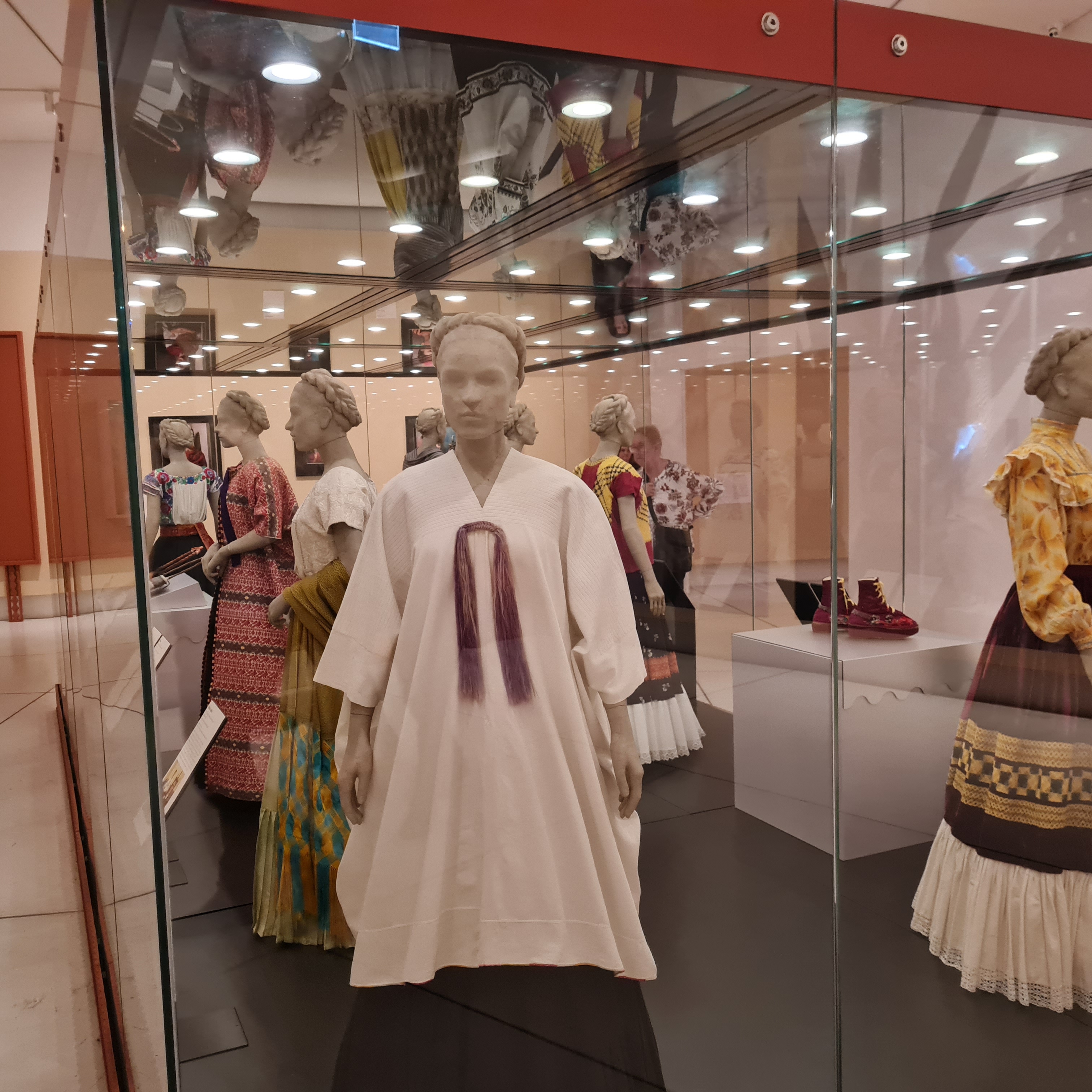
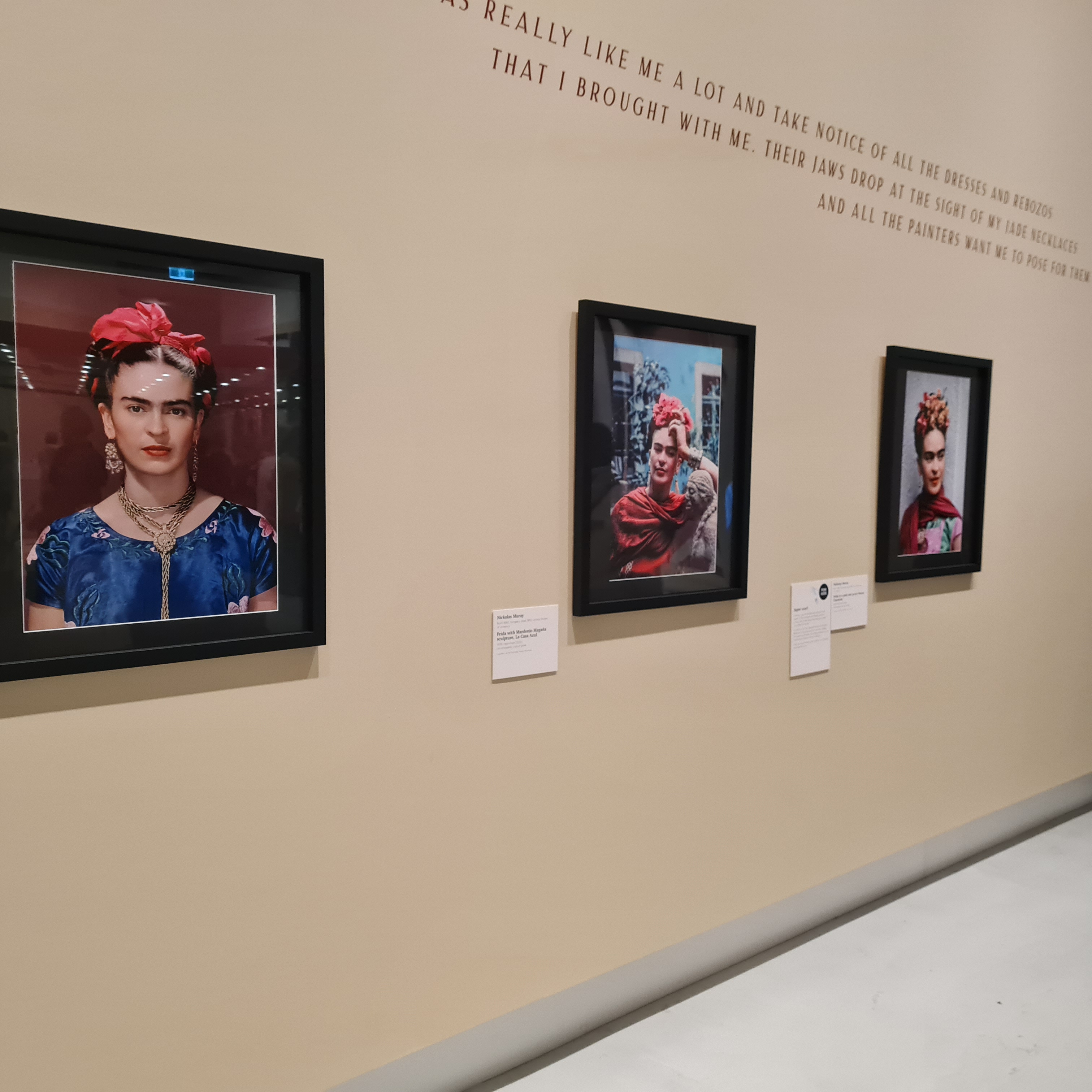
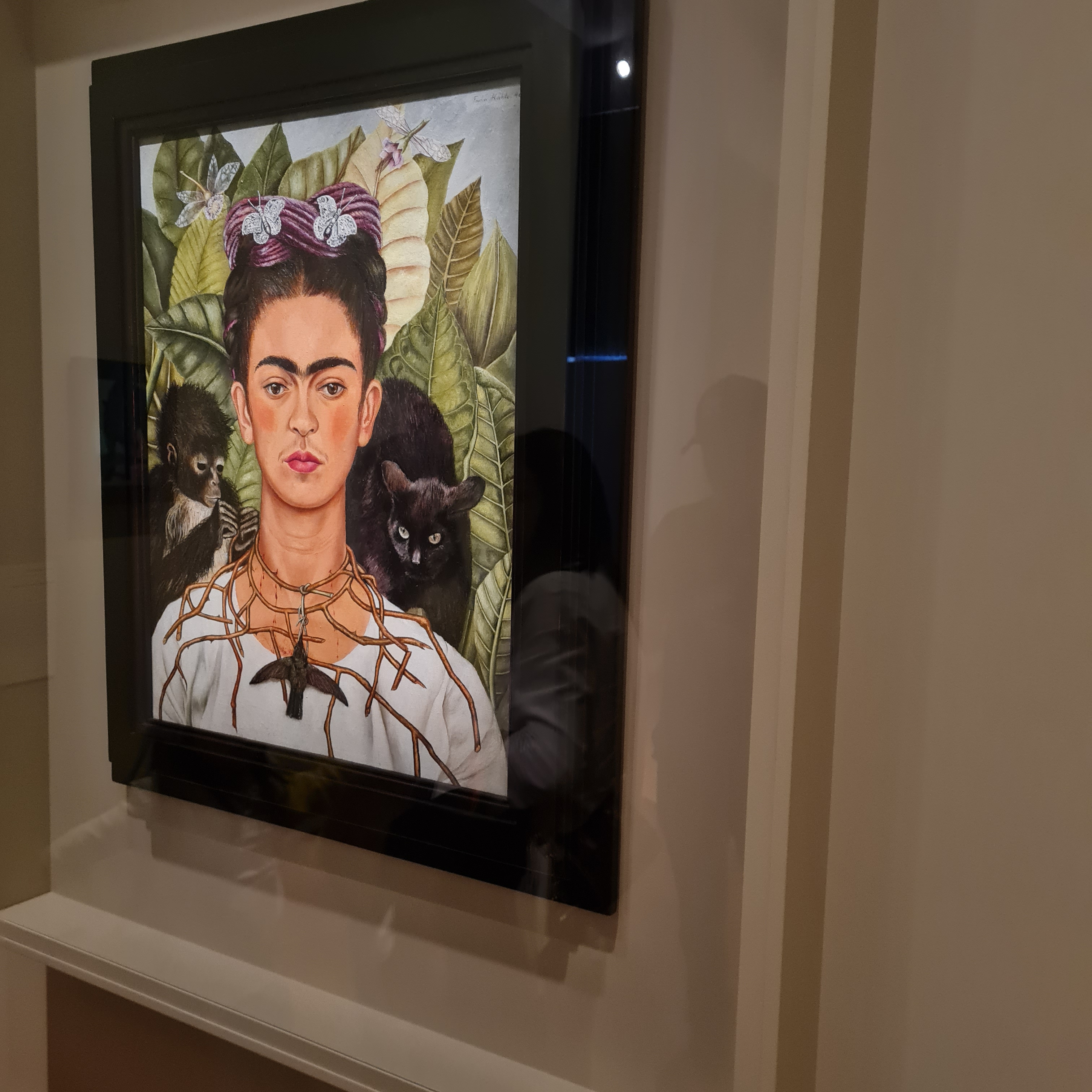
A few weeks ago we went up to the Frida Kahlo exhibition at the Bendigo Art Gallery. It was a beautiful, mild autumn afternoon and the leaves were just starting to turn, owing to our warmer than usual autumn this year.
Bendigo Art Gallery often has really good exhibitions, and this was no exception. Many of their exhibitions, like this one, are textiles based. There were certainly many costumes on display, but dress was just one part of Frida Kahlo’s conscious curation of her image as a daughter of Mexico, and her exploration of her place within her wider family.
Of course, the accident that she suffered as a young woman had a huge effect on the rest of her life, and the exhibition includes objects and explanations of her injuries and later surgery. It places her within the wider Latin American art movement of the time, which became drawn into the contemporary art scene in Europe as well. You come away with a sense of a rather tragic, but very astute fashioner of image and celebrity, long before Madonna and ‘influencers’ came along.
It’s on until Sunday 13 July 2025 so for once I’ve seen it weeks before it closes.
Global Roaming (ABC) I usually listen to Global Roaming with Geraldine Doogue and Hamish Macdonald, but don’t always blog it because it is too topical. But in the episode What does a West-less future look like? they interview Dr Samir Puri whose book Westlessness: The great global rebalancing isn’t one of those ” Shock! Horror! Decline of the West!” arguments, but instead, a look at the rebalancing of power and cultural influence to blocs that do not have Western members e.g. BRICS (which now includes Indonesia, so I suppose it’s now BRIICS.) He draws a distinction between perceptions of maritime colonialism (e.g. the British Empire on the High Seas) and neighbourhood colonialism (e.g. India with the Mughals, and perhaps Russia/Ukraine??) Interesting distinction.
The Rest is History Episode 550 The Road to 1066 Rise of the Normans (Part 3) I think that I knew, but didn’t quite understand, that the rise of the dukes in France (Normandy, Anjou etc) constituted a revolutionary new political, social and military worldview. This is all pretty chaotic in both England and in France as various branches of the royal family vie with each other- real Game of Thrones stuff, with Queen Emma acting stupidly and treacherously. To quote the show notes:
Born into a world of treachery, violence and death, William of Normandy defied all expectations, forging a legacy that lasts to this day. Born out of wedlock and dismissed as an upstart, he was originally known as William the Bastard. Inheriting the Duchy of Normandy at just eight years old, William was faced with betrayal, bloodshed, and anarchy. From the restless Normans, who expanded across Europe as mercenaries and horsemen, to the growing threat of Anjou, the early years of his reign were blighted by power struggles. Following the brutal murder of his guardians, and with Normandy on the brink of collapse, William was forced to survive in a world without loyalty, where ambition was the ultimate currency. Meanwhile, across the Channel, the English throne was in turmoil, as the sons of Æthelred the Unready fought for survival and power… [and somehow Ethelred’s progeny, Harold, ended up on the throne after all]
The Human Subject (BBC)The Children Whose Teeth Were Destroyed This is the story of the more than 600 patients at Vipeholm Hospital in Sweden who, in 1946, were enrolled in a set of unexpectedly dark studies now known as the ‘sugar experiments’. Vipeholm was an institution for ‘feeble minded’ individuals who had come from other institutions where they had been labelled ‘hard to handle’. At this time, it was not really known what caused tooth decay, and people worldwide had very bad teeth. For example, in both WWI and WWII you only needed to have 6 opposing teeth for enlistment. The experiments at first were preventative ie. giving half the amount of sugar of a ‘normal’ Swedish diet at the time, with vitamin supplements. The second phase of the experiments moved to inducing tooth decay by providing large amounts of sugar in their food, as sugary drinks with meals, and most damagingly, between meals when children were allowed to eat 25 toffees a day (toffees, because as we all know, they stick to teeth). When the toffees caused huge numbers of cavities, the teeth were pulled, leaving 660 inmates without teeth. To this day, Swedish children only really have sweets on Saturday.
In the Shadows of Utopia:S2 Episode 5: The Path to the Second Indo-China War – Part Two– The CIA, the NLF and Diem. Time Period Covered 1954 – 1961. So why did the US get involved and get sucked into a situation that the French had been unable to resolve before them. There are three approaches to the war in the historiography: (i) anti-war (ii) domino theory (iii) the Vietnamese perspective. The CIA viewed the Geneva Accords as disastrous because they did not stop the growth of communism. Edward Lansdale of the CIA led small groups of US ‘advisors’ as the Saigon Military Mission, which blew up the railway in Hanoi. By 1956 the United States was pouring aid, especially military aid, into South Vietnam. Despite some private doubts about the suitability of Diem, Eisenhower welcomed him to Washington and pledged his support. The Diem government was full of nepotism and corruption, and he led harsh crackdowns on communism. However, there was still strong resistance in rural areas, and the South Vietnamese communists began appealing to North Vietnam to start up an organization of resistance- the National Liberation Front. Village chiefs were put under pressure by both the NLF and the government troops. Eisenhower changed the rules of engagement, making it possible for US advisors to accompany South Vietnamese troops. In 1959 the first US soldiers died and two years later Kennedy was elected: now it was his problem.
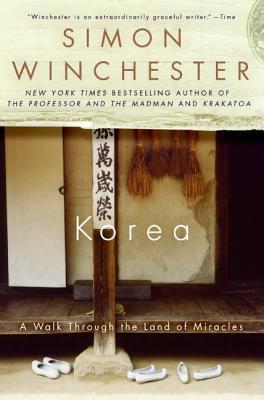
I was going to Korea: I like Simon Winchester. So of course I was attracted to reading this book which was originally published in 1988, and has been recently republished in its second edition. However, there is little evidence that the book has been re-edited in any way, and so it was a very dated travel description of South Korea by an English writer, who spoke minimal Korean, and who reflected the sexism and anti-Americanism of the time.
The premise of the book is that Winchester decided to follow the path of Hendrick Hamel, the Dutch soldier who was shipwrecked on Jeju Island in 1653 on his way to Japan. He was prevented from leaving by the isolationist policies of the Josean emperor, and spent 13 years in what is now Korea, before escaping back to the Netherlands and writing the first western account of Korea. Winchester followed Hamel’s route up into what is now North Korea, but he could not cross the Demilitarized Zone at that time (even though, as he tells us in the preface to the second edition, he did manage to visit later). His route takes him up from Jeju Island to the central and western side of South Korea, where he meets mainly with monks and US servicemen, as well as some ‘ordinary’ South Koreans.
I found the book very dated in its outlook, and I felt uncomfortable about his pontifications on South Korean life and national characteristics from such an Anglo-centric perspectives. Although I am usually a magpie for interesting details, especially when I am travelling in a country that I have read about, I didn’t really gain much from the book to bore my fellow-travellers with (“Hey, did you know that…..”)
I have been travelling overseas with family, and so I didn’t have many opportunities to listen to podcasts, and those that I did listen to were mainly on current affairs (e.g. The Rest is Politics UK and US) and so not really worth recording.
The Rest is History The Road to 1066. One of the few books that I had bought for me as a child was a poetry book about 1066 which I think must have been 1066 and All That. I can’t for the life of me work out why I wanted that book, or how I even knew about it. Nonetheless, I have always been aware of that 1066 was an important date. This 4 part series is right down Tom Holland’s alley, as he wrote the book Millenium: The End of the World and the Forging of Christendom which looks at the turn of the first millenium, and he takes the running in these podcasts. Taking from ‘The Rest is History’ page (largely because I have lost my own notes), Episode 548: The Road to 1066: Anglo-Saxon Apocalypse (Part 1)The Norman Conquest of 1066, culminating in the legendary Battle of Hastings, is perhaps the greatest turning point in the history of the English nation. It was a year that changed the fate of England forever, forging empires, and settling continents. And yet, despite its infamy and significance, the true nature of those totemic events are often forgotten. So what happened in the build up to the Battle of Hastings? The dramas of 1066 were set in motion by a succession crisis in 975 AD, following the death of King Edgar. England by that time was the wealthiest and best run government in Northern Europe, a kingdom of united English speaking peoples, established by Alfred the Great and his successors. Following the mysterious death of Edgar’s first son, Edward, his second son, Æthelred – later known as ‘The Unready’ – took the throne. For many years his kingdom flourished, until disaster struck: the Vikings returned to reign terror upon the Anglo-Saxon people, under the leadership of the terrifying Olaf Tryggvason, King of Norway. With his coffers straining, his people enslaved, and his lands shrinking, Æthelred, now wed to the foreign Emma of Normandy, finally decided to take drastic action, and weed the Vikings out once and for all. So it was that with the dawning of the millennium, a terrible, bloody massacre began….
And then in Episode 549: The Road to 1066 The Revenge of the Vikings Pt 2 Following the bloody St Brice’s Day Massacre, of the 13th of November 1002, which saw King Æthelred brutally exterminating the Danes from England, the Vikings were hungry for revenge. None more so than the terrifying Scandinavian King, Sweyn Forkbeard. Having capitalised on his famous father, Harold Bluetooth’s unification of Norway and Denmark, through his aggressive christianisation of the formerly pagan peoples there, Sweyn had built up a formidable force. It was this power that Æthelred had unwisely taunted, underestimating the might of the Danes. He would pay the price only a few short months later when Sweyn’s terrible fleet landed at Wilton Abbey in Wessex – one of the greatest symbols of the House of Alfred the Great – to bleed England dry, and destroy her King. Time and time again, from this date onwards, Sweyn’s Danish raids would devastate England, even going so far as to lock the Archbishop of Canterbury in a cage…by 1013 Æthelred’s reign was essentially over, his family having fled to Normandy, and England under Danish rule. But then, the death of Sweyn Forkbeard would change everything, setting in motion another titanic war of succession, this time pitting the Scandinavian Cnut against Æthelred’s son Edmund Ironside.
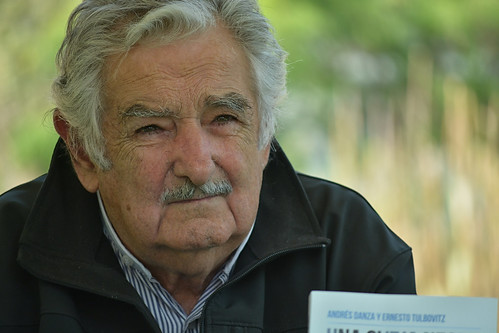
“Pepe” Mujica Cordano was a Uruguayan politician, revolutionary and farmer who served as the 40th president of Uruguay from 2010 to 2015. He died on 13 May 2025. He was imprisoned for 14 years and tortured as a member of the Tupamaros guerillas, and on his release he threw himself into politics. The times suited him: there were a number of left-wing Latin American governments at the time, and the economic situation was good for Uruguay. He never took a salary while he was President, and tootled around in his little blue Volkswagon, continuing to live in his very humble house. After his Presidency, he remained much as he had been while President, giving wide-ranging and wise interviews to journalists.
Today, the United States has a grifter and braggart as President. You could not find a more stark contrast than Pepe Mujica.
At our Unitarian Universalist fellowship, I usually volunteer to take the March service because March is Women’s History Month here in Australia, and I like to look at the stories of significant women and groups- some Unitarian, others not- who have grappled with living our their commitment to social justice and yearning for spirituality. Over the years I’ve looked at Martha Turner, Catherine Helen Spence, Mary Montgomerie Bennett, the Women’s International League for Peace and Freedom, and this year I decided I’d look at the Peabody Sisters- three Unitarian women born in New England during the first decade of the 19th century.
I had vague memories of visiting the Peabody Museum in Salem (same family, different branch) and other than that I knew nothing about them. I’d heard them mentioned in passing in a course on Unitarian Theology (yes, there is such a thing), and a reference to the book by Megan Marshall, so I chose them as my Women’s History theme for the month.
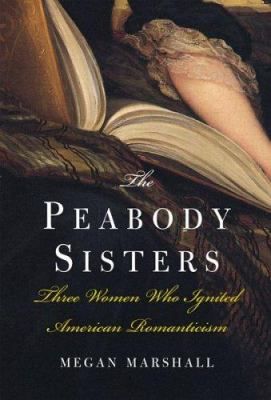
Marshall’s book The Peabody Sisters starts and finishes with a wedding. It starts with Sophia Peabody’s wedding to the author Nathaniel Hawthorne on July 9 1842, and it ends with her sister Mary Peabody’s wedding to the politician and education reformer Horace Mann on May 1 the following year. All three sisters were to live to beyond middle age (indeed, Elizabeth the eldest was to live to the age of ninety) but Marshall has chosen to end her book here. Perhaps it’s because a married woman’s life was so easily obscured by her husband’s, especially if he was prominent in political or literary affairs, as was the case here. Perhaps there was a drying up of the source material at this point, or perhaps Marshall’s interest was more in the sisters as a unit: she doesn’t make it clear.
The three girls had three brothers, but the brothers seem to have been a rather lacklustre group, perhaps because of the tepid example of their father, Nathaniel Peabody, who struggled to make a living as a doctor, dentist and later, farmer. The girls, on the other hand, were spurred by their mother Eliza, to become teachers or to earn their living in some way. Their mother Eliza conducted a boarding school in their home for the daughters of the local town, and was herself a creative and progressive teacher in her own right. The family was on a downwardly mobile trajectory, but Eliza herself had memories of her grandfather’s house at Friendship Hall and the library that was available to her to educate herself. The strong matriarchal influence in the household dynamics put Eliza’s daughters in good stead.
The eldest was Elizabeth, born in 1804, a brilliant linguist, teacher and conversationalist. Her mother came from a Unitarian background, but the young Elizabeth was transfixed by Unitarian luminary William Ellery Channing, known as the ‘Father of Unitarianism’ who preached at her church when Elizabeth was about 8 years old. She threw herself into Unitarian literature and a wide range of reading with such enthusiasm that one summer she was banned from reading anything but the Bible, which she did, reading the New Testament thirty times over a summer, each reading directed towards a different aspect of doctrine. She developed a close friendship with Channing, and as the group that came to be known as the ‘Transcendentalists’ forged links with, and then sometimes broke away from, Unitarianism, she and her sisters were brought into the heart of intellectual life in Boston. She learned ten languages, and through her translations of European texts, she introduced men like Ralph Waldo Emerson, Henry Thoreau and others to Continental and Romantic thought that fed into Transcendentalism. She was loud, gregarious and talkative, but heedless to her personal appearance and dress, much to the chagrin of her mother.
She was a strong sibling to contend with, but her youngest sister Sophia (with emphasis on the ‘i’ when pronouncing her name) was a strong personality too. She did not compete directly with Elizabeth, but instead took to her bed, prostrated by headaches, and the family came to a silent halt so as to not distress her further. She warned her sisters to have no expectations of her, and they didn’t, thus relieving her of the need to financially contribute to the family on a regular basis. Eventually her family, fearing for her life, turned to William Ellery Channing’s physician brother Dr Walter Channing. His interests were in women’s health, and particularly the ‘bed case’ of young women whose poor health confined them to their bedroom. He was skeptical that there was any physical sickness. He was more critical of the medical establishment for letting young girls like Sophia linger in bed for decades, and less critical of Sophia the patient. It was interesting watching Marshall negotiate this issue of female illness and its relationship with emotional and power relationships. She notes that neurologist Oliver Sacks, who wrote at length on migraines, also suggested an emotional bind that is set up in the ‘situational migraine’. As seemed to occur repeatedly with the sisters, once Sophia had the handsome Dr Walter Channing as her confidante, she became infatuated with him, and later infuriated with him when she sensed that he was judging her.
In between these two strong forces was Mary Peabody, the quintessential middle sister. She was said to be the most beautiful of the sisters, but the remaining photograph of her doesn’t show her in a particularly flattering light. She was often swept along in Elizabeth’s plans to re-establish her school in different towns after the school had failed to make money through economic downturns or as the result of scandalous gossip. Elizabeth took up all the oxygen in the room, and although she may have been interested in the conversation, Mary had no wish to be in the centre of it. However, when she was called upon to accompany her sister Sophia to Cuba in the hope that the climate would improve Sophia’s health, her social conscience was assailed by the sight of enslaved people working on the plantation, sparking her interest in social justice.
The relationship between the sisters was at its most fraught and tense when potential partners came onto the scene. Elizabeth competed with both her sisters over men that they had fallen in love with, although she channelled this into a more ‘sisterly’ vein once their sisters had landed their catches. That said, I wouldn’t trust Elizabeth at all.
She threw herself into the intellectual milieu surrounding the Transcendentalists, becoming a writer in her own right (although the little bit of her work that I read was turgid and indigestable) and editing the sermons of William Ellery Channing and writing up Ralph Waldo Emerson’s lectures. She was involved as a teacher in Bronson Alcott’s Temple School, and wrote a book that publicized it, although they fell out over it later. She is credited with the establishment of kindergarten education in America. In 1840 she opened a bookshop in Boston- the first woman to do so. It was bookstore, a lending library, and a place for scholars, liberal thinkers, and transcendentalists to meet. It stocked transcendentalist material and foreign books and shipped books to interested readers. Margaret Fuller began holding ‘conversations’ there in her discussion group comprising both men and women. Elizabeth recorded those too. She began publishing in her own right as well, and became the publisher of ‘The Dial’, the journal of the Transcendental Club.
Group biographies can be difficult, especially family group biographies where one family member may be perceived to overshadow the others. Elizabeth is best remembered by history, but Marshall has worked very hard to provide a family context and bring forward the achievements of the other Peabody sisters beyond marrying prominent men. The book was well received, earning Francis Parkman Prize, the Mark Lynton History Prize, the Massachusetts Book Award in Nonfiction, and it was a finalist for the Pulitzer Prize in biography and memoir. Marshall paints a vibrant picture of intellectually engaged, active women who, although not as well known as the men with whom they socialized, were contributors to Transcendentalism, and American society more generally, at a time when women’s roles were becoming increasingly circumscribed.
My rating: 9/10
Sourced from: Kobo e-book via subscription
Read because: I gave a presentation at my Unitarian Universalist Fellowship to celebrate Women’s History Month.
This movie was available on the plane on my recent trip, but I wanted to save it for the cinema, when I would have people to talk to about it afterwards. I’m glad I did. When I read the book, I wondered how a novella of such interiority could be depicted on the screen. The answer is simply Cillian Murphy, who is absolutely brilliant. As is Emily Watson, who plays the Mother Superior, with such menace below her icy exterior. The film depicted his anguish more as a breakdown than in the book, but I guess that film, by its nature, encourages visual representation of inner pain rather than internal dialogue, as occurs in a book. The sound was very well done too, although to be honest I could barely understand a word they said and found myself craving subtitles (I think I have been spoiled by subtitles). But in terms of reflecting his inner torment, and the stultifying presence of the Church, the sound was excellent. As with The Quiet Girl, it was a movie that had so many levels, and such poignancy, with an ending left ambiguous and yet satisfying at the same time.
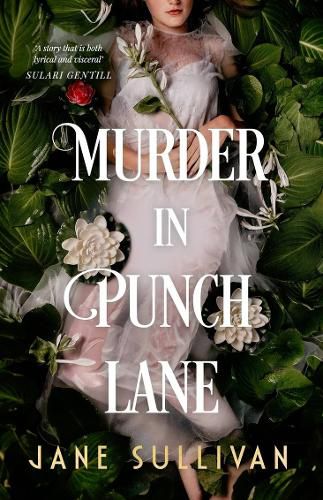
There’s a particular frisson of delight when you’re reading a novel set in your own town. You recognize the streets and you have a mental landscape painting of the setting, even if it is set 160 years earlier. Jane Sullivan, herself now a Melbourne resident after emigrating from England decades ago, takes us to post-Gold Rush Melbourne, and in a way not unlike Kerry Greenwood with her Phrynne Fisher novels, introduces us to a feisty, intelligent amateur detective who is less sidekick and more spur to her co-investigator Magnus Scott, a journalist who styles himself as ‘The Walking Gentleman’.
The novel starts in a bedroom, as a doctor tries to revive a beautiful young actress Marie St Denis from what appears to be, and is later characterized as, an accidental laudanum overdose. Her closest friend, aspiring actress Lola Sanchez, is not satisfied by such a neat explanation, and she enlists the help of journalist Magnus Scott, one of the few people who wrote a sympathetic obituary for Miss Dennis, to investigate. Fired up by the techniques and success of the detectives in the penny-dreadful crime literature she enjoys, Lola undertakes some amateur sleuthing to uncover multiple footprints in Miss Dennis’ room- but to whom do they belong? Lola devises a list of possible suspects, many of whom belong to the highest echelons of Melbourne society, and disguising herself as a young boy, breaks into houses and sneaks around bedrooms looking for clues. In the meantime, Magnus himself is on a rollercoaster of financial events, and it seems that indeed, there are shadowy forces at work, who may or may not be the same men that Lola is suspecting.
I was thinking about 19th and early 20th century crime fiction, and its reliance on plot, coincidence and red herrings, especially compared with the detective stories of the 21st century and their emphasis on the character and motivations of the detective, just as much as of the perpetrator. This book is truly in the former category, complete with cliff-hangers and diversions that at times strain credulity.
For the historian of Melbourne, it is gratifying to see that Sullivan has done her research, and acknowledges the assistance and friendship of writers like Lucy Sussex, whose recent Outrageous Fortunes: The Adventures of Mary Fortune, Crime-writer, and Her Criminal Son George is dealing with a similar time-span and genre. I found myself thinking of Barbara Minchinton’s work on Madame Brussells and The Women of Little Lon, although these both look at a later date. A couple of times I found myself raising a sceptical eyebrow, only to find that Sullivan was right: cold cream in 1868? ( Yes, and before then too), the Menzies Hotel? (Yes, opened in 1867) and so, yes, Sullivan has done her work.
I enjoyed Sullivan’s playful tweaking of real-life characters in creating her own Lola Sanchez and Magnus Scott. The name Lola Sanchez of course evokes the Gold-Rush performer Lola Montez, and Magnus Scott as ‘The Wandering Gentleman’ and editor of the New Bohemian bears more than a passing resemblance to Marcus Clarke. She integrates historical figures as well, most notably the enigmatic Redmond Barry, patriarch of Melbourne’s cultural scene but with his own domestic ambiguities, and Dr Nield, the coroner. She takes us to Redmond Barry’s house in Rathdowne St Carlton that later became integrated into the Royal Childrens Hospital, the Theatre Royal, Chinatown and the eponymous Punch Lane, running between the current-day Exhibition and Spring Streets. And as Sullivan explained in a talk that she gave to the Ivanhoe Reading Circle in April, there was indeed an actress Marie St Denis who died of laudanum poisoning, and the story sprang from historical events, with equally heavy doses of research and imagination.
I wonder if this is the first in a series? There’s scope, and plenty of other Melbourne murders to explore…
The Ezra Klein Show. I’m over in Phnom Penh surrounded with little ones at the moment, and it seemed a particularly apposite time to listen to Ezra Klein’s interview with Jonathan Haidt Our Kids Are the Least Flouishing Generation We Know Of. Haidt’s book The Anxious Generation: How the Great Rewiring of Childhood is Causing an Epidemic of Mental Illness was on the best seller list for a year. Haidt’s work has been picked up by many on the right, although it really transcends a left/right binary, and it’s interesting that he often references the certainties (for good or bad) promulgated by traditional religions. I don’t know if it’s my age, or my affiliation with Unitarian Universalism, but I find much to agree with here.
The Rest is History Episode 538 Horror in the Congo– 3 parts. I had already read Adam Hochschild’s book King Leopold’s Ghost which Tom and Dominic defer to in these episodes, and so I was already familiar with quite a bit of material. However, listening to it at more than 20 years remove, it seems even more relevant today with Trump’s naked shake-down of compromised countries for their rare earths (somehow, everything I read seems to come back to Trump). I had forgotten the degree of privatization and the sheer exploitation of the Congo by King Leopold, and the role of Roger Casement in publicizing the atrocities. The first three episodes deal with the story of the Congo, while Episode 541 Part 4 Fear and Loathing in the Congo looks in detail at Joseph Conrad’s novella, Heart of Darkness which I read over fifty years ago. I remember the feeling of impending doom in it, but I didn’t particularly see it as the masterpiece that Tom and Dominic do. Of course, it was written in 1898, and new literary and historical lenses are trained on it now, with some commentators seeing as racist and imperialistic.
In the Shadows of Utopia. I’m in Cambodia, but Episode 4 of Season Two deals completely with Vietnam. In The Path to the Second Indo-China War Part I The Two Vietnams, Lachlan promises a shorter episode dealing with the years immediately following the Geneva Accords. He starts with the heavily-choreographed photograph of the monk self-immolating in 1963, which most people associate with the Vietnam War, but it was in fact a protest against the actions of the South Vietnamese government before the Vietnam War had even started.
He then moves to examining first North Vietnam, then South Vietnam. Between 1953-1957 the North Vietnamese Government under Ho Chi Minh, following the example of the Soviet and Chinese revolutions, embarked upon a land reform program. This involved cleaning out ‘the reactionary and evil landlords’, but perhaps with not quite the same ruthlessness of Russia and China, with the suggestion that perhaps 1 in 1000 people would need to be executed. Although the numbers of victims may have been lower, it followed the same process: denunciation, land confiscation and redistribution, and later collectivization (which, as in Russia and China the newly landed peasants deeply resented). However, there was so much internal protest that the government admitted its error and abandoned the program and turned its attention instead to the writing of a new constitution which would cement the role of the Communist Government.
In South Vietnam, although under the sponsorship and patronage of the United States, the Diem government undertook a very similar program (albeit less violent). The Geneva Accords were undermined from the start, and the planned elections never took place. The nascent-fascist Diem government was elitist and rife with nepotism. There was a similar land reform program, complete with denunciations and arrests for possible disloyalty, and it too was abandoned when it failed. The formation of the National Liberation Front gave a focus to the armed struggle, and many former South Vietnamese with communist sympathies who had fled north returned to South Vietnam and the civil war resumed.
I visited South Korea with my son and his family, so I thought that I’d embark on a bit of South Korean literature before I went. Other than Pachinko, which is partially set in Korea, I don’t believe that I’ve read any other books set in or about Korea.
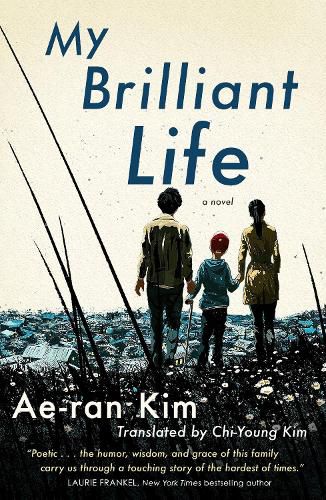
I don’t know exactly what I was expecting, but My Brilliant Life ended up being a completely different from what I thought it would be. As it turned out, I was reading it in Large Print edition (the only one I could find) which gave it an air of being a rather light, speedy read. It is narrated by sixteen year old Aerum, who is suffering from progeria, a rare inherited disease that causes premature aging. As his body gradually shuts down, he decides to write his family story, drawn together from what his parents have told him about their lives in a rural village, their meeting and early marriage and his childhood. He is a lonely child: he cannot attend school, and has no friends of his own age – for what indeed is his age in a body that is accelerating towards a premature death? The family is not rich, and the hospital bills are mounting up, and so he decides to make a paid appearance on a television show, which alleviates the financial pressure and launches him into a rather voyeuristic celebrity. Following the program, he receives many emails, and he begins corresponding with Seoha, who is suffering from cancer, and in the absence of other age-appropriate relationships, he becomes infatuated with her.
I will not divulge the end of the story. It is sad and inevitable. It’s a book about life, love and presence.
Although this is book was in Large Print format, it could possibly be an interesting Young Adult book- after all, there’s no shortage of books about teenagers dying of incurable diseases. I don’t know that I learned much about South Korea from it, but I did learn about progeria.

 The Resident Judge of Port Phillip