
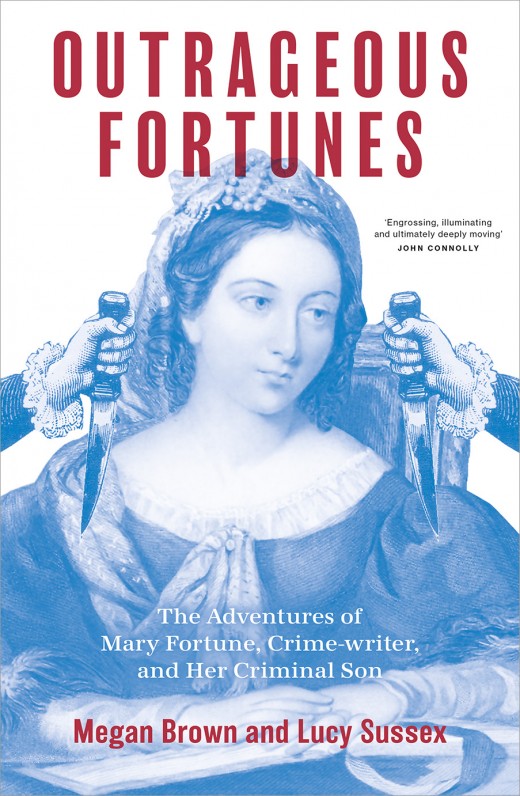
If nominative determinism was a real thing, this book would be about a wealthy woman, her affluent son and their convention-shattering lives. Instead, Mary Fortune worked all her life as a writer and died in poverty, and her son George Fortune spent much of his adult life in jail.
However, ‘Mary Fortune’ is a wonderful name for a writer, even though she always wrote under many other pseudonyms, especially Waif Wanderer and W.W. Although many in literary bohemia knew her real name, it was not widely broadcast. Between 1855 and 1920 she wrote articles, serialized novels, poetry and short stories in various local periodicals, particularly the long-running and popular Australian Journal. From 1868 she contributed a column called ‘The Detective’s Album’, featuring a male detective Mark Sinclair, under the initials W.W. This eventually amounted to over 500 narratives and formed the basis of her book The Detective’s Album, published in 1871 and the first book of crime short stories published in Australia, and the first detective collection by a woman in the world. In her Ladies Page columns, writing variously as Mignon, Nemia, Nessuno and Sylphid, she was both journalist and flâneur (flâneuse) walking the streets and observing – an unusual thing for a woman- and she wrote lively descriptions of Melbourne life, similar to those being penned by Marcus Clarke at the same time, but from a woman’s perspective. She wrote a fictionalized memoir in the 1880s, Twenty Six Years Ago but there is little other personal correspondence. When you read her lively, whip-smart writing you find yourself wondering why you haven’t heard of her before.
She was born Mary Helena Wilson in Ireland, and emigrated with her father to Canada probably in the early years of the Great Famine. They were Protestant, and her father worked as an engineer. In 1851, aged 18 she married surveyor Joseph Fortune, who was to give her that very rather theatrical surname. When the gold rushes erupted in Australia in 1851, her father left, and in 1855 so did she, leaving her husband behind. She and her three year old son George, travelled to Scotland, then on to Australia to find her father, no easy feat in this raucous colonial colony where identities could be erased and redrawn easily. A woman leaving with her child, especially the only child of an only child in a fairly prosperous family, was unusual but she lived an unusual life. She had a second illegitimate child while living on the goldfields, and said nothing of her earlier marriage when she married policeman, Percy Rollo Brett, claiming widow status. The marriage did not last long and they separated, throwing Mary onto her own resources, first on the goldfields, and then in Melbourne.
In the introductory chapter, the authors write:
When the search behind this biography began, little was known beyond her name: Mrs Fortune. To find her meant following her lead as a detective writer, seeking the clues hidden in her vast bibliography. A process of literary detection began. Her game was to drop self-referential fragments- names and events from her life- into her writing. Reading an author through their work can be a trap: the biographical fallacy- the assumption that writing always derives from life. Such was not true in Mary Fortune’s case, for she had a wild imagination. She could write as vividly of a vampire or a vengeful Roma sorceress as of the Victorian goldfields. Yet even at her most sensational her default mode was realist, fed by a tenacious memory. She held grudges interminably and rehashed them in print. Details repeat through the decades of her work, and – thanks for the increasingly digitised world of archives and newspapers- they can be investigated and explained. (p. 4)
Despite the availability of her work in digital form, few readers are likely to immerse themselves in Mary Fortune’s prolific output, and thus to a certain extent we have to take on trust that Mary’s writing does throw light onto her biography. I, for one, think that the authors have identified sufficient parallels and repetitions between Mary’s life and her literary output to validate this as a way of proceeding. That said, though, without Mary’s writing, it would have been a rather thin biography.
One of the most fascinating aspects of this biography, and one which the authors bring out really well, is the paradox that Mary Fortune built her literary reputation (albeit under a nom-de-plume) on criminal activity through her ‘Detective’s Album’ columns, while her only son was completely enmeshed in the criminal system as perpetrator and prisoner. George Fortune’s life, from the age of fourteen was a series of arrests and imprisonments, starting with his arrest for stealing a hat in July 1871. From here he was committed to industrial schools, farm placements, youth imprisonment at Pentridge and eventually long stints in jail in both Victoria and Tasmania. There was no glamour in his criminal history of crime and recidivism.
Mary Fortune had been married to a policeman, and in many ways she mined this connection for the rest of her life. She may have herself been a ‘fizgig’, a police informant. The ambiguous relationship between law and crime lies at the heart of any number of detective series, and it is given an extra frisson in relationships between police and informants, especially women informants. However, her literary career and her son’s criminality came into collision when she published a column in the Ladies Pages of the Herald, where she wrote as ‘Nemia’, that described her visit to Pentridge jail in Melbourne to visit a young, unnamed man. Soon after, for fear that ‘Nemia’ would be linked to the prisoner George Fortune, Mary was sacked from the Herald. She would not return to the newspaper for several years, and then only with fiction.
Mary Fortune lived in the ambiguous space between ‘upper’ and ‘lower’ Bohemia. Other writers knew her, and she conducted a long rivalry with Marcus Clarke whose Peripatetic Philosopher columns were a masculine version of own columns. She would ever only be a contributor, and an anonymous one at that, while her rival Clarke became ‘conductor’ of the Australian Journal in 1871, and as a result her presence in the journal declined. But she was a denizen of ‘lower’ Bohemia as well, with constant money worries, arrests for drunkenness, and a stint in the Benevolent Asylum in North Melbourne before shifting as a lodger between various charitable women. Her son predeceased her, dying in jail in Tasmania, and she died penniless and for many years forgotten.
But not by Lucy Sussex, who had first encountered Mary Fortune when she was working as a researcher for Professor Stephen Knight at Melbourne University, who was researching the history of Australian crime fiction. She wrote her PhD and a subsequent book on the Mothers of Crime Fiction, and a novel based on her search for Fortune called The Scarlet Rider. She edited and published a selection of Mary’s memoirs and journalism in 1989 as The Fortunes of Mary Fortune. Megan Brown completed her PhD on Mary Fortune, and they have co-presented at various conferences. In a closing chapter, Sussex describes an academic joust with another historian whom she dubs ‘Rival Researcher’ who took a rather malicious glee in obscuring her sources, and interactions with Melbourne historian Judith Brett, a descendant of Mary’s policeman ‘husband’, who helped her to start to look at Mary’s son George as a narrative thread in piecing together Mary’s life.
I’m always interested by books that are a collaborative venture because, to me, writing seems such an individual and personal endeavour. The authors only present separately in their closing chapter, yet I wonder if the seams between the authors can still be detected (the book has infected me, now I’m playing detective too!) The introduction frames the authors’ search as a game of literary detection and certainly the conclusion, which evokes the academic rivalry of A. S. Byatt’s Possession, returns to this topic. This theme of literary detection runs subtly through the narrative, reappearing when the authors interview current-day detectives and undertake computer-based forensic linguistic testing of Mary’s writing style to clarify her authorship of individual stories. While cautioning against the perils of applying modern day diagnoses to peoples’ behaviour in the past, they do so nonetheless, suggesting that George Fortune today might be diagnosed with Anti Social Personality Disorder. The reference to Nicola Gobbo as police informer was instructive for me as a Melburnian, but it will date the text and soon be irrelevant. I wonder if these eruptions of current-day commentary reflect the preferences of one of the two authors, or whether they both saw these present-day parallels. Likewise, the introduction of subheadings on just three occasions seemed to jar a little from what was otherwise a flowing narrative, and perhaps reflects the joint authorship- but I don’t know.
Mary Fortune’s good fortune was to have two biographers in Lucy Sussex and Megan Brown who have worked hard over so long to bring her name, and her full-rounded life story before 21st century readers. Their biography is deeply researched, readable and imbued with admiration and sympathy for a trail-blazing woman writer, whose writing is still brisk and lively today.
My rating: 8/10
Sourced from: Review copy from Black Inc., with thanks
 The Resident Judge of Port Phillip