
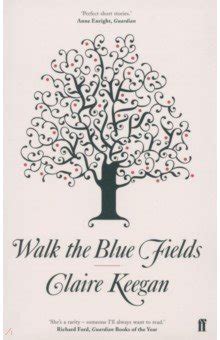
I’m not usually a fan of short stories, but I have read and enjoyed a couple of Claire Keegan’s novellas, and I thought that I’d like to read some of her other writing. I think I’ve finally worked out the best way for me to read short stories, too: just one at a sitting, then put the book away until I find time to read another. And what’s more, I think I’ve finally worked out the best way to write about them too: to acknowledge that some of them will slip by without making an impression, and just hold on to the ones that do.
For me, there were two really strong stories in this collection. The first, ‘The Parting Gift’ is an absolute masterpiece in concise, measured writing and I am in awe of her skill in packing so much backstory and nuance into just 14 pages. It’s written in the second person, present tense – not a narrative style that I’m attracted to, I must admit
In her bedroom your mother is moving things around, opening and closing doors. You wonder what it will be like for her when you leave. Part of you doesn’t care.
Our narrator is packing to leave for New York, and her brother Eugene is to take her to the airport. Her mother orders the narrator to go upstairs to say goodbye to her father, who is in bed (presumably ill). She doesn’t want to: there have been years of sexual abuse, tacitly accepted by her mother. Her mother expects that her husband will give her some money as a parting gift, but he does not. Her brother, who has done his best to protect her from her father, vows that he will leave home too, but she knows that he will not.
The second story that I really enjoyed was ‘Night of the Quicken Trees’ about a wild, unkempt woman, Margaret Flusk who moves into a detached cottage on the outskirts of a rural Irish village. The house was left to her by her cousin, a priest, with whom she fell in love and eventually ended up bearing his child, who later died. She is superstitious and independent, but she gradually yields to the equally independent man in the adjoining cottage, Stack, who lives in filth and sleeps with his goat Josephine. When her periods return, she has the urge to have a child and so they knock a hole between the two cottages, until Margaret leaves him, taking the child with her. The story is told like a fairy-tale, full of portent and warning.
The other stories are mainly set in Ireland, except for ‘Close to the Waters Edge’, which is set in America where a young man celebrates his 21st birthday with his mother and his arrogant, aggressive millionaire step-father. He is gay, but cannot tell his mother and step-father, and so he returns to Harvard, without having told them. With its American setting, this story doesn’t seem to fit in with the others. There’s a unity to the other stories with the sexual indiscretions with priests, the claustrophobia of the small village and many eyes and tongues, and the flat depression of unfulfilled lives.
I’m mystified as to why she (or the publisher) chose ‘Walk the Blue Fields’ as the title. In that story, a priest has just conducted a wedding service where the bride seems unhappy, and there is tension between the groom and his brother, the best man. We learn that in the past the priest had had sex with the bride- the second story in this collection where there is sex between priest and parishioner. But if by choosing one story over another for the title suggests that it is the strongest one in the collection, I beg to differ. For me ‘The Parting Gift’ is the absolute stand-out story, and one that I will remember.
Rating: I never know how to rate short stories.
Sourced from: Yarra Plenty Regional Library.
 The Resident Judge of Port Phillip
Um… YEAH!