
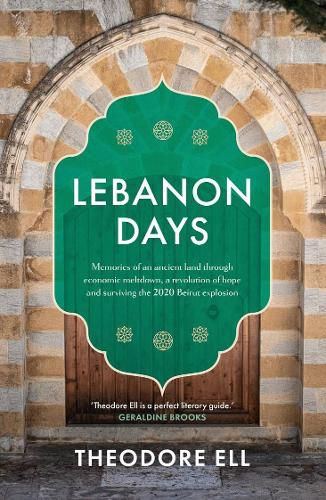
In 2021 Theodore Ell won the ABR Calibre Prize for his essay ‘Facades of Lebanon’ which described the Lebanese revolution and the Beirut port explosion. (I must admit that this essay probably languishes in the towering pile of journals that I haven’t got round to reading yet.) The explosion, caused by a stockpile of nearly 3000 tonnes of ammonium nitrate, dominates his essay which was written in 2020, as part of his way of processing what had happened. As he says:
I wrote an essay ‘Facades of Lebanon’ with the aim of making sense of the abstractions behind the port explosion at the level of personal feeling. If people were to know what the Lebanese knew and what Lebanon had brought me to know, they needed to know what the explosion felt like. They needed an invasion of violence, debris and deafening noise through the window, just as the Lebanese themselves so often had been invaded, over their rooftops and fields as much as over their doorsteps. (p. xix)
But this book, written in the wake of the critical acclaim for the essay, and with more distance of time, deals more with what happened in the periods before and after the explosion. The book is in five parts, and the explosion is just one of these parts. It is the story of the two-and-a-bit years between the end of 2018 and the beginning of 2021 that the author spent in Beirut as the partner of an Australian Embassy official- a time in which Beirut roiled under street protests as part of the thowra (i.e. revolution) which was eventually put down by Hezbollah (or as he writes it ‘Hizballah’) and the COVID lockdowns, during a time of economic collapse exacerbated by government corruption, which in turn laid the conditions for the Beirut port explosion that changed his life.
As the partner of an Embassy employee, he was not allowed to undertake paid employment and so he spent quite a bit of time walking the city, venturing further afield with his wife Caitlyn on weekends, doing odd job volunteer work where he could find it, and writing. As is often the case with Embassy staff, their social circle mainly revolved around other Western diplomatic and aid workers, with most of his contact with local Beirut residents through observation on his travels, and amongst taxi drivers, shopkeepers and businesses catering for young Western expatriates.
Much of this book resonated with me, having spent time with my son and daughter-in-law in both Kenya and Cambodia where they, too, live as expatriates, albeit living (as do Ells and his wife) outside an expatriate enclave. Their description of the succession of new expatriate arrivals and the development, and then breaking apart, of friendships makes sense to me, as does the distance between the expatriate community and local workers in the diplomatic and aid milieu. How clearly I identified with his frustration with learning Arabic which, despite learning basic Spanish and Portuguese, “awed [him] with its complexity” and with which he failed utterly – a feeling I often have when trying to learn Kymer.
The book is divided into five parts, with short unnumbered chapters in each part. Part One ‘Partitions’ explores the 1926 constitution, adopted under French tutelage, which ossified the sectarian divides by designating certain political posts for particular religious and ethnic groups. This arrangement embedded power in the majority Christian group at the time, but given that there hasn’t been another census since 1932, that demographic scenario has been superseded without any corresponding political adjustment. Part Two ‘Phoenicia’ is more travel-based, as he explores regions further afield, and the sway of the historical ‘Phoenician’ culture as part of Lebanese identity. Part Three ‘Thowra’ is his report of the huge protests that brought Beirut citizens out into Martyr’s Square, demanding an end to the corruption that immobilized Lebanese politics, leaving it impotent to deal with the economic collapse. Part Four ‘Shuttered’ describes the effect of the COVID lockdown which Hizbollah and the government leveraged to quell the protests, dwarfed by the Beirut port explosion during which, living in an apartment that directly overlooked the port, they were lucky to survive. There’s some really evocative writing here of the sheer power of the explosion, and its physical and psychic effects. He is clearly suffering PTSD, while Caitlin throws herself into Embassy Emergency Mode. The final Part Five ‘Closing’ deals with the months when they are waiting to return to Australia, which is limiting inbound flights because of COVID. They return to living in West Beirut, where they had first lived when they arrived, imbued with a sense of grief for what had been lost, fearful of Israeli invasion, and yet acutely aware that, as Australian citizens, they can leave, and although able to appreciate the citizens’ fears, they are not their fears.
This is beautifully written, with a fantastic, clear map that lets you locate yourself in the city and in Lebanon more generally. There is a very good glossary at the back for Arab terms he uses frequently, and the whole book supports the unfamiliar reader better than many other books that I have read recently. He integrates travel description, history, political analysis and personal response in what he hopes is a ‘tapestry’ rather than a ‘tableau’ of landscape with figures.
This is a great book. I devoured it on the plane over to Cambodia, and finished it the next day. I can’t wait for the kids to read it- and you should too.
My rating: 9/10
Sourced from: Yarra Plenty Regional Library
 The Resident Judge of Port Phillip
Great review of a wonderful book, I was captured from the first page.
Pingback: Six Degrees of Separation: From ‘The Correspondent’ to …. | The Resident Judge of Port Phillip