
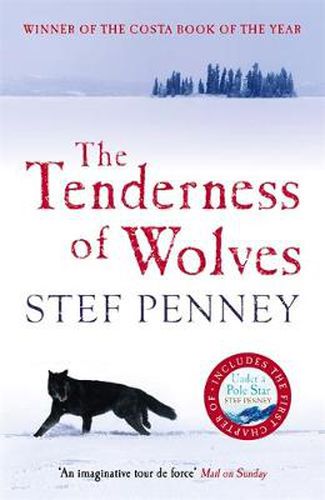
I’ve read Big House mysteries; I’ve read Outback Solitary Aussie Bloke mysteries; I’ve read London-based mysteries. But I don’t think that I’ve ever read an Upper Canada mystery before, especially one set in 1867 which is relatively familiar territory for me because my Judge Willis (the real Resident Judge of this blog) served there in the late 1820s. It is rather strange -and rather amazing, given how vividly she writes- that the author Stef Penney has never visited Canada. The snow and isolation and colonial machinations that she describes in this book all spring from her desk research alone.
Set in the last days of the fur trade, Mrs Ross, a local resident, discovers a brutal murder in the small hut occupied by Laurent Jammet, a French trapper. Suspicion falls on her adopted 17 year-old son, Francis, who was friends with the trapper, and his disappearance from the village only heightens speculation that he is the killer. Donald Moody, an accountant with the Hudson Bay Company, is sent out to investigate the murder, along with Mackinley, the sarcastic and bullying Company Factor from Fort Edgar. They are accompanied by Jacob, Moody’s self-appointed native American protector. They arrest half-Indian William Parker, who was apprehended searching Jammet’s hut after the murder. After Parker is ‘roughed up’ by Mackinley and Scott, the wealthy storekeeper in whose shed Parker is confined, Parker and Mrs Ross go off in search of Francis. There is someone else who is eager to search Jammet’s hut as well: Thomas Sturrock, who believes that a bone tablet which may be of archeological significance is in Jammet’s possession. He has been to the small settlement of Dove River before, having been there years earlier in search of the twon local Seton girls, who disappeared in the forest, never to be found.
And so, we have various people all heading off into the frozen wastes: Francis in search of the man he thinks is the murderer; followed by Mrs Ross and William Parker who are in search of Francis; and then Mackinley and the love-sick Moody who are in search of William Parker. The only nearby settlement is a Lutheran Norwegian community in Himmelvanger, and they take in all of these groups as they stumble in from the snow and icy marshland. Attention then turns to the nearby Hanover House, the company Trading Post, administered by James Stewart. As in the best Mystery Novel tradition, there are many red-herrings and subplots.
The book starts with Mrs Ross’ first person account, and it alternates with other present-tense chapters told by an omnipotent writer, who knows all the characters’ thoughts and backstories. There are rather a lot of characters, and because the book is written in very short chapters without chapter numbers, I found myself getting a bit lost with all the Mr. This and Mr. Thats.
I’m rather mystified by the title, though. There are certainly wolves in this story, surrounding the various groups as they trudge through the snow, and the colonists are all frightened of them. They keep their distance though, and the closest they come is when they sniff around one of the tents at night, breathing over the sleepers and leaving paw-prints. The wolves are certainly less violent than the trappers.
Most impressive of all, though, is Penney’s depiction of the bitter cold and isolation. The landscape, along with the short chapters, makes it a very filmic novel and I wasn’t surprised to find out that she is, in fact, a screenwriter. The book won a Costa Book of the Year in 2007
My rating: 8/10
Sourced from: Council of Adult Education
Read because: CAE selection
 The Resident Judge of Port Phillip
I read this in 2008 with one of those internet bookgroup’s we were in. I remember enjoying it but I remember very little about it now. I wonder if I kept it in my downsize last year.
Anyhow, I enjoyed reading this post and remembering it and those internet bookgroup times.
I didn’t realize that we read it with the Bookgroup List. Perhaps I hadn’t joined them at that stage (or maybe I had left)
You may not have as you say … also I think it was the 20th Century List not the main bookgrouplist.
PS We probably discussed the title in the group but I struggle finding stuff in those old emails now.
I’ve just found my first comment on the book. I wrote: “Well I’ve finished it and look forward to joining in the discussion. I
enjoyed the read. I particularly liked the multiple POV approach, thought the characterisation was good overall (though there were a lot of characters – were they all needed?), and found the evocation of the place interesting.
I thought it was pretty well written but was a bit cliched in places…too many cold chills and shivers up the spine for example. It would probably make a good film.”
Did I know she was a screenwriter? I have no idea?