
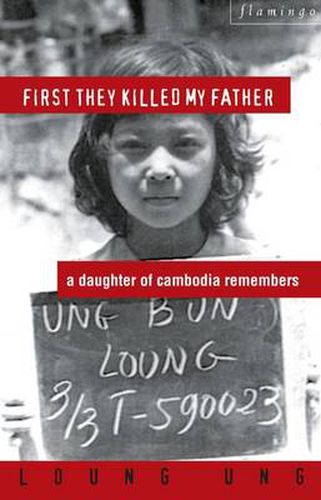
As you might know, some months ago I travelled to Cambodia and am likely to repeat the trip a few times more over the next few years. First They Killed My Father is one of the books that tops the ‘Books You Must Read Before Travelling to Cambodia’ lists, but I felt rather reluctant to read it. In my mind Cambodia was defined by two things: Pol Pot and Angkor Wat, but I want it to be more than that. And yet, having now been there, the influence of both is inescapable. They don’t necessarily define Cambodia, but they have shaped it.
Loung Ung was five years old when the Khmer Rouge swept into Phnom Penh. They were wealthy and of Chinese descent: her mother was ‘full Chinese’ and tall, with almond shaped eyes and a straight Western nose. Her father, part Chinese, part Cambodian, she describes as having “black curly hair, a wide nose, full lips and a round face” with “eyes shaped like a full moon.” Her father originally worked for the Cambodian Royal Secret Service under Prince Sihanouk, and then as a major in the military police under Lon Nol. We don’t actually learn what he did in either of these jobs, but it did afford them an upper-middle class lifestyle in Phnom Penh. She was raised to distance herself somewhat from Cambodia: in the mornings she studied French, in the afternoons Chinese and at night Khmer, and her parents spoke about Cambodian customs as being something “other”.
Not that any of this helped when the Khmer Rouge evacuated the city completely, under the pretense that the US was about to bomb the city, and that they could return in three days. Her mother soon realizes the reality, with her offering money notes to her daughter to use as toilet paper. The family is shifted from location to location, siblings are sent to jobs in different places, and her parents are acutely aware of hiding their middle class origins and pretend that they and their children are peasants. Her parents had reason to fear. I found that one of the most chilling sights in the Tuol Sleng Prison (Security Prison 21), which I visited, was the sight of children, arrested along with their parents, who were questioned and later killed. It was fear of being arrested as a family that led her parents to send their daughters away to fend for themselves. Yet somehow, miraculously, some (but not all) members of the family find their way back to each other when the madness comes to an end. With the family in tatters, she and her brother travel to Vietnam, then use a people smuggler to go to Thailand where they end up in the Lam Sing Refugee Camp, waiting to be taken in by another country. Did her brother’s conversion to Christianity help?- possibly, and she and her brother are granted residency in Vermont.
The book is written in the present tense, and it moves chronologically in a methodical way, with each chapter headed by a date. It purports to be a child’s-eye view, but of course it is being written by an adult. The book has been criticized in Cambodia for inaccuracies, her obliviousness to her privilege, implausibilities and the racism she displays against the ‘base people’ in emphasizing her Chinese origins. You can read several critiques at Kymer Institute – in fact, it’s well worth doing so. Certainly I noticed her disdain of peasants and Cambodians generally, but as for the rest of the criticism- I don’t know enough. I read it partially as a way of trying (unsuccessfully) to understand the Khmer Rouge and how and why they took power with so little apparent resistance. Exhaustion from war and exposure to unyielding and ideologically-driven violence have much to do with it, I suspect. Reading this book while in the country, I enjoyed the descriptions of Phnom Penh (albeit at fifty years remove) and gave context to my ambivalent visit to Tuol Sleng Prison. I’m still looking for books about Cambodia that, while not blithely ignoring the Khmer Rouge years, are not defined by them.
My rating: Hard to say – 7???
Read because: I was there. E-book.
 The Resident Judge of Port Phillip
When we were in Cambodia, our guide told us that there was resentment in the countryside against the people expelled from the cities because they were useless in the struggle for survival. They had no useful skills, were not used to long hours of labour, and they ate scant supplies of food when they didn’t contribute to producing it. Just one person’s opinion, but it does make sense to me. I’ve read other similar accounts of peasant reactions to the ‘useless’ Chinese intelligentsia being sent to rural areas during the Cultural Revolution.
When I was doing a BA in Asian Studies, I read a lot about ancient Cambodian history. It was mostly in one of those ‘bricks’ that universities supply to students studying by correspondence, and I couldn’t now tell you the name of any of them. But if you can track down something like that, I found that understanding the Angkor Wat mythology that surrounded kingship explained a lot about the otherwise inexplicable actions of the wily King/Prime Minister Norodom Sihanouk . I remember writing an essay about it, but alas, not what I wrote!
A result of the Vietnam War. I’ve forgotten more than I knew about Cambodia, influenced by Cambodian workmates. I think Cambodia is still defined by the what happened in the 1970s into the 80s, as long as Hun Sen still rules.
Pingback: Six Degrees of Separation from Tomorrow and Tomorrow and Tomorrow to… | The Resident Judge of Port Phillip