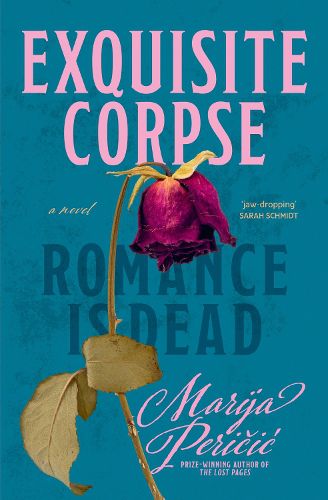
This unsettling novel is based on a true story. Set in Stockholm in 1930, Lina Dahlstrom is dying of tuberculosis and despite her sister’s misgivings, is drawn into the sphere of an eccentric doctor, Carl Dance, who claims that he can cure her. When she dies, his obsession with her grows stronger, and he embarks on a repugnant and criminal scheme to keep her as his own for ever.
I knew, from reviews that I had read of the book, that it was based on a true story, although there is only a single phrase “based on true events” on the back cover. I do wonder how that shaped my response to the novel, because its plot line is so visceral and distasteful that I would have otherwise put it aside as a form of torture porn. The knowledge it was “based on true events” meant that the plot could not be dismissed so neatly.
The story is told in four narratives, each roughly approximate in length, that move the story along chronologically. Part I is told by Greta, a young tobacco factory worker, who is frantic to get medical assistance for her sister Lina, who is floating through tuberculosis, rather indifferent to her fate – apparently one of the emotional manifestations of tuberculosis. With few resources, Greta urges her sister to accept the offer of help by Dr. Dance, even though she feels uneasy around him. Part II is told by Dr Dance as he becomes increasingly unhinged in his obsession with Greta’s corpse, and it is here that my scoffing at the implausability needs to be tempered by my remembrance that there is a kernel of truth here. I think that this is probably the most disturbing, and the best written part of the book. Part III is told by Lina’s corpse – hard narrative trick to speak on behalf of a corpse, but others have done it too- as the sheer perversion of Dr Dance’s actions are perpetrated on her. Pericic gives her a wry humour that is not apparent in the first section, through her sister’s eyes, but perhaps a sensibility that is more 21st century than 20th century. The final Part IV is told from the perspective of Dance’s wife Doris, as she is pressured both by Dance and his friends, into maintaining a veneer of support for Dance when he appears in court. Indirectly, we see another side of Dance here, as he wheedles and manipulates Doris, who is another of his victims.
Apparently ‘Exquisite Corpse’ is a form of drawing game- something that I only learned when looking up reviews of the book. It’s where players each draw a part of an animal on a sheet of paper, unaware of what the other players have drawn beforehand, leading to the creation of a weird, implausible monster-animal. In a way, the four part structure of the book replicates that, with each of the narrators unaware of what the others have said before them. It’s an interesting approach, but one that I don’t think Pericic carried off particularly successfully. Greta and Lina were both working-class girls, but I couldn’t hear their voices. Dance, although his actual profession is opaque in the book, is American and obviously possessed of a strong self-belief, but that does not come through particularly clearly. His wife Doris was presumably of a ‘better’ class and education than Greta and Lina, but that was not apparent.
I must admit, though, that despite the stomach-churning nature of the subject matter, I was drawn in by the book through a mixture of prurience and fascination. It reminded me a bit of Ebershoff’s The Danish Girl both in its time and setting, and also as a glimpse of something intimate that is so dissonant with the surrounding world.
My rating: 7.5 (hard to say)
Sourced from: Yarra Plenty Regional Library, and read because I was fascinated by some reviews.
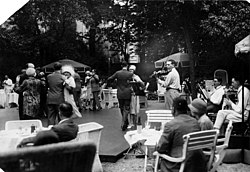
en.m.wikipedia.org A jazz band plays for a tea dance at the hotel Esplanade, Berlin, 1926.
History ExtraWeimar Germany: everything you wanted to know. I must confess that most of what I know about Weimar Germany is from ‘Cabaret’ and Christopher Isherwood’s books. In fact, I wasn’t even sure why it was called ‘Weimar’ until I learned from this podcast that it was named after the town where where the treaty establishing the government was signed. Its early years were marked by hyperinflation, different political factions and several coup attempts, including one in which Hitler was involved. Things stabilized economically a bit with the Dawes Plan whereby US loans were offered to the republic, but it was still politically volatile with 20 different coalitions, 12 chancellors and eight elections in quick succession. Hitler could quite rightly claim that he couldn’t be any worse than some of the later chancellors. The system of proportional representation meant that radicals could be elected. The Social Democrats did try to stop the Nazis, but President Hindenberg didn’t act even though he opposed their ideas. The army hid behind the Freikcorps, a para-military group similar to the Wagner group in Russia today. The fall of Wall Street had nothing to do with the fall of the Weimar Republic- Hitler didn’t even mention Wall Street at the time. The much-vaunted culture of the Weimar Republic only really existed in Berlin, and by the time it fell, people had generally turned against the Weimar Republic.
I went to see the movie ‘Oppenheimer’ and was interested to know how much of it was factual. Quite a bit, it seems, from this episode Oppenheimer: Destroyer of Worlds. It is an interview with Kai Bird, who along with Martin Sherwin, wrote American Prometheus: The Triumph and Tragedy of J. Robert Oppenheimer, on which the film was based. The book took 19 years to write. The interview finishes with Bird observing how politicians seek certainty from scientists, and often turn on them when the scientists demur- observe Trump and Fauci over COVID.
The Rest is HistoryThe Fall of the Aztecs: The Adventure Begins Dominic Sandbrook (one of the two presenters of this very popular podcast) has just released a children’s book about the fall of the Aztecs, and from the introductory reading, it sounds pretty good. I’ve read and listened to a fair bit about the fall of the Aztecs, but this is well worth listening to. As he points out, when the Spanish met the Aztecs, it was the closest thing that we have to meeting aliens. The stories that the Spanish (as the conquerors) tell about it are shaped in the tradition of Alexander the Great, but perhaps they were lying or just misunderstood what they were witnessing. Cortez grew up in Spain during the reconquest of Granada. His family wanted him to be a notary but he travelled to Hispaniola, where Spanish colonization was already underway. Like many other colonists who went ‘island hopping’, he went to Cuba. Cortez was not the first to go to Mexico but when Velázquez, the governor of Cuba, found out that there was gold there (particularly prized because it was portable and divisible), he wanted a functionary who would do what he was told, so he sent Cortez. Big mistake.
London Review of BooksThe Infected Blood Scandal based on a LRB article by Florence Sutcliffe- Braithewaite. In the 1970s and 80s, thousands of hemophiliacs were infected with HIV and Hep C. from infected blood products. At this time, British doctors already knew that blood could transfer hepatitis, although all the government papers about imported blood products between 1970 and 1990 were (conveniently?) pulped. There was particular concern about blood coming from the United States where private companies sourced donations from prisons (large numbers of former/current drug users) or paid people for their blood. However, new innovations in treating hemophilia at home meant that doctors overlooked or downplayed these threats. After this interview, there is a segment with Tom Crewe, who wrote a 2018 article ‘Here was a plague’ about the AIDS crisis and the perceived difference between ‘innocent’ and ‘guilty’ victims.
Background Briefing(ABC) has a series on Whistleblowers at the moment, which is pertinent given the David McBride case underway recently. The Whistleblower who helped catch a paedophile politician is about an electorate officer who became aware of several complaints about the Labor politician that she worked for in the early 2000s. It took more than one complaint before she decided to act. Once she did, she lost her job and was reviled by party members even though the politician was jailed for 10 years. The Whistleblower who captured the nation — and the man who unmasked her as a fraud deals with the convoluted and deeply political case of Kathy Jackson, who was embraced by the conservative party as a whistleblower against key members of the Health Services Union, until her successor blew the whistle on her own financial misappropriation.
Expanding Eyes Still continuing on with Homer’s Iliad- I’ve now finished Book 8. Episode 49: The Complex and Enigmatic Characterization of Paris, the character of Big Ajax in Book 7 and duelling. In the previous episode, he looked at Hector and Andromache, and in this one he looks at the contrasting couple, Paris and Helen. Paris is sitting there, polishing his armour, and Helen bemoans that she had ever been born, and that Paris will always be useless. Is she blaming the Gods, or is there an element of truth in this? Book 7 is puzzling: Hector is pumped, challenging any takers- including Big and Little Ajax. But it’s another inconclusive hand-to-hand combat. But, despite all the bloodshed that his actions have caused, Paris still refuses to hand Helen back.
The Emperors of Rome. Episode CVII Sallust I’d never heard of Sallust, but apparently he was a historian who wrote about specific events, rather than the big broad-scale narrative histories that were popular. He followed the traditional political path, but he wasn’t very successful as a politician. He was seen as one of Caesar’s allies, and was made Governor of an African province, but he was charged with malpractice- which was quite common (both the malpractice, and the courtcases brought by political enemies). Caesar intervened, but Sallust’s political career was over, so decided to become a writer. He wrote about the Cataline conspiracy, which had occurred about 25 years earlier. Why? He saw it as a sign of the division in society and although some his chronology is a bit dodgy, it is generally considered to be well-written. His second book was about the Punic war which occurred in 110 BCE, before he was alive. His third work was only fragments. An interesting idea that it is an ancient source for us, but he was writing about his relatively recent past.
Democracy Sausage. This podcast is presented by ex-Age journalist Mark Kenny, now up at ANU. Responsibilities to Protect is fantastic. Ben Saul has recently been appointed as UN rapporteur on human rights and counter-terrorism, and here he talks about the legalities of the Israel/Gaza situation. It seems strange that ‘legal war’ is hemmed in by so many distinctions. This is really, really good.
In Australia, we’ve recently witnessed the unveiling of the official portrait of a former Prime Minister, Kevin Rudd, ten years after he quit Parliament. It’s certainly ‘different’- almost reminiscent of a Graeme Base picture book illustration with lots of small symbolic details and, yes, a cat. It must be odd, having your portrait painted- especially an official one, which is going to represent you for posterity.
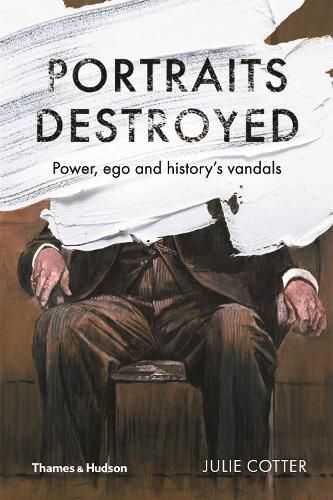
Art historian Julie Cotter’s book Portraits Destroyed looks at the official portrait, or representation, and its reception (generally negative) from either the sitter him/herself or their family, or by later generations. I was not surprised that she has worked on documentaries on Australian art previously, because this book and its chapter structure would lend itself very easily to a documentary series. I can already see her wandering around an art gallery as host.
She starts by considering Winston Churchill, whose now-destroyed portrait is represented on the front cover of the book. I only remember Winston Churchill as a fat, jowly old man and that’s very much the way that artist Graham Sutherland depicted him in 1954. It was unveiled by Churchill himself at Westminster Hall on 30 November 1954, on the occasion of his 80th birthday where he announced it “a remarkable example of modern art” (an ambiguous description, given that Churchill himself was a landscape artist of a very un-modern type).
He would have expected a portrait of a face that flickered with his life: a face that reflected the tumult, the devastation, the glorious victories, the might of the British Empire that the twentieth century had experienced. He would have wanted us to recognize ourselves in his portrait- to hear his speeches to the masses to keep fighting, to remain strong and unite against Hitler, to remember where we were when armistice was declared, to mourn those we had lost. He was his own muse, absorbed by his achievements
Instead, he was faced with the image of himself as a ‘down-and-out drunk who has been picked up out of the gutter in the Strand’ he concluded to his private secretary Anthony Montague Browne.
p. 37
After its unveiling, the portrait was never seen again. It was said that, after his death in 1965, his wife Clementine had burned it herself. This wasn’t strictly true: it was too big for her to take into the garden to set alight to it, and instead Churchill’s next private secretary, Grace Hablin, arranged for her brother to help her move it to his house, where it was burned.
It is fitting that the chapter about Churchill should be followed by a chapter about Hitler, given that they were arch-enemies. In this case, she hones in on an oil portrait painted by Dresden-born contemporary artist Gerhard Richter in 1962, who drew his portrait from an image showing Hitler at Nuremberg in 1934, “in a moment of strangulated shouting, hysterically commanding, his face elongated and distorted” with his right arm across his body (p. 44, 45) It was exhibited for the first and last time in 1964, and then Richter (who had since defected from East Germany) destroyed it himself, probably by cutting it to pieces. Richter himself had joined the obligatory Hitler Youth, and his schoolteacher father Horst, was drafted into the military in 1939. When he returned, he was a broken man, unable to teach because of his Nazi associations. Richter’s uncles were killed, his mentally ill aunt was killed under the Nazi’s T4 program of large-scale euthanasia. Cotter suggests that Richter’s destruction of his own work allowed “the release of a stultifying hatred”, but could also have been because of concern about the work’s impact in 1962, when Nazi ideology still circulated.
Chapter 3 ‘Presidents and Dictators’ looks at American presidents: Hayes, Roosevelt -who had two portraits, one he didn’t like by Chartran, and another which he did by John Singer Sargent- and Kennedy; Stalin; Mubarak in Egypt; and Mugabe. Chapter 4 ‘Royalty and Nobility” looks at English and French royal portraits; portraits of Imperial Roman women, especially Agrippina, and the Egyptian portrayals of Queen Hatshepsut. The Medicis used portraiture to express their power during the Renaissance, with an interesting portrait of Bianca Cappello, who bore The Grand Duke of Tuscany an illegitimate son. Then there are the portraits of Henry VIII, Queen Elizabeth I and the absent portraits of Lady Jane Grey. She then moves to the present day with over 150 official portraits of Queen Elizabeth II, including one by Lucien Freud, and the slashed portrait of Lady Diana Spencer which is now one of the National Portrait Gallery’s most popular exhibits.
Chapter 5 ‘Why Not Mao?’ returns to dictators, and I’m a little surprised that she didn’t place this chapter immediately after Chapter 2 which dealt with Hitler. As she points out, without wanting to lessen Hitler’s atrocities in any way, Mao was responsible for 50-80 million deaths if the Great Leap Forward is combined with the Cultural Revolution. Yet the West has not had the same resistance to displaying Mao’s image, and it is ubiquitous in China itself, (albeit, only by official portrait painters),looming over Tienanmen Square. She then explores Andy Warhol’s images of Mao, prompted by reading in Life magazine that Chairman Mao was the most famous person in the world. There has been little concern expressed about Warhol’s images, given the level of antagonism to portraiture of other leaders responsible for deaths on such a massive scale (p. 146)
Ch. 6 ‘Whitewash: Erasing Black History in the West’ examines the fraught issue of art representing black/white history. There was resistance to white artist Dana Schutz’s portrait of Emmett Till, murdered in the American South in 1955, when the rights of white artists to represent black people was brought into question. She explores the representation of Australian indigenous people by William Westall, who accompanied Matthew Flinders in 1801, and Tom Roberts’ representation of nineteenth century indigenous people in the Torres Strait. She discusses Mount Rushmore, U.S. Confederate statues, and John Batman’s statue here in Melbourne, and their removal or disfigurement, before moving on to the desecration of Eddie Mabo’s image on his grave (I did not know about this). Then there is the destruction of a mural representing indigenous political figures on the side of the Uniting Church’s Wayside Chapel in Bondi in 2016.
In her final chapter ‘Artists Destroy and Destroyed’, she looks at the disappearance of Benjamin Duterrau’s group portrait, the 5 metre long The National Picture, painted in 1840, which I had never heard of (I am familiar with his other paintings of Tasmanian indigenous people). She discusses the rivalry between Degas and Manet, and the reuse of canvases by Van Gogh and Picasso. She looks at the politically driven attacks on artwork, like Suffragette Mary Wood’s slashing of a portrait of Henry James by John Singer Sargent, and a similar attack by Anne Hunt on John Everett Millais’ portrait of Thomas Carlyle. Rolf Harris’ portrait of Queen Elizabeth II has disappeared from public view, along with his other portraits. Then we have the Spanish cleaning lady’s attempts to ‘touch up’ Ecce Homo by Martinez in a Spanish church, and the slow drip, drip of the wax portraits of Urs Fischer, created in order to be destroyed.
As you can probably tell, this is a discursive book that takes us to many paintings. Unfortunately, she has a limited of number of portraits included in the book, so you need to rely on her descriptions (I resisted the temptation to Google them). This was not as much of a drawback as you might think, because the book is more about the context and process of creation/destruction of the portrait, rather than the portrait itself. There is enough theorizing in the book to make it more than just a gallery-hop, and you are always aware that she is an academic/historian writing from a theoretical framework and informed knowledge. But thankfully it eschews the insufferable mumbo-jumbo that clags up a lot of writing about art, and is thoroughly readable and enjoyable. Now I just have to wait for the series on the ABC which I am sure will follow.
It’s Six Degrees of Separation Saturday, the meme hosted by Kate at Books Are My Favourite And Best (see here). The idea is that she chooses a starting book, in this case Anthony Bourdain’s Kitchen Confidential, then you bounce off six other titles that spring to mind. Very rarely have I read her starting book, and this month is no exception.
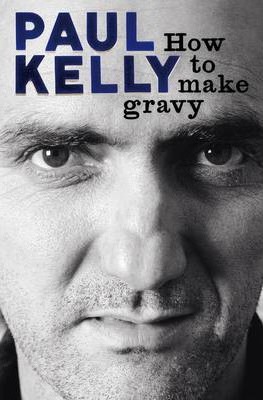
Well, you make gravy in a kitchen, don’t you? (I’m obviously stretching for something to connect with ‘kitchen’). Paul Kelly’s book How to Make Gravy is fantastic. The book is a written version of his A-Z stage show, which extended over four nights, where he would choose 25 songs each night from his repertoire of over 300 songs. The book is in four parts, reflecting the four nights of the performance. The songs are presented alphabetically and the lyrics precede each chapter, bolstered at times by poetry by other poets (Yeats, Donne, Shakespeare), quotations from books, and definitions. Some of the chapters directly relate to the song; others are a form of mental riffing on his childhood and adolescence, a succession of marriages and breakups, drug addiction, diary extracts while on the road, reminiscences of concerts seen and performed. You can just dip into the book, put it aside, and come back to it later. I loved it. My review is here.
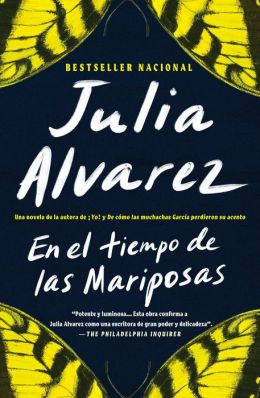
As Australians will know, the song ‘How to Make Gravy’ is about a man in prison ringing his brother a couple of days before Christmas, anticipating the family Christmas lunch that he will miss because he is in jail. My mind skipped to other books about people in jail. I read En El Tiempo de las Mariposas (In the Time of the Butterflies) by Julia Alvarez in the original Spanish, and it was such a strong story that I enjoyed- and understood!- it in spite of my language limitations. “Las Mariposas” was the code-name for the four Mirabel sisters, Patria, Minerva, Maria Theresa and Dede who, for different reasons and to differing extents, were involved in clandestine actions against the dictatorship of Rafael Trujillo (El Jefe) in the Dominican Republic in the 1950s. The whole of the family came under official suspicion, and two of the girls and their husbands and father were imprisoned at various times. The narrative of the book switches between 1994 in the voice of the remaining sister, Dede, and chronological chapters told in the varying voices of Minerva, Maria Teresa and Patria. Although based on historical fact, it is fictionalized. My review is here.
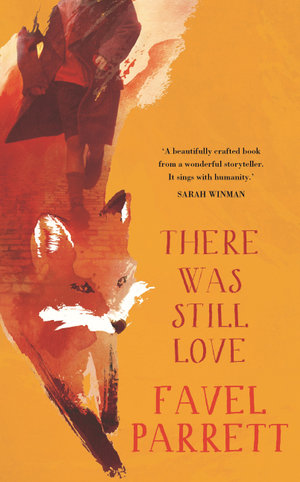
Sisters don’t always have to be geographically close, and that is the case in Favel Parratt’s There was Still Love which seems to be about two cousins in 1980 :- Malá living in Melbourne with her Czech grandparents, Mána and Bill, and Ludek, also living with his grandmother Babi in Prague, completely unaware of his cousin’s existence in Australia. It’s only at the end of the book that you realize the link between these two stories of grandchildren, wrapped in the love of their grandmothers. The two grandmothers were sisters, and by sheer happenstance, one ended up in the West and the other in the East. (My review here).
There are any number of books set in post-war Europe that I could have chosen, but I have gone with Anna Funder’s Stasiland. Funder, working as a journalist in Europe after reunification, was first attracted to investigating East Germany when a request for a program on the “puzzle women” was brushed aside by the television producers she worked with. These “puzzle women”, she later discovered, were employed to reassemble the papers shredded by the Stasi as the wall was falling, a task that would take over 300 years at the current speed. Methodical to the end, the papers had been shredded in order and shoved into a bag together, and so it was possible to piece them together and reveal the banality and the all-pervasive intrusion of the Stasi into the lives of East Germans. (My review here).
Bringing the world of espionage back to a more mundane Melbourne setting is Andrew Croome’s Document Z. ‘Document Z’ opens with an image instantly recognizable to Australians-of-a-certain age, even if we were not born at the time. It’s the image of Evdokia Petrov on the tarmac of Mascot Airport, flanked by a burly man each side of her, clutching her handbag, hand across her chest as if she is heaving, with one shoe lost. The book is a fictionally reimagined telling of the Petrov defection from the perspectives of the participants- Evdokia, her husband Vladimir, Michael Bialaguski the doctor go-between and the various agents on both sides. Croome has obviously done his homework (occasionally a little too obviously) and I marvel at his courage in describing a time long before he was born that is still within living memory today- lots of scope for slips and false notes there. He captures well the sterility of 1950s Canberra with the claustrophobic and enmeshed atmosphere of the Soviet Embassy enclave. (My review here).
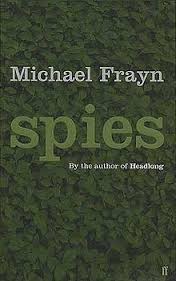
The Petrov Affair was very much an adult, politicized affair, but a more personalized view of espionage is found in Michael Frayn’s Spies. It is imbued with wistful, golden glow of L.P. Hartley’s The Go-Between or Ian McEwan’s Atonement. As in those books, the narrator (Stephen) in Spies also sees too much and yet doesn’t know what s/he is looking at when his friend Keith announces that his mother is a spy. So the boys snoop in her writing desk and follow her, and find more than they had bargained for. The story is told with humour and humility, and the adult Stephen is affectionately kind to his younger self and withholds judgment from him. It’s a very clever book. (My review here).
Well, given that I know absolutely nothing about Anthony Bourdain or Kitchen Confidential, I have travelled to 1950s Britain, East Germany, Czechoslovakia Australia and Dominican Republic- and an Australian prison coming up to Christmas. How fitting.

 The Resident Judge of Port Phillip