
Literature and History. I’ll be doing the Christmas service at my Unitarian fellowship, and even though I know I’ll end up working on the service the night before, I have started thinking about what I’m going to do. I usually have a historical bent to my services, and this time I’m thinking of looking at the historical context into which the Nativity story was embedded. This led me to Ep.76 Judea Under Herod. (You can get the transcript here). Herod was a client king under Roman rule who reigned over the province of Judea between 37 and 4 BCE, at a time when the Republic was tearing itself apart and re-forming as an Empire. We know Herod through the story of Jesus’ birth and death (and to my shame, I thought that it was the same King Herod involved in both, but it wasn’t- they were father and son). None of the historians writing at the time, even Josephus, mention the Massacre of the Innocents, which you’d think they would, if it happened. King Herod was first appointed governor of the backwater territory of Galilee in 47BCE as a result of his father’s connections with Julius Caesar. He was not a popular choice: he was ethnically Idumean and not Jewish, his father had been embroiled in Jewish civil wars and Roman campaigns against Judea. When Herod’s father died and after aligning himself with Mark Antony and Octavian, he was appointed King of Judea, but the Jews didn’t want him, preferring a home-grown Hasmonean king instead. Herod was pretty ruthless: executing his enemies, confiscating their property and even killing family members who threatened him. Apart from that (a big qualification), he put Judea on a strong economic footing, he rebuilt the Second Temple (even though it was still standing albeit profaned by the entry of Roman troops in 63BCE so think of it as Temple 2.5) but it was destroyed by 70CE except for the Western Wall. As a client King, Herod needed to manage competing demands while being essentially powerless. He did manage to keep Judea intact instead of being swallowed into Syria. He had nine wives, and after he died, the kingdom was divided in three and ruled by three sons, one of whom was Herod Antipas, who was the one who ordered the execution of John the Baptist and did nothing to stop the execution of Jesus. It was Herod Agrippa II who ended up dealing with the Apostle Paul. All these Herods! No wonder I was confused.
History This Week Chasing Utopia tells the story of Bronson Alcott (father of Louisa May Alcott) who along with Charles Lane established Fruitlands, a Transcendentalist utopian community, in Massachusetts in 1843. It never really expanded much beyond the two families, and when the men went off to try to get new members, they left his wife Abby May and her daughters to bring in the harvest alone. She increasingly resented Lane’s domination of her husband, and in the end she wrote to her brother, telling him to stop funding the farm and threatening to leave with the children. Eventually, it was Lane who left and a few months later, Bronson and his family left too. So much for Utopia.
Emperors of Rome It’s time to go back to the Emperors of Rome podcast. I take up again at Episode XCIV A Republic Worth Fighting For After Sulla died in 78BCE, the Senate didn’t want to undo his Senate-friendly moves. There was a string of strongmen in the 70sBCE: Crassus, Pompey and then Julius Caesar. Both Crassus and Pompey came up through the military, and both of them had armies behind them. In 70BCE they were made consuls, even though officially Pompey was too young (although by this time, who needs rules?). He was seen as the ‘efficient one’, cleaning up the Slave War, Pirates and King Mithridates, the latter meaning that Pompey finally got the triumph he had been hanging out for. There were extremists in the Senate, like Cato, and the ‘new men’ coming into the Senate. Cataline came from the ‘right’ sort of family, but he was rejected as Consul and so he riled up the disaffected. The existing Consul, Cicero, found out about the plot, and summarily executed the men who were plotting but not Cataline, who escaped. This came back to bite him five years later, when he was put on trial for acting beyond his powers and was exiled.
Conspiracy Theories. (I can’t believe that I’m listening to a podcast called this) Failed Conspiracies: Cataline Conspiracy In the first century BC, there was stiff competition to be consul. Cataline was from an old family but very ambitious and strategic in his search for power. Cicero, on the other hand, was an outsider and a brilliant lawyer. There was rivalry between the two men for a Consul position but Cataline was beaten twice for the position. In 63BCE Cicero learned of a conspiracy to overthrow and assassinate him from letters that had been delivered to Crassus outlining the plot. Cicero had the ringleaders executed but Cataline escaped with his troops, who were attracted by his populist policies, especially amongst ex-military men and heavily indebted farmers. Cataline’s army was defeated and Cataline died a traitor. The presenters then indulge in a bit of ‘what-if’ history that goes too far. What if Cataline had won instead of Cicero? Well, we wouldn’t have had Cicero’s letters, which were all written after the conspiracy and rediscovered by Plutarch. The Roman empire might have turned socialist- and what would the Founding Fathers do with that, given that they modelled America on the Roman Empire. Hmm. Stop already.
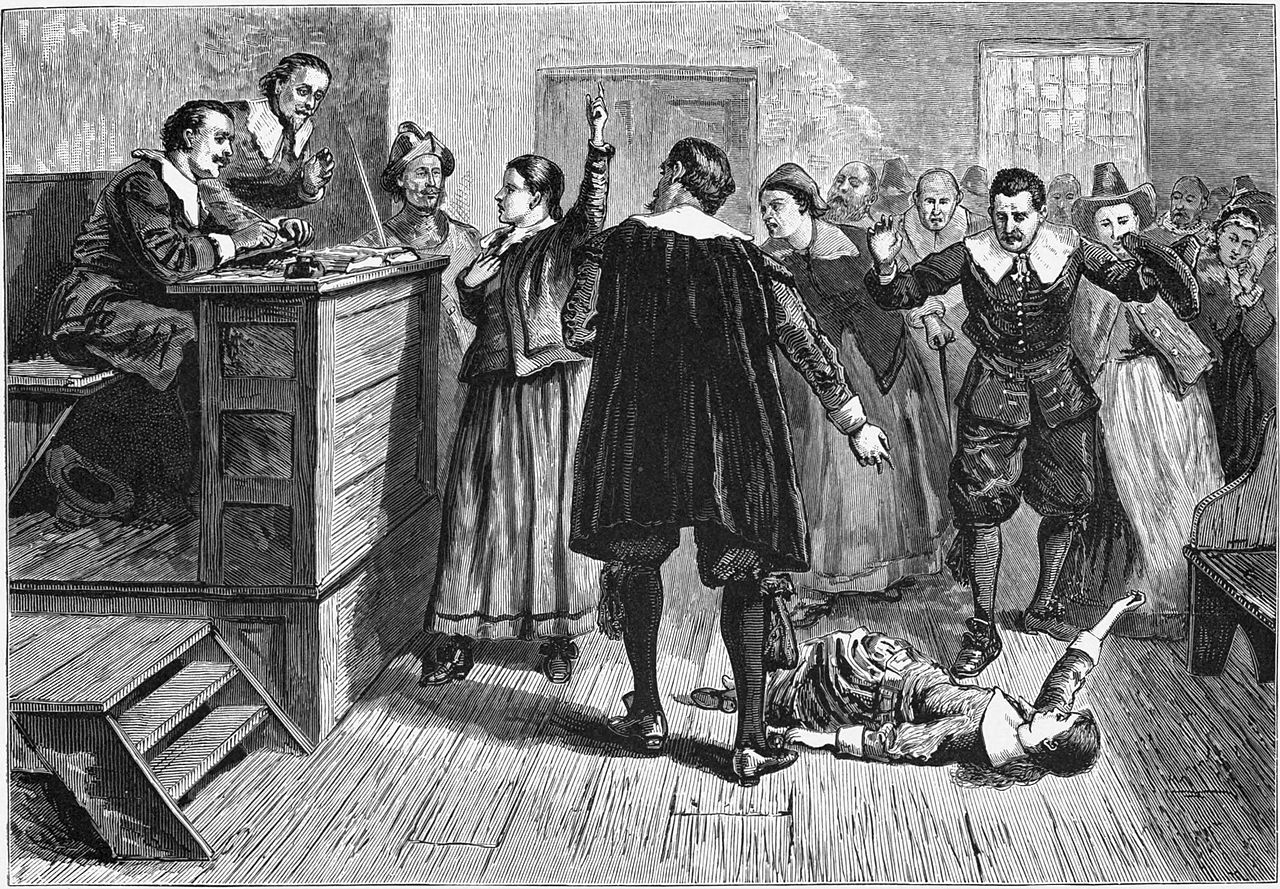
History Hit. To celebrate Halloween and All Saints Days, History Hit revisits The Salem Witch Trials. Europe had gone through its witchy stage in the 15th and 16th century, especially when the Protestants took up the idea, but after a wave of executions, it went out of fashion in Europe. But not in Salem though, where the Puritans (who were out of fashion themselves) were living on a hostile frontier, didn’t like women and believed in Satan- a bad combination. During the witch trials, 200 people – including some men- were accused and 20 died. Some of the accused were adolescent girls, who were given an otherwise unattainable degree of power through their accusations, and rich widows who had land. Eventually, there was pushback from the legal system when they rejected spectral evidence in 1696, and when Europeans were askance that the colonies were still looking for witchcraft, which they had discarded decades earlier.
Expanding Eyes continuing on with Books 3 and 4 of The Iliad. Episode 47 The Contest Between Paris and Menelaus to settle the issue of who gets Helen. What was Agamemnon thinking at the start of Book 3 where he told his men that he was giving up and going home? He was nearly trampled as the men rushed towards their boats, eager to go home after 9 years fighting the Trojans. He was just testing them, but they took him up on it. Perhaps Homer wrote this to show his weak leadership. Paris was the first to propose that he and Menelaus duke it out between them, but then he chickened out when Menelaus took him up on it and he had to be goaded into action by his brother Hector. When Paris was getting beaten, Aphrodite flew down, swept him up, and deposited him in Helen’s bedroom. Actually, the gods are pretty ambiguous here- no-one actually saw Aphrodite do it- and when Helen decided that she’d gone off Paris after all and wanted to go home to Menelaus, Aphrodite rounded on her and terrified her. Book 4 is mainly of fighting. Dolzani comments on the complexity of Helen: she seems quite regretful about leaving Menelaus but then she gives in and sleeps with Paris. (I don’t see any great complexity here, personally. Women do what they have to).
 The Resident Judge of Port Phillip
Good morning.
I have enjoyed your podcasts for a while, and would like to thank you for your time.
David