
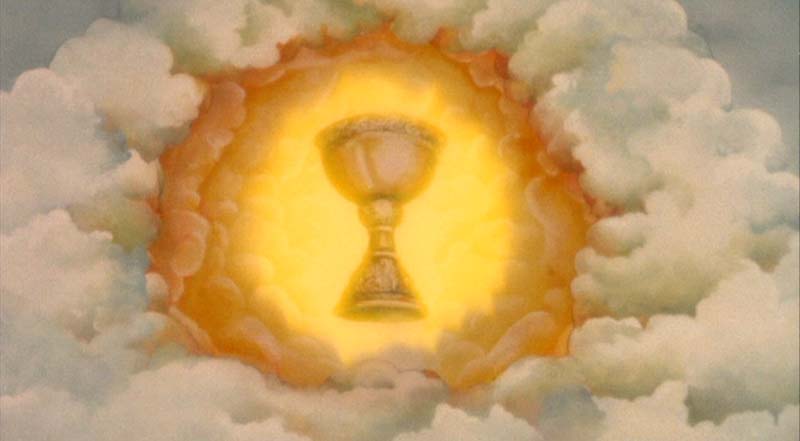
The Rest is History I’m really enjoying this series, featuring historians Tom Holland and Dominic Sandbrook. Until I listened to Episode 346 (really!) The Mystery of the Holy Grail the only thing that I knew about it was the Monty Python version. Holland and Sandbrook are obviously familiar with the Monty Python film too. Tom Holland said that he became angrier at this film than at ‘Life of Brian’, although after several viewings, he realized that the film was actually based on deep knowledge (Terry Jones has written books and presented television documentaries on medieval and ancient history.) They point out the links between the legend of the Holy Grail and T. S. Eliot’s The Wasteland (can I confess that I’ve never read it?), and make several references to Jessie Weston’s 1920 book From Ritual to Romance which argued for its pagan and fertility elements. A ‘grail’ is actually a serving platter, but after 1180 it was transformed into something holy in Chrétien de Troyes’ Perceval where Percival meets the Fisher King and a girl who comes in holding a (a,not the) grail. Robert de Boron introduced a connection with Joseph of Arimathea who owned the grail which had either been the cup used at the Last Supper or alternatively, the cup in which was collected Jesus’ blood when he was hanging on the cross. In other versions, the grail is a stone. In the 19th and 20th centuries, the grail has been seen as a mystery- either through Jung who saw it as the key to all the mythologies, the author Dan Brown and The Da Vinci Code, and through Jessie Westron’s work. Tom Holland thinks that de Troyes dreamed the whole thing up, and that the story of the grail reflects 13th century Latin Christendom at its peak. When the Reformation rejected transubstantiation (i.e that the communion wine actually becomes blood), it’s as if we have the hardware of the holy grail, but not the software to know what it means. I found this all fascinating.
History Extra Big Questions of the Crimean War: into the Valley of Death This is Episode 2 of the History Extra series on the Crimean War, or as it was known at the time in Britain ‘The War with Russia’. The war actually began on the Danube in Romania, and spread to Anatolia, the Caucasus, Georgia, the extreme far-east of Russia and the Baltic. Britain and France had learned from Napoleon, and this was a maritime war, with the British never extending beyond one day’s march from the coastline. It was conducted at a time of technological change e.g. steamships rather than sail; rifles rather than muskets. The British horse-breeding program had led to horses capable of mounting the Charge of the Light Brigade. The advantage the Russians had was the willingness to endure huge loses- it is estimated that there were 800,000 Russian casualties. There is a roll-call of battles (i) across the Danube where the Turks attacked the Russians and won; (ii) the Battle of Sinope, a naval battle that the Russians won, and which brought the British and French into the war, immobilizing the Russian fleet. (iii) Orland Island in the Baltic- not widely reported because there were few British casualties (iv) Alma, in the Crimean peninsula, won by the Allies who should have followed up on their victory, but didn’t (v) Balaclava- and the Charge of the Light Brigade which was a stuff-up but wasn’t the defeat that Tennyson depicted. Rather than only 120 coming back, there were 120 who didn’t come back (vi) Inkerman – the Soldiers Battle (vii) Siege of Sebastopol- not technically a siege as such- but it was like the Western Front that was to follow some 60 years later. (viii) Malakoff- considered to be the last battle, but it wasn’t really. So why did it end? It ended, as wars usually do, by negotiations because Russia was bankrupted by British pressure in stopping exports.
Sydney Writers Festival Barry Cassidy & Friends State of the Nation The usual suspects: Amy Remeikis, Niki Savva and Laura Tingle discussing the Voice, the state of the Liberal Party, Scott Morrison etc. You probably know what they’re going to say anyway.
Reflecting History The Emperors of Rome podcast has taken a backward step to look at the fall of the Roman Republic. I’ve been meaning to read Mike Duncan’s book The Storm Before the Storm for ages, so this seemed a good place to stop and draw breath and look at why the Roman republic, which had been successful for centuries, chose one-man rule through an emperor. I found these podcast series which is less event-driven than both ‘Emperors of Rome’ and ‘The History of Rome’ podcasts and, as the name suggests, more reflective. I have no idea who is presenting it, though. Matt someone. He has a four-part series on the Fall of the Roman Republic, and this seemed a good time to listen to it. Episode 55: The Fall of the Roman Republic Part I-Features of the Republic looks at the strengths of the Roman Republic. First there was the ability of the Roman Republic to channel the ambitions of families into the military, maintaining control of the incentives that made personal honour through service a valuable currency. Then there was the Republic’s ability to compromise and evolve. Because the Romans feared one-man rule, there were 2 consuls, the Assembly (include the Tribunes) and the Senate. It was a balanced system, with specific responsibilities for each component. But this was going to change. Episode 56: The Fall of the Roman Republic Part II-The Long Defeat sees the three Punic Wars establishing Rome as the dominant force in the Mediterranean, but also beginning the process of decay in the Roman Republic. Rome was beaten at first, and especially once Hannibal took the fight to Rome’s home territory, the Italian city-states started backing off. But in 205BCE Scipio triumphed over Carthage, which was burnt to the ground in the Third Punic War. Once the wars ended, Rome now controlled huge amounts of territory in Spain, Greece and Africa, but it could not retreat or stand down. It didn’t want to rule directly, and preferred to work through client kings, but eventually it had to. The expansion of territory brought great wealth, forcing small farmers off the land, and contributing to the growth of a wealthy elite that could buy up slaves (goodbye small farmers!) and leverage their wealth into investments and syndicates. The gap between rich and poor kept expanding, making Rome ripe for a populist leader.
Now and Then With all the hype about Barbie, Heather Cox Richardson and Joanne Freeman look back at the history of dolls in Barbie, GI Joe and the Gang: Dolls Are Us. They start with Laura Ingalls Wilder’s corn cob doll Susan, and move on to Raggedy Ann, a happy servant girl doll produced in the 1930s as part of a book/song/doll marketing production. During the 1940s research was undertaken which demonstrated the link between marketed toys and how children identify themselves, which in turn fed into the intellectual and political climate that produced Brown v the Board of Education and desegregation. Barbie was invented in 1959 based on a European spoof doll – the sort of hyper-sexualized doll you might give a man in a Kris Kringle at an office party- and right from the start there was a tension between her form as a male fantasy and a feminist “girls can do anything” ethos. Barbie’s depiction in a range of professions followed societal trends, rather than drove them: it was decided to have a Doctor Barbie only when there was a certain number of female doctors in the medical system. Ken was released two years later. In 1964 G. I. Joe hit the market as an ‘action figure’ (not a doll), based on Ernie Pyle, the WWII war correspondent. Released during the early years of the Vietnam War, he was already a nostalgic figure. Over the years he morphed into a Special Ops, adventurer, Kung Fu figure- a more individualistic figure of masculinity. Interesting.
 The Resident Judge of Port Phillip
“You probably know what they’re going to say anyway”.
Indeed.
The audience that attended this one could probably write the script.