
Emperors of Rome Episode XCII – The Beginning of the End of the Republic. The Romans themselves claimed to have 400 years of republicanism, up until 133 BCE although this date was nominated after the fact. So what happened in 133 BCE? 1. Attalus of Permagon left his empire to Rome. It was the leftovers of Alexander the Great’s empire, and based on modern day Turkey. At the time, the Romans had Spain, Greece and a bit of Africa, so this bequest gave acdess to Asia and its wealth. This only exacerbated the disparity in wealth which was already appearing in Roman society. 2. Tiberius Gracchus became tribune, and attempted land reform to address the problem of the landless poor flooding into Rome. However, his reforms were vetoed, so Tiberius removed the tribune who opposed it – a very unconstitutional act. The Senate had him murdered, which opened up the possibility of murdering your opponents. The following year the Italian allies (i.e. not Roman citizens as such) were building up to the Social War in the next century. Ten years after Tiberius Gracchus’ assassination his brother Gauis Gracchus tried to introduce the same package of reforms, and attempted to extend Roman citizenship rights to the whole of Italy. Guess what? He got assassinated too, and as with his brother, there were no repercussions. Episode XCIII – Powerful Personalities. As the senate clawed more power from the people, it was inevitable that a few would rise above others, and take over command and influence with an army. Marius, Sulla, and the civil war that followed would just be another log on the funeral pyre of the Roman republic. Marius seemed to come from no-where, a ‘new man’. Some say that he brought on the fall of the empire- he was on the side of the populares, and brought changes to the army. He was married to Julius Caesar’s aunt, and became consul in 104 BCE, elected against the wishes of the Senate, with the support of his troops -i.e. Rome’s first warlord. He opened up the army to men without property, making it possible to have a career within a professional army. He became consul 5 times in a row, which was not consistent with the constitution, and accrued more power than anyone else ever had before. By the end of the 90s BCE, Sulla was on the rise. He was from a very elite family. Sulla was seen as the Senate’s friend but after conflict between Marius and Sulla, Sulla brought his army to Rome, leading to civil war. There was a spate of murders as Sulla became dictator and increased the size of the Senate. Then all of a sudden, in 79 BCE Sulla suddenly resigned.
History Workshop Rethinking Place in British Labour History This program involved projects by three oral historians from the University of Glasgow, looking at ex-industrial workers in ‘traditional working class’ communities- those same ‘red wall’ seats that went from Labor to the Conservatives and have been characterized pro-Leave during Brexit, and who were characterized as being ‘red wall’ . This episode promised to challenge common assumptions about class and region, about schisms and solidarities. But the reality is that I could barely understand a word of these Glaswegian academics, and once they went to telephone interviews, that was even worse. It’s no longer COVID- surely podcasts can do better than interviews over telephone- or at least improve the bloody quality! I gave up.
History Extra Big Questions of the Crimean War: the buildup. So here we are in 2023, back fighting in the Crimea. The Crimean War took place between 1853 to 1856 when an alliance led by Britain and France challenged Russian expansion in the wake of the decline of the Ottoman Empire. Why? Britain wanted to stop Russian expansion towards the Mediterranean, and feared that the collapse of the Ottoman Empire would cause war in Central Europe, while Louis Napoleon, as new Emperor wanted to increase France’s presence. It started in Palestine between Catholic and Russian Orthodox monks of all things, over the symbols in the Church of the Holy Sepulchre and the Russian demands that the Ottomans protect the Orthodox interests. The war took a long time to get going, similar to the Cold War in that it was an ideological rather than a border war. The tipping point was the Russian occupation of Romania. There was a bit of a sliding doors moment, when Britain could have -but didn’t- send its navy to the Baltic, which might have averted the war. The episode features Professor Andrew Lambert.
Travels Through Time. Well, this one is a bit different. This time Peter Moore talks about his new book Life, Liberty and the Pursuit of Happiness in the form of a walking tour. His book is, in effect, a British history of the American Revolution, and his walking tour takes us to
Location One: The Old Cheshire Cheese (William Strahan)
Location Two: 17 Gough Square (Dr Johnson’s House)
Location Three: Near John Wilkes’s Statue on Fetter Lane
Printer William Strahan was Benjamin Franklin’s contact in London, and he sent him 18,000 pounds worth of books and pamphlets over the years, but they fell out over the American Revolution. Dr Johnson was fiercely opposed to the American patriots, but ironically, it was his term the ‘pursuit of happiness’ (particularly in Rasselas) that was taken up by the revolutions – even though Johnson saw happiness as important, but not guaranteed. Englishman John Wilkes was the Donald Trump of his times, followed obsessively by the Americans, and prosecuted for seditions against the Prime Minister Lord Bute in his North Briton journal. In the end, it was Thomas Paine who took Wilkes’ ideas to America.
Democracy Sausage I listen to this nearly every week, but I don’t very often note it because by the time I write this blogpost, the events are long past. But this episode A non-aligned movement features Dr Andrew Leigh, one of the few factionally-unaligned people in the Labor party, talking about the perils of a duopoly among factions. He isn’t so much arguing against factions, noting that they allow broader discussion within a party, but he does deplore the way that non-alignment is punished by withholding of cabinet positions etc.
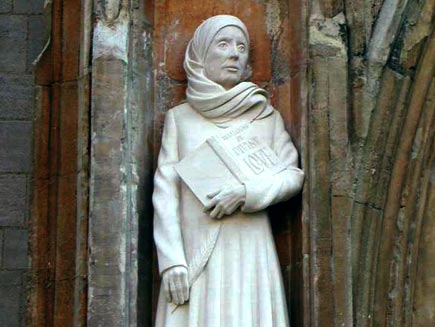
Soul Search (ABC) Julian of Norwich. Ooops. I thought that Julian of Norwich was a man, but not so. In 1373, aged thirty and very ill, she experienced visions which she later wrote down in ‘Revelations of Divine Love’ the first book in English written by a woman. She became an anchoress at St Julian’s church at Norwich, which was at the time the second largest city in England. It was a global city, although the plague killed half of its population of 12,000 people (indeed Julian herself was a plague survivor). It was the time of the Peasant’s Revolt, two Popes, and the Bishop of Norwich was a military bishop. It was a time of anxiety about heresy, and from her cell Julian would have been able to hear people being burned at the stake. Being an anchoress was recognized as a life choice. In an anchoress’ cell, there were three windows: a hatch for food and removal of waste; a squint so that she could see the church, and a third window at street level with a curtain, where people could converse with her. The program features Professor Daniel Anlezark, McCaughey Professor of Early English Literature and Language at the University of Sydney; Dr Janina Ramirez Research Fellow in History of Art at Harris Manchester College, University of Oxford and author of Julia of Norwich, a very brief history, and presenter of the documentary BBC The Search for the Lost Manuscript Julian of Norwich (on You Tube) and The Reverend Dr Sally Douglas, lecturer in biblical studies at Pilgrim Theological college in Melbourne, and author of Jesus Sophia: Returning to Woman Wisdom in the Bible, Practice, and Prayer.
 The Resident Judge of Port Phillip
Thank you, Janine! Interesting about Rome and I’ve currently got John Moore’s podcast playing because that view of the US with Ben Franklin and prior to the Revolution sounded interesting and besides, I’m a huge fan of Sarah Bakewell. (And I’ve got Moore’s book on my Wish List.)