
First Saturday means Six Degrees of Separation day, a meme hosted by Kate at Books Are My Favourite and Best. She chooses the starting book and you add six books that spring to mind. As usual, I have not read the starting book Time Shelter by Georgi Gospodinov. Apparently it’s about dementia, but literal soul that I am, my mind sprang to the ideas of ‘time’ and ‘shelter’ in putting together my list.
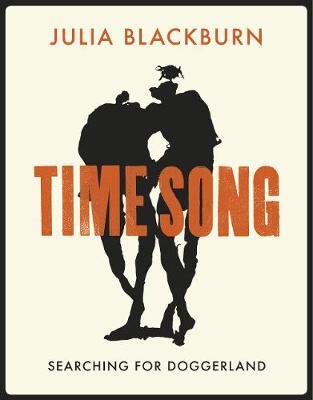
My starting book is Time Song by Julia Blackburn, chosen mainly because the name sounded similar to Time Shelter. It’s about her search for Doggerland , which existed in the North Sea and English Channel 18,000 years ago, making what we now know as the United Kingdom a contiguous part of Europe. Now on the bottom of the ocean, it was once a fertile plain, with its own coastlines and rivers, with humans roaming across it. It was not a route from one place to another, but a territory in its own right. (My review here).
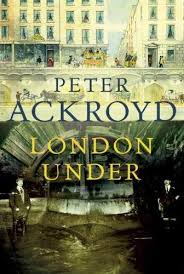
The idea of uncovering layers of a lost place is explored in Peter Ackroyd’s London Under. It draws on the concept of London as a palimpsest, alternately destroyed and rebuilt, the same patterns or practices repeated on the same site, albeit in different manifestations, across the centuries. He advanced this characterization in his big baggy monster London: A Biography, but this is a slimmer volume, concentrating on rivers and underground networks. (My review here).
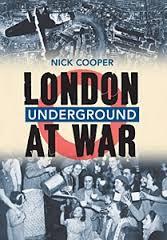
Nick Cooper’s London Underground at War also digs under the surface of London, but his emphasis is on the underground railway, and particularly its use as a shelter during World War II. It is largely a book of events and incidents, and it reads a bit like a report, without the poetry of Peter Ackroyd’s book. The presence of Londoners affected the Underground during the war, more than how the Underground affected them. (My review here).
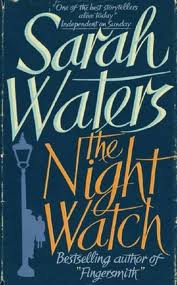
The Blitz lends itself well to a fictional telling, and I loved Sarah Waters’ The Night Watch. Unlike Sarah Waters’ earlier books Tipping the Velvet and Fingersmith, this book is set during the 1940s. Waters’ narrative revolves around four main characters: Kay, Helen, Viv and Duncan. Her master stroke is to tell the narrative backwards, starting in 1947, then 1944 and finally 1941. (My review here).
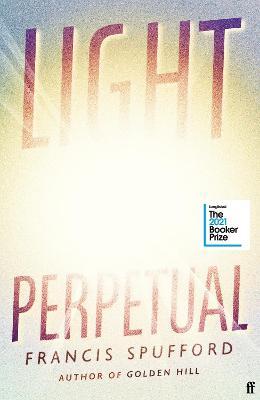
Another book that shifts through time, with a starting point during World War II is Francis Spufford’s Light Perpetual. It starts with the real-life death of 168 people who died in the New Cross Road branch of Woolworths in November 1944 in a V-2 attack on a Saturday lunchtime, with the shop crowded with shoppers. Fifteen of those 168 were aged under 11. Spufford fictionalizes five of these children: sisters Jo and Valerie, Alec, Ben and Vernon and then jumps forward as if the five children were not killed. In fact, they were not even in the store. Instead, they lived lives untouched by that November 1944 attack. He tells their counterfactual lives at ever-increasing chunks of time. It’s like a ‘Seven-up’ series on the page. (My review here)
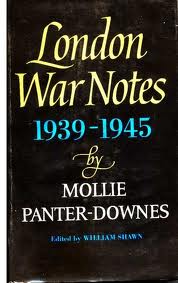
A non-fiction book that deals with World War II is Molly Panter-Downes’ (what an unfortunate name) London War Notes 1939-1945. It is a collection of her “Letter from London” columns that were published in the New Yorker during the War. The book is divided into seven sections, for each year of the war, each commencing with a brief one-page time line of major events during that year. She fictionalized much of this material in her short story collection Good Evening Mrs Craven which is well worth a read too – does that make six and a half? (See my review here)
So, most of my titles played around with the idea of ‘Time’ and ‘Shelter’, but ended up particularly England-focussed, without really meaning to be. I’ll have to roam further afield next time with August’s book Romantic Comedy.
 The Resident Judge of Port Phillip
There’s a terrific museum in London, which consists of exhibitions showing the different layers of London, going back to pre-human habitation when there were elephants and rhinoceroses. (It was warmer then!)
If you haven’t been there, I wrote about it here: https://hillfamilysoutherndivision.wordpress.com/2010/09/26/museum-of-london-saturday-25-9-10/
Yes! We visited it too. It was excellent- although in a very unprepossessing position!
Yes, we would never have found it if we hadn’t had a terrific little book called The Museums of London. I’ve ticked off all the ones we’ve been too, and we’ve still got half the book to do…
I loved Light Perpetual and The Night Watch, but everything else on your chain tempts me too. A great set of links!
Yes, I enjoy books set in England during WW2. More fun reading about it than enduring it.
Exactly. I feel the same.
A very London chain here!
I do like the sound of Time Song. Must look it up. And I’ve enjoyed another of Spufford’s titles, and this sounds a good one as well.
Nice work. Light Perpetual–this sounds interesting. The Seven-Up series was fascinating–I’ve watched them all. (Another somewhat like it was a single documentary on men born the same day as the then Prince of Wales/King Charles)
Such a different direction from the one you took, if I had world enough and time, I would definitely buy some of these but my TBR list is already too long. Do you know The Atlas of Vanishing Places by Travis Elborough?
https://how-would-you-know.com/2023/07/6-degrees-of-separation-time-shelter.html
No – I hadn’t heard of it, but it looks just like the sort of book that I would like. I see that he has written several “Atlas” books.